COMPARATIVE EVALUATION OF DIMENSIONAL
STABILITY OF THREE TYPES OF INTEROCCLUSAL
RECORDING MATERIALS
- AN INVITRO STUDY
Dissertation submitted to
The Tamil Nadu Dr. M.G.R. Medical University In partial fulfillment for the degree of
MASTER OF DENTAL SURGERY
SEPTEMBER - 2006
Acknowledgments
First and foremost I am indebted to my teacher and guide Prof. Dr. H. Annapoorani MDS, Professor and Head, Dept of
Prosthodontics, for her help and guidance that has enabled me comprehend this work and reach its successful culmination. I thank her for her blessings and love.
A great deal of thanks goes to my teachers Dr.Sivaga mi., MDS, Professor, Dr.Sanjana., MDS , Professor,
Dr.Vidhya. ,MDS,DNB,Ass t.professor, Dr.Lakshmi . , MDS , Reader, Dr. Aruna. , MDS, Reader, Dr. Hariharan ., MDS , Lecturer, Dr.Sendhilnathan., MDS , Lecturer, for their constant support and precious ideas.
I would like to express my deepest gratitude to my teacher Prof. Dr. E. Munirathnam Naidu, MDS, for his unwavering guidance and immeasurable encouragement.
I am thankful to Dr. B. Sivapathasundharam MDS,
Professor and H ead, Dr.Sivakumar MDS, Dr. Einstein MDS and Dr.Lavanya from the Dept of Oral Pathology , Meenakshi Ammal Dental College, Chennai, for their help in completing this study.
I am grateful to all my fellow postgraduates, without whose support, moral and otherwise, this study would not have been possible.
A great deal of thanks goes to my friends Dr.Shrikanth Nair M.D.S and Dr.Ashish Kunnekel for their kind help rendered in completing this task.
Special thanks to Mr. Raja, Dept of statisti cs, MAHER University, who helped me in statistical analysis for this study.
K A R T H I K E Y A N . K
C o m p a r a t i v e E v a l u a t i o n o f D i m e n s i o n a l S t a b i l i t y o f T h r e e T y p e s o f I n t e r o c c l u s a l
R e c o r d i n g M a t e r i a l s-A n I n v i t r o S t u d y
( U n d e r t h e g u i d a n c e o f D r . H . A N N A P O O R A N I , M . D . S )
A i m : T h e a i m o f t h i s I n v i t r o s t u d y w a s t o e v a l u a t e a n d C o m p a r e t h e D i m e n s i o n a l s t a b i l i t y o f t h r e e t y p e s o f I n t e r o c c l u s s a l r e c o r d i n g m a t e r i a l s a t v a r i o u s t i m e i n t e r v a l s .
M a t e r i a l a n d m e t h o d s : T h e m a t e r i a l s u s e d i n t h e s t u d y w e r e p o l y v i n y l s i l o x a n e , z i n c o x i d e e u g e n o l p a s t e a n d B i t e r e g i s t r a t i o n w a x . T h e t e s t w a s c a r r i e d o u t u s i n g a m o l d s i m i l a r t o t h a t o f A D A s p e c i f i c a t i o n N o . 1 9 . A t o t a l o f 3 0 s a m p l e s w e r e m a d e w i t h e a c h g r o u p c o n s i s t i n g o f 1 0 s a m p l e s . T h e s a m p l e s w e r e m e a s u r e d u s i n g a n o p t i c a l m i c r o s c o p e w i t h m i c r o m e t e r p r o v i s i o n . T h e m e a s u r e m e n t s w e r e m a d e a t a t i m e i n t e r v a l o f 1 h r , 2 4 h r , 4 8 h r , a n d 7 2 h r s .
R e s u l t s : F i v e r e a d i n g s w e r e t a k e n f o r e a c h s a m p l e a t e a c h t i m e i n t e r v a l a n d t h e m e a n o f t h e f i v e r e a d i n g s w a s c o n s i d e r e d f o r m e a s u r i n g t h e d i m e n s i o n a l c h a n g e o f t h e s a m p l e b y c o m p a r i n g w i t h t h a t o f t h e o r i g i n a l m e a s u r e m e n t i n t h e m e t a l l i c d i e . T h e r e s u l t s o b t a i n e d w e r e s t a t i s t i c a l l y a n a l y z e d u s i n g a o n e - w a y a n a l y s i s o f v a r i a n c e ( A N O V A ) a n d T u k e y - H S D . T h e m e a n p e r c e n t a g e D i m e n s i o n a l C h a n g e a t v a r i o u s t i m e
i n t e r v a l f o r I ) G r o u p A 1 h r - 0 . 2 2 % (±0 . 1 0 ) , 2 4 h r - 0 . 4 8 % (± 0 . 0 6 ) , 4 8 h r s - 0 . 6 6 %
(±0 . 0 9 ) , 7 2 h r s - 0 . 7 9 % (±0 . 0 7 ) I I ) G r o u p B- 1 h r - 0 . 5 8 % (±0 . 0 8 ) , 2 4 h r - 0 . 9 3 % (±0 . 0 8 ) ,
4 8 h r s - 1 . 2 3 % (±0 . 0 8 ) , 7 2 h r s - 1 . 4 6 % (±0 . 0 9 ) I I I ) G r o u p C - 1 h r - 0 . 4 4 % (±0 . 0 6 ) ,
2 4 h r - 0 . 6 0 % (±0 . 0 8 ) , 4 8 h r s - 0 . 7 7 % (±0 . 1 1 ) , 7 2 h r s - 1 . 0 7 % (±0 . 0 8 ) r e s p e c t i v e l y . G r o u p A
w a s m u c h d i m e n s i o n a l l y s t a b l e f o l l o w e d b y G r o u p C a n d G r o u p B r e s p e c t i v e l y .
C o n c l u s i o n :
D i m e n s i o n a l s t a b i l i t y i s i n f l u e n c e d b y b o t h “ m a t e r i a l ” f a c t o r a n d “ t i m e ” f a c t o r . D i m e n s i o n a l s t a b i l i t y d e c r e a s e d a s t h e t i m e f a c t o r i n c r e a s e d . P o l y v i n y l s i l o x a n e ( v i r t u a l ) w a s m o r e d i m e n s i o n a l l y s t a b l e f o l l o w e d b y z i n c o x i d e e u g e n o l ( s u p e r b i t e ) a n d B i t e r e g i s t r a t i o n w a x ( A l u m a x ) r e s p e c t i v e l y .
CONTENTS
PAGE NO.
1.
LIST OF FIGURES
viii
2.
LIST OF TABLES
ix
3.
INTRODUCTION
2-3
4.
REVIEW OF LITERATURE
5-14
5.
MATERIALS AND METHODS
16-28
6.
RESULTS
30-39
7.
DISCUSSION
41-53
8.
SUMMARY AND CONCLUSIONS
55-56
9.
REFERENCES
58-61
List of Figures
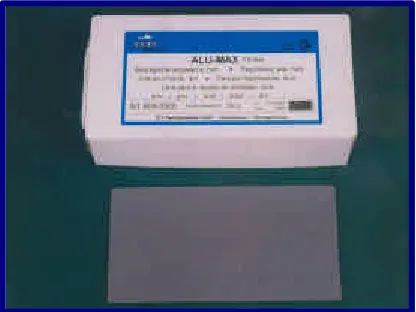
Figure 1 : Zincoxide Eugenol Bite Registration Material Figure 2 : Bite Registration Wax (Alumax)
Figure 3 : Poly vinyl siloxane Bite registration material Figure 4 : Armamentarium
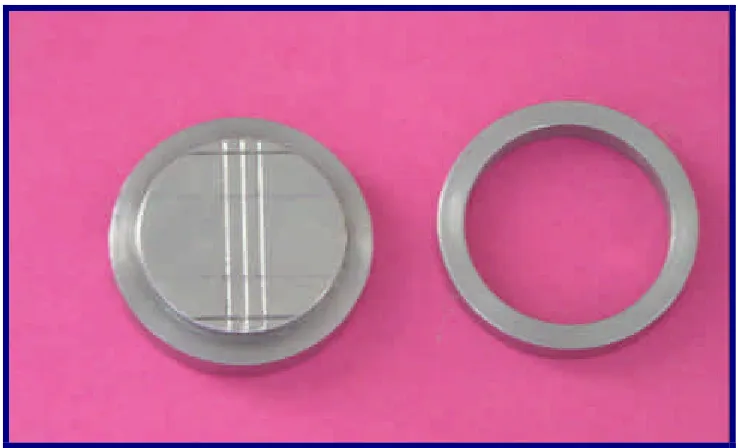
Figure 5 : Stainless steel Die
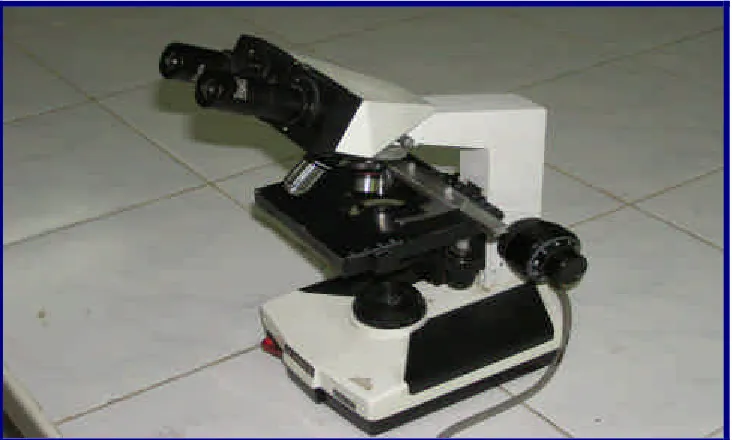
Figure 6 : Thermostat controlled water bath Figure 7 : Optical Microscope
Figure 8 : Polyvinyl siloxane samples Figure 9 : Alumax samples
Figure 10 : Zinc oxide Eugenol samples
Figure 11 : Schematic representation of the Die a) Ruled Block
b) Cross Section of the Ruled Block c) Mold Ring
d) Cross Section of the Mold Ring
Figure 1 2 : Comparison of Dimensional change at various Time Intervals between Group A, B and C
Figure 13 : Optical Microscopic view of polyvinylsiloxane sample Figure 14 : Optical Microscopic view of Alumax sample
List of Tables
Table 1 : Distribution of Specimen
Table II : Mean percentage Dimensional change for GroupA (polyvinylsiloxane) at various time intervals
Table III : Mean percentage Dimensional change for Group B (Alumax) at various time intervals
Table IV : Mean percentage Dimensional change for Group C (zincoxide Eugenol) at various time intervals
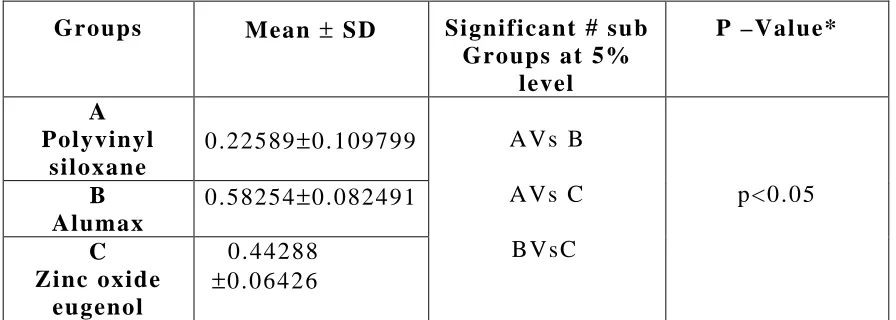
Table V : Mean, Standard deviation and test of significance Of mean percentage change between different types of Interocclussal recording materials at 1 hour
Table VI : Mean, Standard deviation and test of significance Of mean percentage change between different types of Interocclussal recording materials at 24 hour
Table VI I : Mean, Standard deviation and test of significance
Of mean percentage change between different types of Interocclussal recording materials at 48 hour
Table VIII: Mean, Standard deviation and test of significance of Mean percentage change between different types of Interocclussal recording materials at 72 hour
Introduction
Precise articulation of patients cast is a prerequisite for proper diagnosis and subsequent treatment.
To create a harmonious occlusion, it is essential to record the existing Maxillomandibular relations. If the inter arch registration is inaccurate, the mounted cast will not show the existing maxillo mandibular relationship, and it will lead to error in diagnosis and treatment.
Inter occlusal recording materials are generally used to record the Maxillomandibular relation. Thes e materials should have a good dimensional stability and minimal resistance to closure while setting and resistance to compression after polymerization.
Many materials have been used for inter occlusal recording such as Dental plaster with modifiers, waxes, acrylic resins, zincoxide eugenol pastes, silicone elastomers and polyether elastomers. These materials have their own advantages and disadvantages.
Although numerous studies have been done on Dimensional stability of the parent impression materials, there are only a few studies on Interocclusal registration materials as such.
In the above context, we had desi gned an Invitro study with the following objectives.
Ø To evaluate the Dimensional stability of three types of interocclusal recording material namely the polyvinylsiloxane bite registration material, Bite registration wax, and the zincoxide eugenol bite registration paste at a time interval of 1hr, 24hrs, 48hrs, and and72hrs.
Ø To compare the Dimensional stability of these materials at a time interval of 1hr, 24hrs, 48hrs, and 72hrs.
Review of Literature
Skurnik H1 described the use of wax, metallic pastes (zinc oxide and eugenol) and acrylic resin in making interocclusal record. The author had concluded that high quality wax is a useful and versatile material for registering interocclusal record. The author also suggested better method of obtaining accurate records for all of the above said materials.
Millstein PL, Clark RE, and Kronman JH2 Conducted a study to determine the effects of initial heating temperature, initial closing pressure, storage environment and storage time on the accura cy of recording made with single and double- thickness samples of pink base plate wax. They found that 1) complete closure in to the waxes was not achievable under pressure comparable to those of a clinical 2) storage of wax records in water produced the greatest change and the ai r cooling resulted in the least 3) Vertical and rotational changes occurred when the test model was replaced in bite registration record.
Millstein PL, Clark RE, and Myerson RL3 conducted a study to relate the accuracy of silicon e body Interocclusal records to their associated weight loss due to volatiles. Three brands of silicone – body impression material were used. The Hydroptic test and the
measurement system were used to determine the dimensional change at a time intervals of 2 hrs, 6 hrs, 24 hrs, & 48 hrs. The authors found that (1) a direct relationship exists between dimensional change and percent of weight loss (2) minimizing the weight loss of standing silicone impression would enhance their accuracy.
Eames WB etal4 conducted a study compare the accuracy and dimension stability of 34 materials of 13 manufactures.The test methodology was done in accordance to ADA specification No. 19. The materials used were polyether, silicone and poly sulfide.They found out that at 24 hrs stability ranged from 0.18% - 0.84% and at 30mts all materials ranged from 0.11 to 0.45%. Poly ether and poly sulfide were more stable and silicones were least stable dimensionally.
samples. They also found that polyether was the least one and the zincoxide eugenol paste was the greatest to show dimensional changes.
Millstein PL and Clark RE6 conducted a study to relate the accuracy of silicone body and self curing resin interocclusal records and associated weight loss due to volatiles. They found that silicone body interocclusal records are more reliable than self curing resins in terms of dimensional accuracy and weight loss.
Millstein PL and Clark RE7 conducted a study to investigate the effects of initial heating, intra oral with drawl, storage environments, storage times and setting forces of the accuracy of laminated and non laminated, metalized and non metalized wax interocclusal wafers. The authors found out that 1)Laminated wax interocclusal wafers are highly technique sensitive 2)Wafers that were both laminated and metalized were found to be the most accurate and dimensionally stable.
removing the condylar spheres and replacing with a Buhnergraph. The position of the hand articulated mandibular cast and those mounted with the interocclusal record was measured with a traveling microscope micrometer. The authors concluded that the 1) polyether interocclusal recording medium was the most accurate, followed by zincoxide eugenol and waxes2) the distortion occurred more frequently in a vertical direction followed by an antero posterior direction.
Lassila V1 0 conducted a study to compare the clinical properties of five routinely used inter occlusal recording materials. The properties studied were resistance to closure, thermal expansion, Setting and storage under various conditions. The materials used in the study were silicone Putty, Polyether, zincoxide eugenol paste, Eugenol free zinc oxide paste, acrylic resin and base pl ate wax. The author found out that 1) volumetric contraction of elastomers after polymerization was not clinically significant 2) The Dimensional stability of rigid materials namely the acrylic resin and zinc oxide paste was good over a period of 72 hours with value below 0.3% 3) The initial resistance to closure was 0.5to0.6N.
Muller J eta l1 1 conducted a study to determine the three dimensional errors in mounting dentulous casts on an articulator, namely 1) the inter occlusal record material 2) Storage time of the registration
Muller J eta l1 2 conducted a study to determine the vertical errors in mounting dentulous casts on an articulator as affected by three parameters: (1) the registration materials. (2) The storage time of the records and (3) the points from which the measurements were made. They found out that 1) Detection of changes of vertical dimension should be done at more than one measurin g point on the occlusal surface 2) None of the materials tested gave reliable re sults at all occlusal surfaces 3) The lowest vertical deviation at the occlusal surface was induced by the corrected wax wafer after a short storage for 30mts 4) Ramitec polyether was the second most accurate mat erial and the only one with clinically sufficient dimensional stability up to 24 hrs.
intercast relationship when different materials are used to records interjaw relationship at IC and RC Position.
Freilich MA, Altieri JV, Wahle JJ 1 4 reviewed the principles related to the support and stability requirements for mounting dental casts of the dentate or partially dentate patients (2) Categorized, described and discussed the clinical condition of several different types of interocclusal records. The authors concluded that the goal of the interocclusal records should provide the support and stability that the casts of the remaining dentition lack.
Breeding LC, Dixon DL and Kinderknecht KE1 5 Conducted a study to develop a methodology to 1) measure the three dimensional accuracy of interocclusal recording materials wi th a computerized recording device 2) Applying that methodology to compare the accuracy of three interocclusal recording materials . The authors found out that 1) the axiotron computers provide a simple and quick method to evaluate the accuracy of mounting work casts 2) the thermoplastic generated mounting errors were significantly greater than those generated by the acrylic resin and vinyl polysiloxane.
used included zinc oxide eugenol, polyvinyl siloxane and polyether. The samples was made using mold according to ADA specification No.19. The surface hardness of each sample was tested with Shore- A durometer. The dimensional stability was determined by measuring the line scribed on the sample using trave ling microscope at a magnification of 25 x at an interval of 25 minutes and 24 hours after the start of mixing. The authors concluded that there was significant differences among the dimension al stability and hardness. Polyether showed superior dimensional stability compared to polyvinyl siloxane.
Millstein PL and Hsu C1 7 conducted a study to determine the accuracy and dimensional stability of elastomeric interocclusal recording materials. In the study five brands of polyvinyl siloxane recording material and one brand of polyether was used. The authors concluded that all the brands was dimensionally stable over a 48 hour time period and the negligible weight change of 0.1 % did not affect the dimensional stability.
is not always achieved clinically. The authors had modified the classic jaw relation recording technique. The modification was that the polymerized record material after its set was stabilized on on e of the jaw. A hydrocolloid impression is made incorporating the record. A cast in direct contact with the record was poured in that impression. This cast record system was used for the reproduction of the jaw relation on the articulator. The results revealed that the modified tech nique limits the transferring in accuracy compared to conventional transfer method.
Dixon LA1 9 reviewed the methods and materials used to record the centric relation position and eccentric maxillomandibular relations and to compare the articulators available for mounting casts. The potential application of this review article by the author enabled to examine the various methods for recording the centric relation position and to observe the accuracy of the recording materials that have changed over time.
Materials and Methods
The present Invitro study was conducted to evaluate and Compare the Dimensional stability of three types of Interocclussal recording materials at various time intervals.
Materials
1. PolyvinylSiloxane Bite Registration Material. (Virtual, Ivoclar company, USA) (Fig.3)
2. Zinc Oxide Eugenol Bite Registration paste. (Superbite-Bosworth company, USA) (Fig.1)
3. Bite Registration wax – Hard.(Alumax, Yeti Dent al corporation, Germany) (Fig.2)
4. Silicone Separating Medium.
Instruments
1. Stainless Steel Die. (Fig.5) 2. Glass Plate.
3. Polyethylene sheet. 4. Stop Clock.
5. 5ml Glass syringe.
7. Scalpel and Blade. 8. 500 gm weighing stone. 9. Spatula and gl ass slab.
10. DigitalVernierCaliper. (Erskine Dental, U.S.A )
Equipment
METHODOLOGY
A. Fabrication of the Metal Master die
A stainless steel master die was fabricated similar to ADA specification no 19.2 1 The master die consists of a ruled block and a mold ring. (Fig 5)
DIMENSION OF THE MASTER DIE
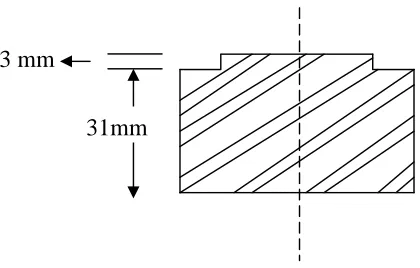
RULED BLOCK (Fig.11 a) Height –31mm
Width – 38mm
A 3mm height and 29.97± 0.01 mm diameter step has been made on one side of the die to which the metallic mold ring fits. The die consist of three parallel lines A, B, C which are spaced equally by 2.5 mm from each other.
MOLD RING (Fig.11 c)
Outer ring diameter - 38mm Inner ring diameter - 30mm
Height - 6mm
B. Fabrication of the test specimens
ambient room temperature for at least 24 hrs prior to t esting. Materials that were supplied in automixing cartridges were dispensed through the cartridges and the Materials supplied in tubes namely the zinc oxide eugenol bite registration paste was dispensed by taking equal length of base and catalyst paste. The material was mixed with a spatula in a glass slab to a streak free consistency as per the manufacture’s instruction.
For the wax, the method was modified by submerging it at a 45°C water bath for 5 minutes using a 5 ml glass syringe syringe.
After homogenous mixing, the materials were carried to the die. The die was inverted on to a 4X4 inch square glass plate covered with polyethylene sheet. Hand pressure was applied for 5 seconds to initially express the materials; this was followed by application of a 500gm weight to further eliminate excess materials.
The material was separated from the mold, the resulting specimens were in the form of a disk measuring 0.3cm in thickness and 3 cm in diameter with 3 parallel lines on the surface(Fig.8, 9, 10).Three lines were named as A, B and C.
[image:25.595.71.543.349.470.2]C. Grouping of the samples
TABLE: 1 DISTRIBUTION OF SPECIMENS
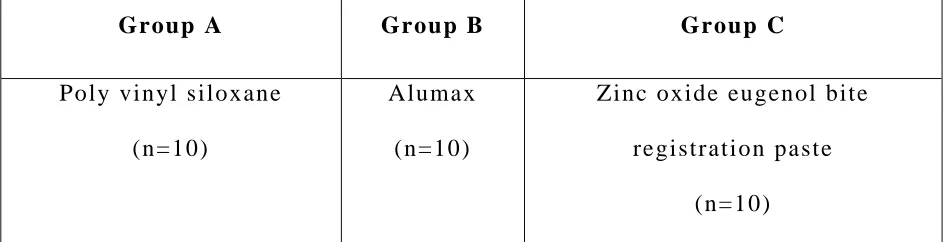
Group A Group B Group C
Poly vinyl siloxane (n=10)
Alumax (n=10)
Zinc oxide eugenol bite registration paste
(n=10)
D. Measurement of the test samples
The distance between the parallel lines A and C was measured utilizing optical microscope with a provision of micrometer (Fig 7). The magnification used for the measurement was 10 X. 2 1
The mean of the five readings was used for calculation in each sample. Readings was recorded for all the ten samples of each group at an interval of 1 hr, 24hrs, 48hrs, and 72 hrs.
The mean measurement of the distance AC in each sample was compared to the corresponding measurement of 5000.200 micron meter in the standard stainless steel die measured under the same optical microscope.
E. Evaluation of Dimensional Change
The change in the Dimension is calculated by using the formula
2 1
Dimensional change % = (X-Y) x 100 X
Where X is the standard measurement (µm) of AC in the Di e. Y is the observed measurement (µm) of AC in the sample.
F. STASTICAL ANALYSIS
Fig 1: Zincoxide Eugenol Bite Registration Material
Fig 2: Bite Registration Wax (Alumax)
[image:27.595.203.411.312.468.2] [image:27.595.204.409.512.667.2]
Fig 4: Armamentarium
[image:28.595.124.491.112.337.2] [image:28.595.122.491.429.653.2]Fig 6: Thermostat controlled water bath
[image:29.595.125.491.445.665.2]
Fig 8: Polyvinyl siloxane samples
[image:30.595.203.412.98.262.2]Fig 9: Alumax samples
[image:30.595.203.411.308.463.2] [image:30.595.204.411.515.675.2]
a) Ruled Block b) Cross Section of the Ruled Block
c) Mold Ring d) Cross Section of the Mold Ring
Fig 11: Schematic representation of the Die 31mm
3 mm
38 mm 30 mm
6 mm 30 mm
A B C
[image:31.595.297.507.153.287.2]Research Design
30 Samples
Group A (n=10) (polyvinylsiloxane)
Group C (n=10) (zincoxideeugenol)
Dimensional change observed using optical microscope at 1, 24, 48, & 72 hrs
Results
Statistical Analysis Group B (n=10)
Results
The following results were obtained from this study which evaluated and compared the Dimensional stability of three different types of Interocclusal recording materials. The materials were divided into three Groups as Group A (polyvinylsiloxane), Group B (Alumax) and Group C (Zinc oxide eugenol). Each Group had 10samples. Five readings were made per sampl e at each time interval of 1hr, 24hrs, 48hrs, and 72hrs, and the average obtained was taken for calculating the Percentage Dimensional change at various time intervals.
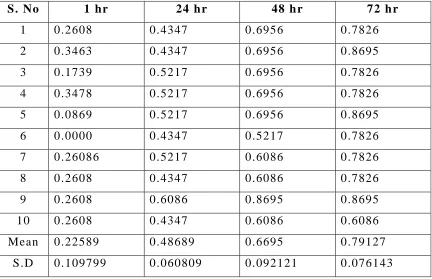
Table-II: Mean Percentage Dimensional change for GroupA (polyvinylsiloxane) at various time intervals
S. No 1 hr 24 h r 48 h r 72 h r
1 0.2608 0.4347 0.6956 0.7826
2 0.3463 0.4347 0.6956 0.8695
3 0.1739 0.5217 0.6956 0.7826
4 0.3478 0.5217 0.6956 0.7826
5 0.0869 0.5217 0.6956 0.8695
6 0.0000 0.4347 0.5217 0.7826
7 0.26086 0.5217 0.6086 0.7826
8 0.2608 0.4347 0.6086 0.7826
9 0.2608 0.6086 0.8695 0.8695
10 0.2608 0.4347 0.6086 0.6086
Mean 0.22589 0.48689 0.6695 0.79127 S.D 0.109799 0.060809 0.092121 0.076143
Results:
The mean Dimensional Change % for Group A at various time interval are
• 1 hr - 0.22% (±0.10)
• 24hr- 0.48 % (±0.06)
• 48hrs -0.66% (±0.09)
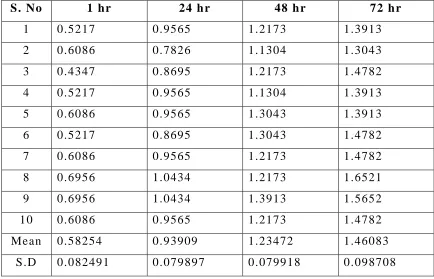
Table-II I: Mean Percentage Dimensional change for Group B (Alumax) at various time intervals
S. No 1 hr 24 h r 48 h r 72 h r
1 0.5217 0.9565 1.2173 1.3913
2 0.6086 0.7826 1.1304 1.3043
3 0.4347 0.8695 1.2173 1.4782
4 0.5217 0.9565 1.1304 1.3913
5 0.6086 0.9565 1.3043 1.3913
6 0.5217 0.8695 1.3043 1.4782
7 0.6086 0.9565 1.2173 1.4782
8 0.6956 1.0434 1.2173 1.6521
9 0.6956 1.0434 1.3913 1.5652
10 0.6086 0.9565 1.2173 1.4782
Mean 0.58254 0.93909 1.23472 1.46083 S.D 0.082491 0.079897 0.079918 0.098708
Results:
The mean Dimensional Change % for Group B at various time interval are
• 1 hr - 0.58% (±0.08)
• 24hr - 0.93% (±0.08)
• 48hrs - 1.23% (±0.08)
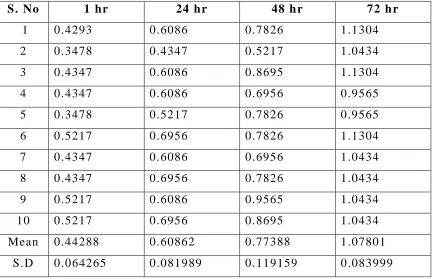
[image:35.595.89.523.196.475.2]Table-I V: Mean percentage Dimensional change for Group C (zincoxide Eugenol) at various time intervals
S. No 1 hr 24 h r 48 h r 72 h r
1 0.4293 0.6086 0.7826 1.1304
2 0.3478 0.4347 0.5217 1.0434
3 0.4347 0.6086 0.8695 1.1304
4 0.4347 0.6086 0.6956 0.9565
5 0.3478 0.52 17 0.7826 0.9565
6 0.5217 0.6956 0.7826 1.1304
7 0.4347 0.6086 0.6956 1.0434
8 0.4347 0.6956 0.7826 1.0434
9 0.5217 0.6086 0.9565 1.0434
10 0.5217 0.6956 0.8695 1.0434
Mean 0.44288 0.60862 0.77388 1.07801 S.D 0.064265 0.081989 0.119159 0.083999
Results:
The mean Dimensional Change % for Group C at various time interval are
• 1 hr - 0.44 % (±0.06)
• 24hr - 0.60 % (±0.08)
• 48hrs -0.77 % (±0.11)
[image:36.595.92.524.209.488.2]Statistical Analysis
Table-V: Mean, Standard deviation and test of significance of mean Percent age change between different types of Interocclussal
recording materials at 1 hour
Groups Mean ± SD Significant # sub Groups at 5%
level
P – Value*
A Polyvinyl
siloxane
0.22589±0.109799 B
Alumax
0.58254±0.082491 C Zinc oxide eugenol 0.44288 ±0.06426 AVs B AVs C BVsC p<0.05
* One – W a y ANOVA was used to calculate the p – value.
# Tukey – HSD procedure was employed to identify the significant groups at 5% level
INFERENCE
Table-VI: Mean, Standard deviation and test of significance of mean Percentage change between different types of Interocclussal
recording materials at 24 hour
Groups Mean ± SD Significant # sub Groups at 5%
level
P –Value*
A Polyvinyl
siloxane
0.48689±0.060809 B
Alumax 0.93909±0.079897 C
Zinc oxide eugenol
0.60862±0.081989
AVs B AVs C BVsC p<0.05
* One – W a y ANOVA was used to calculate the p – value.
# Tukey – HSD procedure was employed to identify the significant groups at 5% level.
INFERENCE
Table-VII : Mean, Standard deviation and test of significance of mean Percentage change between different types of Interocclussal
recording materials at 48 hour
Groups Mean ± SD Significant # sub Groups at 5%
level
P – Value*
A Polyvinyl
siloxane
0.6695±0.092121 B
Alumax 1.23472±0.079918 C
Zinc oxide eugenol
0.77388±0. 119159
AVs B
BVsC
p<0.05
* One – W a y ANOVA was used to calculate the p – value.
# Tukey – HSD procedure was employed to identify the significant groups at 5% level.
INFERENCE
[image:39.595.102.548.215.381.2]Table-VIII : Mean, Standard deviation and test of significance of mean Percentage change between different types of Interocclussal
recording materials at 72 hour
Groups Mean ± SD Significant # sub Groups at 5%
level
P – Value*
A Polyvinyl
siloxane
0.79127±0.076143 B
Alumax 1.46083±0.098708 C
Zinc oxide eugenol
1.07821±0.083999
A Vs B A Vs C
B Vs C
p<0.05
* One – W a y ANOVA was used to calculate the p – value.
# Tukey – HSD procedure was employed to identify the significant groups at 5% level.
INFERENCE
Mean values of group A is significantly lower than the mean value in group B and group C (p<0.05) and Group C is significantly lower than the mean value in group B (p<0.05)
[image:40.595.102.548.223.386.2]0 .22589 0 .58254 0 .44288 0.48689 0 .93909 0.60862 0.6695 1 .23472 0 .77388 0.79127 1.46083 1 .07801 0 0.2 0.4 0.6 0.8 1 1.2 1.4 1.6
Dimensional Change %
1 Hr 24 Hr 48 Hr 72 Hr
Time Interval
Group A (Polyvinylsiloxane) Group B (Alumax)
GroupC (ZincoxideEugenol)
Fig12:
Comparison of Dimensional change at various Time
[image:41.842.163.681.105.420.2]Fig 1 3: Optical Microscopic view of polyvinylsiloxane sample
Fig 1 4: Optical Microscopic view of Alumax sample
[image:42.595.186.428.124.292.2] [image:42.595.187.428.334.499.2] [image:42.595.186.427.542.707.2]Discussion
One could not have put it more aptly than Stuart when he said, “I suppose we fear centric relation as the superstitious fear a ghost because we do not understand it”.
When treading into the boundaries of the subject such as inter occlusal records, it is natural for one to feel intimidated and scared for one does not know what to expect and what secrets it holds in its womb; but none so dark and scary as the secrets of ignorance about the subject.
Thus as one prods along slowly unwilling to upturn many a stone for fear one comes across the trail left by people who had walked the same trail before.
Each one with his or her own belief and philosophies but all headed towards the same goal. At times standing at cross roads one wonders about the path to take for in front lie numerous trails all claiming to reach the same goal, at su ch times the only comforting voice is that of Boucher who says, “there are as many ways to solve problems of jaw relations and occlusion as there were dentists.”
its importance. To quote Christensen who said, “…accurate inter occlusal record was of particular importance……. small errors in relating. The working casts may cause frustrations with occlusal adjustment and this results in the alteration of the occlusal anatomy and even ruining an otherwise acceptable prosthesis”.
He was not alone for Kantor seconded him by saying, “The centric jaw relation was important as it was used as a reference position for the restoration of occlusion”.
On delving deeper one realizes that the importance of the interocclusal records was never in doubt, however the steps of recording it had always been a bone of contention for long. At times one ends up wondering as to how such a well meaning group of indi viduals could paint such a disparate picture. But then all of them could be forgiven for all them had just one intention in mind, that to improve the quality of treatment we offered to our patients.
It becomes clear that though presented with the best of intentions not all the procedures had universal acceptability and it is only armed with this knowledge can one hope to exor cise the ghosts of interocclusal records that haunt us.
then again this had been just the beginning of the journey that lay ahead.
Articulators simulate the patients maxillomandibular relation and movements, thus enabling the dentist and technician to study the dentition in function and to construct the restoration5.
There are 3 main primary factors that warrant the use of a correct and dimensionally stable inter occlusal registrations so that the maxillary and mandibular relation might be recreated on the articulator for the fabrication of a prosthesis.
These 3 factors are like the corners of a triangle, separate yet unmistakably linked with each other, and they have to be viewed and considered together in totality and not separately.
ANATOMIC HARMONY
For the proper functioning of any system it is required that all its respective components are in their respective places. The
ANATOMIC HARMONY
masticatory system too is not an exception, and if any part of it does become malaligned, the entire system must adapt to compensate it. Such adaptations to malalignment create stress and accelerate wear. Anatomic harmony is permissive harmony. It is the starting point from which function occurs. An existence of a peaceful neuromuscular system is determined by the presence of a balanced static relationship.
This is mandatory because the muscles control all the functions and they must have a static resting relationship from which functional activity can begin and to which it can return once the functional demands are completed.
Any thing that interferes with static harmony of any part alters normal muscle function into an unbalanced relationship of constant demand. Muscles have an optimum length at rest, and an optimum length of contraction, and correct anatomic harmony depends on allowing the muscle to function to its normal limits without interferences.
achieved, we can be assured of the best esthetics as well as the comfort of a peaceful neuromuscular system.
FUNCTIONAL HARMONY
The TMJ performs a variety of movements and, each part of the masticatory apparatus has several different functions. To perform a variet y of functions, it is obvious that the lips, tongue, cheeks, bone, joints, and muscles must have a highly organized relationship to each other and to the teeth, which must fit into the system without disturbing any of the other functional demands, or vice versa.
The importance of understanding the functional interrelationships of the masticatory system cannot be over stressed. It is impossible to adequately evaluate cause and affect influences in the dentition or the joints without knowledge of functional interdependencies.
The goal of functional harmony is a peaceful neuromuscular system. The masticatory system is capable of high capacity demands. The system must be free to function to its anatomic limit without mechanical interference but must not be restricted to function solely at that limit. It must function to the limit when needed. It must be at peace when functional demands are reduced.
OCCLUSAL STABILITY
The essence of both anatomic and functional harmony is balance. The teeth are the most adaptable movable part of the masticatory system. The forces exerted against them rather easily alter their position, either vertically or horizontally. For any tooth position to be stable it must be in balanced harmony with all forces, both vertical and horizontal, and so it is just as important to have knowledge of the forces that exert pressures against the teeth, as i t is to understand classic occlusal relationships.
Many materials and techniques have been used for Maxillo mandibular registration procedures since the first Interoclussl registration made in 1756 by Philip Pfaff.
The ideal properties an Interocclus al material should have are2 4
Ø Dimensional stability after setting;
Ø Resistance to compression after polymerization;
Ø Ease of manipulation;
Ø Absence of adverse eff ects on the tissues;
Ø Accurate recording of the incisal or occlusal surface of the teeth;
Ø Ease of verification.
Bite registration Wax and zinc oxide eugenol paste have traditionally been used for maxillomandibular registration purposes. But with the introduction of polyether and polyvinylsiloxane inter occlusal recording material has made the clinician unsure which material they should use.
These In t erocclusal recording materials are chemically similar to the parent impression material but mo difications have been made by adding plasticizers like petrolatum and fillers to provide better handling properties. Catalysts have also been added in order to accelerate their polymerization reaction5 , 2 0 , 2 2
The bite registration wax consists of beeswax or paraffin or ceresin and oils. Some products may contain Aluminum or Copper particles to enhance stability.2 2
articulation of a patient casts can occur for various reasons like transport to the lab from a distant place.
Therefore, the dimensional stability of interocclusal recording materials over time is of utmost importance.
So, a study was designed to evaluate and compare the dimensional stability of three types of interocclusal recording medium namely polyvinylsiloxane, (virtual, Ivoclar), Bite registration wax (Alumax) and zinc oxide eugenol paste (Superbite) at a time interval of 1 hr, 24 hr, 48 and 72 hrs.
The above mentioned time interval were considered as time taken to carry it to distant laboratories or a delay in the articulation of the cast in the laboratory.
Only the linear dimensional change of the interocclusal recording materials over time was measured in this study. These measurements provide an indication regarding the dimensional stability. However dimensional stability can also be studied in all the three planes using equipments like condymeter1 1, computerized Axiotron1 5 and Buhnergraph.8
material assembly were placed in to the water bath of 36 ±10C to stimulate the oral temperature 2 0.
Specimens having 0.3 mm thickness was considered for measurement because the accuracy may vary with time intervals and at different thickness. So for this purpose, a digital Vernier caliper was used. Five reading were made between the two parallel lines AC Using an optical microscope with micrometer provision.
The present study measures only the linear changes. So an optical microscope with micrometer provision was chosen for the measurement as per the testing methodology for ADA s pecification No.19.
The results were obtained and Statistical analysis was performed using analysis of variance (ANOVA) and then Tukey honestly significantly different (HSD) tests for comparisons among groups at the .05 level of significance.
Group A (polyvinylsiloxane) presented the smallest linear changes of all the material tested, at all time intervals followed by group C (Zinc oxide eugenol) and group B (Alumax) respectively.
The result of this study was in accordance with those of Lassila V1 0 and Michalakis KX et al2 0.
Several factors contribute to the dimensional change. The major factor being the loss of volatiles as time passes. Several studies were conducted to find the reason for linear change by correlating with weight loss induced by the volatiles. The study by Myerson R L3 concluded that there is existence of correlation between the two factors. However, the studies by MillsteinPL1 7and Michalakis etal2 0 showed that there is no correlation between weight changes to the linear change.
Wax showed the greatest linear changes of all the material tested in this study. This was attributed to the greater coefficient of thermal expansion 2 0 , 2 2 and distortion due to the stress release .2 , 7 ,
2 2
The zinc oxide eugenol undergoes setting by chelation reaction.2 2 , 2 3 The by products of this reaction may undergo evaporation and this may contribute to their dimensional change.
5 , 2 0
In case of the polyvinyl siloxane, the excellent dimensional stability was attributed to the fact that it set by addition reaction. Hence there is no by products and loss of volatiles. 2 2 , 2 3
Indirectly made prostheses, crowns and fixed partial dentures should be placed in the mouth without occlusal adjustments; to achieve this goal, an accurate interocclusal recording material which is dimensionally stable is necessary.
Several studies have showed that three dimensional changes are induced in an articulator by these materials as time passes.2 , 7 , 1 1
Few authors have suggested ideal time for articulation of cast with respect to the type of intero cclusal records used. The study by MullerJ et al 1 1 has showed that the Polyvinyl siloxane interocclusal records must be articulated with in 24 hrs and the zincoxide eugenol and wax should be articulated with in 1hr to get an accurate restoration. The result of this present study is also in accordance with the above mentioned study.
Thus it becomes mandatory to choose a material not only depending on the clinical situation but also based on the time taken for the articulation.
stability, but in routine clinical situation the dimensional errors occur in all the three dimensions.
The clinical implications of this study are as follow:
Ø Dimensional stability is influenced by both “material” factor and “time” factor.
Ø The clinicians must be aware that errors in articulation will be induced by these interocclusal recording materials as time elapses.
Ø Selection of an Interocclusal recording materials with these facts in mind will yield a very good result.
Summary and Conclusion
The present Invitro study was conducted to evaluate and to compare the Dimensional Stability of three types of Interocclusal recording materials at various time intervals.
The materials used in the study were polyvinylsiloxane, zinc oxide eugenol paste and Bite registration wax. The test was
carried using a mold similar to that of ADA specification No. 19. A total of 30 samples were made and each group consists of 10 samples. The samples were measured using an optical microscope with micrometer provision. The measurements were made at a time interval of 1hr, 24 hr, 48 hr, and 72 hrs.
The results were obtained and subjected to statistical analysis. From the analysis the following conclusions were drawn:
Ø Dimensional stability is influenced by both “material” factor and “time” factor.
Ø Dimensional stability decreased as the time factor increased.
Ø Polyvinylsiloxane (virtual) was more dimensionally stable followed by zinc oxide eugenol (superbite) and Bite registration wax (Alumax) respectively.
References
1. Skurnik H: Accurate Interocclusal Records. J Prosthet Dent 1969; 21: 154 -165.
2. Millstein PL , Clark RE, Kronman JH: Determination of the accuracy of wax interocclusal registration Part II. J Prosthet Dent 1971; 25: 189- 196.
3. Millstein PL, Clark RE, Myerson RL: Differential accuracy of silicone – body interocclusal records and associated weight loss due to volatiles. J Prosthet Dent 1975; 33: 649 – 654.
4. Eames WB, Wallace SW, Suway NB, Rogers LB: Accuracy and dimensional stability of elastomeric impression materials. J Prosthet Dent 1979; 42: 159 -162. 5. Balthazar-Hart Y, Sandrik JL, Malone WFP, Mazur B,
Hart T : Accuracy and dimensional stability of four interocclusal recording materials. J Prosthet Dent 1981; 45: 586- 59.
6. Millsteintein PL, Clark RE: Differential accuracy of Silicone body and self curing resin interocclusal records and associated weight loss. J Prosthet Dent 1981; 46: 380 – 384.
7. Millstein PL , Clark RE: Determination of the accuracy of laminated wax interocclusal wafers. J Prosthet Dent 1983; 50: 327 - 331.
8. Fattore L, Malone WF, Sandrik JL, Mazur B, Hart T: Clinical evaluation of the accuracy of interoccusal recording materials. J Prosthet Dent 1984; 51: 152- 157. 9. Lassila V, Mccabe JF: Properties of Interocclusal
regist ration materials. J Prosthet Dent 1985; 53: 100 - 104. 10. Lassila V: Comparison of five interoclussal recording
material. J Prosthet Dent 1986 ; 55 : 215 -218.
11. Muller J, Gotz G, Horz W, Kraft E: Study of the accuracy of different recording materials. J Prosthet Dent 1990; 63: 41 – 46 .
12. Muller J, Gotz G, Bruckner G, Kraft E: An Experimental study of vertical deviat ions induced by different interocclusal recording materials. J Prosthet Dent 1991; 65: 43- 50.
13. Ursterin M, Moskona D, Cardash HS: A clinical evaluation of materials used in registering interjaw relation ship. J Prosthet Dent 1991; 65: 372 - 377.
15. Breeding LC, Dixon DL, Kinderknecht KE: Accuracy of three interocclusal recording materials used to mount a working cast. J Prosthet Dent 1994; 71: 265 - 270.
16. Chai J, Tan E, Pang I: A study of the surface hardness and dimensional stability of s everal intermaxillary registration materials. Int J Prosthodont 1994; 7: 538-542.
17. Millstein PL , Hsu C: Differential accuracy of elastomeric recording materials and associated weight change. J Prosthet Dent 1994; 71: 400-403 .
18. Tripodakis AP, Vergos VK, An dreas G: Evaluation of the accuracy of interocclusal records in relation to two recording techniques. J Prosthet Dent 1997; 77: 141 -146. 19. Dixon LA: Overview of articulation materials and methods
for the Prosthodontic patient. J Prosthet Dent 2000; 8 3: 235 - 247.
20. Michalakis K X, Pissiotis A, Anastasiadou V, Kapori D: An experimental study on particular physical properties of several Interocclusal recording media. Part II: Linear Dimensional change. J Prosthodont 2004 ; 13: 150 - 159. 21. Reports of Councils and Bureaus: Revised American
22. Craig RG, Powers JM, Wataha JC: Dental Materials, Properties and Manipulation. Seventh Edition, India 2001; Harcourt private limited.
23.
Anusavice:
Philips science of Dental materials. Eleventh Edition, India 2003; Saunders Publication.Appendix
MEASUREMENT VALUE OBSERVED FOR
POLYVINYLSILOXANE AT VARIOUS TIME INTERVALS IN µm
S. No 1 hr 24 h r 48 h r 72 h r
1 4987.156 4978.460 4965.416 4961.068
2 4982.808 4978.460 4965.416 4956.720
3 4991.504 4974.112 4965.416 4961.068
4 4982.808 4974.112 4965.416 4961.068
5 4995.852 4974.112 4965.416 4956.720
6 5000.200 4978.460 4974.112 4961.068
7 4987.156 4974.112 4969.764 4961.068
8 4987.156 4978.460 4969.764 4961.068
9 4987.156 4969.764 4956.720 4956.720
MEASUREMENT VALUE OBSERVED FOR ZINCOXIDE EUGENOL AT VARIOUS TIME INTERVALS I N µ m
S. No 1 hr 24 h r 48 h r 72 h r
1 4978.460 4969.764 4961.068 4943.676
2 4982.808 4978.460 4974.112 4948.024
3 4978.460 4969.764 4956.720 4943.676
4 4978.460 4969.764 4965.416 4952.372
5 4982.802 4974.112 4961.068 4952.372
6 4974.112 4965.416 4961.068 4943.76
7 4978.460 4969.764 4965.416 4948.024
8 4978.460 4965.416 4961.068 4948.024
9 4974.112 4969.764 4952.372 4943.676
MEASUREMENT VALUE OBSERVED FOR ALUMAX AT VARIOUS TIME INTERVALS I N µ m
S. No 1 hr 24 h r 48 h r 72 h r
1 4974.112 4952.372 4639.328 4930.632
2 4969.764 4961.068 4943.676 4934.980
3 4978.460 4956.720 4939.328 4926.284
4 4974.112 4952.372 4943.676 4930.632
5 4969.764 4952.372 4934.980 4930.632
6 4974.112 4956.720 4939.328 4926.284
7 4969.764 4956.372 4939.328 4926.284
8 4965.416 4948.024 4934.980 4917.588
9 4965.416 4948.024 4930.632 4921.936