EFFECT OF BACK CARE PROGRAM IN PREVENTING BACK
INJURIES AMOUNG NURSING STUDENTS
- AN EXPERIMENTAL STUDY
Dissertation submitted to The Tamil Nadu Dr. M.G.R. Medical University towards partial fulfilment of the requirements of Master of Physiotherapy [Advanced PT in Orthopaedics] Degree Programme.
KMCH COLLEGE OF PHYSIOTHERAPY
[A Unit of Kovai Medical Center Research & Educational Trust]
Post Box No. 3209, Avanashi Road, Coimbatore-641 014.
CERTIFICATE
This is to certify that research work entitled “EFFECT OF BACK CARE PROGRAM IN PREVENTING BACK INJURIES AMOUNG NURSING
STUDENTS" was carried out by the candidate bearing the Register No:
27091602, KMCH College of Physiotherapy towards partial fulfillment of the requirements of the Master of Physiotherapy (Advanced PT in Orthopaedics) of The Tamil Nadu Dr. M.G.R. Medical University, Chennai-32
PROJECT GUIDE PRINCIPAL
Mr. K.SHAYAM SUNDAR, M.P.T, Dr. EDMUND M. D’COUTO, Professor, MBBS.Dip.Phy.Med & Rehab, KMCH College of Physiotherapy, KMCH College of Physiotherapy, Coimbatore- 641014. Coimbatore- 641014.
INTERNAL EXAMINER EXTERNAL EXAMINER
ACKNOWLODGEMENT
On the successful completion of my project, I wish to express my gratitude to so many people who have contributed to its completion.
First and foremost, I thank GOD for showering me with his divine blessings, enriched love and matchless grace, which gave me inner strength and guidance throughout my study.
I’m deeply indebted to My Beloved Parents and Brother for their unconditional love, sincere prayers, encouragement, constant inspiration and care without which I would not have accomplished anything.
My warm hearted thanks to the KMCH Management, especially to the Chairman Dr. Nalla G. Pallaniswami M.D.(AB), and the Trustee Dr. Thavamani D. Pallaniswamy M.D. (AB) F.A.A.P., who are the stalwarts of the institute.
I thank Dr. O.T. Bhuvaneswaran Ph.D, Chief Executive Officer, for his intensive efforts towards the academics.
I express my heartiest thanks in this instance to my project guide,
Mr. K.Shayam Sundar, M.P.T(Ortho) ,Professor for his benevolent guidance, support and valuable suggestions throughout the course of the study.
I am grateful to Dr.S. Madhavi, M.sc (N), Ph.D., principal and all the faculty of the college of nursing for allowing me to do the project among the nursing student.
I sincerely thank to my class in-charge Mrs. A. Brammatha, M.P.T.(Neuro), KMCH College of Physiotherapy for his generous support and encouragement.
I extend my gratitude to Mr. K. Venugopal,M.A.,M.Phil, Professor,
Research & Biostatistics for letting me know the intricacies of Biostatistics. I wish to express my thanks to all the faculty members for their support.
I perpetuate my thanks to my librarian, Mr.P.Dhamodharan and his fellow members for their co-operation and patience in providing books for reference, which helped me to complete this project successfully.
CONTENTS
CHAPTER TITLE PAGE
NO.
1. Abstract 1
2. Introduction 3
2.1 Need for the study 6
3. Review of literature 7
3.1 Work related musculoskeletal disorders
11
3.2 Work related musculoskeletal disorders in health care workers
12
3.3 Work related musculoskeletal disorders in nurses
14
3.4 Incidence of low back pain among nurses
16
3.5 Prevention of low back pain 20
4. Aims and Objective 23
5. Materials and Methodology 24
5.1 Study Design 24
5.2 Study setting 24
5.3 Sampling technique 24 5.4 Study population 24
5.5 Study duration 24
5.6.1 Inclusion Criteria 25 5.6.2 Exclusion criteria 25
5.7 Hypothesis 26
5.7.1 Null Hypothesis 26 5.7.2 Alternate Hypothesis 26
5.8 Study method 26
5.9 Procedure 27
5.10 Statistical analysis 30
6. Data Presentation and results 31
6.1 Tabulation 31
6.2 Graphical presentation 33 6.3 Data analysis and results 35
7. Discussion 38
8. Summary and Conclusion 42
9. Limitations and Suggestions 43
Bibliography Appendix
1.
ABSTRACT
AIM:
To study the effect of back care program in preventing back injuries among nursing students.
METHODS AND MEASURES:
Pre-test Cornell musculoskeletal discomfort questionnaire were taken for students, subjects who scored more than 7 were selected according to the questionnaire scores.
Nursing students were given education about proper lifting technique, to avoid the repetitive movements, postural corrections and diva like back care program.
Post test Cornell musculoskeletal discomfort questionnaire is given to the students and asked to fulfill the questionnaire and to evaluate the effect of back care program.
RESULTS:
Statistical analysis was done using paired‘t’ test. The study showed a significant reduction in the incidence of back pain with the back care program.
CONCLUSION:
From this study it is concluded that the back care program given to the nurses significantly reduced the occurrence of back injury and thereby reducing incidence of back pain.
2.
INTRODUCTION
Musculoskeletal disorders include a wide range of inflammatory and degenerative conditions affecting the muscles, tendons, ligaments, joints, peripheral nerves and supporting blood vessels.
These include clinical syndromes such as tendon inflammations and related conditions (tenosynovitis, epicondylitis, bursitis), nerve compression disorders (carpal tunnel syndromes, sciatica) and osteoarthorois, as well as less well standradised conditions such as myalgia, low back pain and other regional pain syndromes.
Work absenteeism or disability are caused due to musculoskeletal disorders than any other group of disease.. Musculoskeletal disorders occur in certain industries and occupations with rates up to 3 or 4 times higher than overall frequency.
High risk sectors include nursing, nursing aides and other patient care workers. Work related musculoskeletal disorders and in particular low back pain pose a major health and socio economic problem in modern society. It has been shown that 60-80% of general population suffers from back pain. Among nurses the life time prevalence was found to be slightly higher, varying between 56% and 90%.
However, Abenhain and colleagues found that 67% of the total numbers of episodes reported by nurses with in a three year follow up were recurrences.
progressive aggravating course and recurrence or persistent nature may be assumed.
There are several important consequences of high nursing work load which lead to low back pain. Nursing students are expected to perform non professional activity such as delivering and retrieving food trays, housekeeping duties; transporting patients and ordering, coordinating or performing ancillary activities.
Physical job features that are frequently cited as a risk factor for musculoskeletal disorders based on both experimental science and epidemiologic investigations, include rapid work pace and repetitive motion patterns; insufficient recovery times; heavy lifting and forceful manual exertions; non neutral body postures; mechanical pressure concentrations and any of these in combination with each other or with undesirable features of psychological work environment like high demands and low degree of control over one’s own work.
2.1 NEED FOR THE STUDY
Nursing tasks can be redesigned to improve care giver and patient safety using the new patient handling techniques and work practice controls. Still physical stress and other work related factors affect their health, furthermore, low back pain in primarily responsible for the loss of ability to perform social roles at work because of physical limitations, which leads to higher rate of sick leave.
Reducing musculoskeletal injuries and other back problems during patient care demands more than a “quick fix” or singular solution such as more training or simply placing life on a unit. Promoters of back injury preventing program need to:
• The extent and cost of injuries are to be determined in their organization
• Determine a reasonable goal for their organization
• Develop a plan of action to prevent injuries
3.
REVIEW OF LITERATURE
In a study on the journal “A Business Case for Patient Care Ergonomic Interventions” (2005). Six of the top 10 professions such as nurse's aides, licensed practical nurses, registered nurses, health aides, radiology technicians, and physical therapists at greatest risk for back injury are. One third of injuries of back among nurses are attributed to handling patients and the frequency with which they are required to manually move patients. From a worldwide perspective, back injuries to nurses have prevalence of approximately17 percent, an annual prevalence of 40-50 percent and a lifetime prevalence of 35-80 percent.
Joint Commission on Accreditation of Healthcare Organizations.
Fragala, G (1996) Concluded that the risk factors that workers in nursing homes face include:
¾ Force here refers to the amount of physical effort required to perform a task (such as heavy lifting) or to maintain control of equipment or tools;
¾ Awkward postures are positions that place stress on the body, such as reaching above shoulder height, kneeling, squatting, leaning over a bed, or twisting the torso while lifting.
Everett C Hills in his article on mechanical back pain and pathomechanics of back pain stated that biomechanically, the movements of the lumbar spine consist of the cumulative motions of the vertebrae, with 80-90% of the lumbar flexion/extension occurring at the L4-L5 and L5-S1 intervertebral disks. The most risky positions for the lumbar spine for producing low back pain is forward flexion (bent forward), rotation (trunk twisted), and attempting to lift a heavy object with out-stretched hands. Annular collagen fibers resists axial loading for a short duration in the disk. Increased pressure to the annulus fibrosis and endplates are created by axial loading for a long duration. The loading forces can be adequately resisted if the annulus and the end plates are intact. Both, compressive muscular and loading forces increases the intra discal pressure that exceeds the strength of the annular fibers.
Torsional forces on the disks produces shear force that may induce annular tears.
The nucleus pulposus may leak through tears in the annulus fibrosis. Early tears may not be painful because the central fibers of the disc are pain free.
Occupational Safety and Health Administration summaries the causes of back injuries as
Organizational causes: Many factors which causes back injuries among healthcare personnel: an aging workforce, sicker patients, staffing shortages, obesity in both patients and employees, gender, and stress due to organizational change.
Individual causes: The causes of back pain and other work-related
musculoskeletal injuries are:
¾ A single traumatic event, such as a slip .
or improper lifting; tension, emotional problems; pregnancy; tobacco smoking; poor physical condition; and sports or hobbies.
¾ Cumulative trauma to the spine and related structures.
Cumulative trauma disorders
Most work-related musculoskeletal injuries results from cumulative injuries, and are therefore called "cumulative trauma disorders" (CTDs). For example, exerting the spine – like lifting improperly or lifting patients those are too heavy for the worker's back to support - may cause micro-tears in the spinal disks. Small injuries do not cause pain, so the employee is usually not aware the disk has been damaged. If the injury is not allowed to heal, the damage may build up and result in a bulging or ruptured disk, creating a cumulative injury marked by pain.
3.1. WORK RELATED MUSCULOSKELETAL DISORDERS:
Van Nostrand Reinhold-Work related musculoskeletal disorders are sometime called repetitive strain injuries, cumulative trauma disorders and overuse injuries, which affects neck, upper back, shoulder, elbow, wrist, low back, knees and ankle.10
Canadian centre for occupational health and safety Work related
musculoskeletal disorders are a group of painful disorders of muscle, tendons and nerves. Work activities which are frequent and repetitive are activities with awkward posture cause these disorders which may be painful during work or at rest.6
Laura Punnett-
3.2. WORK RELATED MUSCULOSKELETAL DISORDERS IN
HEALTH CARE WORKERS
Byron E Bork and Thomas M Cook did a study on “work related
musculoskeletal disorders among physiotherapist”
said that
increasing evidence of musculoskeletal disorders are common in workers in the health care industry.5Stellman J M in their study titled “safety in the health care industry” said that the health care industry as an employee has injury rate that is higher than that of other service industries.40
Shamshad Hussain in his book titled “current orthopaedics” musculoskeletal injuries occur frequently, result in significant disability, and consume a mojor portion of health care resources.34
Hrudey WP-
Needleman J.,Kovner C and Floods.S-
They examined the relationship between nursing staff levels and quality of care in hospital and have concluded that a higher percentage of nursing care hours were correlated with better patient outcomes,including fewer medical errors.18
Jane Lipscomb-
He found the prevalence of reported neck, shoulder and back musculoskeletal disorder cases among the health care workers population with 20%, 17% and 29% respectively.18
Barbara Brady –
This study examined the association between health care system changes and nurses health in musculoskeletal disorders.18
Stefano Bruno-
3.3. WORK RELATED MUSCULOSKELETAL DISORDERS IN NURSES
Daraiseh N et al conducted a study titled “musculoskeletal outcomes in multiple body regions and work effects among nurses: the effects of stressful and stimulating working conditions” said that nurses experience high rates of musculoskeletal disorders.9
Smith D R at al -musculoskeletal disorders begin in nursing school, with exposure to patient care activities that require lifting heavy load, sustaining awkward posture, and repeating stressful movements.38
I Maul and T Laubli in their work entitled
“
course of low back pain among nurses: A longitudinal study across eight years” concluded that work related musculoskeletal disorders and in particular low back pain, pose a major health and socioeconomic problem among nurses.17Videman T and Tola S -work related musculoskeletal disorders are common among health care workers with the nursing population that constitutes about 33% of the hospital work force at particularly high risk and accounting for 60% of the reported occupational injuries.44
Kilbom A- work related musculoskeletal disorders among nurses cause lost work time or absenteeism, increase work restriction, transfer to another job are disability than any other group of disease.21
Silverstein et al in their study
“
occupational factors and carpel tunnel syndrome” reported that repetitive movements, awkward posture and high force levels as the three primary risk factors that have been associated with work related musculoskeletal disorders.35Trinkoff A M et al -6%, 8% and 11% of registered nurses reported even changing jobs for neck, shoulder and back problems respectively.42
Carol A.Sedak-
Colligan MJ-
He reported that Danish nurses working rotating shifts were found to have significantly more clinic visits related to sprains and strains than nurses working other shifts.8
3.4. INCIDENCE OF LOW BACK PAIN AMONG NURSES
Smedley in his manual on handling activities and risk of low back pain in nurses said that lifting patients in bed, transferring patients out of bed, and lifting patients from the floor where the job activities most commonly reported as source of back pain among nurses.36
Alan Hedge -bed making also increases the risk of back injury because of the bending and stretching involved in putting sheets onto a bed.22
Knibbe J J and Friele R D conducted a survey of back pain prevalence and physical work demands by giving a questionnaire compared nurses working in institutional care with nurses working in patients private home and results showed high prevalence among community nurses.22
Tinubu B M conducted a study on “work related musculoskeletal disorders in Ibadan, south west Nigeria: A cross sectional survey” said that a high proportion of nurses reported work related musculoskeletal disorders at somebody site in their occupational lives with the low back being injured most often.41
D Smith in their study titled “musculoskeletal disorders self reported by female nursing students in central Japan : A complete cross sectional survey” musculoskeletal disorder represents one of the most frequently occurring and costly occupational issues in nursing.43
Edgar Vieira in his study said that nurses suffer from work related low back pain more often than workers in the other profession.11
Richard F Edlich M D PhD Kathryne L Winters in their study
“
prevention of disabling back injuries in nurses by the use of patient lift systems” concluded that among health care personnel, nurses have the highest rate of back pain, with an annual prevalence of 40-50% and a life time prevalence of 35-80%.32Jensen R in his study “disabling back injury among nursing professional;
research needs and justification” said that nurses have the highest incidence rate of workers compensation claims for back injuries.19
Garg A, Qwen B D conducted a study on “an ergonomic evaluation of nursing assistance job in a nursing home” he concluded that the occupational back pain in nurses is a greater problem, because nurses perceive back pain as an inevitable part of nursing practice.12
Nationale institute for occupational safety and health (NIOSH)
concluded that “1 worker in 200 experience an over exertion injury and that over exertion is the cause of 60% of low back injury reports”43
Kerri L Lawrence in their study of your aging back; a look at back strain in
the work place; job safety and health concluded that back strain due to over
exertion represents one of the largest segments of employee injuries in the work place.20
Mayo clinic staff said that many occupations such as nursing, construction and factory work may place significant demands on your back. Even the normal office work can worsen back pain if you fall into risky habits.27
Snook S H in his study titled “work related low back pain: secondary intervention”; sad that Non specific low back pain is basically an age related disorder that is affected by differences by occupation, genetics and personal behavior.39
I Maul and T Laubli-
Leamon-
He stated that low back trouble (LBT) is often the most expensive work related injury.Nursing has one of the highest prevalence rates for back pain in comparison to other professions.24
Wunderlich.GS, Sloan FA-
They insisted that inadequate staffing also has been associated with back injuries among nurses.18
Antonio Lorusso-
He suggested that female gender, physical factors and psycho-social factors were important LBP risk factors with prevalence rates 33% to 86%.2
3.5 PREVENTION OF LOW BACK PAIN
According to Ohio university study by Marras “patient handling was found to be an extremely hazardous job that had substantial risk of causing a low back injury whether with one or two patient handlers.25
American nurses association- patient handling tasks are recognized as the primary cause for musculoskeletal disorders among the nursing work force of primary concern are back injuries and shoulder strains which can both be severely debilitating.30
Owen B D 20% transfer to a different unit, position or employment because of lower back pain, 12 percent considering leaving profession.30
Mary Mincer Hansen R N PhD the evidence based solutions include use of patient handling equipment/ devices, patient care ergonomic assessment protocols, no lift policies, patient lift teams.36
Chidozie E M Bada and Fabunmi-
In an effort to reduce the rate of occupational hazards and also to promote efficiency in patient care, education programme on preventing and coping stratergies for musculoskeletal disorders were recommended for nurses.3
Geiger-Brown J-
A.K. Burton and T.L. Symonds-
4.
AIM AND OBJECTIVE
Aim:
To find out the effect of back care program in preventing back injuries among nursing students
Objective:
5.
MATERIALS AND METHODOLOGY
5.1. STUDY DESIGN:
Pre test and post test experimental study design
5.2. STUDY SETTING:
KMCH College of nursing, Kovai medical centre and hospital, Coimbatore-14.
5.3. SAMPLING TECHNIQUE:
Random sampling technique.
5.4. STUDY POPULATION:
40 subjects (nursing students)
5.5. STUDY DURATION:
5.6. CRITERIA:
5.6.1. INCLUSION CRITERIA:
Age 20-25 years Sex female
Nursing students who go for postings
5.6.2. EXCLUSION CRITERIA:
Musculoskeletal deformities Recent trauma
5.7. HYPOTHESES:
5.7.1. NULL HYPOTHESIS:
HO1- There is no significant effect of back care program in preventing low
back pain among nursing students
5.7.2. ALTERNATE HYPOTHESIS:
Ha1-There is a significant effect of back care program in preventing low back
pain among nursing students
5.8. STUDY METHOD:
Back care program - lifting technique
-avoidance of repetitive movements -postural correction
5.9. PROCEDURE:
The Cornell musculoskeletal discomfort questionnaires were given to 150 nursing students, who fulfilled the inclusion criteria. Subjects who scored a score of more than 7 were taken for the study. All of them who were a part of the research signed the consent form.
Initially the students were given education about proper lifting technique, to avoid the repetitive movements, postural correction and diva like back care program. They were asked to follow the back care program everyday including work places and in hostels.
THE BACK CARE PROGRAM INCLUDES:
Lifting technique:
The students are advised with series of principles to be followed in training programs, which include the following
- Think before you lift
- Life patients close to your waist
- Adjust bed height according to your waist level - Adopt a proper and a stable position
- At the start of the lift, don’t stoop or squat
- Don’t flex your spine any further while lifting patient - Avoid twisting of trunk or leaning side ways
- Create a lifting teams: many hospitals have a lift teams in place. In acute care setting, have more than one nurse lift, shift and/or transfer a patient can reduce injury. This also includes, were possible, the use of lifting equipment.
Avoid repetitive movements:
Repetitive movements occur while moving patients laterally and turning patients everyday is repetitive and that there is no real way to stop patient care. It is important for nursing staff to somehow be able to take rest periods after doing these repetitive motions within a short period of time. Coffee breaks are great time to relax and rest the back, but when not on a break, if a nurse has pain in her back, she should be able to find relief from other staff if at all possible.
Posture to be maintained during work:
Avoid prolonged fixed positions:
Other factor in nursing is, holding a patient or a piece of equipment in one place. This can put tremendous strain on the neck, shoulders, and back. If in a position like this, a nurse should, if possible, should ask for relief from another nurse if possible. While sitting for a long time, make sure your back is maintained straight or a pillow can be used in the lumbar area to support the back. If standing for a long time, place a stool in front of you to rest your legs alternatively.
Avoid twisting by turning your body:
When you have to pick up something heavy, whether it be equipment or even patient, plant your feet firmly on the groung for support. But as you turn, make sure you turn your feet and your entire body. Lifting combined with twisting can lead to back injury.
Practice “diva like back care”:
Some tips to take care of your back:
• Regular rest – take time to rest your back when you are not working
P W PAIRED `t Where, S=co &gro &
t’ TEST (w
ombined sta =differen oup 2 resp =number =Mean o
5.10 STA
within gro S = andard dev nce betwee pectively.
r of patient of group 1
ATISTIC
oups)
t
viation en initial an
ts in group and group
CAL AN
=
nd final rea
p 1 and gro 2 respecti
ALYSIS
adings in g
oup 2 respe ively.
group 1
6.
DATA PRESENTATION AND RESULTS
[image:37.612.66.510.172.528.2]6.1.
TABULATION
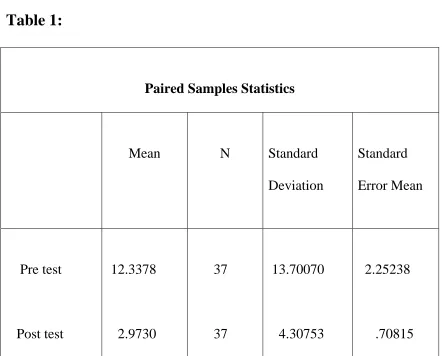
Table 1:
Paired Samples Statistics
Mean N Standard Deviation
Standard Error Mean
Pre test
Post test
12.3378
2.9730
37
37
13.70070
4.30753
2.25238
Table 2
Paired ‘t’ test: Cornell musculoskeletal discomfort questionnaire
Pre-test and
Post-test
Paired Differences Mean
Standard
Deviation
Standard Error
Mean
t df Significance
(2 tailed)
6.2 GRAPHICAL REPRESENTATION
This graph shows the pre test values of the Cornell musculoskeletal disorder questionnaire
This graph shows the post test values of the same questionnaire
0 20 40 60 80 100
1 4 7 10 13 16 19 22 25 28 31 34 37 40
S c o r e s o f C M D Q Samples
Pre
test
Pre test
0 5 10 15 20 25
1 4 7 10 13 16 19 22 25 28 31 34 37 40
s c o r e s o f C M D Q Samples
post
test
Graph showing the mean values between the pre test and the post test
The table‘t’ value for 36 degrees of freedom is 1.645 and the calculated‘t’ value is 4.375. Since the calculated‘t’ value is greater than table‘t’ value there is a significant reduction of back pain among nursing students. Hence null hypothesis is rejected and it is concluded that there is a statistical significant improvement in reducing incidences of back pain among nursing students by back care programme.
0 5 10 15 20 25 30
Pre test Post test
M e a n o f C M D Q
Pre test
6.3
DATA ANALYSIS AND RESULTS
The questionnaire had three components; the first part included the frequency of aches and pains during the last work week. The second part assessed how uncomfortable they felt due to the aches and pains. The third part assessed how the aches, pain and discomfort interfered in their work.
The table ‘t’ value for 36 degrees of freedom is 1.645 and the calculated ‘t’ value is 4.357. Since the calculated ‘t’ value is greater than table ‘t’ value there is positive correlation. Therefore the null hypothesis is rejected and is concluded that there is a statistical significant improvement in reducing incidences of back pain among nurses by back care programme.
Sampling method: Simple random sampling
150 nursing students
Included No of subjects 40 (based on Cornell
musculoskeletal discomfort
questionnaire)
Education and back care
Excluded 110 subjects
People followed the back care and education 37
People not followed the back care and education 3
Data analyzed with 37 samples Eliminated from the study
7.
DISCUSSION
Musculoskeletal disorders includes a vast range of inflammatory and degenerative conditions affecting the muscles, tendons, ligaments, joints, peripheral nerves and supporting blood vessels.
Clinical syndromes such as inflammation of tendons and related conditions (tenosynovitis, epicondylitis, bursitis), nerve compression disorders (carpal tunnel syndromes, sciatica) and osteoarthrosis, as well as less well standardized conditions such as myalgia, low back pain and other regional pain syndromes.
High risk sectors which are affected by musculoskeletal disorders and cause more sickness absentiseem include nursing, nursing aides and other patient care workers. Work related musculoskeletal disorders and in particular low back pain pose a major health and socio economic problem in modern society.
Among nurses the life time prevalence was found to be slightly higher, varying between 56% and 90%.
postures; mechanical pressure concentrations and any of these in combination with each other or with undesirable features of psychological work environment like high demands and low degree of control over one’s own work.
Smith D R at al -musculoskeletal disorders begin in nursing school, with exposure to patient care activities that require lifting heavy load, sustaining awkward posture, and repeating stressful movements.38
I Maul and T Laubli -work related musculoskeletal disorders and in particular low back pain, pose a major health and socioeconomic problem among nurses.17
Back injury prevention training seems to play an important role in reducing the incidence of injury.
According to Ohio university study by Marras “patient handling was found to be an extremely hazardous job that had substantial risk of causing a low back injury whether with one or two patient handlers
This study focused on giving a back care program to the nursing students and to find out if the program has any effect in reducing the incidence of back pain among the nursing students.
40 nursing students were inducted into the study based on the inclusion criteria. All of them were given the Cornell musculoskeletal disorder questionnaire. The questionnaire consisted of three items which assessed the frequency pain and discomfort in the past week and if they had pain and discomfort how uncomfortable the felt and also if the pain and discomfort that they experienced interfered in their work, the questionnaire included all the major joints of the upper and lower limbs were included and also the back.
The results after a month showed a significant reduction in the incidence of back pain and also reduction in the intensity of pain. The reduction in the incidence of pain was attributed to the fact that the back care program given to the patients reduced the incidence of back injury which in turn reduced the incidence of pain among the nursing students.
8.
SUMMARY AND CONCLUSION
This study conducted in an effort to find out the effect of back care program in reducing the incidence of back pain among nursing students. The study included 40 nursing students who have regular clinical postings.
This study was a pre and post test experimental study design. The results were analysed using paired t test. The results showed a significant reduction in the occurrence of back pain.
From this study, it is concluded that the back care program given to the nursing students significantly reduced the occurrence of back injury and thereby reducing incidence of back pain.
So it is also recommended to add back care programme in nursing programme of all level.
It is also recommended to have frequent classes on back care with debriefing to ensure all nurses attending the back care programme understand the
biomechanics of doing their job safely and with atmost energy conservation.
9.
LIMITATION AND SUGGESTIONS
¾ Sample taken was too small hence further studies can be done with larger samples.
¾ Study duration was too small hence further studies with longer study duration can be implied
¾ Students were taken for this study hence further study with staff can be done.
¾ Similar studies on different geographical locations can be done.
BIBLIOGRAPHY
1. A.K. Burton and T.L Symonds;Is Ergonomic intervention alone sufficient to limit musculoskeletal problems in nurses?;Occup Med Vol.47,25-32,1997. 2. Antonio Lorusso,Stefano Bruno; A Review of low back pain and
musculoskeletal disorders among Italian nursing personnel;August 3, 2007; Industrial Health 2007,45,637-644.
3. Chidozie EM Bada fabunmi,Bolanle MS Tinubu ,Work-related Musculoskeletal Disorders among Nurses in Ibadan,South-west Nigeria:a cross-sectional survey; BMC Musculoskeletal disorders 2010,11:12.
4. Buckle P epidemiological aspects of back pain within the nursing profession. Int J Nurse Stud 1987;2:319-324
5. Byron E Bork, Thomas M Cook et al. work related musculoskeletal disorders among physiotherapist. Phsy Ther 1996;76(8)
6. Cannadian centre for occupational health and safety. “work related musculoskeletal disorders”.
7. Carol A Sedak ,Nurse safety;NAON’S Role in preventing work place musculoskeletal injury;,Orthopaedic nursing, December 2006, Vol 25,no.6. 8. Colligan MJ, Tasto DL.Frequency of sickness absence and work-site clinic
visits among nurses as a function of shift.J Environ Pathol Toxicol 1979;2 [5];135-148.
9. Daraiseh N, Genaidy A M et al musculoskeletal outcomes in multiple body regions and work effects among nurses: the effects of stressful and stimulating working conditions. Ergo. 2003:46(12):1178-1199
10.Eastman Kodak Company. Ergonomic design for people at work (vol 1 &2) Van Nostrand Rein Hold: New York 1983
11.Edgar Vieira. Nurses suffer from work related low back pain more often than workers in other profession.6 Aug 2006. http://wwww.ualberta.ca
12.Garg A, Owen B D, Carlson B. an ergonomic evaluation of nursing assistance job in a nursing home. Ergonomic. 1992;35:979-996
14.Gropelli T M, Corlek. Nurses and therapists experience with occupational musculoskeletal injuries. AAOHN J.2010 April;58(4):159-166.
15.Hrudey WP.Over-diagnosis and Over-treatment of low back pain;Long-term effects.J.Occup Rehab 1991;1:303-311.
16.I Maul, T Laubli course of low back pain among nurses: A longitudinal study across eight years Occup Envir Med 2003;60:497-503
17.I.Maul,T.Laubli;Course of low back pain among nurses: a longitudinal study:Occup Environ Med 2005;60:497-503.
18.Barbara brady,Jane Lipscomb,Alison Trinkoff; Health care system changes and reported musculoskeletal disorders among registered nurses;Am J Public Health.2004;94:1431-1435
19.Jensen R disabling back injury among nursing professional; research needs and justification. Res Nurse Health 1987;10:29-38
20.Kerri L. Lawrence your aging back; a look at back strain in the work place; job safety and health quarterly/ fall 1990, 25-27
21.Kilbom A: editorial/ prevention of work related musculoskeletal disorders in the work place Int J Ind Ergo 1998;21:123
22. Alan hedge,Knibbe J J, Friele R D prevalence of back pain and characteristics of the physical work load of community nurses. Ergo 1996;39(2):186-198
23.Laura Punnett;David H. Wegmon: Work-related musculoskeletal disorders;the epidemiologic evidence and the debate;Journal of electromyography and kinesiology 14 (2004) 13-23.
24.Leamon TB,Research to reality;a critical review of the validity of various criteria for the prevention of occupationally induced low back pain disability.Ergonomics 1994;37:1959-1974.
25.Marras back injury prevention- causes of back injury
http://www.premierinc.com/safety/topics/back injury/
26.Mary Mincer Hansen RN PHd IOWA department of public health- home care highlights Dec 2004
27.Mayo foundation for medical education and research 1998-2011. Back pain at work: preventing aches, pains and injuries; HQ 00955, Feb & 2009
29.Occupational health. Clinics for Ontario workers Inc.; work related musculoskeletal disorders
30.Owen B D the magnitude of low back pain in nursing west J Nurs Res 1989;11(2):234-242
31.Punnett L, Wegman D H work related musculoskeletal injuries. The epidemiologic evidence and the debate J Electro Myo Kinesio 2004;14:13-23
32.Richard F Edlich MD PHd, Kathryne L Winters prevention of disabling back injuries in nurses by the use of patient lift systems. J long term effects of medi impl.2004;14(6):521-523
33.S Moretz “how to prevent costly back injuries”, occupational hazards (7); 45-48, 1987.
34.Shamshad Hussain Current orthopaedics 50-51
35.Silverstein B A Fine L J, Armstrong T J occupational factors and carpel tunnel syndrome. Amer J of Ind Med 1987;11:343-358
36.Smedley J Egger P Cooper C Cooggon D manual handling activities and risk of low back pain in nurses. Occu Envirn Med 1995;52:160-163
37.Smith D R, Leggat P A musculoskeletal disorders in nursing. Aus Nur J 2003;11:124
38.Smith D R, Sato M et al musculoskeletal disorders self reported by female nursing students in central Japan : A complete cross sectional survey. Int J Nurs Stud.2003;40(7):725-729
39.Snook S H work related low back pain: secondary intervention; J electromyogr Kinesiol 2004 Feb;14 (1:153-160)
40.Stellman J M safety in the health care industry. Occup Heal Nurs 1982;10;17-21
41.Tinabu B M, Mbada C E. work related musculoskeletal disorders in Ibadan, south west Nigeria: A cross sectional survey. BMC musculoskeletal disorder. 2010; 20:11-12
43.D.Smith,U S department of Health And Human Services. Public Health Service Centres For Disease Control. National Institute For Occupational Safety And Health. Work practices guide for manual lifting. DHHS (NIOSH) publication number 81-122. Cincinati, OH;1981.p.Xiii.
44.Videman T Nurminen Tolas, et al low back pain in nurses and some loading factors at work. Spine 1984;9:400-404
APPENDIX I
CONSENT FORM
I voluntarily consent to participate in a research study named “EFFECT OF BACK CARE PROGRAM IN
PREVENTING BACK INJURIES AMOUNG NURSES”
The researcher has explained me the treatment approach in brief, risk of the participation and has had answered the question related to the research to my satisfaction.
Signature of the researcher Signature of the participant
Signature of the witness
APPENDIX II
APPENDIX III
Cornell Musculoskeletal Discomfort Questionnaire.
APPENDIX IV
DO’S AND DONT’SSitting:
Do’s:
Sit as little as possible and then only for short periods.
Place a supportive towel roll at the belt line of the back especially when sitting for a long time
When getting up from sitting, keep the normal curves in your back. Move to the front of the seat and stand up by straightening your legs. Avoid bending forward at the waist.
Try to keep the normal curves in your back at all times
Don’ts:
Do not place your legs straight out in front of you while sitting
Standing:
Do’s:
If you must stand for a long period of time, keep one leg up on a foot stool
Don’ts:
Avoid half bent positions
Lifting:
Do’s:
Avoid lifting altogether, if you can.
Use the correct lifting technique. Keep your back straight when lifting
Stand close to the load, have a firm footing and wide stance.
Have a secure grip on the load and lift by straightening your knees.
Do a steady lift and do not jerk. Shift your feet to turn and do not twist your back.
Don’ts:
Never stoop or bend forward.
Bending: