Methods against Methods
Marc Stierand
NHTV Breda University of Applied Sciences, the Netherlands
Viktor Dörfler
University of Strathclyde, United Kingdom
Keywords: methods; creativity; innovation; problem-solving; systems view; lateral thinking; extraordinariness; master level knowledge;
ABSTRACT
This chapter intends to clarify some issues about the often misunderstood terminology of creativity and innovation methods. Following the train of thought outlined in this chapter, it is argued that neither creativity nor innovation is guided by a method. There are only methods against methods that can help the extraordinary individual to step faster and easier into a state of mind that is conducive to creativity, but which has no effect on whether the creative output becomes an innovation. In order to support this claim, three major reasons that seem to be responsible for making people believe that such methods for creativity and innovation exist are outlined here. Next, the chapter addresses the phenomenon of creativity and continues with a discussion on the systemic character of creativity and innovation. Finally it shows that there are no methods for creativity, but methods against non-creativity by explaining in particular how one of these methods against non-creativity works. What this chapter outlines here is a necessarily one-sided and partial view, aiming not to convince the readers of the correctness of the view, but rather to make them think by presenting one possible consistent approach.
CREATIVITY AND INNOVATION
Are there steps that, when followed, lead not only to a new idea (i.e. creativity), but also to a successful idea (i.e. innovation)? We do not think that there are, but we think that there are methods against methods that can help the creative individual to step faster and easier into a state of mind that is conducive to creativity. But there is still no connection to innovation, because whether an idea becomes an innovation is not decided by the creative individual, but, as we shall see later, by the perceptive value of this idea.
because its validity is very difficult to test. Therefore, academia has created a preference for seeing innovation as a continuous, rational, and purposive process (Nelson & Winter, 1982; Rogers, 1962). Researchers interested in innovation often apply micro perspectives and frequently seem to be lost in thought trying to answer questions of explanation, prediction, and correspondence. This has led to a lack of understanding about the phenomenology of innovation, which we see as the foundation on which any explanation, prediction and correspondence should be built. Moreover, there is still the problem that we have to deal with creativity when we engage with the topic of innovation. Although many researchers acknowledge the link between creativity and in- novation, they just close creativity into a black box or go around in circles by trying to blueprint the creative process.
The problem about creativity is that we know it exists, but we do not know how it works. In other words, we do not know what the creative process looks like. We have never seen it. We have only seen the creative product that is the result of a person’s creativity. Another widespread issue is linked to the creative individual. Many people think that everyone can be creative. But if this would be the case, why are there so few Mozart’s and Shakespeare’s? Our Western and postmodern society tends to equate equality with sameness and thereby neglects the creative extraordinariness of a few. Our society does not welcome outliers. In fact, we even cut off these tall poppies, because their talents naturally distinguish them from the rest of us. People can be equal, but they are not the same. Not everyone can paint like Matisse and not everyone can write like Goethe. Even if one could prove that all people start with the same genetic makeup for creativity from birth, not everyone will be able or will have the chance to develop a creative ability that can produce creations of the quality and influence as those of the aforementioned masters.
In order to support our arguments, we are going to outline our understanding of creativity and innovation and show how both phenomena are linked. Based on this outline we focus on the creative individual. We particularly draw on Gardner’s conception of extraordinariness in order to illustrate that creating something new and valuable requires an individual with substantial knowledge and not just the ability to enter a state of mind that is conducive to creativity. Then we expand our discussion to the phenomenon of innovation by showing that innovations are not produced solely by an individual but require the socio-cultural world for validation and co-creation of the new value. At the end we look at de Bono’s work on creativity methods.
creativity/innovation. Thus this paper does not include description or comparison of various methods. There is one exception to this, a group of methods baring specific relevance to our argument; this group is outlined briefly to support understanding. We do not aim at convincing the readers that this is the only right way to address creativity and innovation, only that this is one possible way. By doing so, we would like to make the readers think more deeply about creativity and innovation. However, before doing so it is necessary to explain what we mean by creativity.
UNDERSTANDING CREATIVITY
Let us start explaining creativity through the notion of problem solving. Simon (1973) distinguished between ill-structured and well-structured problems and regards the first as a residual concept, which means that a problem is ill-structured when it is not well-structured. An ill-structured problem is one that is deficiently defined, whereas a well-structured problem possesses some or all of the following characteristics (Simon, 1973: 183):
1. There exist definite criteria to test the solution;
2. The initial problem state, the goal state and all intermediate states may be represented;
3. The transitions between the previous states can be represented; 4. The acquired knowledge can be represented;
5. The effects of the environment can be represented;
6. And a feasible amount of search and computing is required;
differently, is non-algorithmic. This means that this part of thinking cannot be put into a finite sequence of instructions for solving a problem. De Bono (1971, 1994) calls this non- algorithmic part of thinking lateral thinking or sometimes parallel thinking. The notion of lateral thinking can be easily grasped through explaining how good jokes work (Baracskai, 1998). In good jokes the joke teller takes us on a vertical way of thinking. Something like:
A man and a friend are playing golf one day at their local golf course. One of the guys is about to chip onto the green when he sees a long funeral procession on the road next to the course. He stops in mid-swing, takes off his golf cap, closes his eyes, and bows down in prayer.
This vertical way sets us on a way towards the obvious conclusion: probably the man stops playing golf, because he wants to be respectful towards the mourners. This is the essence of vertical thinking; there is a single outcome and the thinking converges towards it. But in a joke there is a jump out from the vertical storyline into a lateral direction. The obvious is rearranging to form a new order, to make new sense when we get to the punch line. In our example the friend says:
“Wow, that is the most thoughtful and touching thing I have ever seen. You truly are a kind man.” The man then replies: “Yeah, well we were married 35 years.”
result on paper in full consciousness. We now have a reasonably solid explanation why there can be no methods for being creative: First, the creative jump cannot be seen in advance, but only retrospectively. And second, an algorithm cannot go into a place that cannot be seen. This is only possible through imagination and intuition. We now continue to outline the systemic character of creativity and innovation by referring to the link between creativity and innovation, the creatives, and idea creation and value creation. These aspects, as we will show, are reasons why we cannot apply steps for creativity and innovation.
THE SYSTEMIC CHARACTER OF CREATIVITY AND INNOVATION
The Link between Creativity and Innovation
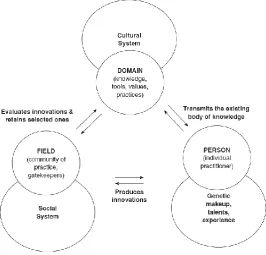
[image:5.595.164.431.458.713.2]Csíkszentmihályi (1997, 2006) speaks of two types of creativity: Creativity (with a capital C) and creativity (with a lower case c) as can be seen in the following figure. Creativity (with a capital C) is a system of three interrelated parts: the domain, the field, and the individual. The domain is the area in which the individual has chosen to work. Each domain has its specific rules, knowledge, tools, practices and values. The field, on the other hand, consists of the persons and institutions that judge the individual creator’s quality of work. In other words, the field consists of the gatekeepers to the domain. The individual creator, in contrast, is influenced by her/his personal creativity (that is creativity with a lower case c) and by her/his specific genetic makeup, talent and experience (Figure 1).
Hence, Creativity is concerned with changing or transforming an existing domain, whereas creativity is concerned with the actions or thoughts of a creative person that have the power to change or transform an existing domain. In other words, creativity is concerned with the creation of a new idea and Creativity is concerned with realizing a new value, that is, the successful innovation from the idea. This link between creativity and innovation can be expressed as a two stage heuristic process. The first stage is a creative process of solving an ill-structured problem in which the problem solver rearranges her/his existing knowledge in order to obtain a solution for the problem (Dörfler, 2004). The validation of the idea happens then in the network of gatekeepers. The second stage is concerned with how the idea is converted into a value. The validation of the new value is then executed by the field, which actually co-creates the value by promoting it to the domain (Figure 2).
Figure 2: Heuristic Process of Innovation. Source: own figure
Going back about one century to the beginnings of innovation research tells us that the interest in innovation actually emerged from diverse branches within the social sciences. While these branches applied different background knowledge, they had the common intention to describe and give reasons for social changes. Anthropologists like Alfred Kroeber (1876-1960) and Ralph Linton (1883-1953), for example, explored cross-cultural diffusions of technical and social practices, which they called borrowing inventions. And sociologists like William Ogburn (1886-1959) explained social change as continuous cultural lag. The economist Joseph Schumpeter (1911, 1939, 1947), however, is certainly acknowledged by many as the initiator of innovation research. He derived his ideas about innovation from his analysis of economic and social systems and many believe that his thoughts gave the impetus to recognize innovation as the crucial factor for economic progress and change. In his early work, he assumed that a company’s size affects its ability to innovate and therefore smaller companies, while being more flexible, seem to be better positioned to innovate than larger and more bureaucratic companies. Later, though, he suspected that larger companies, in particular those with a monopolistic market power, might be better positioned to innovate than smaller firms, because of their power and because they often have better resources. Fundamentally, he saw innovations as waves of creative destruction that can revolutionize a whole market. This view challenged the status quo of capitalism at the time, because it rejected the view that capital- ism is about managing its existing structures and proposed that it actually is about destroying its existing structures in order to create new ones. This also meant that firms that can respond fast enough and can take hold of discontinuities are better positioned that firms that have difficulties to do so. Hence, innovation is therefore not the response to a well-structured problem for which we are able to apply exact criteria that we can test and neither
new idea new knowledge
innovation new value
fiel
d
dom
can we blueprint each single phase of the innovation process. Approaches that try to make us believe that this is possible just create an artificially validated process under a condition that Bessant and Caffyn (1997) termed continuous innovation. Under this condition, innovation is nothing more than a process of improvement that takes place in a framework of existing and known rules. Simply said, continuous innovation means doing things as usual, only better. This does not exclude significant changes but implies that changes occur within an established framework. Of course, continuous innovation is already a complex phenomenon, but research cannot ignore that innovation can also be influenced by discontinuous and chaotic conditions. Discontinuity can be a scary notion, because it is not an everyday event. Innovators are forced to experiment in order to accumulate new knowledge that can help them to keep track in an unpredictable world. During times of experimentation a so-called dominant design emerges that in some way predicts the most popular but not necessarily the most sophisticated trajectory of the future. The old trajectories, however, are still in place and normally undergo rapid improvements, which in turn sharpens the conditions for all actors. But many still see innovation as a linear and continuous process and argue that social (i.e. non-technological) and technological innovations are opposite ends of a continuum. Yet, social innovation just means that it is the result of accepting something new that changes the domain or creates a new domain. Consequently, every innovation, whether technological or non-technological, is also a social innovation, because the creative output has to pass social validation before it can become an innovation. This becomes obvious, if we look at how some great technical innovations that affected our lives. For instance, the first airplane was designed in 1903 but this had no effect on our lives whatsoever. The real impact of flying happened only in the 1960’s, when we actually started to use airplanes to fly all over the world. We have now seen that innovation lies outside the influence of the creator, because it is a social validation of the creator’s idea. It is obvious that there cannot be a method for controlling this social validation. This raises interesting questions regarding the responsibility of the innovator and also of various social institutions, but we do not engage with these in this chapter. We have now seen that innovation lies outside the influence of the creator, because it is a social validation of the creator’s idea. It is obvious that there cannot be a method for controlling this social validation. This raises interesting questions regarding the responsibility of the innovator and also of various social institutions, but we do not engage with these in this chapter.
The term “social innovation” has been used throughout the literature to express a range of different ideas (Pol & Ville, 2009). Taylor and Gabor were probably the first who mentioned the term explicitly .As a behavioural scientist, Taylor (1970: 70) argued that social innovation is a response to social needs by introducing, for example, an “innovative new school, a new way
valued roles, identities, and skills of high complexity. In other words, social innovations may enrage and put whole communities to the test. Taylor offers here the amusing contrast with the invention of a new and better mousetrap. A new mousetrap will most likely be accepted quite quickly given sufficient advertising and right distribution. The reason is that accepting a new mousetrap involves no revolution in a person’s identity or life style, whereas a social innovation requires a radical and revolutionary change of values and beliefs. And we all know how difficult that is.
After this detour into the social aspect of innovations, let us now look at the creatives themselves before we continue to discuss the topics of idea validation and value creation in detail.
The Creatives
Social psychologists have long argued for a link between extraordinary individuals and creativity (see e.g. Gardner, 1993; Guildford, 1950; Koestler, 1964; Osborn, 1953). More recently, however, they have begun suggesting that creativity is not exclusive to extraordinary individuals, but is a primary component of every human life. The problem is that situational factors, such as childhood and education, are very influential and finally decide whether a person is able to actualize on her/his creative potential. In other words, we face the same problem as earlier mentioned that, even if we assume that at birth all people start with the same genetic makeup for creativity, not everybody has the chance to exploit it. Gardner (1998: 11-12) distinguishes between four main types of extraordinary people: the master, the maker, the introspector, and the influencer. For example, he describes Wolfgang Amadeus Mozart as a master who typically “gains complete mastery over one or more domains of accomplishment;
his or her innovation occurs within established practice.” Sigmund Freud represents the maker,
because a “maker may have mastered existing domains, but he or she devotes energies to the
creation of a new domain.” The introspector is represented by Virginia Woolf, because the “primary concern to this individual is an exploration of his or her inner life.” And finally
Mahatma Gandhi embodies the influencer, who “has as a primary goal the influencing of other
individuals.” Further, it is important to note, argues Gardner, that individuals may comprise
can exploit their position until imitators copy their ideas (Dörfler, 2010). Schumpeter (1911), however, strictly differentiated between the inventor and the innovator:
“Economic leadership in particular must be hence distinguished from ‘invention’. As long as they are not carried into practice, inventions are economically irrelevant. And to carry any improvement into effect is a task entirely different from inventing of it, and a task, moreover, requiring entirely different kind of aptitudes. Although entrepreneurs of course may be inventors just as they may be capitalists, they are inventors not by nature of their function but by coincidence and vice versa. Besides, the innovations which it is the function of the entrepreneur to carry out need not necessarily be any inventions at all” (Schumpeter, 1911: 88-89).
Idea Validation and Value Creation
and tends to punish those who challenge its culture. Let us discuss this two-way influence between the domain and its gatekeepers (i.e. field) and the individual by means of the concept of value systems. According to von Bertalanffy (1981: 13) “values are things or acts which are chosen by and are desirable to an individual or to society within a certain frame of reference.” This means people within a value system are concerned with what is good and what is bad. Our individual value system can be described as muddled, because in the course of our lives, due to many different events, we change or reject values or adopt new ones. On the other hand, the value system of a domain is born from complex interactions of the value systems of its individual members and from the influence of other domains. The interesting thing is, however, that after the domain’s value system is formed, it becomes independent of its members. This phenomenon can be explained by Hamel and Prahalad’s (1994: 55-56) story about a group of monkeys. A number of monkeys were put in a cage. In the middle of this cage was a pole and at the top of this pole were bananas. As soon as the monkeys tried to get up to the bananas they received a cold shower. Now, the interesting part is that the monkeys very quickly learned not to go up the pole to get the bananas, because they would get a cold shower, which they obviously did not like. Later, all the monkeys were re-placed one by one and still no new monkey touched the bananas, because it became part of their group value system and each new monkey was “told” not to get the bananas. Again, we have shown that there is a difference between the perception of an individual and the perception of others. Therefore, it became now even clearer that there can be no method to make other people positively validate an idea and transform it into a new value. Now we are going back to creativity itself, which we have shown is a prerequisite for innovation, to explain its anti-methodological character.
NO METHODS ALLOWED
them; the “Consider All Factors” (CAF) suggests thoroughness instead of quick recipes; the “Other People’s Views” (OPV) emphasises open-mindedness through considering who is affected (it can be considered a version of the stakeholder analysis); the “Alternatives, Possibilities and Choices” (APC) encourages both exploring and constructing alternatives; the “First Important Priorities” (FIP) focuses on selecting what really matters; the “Consequence and Sequel” (C&S) urges exploring the consequences of the alternative actions; and finally the “Plus, Minus and Interesting” (PMI) is an assessment tool (de Bono, 1993: 63-150). Is this not infuriating? Why would someone who obviously understands the essence of creativity offer methods for it? Using Feyerabend we could say that anything goes but what you would normally do. These methods do not aim at making the creative process happen but rather at preventing us using the methods that we learned so well. De Bono’s point is that we are so badly brainwashed that we would use the learned methods even subconsciously. Therefore his methods should not be seen as methods for creativity but rather as methods against
non-creativity. Methods against methods.
of communication, when we use vertical thinking, we always give selective judgments about another person’s statement. In other words, we either agree or disagree with what the other person has said. The same will happen when beginners try to use the word PO. We are so indoctrinated by the selective mechanisms of our language that we think the PO-statement is also a judgment. But it is not. This is the very essence of PO. Maybe it is helpful to picture PO as a sticky tape with which we can tape those possibilities that we would normally reject as being completely irrelevant, useless, illogical or impossible to realise. However, this does not imply that the PO-statement is a better alternative or even an alternative at all. In this sense PO is never judgmental and therefore it is a protection that allows following new ways and that can help us to use information in a provocative way. Moreover, PO can bring relaxation in situations where we stuck in the rigidity of thinking. It can make us smile, because we can formulate seemingly alien possibilities that seem so absurd that they can help us break the rigidity to see the problem from a different angle from which we might easier grasp a solution.
CONCLUSION
At the beginning we asked whether there are steps that, when followed, lead not only to a new idea (i.e. creativity), but also to a successful idea (i.e. innovation). We argued that there are no such steps, but that there are methods against methods that can help the creative individual to step faster and easier into a state of mind that is conducive to creativity. Then we identified a number of reasons why some people think that such steps exist. The first reason is that academia has created a preference for seeing innovation as a continuous, rational, and purposive process, because the fuzzy aspects of creativity are difficult to validate and cannot result in testable explanations, predictions, and correspondence. The second reason is that many academics close creativity into a black box or run around in circles trying to blueprint the creative process. We see this is as a problem, because on the one hand we cannot ignore that creativity is a prerequisite for innovation, but on the other hand we have to accept that nobody knows how creativity works. The only possibility that remains is therefore to come as close as possible to the phenomenon of creativity. The third reason is connected to the creative individual. Academia tends to assume that everyone can be creative and often rejects that a truly creative idea requires an extraordinary mind. This has probably created the strongest belief that steps exist that, when followed, bring us to the novum. In order to support these earlier mentioned reasons, we discussed the systemic character of creativity and innovation by particularly focusing on the link between creativity and innovation, the creatives, and how ideas are validated and how new values are created. Based on this discussion we concluded that creativity, and for that matter innovation, does not allow for methods. In other words, there are no methods for creativity, but methods against non-creativity. This claim was further supported by particularly focusing on the method “PO” as proposed by de Bono.
This is a necessarily one-sided and limited view; but rather than providing a shallow and more inclusive overview of a topic we chose to immerse more deeply in this narrow interpretation. Our aim was not to convince the readers that our view is correct (let alone the only possible correct one) but to make them think more deeply about their own view of creativity and innovation. This is why we did not address areas that would be necessary for a more comprehensive discussion, such as the levels or types of creativity and especially the particular techniques/methods aimed at creativity and innovation.
There are also topics in this chapter that we marginally discussed, only to the extent needed for our present theme, some of which may be candidates for future research. Particularly we plan to engage more deeply into the social aspects of creativity and innovation including the questions of responsibility. We have further plans to research various aspects of creativity. In a project that we completed, Marc interviewed 19 of the greatest chefs in the world. In another, presently ongoing project, Viktor interviewed so far 15 grandmasters (people at the highest knowledge level), including 12 Nobel Laureates. We have further plans to carry out similar research projects in various creative industries. The rich qualitative data that we are collecting will be analysed in the framework outlined in this chapter.
REFERNCES
Amabile, T (1988) A model of creativity and innovation in organizations, Staw, B & Cummings, L Research in organizational behaviour (Vol. 10), JAI Press, Greenwich, CT: 123-167.
Amabile, T (1996) Creativity in Context, Westview Press, Boulder.
Baracskai, Z (1998) Profi problémamegoldó (Master of Problem Solving), “Szabolcs-Szatmár-Bereg megyei Könyvtárak” Egyesülés, Nyíregyháza.
von Bertalanffy, L (1981) A Systems View of Man, Westview Press, Boulder, CO.
Bessant, J & Caffyn, S (1997) High-Involvement Innovation Through Continuous Improvement, International Journal of Technology Management, 14(1): 7-28.
de Bono, E (1971) Lateral Thinking for Management: A Handbook, McGraw-Hill, London.
de Bono, E (1973) Po: Beyond Yes and No, Penguin Books, London, UK.
de Bono, E (1990) Six Thinking Hats, Penguin Books, London.
de Bono, E (1993) Teach Your Child How to Think, Penguin Books, London, UK.
de Bono, E (1994) Parallel Thinking: From Socratic to De Bono Thinking, Viking, Penguin Group, London.
Csíkszentmihályi, M (1997) Creativity, HarperCollins, New York, NY.
Csíkszentmihályi, M (2006) A Systems Perspective on Creativity, Henry, J Creative Management and Development (3rd edition), Sage, London: 3-17.
Dörfler, V (2010) Fit for Innovation, Jolly, A The Innovation Handbook: How to Profit from your Ideas, Intellectual Property and Market Knowledge, Kogan Page, London, UK: 150-153.
Einstein, A (1956/1984) The World As I See It, Kensington Publishing, New York, NY.
Feyerabend, PK (1987/2002) Farewell to Reason, Verso, New York, NY.
Feyerabend, PK (1993/2002) Against Method (3rd ed.), Verso, London, UK.
Gabor, D (1970) Innovations: Scientific, Technological and Social, Oxford University Press, Oxford.
Gardner, H (1993) Creating Minds, Basic Books, New York.
Gardner, H (1998) Extraordinary Minds, Phoenix, London.
George, J (2007) Creativity in Organizations, The Academy of Management Annals, 1(1): 439-477.
Gladwell, M (2005) Blink: The Power of Thinking without Thinking, Penguin Books, London, UK.
Guildford, J (1950) Creativity, American Psychologist, 5: 444-454.
Hadamard, J (1954) The Psychology of Invention in the Mathematical Field, Dover Publications, New York, NY.
Hamel, G & Prahalad, CK (1994) Competing for the Future, Harvard Business School Press, Boston, MA.
Koestler, A (1964) The act of creation, Macmillan, New York.
Nelson, R & Winter, G (1982/2003) An evolutionary theory of economic change, Belknap Press, Cambridge.
Newell, A & Simon, HA (1972) Human Problem Solving, Prentice Hall, Englewood Cliffs, NJ.
Osborn, A (1953) Applied imagination (revised ed.), Charles Scribner’s Sons, New York.
Pol, E & Ville, S (2009) Social innovation: Buzz word or enduring term?, The Journal of Socio-Economics, 38: 878-885.
Pólya, G (1957/1990) How to Solve It: A New Aspect of Mathematical Method, Penguin Books, London.
Prietula, M & Simon, H (1998) The Experts in Your Midst, Harvard Business Review, January-February: 120-124.
Rogers, E (1962/2003) Diffusion of innovations (5th ed.), Free Press, New York.
Schumpeter, J (1911/1934) The Theory of Economic Development, Harvard University Press, Cambridge.
Schumpeter, J (1939/1961) Konjunkturzyklen, Vandenhoeck & Ruprecht, Göttingen.
Schumpeter, J (1947/1976) Capitalism, Socialism and Democracy (5th ed.), George Allen &
Unwin, London.
Simon, HA (1973) The structure of ill structured problems, Artificial Intelligence, 4(3-4): 181-201. https://doi.org/10.1016/0004-3702(73)90011-8
Taylor, J (1970) Introducing Social Innovation, Journal of Applied Behavioral Science, 6(1): 69-77.
Zaltman, G, Duncan, R & Holbek, J (1973) Innovations and organisations, John Wiley & Sons, New York.