City, University of London Institutional Repository
Citation
:
Wirasinghe, N E A (1975). Swirling and non-swirling flow in conical diffusers. (Unpublished Doctoral thesis, City, University of London)This is the submitted version of the paper.
This version of the publication may differ from the final published
version.
Permanent repository link:
http://openaccess.city.ac.uk/20630/Link to published version
:
Copyright and reuse:
City Research Online aims to make research
outputs of City, University of London available to a wider audience.
Copyright and Moral Rights remain with the author(s) and/or copyright
holders. URLs from City Research Online may be freely distributed and
linked to.
SWIRLING AND NON-SWIRLING FLOW
IN CONICAL DIFFUSERS
N.E.A. WIRASINGHE
A th e s is presented f o r the degree o f
Doctor o f Philosophy o f The C ity U n iv e rsity .
Department o f Mechanical Engineering,
The C ity U n iv e rsity ,
2
ABSTRACT
The performance of conical diffusers with axial and
swirling flew has been considered. As a necessary starting point
the various criteria used for defining performance have been
reviewed and have been extended to swirling flew cases. A new
'AREA-PLOT' method, which unifies presentation of performance
information, for plane and conical diffusers has been preposed.
An added attraction of this method is that it displays all three
geometric variables of the diffusers.
As swirl modifies the boundary layer it was necessary to
have seme knowledge of the growth of the boundary layer in the axial
flew situation. This was achieved by extending the 'ROSS-FRASER'
model as a closed form solution requiring only the initial boundary
conditions. The predictions compare very well with published
experimental results.
The swirling flow case has been considered both
mathematically and experimentally, the latter being studied through
flew visualisation and measurement. An extensive survey of available
literature, on theoretical and experimental work, has been presented
with particular emphasis on areas not covered by previous surveys.
The mathematical analysis was aimed at identifying the dominant
parameters. The solution indicates the preferred coordinate system
and the possibility of further extension. It has been shown that
it is possible to represent the tangential velocity distribution
Further analysis indicated that the divergence of the solid-body
rotation core was parallel to the wall of the diffuser.
Flew visualisation studies have identified breakdown
and non-breakdewn areas in turbulent swirling pipe flow. The
development of the various modes of breakdown have been recorded.
Detailed flew measurement in the 10° diffuser indicates that
swirl has a definite effect on eliminating separation tendencies.
It was found that swirl modifies the wall static pressure drop in
PRINCIPAL NOMENCLATURE.
a Radius of crank of slider-crank mechanism
A Constant; cross-sectional area of duct
AR Area ratio (= A^/A^)
B,C,k Constants
y
s A s D F G H K I L M n P P q q à r RR
2
,IRSkin friction coefficient
Pressure recovery coefficient
Ideal pressure recovery coefficient
Coefficient of performance
Shape parameter
General function
Exponent (function of |R0O ); General function
Shape parameter ( =
0/0
)Calibration factor associated with spherical probe
Mixing length; length of link of slider-crank mechanism
Slant length of diffuser
Angular momentum
= l/a as applied to slider crank mechanism
Static pressure
Mean static pressure
Mean axial kinetic energy
Mass flux through a region in the boundary layer
Mass flux through a cross-section
Radial co-ordinate
Radius of duct
Reynolds number
5
SR Non-dimensional wetted surface area
t time
u Axial velocity
u Mean axial velocity
u Peak value of axial velocity profile
u Friction velocity (=
J%jp
) v Tangential velocityV Total velocity
W Radial velocity
y Distance measured radially from wall
Y Thickness of boundary layer
z Axial co-ordinate
Greek Symbols
fl Non-dimensional axial length (= z/Rq ); Angle of yaw
Radius ratio (= r/R or (r/krcf as indicated); Angle of pitch
y
Functional characteristic (= u0
j
uc ); Angle between velocityvector and a given point on sphere
y * Axial kinetic energy factor
y** Axial momentum factor
<3 Dihedral angle; Boundary layer displacement thickness
€ Overall effectiveness; Eddy viscosity
C
Velocity ratio (= u/uco )7) Nondimens ional boundary layer co-ordinate
T)
Overall energy efficiency7)e Energy efficiency
0
Crank angle; Three dimensional momentum thickness6
Diffuser loss coefficient
r Circulation
p
Core velocity ratio (= u j uc0
)V
Kinematic viscosityP Density T Shear stress
4>
Cone angle of diffuser; Probe conical angle*
Swirl angle [ T a n '(v / u ) ]$ Projected maximum swirl angle [ T a n (Rco/u ) ]
CO Angular velocity
Q Circulation number (= R f / ü )
Superscripts
* Swirl case
1
Instantaneous fluctuating components;[ ] Partial differential
Subscripts
c Conical diffuser; Value at inviscid core or at
"solid-body rotation" core
CL Centreline
d Based on diameter
i General case
p Plane diffuser
w Value at wall
Q
Based on n m e n t u m thickness; Value obtained by extrapolatinglaminar sub-layer profile to y =
6
oo Inviscid flew outside boundary layer
ACKNOWIEDGEMENTS
The author wishes to extend his grateful thanks
to Dr. R.S. Neve for his guidance and encouragement
throughout this project.
The assistance of Mr. J.A. Snell, with computing,
and of Dr. A.W. Gillies, with mathematical work, is
acknowledged. The author is extremely grateful to Mr. R.
Chapman for developing the control system and to Mr. H.E.
Hart and his staff for their assistance with building the
test apparatus. Thanks are also extended to all those who
have assisted at various times including the library staff
and the computer staff.
Finally thanks are due to Mrs. K. Ahtuam for the
efficient manner in which this manuscript was typed and to
the Senate of The City University for granting the
CONTENTS Page.
ABSTRACT 2
PRINCIPAL NOMENCLATURE
4
ACKNOWLEDGEMENTS
7
CONTENTS
8
LIST CF FIGURES 13
LIST OF TABLES
CHAPTER I ; INTRODUCTION 19
CHAPTER 2 ; ESTIMATION AND PRESENTATION OF DIFFUSER
PERFORMANCE INFORMATION 27
2.1 Introduction 27
2.2 Axial flew at entry 27
2.3 A unified method for correlating performance
data for plane and conical diffusers 30
2.3.1 Introduction 30
2.3.2 Methods already in use 30
2.3.3 The 'AREA-PICT' method 35
2.4 Swirling flow at entry 37
2.5 Conclusions 41
CHAPTER 3 : BOUNDARY LAYER GROWTH IN A CONICAL DIFFUSER
WITH AXIAL FLOW 45
3.1 Introduction 45
3.2 Method of the Pennsylvania State University
Group 46
3.3 Ross's two dimensional model 47
3.3.1 Introduction 47
9
3.3.3 Growth of Flew Parameters 49
3.4 Fraser's three dimensional model 51
3.4.1 Introduction 51
3.4.2 Modification to Boss's equations 52
3.4.3 Method of solution 53
3.4.4 Limitations and conclusions 53
3.5 Extensions to the 'Fraser-model' 55
3.5.1 Basis of extension 55
3.5.2 Velocity profiles 56
3.5.3 Mass flux and core-velocity 58
3.5.4 The axisyirmetric momentum thickness 60
3.5.5 Computation of boundary layer parameters 60
3.5.6 Discussion and comparison 63
CHAPTER 4 : SWIRLING FLOWS; IÎ.TIODUCTION AND LITERATURE
SURVEY 73
4.1 Introduction 73
4.2 The vortex breakdown phenomenon 75
4.3 Survey of experimental work 78
4.3.1 Swirling flow in pipes 78
4.3.2 Swirling flew in conical diffusers 83
4.3.3 Swirling flew in Annular diffusers 91
4.3.4 Swirling free-jets 92
4.4 Conclusions 93
CHAPTER 5 ; THEORETICAL ANALYSIS OF SWIRLING FLOW 95
5.1 Introduction 95
5.2 Survey of prediction methods 96
5.3 Solution of the equations of motion for laminar
swirling flew in a conical diffuser.
Page
10
5.3.1 Governing equations 105
5.3.2 The swirl distribution 106
5.3.3 Decay of swirl intensity 107
5.3.4 Method of solution 114
5.3.5 The static pressure distribution 116
5.3.6 Discussion of solution
117
5.4 Conclusions
119
CHAPTER
6
; EXPERIMENTAL EQUIPMENT 1246.1 Design considerations 124
6.1.1 Basic requirements 124
6.1.2 Scale and flexibility of test rig 124
6.2 Test-Rig 126
6.2.1 General arrangement 126
6.2.2 Swirl generation 133
6.2.3 'Universal' coupling for probe-carrier 139
6.2.4 Probe traversing mechanism 140
6.3 Instrumentation and calibration 153
6.3.1 Measurement of mean flew-rates and
turbulence 153
6.3.2 Speed control of swirl generator drive
motor 157
PRECAUTIONARY MEASURES = ---
1
--- ' ... ... --167 CHAPTER 7 ; THE SPHERICAL PITCT PROBE FOR MEASUREMENT IN SWIRLINGFLOWS 168
7.1 Introduction 168
11
Paçje
7.3 Probes in yaw and pitch measurement 170
7.3.1 Flew past a sphere 170
7.3.2 Presentation of calibration curves 172
7.3.3 Coordinate system 176
7.4 Calibration equipment 177
7.4.1 Design considerations 177
7.4.2 Probes used and calibration tunnel 178
7.5 Calibration and analysis 182
7.6 Conclusions 190
CHAPTER
8
: FLOW VISUALISATION IN WATER 1918.1 Introduction 191
8.2 Flow visualisation and tracer agents 192
8.3 Experimental apparatus 195
8.4 Experimental work 196
8.5 Observations 199
8.5.1 The development of vortex breakdown 199
8.5.2 Vortex breakdown in a diffuser 208
8.5.3 The travelling primary core-head
211
8.6
Conclusions 211CHAPTER 9 : MEASUREMENT OF FLOW IN DIFFUSERS 217
9.1 Introduction _ 217
9.2 Experimental apparatus 217
9.3 Evaluation of flew properties 218
9.4 Performance of swirl generator 220
9.5 Flow in the 10° diffuser 225
12
Page
9.7.1 Basic assumptions 237
9.7.2 Diffuser performance 240
9.8 Discussion and conclusions 240
CHAPTER 1 0 : CONCLUDING COMMENTS 249
10.1 Aims and method of investigation 249
10.2 Results 249
10.3 Guidelines for future research 252
REFERENCES 256
TABLES 262
13
LIST OF FIGURES
CHAPTER I
page
1.1 Diffuser efficiency; Peters (1934) 22
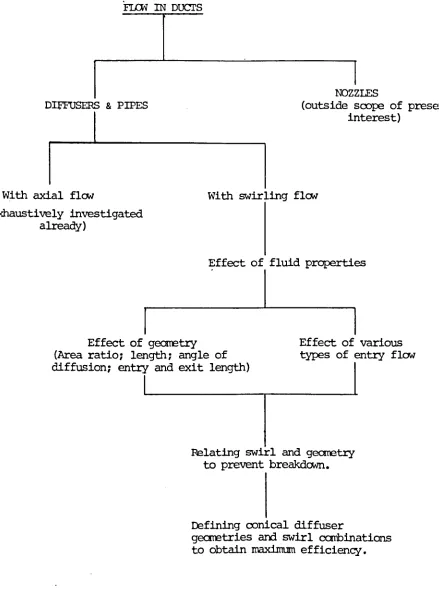
1.2 Flew chart displaying scope for research
associated with diffusers 24
CHAPTER 2
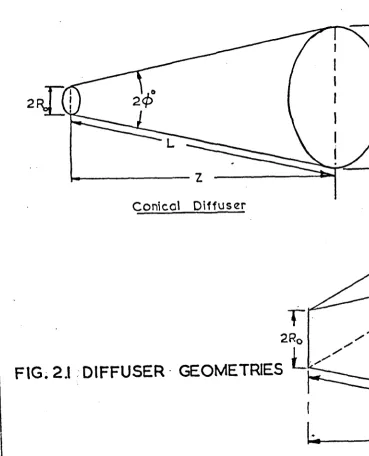
2.1 Diffuser geometries 31
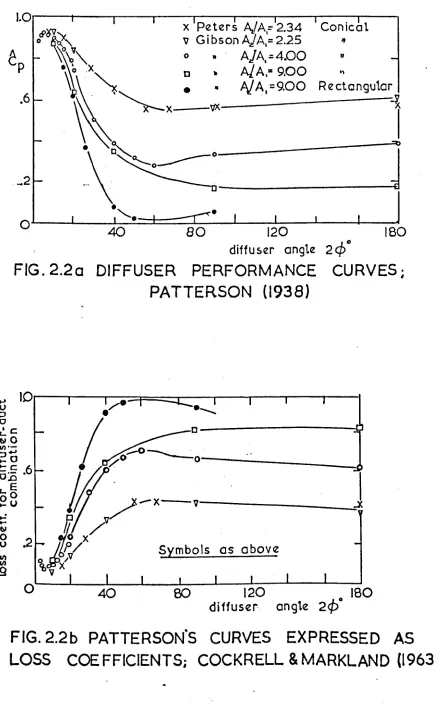
2.2.a. Diffuser performance curves; Patterson (1938) 32
b. Patterson's curves expressed as loss coefficients;
Cockrell and Markland (1963)’ 32
2.3 Significance of squared terms in equation (2.3.2.
6
) 34 2.4 Flow regimes in plane diffusers; Fox and Kline (1962) 382.5 Typical performance curves for plane diffusers; Fox
and Kline (1962) 38
2.6 Conical diffuser performance without swirl; McDonald
and Fox (1966) 39
2.7 Performance of conical diffusers - 'AREA-PLOT' 42
2.8 Flew regimes in conical diffusers; Axial flew;
McDonald and Fox (1966) 43
2.9 'AREA-PLOT' presentation of flow regimes in diffusers 44
CHAPTER 3
3.1 Division of velocity profile in boundary layer 50
3.2 Variation of (2 + G) with IRgo 50
3.3 Curve for determining D. 64
3.4 Coordinates used in duct. 64
Page 3.6 Velocity distribution in boundary layer
68
3.7 Comparison with data from Fraser68
3.8 The two modes of convergence 713.9 Simplified flow chart - Master 'BLID' 72
CHAPTER 4
4.1 The two forms of vortex breakdown 77
4.2 The spiral and axisynmetric modes of breakdown;
L a m b o u m e and Bryer (1961) 79
4.3 Swirl instability in laminar pipe flew; Talbot (1954) 80
4.4.a Diffuser "under" efficiency; Liepe (1966)
b Diffuser flew regimes; Liepe (1960) 85
4.5 Effect of swirl on (a) Diffuser performance 90
*
(b) Contours of constant C p = 0.70 90
(c) Line of optimum performance G - G 90
CHAPTER 5
5.1 Computer fit of exponential function to diffuser data 109
5.2 Computer fit of exponential function to pipe data 110
5.3 Variation of flew parameters 111
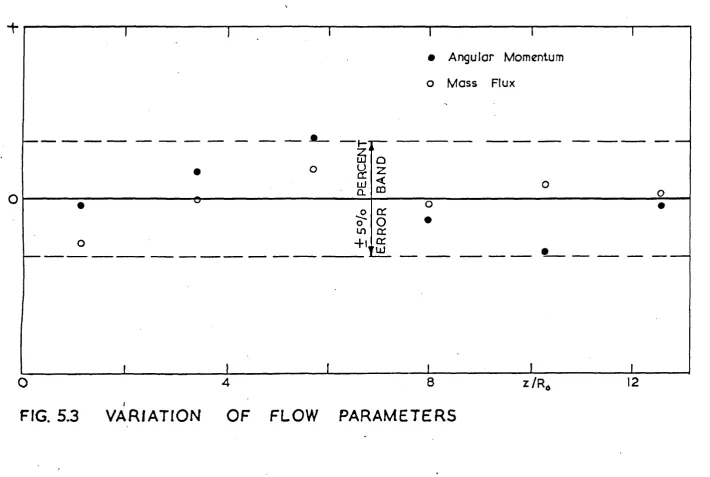
5.4 Divergence of core-radius 112
5.5 Variation of constants of tangential velocity
function 113
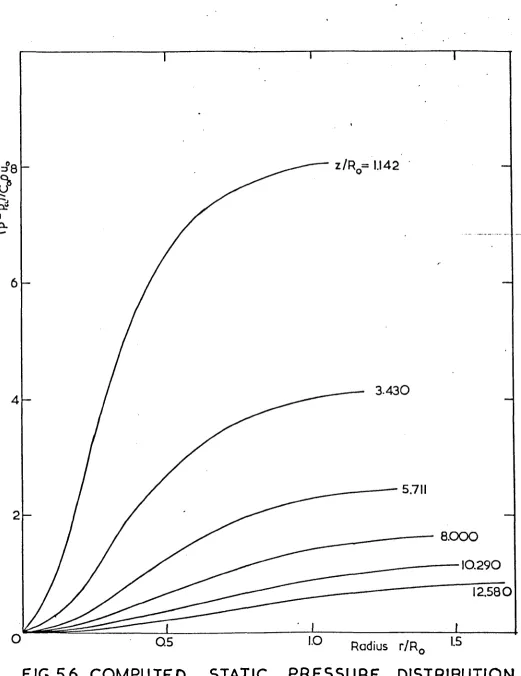
5.6 Computed static pressure distribution in diffusers 118
5.7 Variation of turbulent viscosity in pipe flew;
SCHLINGER (1953) 121
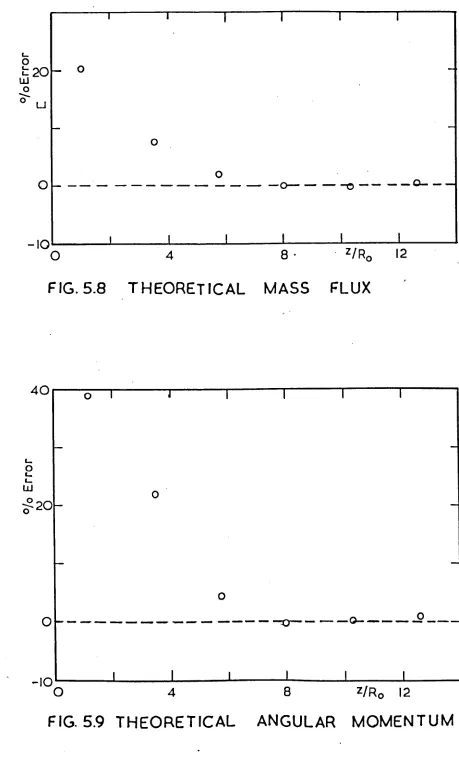
5.8 Theoretical mass flux 122
14-15
6.1 Overall dimensions of test-rig 127
6.2 Layout of test rig 128
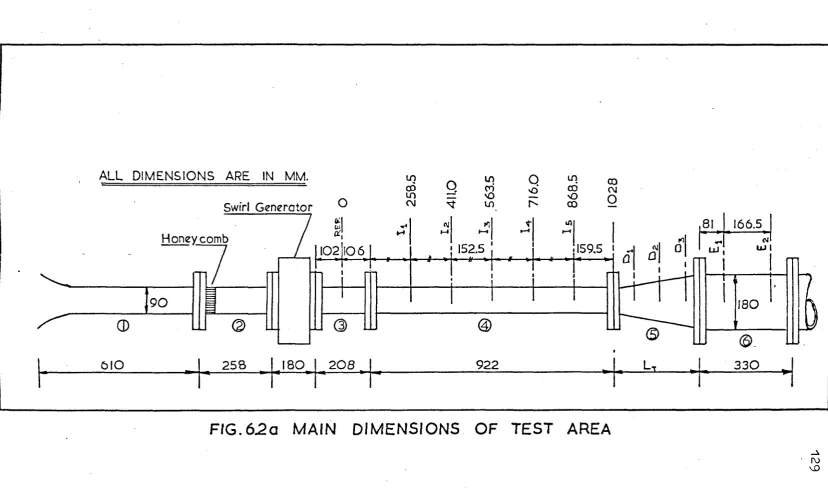
6.2a Main dimensions of test area 129
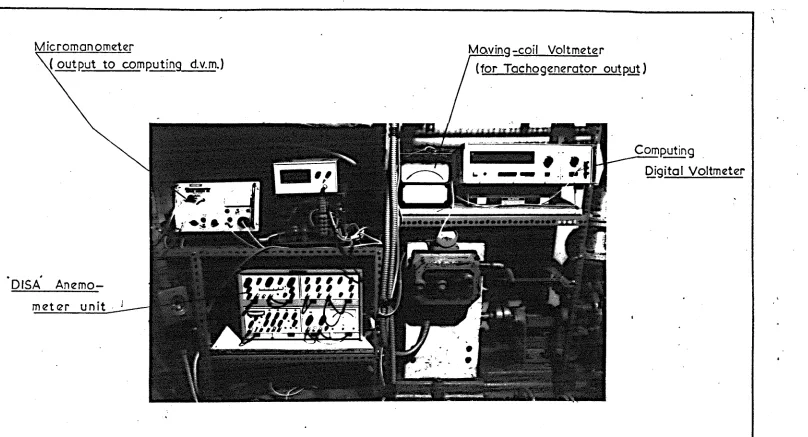
6.3 Recording instruments used for experimentation 130
6.4 Gwynnes centrifugal pump characteristics 132
6.5 Exploded view of swirl generator 135
6.6
Honey-ccmb swirl generator 1376.7 Swirl generator assembly 138
6.8
"Universal" coupling for probe carrier 1416.9 Angular divisions used for stepping motion 144
6.10 Sensitivity of harmonic motion 145
6.11 and 6.11a Probe traversing mechanism 147
6.12 and 6.12a Diffusers used in experiments 149
6.13 Electro-mechanical control system for traverse
mechanism 152
6.14 Orifice plate calibration curve - air 154
6.15 Orifice plate calibration curve - water 155
6.16 Orifice plate calibration curve - water 156
6.17 Control system for speed variation 159
6.18 Effect of thyristor on A.C. output 159
6.19 Method of obtaining pulses 161
6.20 Circuit used in speed control system 162
6.21 Layout of electronic circuit 163
6.22 Method of speed control via feed-back 164
6.23 Calibration curve; Swirl generator drive motor
CHAPTER 6 Page
16
7.1 The five-hole spherical probe 171
7.2 Drill jig for hemispherical probe head 179
7.2a The hemispherical pitot probe 179
7.3 The calibration tunnel 181
7.4(a, b, c)Characteristics of hemispherical pitot probe 183
7.5 Calibration curve for hemispherical probe 187
7.6 Curves shewing suitability of P
2
and p^ forbalancing probe 188
7.7 Swirl angle and static pressure measurements using
hemispherical probe 189
CHAPTER
8
8.1 Size distribution of polystyrene 'waste' 197
8.2 Arrangement for photography 200
8.3 Development of vortex breakdown in pipe flew 203
8.4 Development of vortex breakdown in pipe flow 209
8.5 Flew regimes in swirling pipe flow 210
8.6
The travelling primary core-head in swirling flow 2128.7 Vortex breakdown in a diffuser - Sarpkaya (1971) 215
CHAPTER 9
9.1 Variation of tangential velocity with speed of
swirl generator (as measured at st.l in
10
° diffuser)221
9.2 Variation of axial velocity for above case 2239.3 Variation of flow properties for above case 224
9.4 Axial velocity distribution in 10° diffuser 226
9.5 Tangential velocity distribution in 10° diffuser 227
9.6 Variation of flow properties in 10° diffuser;
swirl 228
17
9.7 Variation of flow properties in 10° diffuser;
axial flew
9.8 Wall-static pressure drop in inlet pipe
9.9 Wall-static pressure in diffuser and tail-piece
9.10 Pressure variation in diffuser-pipe combination
9.11 Diffuser performance with swirl
Pase
229
231
232
241
LIST OF TABLES
CHAPTER 3 Page
3/1 Diffuser boundary layer data; Fraser (1958) 262
3/II Diffuser boundary layer data; Computed 263
3/III Computed velocity profiles 264
CHAPTER 5
5/1 Carputed flow properties for
6
° Diffuser 265 CHAPTER 77/1 Probe characteristic data - Refer Fig. 7.4 266
CHAPTER 9
9/1 Flew properties with increasing swirl 267
9/II Data for 10° diffuser - Axial flow 268
9/III Data for 10° diffuser - Swirl 2 269
CHAPTER I
INTRODUCTION
In fluid mechanics, a duct in which the cross-sectional
area increases in the direction of flow is termed a diffuser. In
subsonic flews it decelerates the flow with an accompanying
increase in static pressure. Which of these is the primary
objective is dependent on the particular application; however each
of these objectives needs to be achieved with the minimum of
losses. Almost any basic contour may be used to achieve this
expansion; the conical diffuser however has been used extensively
owing to its simple geometry which makes it attractive in practical
applications.
Despite the vast amount of research over the years, the
basic characteristics of flew in a diffuser are still not clearly
understood. Whilst it is desirable to employ an optimum diffuser
where possible (i.e. one which yields the highest pressure
recovery coefficient), in practice other design considerations
preclude this and sometimes it is necessary to employ an other
than optimum diffuser. This more immediate requirement of the
design engineer has been satisfied by providing performance charts
in which the pressure recovery coefficient, defined as
c p= (P.-P.i/q,
is given as a function of the area ratio and expansion angle (or
20
In major industrial applications even a few percent
improvement of efficiency represents a significant financial
saving and therefore factors influencing diffuser performance are
eagerly sought. Early researchers were of the view that performance
was a function only of the gecmetry of the diffuser. However,
recent work has shewn that the thickness of the inlet boundary
layer and the level of inlet turbulence are also relèvent parameters.
The adverse pressure gradient associated with flow in the diffuser
thickens the boundary layer and can lead to separation. In
separated flews the kinetic energy available for conversion to
flew work is lost as internal energy.
Over the years various methods have been employed to
prevent boundary layer separation. Of these, boundary layer
suction in particular has received a great deal of attention.
This removal of Slew moving fluid from the boundary layer causes
high velocity fluid fran the core region to replace it. The
greater kinetic energy of this fluid enables it to overcome the
effects of the pressure gradient thus preventing separation.
Ackeret (1958), Furruya, et. al. (1966) and several others have
improved performance by this method. Moon (1958) reported that
suction was effective only with thin entry boundary layer
thickness and that suction was totally ineffective when this was
excessively thick.
Several other isolated methods have been used iron time
to time. Persh and Bailey (1954) increased wall roughness while
both claim iirprovements. Improvements have also been claimed for
wide angle diffusers by Yang (1965) who suspended an axisyirmetric
aerofoil centrally inside the diffuser. The effect of screens on
performance was investigated by W i n t e m i t z and Ramsey (1957) and
Moore and Kline (1958). Sprenger (1959), Senoo and Nishi (1974)
and several others used vortex generators to improve diffuser
performance. These were used only in specific applications and a
vast amount of experimentation isrequired to determine the
optimum configuration of vortex generators and to quantify the
benefits.
According to Peters (1931
),
Andres (1909) was the first to suggest that swirl may be used as an efficient means ofredistributing energy though the latter did not venture to
investigate this any further. Peters himself carried out some
preliminary work to investigate this view. As seen from Fig. (1.1),
swirl in fact does improve performance. Later, work by Liepe (1960)
and Van Dewoes tine (1969) further reinforced this view.
The current research programme arose from the view that
it may be possible to improve the performance of the fluidic vortex
amplifier by attaching a diffuser to its exit. The discharge from
a switched vortex amplifier possesses a high degree of swirl and
the aim is to generate a higher impedence in the chamber by diffusing
the discharge. Following recent work on the performance of fluidic
vortex amplifiers by Neve (1971) it was decided to conduct
a comprehensive research programme to investigate the character of
swirling flew in diffusers and in a pipe (diffuser with zero
divergence angle
),
and also to contribute to the existing knowledgeE
ff
ic
ie
n
c
y
FIG.U DIFFUSER
EFFICIENCY ; PETERS ( 1934 )
23
Flew in ducts covers a major portion of the subject of
fluid mechanics. As Fig. (1.2) indicates, even when restricted
to conical diffusers the subject is extremely wide. It is
obviously inpossible to build one universal test apparatus to
investigate the entire problem. Each individual project, within
the main programme, should investigate a few of the parameters at
a time thus providing the necessary information to put this subject
on a similar footing to that of diffuser performance with axial
flew. Cwing to the almost non-existent expertise in this field,
laying a suitable foundation was seen as an absolute necessity.
Ihe present project was seen as one that would make a global
assessment of the programme in addition to performing a steering
function for future research in this field.
A considerable degree of ambiguity still exists in the
manner in which diffuser performance is evaluated. In Chapter Two
the various criteria have been developed logically in an attempt
to coordinate these. Parallel criteria have also been developed
for evaluating performance of diffusers with swirling flow. A
new 'AREA-PLOT' method unifying presentation of such information,
in two and three dimensional flews, has also been developed.
The boundary layer growth in the conical diffuser, with axial flew,
is considered analytically, in Chapter Three, by extending the work
of previous investigators to obtain a closed form solution. The
special numerical techniques developed are also included but the
24
FLOW IN DUCTS
DIFFUSERS & PIPES
NOZZLES
(outside scope of present interest)
With axial flow
(exhaustively investigated already)
With swirling flew
Effect of fluid properties
Effect of geometry (Area ratio; length; angle of diffusion; entry and exit length)
Effect of various types of entry flow
Relating swirl and geometry to prevent breakdown.
Defining conical diffuser
geometries and swirl combinations to obtain maximum efficiency.
Fig. 1.2 FLOW CHART DISPLAYING SCOPE FOR RESEARCH ASSOCIATED
[image:25.530.51.490.58.655.2]25
The characteristics of swirling flow and the associated
vortex breakdown phenomenon are introduced in Chapter Four. An
extensive survey of relevant previous experimental work is
presented. Included is a discussion on the role of swirling flow
in jets, pipes, conical diffusers and annular diffusers. Ctoing
to the scarcity of experimental data mathematical analysis of the
swirling flew problem has been stunted. Most of the prediction
methods proposed have attempted to predict the occurrence of vortex
breakdown. Only a few have attempted to study decay of swirl.
These methods have been reviewed in Chapter Five. Furthermore the
governing equations of motion have been solved to investigate the
influence of dominant parameters in laminar swirling flow in
conical diffusers.
During the design stages of the test apparatus and
instrumentation, it was decided not to limit the scope of the
apparatus to this project alone but to endeavour to make it
sufficiently flexible to accommodate as much of the forseeable
future programme as possible. Consequently convenience had to be
sacrificed for greater latitude of experimentation. Design
information is reported in detail in Chapter Six. As the five-hole
pitot probe used for measurement was the subject of a more detailed
analysis, it is discussed separately in Chapter Seven.
Chapter Eight describes the flew visualisation work
conducted in water to observe the development of vortex breakdown.
Ihe discussion throws light on the difficulties associated with
such work. Experimental work associated with flew measurement in
Diffuser performance information is also included with comparisons,
where possible.
The work carried out is reviewed in Chapter T e n / and the
results are presented. Possible extensions in the various areas
CHAPTER TWO
ESTIMATION AND PRESENTATION OF DIFFUSER
PERFORMANCE INFORMATION
2.1
INTRODUCTIONAs diffusers are concerned with obtaining as much static
pressure as possible iron the kinetic energy of the fluid their
functional efficiency must be measured accordingly. Various
definitions for such measurements have been proposed in an attempt
to obtain a convenient method for presenting performance information.
As a result a certain degree of ambiguity has been introduced. In
an attempt to resolve this the various definitions used for
measurement of performance are derived in a logical manner. The
validity of same of the terms used will always remain arguable
though this is of secondary Importance. The subsequent discussion
will also concentrate on developing a suitable basis for presenting
such information when the flew at entry to the diffuser possesses
a swirl component of velocity. In addition an improved 'AREA-PLOT'
method has been developed for presenting performance information.
2.2_______AXIAL FLOW AT ENTRY
efficiency' of a diffuser be defined as the ratio of the power
transformed to the power supplied for transformation.
Patterson (1938) suggested that the 'overall energy
28
If the flew is axial at inlet and outlet sections
then V = u and, as the uniform pressure is in addition
transmitted through the boundary-layer, the above equation yields
the 'energy efficiency'.
Using the kinetic energy (weighting) factor
y
u*A =f udA
*
K
this becomes
\ =
(P z - R } (2*2 ‘3)where AR =
AjA^
and q =»ptf/2
. If the velocity distributionis uniform at the initial and final sections then % * % ! = ■ I
and equation (2.2.3) reduces to the 'coefficient of performance'
C p = (pa- R ) / q t(!-ARJ" (2.2.4)
In real flews in ducts the presence of the boundary layer
causes a non-uniformity of velocity. As a consequence of its
definition y ^ will always be greater than unity and in the case
of the paraboloid velocity distribution associated with fully
developed laminar flows % = 2. In the case of a thin inlet
boundary layer may be assumed to be unity but such an assumption
is invalidated at the exit of a diffuser where the adverse pressure
gradient creates a very thick boundary-layer.
i/
TH-In a typical case using the
77
power lawu/u =■ (I — r/R )
yields
=
1.06. Peters (1931) suggested the use of a betterapproximation to test data given by
* m
29
which for m = 2 yields % = 1.045. Even though y ^ is
always greater than y ^
,
in diffusers of practical interest-1 -2
A R is less than unity and A R is very much less than unity.
Applying this condition and the assumption that y ^ =
1
to equation (2.2.3) yields the 'pressure recovery coefficient'c p=
<2-2-5>
which has been used frequently as it obviates the need to
evaluate velocity profile data at exit.
For flew in a diffuser, under uniform conditions, the
Bernoulli equation with a loss term A p is
p, + q* =
and in the ideal case this becomes
p, + q, = Pa+q*
Invoking this ideal condition into equation (2.2.5) leads to the
'ideal pressure recovery coefficient'.
C p = I - A R 2 (2.2.6.)
Almost wholly, diffuser performance has been measured
in one or more of the above forms (or a modification of the above
forms). Sovran and Klcmp (1967) for example, suggested the use
of the diffuser "overall effectiveness" defined as
€
Clearly this is identical with the coefficient of
performance defined in equation (2.2.4). Cockrell and Markland
(1963) proposed the use of the "diffuser loss coefficient".
\
= I - C pThus it is seen that all the forms are approximations
30
2.3______ A UNIFIED METHOD FOR CORRELATING PERFORMANCE DATA OF
PLANE AND CCNICAL DIFFUSERS.
2.3.1 ___ Introduction
Systematic studies were carried out at Stanford
University with plane (two dimensional; Fig. (2.1)) diffusers
in an attempt to extend the knowledge gained to conical diffuser
flews. This attempt was greatly hindered by the lack of a suitable
basis for correlating performance information from these two types.
A
conical diffuser may be uniquely defined by any two ofthe three common geometric paramters; viz. area ratio, divergence
angle and length to inlet diameter ratio. In industrial situations
any one of these may be the constraining parameter. Quite often
the performance itself is the constraining parameter when
equipment dewnstream of the diffuser requires a prescribed input
pressure. If performance charts are not readily available in
the required form this would cause inconvenience.
2.3.2 Methods Already in Use
The method used by Patterson in his early review is
shewn in Fig. (2.2a). A similar method was used by Cockrell and
Markland, Fig. (2.2b). It is useful to note that in both cases
the length parameter has been considered to be the least important.
Recently at Stanford University contour plots were used, with plane
walled diffusers, in which all three parameters were readily
available. The simple geometric relationships of the plane
diffuser have made this possible.
---z
---Conieoi D iffu se r
T
2
R0
[image:32.407.31.400.45.501.2]*-32
FIG. 2.2a DIFFUSER PERFORMANCE CURVES;
PATTERSON (1938)
[image:34.530.34.470.61.778.2]53
R = R0+ z Tan
cj>(2.3.2.1)
For the plane walled diffuser the area ratio is
ARp = R / R
0— J
0(
2.
3.
2.
2)
and substituting this into equation (2.3.2.1) yields
ARp=| +(z/F^ Tan
<$>(2.3.2.3)
or
I n (ARp-1 ) = ln(z/Rj +ln(Tanc£)
(2.3.2.4)
The use of logarithmic scales would result In the half
angles appearing as a series of parallel straight lines. Furthermore,
as the area ratio is always greater than unity, the region of greatest
practical interest, which is the region of smaller area ratios, is
stretched out by the use of (AR ~ I) as the ordinate. P
On the basis of the limited conical diffuser data
available at the time, Kline, Abbot and Fox (1959) postulated that
performance data for axisyirmetric flews could be correlated on the
same basis as the data frem two dimensional flews.
For a conical diffuser the area ratio is
2
A R C = ( R / F y = j8 (2.3.2.5)
and on substituting for R in equation (2.3.2.1) yields
AF\.= I + 2(z/k)Tan
4>
+ [(z/Fy Tan<£]*
(2.3.2.6)
This expression would be similar to that given by
equation (2.3.2.3) provided the last term is negligible. Fig. (2.3)
which has been drawn with and without the last term of equation
(2.3.2.
6)
shews the importance of this term. It follows that whilethe contour plots provide an opportunity to present all three
parameters for plane diffusers they do not permit a similar
representation of conical diffuser information. This naturally
(
A
R
-I
J
35
2.3.3 The 'AREA-PLOT* Method
A new type of ‘AREA-PLOT' is suggested as a preferable
alternative to the previously discussed contour plots. The
ordinate is the flew area ratio and the abscissa is the ratio of
wetted surface area to inlet flew area. The introduction of a
new parameter, to add to the three already in existence, may at
first sight seem an added complication. However it will be shewn
that this permits the development of identical relationships for
both forms of diffuser.
Plane Walled Diffuser
Referring to Fig. (2.1) the slant length is
L = ( R “ F\j) / Sin
4>
and L / R Q= p - l ) / S i n < ^ >
The wetted area per unit width of diffuser is S = 2L
and the relevant wetted surface area ratio is defined as
SRp = 8/ 2Rq= 1/3 — I )/Sin<#>
frcm which
In (ARp- 1 ) = In (SRp) + ln(Sinc#>)
(2.3.3.1)
Conical Diffuser
Considering an element on the conical surface
z =■ L. C o s
4>
and dz =■ Cosc^.dLThe wetted area is
Sc= 2 ir^ R .d L
= 2fl/(Rrt+z.Tanc£) dz/Cos<£ *b °
integrating and substituting for Z fran equation (2.3.2.1)
36
Also the flew area ratio is
A R c = ( R / R of = j0*
The relevant wetted surface area ratio is defined as
S R C = | / ir R o = ( £ * - I )/S\ncj>
from which
t n ( A R - l ) = In (SFy 4- In (Sinc^>) (2.3.3.2)
Equations (2.3.3.1) and (2.3.3.2) indicate that it is
new possible to correlate plane walled and conical diffuser results.
On these 'AREA-PLOTS', lines of constant nan-dimensional axial
length for the conical diffuser (not applicable to plane walled
diffuser) have been drawn as this is the case of greatest practical
interest. In addition to this correlation facility all the
parameters are new represented in these new plots. In view of the
small angles considered in practice it is suggested that Sinc£
be replaced by
cf>
(radians); thusI n ( A R - l ) - In (SR) + I n (<£) (2.3.3.3)
The error, in the geometric relationship of
(f)
, AR and SR for a conical diffuser, in assuming Sin(f> =cj>
is extremely small. The error in surface area, based on the true valuefor A R = 6, for a typical range of diffuser angles is as follows:
2
cf>°
10 20 30 e % 0.127 0.510 1.152It should be observed that for the plane walled diffuser
the expression obtained by the present method (equation (2.3.3.1))
and that used in the contour plots (equation (2.3.2.4)) are almost
equal as in the range of greatest practical interest T a n c £ « S l n < £
Hence for these, contour plots may be used as before with the
37
Figs.(2.4 and 2.5) shew the flew regimes for a plane walled
diffuser and a typical performance chart respectively. Figs.
(2.6. and 2.7) show a typical performance chart for conical diffusers
in the earlier and later type of plot.
axial flew at entry the "pressure coefficient" defined by equation
(2.2.5) may be used to estimate the error. It is arguable whether
the performance of a diffuser should be measured in terms of the
actual dynamic pressure used in the conversion process or in terms
of that which is required at input irrespective of the dynamic
pressure left at exit. The latter has been in carman use as it
obviates the need to evaluate velocity profile details at the exit
section.
For the swirling flew case the "overall energy efficiency"
is as defined by equation (2.2.1)
, ^2 2. Z
but V = u + v
and
p = pec+ pv^2
The angular momentum flux is
Considering the special case of solid-body rotation, v = rCO ,
this becomes
2.4 SWIRLING FLOW AT ENTRY
It was shewn that in the case of a conical diffuser with
(2.4.1)
Introducing the angular momentum (weighting) factor
M =)/
irp
oo G
r7 2 =
2
irpoú£ur5dr
(2.4.2)The flew work term in the numerator of equation (2.2.1)
F IG.2.4 FLOW REGIMES IN PLANE
DIFFUSERS
(
A
R
.
-I)
39
40
which, for the solid-body rotation case reduces to
f
pudA =■ CLP /p
+-C
0M
/2•A (2.4.3)
The kinetic energy term in the denominator of
equation (2.2.1) is
P/2
.¡V
u d A =irpfo
(u -I- v*) ur dr which, for the solid-body rotation case reduces toP & j j V u d A » G L q ^ / p + 0 0 M / 2 (2.4.4) Substituting the above expressions into equation (2.2.1)
yields
* Q - ^ - g J / p + ( c q M e - o q M ) / 2 4 5)
°
- (WM
2-W,M
l)/ 2If the angular momentum is conserved then
CL(p- p )/p 4-
- I )/2
7)= --- * » - ■--- LJ--- !--- (2.4.6)
Q.q(%( I ~ AR
X l y j l p ~M^Woo, - D
/2If only a very Jnild' swirl is inparted to the fluid
at entry then it may be assumed that the pressure distribution
is uniform across the section. Also if only the kinetic energy
at inlet is used as a reference, as is usually the case, then the
above equation reduces to the 'pressure recovery coefficient'
C p “ ( | - R ) / ( q , % , + P M “ ,/2Q ) (2.4.7)
This equation provides a very convenient basis for
ccmparison of performance, provided only 'mild' swirl is used,
as it does not require a detailed knowledge of the velocity
profile at exit. The validity of the assumptions made in reducing
41
2.5 CONCLUSIONS
It has been shewn that sane degree of ambiguity exists
in the estimation of diffuser performance; this being more serious
when swirl is present at inlet. An improved 1AREA-PLOT' has been
proposed for the presentation of performance information. Figs.
(2.4) and (2.5) shew the flew regimes and a typical performance
chart, respectively, associated with plane diffusers. Fig. (2.6)
shews a typical performance chart for a conical diffuser which
has been redrawn on the new plot on Fig. (2.7). The advantage of
the latter form is the appearance of the cone angles. Fig. (2.8)
shews the flew regimes associated with conical diffusers; this has
been redrawn on the new plot on Fig. (2.9). It is seen that if the
flow regimes in Figs. (2.4) and (2.8) are caipared the trends are
not easily apparent. If, hewever, Fig. (2.4) is corpared with Fig.
(2.9) the trends are obvious thus further justifying the use of
these plots. Comparison infaert, does indicate that the lines
of first appreciable stall for plane and conical diffusers do not
correspond to the same geometries. Further analysis is required
to determine whether or not it is possible to correlate performance
data for the two forms of diffuser. In concluding, it is worth
noting that all the previous investigators [ Peters (1931), Liepe
(1963) and Van Dewoestine (1969) ] emitted the exit velocity profile
details in evaluating performance (for swirling flow cases) owing
to the difficulty of measuring these. The use of angular momentum
flux instead of tangential velocity, in the evaluation of performance
with swirl, eliminates seme of the errors associated with
(
a
r
-i
.
(A
F
^
-I
)
S R C
8 0
Refer Fig.2.8 for symbols
tine of first
appreciable stall
5
IO
2 0
4 0
8 0
SRc
FIG.2.9 AREA-PLOT PRESENTATION OF FLOW REGIMES IN DIFFUSERS
-F?-f?k
s
CHAPTER THREE
BOUNDARY LAYER GROWTH IN A CONICAL DIFFUSER WITH AXIAL FLOW
3.1_______ INTRODUCTION
The lack of success in the attempts to predict the
flew in a conical diffuser could be attributed to the failure
to solve the governing equations of motion. The Navier-Stokes'
equations have been accepted universally as a basis for the
theoretical analysis of fluid dynamic problems. These were
first developed for laminar flow applications and later Osborne
Reynolds extended these to turbulent flow cases. He replaced
the laminar velocities and mean pressures by their instantaneous
counterparts. The resulting equations, generally known as
Reynolds * equations, had additional terms representing turbulent
transport of momentum known as Reynolds' stresses. The original
laminar equations, being non-linear, have been solved exactly
only for a very few cases. Now with the addition of the
turbulent stress terms such a solution is unimaginable.
Analytical approaches too have had only a limited degree
of success. Where a diffuser is concerned one factor largely
responsible has been the limited knowledge of the growth of the
turbulent boundary- layer in the presence of an adverse pressure
gradient.
This chapter deals with an analytical method for
46
of the model was developed Initially during an extensive
programme of research an flow in diffusers at the Pennsylvania
State University. This has been extended now to cbviate the
need for information an the core-velocity along the length of
the diffuser.
3.2_______METHOD OF TOE PENNSYLVANIA STATE UNIVERSITY GROUP
A programme of research was initiated in 1945 at the Pennsylvania State University in connection w ith the design of a high speed water-tunnel. Ross, w h o w a s associated w i t h this programme, postulated a new physical approach to the turbulent boundary-layer problems. This, combined w i t h empirical
correlations,, provided a method for evaluating two-dimensicnal- turbulent boundary-layer parameters in the presence of an adverse pressure gradient.
Fraser extended this quite successfully to three
dimensional flows. Within the range of validity of the method,
the predicted values of boundary layer parameters compared very
well with their experimental counterparts. Later Robertson and
Fraser proposed a method for diffuser design using Fraser's
model, based cn the occurrence of "separation" as the criterion
for determining the geometry of the diffuser. They went further
to suggest a method for predicting the performance coefficient.
The method involves using a set of graphs and equations
to evaluate the boundary-layer parameters, proceeding downstream
in a station-wise manner. It requires prior knowledge of the
that this could be calculated frcm experimentally obtained
static pressures at each station.
3.3______ FOSS'S TWO DIMENSIONAL MODEL
3.3.1 ___ Introduction
The method is based on a new approach to flow in the
boundary-layer. A three-zone division is considered based on
the relative influence of viscosity an flaw in the boundary layer.
He analysed a vast amount of experimental data frcm previous
investigations to obtain correlations between the growth of flew
parameters. As Ross (1956) has already discussed his method in
detail only the basis of his work will be discussed here since
it is the extensions made by Fraser (1958) into three
dimensional flews that are of major interest.
3.3.2 ___The Turbulent Boundary Layer Profile
Prandtl' s mixing length theory for momentum transfer
between various strata in a turbulent flow leads to the following
relationship for the dominant Reynolds stress:
T = -puV=pf!|du/dy|.du/dy (3.3.2.1)
Amongst others, an assumption of mixing length being
proportional to distance from the wall then leads to the well
known logarithmic velocity profile
u/iy= A lo g j uy/v) -I- B
(3.3.2.2)
where A and B have been determined experimental ly to be 2.5 and
5.6 respectively. Close to the wall the logarithmic term tends
to an infinitely negative value, but in this region a laminar
48
mixing length tending to zero because of the solidity of the
wall accords well with this fact. The three regions involved
in this analysis (the laminar sub-layer, logarithmic region and
a buffer zone) have known velocity profiles in a turbulent boundary
layer up to a height of about 7) = 0.1. From 7) = 0 . 2 5 to
7) = 1, equation (3.3.2.2) becomes progressively less
satisfactory, largely because the mixing length no longer retains
its proportionality to y but attains a constant value of about
0.14Y. Resort is usually then made to the 1/n-pcwer law, where n
depends an Reynolds nunber but is usually taken as 7, or to a 3
"wake" type profile, or to the - power law based on work by
Darcy
, 3/a
( l - u / u j = D .(I - y/Y ) (3 .3 .2 .3 )
where D is a shape factor which depends on the past history of
the flow.
It seems reasonable, therefore, to divide the boundary
layer not into regions which depend on the mixing length being
constant, proportional to y, or equal to zero but into regions
which are either dependent on past history of the boundary layer
and free-stream pressure gradient or influenced by the proximity
of the wall and independent of pressure gradient. In any
turbulent layer in an adverse pressure gradient, the profile from
the wall to about
7
) = 0.1 is known not to be sensitive to this pressure gradient whereas the profile from 7) = 0.25 to 7) = 1is. Ross has therefore suggested that the breakdown shown in
Figure (3.1), which includes a blending region, dependent to
4-9
velocity profiles are made compatible. This latter condition
may often require an inflection, so the equation for this region
would need to be at least a cubic.
Ross states that for the outer turbulent region
(equation 3.3.2.3) an accurate idea of impending boundary layer
separation is given by the condition D = 1.3 + 0.1. This is
clearly equivalent to the shape factor H i « 6 I Q ) for the -y - pcwer lav profile tending to a separation value of about 3.5.
The substitution of a constant mixing length into
Prandtl's model leads to
D =[2/3][Y/l]7t/Pui (3.3.2.4)
and multiplication of both sides by U o/u<joo leads, after
rearrangement, to
, -i/a
[Y/D](uoayuJ=[3l/2]
[rjpul)
(3.3.2.4) The term an the left-hand side is a function only ofdistance downstream fran the initial condition (suffix 0) and not
of local wall conditions; experimental results by Schubauer and
Klebanoff (1950) have confirmed this.
3.3.3_____Growth of Flow Parameters
The use of the vcn Karman integral momentum equation
d0/dz = ( 2 + H ).[0/pu*]{dp/dz]+Cf/2 (3.3.3.1)
in turbulent flows with adverse pressure gradients has already
resulted in poor approximations. It was originally derived for
use with laminar boundary- layers and has been applied quite
extensively to turbulent flows with seme degree of success.
However, it needs to b e modified before it can be applied
V D
FIG.3.1
DIVISION OF VELOCITY
E
X
P
O
N
E
N
T
(
2
t
-G
)
FIG.3.2 VARIATION OF(2+G] V/ITH Rs9o
vn
In view of the difficulty in solving such an equation
Ross preposed an empirical relationship for the growth of
momentum thickness,
2+G
9JQ
= (uc/u j
(3.3.3.
2
)
where G is a parameter dependent only an the inlet momentum
thickness Reynolds' nunber, Fig. (3.2) shows the variation of
(2 + G) with Pq which may b e represented by
(24G ) =0.0143(In \Rgf - 0 4 6 6 7 In IR,+7.554
(3.3.3.3)
Furthermore an the basis of the Prandtl momentum-
transfer theory and dimensional analysis, Ross showed the outer
velocity profile parameter D to be governed by,
tY/0D][uc/u J = [(A (v z )/0 J + vyeoD j [§/0]
(3.3.3.41
where A is a constant evaluated in the zero-pressure gradient
region ahead of the region of relatively strong pressure gradients.
Ross went on to show that
A -O .0 2 5 ( 1 + 12C fo)
(3.3.3.5)
If the initial velocity profile is knewn A may be
calculated by determining . By obtaining Y/0D, D could o
be read off Figure (3.3) which is an experimental curve provided
by Ross from several sets of data. Now the problem is one of
solving a series of algebraic equations with the aid of seme
experimental curves.
As pointed out by Ross himself, the most serious
limitation of the method is that, in its algebraic form, it is
applicable only for about fifty inlet boundary layers thicknesses.
3.4______ FRASER'S THREE DIMENSIONAL M3DEL
3.4.1 Introduction
52
flew situations in three dimensions it offered scope for
extension into such flews. Fraser made a very useful contribution
when he extended Ross's two-dimensional model to three-
dimensional flows. There is no justification in discussing this
in great detail as it has already been the subject of several
publications, (Fraser (1956, 1958)). However, in leading onto
the discussion of the present extensions to this method, it is
necessary briefly to outline the method with special emphasis cn
the advantages, limiting factors and the drawbacks.
3 .4 .2 _____Modifications to Ross's Equations
The growth of the momentum thickness in three
dimensional flow is,
0R/0oRo = ( u / u c ) (3 .4 .2 .1 )
furthermore the variation of the shape parameter D is governed by
[ Y R / D ] [ u / u e] = A z " + Y0FVDo (3 .4 .2 .2 )
A, which is a function of the initial shear stress, is given by
the empirical relationship
A = ( T c ’f - 0 . 0 3 8 ) (3 .4 .2 .3 ) *o
which provides a reasonable approximation.
A function characteristic
y
, related to the innervelocity profile, and the outer law velocity profile shape
parameter D are related by the empirical relationship
y = 0 . 9 ( | - 0 . 6 8 D ) (3 .4 .2 .4 )
and it has been shown that the shear stress coefficient now
becomes
C f = 2 y / [ 0 . 7 + - 5 l o g j y i R , ) f (3 .4 .2 .5 )
relat-ing Y
IQ
and D. Rcbertsan and Fraser (1960) showed thatthey were related by
Y/0D=[2O/D] [0/R]+ I.8/D+ 3.6/D+.675 D*
(3.4.2.6)
The shear stress coefficient at inlet may be
evaluated using the relationship
Cj=-2/[6.2+52 l o g J I R j f (3.4.2.7)
3.4.3 Method of solution
Ihe initial values required for ccnmencement of the
procedure are Y . © and U . It is also assumed that the o' o co
core velocity, outside the boundary-layer, could b e computed
from a knowledge of the experimental pressure distribution.
The above equations and graphs are sufficient to evaluate the
flow parameters.
In a typical problem, e.g. a diffuser, a marching
technique would have to be adopted. Suitably spaced stations
should be considered. The starting values applicable to any
particular station are obtained from the previous station.
3.4.4._____ Limitations and Conclusions
This method is only applicable to flows where a
potential core exists. As Fraser points out, when the flow
approaches a fully-developed state various forces and second
order effects that are neglected in the present analysis might
become important.
Practical application of the method is limited by
the necessity of determining the initial values of D, Y and ©
by experimental methods. It was pointed out by Ross and by
54
profile for the proper determination of D and Y.
For any theoretical model starting values must be
provided; the only difference in this case is that evaluating
these is cunfoerscme. This however is not a major disadvantage.
One aspect of the method that does not make it very attractive
is the need to calculate the core velocity (from the pressure
distribution) for each station.
The main aim of the work of the Pennsylvania State
Group was to predict the performance of diffusers with a wide
variety of geometries and inlet conditions. Development of a
method to predict the growth of boundary-layers in an adverse
pressure gradient was a necessary contribution towards their
main goal.
The performance coefficient of a diffuser is defined
as the ratio of the static pressure gain across the diffuser to
the inlet dynamic pressure (sometimes the change in dynamic
pressure is regarded as the reference value). It follows that
if the pressure distribution has to be measured, in order to
proceed with the above model to evaluate the boundary-layer
parameters and hence compute the performance coefficient, one
might as well compute the performance coefficient without
recourse to the above model. It must be emphasised, lest the
author’s ocranents are misconstrued, that the model itself is
very attractive in the analysis of boundary-layer properties
though not so, in its present form, for predicting the
55
Thus, the logical extension to the Pennsylvania
State work would be the development of a method which does
not require measured values of static pressure as a pre
requisite.
3.5______ EXTENSIONS TO THE 'FRASER-MODEL*
3.5.1____ Basis of Extension
The present research prograrrme has extended the
invaluable work of the Pennsylvania State Group, thus making
it possible to evaluate boundary-layer parameters without
recourse to pressure measurement at each station.
The extension involves the introduction of the
equation of continuity to the model. However this requires a
detailed knowledge of the velocity distribution. Additional
equations have been introduced to identify completely the
velocity profile. This enables the determination of all the
required flow parameters. Another feature is that the initial
value of D can be evaluated in a very straight-forward manner
by recourse to a subroutine in the main programme.
At the time of the Pennsylvania State programme,
computers were not in wide use and graphical techniques were
the order of the day. As Boss himself pointed out, it was
necessary to develop a method that was easily handled without
having to resort to solving differential equations. But with
the present wide use of computers there is no reason why the
entire process should not be programmed in a manner suitable for
the computer. A special programme was developed to handle the
56
As will be seen fran the ensuing sub-sections, it would not have
been possible to develop this method without the aid of the
computer. The task of developing the programme was by no means
easy and special numerical techniques had to be developed to
speed up the process.
3.5.2_____Velocity Profiles
The shear stress coefficient is
C f = x / [ p u e7 2 ]
and the friction velocity is
U « = J W
from which
U#/Uc=
JcJ2
= f*
.
(3.5.2.1)
The following relationships are available for the inner (t^) and
outer (u4) regions for ( 2 0 v / u J < y^O.I Y
ua/u^= c .[1 -h C^tr» (y u^/v) ] (3.5.2.2)
and f o r . 2 5 Y ^ y ^ Y
u/uc = 1 — D ( I — y/Y) (3.5.2.3)
But yq*/v =• [y/Y] [Y
IQ]
[u^/uj[Qujv]
= I) IR»t.tY/0]
— 7) A c (3.5.2.4)
where A c= IR^fJ Y
IQ)
Also u2/u^= [u£/ujluc/i^l = u 2/ucf* (3.5.2.5)
Using equations (3.5.2.2., .4, .5) w e have
u a/uc = f*Cv[ | - h C + ln(7iAc)] (3.5.2.6)
Very close to the wall in the laminar sub-layer the
inadmissibility of the mixing-length theory makes equation
57
term precludes its use at the wall where 7) = O • This is
overcome by the introduction of a profile governed by a quadratic
from the wall to approximately y u /
V
= 20; thusu,/uc =
axT]
+-Qzlf
(3.5.2.7) valid up to7
] - 2 0 W u^YThe blending region may be suitably expressed using a
cubic equation with four unknowns, thus for 0.1^7) < 0 . 2 5
u,/uc= bc4 b,7)4 bj)*+ b37)J (3.5.2.8)
We now have a set of equations governing the entire velocity
profile, viz.
20/Ac . ut/uc = a 7) +
ajf~
2 0/Ac«S 7)
a
0.1 .
u /uc = Vc , [ I + c^tog {7) Ac) ]
( 3 5 2 9 )
0.1
<
7) <
0.
2 5;
u/uc = b
0+b,
7) + b /
4b
7)50
.
2 5^
7) <
1.0;
u/uc = I - D (I
- T ) FAt any cannon point between successive segments
continuity is satisfied in ordinate and gradient only. For greater
accuracy continuity in curvature could have been included though
this would have led to more complex equations for the polynomials.
Differentiating the above equations (3.5.2.9) w.r.t.
7) ,
yields(u,/ut)'= a, 4-
2azT
)
(Ug/Uj =
I^CyC^/
T]
(u
3/uc)' = b,
4-
2^
7)4 3b /
( u > c)'= 3 D (I -7)f / 2
58
Solving for a^, aj at ]) = 20/Ac using equations (3.5.2.9)
and (3.5.2.10) yields
I 2 0 /A.
I 4 0 / A,
a ,
a.
tjPjt I 4 (20)] A c/ 2 0
1&C+AJ20
(3.5.2.11)
Similarly solving for b Q , k^, b 2 , b 3 at 7) = 0.1 and 7) = 0 . 2 5
yields
1 0.1 0.01 0 . 0 0 1 V f^C([ 1 + C Jji(Ac/I 0)]
0 1 0.2 0 0 3 I 0 f ^ c 4
1 .25 .0625 0.0156 b3
Vi .
1 - 3 D/8
0 1 0.5 0.1875
_
_
_
i 3 D / 4
(3.5.2.12)
At this stage a detailed knowledge of the velocity profiles
is available.
3.5.3_____Mass Flux and Core Velocity
Fran Figure (3.4) R = r + y and r/Y - R / Y -7)
for flew within the boundary-layer
or
r
ta.2irpJ
ur dra
f ^
— 2irp
Y u i Cu/uJ [r/Y] d (r/Y)— 2irp
Y u / [u/uj [(R/Y) -7)] d[(R/Y) -7) ] . */Y' \ ^q<= 2irp Y uy [u AJj [(R / Y ) -7) ] d7) (3.5.3.1)
Considering each segment of tke profile separately,
(a) Wall region
^20/Ac
q. = 2irpY
ujiafl
+ a 7)*) [(R/Y) - 7) ] d7] HD2i7pYuc[400 / A j [ ( a / 2 ) ( R / Y ) + 2 0 ( a j R / Y ) - a ()/3Ac
-(b) Inner region
(3.5.3.2)
-lOOajAJ
q. * 2jrpY u / f £ [ H - C ln ( r ) A ) ] [ ( R / Y ) - i) ] di)
- 27rpY2u f f t[7) ((R/Y) - 7]) ( I - C C j . n ( 7 ) A c)) - 7) / A J
0.1
59
(c) Blending region
q =
2irp\uJ[
b„+ b,7) +bjf~
+bjf
]
[(R/Y) - 7) ] d7)3 “o.l 3
= 2 7 rp Y u c [(R/Y)bo7] + Q 5 ( ( R / Y ) b >- b 0)7)2' +
---=-27TpYuc^E((R/Y)hi;r-r h.) 7)V i £**
(3.5.3.4)
where h.= b.
X V-2and
h = h = 0
l &(d) Outer region
q=2irpYuJjL?- D (I — 77) ] [ ( R / Y ) -7) ] d7)
=2?rpYujO.75 (R/Y) +(
9J3[{
R/Y) - 13/2 8 )/80)-15/32]‘0° s(3.5.3.5)
(e) In the potential core outside the boundary-layer
= 7Tpuc( R - Y ) Z
thus qs= 2trpYUc[((R/Y)-|f/2] (3.5.3.6)
In general, mass flux through a region in a particular
section is
q.=7rp Y u cA.
and mass flux through the section is • U s
2
X-S
Ci
= .Eq.=7rpYuEA-.X r £\>l U where A i=q./rrpYuc
Ihe average velocity is
U 7 r p R * = Lj.pJr27rr(u^/uc)dr
=
2irpYujtuJuc)
[(R/Y) -7) ]d7
)U/u =■ (Y/R? E A -W A-a I >■ or
Let
then
l = U/u,
l = ll
At inlet equation (3.5.3.7) becomes
(3.5.3.7)
(3.5.3.8)
(3.5.3.9)
60
Fran equations (3.5.3.7) and (3.5.3.10), the core velocity is
¡1 = l Q o/ d ] [ ( Y t/RJ/(j6Y/R)] (3.5.3.11) 3.5.4 ___ The Axisynmetric Momentum Thickness
The suitability of the functions used to define the velocity profile in the boundary-layer may b e verified b y
comparing the momentum thickness obtained b y integrating the profile w ith that obtained from equation (3.4.2.1). It should b e noted
that this equation is defined in terms of three dimensional
momentum thicknesses and that these differ from the two dimensional thicknesses whe n the boundary-layer is appreciably thick as at the exit of the diffuser. The axisynmetric momentum thickness may b e derived from the velocity profiles as follows.
Consider an axisymmetric duct of radius R, Figure (3.4). The deficit of momentum is
irp[R - (R -
0)
]U = / 2 i r p r u ( U - u ) d r B u t R = r + yHence - 0 * + 2 R 0 = 2jT(u/D) [I “ ( u / D}]( R - y )dy
Introducing f (7)) = (u/U)[l- (u/U)]and 7)= y/R and simplifying
yields
(0 /R J - 2j0(0/Rj + 2 0 (Y /F ^ f (7))[l - 7) (Y/F$3]d7) = O
or
(0/F^f“ 2j0(0/Rj + 2j6(Y/Fy F(
t)) = O
(3.5.4.1)
If (0/R) is small then the above equation approximates to
( 0 y R j = (Y/R)f(7)) (3.5.4.2) and if (0/R) is large then
(0/F$
= [l±(l -2(Y/FyF(7))/i0)] (3.5.4.3) 3.5.5 ____ Computation of Boundary-Layer ParametersA.________Computational Procedure