Alexander Inglis
A Thesis Submitted for the Degree of PhD at the
University of St Andrews
1933
Full metadata for this item is available in St Andrews Research Repository
at:
http://research-repository.st-andrews.ac.uk/
Please use this identifier to cite or link to this item: http://hdl.handle.net/10023/11211
All rights reserved
INFORMATION TO ALL USERS
The quality of this reproduction is dependent upon the quality of the copy submitted.
In the unlikely event that the author did not send a complete manuscript
and there are missing pages, these will be noted. Also, if material had to be removed, a note will indicate the deletion.
uest.
ProQuest 10166099
Published by ProQuest LLC(2016). Copyright of the Dissertation is held by the Author.
All rights reserved.
This work is protected against unauthorized copying under Title 17, United States Code. Microform Edition © ProQuest LLC.
ProQuest LLC
789 East Eisenhower Parkway P.Q. Box 1346
STATEMENT OF STUDY
(b)
WITH DETAILS ABOUT ADMISSION.
University of Liverpool:
June 1922. Awarded degree of B.Sc. with honours
in Mathematics.
June 1923. Awarded Diploma in Education for a thesis
entitled; Historical Considerations in the Teaching of Mathematics.
June 1927. Awarded the degree of M.Sc., for a thesis entitled: The Dynamics of Rotating Fluids.
Appointments.
October 1923 to August 1929. Assistant Master in the Mathematics Department, High School of Dundee.
September 1929 to date. Principal Teacher of Mathematics, Bell - Baxter School, Cupar, Fife.
Details of Admission;
It was intimated to me on the 17th November 1930 that the Senate had agreed to admit me as a Research Student as from 1st October 1930 and that a thesis might be presented on the
BIBLIOGRAPHY.
Hutton, C.
Ball, W.W.R. A Short History of Mathematics (London,1908) . A History of the Study of Mathematics at
Cambridge, (Cambridge,I889)•
Commercium Epistolicum D. Johannis Collins, et Aliorum de Analyst Promota, (London, I712).
Gibson, G.A. Proceedings of the Edinburgh Mathematical Society I. 41 (1922), 2-25., and II. 1.(1927), 1-18.
A Mathematical and Philosophical Dictionary, (London,1795), 2 vols. Tracts on Mathematical and Philosophical Subjects, (London I8l2) .
I. Nos.12, 19-21, and II No.33.
De Arte Logistica (Edinburgh,1839)Î edited by Mark Napier for the Baunatyne Club.
Napier Tercentenary Memorial Volume, (Edinburgh, I915).
Rigaud, S.J. Correspondence of Scientific Men of the Seven teenth Century, (Oxford,I84I)• 2 vols.
History of Mathematics, (Boston,I923), 2 vols. The Academic Gregories, (Edinburgh,1901).
The Great Mathematicians, (London,1929).
Proceedings of the Edinburgh Mathematical Society II, 3(1933), 151-172.
Certaine Errors in Navigation Detected and Corrected , (London,1399
)-Napier, J.
Smith, D.E. Stewart, A.G. Turnbull, H.W.
. INTRODUCTION. JL • """*
During the sixteenth and seventeenth centuries remarkable progress was made in the developement of Mathematics. Many of most powerful weapons that now figure in the equipment of a modern scientist were discovered during this period, and the University of St. Andrews may reasonably claim a considerable
share in these advancements. Two great mathematicians of the time were associated with the University - John Napier, who was a student at St.Salvator•s College for a year about 15&3, and James Gregory, who held the chair of mathematics from 1668 to 1674- The neune of Napier has been kindly used by posterity and his memory honoured by the tercentenary congress of 1914, while that of Gregory is best known when attached to a series appearing in elementary trigonometry. It would be irrelevant here to contrast their respective contributions to mathematics, but there is no doubt that while Napier lived in St.Andrews for a short time only and made his discoveries in after years,
Gregory's tenure of office at the University is noteworthy for many valuable researches that make him worthy of comparison with Newton his great comtemporary.
Gregory doubtless inherited some of his ability from his mother's family, for her father - David Anderson - was a
b
of mathematics at Paris during the early part of the seventeenth century. Gregory early gave evidence of his genius. His
"Optica Promota" (Londor^660) was published when he was only
twenty-two and was the explanation of the theory and construction of a reflecting telescope. This invention was purely theoretical for it required a paratolic concave lens that even skilled
grinders could not make. A spherical lens was tried but it was not a success. Gregory then studied for a time in Padua, where he wrote "Vera Circuit et Hyperbolae Quadratd/Ma, " (Padtra ,1667). This work was republished in the following year with an appendix
"Geometriae Pat’s Universalis." On his return in lb68
Gregory was elected a fellow of the Royal Society. Soon after "Exercitationes Geometricae" (London,1668) appeared and Gregory was elected to the chair at St. Andrews. He resigned in I674 to take up a similar appointment in Edinburgh, where he died the following year.
&
Gregory's work in mathematics ih contained partly in the books mentioned, but a great deal is in the letters he wrote to John Collins (1625-I683). In his own words Collins was " not educated at universities, and so my attainments are mean, yet I have an ardent love to these studies, and endeavouring to raise a catalogue of mathematical books, and to procure scarce ones
for the use of the Royal Society." The correspondence started while Gregory was in Padna, at a time when Collins was " in a troublesome employment that prevents my studies, to wit, chief
1675. Collins correaponded with many of the leading
mathematicians of the day, and later found a more congenial occupation as secretary of the Royal Society. Most of the
correspondence is included in a two volume work, "Correspondence of Scientific Men in the Seventeenth Century," (Oxford,I841) edited by Professor Rigaud. X- Unfortunately, many of the Oregory-Collins letters in Rigaud are not given in a complete form, but are merely excerpts from the originals. Apparently Collins was in the habit of copying any part of a letter that particularly interested him, and it is these copies that are the originals of the "extracts". Many of the original letters are in the Royal Society Manuscript Collection, f and what is more interesting still, with them are various rough notes and
soribblingB made by Gregory on the backs of letters or on envelopes. Some mention is made of Gregory’s work in the
"Commercium Epistolicum" (London,1712), but as this compilation was made with a view to establishing Newton as the ( t ^ e
inventor of Mathematical Analysis, and at a time when feeling
was high over the Newton-Leibluz controversy, anything likely to detract from Newton's greatness was excluded. In consequence to judge Gregory on his results included in the "Commercium Epistolicum" is to disregard most of his work. Unfortunately the Rigaud collection was ignored as far as Gregory is concerned until comparatively recently. The late Professor Gibson wrote a most interesting article on the Gregory-Collins corres pondence and which was based on Rigaud, but he merely touched the fringe of the matter. However he called attention to the unexplored field in Rigaud, and suggested that any account
of Gregory's work should be based on the complete correspondence and not merely on the references in the "Commercium Epistolicum".
Besides their association with the University of
St. Andrews there is another link between Napier and Gregory. When the latter returned from Padua in I668 he learnt of the
challenge that Nicholas Mercator (1620-1687) had made to
scientists two years earlier. The analogy existing between Kdward Wright's tables of secants and a system of logarithms had been known for some years, but had not been demonstrated mathematically. Mercator seems to have formulated a mathem atical explanation of some kind, and consequently challenged his contemporaries to give another, and possibly, a better. Gregory provided the first authentic mathematical demonstration in his "Exercitationes" which was published the same year, and an explanation of this is given below.
Wright's tables undoubtedly ipark a turning point in the history of navigation, as before their publication, navigation was but little more than guesswork. Gerard Mercator (1512 -1594) in 1556 published a chart which he claimed solved the problem of representing a portion of a sphere on a plane. On this chart a rhumb line,i.e., a curve which cuts the
meridians at a constant angle, was represented by a straight line, but obviously, the charts were found to be inaccurate
6.
when used practically. Edward Wright, of Caixne College, Cambridge, really solved the problem in his "Certaine Errors of Navigation" (London,1599)• He was lead to realise the inaccuracy of existing methods of navigation during a voyage to the Azores in 1589, which he made under the leadership of the Earl of Cumberland. This voyage caused him to become generally interested, for he improved and invented many nautical instruments.
The mathematical theory of the "Errors" must have been
evolved earlier, for part of it is given in Thomas Blunderville*s "Exercises" 1594* The essence of the theory is that parallels^ meridians and rhumb lines must all be represented by straight lines on a chart; therefore, as the degrees of longitude are increased everywhere so as to be equal to each other, then the degrees of latitude must be increased in proportion., i.e., at all points they are increased in the ratio of the radius to the cosine of the latitude and hence as the secant of the latitude to the radius. Therefore, an arc of a meridan is proportional to the sum of all the secants of the latitudes. Consequently Wright's continuous addition of the secants of
small angles is virtually the following
^ (9
~
(
.
^
^
)
— icy -hk^ C ^ T ^ J),
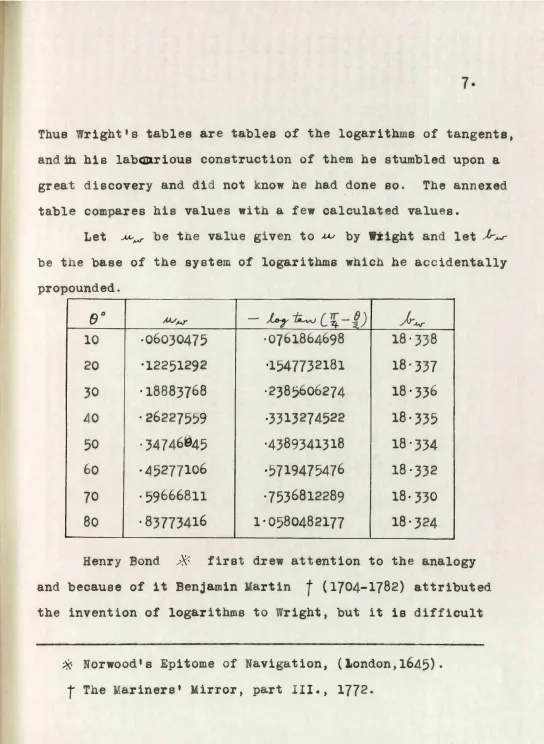
great discovery and did not know he had done so. The annexed table compares his values with a few calculated values.
Let be the value given to ^ by Wiight and let be the base of the system of logarithms which he accidentally propounded.
10 •06030475 0761864698 18 338
20 12251292 •1547732181 18 337
30 •18883768 •2385606274 18•336
40 • 26227559 •3313274522 18 335
50 •34746045 ■4389341318 18-334
60 •45277106 •5719475476 18-332
70 • 59666811 •7536812289 18^330
80 ■ 83773416 1 0580482177 1 8 3 2 4
Henry Bond ^ first drew attention to the analogy and because of it Benjamin Martin f (1704-I782) attributed the invention of logarithms to Wright, but it is difficult
[image:15.595.28.572.46.790.2]8.
to regard this claim as serious as Wright certainly did not use his tables for the multiplication and division of numbers.
Gregory was first led to the problem when he found
approximations to the hyperbolic asymptotic spaces by means of a series of inscribed and circumscribing polygons in the
“Vera Circuli*. He showed that these areas were analogous to a system of l o g a  t h w n s , in fact he found
He pursued this logatithenic thmory further in the “Exercitationes", and his reply to Mercator's challenge is a section headed, “N.Mercatorts c^uadrattttfh hyperbolae
geometricae demonstrate." His demonstration is as follows
-Let A OL/ c. 6 represent the curve ^
and let M, rV ^ etc. mark unit intervals, along Ox. between ^ and the origin O . To the first order of approximation, i.e., regarding AB as a straight line, oM M ^ ^ , etc. are congruent right angled triangles, the area of each being equal to à ^ (3|r S.
To the second order of approximation, the area is
à A fc:^:> - A-^ ,
and to the third order it is
i A - r h s i .
where A ^ A W ^ ... represent
r N M /\
O S
For the approximation of the second order let
eu + (tX. + <i X. .
L y A V
o
ouÀr- -+ C/
i -t- Cy
-+ 3 c
a c.
l eu +Aé,
Ar~ -/• '5' c.
A c
j (u + 3 ^ ■+’
^ + 7c.
A c
4 + /(o c
^
A c
10.
Therefore,
A ^ ^ Cx.— /J)
= Of}— cj) + o2c/x. Hence, by Gregory»s formula, the area is
^ h-c2c?cJ) — 7^ • “2c.
- ^ 3 -2,J).
Py modern methods, the area is
^ cu + /6^ -f ^ cu + /6'Cx,— + c
^ + § C Jx. — ^J.
For the approximation of the third order let
^ = CL. 4- Ircc 4- Q/xJ*" -h
-OC — /
X
r A y A V A - V
O ou
U /' *4- C. -t X/
/ ou- -t -6- 4- c. 4- ^
.6- + 3 c . + ^ d /
Q.C- -¥■ (odif
69 of/
2
3
4- 4
•4c-4-CU 4- 3 j r - + ^ c
U/' 3c
4-y6- 4- %C, +37tf(/
A c +
A c 4 of/
6) of/
(p<Jb
4- Ou 4"
/6- + -h 6/1 oO
Ac. 4 A4"^
Also,
A ^ L'K') = 0
- •+ C 3L /) -+ (^33C, ' 3PC. *+ l_).
Therefore, by Gregory*8 formula the area la ^
i A ftx3 -
]
- h ^ GxJ — ^ d/y-cb + + dy^Cb
= ^ A ^Cac^ — ^ ^ <3c + c h { ( o X , — 3 ^ ^ ^ lO 'T C tL i^ ' ^ C y ^ — lâ 'O -c b ^
= i - § C3pc-;i) + ^
By -Modern methods the area Is
^ X. 3 1
^ C U f y&X, -f o io e J ^ ) objC' (Ky -h X f ' C ^ ' - Q -f C y ( _ ^ - f ^ + C ^ ~ 0 J
JC-I
Now If the equal intervals ^ / V e t c . , represent
unit angle, and if the ordinates ... etc.,
represent the corresponding tangents, the area A M o^^ for example, is the logarithm of the secant of the angle
represented by A M j, thus
12.
Therefore these approximations may be used to calculation a system of logarithms. Also if the ordinates represented
the corresponding secants, the area for example ,
is the logarithm of the expression used by Wright, In fact it is a logarithmic tangent, because
=- C %
/-fj^ -x.
Gregory also in the “Exercitationes** gave geometrical methods of finding the series for
These had previously been discovered by Nicholas Mercator 2% There is a very interesting note on these series in Rigaud II. 240. This is taken from one of Collins*s “extracts" but apparently the original letter was addressed to Michael
Daafy. The Kote was first written by Gregory on the back of a letter from Collins of the 29th September,I67O. Neither this letter from Collins nor that to Daiy appear in Rigaud or the "Commercium Epistolicum". Daiy seems to have been
vu
a gapger in Bristol, for which position he was grateful to Collins, t Later Collins wrote to Sir John Frederick on DaZy's behalf, asking that the latter be appointed to teach " 40 boys arithmetic and navigation. " ^
X- Logarithffiotechtna, (London, 1668). I Rigaud, I. 99.
The note is called “An approach for the sum of the infinite series whereby the logarithms are made.“
“Let the penultimate term - p
the last term = ^ .
The sum of all the terms before the penultimate, oJ^
together with » 1® equal to the aggregate of
the whole infinite series almost, as for example, the aggregate of the whole series.
'’2^ + 2 ! ^ + + ...
c- 3c-^ Sc.^
is more than
. /yu
— "T"
- 3 + < + — ■
^ c. S 6» 3 C/^ 6/ /Mx
Gregory seems to have been aware that although a series may be convergent some converge so slowly as to be almost useless for practical purposes, and he finishes by remarking
that the character of the given series, “ changeth
exceedingly, according to the proportion of ^ to c. *. Also the given approximation is not of much value in the
beginning of the series, “albeit it is also true there, but about the 9th, 11th or 13th p o t e s t a ^ t is of considerable use.*
Consider the series 3 ^ i 'Vt^ 'Vv
7e.’ ■
A S' 7 4
'Vv 'H/ 'K/
T" — — "T" — ~r
14.
the given approximation is The sum of the series
~ h ---*5,
0 ^ - 2 + , approximately.
I.e., Writing ^ = x, ^
I — yc
— 3 \ .2.
O Æi-VA, 3
ivv/ — a, ~+
How if - 6 , the right hand side
; -
/
ff'-i
JC -I- — 4- % +
3C + + % +
THE DEVELOPMENT OF THE BINOMIAL THEOREM.
The triangular arrangement of the figurate numbers usually called the "fhscal Triangle", was known to mathe maticians long before "Pascal’s Traite das triangle
arithmétique," 1654* As far as can be ascertained from mathematical historians the earliest appearance is in the
•* /
works of Chu - Shi - Kie, whD is described as "the greatest of the Chinese Algebraists of his time," 1303.*-^ Its first appearance in Europe was on the title page of the "Arithmetic" of Apianus,1527 • Stifel (i486-1567)t~in the
"Arithmetica Integra", (Nuremberg,1^44) » (fol.44 et seq.,) indicated the coefficients in the expansion of (. /
provided those of were already known. He used
these expansions for the extraction of roots,and Caofdan (1501-1576) even dbtscribed the invention of the "triangle" to h i m . f
.)<( D.E.Smith, History of Mathematics,II,508. He quotes Y.Mikamni, The Development of Mathematics in China and Japan, (Leipzig,1913), 106
-j* W.W.Rouse Ball, A Short History of Mathematics ' (London,1908), and Charles Hutton, A Mathematical
1 6.
Tartaglia in hie treatise on numbers ,15!:)b, seems to have been acquainted with some of the properties of the triangle, and claimed its invention as his ownl Johann Scheub§à ^
{1494-1570), professor of mathematics at Tubingen, proceeded much further in his investigations, for he extracted roots as high as the 24th -j- by means of these b i n o m i a l
coefficients. Scheubnè is known to have been interested in Hindu algebra, and it is possible he was influenced by some approach to the matter made by a Hindu algebraist. Steyia(1548-1620) also extracted roots with the aid of the
"triangle"^ ^ but all these mathematicians u^^^-unable to find any given term of the table without first finding all the previous terms.
Pascal’s "Traité* was written in 1654, but was published posthumously in 1665. In it most of the properties of the
"triangle* are demonstrated,but his proofs are mere outlines and his verifications.are not valid for all values.
Smith, I. 239.
-y
17
The Pascal Triangle, as described in " Traite du triangle arithmétique."
Table P :
!o n
1 / 1 / / / / / / / /
3 4- s 6 7 9 /O
1 J lo lo !S 5 6 4 -5
/ !o o?0 36' 5 6 13.0
/ 5" 15 7o /^6
/ L> Jl! 5 6 /QL ^ 5 2
/ 7 Ù. !o
/ 36, /:)o
/ 9 4 6
-/ (0
/
1
S
9
/o
18.
This treatise was the means of Pascal and Per mat laying the
foundations of the calculus of probabilities, so for this reason - if for no other- it occupies an important position in the
development of mathematical thought. It commences with a description of the construction of the triangle and nineteen properties are then given, all these are demonstrated by
examples and not rigorously proved. The most important of f
these ”consequences” is that dealing with the calculation of any term. The examples given really involve the formula
-t
f " - ' - = ^ - 9 . ' ■ '■
where is the element in the ^ row and /ww ^
column. The expansions of are
found and verified by taking known values for A • Thus
^ = A ^ -t A " - f - ^ ^ I’
Let A = /.
Therefore,
Q - t i Ÿ A + t. /*- + 4-1 +1
=
which la known to be true. The expanalona 0 and { A are then given correctly and finally Pascal states
” Others have already diecueeed the subject.* Herlgogue is mentioned as one of these ^others*.
The b i n o m i a l expansion for a positive index is extensively used for the extraction of roots in Napier’s "De Arte Loglstica*. The method is carefully and fully explained by means of examples, although Napier does not explain how the “triangle" is formed. The triangular array is here called a " table of supplements", and contains the b i n o m i a l coefficients from I %o ^ ^ . The
"supplement" of a number is best explained by the following examples:
= Q o -f- = lo*' a. to. :l + .2"*
Hence the supplement of /%"*" is
to. a. + a * =
*» TABULA SUPPLH34ENTORUM. •
'fST
Table
/o /s
lo
3(o
/O
330
(a (o
Similarly
: ( / S L O + i ) ,
and the supplement of I is
120. :i -h -5^ =
Also, the supplement of is
3. /o"^. ^ -f J . /o. 4-^ = / 7 4-4^
Example 1. To find the square root of 55223*
2. 3
I
S S 2. 2. ^
0 # #
^ 3 ^
Counting the units* digit as^kero place", the digits are grouped in pairs. The first "pair" is 5 the nearest integral perfect square less than or equal to 5 is 4*, i.e. . 2 is thus the first digit of the square root. Subtracting 4 from 5 the next number to be considered is 152. The supplement is
^ . ^0.3 + 3"^ = 7^
this being the nearest number of the form
2 2
.
Subtracting 129 from 1^2 leaves 23 and so tixe next number e
to be considered is 2325. The procedure is repeated and the second supplement is
<330. 5 ”+ ~ •? 3 <2 ^ Hence the required square root is 235*
The reverse process perhaps explains the method -J 3S * = +
sy-- + ^ . A3 0.S + 5 *-= -2 3o23- +
“ (^00 "f" 3o^ *2.3-i$,\3
=
i-Ql.^OO.
So
-f 3 0 " ^ -f= ICro"^ -h lOV -f- ^ 3.2 5-.
Example 2. To find the c u b © root of 12977875*
8
I
o
4
/ a 7 7 9 7 -6“
. A •
^ 3
6-8
4 - / 6 7
^ /
o
&
y
s
the nearest perfect cube less than or equal to 12 is 8.,
i.e., ^ . After subtracting, the ne«t number to be considered is 4977* The supplement must be a number of the form
3 + 3 -h ^ 9 T y*
Hence the supplement is
3. 3 + 3 . .9 0. 3^ + 3"^ = ^ I Co J.
This is subtracted from 4977 leaving 810 and so the second supplement must be less than or equal to 8l0873*
i.e. 3. 5 + 3.-930. -h 3'^ = 9 / 0 9JS-.
Thus the required cube root is 235*
Hence, . 5 /
c53o'^ + (" J. ^ 30"^ 5- + 3. c23 0.
= 3 0 + 3. .200.3 0^ + 3o'^J +- S i o 9 j s
-- 9. loo^ ~h ^ / C> . /o^ ~f~ 9 1 cy ^ 3 .
-?4*
Ezamrle 3>
To find the fifth root of 812,990,017,201. The supplements will be of the form
S ' ^ -f to -f- (o aj’ -t- S ckÀ-^ +
and the digits must be grouped in fives.
I (o 7 4 7 6,
f 9
g I ^ o 0 / 7 . A O /
______ 4 ____________________ - f __________________i_
3 4
^ y ^ «2 6
«2-_______ / & 7 4 7 < ^ / 7 4 0 /
The first digit in the root is given by finding the nearest per-feet fifth power less than or equal to 01, i.e., 3 2. The first supplement is
jr. f- to.4 0"^. + / o . 4 o ^ '5’. 4^^ -+
4-= 4 , 6) j
this being the nearest number of the required form less than or equal to 4,929,900.
Similarly the second supplement is
5". .2/f.ot / + !o- - f to- J3^o^. ^H-o. I -t~ /
' Ifo , , (o n , ^ o ! .
Hence the required fifth root is 241.
Napier also dealt with "imperfect powers", and in so doing approached very closely to the decimal notation.
Example 4. To find the square root of I64860.
/ 8 C> G
(o
The calculation proceeds as before to the point of finding that 406 is the integral part of the root. Then
4o(o. d. / = .
Therefore, the required square root is 4
By the binomial theorem.
-4 o 4 +
S/4. ^oL> ^ .
-26.
L -2co y *^2cc+/
Example 5. To find the cube root of 9 9 8.
The integral part of the root is obviously 9, and 3. 9 ^ -f- ^ . -i- I^ =■ f.
Therefore, Napier states, the cube root lies between
•X-This seems to be based on the inequality
which is not true for all values of and .
However another method is given. If 998 is multiplied by 100 , its square root is multiplied by 100. Therefore first find the square root of 9,980,000. Proceeding as before the lower limit of the root is 9 7^ and the upper
limit 10. These results may be compared with those found by the first method, it is in fact curious that Napier made no such comparison.
’
)< J.E.A.Steggall: A Short Account of the treatise " De Arte Logistica", Napier Memorial Volume,
(Edinburgh,1915), 145 -j' Napier Memorial Volume,
First Result:
^*7
Second Result;
/O
oo.
Result by binomial theorem:
9' 99
From these few examples It is clear that Kapler was well acquainted with the manipulation of the binomial expansion for a positive integral index. Also, his decimal notation is practically that of the present time.
Other mathematicians also used the binomial expansion but only for the extraction of roots until the appearance of Schooten* s edition of Vieta's contributions to
mathematics. The expansions given by Vieta are of particular interest in a survey of Gregory's work, for the geometrical demonstrations were provided by Alexander Anderson, at that time the professor of mathematics at Paris. Vieta*s series
were evolved by considering the chord subtending an a n g l e C r r - n B }
28.
at the centre of a unit circle, where ^ ^ ^ ^
C
Let O be the centre of a unit circle, and let be an angle Aoe> at the centre of the circle subtended by an ar c 'vv/CL/.
If ^ o c is the diameter through /) , let the chord C/8 -Then,
How if ^ is written for
table gives the expressions for
when w = / A . 3 ..
-2.
O yfcx/
S'.
[image:36.597.25.571.49.793.2]Table A.
X-X/
The coefficients of therefore are given by the aiiày
-3
4- ^
5-
5-(o 9
7 %
• H - 7
30.
Again, consider a circle of radius ^ fiind centre O . Let A be any point on the circumference, and let the
arcs ^ (hc ^ — etc. be all equal to , such
that the chotd is unity and the chord A c ig cO.
the other chords, etc., must be expressed
in terms of cL.
I f angle A 0 6 = cj> , then
a.
3.
Also, <L 4
4 w 4
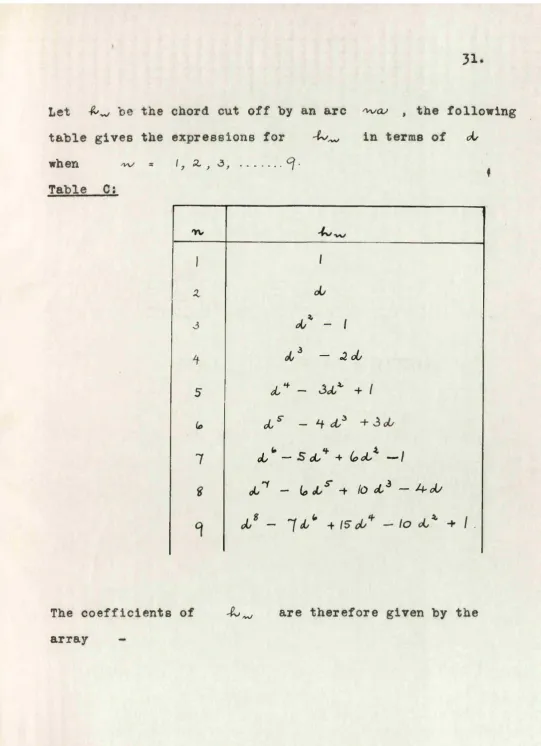
Let be the chord cut off by an arc , the following table gives the expressions for in terms of cir
when
Table C;
a ,
TV
o2 C?6
Jif — ’ (jU 4" 6? dy — I
— la ■+ lo cL^ — U- cO
The coefficients of array
[image:39.595.26.568.48.795.2]32
I
Table D: I
1 z
I 3 /
1 4- 3
1 5 (o I
I fo 10 4
1 7 IS lo
Table D le a "strained" version of Table P. the columns being identical, but those of D commence two rows lower than in P.
. fiL
Suppose the element of P. in the row has dropped to the row in D . , then
/Cf — X/ "h o2 ^ ^ ^ y Kÿi
where the element considered is in the ^ column.
Therefore if ^ Is an element of D. in the ^ row,
f
C ' ^ - f ^ 0
C ^ O
-There are thus two sets of coefficient^ given by
and and the connection may be shown most simply by means of a determinant, o Let the determinant of the
order,
X I o o I
I X I O o
0 I X / o
O O I X O
... X I
1 O 0 O I X
be represented by . It is such that the sum of the elements in each row and each column is (.x-fA), the principal diagonal being composed of x ’s, and the element in the first row and
row being unity.
column and that in the first column and
3 4 .
Also, let another determinant of the ^ order be considered, where 4,^ is merely with zero in place of unity in the element of the first row and
column and that of the first column and row. Therefore,
^ c ~ 3
- C ^ - t <3')( CL ^ — CU^ 3
and therefore, ...
*2h-H
Also,
" Cx.^— 43
&
and therefore, = C ^ ^ — 4) cl ^
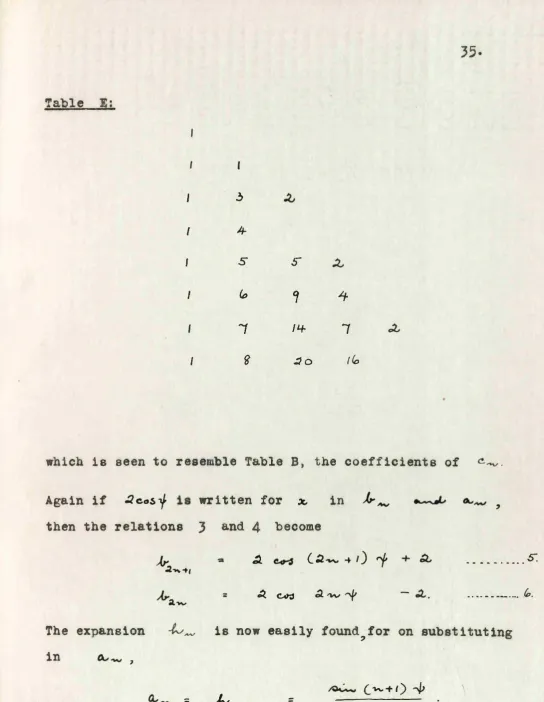
-Table E:
/ 3
(
4-/ 5" r
/ (p 9 4
/ 1 IH- 7
/ 9 ^ o / &)
which l8 seen to resemble Table B, the coefficients of
Again if :?co5Y written for x in >6»^ ^
then the relations 3 &n(i 4 become
Xr - £l Cû-vn, 4 /3 'Y' ^ ^
^>v4(
^ c«ya A 'w ^ ~~ — (o.
S.'w^
The expansion is now easily found^for on substituting
in ,
r ^ 4 A ^ \
[image:43.595.26.571.54.757.2]36
Therefore,
Similarly,
^_l >^,-3
‘ ~ “I/— -.i. 1/ — i,i
. - 6i_-33c-rz±j ^
— H ) C '* ^ — C ^3 c À j ^ ~
3Î
I — 3_)^'vx'— ^ ^ — 5” '>v/ 6 __
^ "Ÿ
^ .)%'
Writing CI - t«3* "f »
^ ^ - '-<---- O C ^ - A )
"Ÿ 3 f
—|- 'w^ 'Vv — /) (^ >1-— A ) w. — 3 3 0-1.,-5T
*7
■^- E.W.Hobson, Trigonometry, (Cambridge,1$91) > >0, lOJ.
t
'K/
-f- O C ^ j g D iTYCèl
But c.^ is an expansion In powers of cosines, and
consequently, and together form the
binomial expansion of
c c . s r ,
where
C
h andS
=
^
, and the coefficientsin the expansion are alternately positive and negative; or as would be written in a modern text book^—
= /%
C
-i- i
'
f
'
3 ,
The above is based on Vieta*s work and on Briggs, " Trigonométrie Brittanica ", (Gondae,I633), 12-52. Briggs gives the following *abacus", which is of course the table of binomial coefficients.
"Abacus IT ài y f/o ^
38,
H 4 F 6 J> c 6 4
- g - 7 U> - 4 -3 at /
/ i 1 / I 1 1 1
9 g 1 û> 5~ 4 3 A
3 (c â. / /S' to 6 3
^-4 56. 3>S- to 4
/A6, n o 3S- Is s~
la, (e> SÙ, at Q>
8h -2 g' 7
%
binomial are highly interesting. Thus
-Any one of the diagonal numbers is in proportion to the next higher in the diagonal as the vertical of the former is to the marginal of the latter. For example, take 7 0 in column D. of the "Abacus",
-70 S' Uppermost number of D .
^ Marginal Number of line 4*
Therefore if the coefficients of Cx.~h^} are required the first column /\ gives the coefficient of the second term
-Hence ^
«3,
3rd Coefficient “ o^-/
Therefore, 3^^ Coefficient - ^^ 427 7.!^
I . A
Similarly, 4th Coefficient
and so on.
I ■ s.. 3,
It is surprising that there are no references to Briggs in Vieta*s work, although there was an interval of thirteen years between the two publications. Briggs later complained ^ that Vlacq had deliberately omitted part of his work on
figurâte numbers from the second, and later, editions of the
40.
" Arithmetica Logarithm lea ** a fact which Is of fundamental Importance when the contribution of Gregory to the subject Is considered.
The method used by Gregory for demonstrating the
mathematical slgnlfIceuice of Wright * a tables and outlined In ^ ^ , Is really what Is now called Simpson’s Rule for
approximate Integration, but his expressions for the area are not correct In the general curve.f Gregory seems to have realized this and afterwards found the area under a curve by expanding as a power series and Integrating term by term, Thus he was familiar with the general binomial expansion which he sent to Collins In a letter of the 23rd November,1670. The question that at once arises Is ; Had Gregory heard of Newton’s discovery by this time? or, Was Gregory acquainted with the work of Briggs on the binomial theorem? Newton did not publish his discovery until his letter to Oldenburg of the 13th June 1676, the latter which was then sent on to Lelbrl&z. Also the only Newtonian results Gregory had seen by the end of 167O were the series for the zones of a circle. Briggs himself stated that his work on flgurate numbers had been omitted by Vlacq from the second and subsequent editions of the "Arlthmetlca Logarlthmloa” and It was the second edition only of the work.
It Is given In the first edition - (London,I624),24-3 2* I HelnVlch, Blbllotheca Mathematica, (19OO), I.90-9 2.
that was in the univereity library at St. Andrews. Gregory was not a wealthy man and the first edition was a rare and valuable book that he certainly did not buy. Consequently it seems that his discovery was independent of either Briggs or Newton, and its very nature is characteristic of his work at the time for it is through the medium of logarithms that he approached it. Although he starts by saying that the series ** may have some affinity with those of Newton,** he is referring to those that Collins had already sent to him. Suppose -(r is a number whose logarithm is , and + is the logarithm of -t . It is required to find the number whose logarithm is ( c +
Consider a power series in ^ '
Ï .
and also the series
o_ — A
T 9 ---
---Then ^
-f-(K>-'3c,
-h CL C • c
-h Ouc
{
- «-J+
UL
f -ft ) M
Therefore ^
#
42
and it is given by the series
4- ... :;y;'
c . ^ C. 3c^.
?.
The binomial coefficients also appear in an interpolation formula given in the letter.
If j- C^) is a function such that f C^) and the
successive differences ^ ^ f ^ , e t c . ,
are known, then
4- 6 ^ - C ^ ~ ^-- C 3C — ^ ^ 3
--L <oe^. 3A,
+ . /o.
This is usually called the Newton-Gregory Interpolation Formula, and it is often used in the form
= :fCo) + ^ A f w +
4 PC (x. - Cx> ^ Co)
Gregory gave an example of the use of and one of the application of 10.
It is required to find the 364 geometric means between 100 and 106. Writing
^ « loo y JL - (e> y I ^
in 9 j the expansion is that of /oo
[i-(-Hutton calculated this expression to 59 places of decimals,
giving • o 15^ (953 ^ S ....
It is required to find -53 '^. Writing * /O^ X- = ^ 3 y ^ =• ^ y
in 10,y the difference table is
A
lo
a. 3
15^
^ C>
A a 5-0
^ s o
:io^
7
as-3 0 0 0
' I S O
/1 3 7 5
-3 7 5" o
Therefore,
44.
c23“^ - ^ 3y s -f ^3 ^j^s-o
'3. g. 3
S'.lo. I S
S'. lO
'^Sa
looo -h C^l^S' -h *^6»8-o -h 3/Ji.
fCL
4. THE EXPANSION OF c** -^6 c^db .
The letter of the 23rd November
Ibyo
contains many interesting results but is dismissed in a few lines in the Commercium Epistollcum (23). The original letter is to be found in the R .3.Coll., only extracts from it being given by Rigaud. After the various results in the extracts have beenoutlined a comparison will be made of the two versions.
Gibson gives a fairly full account but omits what is probably the most interesting result that Gregory ever formulated. This has been fully dealt with by Professor Turnbull. X'
Gibson has suggested that Gregory was familiar with the work of Vieta and Anderson that has been given in ^ 3
but Professor Turnbull has shown that Gregory found the series for c<rô and through his knowledge of of interpolation formulae.
46
y
Let O be the centre of a circle of radius and let two arcs of the circle X A and X 6 be considered where X A is less than a quadrant X y ^ and X 6 is greater than the quadrant. Let arc A y = arc y (h ~ ^ , 2>y =
Suppose there are two series of continued proportionals,
Ay.
- - at/'
/.
A y ^ ^ ^
also suppose there are two other series
3 >
6L — ' ! • »L.. / A . oa, 9 3 .4-. <1/
Ox ^ — - (L/C. '— 3. 4"- c. ^ 7
4-. 6".
— O/C/ — ' .2 3 c g- . c,^
/f
I
I
^ "C. <£ -?
the first term, the product of the first two terras, the
Let ^ 7 ^ ^ } ... denote respectively
product of the first three terms, etc. of series J and
r Ç ^
e. ^ ^ "ë, ; denote respectively the product of the first two terms, of the first three terras, etc. of series 4 . Then the sine of the arc which exceeds the quadrant by an amount Av
g — . <3 o-c. + ajt> _ S ' -/• "4‘S-e^
^ c,
“t* _ — *•
-■"■■-The above is translated freely from Gregory's Latin, and the following explanation follows the suggestions made by Gibson and Turnbull.
Let ^ A o y « ^<j)^&nd ^ y o S = oC . \
A l s o , - JP y = ^ I — ^ ^ ^ ^ ^ j
and, ^ j Ar .
Substituting in the terms of series S~
\
% r ( ^ - < o . & 7
[ -2*. c**
J e c + _ r ^Oc CCk.-'C/) g, . *2.0
" L 3 ! J
48.
Similarly,
‘ % T • 9g-*) ,
-f c.
f /C»/uc-*'
»; c.^
CL.‘-[<K.‘^~ C.^) [o-~ 4-C,^)0^''- ^C-’-JO^"- /^C-0
!o\
Thus, replacing the terms in series 5" and dividing
/3c-wi->
by
Ç + oC 1:2, y 1 _ _
1
A! c.
(
f - B ^ Ÿi z:j
4-!
L ^ V
— cx' ' )64.^ ^ V
6>î ^ > 7
4
-2!
4
-/o( c.'°
But ^ , and writing ^ for ~ ^ the series becomes,
Co^
(f> -
I —cf>^
"'H-L
— .—«2 • ^
_
4.)6!
Writing X for s ^ <j> the right hand side Is
I o v ^ t — O H- Q u o * ’ — ( V ^ K . — ^ ^ 0 ( *
I — ' JU + JO — — ---— ---r X.
«2! 4^!
-+ ...
A similar series is given for the sine of an arc subtending an angle ^ <9 at the centre of the circle.
Let ffCy ■= i>~ s (9 ^ o5 — o — c? ^ y
hence ^ " ^Xy. A, ^ ^ .
Let two series be taken
-and
y — O ^ ^ <:X^ — 4 O ^ CO ^ ^ Cy^ ^ a. 3 c,=^ 4-.S’. o*- . y i c ^
CO^— cx**'— ^ 5-0^
y . o*" /o. II.
— ^ AC- -C/ ''vtA/
Let ê ? c- c: ^ c: y .-.represent the prodiict
^ Gregory writes ^ but this is probably a slip and ^
50.
of the first two terms, of the first three terms, etc. of the series
fo-Then ^ & a = ^ ^
^ ^ tV; cjiL <LoL^ C-c6^
Substituting the terms of /o in the right hand side of //
-■ =. A = ^ J. _ ^ o. + «,■*"
^ C.'^ <t‘*' 3 , ^ 3 SI 3/
Ou
7Î
Dividing throughout by L. sc^ 9 ^ and writing ^ L
(9 ^ 3! <1,
S'! cx
7/ c^.7
If ^ is written for % ^ and o? for 9 ^
^ r r _ _ ± r i = ^ _ - y Ç - ' - Q ^ q s ^ c^ Ÿ
/ O ^ o? (p 31
Ri3«,u«(,. jj_ . so(c.
When X. is written for ^ ^ the right hand
side of Z4- becomes
S-;
— ' W O C ^ — ^3 6
"9? ^
52
MENSURATION FORMULAE.
Gregory used the series & and of the last section to find formulae for the length of an arc of a circle and for the seml^clrcumference. Considering a circle of unit radius, e Is an arc such that
- d/ and e, — /— .
Series may be written
c 3 ! ^
-
H £ z O ( ^ ± ^ X i ^+
..
/7'
Now let 5 ’*be the sine of an arc which is to the arc c. in the ratio of 3 to -2 *;
, . J ,, _ I - S
/. t . I /UtLw — --- —
/0/cLv
[ i ' i ' ' ) ^ C Î ~ ^
-
Cf
-
Ip'-
9 7^
^
+ C ^ " - y ' + ^ ÿ { , f
12
.
- (iL. - !1± ' \ -jc,^s^
io. ^ ^ —
~h S ^ (p ^ jf^*^ — YS.OO-^^~jj~t
4 ...
a.
^ X*- ~ ^^3 ^ ... j/ ;
where ‘■1,^3., 6. ^ ... etc. are written for the
coefficients of % , etc.
<^ ’ et' ’ c U ^ ’
3[ C i i ~ r ) ^
lis'-± f -343 _ 4o3- ^ I )
s! i J ^ 71, ^ J
54.
c = -
i
-
/
+
£îM _ £7 ■
)
= _ .
7 ' ^oxj.2 4.44^0,
__ / £ i ^ _ ^
?! L tojiif.c> IOH.H- / % y /6
J _ J ? D , 3 3? _
^ ' IOJ.J+C) S ' f S ^ ^ o o
= -!- ( '"^4 '4.7 + 4, 74, f°3 ^ y g ^ / / . ' V /t,, 3t ? a , 0 4 g /fc
_
_
/, y ? 7,73.S-JijO-^g /se
j _ H , S ' o A ^ £?-£■
■ /C., 3 A ?
4 3 y -2 / V
/^ 6 //-A ^ 8o J^ a ^ o
Therefore substituting these values of c, c.^ ^ etc J, , i _ ^ . e ^ e4 + _ Z a ^
ecl ^ I2.S cL S^j, IS. 0 oL 3j ^H.o^(mi4-o oL
i"
e. + 4 g f? .t"* + -^4 A / 7
Gregory «rites this result in the form
^ _ Z5± 1_
y
/a sr
S^iQ.o cL 2»^ eC^+ ^ 4 3, a / Y
^ S , » - 7 5 , ^ o o
-K — '
The series in the demominator of does not agree
with that given by Gregory in all its terms. The discrept&ncies occur as follows:
-Gregory Calculation
7 9 /a 6 9
U t-ho 3, 44-0 j 6440
!> U B£>J, o ^ a L/ZA ^ S'© 7^ o ^ o
These are merely arithmetical errors and may be due to faulty copying by Collins.
A special case, viz., c ^ ^ is now considered
^ Ï .1^ =
---^ ' ir
56
Therefore, writing ^ k iR .
Semi-circumference of a circle of radius unity
L> — 'J I
•X*
1 - ^ -t- -f
2SC>0
g-Q,Oyl(oO
-f >/-g- ^
foOp C,AS_,^^0
4- ...
Other formulae are given for the length of an arc of a circle and for the semi-circumference. Again considering an arc c of a circle of unit radius, let
/it — I — CaKS C/ , ^ - I— d-tf-tf ^ Cy ^
e and o L being defined as before.
Therefore, ^ ^
/ — <L
® 9
— C-ATi ^ C
-Thus, integrating / term by term
-h [±L___ 4
Heno«,
a t
II
/4-4 c> S
l -h 1^1 er I^Oj<^CoO
^ ...f.
Before integrating a certain modification is
necessary, because e in this series is not the same as e in , ÿ 4 . If is written in 6 ., then
i
■
è
■
Thus the series ù> ^ § ^
-co^ ~
is
I - jtL
f iL Ÿ'
-2/ oC --- — --- L
-f
Thus integrating 5“ COri
term by term
- t % ---<— -» 19ro dj^
Therefore,
X' - % - V90 756— ^
c6^
To find the semi-circumference write c = -H and therefore .dz — o2.
é.
58-Also,
Si f Tr S'oww
-Hence, substituting in 6> ^ the semi-circumference of a circle of unit radius
_^ --- --- Y
~~ n ^ _L _ /
-3 -% 7 5 6 ■ " ■
Again in a circle of unit radius let be an arc such that
;t ^ xivCv, Cx and ^ = I— c.
Then
^ __________________________
* ” J J ± ± ^ — ....
^ fUS 64- 0^00
This formula may be explained by rather different treatment from that of the others.
Let =. —
H e n c e , À:> - ^ x. C f- ^ ^ o^^cL ^ .
Sufcetituting In ?
V - 7 T
X.
( - l i - _
^ M-S IQ>2 ù>H^9roo
But,
^ ^ !h x7 ^ '^'
oAI - 3C^ JS" a/5^
Thus there is, not complete agreement with G r e gory’s formula, but again the errors are merely arithmetical.