If not for profit,
for what and how?
Interuniversity Attraction Pole (IAP)
on Social Enterprise (SOCENT) 2012-2017
and
The Social Innovation Continuum:
Towards Addressing Definitional
Ambiguity
AnneAnne Anne
Anne DE BRUINDE BRUINDE BRUIN & Loren M. DE BRUIN& Loren M. & Loren M. & Loren M. STANGLSTANGLSTANGL STANGL
New Zealand Social Innovation and Entrepreneurship Research Centre Massey University
EMES-SOCENT Conference Selected Papers, no. LG13-68
Abstract Abstract Abstract Abstract
From a social problem-solution springboard, this paper develops a framework to capture the breadth and fluidity of social innovation within the contemporary landscape of innovation. The social innovation continuum advanced in the paper reconciles incremental, institutional and disruptive social innovations that vary in their scalability and impact. A novel notion of hybrid innovation extends the mainstream perspective of social innovation, to encompass science and technology innovations that are predominantly profit driven but can have an enormous impact on solving specific social problems of global significance. Consideration is also given to how associated social entrepreneur and entrepreneurship and social enterprise frames fit in relation to the social innovation continuum. The flexible yet robust continuum framework is recommended as a route to overcome current definitional ambiguity as well as for extending the concept of social innovation.
K KK
Keywordseywordseywordseywords:::: social innovation continuum, hybrid innovation, problem-solution, social value creation, social enterprise
1. INTRODUCTION
While the term social innovation is relatively new, its practice is not. The practice of individuals, partnerships and community groups working together in innovative ways to devise and implement resourceful solutions to complex social problems, has a long history (Philis, Deiglmeier, & Miller, 2008; Pol & Ville, 2009; Pulford, 2010). Coherent understanding of social innovation, however, is embryonic and scholarly enquiries of social innovation, though growing, are in their infancy (Howaldt & Schwarz, 2010; Mulgan, 2012b). Currently there is unsettled debate on the scope and boundaries of the concept of social innovation. This conceptual problem is summarized aptly by the observation that “‘social innovation’ is a term that almost everyone likes, but nobody is quite sure of what it means” (Pol & Ville, 2009, p. 881).Social innovation faces “two potential crises of definition” with interpretive challenges in relation to both terms ‘social’ and ‘innovation’ contributing to the lack of definitional consensus on social innovation (Nicholls & Murdock, 2012).
Nonetheless,scholarly study has progressed sufficiently to accept that the locus of social innovation is not only civil society. Social innovation can occur in the non-profit sector, the private or public sectors and intersect across sectors (Murray, Caulier-Grice, & Mulgan, 2010; Philis et al., 2008). The boundaries of social innovation are not fixed. Any attempt to address the definitional ambiguity of social innovation must therefore also encapsulate its diversity and range. This paper adopts a continuum approach to achieve this. It develops the ‘social innovation continuum’ as a robust conceptual framework to overcome the definitional haziness of social innovation and simultaneously capture its fluid boundaries.
Social innovation is multifaceted and a vital aspect of a new innovation paradigm (FORA, 2009). The call for recognition of a new ‘post-industrial innovation paradigm’ that includes social innovation as an integral facet, is gaining momentum (Howaldt & Schwarz, 2010). “In such a new paradigm, social innovations as well as technological and economic innovations could be integratively comprehended as components of social change in a ‘holistic’ interpretation of innovation” (Hochgerner, 2009, p. 40). Definitional reconciliation of the ambiguity of social innovation necessitates fit with a holistic perspective of innovation. Our paper aims to do this. Hence we develop a concept of ‘hybrid innovation’ to argue that innovation targeted at solving social problems and commercially driven science and technology innovation need not be mutually exclusive. The social innovation continuum framework can capture hybrid innovation as well as the variety of other forms of social innovation such as partnership driven initiatives targeting context-embedded problems at a local or regional level.
failures on social innovation. The penultimate section of the paper provides some empirical illustration of the different forms of social innovation along the continuum. The conclusion draws the threads together.
2. UNDERPINNING DEFINITION
An absence of definitional consensus is not unexpected given that social innovation is both an emerging field of study and is multidimensional and complex. There is a plethora of perspectives that seek to encapsulate the essence of social innovation. However typically, explicit or intrinsic in many definitions, is that social innovation aims to answer social problems and needs in new ways. For example Howaldt and Schwartz (2010, p. 21) claim, “A social innovation is a new combination and/or new configuration of social practices in certain areas of action or social contexts prompted by certain actors or constellations of actors in an intentional targeted manner with the goal of better satisfying or answering needs and problems than is possible on the basis of established practices.” There is an explicit social problem-solution focus in the definition of Phills et al. (2008, p. 36) who describe social innovation as “A novel solution to a social problem that is more effective, efficient, sustainable, or just than existing solutions and for which the value created accrues primarily to society as a whole rather than private individuals.” Similarly, the working definition of the LEED Forum on Social Innovations (OECD, 2000) emphasises that social innovation seeks new answers to social problems.
In the extant literature, social innovation definitions often link to process and outcome. Whereas Sharra and Nyssens (2010) observe that definitions fall into two complementary camps, with emphasis on either process or outcome, increasingly process and outcome are being combined in definitional offerings. For example, Nicholls and Murdock (2012, p. 7) neatly combine social process-outcome with different levels of analysis – micro, mezzo and macro, to illustrate the dimensions of social innovation. Process and outcome may, however, be re-phrased in terms of a problem-solution matrix. Hence, the means of dealing with social problems or needs is the process, while the outcome is the solution.
A social problem-solution underpinning lies at the core of socially innovative action and result. It has potential for reconciling varied forms of social innovation. Empirically too a problem-solution perspective is viable (Svensson & Bengtsson, 2010). We therefore adopt a problem-solution approach, which also encompasses the ‘tackling social needs’ perspective, as the foundation for building our definitional framework.
It is acknowledged that social innovation can have a ‘dark side’. Not all social innovations have positive outcomes or are used in a manner that enhances wellbeing (de Bruin, Shaw, & Chalmers, forthcoming; Nicholls & Murdock, 2012). As Nicholls and Murdock (2012, p. 5) emphasise, “Social innovation is not, in and of itself, a socially positive thing.” There could be detrimental social outcomes. For example, in the latter part of the twentieth century, with oil price hikes of the 1970s, interest in rural development and mounting climate change concerns, increased production of biofuels seemed to hold great promise. However, more lately, the negative consequences of biofuel production, in terms of increased deforestation, decreased availability of farming land and related undesirable environmental sustainability and food security side effects (Ajonovic, 2011; Inderwildi & King, 2009) has shown to outweigh social benefits (Borzaga & Bodini, 2012). Thus, solutions to social problems, in themselves, need not lead to positive net social benefits. Desirable social innovations improve the macro-quality of life (Pol & Ville, 2009). Hence, we draw attention to the positive net social benefit assumption that underlies our continuum framework specification.
individual welfare gains, a welfare gains focus provides a useful supplement to a social value creation angle. To build our definitional framework, we therefore assume that social problem and needs focused innovation, is social value creating and wellbeing enhancing, with positive net social benefits.
3. THE SOCIAL INNOVATION CONTINUUM
We adopt a continuum approach to capture the fluid boundaries and variability that characterises social innovation. Building on our problem-solution working definition, the essence of the continuum is that different forms of innovation along the continuum have a common outcome - that of advancing new, positive net social value creating solutions to social problems. Since solutions occur at various levels, the continuum notion provides the definitional flexibility needed to encompass the diversity of social innovations at different levels as well as capture the scalability and potential impact of these innovations on mitigation of intractable social problems and for enduring social change.
At this stage it is appropriate to clarify that the social innovation continuum framework we advance, does not utilise legal organisational and ownership structure classifications such as co-operatives, private companies, charitable foundations etc. This variable, as well as motivation factors e.g. private profit versus public gain, are superfluous to our argument. Our social problem-solution foundation allows us to do away with consideration of these variables. Their inclusion in definitional discussions of social innovation only serves to cause unnecessary confusion and ambiguity.
3.1. Scalability-Impact and Multilevel
In the literature, it not uncommon for definitional perspectives, to either explicitly or implicitly take a stance on the scale and impact of social innovations. Westley and Antadze (2010, p. 15) classify social innovation as “processes, products, and initiatives which profoundly challenge the system that created the problem that they seek to address” and thus associate social innovation with institutional and systemic change. By contrast, their complex systems view of social innovation regards responses “to locally perceived problems or social needs” as social “inventions” that become social innovations only rarely when these locally embedded solutions are scaled up to have a broader and lasting impact (Westley & Antadze, 2010, p.2). Conversely, Nicholls and Murdock (2012) are more inclusive in their approach and see social innovation occurring at multiple levels based on whether the innovative solution is focused towards addressing market failures (incremental), reconfiguring market structures (institutional) or altering social systems (disruptive).
The need for and ways to ‘scale up’ social innovations with potential for transformative social change, is a topic of increasing interest in the literature as well as in policy circles (Antadze & Westley, 2010; BEPA, 2011; Mulgan, Tucker, Ali, & Sanders, 2007; Schwab Foundation, 2013; Westley & Antadze, 2010). However, the magnitude and extent of scaling and impact issue from an overarching perspective of particular solutions per se, has received little attention. To illustrate this point, we return to the biofuel example discussed earlier. Conceptually biofuels represent an alternative clean energy solution. However, it is the scale of biofuel crops necessary to make a meaningful impact on the mitigation of greenhouse gases that creates additional social problems. “Food-based biofuels, the so-called first-generation biofuels, can only ever provide a fraction of the fuel required to meet demand and is clearly detrimental to the need to complement the world’s food demands” (Inderwildi & King, 2009, p. 344). According to the United States Department of Energy Status Report (2006), a transfer of 100% of the county’s maize grain production to the production of ethanol would only supply 15% of the country’s transport fuel needs. Thus, the negative externalities that arise from scaling biofuel crops constrict their impact as a viable solution to global energy problems.
“Some definitions exclude minor or small innovations from consideration, whereas others distinguish between incremental and radical innovations. We do not specify the magnitude of the improvement as part of our definition. Our view is that such judgments are highly subjective and that it is better to treat magnitude as falling within a continuous range of values.”
In fact, our continuum perspective can recognise and convey the important role social innovations play in creating solutions to specific localised problems despite remaining less scalable to other contexts. By the same token, the continuum also allows for localised social innovations that can have lessons for scalability to other contexts, as illustrated by small scale local associations that have the potential to shape and facilitate community based climate change adaptations in developing countries (Rodima-Taylor, 2012).
The essence of a problem-solution approach to social innovation revolves around the potential impact of the solution or its ability to be scaled from a local to a global level. Turning the lens on the scalability and impact of the solution also enables a better grasp of the processes that underlie the dynamics of social innovation. A continuum approach to social innovation is a robust framework that can highlight on the one hand that social innovation can occur at the local level and on the other hand that the scaling of solutions is fundamental to transformative social change. The nature of solutions to problems lies at the core of the social innovation continuum. Thus the scalability of the solutions and to what extent they mitigate intractable problems allows for the momentum along the continuum. Scaling of solutions creates the momentum between incremental product-focused or local needs focused collaborative social innovations, and systems-focused disruptive social innovation.
3.2. Social Entrepreneurs, Social Enterprise and Social Innovation
There is a ground swell of awareness and growing research and literature on the importance of social entrepreneurs and social enterprise and their connection to social innovation. Leadbeater (1997, p.8) go so far as to claim that:
“Social entrepreneurs will be one of the most important sources of innovation. Social entrepreneurs identify under-utilised resources – people, buildings, equipment – and find ways of putting them to use to satisfy unmet social (and community needs). They innovate new welfare services and new ways of delivering existing services. Social entrepreneurs who deploy entrepreneurial skills for social ends are at work in parts of the traditional public sector, some large private sector corporations and at the most innovative edge of the voluntary sector.”
Mair and Marti (2006, p. 37) too point out that social entrepreneurs “catalyze social change”. In similar vein Bill Drayton, founder of Ashoka draws attention to transformational change that social entrepreneurs bring about in his popularly quoted statement: “social entrepreneurs are not just content to give a fish or teach how to fish. They will not rest until they have revolutionalized the fishing industry”(Drayton, 2004). From an overarching perspective Kirkman (2012, p. 14) views the social enterprise as a social innovation in its own right, a new solution for existing non-profit organisations’ financial and organisational problems, and a “new way of doing things in the non-profit arena.” Given this discourse therefore, it would be a serious omission if any attempt at reconciling definitional ambiguity of social innovation, did not discuss how social enterprise and entrepreneurship fits in with the proposed framework.
“entrepreneurial discovery is as much about problem finding as problem solving”, Zahra et al. (2009, p. 522) argue that different types of social entrepreneurs are motivated to target solutions to different levels of social problems. According to Zahra et al. (2009), contextually embedded social problems are targeted by the social bricoleur (based on Hayek, 1945) whose local knowledge and capacity to improvise creates innovative solutions. However scalability is often difficult. The social constructionist (based on Kirzner, 1973), identifies opportunities at the intersection or private, public and civil society and designs alternative structures with greater potential for scalability. The social engineer (based on Schumpeter, 1942) targets systemic problems at a global scale. Effectively, each type of social entrepreneur targets a different level of social innovation, which is associated with issues regarding the scalability of the solution. As such, innovative solutions of social entrepreneurs and social enterprises can easily be classified within the social innovation continuum according to the nature and scalability of the innovation. Barraket and Furneaux (2012, p.218) detect “To date, the social innovation produced by social enterprise has been largely presumed rather than empirically demonstrated”. Detailed empirical study by researchers of innovation of social enterprises will therefore facilitate the positioning and classification of this innovation in relation to the continuum.
3.3. Hybrid Innovation
‘Hybrid’ terminology in related literature has hitherto been commonly associated with a blending of goals. Thus in social entrepreneurship literature, ‘hybrid ventures’ are those that pursue both economic and social goals (cf. Neck, Brush, & Allen, 2009). The notion of hybrid innovation we put forward is very distinct from such a specification and is not meant to denote innovation of social enterprises. The term ‘hybrid innovations’ has also been used to describe social welfare innovation associated with a sector mix. Nicholls & Murdock (2012, p. 10) draw attention to this: "Between the private and public sector ideal types are hybrid innovations such as the public-private partnerships mentioned above that provide new models of welfare provisions outside of, but often in tandem with, the state (citing, Bovaird, 2006; Osborne, 2010)." Our specification is different from these notions of hybridity.
Our notion of hybrid innovation is designed to explain why innovation targeted at solving social problems and commercially driven science and technology innovation need not be mutually exclusive. Kanter (1999, p. 123) drew attention to ‘corporate social innovation’ where “(T)ackling social sector problems forces companies to stretch their capabilities to produce innovations that have business as well as community payoffs.” Our hybrid innovating businesses too are targeting solutions to social problems even if they do not have an explicit social mission and are predominantly profit oriented. A convergence in the outcome of commercially driven innovation with that of other forms of social innovation lies at the core of hybrid innovation. Embracing the hybrid innovation concept broadens the scope of social innovation. For us hybrid innovations create economic value but also social value by providing solutions to social problems. This resonates with concept of creating ‘shared value’ of Porter and Kramer (2011). They argue that society can no long consider social and economic goals as polar opposites. Future global growth is dependent on creating economic value though creating social value by addressing societal needs and challenges and not merely focusing on profit.
In innovation studies literature, the term ‘hybrid innovation’ is most commonly associated with innovation developing at the nexus of commercially oriented firms and user communities (Harhoff & Mayrhofer, 2007). Users play an increasingly important role in developing innovations (von Hippel, 2005) and include both public and private stakeholders. Our view of hybrid innovation does not exclude such interaction but simply adds the caveat that it should be working toward innovation that constitutes a solution to a social problem.
answering this question, we make a normative judgment in light of not wanting to broaden the notion of social innovation so much as it becomes meaningless. Although the continuum framework is intended to be a flexible means for addressing definitional haziness and extension to better reflect the contemporary landscape of innovation, we do not want the concept of social innovation to be so flexible that it loses its usefulness and runs the risk of including everything (Pol & Ville, 2009). Hence the judgment call we make is to overlay our specification of hybrid innovation with a consideration of scalability of the solution and potential impact on a ‘big’ or ‘wicked’ social problem. Mulgan, et al. (2007, p.45) discusses this link between scale, impact and commercial entities,
“However, whilst social innovation certainly occurs through social enterprise and social entrepreneurship it also happens in many other contexts. Conversely, although social entrepreneurship often involves innovation, only a small minority of social entrepreneurs create new models that can then be scaled up, and that process of scaling up often involves governments and larger businesses.”
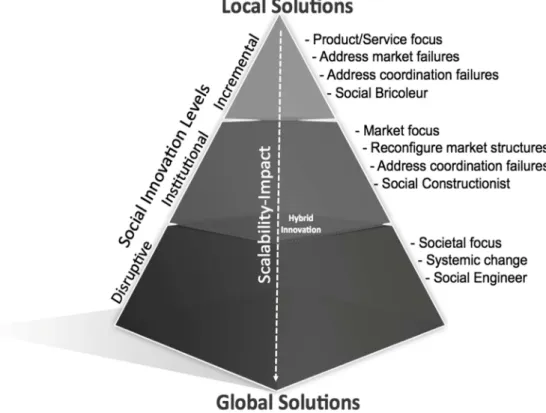
We consider the potential of innovation for mitigating a social problem on an impactful scale, as a rationale for inclusion of commercially driven innovation within social innovation. Inserting an ‘of significant scale/impact’ stipulation for hybrid innovation, we believe deals with the issue of ‘anything goes’ and possible allegations that all innovation might be classified as social innovation. Figure 1 presents a stylised portrayal of the social innovation continuum as an integrative framework representing a range of social innovations with varied foci, across various levels, in response to different stimuli. These social innovations are all reconciled via a convergence of outcome, namely solution to a social problem within a crosscutting theme in terms of the scalability and impact of the solution. It also places social entrepreneur types of Zahra et al. (2009) within the continuum. Our specification of hybrid innovation, by definition, falls towards the high scalability end of the continuum. Scalability and impact usually necessitates multi-sector collaboration. We discuss the multi-sector imperative of social innovation in the following section.
Figure 1: The Soc Figure 1: The Soc Figure 1: The Soc
3.4. Multi-Sector Collaboration
Social innovation blurs the boundaries between the public sector, the private sector, and civil society and often emerges at the intersection of sectors (Phills et al. 2008, Nicholls & Murdock, 2012). BEPA (2011, p.34l) stress that social innovation “is about developing innovative solutions and new forms of organisation and interactions to tackle social issues”. Thus, collaboration is an underlying ethic of social innovation. Social innovation can therefore address social needs not only through new ideas but also through creation of new collaborations, which benefit society by enhancing the ‘capacity to act’ (Mulgan, 2012a, p. 22)
However, the concept of blurring sector boundaries encapsulates more than just new forms of collaboration. The process of developing social innovation, like other forms of innovation, is not linear but rather an interactive process. In social innovation, this adaptive process may involve fluid interplay between the sectors. Mulgan et al. (2007, p.27) describe this process in terms of the Young Foundation:
“Many of the innovations associated with the Young Foundation ended up in a different sector from where they had started: not for profit ideas ended up as for-profit firms; public agencies ended up as charities, charities ended up as government agencies. These provide strong arguments against any support for innovation that is too prescriptive too early about the best organisational form of a new idea.”
Indeed, Mulgan (2012a, p.22) argues that social innovation, “…does not of itself imply any view as to whether particular functions or services are best provided by public, private or non-profit organisations”. Kania and Kramer (2011) contend that solutions to complex social problems originate at the nexus of public and private activities and thus can only be solved by cross-sector collaborations including these very organisations.
An additional factor influencing the multi-sector collaborative nature of social innovation is the growing opportunities for private organisations to see global challenges as opportunities driving innovation. According to the New Nature of Innovation report, “The private/public demarcation line is becoming increasingly blurred and is being challenged by a myriad of companies, in particular leading global companies. They find new business opportunities by designing solutions to problems caused by mankind’s behaviour” (FORA, 2009, p.11).
The importance of multi-sector collaboration in creating social innovation further supports our inclusion of hybrid innovation in the social innovation continuum. Social innovation that has the potential to create large-scale social change occurs at the inter-play of civil society, public and private sectors (Kania & Kramer, 2011). The multitude of agents that need to effectively engage in solving social problems, especially where social innovations emanate at the intersection of sectors, can pose a coordination challenges. We therefore introduce the notion of coordination failures in the next section.
3.5. Coordination Failures
challenge: “the problem of hundreds of people, scattered in a dense, foggy forest, trying to locate one another”. He asserts, however, that government intervention is not the ideal way to address coordination problems. Other literature too draws attention to pitfalls in government attempts to address coordination problems e.g. Beaulier and Subrick (2006). Nevertheless addressing coordination failures is crucial when many interdependent actors with disparate logics across the public, private and civil society sectors, need to band together to mitigate complex social problems. Ways to promote coordination of collective action to build solutions to social problems is undoubtedly an important consideration in the context of social innovation. We provide examples of coordination attempts at the local and global levels in the following section.
4. THE SOCIAL INNOVATION CONTINUUM: ILLUSTRATION
In order to elaborate on various forms of social innovation in relation to the continuum, this section provides a small sample of innovations at the three levels distinguished in Figure 1 – incremental, institutional and disruptive social innovation, coupled with their local or global focus. We also highlight the scalability and potential impact of the solutions to social problems, the role that multi-sector collaborations often play in the development of social innovation. We also interrogate the typologies of social entrepreneurship represented in our sample.
4.1. Incremental Social Innovation-Local Focus
Typically wicked global problems have a local dimension that requires national, local, and community specific solutions. For example, youth employment is a societal challenge. Youth disengagement with work and education is a widespread problem that demands innovative solutions. Globally, youth unemployment is high and is climbing rapidly. Youth (15-24 years) unemployment, underemployment and disengagement from both formal learning and work, can be detrimental not only to the future wellbeing outcomes of the youth themselves but also for social cohesion. However, addressing the youth employment challenge often requires innovative context specific solutions. We use the New Zealand context of youth employment to highlight this. New Zealand too faces a grave and complex youth employment challenge. The youth unemployment rate of 16.8% is considerably higher than the overall unemployment rate of 6.6% in the year to June 2012 and ethnic differentials in youth unemployment and NEET (Not in Education, Employment or Training) are pronounced, with Māori and Pasifika youth particularly labour market disadvantaged (New Zealand Human Rights Commission, 2012). New Zealand’s largest city, Auckland, has high proportions of youth, especially Māori and Pasifika young people. Failure to address the youth employment challenge means Auckland will lose this valuable demographic dividend.
The development of new ways of working together and coordination and alignment of initiatives and partnerships that can move swiftly towards a common purpose are often crucial to mitigating wicked problems, and in themselves can be a form of social innovation. Governance arrangements that catalyse and coordinate local partnership driven solutions to regional disadvantage and other such context specific solutions to local community based social problems illustrates the enactment of incremental social innovation. New governance arrangements like that of the Southern Initiative for example, are necessary to deal with the coordination problem but being idiosyncratic to the cultural, demographic, institutional and spatial circumstances of the region, are less scalable to other contexts. These arrangements, as well as many of the interconnected initiatives that provide innovative micro-level solutions within broader initiatives are therefore compatible with the local micro-level end of our social innovation continuum.
The newly (late 2012) appointed CEO of the Southern Initiative whilst not a founder of a social venture per se, might be interpreted as a candidate for the label ‘social bricoleur’ (Zahra et al. 2009) in that he would need to catalyse and coordinate the evolving collaborations to progress the Initiative, whilst also ensuring participatory and empowering processes. Nevertheless as Schumpeter, pointed out when he updated his earlier theory of the entrepreneur in the 1940s, the ‘entrepreneurial function need not be embodied in a physical person and, in particular, in a single physical person. Every social environment has its own way of filling the entrepreneurial function’ (Schumpeter, cited in Swedberg, 1991, p. 173). As such we would suggest that rather than a single person, the bricoleur social entrepreneur function is likely to be embodied in several local leaders, directly engaged in ‘making things happen’ and providing innovative solutions to mitigate social disadvantage and advance the Southern Initiative. In similar vein, Goldsmith’s concept of a ‘civic entrepreneur’ is an appealing one with which to label social entrepreneurs who catalyse and scale social innovation through their ability to build partnerships and navigate the choppy seas of bureaucracy. They can be public servants or elected officials, venture capitalists, philanthropists, faith-based providers, engaged citizens or business leaders promoting new notions of corporate social responsibility. Hence, ‘Civic entrepreneurship represents both the spirit of change and the spirit of community’– something that entrepreneurial communities resolute on enhancing quality of life must foster (Goldsmith, Georges, & Burke, 2010, p. 6).
4.2. Institutional Social Innovation-Global Focus
Social innovation which attempts to retool or reconfigure existing social or economic structures, often by repositioning new technology to ‘social’ rather than purely ‘economic’ needs can be considered institutional social innovation (Nicholls & Murdock, 2012). Social, from this standpoint, can be considered a value creation opportunity rather than a constraint with innovation aimed at tackling societal challenges (Bonifacio, forthcoming). In this section we illustrate three examples of institutional social innovation. The first, Medical Patent Pooling (MMP) discusses a use of novel business model inspired means to harness profit driven transformative technological developments to achieve scale to solve serious social problems. Second, Medicine Mondiale has created the institutional means to effectively coordinate a global network of experts to develop medical solutions to make health care more accessible. The third, LanzaTech Ltd, tackles existing institutional structures across industries and countries on the use and reuse of carbon to change resource perceptions.
However, use of these arrangements to overcome monopoly high prices, to develop generic, better adapted, low price medicines in order to increase the accessibility of the poor to treatment, is a new non-standard use. For example, The Medicines Patent Pool (MPP), founded in 2010 is a United Nations supported initiative made possible through the World Health Organization (WHO) based financing mechanism UNITAID. MPP aims for promote affordable HIV treatment in developing countries (www.medicinespatentpool.org/). It sits within a pyramid of global partnerships. UNITAID was initially an agreement with the governments of Brazil, Chile, France, Norway and the United Kingdom, to provide additional funding for the fight against HIV/AIDS, malaria and tuberculosis. UNITAID is currently funded by a levy on airline tickets by several countries and the Bill and Melinda Gates Foundation. In turn, UNITAID is implemented through a host of initiatives including MPP, projects of philanthropic organisations like the Clinton Health Access Initiative, and the United Nations Children’s Fund. MPP therefore illustrates the emergence of a growing number of global partnership based social innovations that aim to reconfigure market structures on how medicine is distributed to the most needy.
Like the MPP, Medicine Mondiale too is a pooling mechanism that aims for a similar outcome of affordable healthcare. Medicine Mondiale is a social enterprise that deals to the coordination failure problem of the market by providing an effective means by which experts can pool their donated knowledge and time to develop medical solutions that are affordable and suitable for use in developing countries. Medicine Mondiale manages a global network of scientific, clinical and business experts that come together to improve access to quality health care at a global level. The pooling of expertise has enabled the development of several cutting edge technology solutions for medical needs. For example, Medicine Mondiale’s Liferaft Infant Incubator radically departs from the standard design of the high cost infant incubator used in the developed countries. Not only is the Liferaft incubator much lower cost but it is low maintenance because it has eliminated the need for air filters used in traditional incubators to filter out bacteria and which need replacement every two months. The new Medicine Mondiale incubator is effectively maintenance free, robust infant incubator (see http://www.medicinemondiale.org/).
New Zealander Sir Ray Avery is the founder and CEO of Medicine Mondiale. He is a social entrepreneur par excellence and fits the ‘Social Constructionist’ social entrepreneur type of Zahra et al. (2009). Avery established Medicine Mondiale in 2003. He is the recipient of several prestigious awards including a knighthood when he was made Knight Grand Companion of the New Zealand Order of Merit in the 2011 New Year honors list for services to philanthropy. He is an inspirational entrepreneur and social innovator, as well as an advocate of improving the quality and standard of healthcare in the developing world. Medicine Mondiale now promotes and coordinates the Ethical Science Group, an independent group of experts and student volunteers, who evaluate the quality standards and efficacy of healthcare initiatives in the developing world. The research of the Ethical Science Group is disseminated in Medical Journals and through NGOs and the international media. LanzaTech Ltd, a New Zealand clean energy company, presents a slightly different form of institutional social innovation from MMP and Medicine Mondiale. Like the previous two examples, LanzaTech is creating solutions to global problems, which require a reconfiguration of existing market structures, i.e., institutional social innovation. However, unlike MMP and Medicine Mondiale, LanzaTech’s solution does not emerge from pooling diverse resources and overcoming coordination failures. Rather, LanzaTech is providing a technical solution that requires coalitions of cross-sector advocates for implementation. In doing so, LanzaTech exemplifies hybrid innovation as a driving institutional social innovation tackling energy and climate change challenges.
Globally the need to reduce greenhouse emissions and reduce dependency of petroleum is of paramount concern. Demand for petroleum is expected to double in the next 40 years. According to the International Energy Agency (IEA) the world is not on track to reduce global greenhouse emissions and in face, carbon-dioxide (CO2) levels increased by 1.4% in 2012, a historic high (IEA, 2013).
2015 (Bloomberg, 2013a) Although these efforts have reduced the growth or CO2 emissions, China
was still the single largest contributor towards CO2 emissions in 2012 (IEA, 2013). In January 2013
China recorded record pollution levels measuring almost 40 times higher than the World Health Organization guidelines (Bloomberg, 2013b). Social unrest in China over poor air conditions is now a major concern for the government, as is maintaining economic growth whilst reducing changing the energy consumption patterns. The European Union (EU) faces a similar problem. The EU’s 2008 ‘climate and energy package” mandates a 20% increase in energy efficiency by 2020 accompanied by a 20% reduction in CO2 emissions based on 1990 figures (da Graça Carvalho, Bonifacio, & Dechamps, 2011). According to da Garça Carvalho et al. (2011), success in adhering to these mandates can only be achieved through a reorganisation of society within the 27 EU member states in order to adopt a unified ‘social vision’. These authors contend the first challenge is for actors within the various sectors to view the low carbon challenge as an opportunity rather than a constraint. Named in 2012 by the World Economic Forum as a potential ‘technology game-changer’, LanzaTech has developed a unique technology that uses a microbe to convert poisonous gas (rich in CO and CO2) into components to produce other fuels and platform chemicals. LanzaTech’s vision is “…to
meet the world’s growing energy needs, enabling sustainable industrial growth while at the same time ensuring that allallallall people across allallallall global economies have equal access to clean energy”
(www.lanzatech.com). However, to fulfill this vision, LanzaTech needs to change the perception of
‘value’ by the actors in each sector. Often this means presenting the solution in a way that creates value for the various sectors. In the case of steel production in China, LanzaTech collaborates with steel manufactures and demonstrates how waste gas can be converted to valuable energy resources. This in turn supports government and civil society efforts to reduce harmful CO2. LanzaTech is not just
targeting the steel industry. Rather they are attempting to change the way organisations think about energy and waste. Currently LanzaTech collaborates with actors from public, private and civil society sectors relating to the biofuel, aviation and forestry industries as well as manufactures of plastics, nylon and of course steel. Innovations like the LanzaTech process result in new, commercially viable products that simultaneously target social problems and needs. The outcome of their innovation is a solution to the social problems created by a lack of environmental sustainability. The essence of hybrid innovation therefore is convergence in the outcome of commercially driven innovation with that of other forms of social innovation, but with the solution having the ability to reach sufficient scale for considerable impact on the problem.
4.3. Disruptive Social Innovation--Global Focus
Disruptive social innovation targets systemic change at a global scale. This form of social innovation may range from organised social movements with formal membership to loose coalitions of actors united by a common purpose and passion (Nicholls & Murdock, 2012). It may involve entrepreneurs who identify systemic problems and propose transformational solutions - classified as social engineers (Zahra, et al, 2009). Muhammad Yunus, founder of the Grameen Bank is often portrayed as a social engineer creating disruptive social innovation and the microfinance movement is commonly given as an example of this type of social innovation. We consider Ankur Jain, and the Kairos Society, as another example.
The Kairos Society is a non-profit organisation established in 2007 by Ankur Jain when he was a student at Wharton School of Business, University of Pennsylvania. Jain’s inspiration came from possible answers to the question: “What if today’s most influential leaders were friends 30 years ago?” (www.kairossoicety.org). Jain established the society with the vision of uniting a generation of entrepreneurs who are passionate about solving global social problems.
This non-profit’s mission is: “to tackle our world’s biggest problems through entrepreneurship and innovation” (www.kairossoicety.org).
“We work to find and empower the young pioneers who will push the world forward through entrepreneurship and innovation - we do so with the support of the top universities, mentors, and corporations across the globe. At the Kairos Society, we view today’s global problems as opportunities for entrepreneurs to focus on the meaningful businesses and innovations that will radically change the world for the better. Not only for our generation, but for the generations to come.” (www.kairossociety.org)
The Kairos Society is aiming to be a powerful force for social change. For example, they recently partnered with Innovation for Green Advanced Transportation Excellence (i-GATE), a US-based public-private partnership designed to promote clean-energy technologies. Through this collaborative arrangement, the society hopes to create a platform to incubate and accelerate the impact of student-run ventures targeting global social problems (www.kairossociety.org). The young members of the Society therefore are attempting to create an elite social movement that will directly tackle the youth employment problem at a global level through social venture creation and social entrepreneurship. They also intend to inspire young people to view wicked social problems as opportunities to grow ‘the next generation of billionaires’ (Geromel, 2013).
5. CONCLUDING COMMENT
An effective way toaddress the current definitional ambiguity that surrounds social innovation as well as extend the notion to pre-empt future questioning of its validity by tackling blind spots, is a worthy endeavour. This essentially conceptual paper develops the social innovation continuum framework as an integrative framework that captures the range of social innovations across levels, sectors and differences in focus. We springboard from a social problem-solution underpinning, to put forward the social innovation continuum as a viable and robust means to reflect the diversity and contextual range of social innovation. We reconcile varied forms of social innovation via a convergence of outcome, namely solution to a social problem. This is not to say however, that this standpoint ignores that the processes involved in social innovation are unimportant. As we discuss, multi-sector collaboration and partnership is increasingly an integral to the process of social innovation. We also reiterate here that process and outcome can be framed within the problem-solution approach that lies at the foundation of the social innovation continuum. Hence the ways and means of tackling the problem is the process while the outcome is the solution.
Our novel notion of hybrid innovation delineated in this paper is designed to extend the mainstream perspective of social innovation to provide a more holistic view of social innovation and one that is cognizant of the contemporary innovation landscape. Hybrid innovators are therefore dual-purpose innovators in that they are predominantly profit driven but simultaneously provide a solution for mitigating a wicked social problem on an impactful scale. Their innovation thus falls toward the high scalability end of the continuum.
REFERENCES
Ajonovic, A. (2011). Biofules versus food production: Does biofuels production increase food prices?
Energy, 36(4), 2070-2076.
Antadze, N., & Westley, F. (2010). Funding social innovation: How do we know what to grow? The Philanthropists, 23(3), 343-356.
Auckland Council. (2012). The Auckland Plan. Retrieved 12 December 2012, from
http://theplan.theaucklandplan.govt.nz/aucklands-people/#the-southern-initiative
Barraket, J., & Furneaux, C. W. (2012). Social Innovation and Social Enterprise: Evidence from Australia. In H.-W. Franz, J. Hochgerner & J. Howaldt (Eds.), Challege Social Innovation Potentials for Business, Social Entrepreneurship, Welfare and Civil Society (pp. 215-241). Berlin: Springer.
Beaulier, S. A., & Subrick, R. J. (2006). Poverty traps and the robust political economy of development assistance. The Review of Austrian Economics, 19(2/3), 217-226.
BEPA. (2011). Empowering people, driving change: Social innovation in the European Union. Retrieved 11 December 2012, from http://ec.europa.eu/bepa/pdf.publications_pdf/social
innovation.pdf
Bloomberg. (2013a). China boosts energy and emissions goals after record smog [Electronic Version]. Bloomberg Business Press. Retrieved 16 March 2013, from
http://www.bloomberg.com/news/print/2013-03-05/china-increases-energy-efficiency-pollution-reduction-targets.html
Bloomberg. (2013b). China vows to curb emissions as pollution fuels social unrest [Electronic Version], from www.Bloomberg.com/5 March 2013)
Bonifacio, M. (forthcoming). Social innovation: A novel policy stream or a policy compromise? An EU perspective. European Review(DISI-12-035).
Borzaga, C., & Bodini, R. (2012). What to make of social innovation? Towards a framework for policy development. Unpublished working paper. European Research Institute on Cooperative and Social Enterprises.
Brenner, S. (2009). An optimal mechanism for patent pool formation. Economic Theory, 40(3), 373-388.
da Graça Carvalho, M., Bonifacio, M., & Dechamps, P. (2011). Building a low carbon society.
Energy, 36(4), 1842-1847.
Dacin, M. T., Dacin, P. A., & Tracey, P. (2011). Entrepreneurship: A critique and future directions.
Organization Science, 22(5), 1203-1213.
de Bruin, A., Shaw, E., & Chalmers, D. (forthcoming). Social Entrepreneurship: Looking Back, Moving Ahead. In E. Chell & M. Karatas-Özkan (Eds.), Handbook of Research in Small Business and Entrepreneurship: Edward Elgar.
Drayton, B. (2004). Leading Social Entrepreneurs Changing the World: Ashoka Innovators for the Public.
FORA. (2009). New Nature of Innovation. Copenhagen: Finnish Minstry of Employment and the Economy
Danish Authority for Enterprise and Constructiono. Document Number)
Geromel, R. (2013). Kairos Society and the world's next generation of new billionaires [Electronic
Version]. Forbes. Retrieved 5 May 2013, from
http://www.forbes.com/sites/ricardogeromel/2013/04/02/kairos-society-and-the-worlds-next-generation-of-new-billionaires/
Goldsmith, S., Georges, G., & Burke, T. G. (2010). The Power of Social Innovation: How Civic Entrepreneurs Ingnite Community Networks for Good. San Francisco, CA: Jossey-Bass.
Harhoff, D., & Mayrhofer, P. (2007). User communities and hybrid innovation processes-Theroretical foundations and implications for policy and research. Paper presented at the Second Annual Conference on Institutional Foundations for Industry Self-Regulation, Boston, MA.
Hayek, F. A. (1945). The use of knowledge in society. American Economic Review, 35, 519-530. Hochgerner, J. (2009). Innovation Processes in the Dynamics of Social Change. In J. Loudin & K.
Hoff, K. (2000). Beyond Rosensetein-Rodan: The Modern Theory of Coordination Problems in Development. Paper presented at the Proceedings of the Annual World Bank Conference on Development Economics, Washington, DC.
Howaldt, J., & Schwarz, M. (2010). Social innovation: Concepts, research fields and international trends. In K. Henning & F. Hess (Eds.), IMA/ZLW (Vol. 5, pp. 88): International Monitoring Association.
IEA. (2013). Redrawing the Energy-Climate Map
Inderwildi, O. R., & King, D. A. (2009). Qua vadis biofuels? Energy and Environmental Science, 2, 343-346.
Kania, J., & Kramer, M. R. (2011). Collective impact. Stanford Social Innovation Review, Winter 2011, 36-41.
Kanter, R. (1999). From spare change to real change: The social sector as beta site for business innovation. Harvard Business Review, 77(3), 122-132.
Kirkman, D. M. (2012). Social Enterprises: A multilevel framework for the innovation adoption process. Innovation Management, Policy and Practice, 14(1), 1-28.
Kirzner, I. M. (1973). Competition and Entrepreneurship. Chicago: University of Chicago Press. Leadbeater, C. (1997). The Rise of the Social Entrepreneur. London: Demos.
Lerner, J., & Tirole, J. (2004). Efficient patent pools. American Economic Review, 94(3), 691-711. Lerner, J., & Tirole, J. (2007). Public Policy toward Patent Pools. In A. B. Jaffe, J. Lener & S. Stern
(Eds.), Innovation Policy and the Economy (Vol. 8, pp. 157-186). Chicago: University of Chicago Press.
Mair, J., & Martí, I. (2006). Social entrepreneurship research: A source of explanation, prediction, and delight. Journal of World Business, 41(1), 36-44.
Matsuyama, K. (1996). Economic Development as Coordination Problems. In M. Aoki, H. Kim & M. Okuno-Fujiwara (Eds.), The Role of Government in East Asian Development: A Comparative Institutional Analysis. New York: Oxford University Press.
Mulgan, G. (2012a). Social Innovation Theories: Can Theory Catch up with Practice? In H.-W. Franz, J. Hochgerner & J. Howaldt (Eds.), Challenge Social Innovation: Potentials for Business, Social Entrepreneurship, Welfare and Civil Society (pp. 19-42). Berlin Heidelberg: Springer
Mulgan, G. (2012b). The Theoretical Foundations of Social Innovation. In A. Nicholls & A. Murdock (Eds.), Social Innovation: Blurring Boundaries to Reconfigure Markets. Hampshire: Palgrame MacMillan.
Mulgan, G., Tucker, S., Ali, R., & Sanders, B. (2007). Social Innovation: What is is, why is matters and how it can be accelerated. Unpublished Working Paper. Oxford University, Skoll Centre of Social Entrepreneurship.
Murray, R., Caulier-Grice, J., & Mulgan, G. (2010). The Open Book of Social Innovation: The Young Foundation and NESTA.
Neck, H., Brush, C., & Allen, E. (2009). The landscape of social entrepreneurship. Business Horizons, 52(1), 13-19.
New Zealand Human Rights Commission. (2012). Youth Employment Problem: A New Zealand
Context. Retrieved 12 December 2012, from
http://live.isitesoftware.co.nz/neon/documents/Information%20about%20youth%20employme nt%20in%20New%20Zealand.pdf
Nicholls, A., & Murdock, A. (2012). The Nature of Social Innovation. In A. Nicholls & A. Murdock (Eds.), Social Innovation: Blurring Boundries to Reconfigure Markets (pp. 1-32). Hampshire: Palgrave MacMillan.
OECD. (2000). LEED Forum on Social Innovation. Retrieved 17 November 2012, from
http://www.oecd.org/document/21/0,3746,en_2649_34417_44255253_1_1_1_1,00.html Philis, J. A., Deiglmeier, K., & Miller, D. T. (2008). Rediscovering social innovation. Stanford Social
Innovation Review, 6(4), 34-43.
Pol, E., & Ville, S. (2009). Social innovation: Buzz word or enduring term? The Journal of Socio-Economics, 38, 878-885.
Porter, M. E., & Kramer, M. R. (2011). Creating shared value [Electronic Version]. Harvard Business Review, 62-77, from www.hbr.org/2011/01/the-big-idea-creating-shared-value/ar/pr
Rodima-Taylor, D. (2012). Social innovation and climate adaptation: Local collective action in diversifying Tanzania. Applied Geography, 33(April), 128-134.
Schumpeter, J. A. (1942). Capitalism, Socialism and Democracy (5th edition, 1987 ed.). London: Unwin Hyman.
Schwab Foundation. (2013). Breaking the Binary: Policy Guide to Scaling Social Innovation. Schwab Foundation for Social Entrepreneurship.
Sharra, R., & Nyssens, M. (2010). Social Innovation: An Interdisciplinary and Critical Review of the Concept. Universite Catholique de Louvain.
Svensson, P., & Bengtsson, L. (2010). 'Users' influence on social service innovations: Two Swedish case studies. Journal of Social Entrepreneurship, 1(12), 190-212.
Swedberg, R. (1991). Joseph A. Schumpeter: His Life and Work. Cambridge: Polity Press.
USA Department of Energy. (2006). On the Road to Energy Security, Implementing a Comprehensive Energy Strategy: A Status Report.
von Hippel, E. (2005). Democratizing Innovation. Cambridge, MA: The MIT Press.
Westley, F., & Antadze, N. (2010). Making a difference: Strategies for scaling social innovation for greater impact. The Innovation Journal: The Public Sector Innovation Journal, 15(2), 2-19. Young, H. P. (2011). The Dynamics of Social Innovation. In P. R. Milgrom (Ed.), Proceedings of the
National Academy of Sciences (Vol. 108, pp. 21285-21291): National Academy of Sciences. Zahra, S. A., Gedajlovic, E., Neubaum, D. O., & Shulman, J. M. (2009). A typology of social
MASSEY UNIVERSITY
MASSEY RESEARCH ONLINE http://mro.massey.ac.nz/
Massey Documents by Type Conference Papers