HUMAN AUDITORY INFORMATION PROCESSING
Ronald Gene Hicks
A Thesis Submitted for the Degree of PhD
at the
University of St Andrews
1973
Full metadata for this item is available in
St Andrews Research Repository
at:
http://research-repository.st-andrews.ac.uk/
Please use this identifier to cite or link to this item:
http://hdl.handle.net/10023/15118
' ...5
i
•
/'
Ronald G. Hicks -
t
' ^ Human Auditory Information Processing
Psychology Department University of St, Andrews
Abstract
!
I
The purpose of this study is to investigate the -g flow of nonsymbplic auditory information in humans. To .1 achieve this goal the observer adjusts the loudness of a
Gaussian noise ^Gl\!) signal to match the perceived intensity of an elactrodermal stimulus (EDS)., a cross-modality
matching task. The loudness of the GN and the voltage of the EDS were maintained within the Observer's ( O's)
sensory probabilistic zone. The sensory probabilistic zone is a range of stimulus intensity from somewhere above "no detection" to "100*?^ detection". ’ The independent
variable is a binary condition in that it consisted of catch trials of the time and the remaining time of an EDS at ^ given intensity (previously determined at an intensity that elicited a response 50^ of the time).
Consequently, the O's adjustment of the GN reflected his decision-making processes, analysed by signal detection theory and cybernetics.
Experiment one demonstrated that neither practice nor the experimenter influenced the O's performance. Also, there are no residual carry-over effects. The 0 has
difficulty assigning relative value to the auditory signals and has little or no difficulty in combining, organizing or co-ordinating the auditory information. The second experiment demonstrated that the O's difficulty in assign ing relative value to the signals is due. to a short memory retention of the nonsymbolic auditory signals ^half-life of less than a second). However, verbal confidence ratings (VCRs) add persistency to the auditory memory (echoic
memory), its half-life is extended to about 3.1 seconds. The VCR has a half-life of about four seconds. Experiment three demonstrated that nonsymbolic auditory information processing is not affected by interfering signals.
From a cybernetic model of the results it is co n cluded that nonsymbolic auditory information is processed by a filtered, single channel, series processor. Persist ency is added to the system's memory component by an
ProQuest Number: 10166521
All rights reserved
INFORMATION TO ALL USERS
The quality of this reproduction is dependent upon the quality of the copy submitted.
In the unlikely event that the author did not send a com plete manuscript and there are missing pages, these will be noted. Also, if material had to be removed,
a note will indicate the deletion.
uest
ProQuest 10166521
Published by ProQuest LLO (2017). Copyright of the Dissertation is held by the Author.
All rights reserved.
This work is protected against unauthorized copying under Title 17, United States C ode Microform Edition © ProQuest LLO.
ProQuest LLO.
789 East Eisenhower Parkway P.Q. Box 1346
Preface
Declaration
The body of this thesis, Human Auditory Information Processing, has been composed by the candidate and the work recorded has also been done by the candidate. Neither the composition nor the recorded work has been accepted in any previous application for a higher degree.
Under Ordinance General No. 12 I was admitted as a research student in the Department of Psychology, University of St. Andrews, on November 1970 and as a candidate for the Degree of Doctor of Philosophy on 5 lYlay 1971.
Certification
I certify that Ronald G. Hicks has completed eighir terms of research work in the United College of St. Salvator and St, Leonard, University of St. Andrews, that he has
fulfilled the conditions of Resolution No. 1 (1967) of the University Court, and that he is qualified to submit the
" tir/ r j. '"X" 1.1
UNIVERSITY OF ST. ANDREWS
HUMAN AUDITORY INFORMATION PROCESSING
A THESIS SUBMITTED TO THE FACULTY OF ARTS
IN CANDIDACY FOR THE DEGREE OF DOCTOR OF PHILOSOPHY
DEPARTMENT OF PSYCHOLOGY
BY
RONALD G. HICKS ST. ANDREWS DECEMBER, 1972.
ACKN OWLEDGEIYIENT
My deepest gratitude to the staff of the Psychology Department especially Professor H'UA* Jeeves and Drs* D* (Ylilner and F. Ledwith for allowing me to pursue my own interests while providing constructive feedback.
rrj- ;-T
ABLE OF CONTENTS
LIST OF TABLES « . • . xii
LIST OF ILLUSTRATIONS ...
Chapter
1. INTRODUCTION 1
Probabilistic Functionalism Information Processing
Approach Purpose
2. SELECTIVE REVIEW OF
THE LITERATURE ...
Cross-modality Matching
cutaneous Auditory
3. METHOD . . . ... 62
Apparatus
Procedure
4. EXPERIMENT ONE ... 6 6
Introduction Method
Results Di scussi on Summary
5. EXPERIMENT TWO . . . ... 97 Introduction
Method Results
Discussion
Summary »
A . . ■ Ï
Chapter
6. EXPERIniENT THREE ...Ill
Introduction Method
Results Di scussi on Summary
7. DISCUSSION 125
Review
Single-Channel Processor Auditory Memory
Filter C onclusi on,
8 . SUMMARY 158
Appendix
I . Effects of Elactrodermal Stimulation . . . 151 II. Cross-Modality Matching In Decision
Making . ... 164
III. Instrumentation . 173
GLOSSARY 182
REFERENCES 191
-j— r
LIST OF TABLES .
Table Page
1. Composite of Hawkes' and
Warm's Data • • • • • • • • • * 41
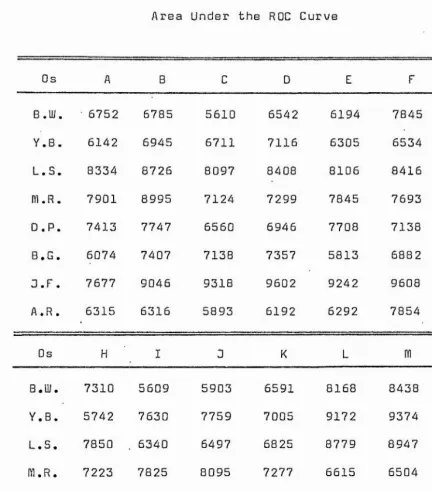
2. Experimental Design • • • « • « • • • • 73 3. Area Under the ROC Curve ... 76.
4. Practice Effects . . . 78
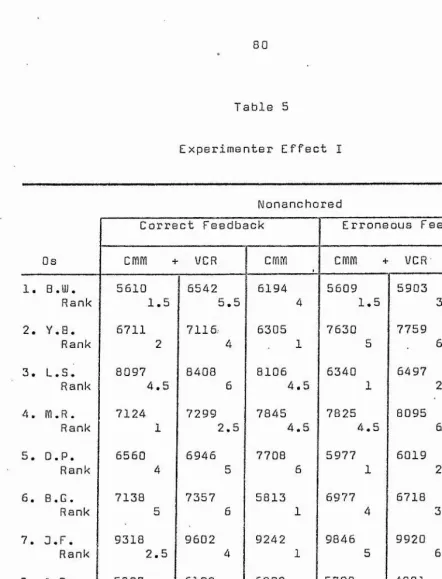
5. Experimental Effect I . . . • • ... BO
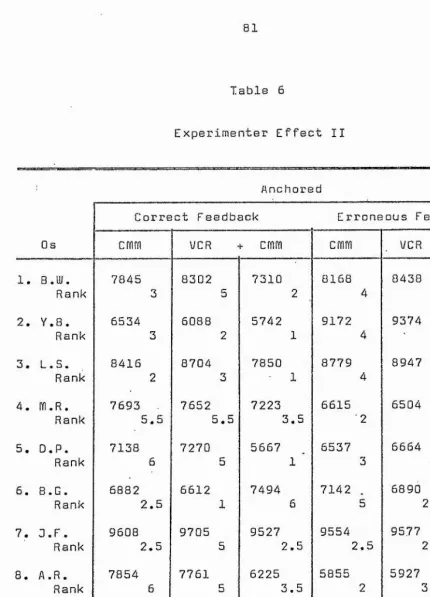
6. Experimental Effect II ... 81
7. Residual Effects 83
8 . Anchor Effects 85
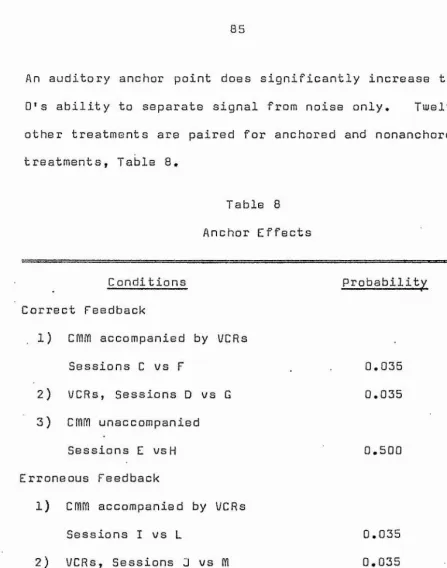
9. VCR Effect . . . • • • • . • • 87
10. Carry-over Effect I 89
11. Carry-over Effect II 90
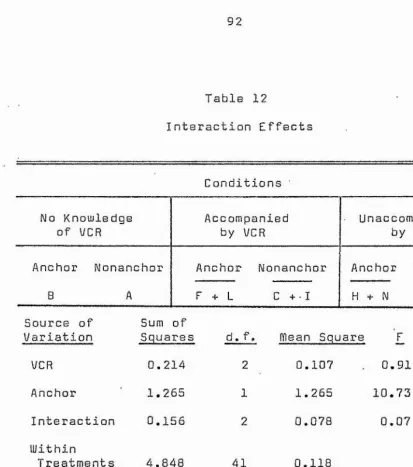
12. Interaction Effects 92
13. Delay Effects on C MM ... .... • 101 14. Delay Effects on VCRs ... 105 15. Memory Half-Lives for
VCR end CMM 107
16. CMM Context Effects 115
17. VCR Context Effects . . 116
18. CMM Base-line Shift . . . 118
19. Spearman Rank Correlation
Coefficient . . . 123
20. Studies on Auditory
(Lchoic) Memory 139
21. Area Under ROC Curve 168
■5-..."-''y
m
LIST OF ILLUSTRATIONS
Figure
1. Flow Diagram of Experimental Design 2. A Theoretical Diagram of Cross-
Modality Matching
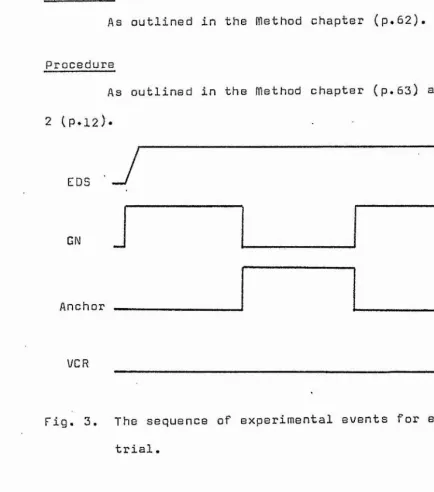
3. The Sequence of Experimental Events for Each Trial
4. Results of Experiment One
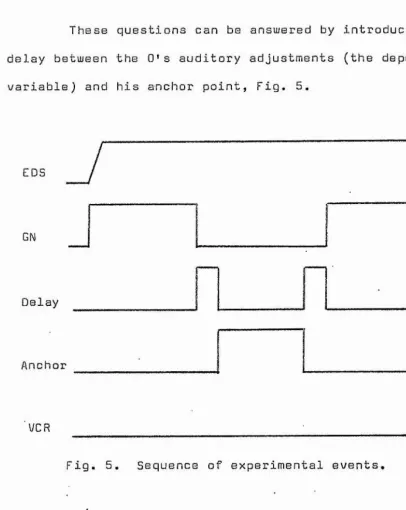
5. Sequence of Experimental Events 5, The Relative Strength of the
Auditory Memory as a Function of Time
7, Relative Strength of the Auditory and Verbal Memories
8 # Contextual Effect on CMM
9. Signal Flowgraph
10. Broadbent’s (1958-1971) Flow of Information within the Nervous
System
11. Hunt's (1971) Structures of Simulated Man
12. Hunt's (1971) Structures of the Sensory Buffer
13. Instrumentation Photograph
1. Instrumentation # # »
page 11 12 71 95 98 103 106 122 134 144 154 158 175 174 IV
•- V,- 1 ■■■ -.-i T ~ 7' T ■’ = ' - " W > f s v ; . . r >
The purpose of this study is to investigate the
human beings derive their decisions* The decisions were analyzed by probability theory. The subsequent knowledge of the synthesis of auditory information within the human being was then shown as a diagram. The rest of chapter one will expand and clarify this paragraph*
The term perception usually refers to the way one comes to know the world or the way one experiences the world of objects and events. The mechanism of perceiving has been of interest to man since his origin. Today
every investigator has his own theoretical concept of perception.
Most investigators (Chaplin and Krawiec, 1958) accept four fundamental assumptions comprising (1) natural
monism, (2) mechanism, (3) operationism, .(4) determinism.
■ 1
' ^
ÿ
Chapter 1 J
Introduction
flow of auditory information in the human being. This study could lead to the continued use of man as the
supreme decision-maker by supplementing his deficiencies # ■ I and harnessing his proficiencies. To achieve this goal, 4]
a simple auditory stimulus, unrelated to any previous ÿ learning, was varied with the aim of determining how
2
In this investigation the first three are adopted but for the fourth, determinism, Brunswik’s (1950) theory of
probabilistic functionalism is substituted. Brunswik's theory will be briefly described.
Probabilistic Functionalism
Brunswik (1955) based the concept of statistical uncertainty in the prediction of behaviour upon the
assertion of a fundamental discrepancy between perception and behaviour. In the functionalist tradition, the
theory stresses the achievement of the organism in adjusting to the environment and the processes involved. A percept is regarded as an inference about the world reached on the basis of cues from the environment.
Brunswik felt that even if we could know everything about the stimulus conditions existing in the world and every thing about the observer’s responses, a perfect prediction about perception could still not be made. One can
predict perception from behaviour or behaviour from
perception with only a certain probability of correctness. It is, according to Brunswik, theoretically impossible to have strict laws of perception corresponding to Newtonian laws of physics.
3
in the environment prevent the reconstruction from ever
being perfectly related to the objects in the environment* %
■
f
Thus the observer is perpetually in the process of making guesses or bets on the basis of uncertain information i.e., decision making.
Brunswik ' s probabilistic functionalism provides
the philosophical framework for this investigation and l!: topics such as statistical decision making, information
processing, and cybernetics are compatible within this
I
framework. "It is of utmost significance that in a1
number of specific instances cyberneticists have trans gressed the limits of the machine boundary and have demonstrated the suitability of their conceptions in dealing with problems in which the spatial or temporal environment is made part of a larger system ••••
Communication theory may well contribute to the efforts - % to determine the structural and functional properties of
the unit of behaviour in abstract terms. Such determin ation will in turn contribute toward an explicit
recognition not only of the rules and restrictions but also of the licenses and liberties of the objective
approach. It will further contribute to the much-needed establishment of psychology as a discipline of
distinctive, we1 1-circumscribed internal coherence and
formal unity of purpose within the more broadly unitary framework of science at large (Brunswik, 1950, 87 and 92)."
i
Recently, Sjoberg (1971) in a review of Brunswik’s probabilistic functionalism emphasised the application of probabilistic functionalism in perception, learning and applied psychology.
Information Proce.ssing
In attempting to explain m a n ’s behaviour,
psychologists have not only generated their own particular theories but have searched in related disciplines for models that might be applied fruitfully in a behavioural context. Information processing converges from two main sources; (l) problem solving, and (2 ) physical communi
cation sciences.
Until about fourteen years ago psychological research on problem solving was only sporadic. A few scientists worked consistently on the subject but there was no major point of view or technique to bring their work into focus. Then, Newell, Simon,and Shaw (1958) introduced a new theory of human problem solving, based on concepts of information processing and computer programming. They were primarily interested in the process of solving problems and argued that computer programmes could serve to specify unambiguous theories about the way humans process information. Information processing considers complex behaviour in terms of
organizational hierarchies. Organized hierarchies of
■■a
■i
I
y
I
I
1
I
activities are the substance of computer programmes,so the language of programming, e.g., flow diagrams, subroutines, list structures and the like, provide a convenient way of talking about complex behaviour.
Physical communication science, communication theory, or^less accurately, information theory, provides a system for considering certain relationships between events which can be described in probabilistic terms, "Information theory" is used in at least three senses (Elias, 1970). In the narrowest of these senses, it denotes a class of problem concerning the generation, storage, transmission, and processing of information, in which a particular measure of information is used. The basic unit of informational measurement (the bit) has universal applicability and may be used wherever categories or classes of objects or events can be
distinguished. In a broader sense, information theory can include any analysis of communications problems,
including statistical problems of the detection of signals in the presence of noise, e.g., statistical decision
theory. In a still broader sense, information theory is used as a synonym for the term "cybernetics" introduced by Wiener (1948) to denote, in addition to the areas
listed in the foregoing, the theory of servomechanisms, Cfi the theory of automata, and the application of these and
.. ^ V' : . .
machines. Briefly, cybernetics means "steersman" and is concerned with the communication and variability of information and its use in controlling the behaviour of biological, physical and chemical systems. One of the first steps in a cybernetics problem, or programming an
diagrammatic representation of the system under study
analogue or a digital computer, is the frequent use of I
illustrating the relationships and interdependence of key |
system parameters. Such diagrams are often called t
I
information flow diagrams.
In summary, the role of information processing, or, more specifically cybernetics, has been related to complex behaviour. With this approach, man may be
considered as a simple device for transmitting information; in a more complicated example, he may be considered as a component in a system that requires him to collect
information, filter it, store it, evaluate it, and apply given rules to it, that is - man is a decision maker. The decision to utilize the cybernetic approach is one that I feel offers the greater flexibility in analysing the information reported in this paper.
Approach
The approach of this study is basically empirical. "The term empirical has to do with experience, but the
word has at least two meanings which are commonly .i confused. The Germans make a convenient distinction • ' 'Î
between Erlebnis and Erfahrung. Erlebnis refers to present experience, that which is immediately there for the observer without reference to its origin; Erfahrung, to the accumulation of past Erlebnisse (MacLeod, 1954,
p.48)." This study will look at the data of Erlebnis. £ In this manner unnecessary assumptions as to how the human £
I
being is processing his information can be avoided. .4
Numerous studies have used verbal and visual Î
information to develop hypothetical constructs concerning I--£ how humans process information. A hypothetical construct yÿ is an inferred concept, a conclusion derived from something
assumed. Generally, a hypothetical construct has excess meaning (the semantic logic used to explain the observer’s
"f.
performance introduces ambiguity, e.g., stimulus recog-nition, memory storage and retrieval) and therefore the passage from the independent variables to the dependent
variable is made with less than logical certainty (Bindra, ^ 1959).
In experimental research in human information processing, there are several disadvantages inherent in the use of either alphabetical or numerical material as the stimulus. The main disadvantage is that the
experimenter's interpretation of the dependent variable from the independent variable is made with less than
logical certainty. This is because the observer must
■%
make the following transformation; (1) the recognitionits basic components, (3) matching these components with data retained in memory, and (4) the storage and
retrieval of complex sensory data to and from memory (Halle
&
Stevens, 1952; Katz&
Fodor, 1953). Hence, the logical uncertainty between the independent anddependent variables is due to: (1 ) the observer performing
complex tasks requiring numerous transformations, (2 ) each
stop in the sequence of transformations can introduce added probability of noise, and (3) as a result of one and two the conclusions concerning the observer’s perform ance becomes increasingly ambiguous.
To determine how humans process information, why start with such complex learned stimuli? To eliminate as much excess meaning as possible from the transition between the independent variable and the dependent variable, this investigation required the observer to perform unique manipulations of simple sensory stimuli. Thus the observer’s ability to process information can be
described with greater logical certainty since there will be fewer transitions between the independent and dependent variables.
solving activity and the allied fields of learning, without having some knowledge of how information is received (as well as recognised and recalled) in the first place."
Cross-modality matching (ClïlM) means the degree of accuracy with which stimulus intensities can be matched across different sensory modalities (see Glossary, P.183), Cross-modality matching can be a useful tool in the
analysis of human information processing behaviour. The advantages of using CMM are; (1) the sensory message transmitted to the observer is isolated from all other immediate sensory information; consequently, the message has no context - it is an entity, and (2 ) the sensory
message does not have a past history - the message is unique. Also, if the observer's responses are analyzed according to statistical decision theory, the observer’s response biases do not affect the data (Swets & Green, 1961). The data simply reflect .the observer's ability to separate signal from noise on two sensory continua as determined by his ability to match the perceived magni tudes of the two signals.
In general, CMM seems to provide a useful
laboratory tool for assessing how the observer processes information while .eliminating many of the difficulties encountered with other techniques, typically problems involving; recognition, context, past history and response bias.
i
1
10
In summary, the proposed study is concerned with determining how the observer is processing auditory
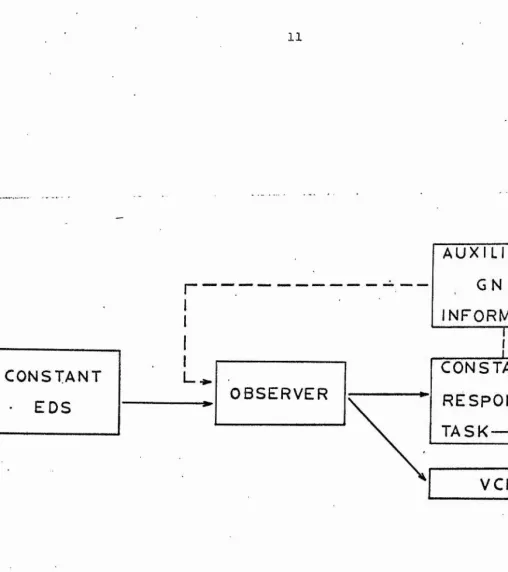
information. This can be accomplished by keeping the stimulus parameters constant and measuring the observer's consistency of responding as a function of the amount and kind of auditory information the observer has available. The flow diagram (Fig. 1) represents an oversimplified experimental design. The observer (0) is presented with the same stimulus condition (electrodermal stimuli, EDS) for the entire experiment. Likewise, the 0
performs the same task (CMM) of adjusting the magnitude of a Gaussian noise signal (GN) to match the perceived intensity of the ED stimulus (see Fig, 2). The only alterations in the experimental conditions are; (1 ) the .
O's access to auxiliary information about the GN is
varied, and (2 ) the 0 may be required to perform an added
IX
CONSTANT
■ EDS
VCRs
OBSERVER
A U X IL IA R Y
NFORMATION
GN
CONSTANT
RESPONSE
TA SK — CMM
' '!•
ti
Fig. 1. - The flow diagram represents an oversimplified experimental design. The D is presented with the same stimulus condition (electrodermal, EDS) for the entire experiment. Likewise, the 0 responds with the same task (CIYIIYI) of adjusting the magnitude of the Gaussian noise (GN). The only alterations in the experimental conditions
are;-(1) the 0*s access to auxiliary information about the GN is varied, and (2 ) the 0 may be required to perform an
[image:22.617.14.522.22.594.2]12
Sensory Probabilistic Zone
100%
Cross“Modality Matching
! 1100% 50%
99%
Sensory Probabilistic Zone
Fig, 2, - A theoretical diagram of cross-modality
... . - V . «r.y fr-' ■ "y-rc,.''
13
Purpose
The purpose of this thesis is to investigate how human beings process auditory information. Based upon these investigations a cybernetic model will be developed. The model is applicable only to this investigation.
Indeed cybernetic systems "must in a single human being, number hundreds of thousands (Porter, 1969, p.4)." No attempt will be made to fully develop a general theory;
one should abandon the direct search for super
theories of learning, super theories of development, and super theories of mental illness or perception. These have proved themselves to offer a redescription rather than an explanation, which is the danger into which psychologists, like us all, are particularly prone to fall (Scriven, 1954, p.176)," However, a modality specific model (audition) will be developed that
Chapter 2
Selective Review of the Literature
This chapter selectively reviews the literature in three areas that provide the theoretical foundation for this study; (1 ) cross-modality matching, (2)
cutaneous information, and (3) information processing of simple auditory information.
Cross-IYlodality Matching
Cross-modality matching (Ciyilïl) has been previously defined (p. 9 ) as the degree of accuracy with which a
sensory intensity can be matched across modalities. The purpose of this study is to determine the flow of auditory information (Erlebnis) within the organism. The purpose is achieved by having Os perform a ClYtlY) task and, then observing how the O ’s performance alters when auxiliary information about the auditory signal is provided. For the present study only one aspect of the flow diagram is
15
influence the 0 *s judgments; or how the presence of a
sensory stimulus in one modality facilitates the detection of a signal presented to another modality* However the above topics are of some importance since the Os do match sensory intensity across modalities*
Cross-modal integration is a wide and heterogeneous field of study. Most of the topics reviewed have been limited to studies that have used auditory stimuli.
There is not a discrete separation between topics, although the categories are helpful in the organization and communi cation of the material. The review topics are: (1)
sensory transfer, (2 ) contextual and assimilation effects,
(3) facilitation, (4) equivalence, and (5) psychophysical measurement•
Sensory Transfer
Two types of sensory transfer can be defined; intersensory or cross-modal transfer occurs when an organism uses information from one sense modality to perform a task or solve a problem involving a different sense modality ; intrasensory, or intramodal, transfer occurs when both the information and the task are in the same sense mode.
Eleanor 3. üibson's book Principles of Perceptual Learning and Development* chapter eleven, provides an
excellent historical perspective of intermodal transfer research
16
as well as a review of work up to about 1968. Recent reviews on studies in cross-modal transfer (e.g. Bjorkman, 1971, and von Wright, 1970) emphasise the following
findings; (l) cross-modal transfer is easily demonstrated with human beings but ClYltYl is extremely difficult and
perhaps impossible in animals, (2) the capacity of cross-
modal transfer seems to be a function of age, and (3) the
transfer effect is often found to be asymmetric (e.g. information transfer from touch to vision is larger than transfer from
vision to touch).
In explaining the third empirical finding, from the above list, several authors have suggested that verbal mediation may play an important role in cross-modal
transfer (see Garvill and molander, 1958 for a review of verbal mediation effects in cross-modpl transfer).
However, it is also argued (Garvill and Wolander, 1971) that not all forms of cross-modal transfer need to be mediated by language or verbal behaviour (Blank et al. 1968), Blank et al, trained young children in a form discrimination task either visually or tactually and
tested for transfer in the other modality. They obtained transfer from vision to touch but not in the other
direction. Although transfer occurred, the children could not label the shapes used and the authors concluded that language was not a necessary mediator for transfer.
; ''î : < ù - , -/jz ya-y;
17
The soundness ''of this conclusion can be questioned, however, since no transfer occurred from touch to vision and since the lack of overt verbal responses by no means excludes the possibility of covert verbal responses,
Garvill and [Ylolander (1971) trained Os to
associate nonsense syllables to three-dimensional ceramic objects (Gibson’s forms, 1965) which were presented either visually or tactually. Verbal mediation was found to be an effective aid in the transfer of inform ation between the two sensory modalities*
Previous studies of cross-modal matching between vision and hearing used some version or modification of the Birch and Belmont test (1964), It is an audio visual "matching to sample" task in which the 0 listens
to a pattern being tapped out, then selects from among
three or four frtorse-code-like patterns pictured on a | card the one which corresponds to what he heard. The
a differences obtained between groups on audiovisual & matching ability, using this test, may be affected by
three other types of performance implicit in the test structure; (l) spatiotemporal transformation - a temporal auditory pattern is compared to spatial visual patterns; (2) counting - in some items the comparison patterns do
not all contain the same number of elements; (3) length perception - in other items the visual comparison
a
I
yr- .«.y r,/' 'i «' '
18
patterns do not have the same length. These performances might not differ as much in normal adults as they do among the groups that Birch and Belmont tested, which mostly consisted of children or of persons with brain damage.
These earlier studies, while evaluating audio
visual transfer, did not report on either the complementary cross-modal performance, viz, visuoauditory transfer, or intramodal transfer for both vision and hearing. The inferiority of cross-modal transfer reported by Birch and Lefford (1963) can be due to comparing it to the intramodal transfer within the most accurate of the two sense modes in question; on the other hand, comparing cross-modal transfer to the intramodal transfer within the less accurate of the two senses should result in cross-modal superior performance (Bryant, 1968), lYluehl and Kremenak (1956) introduced the necessary intramodal comparisons by adding the complementary visuoauditory CIYIIYI task, and changed the test from "matching to sample" to "same-different". Their items, however, were
different among the four tasks, and differences in item difficulty could have affected the differences obtained among their conditions; also, their cross-modal tests still involved spatiotemporal comparisons from vision to hearing, while the intramodal tests for vision and
hearing involved only spatial and temporal comparisons, respectively.
19
Rubinstein and Gruenberg (1971) compared cross- modal matching between vision and hearing to intramodal matching within these modes in normal adults# Temporal pattern perception for vision and audition was measured using pair comparisons of precisely determined rhythms as test items. Visual rhythms were more difficult to match than were comparable auditory ones. The
differences between intra and cross-modal transfer were related to the frequency of pattern elements, with cross- modal performance decreasing more when frequency rose.
Chan and Travers (1955) studied the effects of sense modality switching on the learning of elements in a serial learning task. The study involved a task with seven nonsense syllables, each of which could be
presented in either the auditory or visual modality. Switching the sense modality of transmission took place with some Os on the second position and with other Os on the fifth position/ At the higher of the two speeds of presentation used, there was no significant effect on learning produced by switching modality in the second position. However, the switching of modality in the fifth position produced; (1 ) a significant increase in
learning the syllable on which the switch occurred, and (2 ) a significant decrement in learning of the following
-; v ^ v - i '^ v
-20
back to the original modality. The increment was interpreted as a von Restoff effect, and the decrement was considered to be a result of loss of time involved in switching (see Heid, 1964, for a review and his added studies on time loss caused by switching modalities).
The fact that in the Chan and Travers (1965)
study the effect of switching was much more marked in the fifth position than in the second suggests that, as
information is received through a particular sense modality, switching to another modality requires an increasing amount of lost time. Their 1970 study
investigates further this tendency for switching effects to become more marked as a particular sense modality continues to be used for information transmission. This study used as signals either brief series of flashes of light or brief series of sound "blips." Each signal consisted of 3, 4, 5 or 6 flashes or blips. Four
signals were given consecutively through either the
auditory or the visual modality. The task of the 0 was to report at the end of each series of four signals the number of flashes or blips in each of the signals. The design of the study involved a switch in sense modality at each one of the four possible positions in the series. Thus, it was possible to determine if the transmission of information through one sense modality makes it ■ progressively more difficult or more time consuming to
21
switch to another source of information transmitted through another modality. The results generally
supported the contention that, as information is received, through a particular modality, there is a build-up of the disruption involved in switching sense modality*
In conclusion,sensory transfer does occur asymmetrically and is influenced by verbal mediation effects. Also,switching sense modalities disrupts information processing.
Contextual and Assimilation Effects
Anchoring or contextual effects in psychophysical judgments may take the form of either contrast effects or assimilation effects, (An anchor is a reference point in the O ’s stimulus or response continuum set at some mathematically defined intensity by the experi
menter.) A contrast effect occurs when the presentation of an anchor produces a shift in the judgment of control stimuli toward that portion of the judgment scale most distant from that used for judging the anchor,- An assimilation effect occurs when the effect of the anchor is to move the judgments of the control stimuli toward
the portion of scale used in judging the anchor. \ The theory of adaptation level (Nelson, 1964)
-s.
22
stimulus from a point of sensory indifference
(the adaptation level), based upon the O's experience with the focal stimuli, background stimuli, and residual stimuli from his previous contact with the stimulus
domain. The effect of presenting an anchor is to shift the adaptation level toward the anchor. As the distance between the original set of stimuli and the adaptation level has changed, and the scale judgments are proportional to distance from the adaptation level, the judgments of these stimuli will shift toward the end of the scale
r.
opposite the anchor. Thus, comparatively high intensity anchors decrease the judgments of scaled stimuli and
comparatively low intensity.anchors increase them. >
A difficulty with the adaptation-level analysis
of context effects is that only contrast effects are V predicted. (Here, the relevant item of adaptation-level
theory is that all background stimuli as well as the test stimuli are pooled in the O's decision). On the other hand, Sherif, Taub, and Hoyland (1958) were able to obtain assimilation effects in the judgment of lifted weights when the anchoring stimulus was close to the series stimuli in value. Parducci and Marshall (1962), however, offered an explanation of this phenomenon
congruent with adaptation-level theory. Rather than
considering the anchor as simply one of the stimuli to Y
be judged and finding the adaptation-level as the T
23
assimilated effect of independent stimuli as did Sherif et al, the anchor was considered by Parducci and Marshall to be a standard in regard to which each comparison
stimulus was evaluated. Consequently,values for the adaptation level were obtained such that Sherif's results were predictable as a contrast effect and therefore
congruent with adaptation-level theory.
The difficulties in considering assimilation as an adaptation-level effect have been increased by the demonstration that assimilation effects may be obtained in cross-modal judgments, Sevan and Pritchard (1964) obtained a typical contrast effect in the judgment of soft tones when more intense tones were introduced as anchoring stimuli. However, the introduction of lights, previously matched in intensity to the loud tones,
produced an assimilation effect in the judgment of the soft tones. They were judged louder in this condition than in a soft tone control condition.
In order to incorporate the assimilation effect into adaptation-level theory, Sevan and Pritchard
24
below the series of tones presented for judgment. This
f
/(-i
would produce a contrast effect and increase the apparent y ■% magnitude of the soft series of tones. The experimental ig results of Sevan and Pritchard confirmed their postulate.
I
In order to support the conclusion that the cross-modality assimilation effect is a sensory effect congruent with adaptation-level (AL) principles, three factors of the Sevan.and Pritchard study should be resolved: (1) effects of attention shift between
tone-light conditions as opposed to the tone-tone conditions, (2) role of response biases, and (3) the role of verbal medi ation•
Melamedb(1970 and 1971) studies were designed to investigate the contribution of the verbal mediation factors to cross-modality assimilation effect. In summary, the O's verbal judgments of intensity of soft - tones judged with a series of bright lights (assimilation effect) werefound to be dependent on the fact that the lights were judged at the same time. The dependence between tones and lights was not observed in a parallel investigation of contrast effects in the judgments of tones alone. "Both the form of the assimilation effect and its specific dependence on judging both stimulus modalities argues against a sensory explanation.
Instead, it is argued that this cross-modality
/ y
25
assimilation effect represents a resolution of the specific difficulties involved in judging two quali tatively different modalities on one judgment scale (Melamed, 1970, p.185)."
Namba, Yoshikawa and Yasuda (1972) investigated anchor effects on loudness judgments, using reaction time (RT) as an index of loudness. Their problem, of equal concern to all who study perception, is that
perception is an unobservable intervening concept. UJe ,
'd
can only guess the perceptual world from relations between Y stimuli presented to Os and the overt responses made by y Os to the stimuli. Therefore, it is only possible to'
‘j use responses as a clue to the law of perception,
Consequently, the characteristics of responses might be "y confused with those of perception, and sometimes it
happens that what was considered as the law of perception ' is found to be nothing but the law of response, e.g.
btevens vs. Nelson's extending AL theory to a category judgment of weight (Stevens, 1958).
In order to eliminate performance deficiencies accompanying verbal categories, there have been many experiments concerning anchor effects using absolute physical magnitude. For example, Fillenbaum (1963) used a verbal category scale and a direct ratio of height to the width of rectangles and found that the O's judgments reflected no anchor effects when direct ratios were used.
%
/ ,..r ' " '/
26
Harvey and Campbell (1963) found anchor effects in the judgment of weight using a verbal category scale and physical magnitude (ounce), but in the latter case the effects were smaller. Nelson and Kozaki (1968) showed that the same anchor effects existed in direct estimation of the number of dots, as when a category scale was used. Bell and Bevan (1968) found clear anchor effects in the judgment of four factors of Gestalt, Besides, anchor effects have also been seen in many experiments where stimuli of low intensity were used as anchors (Black and Bevan, 1960; Goldstone et al, 1962; Sevan and Pritchard, 1963).
As described above, many experiments have been done in order to make clear the relation between
perception and response concerning anchor effects. Though many of these authors deny that anchor effects are attributable merely to the semantic shift of scaling, there is no general agreement as to the exact nature of anchor effects.
In order to reexamine the problem .of verbal mediation influencing anchor effect, Namba and et al (1972) conducted two experiments. In Experiment 1, anchor effects were, reexamined using verbal categories. . Two kinds of auditory anchor stimuli, 60 and 90 dO at 1,000 Hz, and four kinds of series stimuli, 60, 70, 80 and 90 dB tones, were used* In this experiment, clear
-VA'.-;:-, T", "'Ti_T V ■. «
27
anchor effects were found as in previous experiments. Experiment 2 was conducted using reaction time (RT) as an index of loudness with stimulus conditions similar to those in Experiment 1. The same anchor effects could also be demonstrated in this experiment.
As RT is quite free from the limitations inevitably accompanying the verbal responses, it was concluded that the anchor effects reflect the shift in perception and are not caused by verbal mediation effects;
■ In summary , anchor effects probably reflect a shift in perception and are not caused by verbal mediation. Secondly, cross-modality assimilation effects probably represent the O's difficulties in judging two quali tatively different modalities on one judgment scale.
F acilitation
Here,facilitation means the increased ease of detecting the presence or magnitude of sensory stimuli in one modality by introducing a sensory stimulus to another modality. However, studies of the effects of auxiliary visual stimulation on absolute auditory sensitivity have not totally agreed on their results. Most studies have shown that auxiliary white light
u
improves auditory sensitivity (reviewed by Ozbayder, 1961). However, Sheridan .et al (1966) reported that white light had no effect on auditory sensitivity at four frequencies examined (250-2000 Hz), but
v r -' ‘ - V " " -‘ .'irn;
I
:
28
depressed sensitivity at a fifth frequency (5000 Hz). Other investigators have found that concomitant
stimulation with certain coloured lights can- depress auditory sensitivity (London, 1954 reviews this subject). In none of the above mentioned studies, however, was there evidence of any attempt to control or measure false positive responses,
Bothe and Marks (1970) attempted to evaluate the effects of white light on the detection of Gaussian noise. The conditions compared were darkness, constant room illumination, and sound-synchronized flashes of light at three .intensities* Use of a confidence rating procedure and analysis in terms of the theory of signal detectability provided an opportunity to separate any effect of auxiliary visual stimulation on auditory
sensitivity from an effect on criterion* This could be accomplished by comparing the entire receiver-operating- characteristics for all of the conditions. The authors concluded that there appeared to be no consistent effect of auxiliary visual stimulation on absolute auditory sensitivity for the four Os examined.
In conclusion, the previous studies have appeared to incorporate the 0 ‘s response biases into his detection
accuracy resulting in a lack of experimental reliability. The Bothe and Marks (1970) study, which removed response , biases from the O's detection accuracy, has not confirmed that facilitation has any influence upon the O's ability to detect stimuli.
29
Equivalence
Here,equivalence means that the information gathered by one perceptual system is "covariant,
coincident, or correlated with the information got by another perceptual system (Gibson, 1966, p.298)," and thereby "unity" is achieved. In general the studies in this section are concerned with how "unity" is established.
3. Gibson (1962) reported use of a series of sculptured free-form solid objects designed especially to be appropriate for the study of haptic (active touch) perception. Each object has a solid three-dimensional shape with five elevations around a central hump. The exact shapes and sizes of the elevated protuberances, as well as the valleys and ridges among them, distinguish each solid from the others in the series. Abravarel (1971) used these objects for investigating haptic and visual equivalence matching, as well as for the study of short-term memory demands on mnemonic processes as well as perceptual ones. Five groups of Os were tested under conditions of intra and intermodal equivalence matching for free-form unfamiliar shapes. Gibson's (1966) findings indicated that visual intramodal matching was superior to intermodal matching, a result consistent with his previous research (Gibson, 1962). The order of accuracy in
forming equivalence was; (1 ) intramodal visual, (2)
30
Numerous other CMiï! studies have established the greater detection accuracy of the visual to tactual comparison over the tactual to visual comparison
(Garvill and lYlolander, 1969; Lobb, 1970; Koen, 1971). Goodnow (1970) proposed that the difficulty of the
visual-tactual condition relative to the tactual-visual ‘ condition could be explained in terms of a less stable memory for tactual information. This hypothesis was based on results obtained by Posner (1957), who compared retention of kinesthetic and visual information and
found that the retention of kinesthetic information was affected by an unfilled retention interval while the visual information was not. Goodnow (1970) found that the difference in difficulty between; visual standard and visual comparison; tactual standard and tactual comparison; visual standard and tactual comparison; and tactual standard and visual comparison, increased as a function of the number of comparison objects, which supported her hypothesis.
However, Garvill and Molander (1972) did not confirm Goodnow's hypothesis. They manipulated intra and cross-modal matching of nonsense forms (Gibson's
forms) using two standard modalities (visual vs. tactual), and two comparison (again visual vs. tactual). The standard form was separated by either one, ten or thirty seconds from the comparison. The authors conclude that
n . . - À- Y' A- -.A:-;,'? ÿp,'. ' '!
31
retention intervals had no effect in any of the modality conditions. There are two faults with this study*
Firstly, the Os' criterion biases were incorporated in the data. Secondly, the Os could easily verbally code the forms, consequently, a retention interval between the standard and comparison would not have an effect since the information could be stored in the verbal memory for all possible combinations of forms.
li'hen a perceptual problem can be solved by
exploring the stimulus objects visually or tactually, or when part of the problem is presented via one modality and the remainder via another modality, there is an
opportunity to compare the information-handling character istics of the two systems. In a situation employing multivariant stimuli, some properties may be more salient for one modality than for the other, resulting in .
differential problem difficulty for the two modalities. While Gibson (1952) has demonstrated that tactual- to-visual matches can be made without previous experience, although performance improves with practice, most studies have been concerned with form discrimination and
subsequent cross-modal transfer of training (see section on sensory transfer). The difficulty in interpreting and integrating the results of cross-modal studies seems to arise because there is no basis for determining why equivalence does or does not occur. Except for Picj<
32
quantification and little is known about the form dimensions along which discrimination, matching, and cross-modal transfer takes place. Psychophysical know ledge of what stimulus information is used and how it is used in transfer or cross-modal comparison should aid in understanding the processes involved.
In earlier studies, a comparison of the physical
% -•ÿ£ correlates of visual and tactual form complexity scales
-. (Owen and Drown, 1970) demonstrated -a high degree of
equivalence in information utilization. Other studies verified these findings using multidimensional scaling analyses (Brown and Brumaghim, 1958) and an anchoring design (Brumaghim and Brown, 1958). Owen and Brown (1970 and 1970) investigated pattern discrimination in the case of visual and tactual presentations. The tactual stimuli were forms constructed of fine abrasive paper glued onto a poster board. The visual stimuli were transparencies presented with the same area as the tactual forms. The O's task was to match one of six randomly presented forms to the test form. The data 'wereanalysed' by correlating both intra and intersensory comparisons. There was no attempt to separate the O's criterion for responding from their sensitivity of detecting the forms. The authors concluded "if task
demands or previous problems do not suggest a strategy, 4
■ I
the information in the problem will (p.306)." '
■ 1
:
I ■i
?-I
' ' ' ...
.
■
33
Anderson (1955) studied the relationships between
■%
visual and auditory autokinetic phenomena and affirmedthat these phenomena are indeed determined by each .v? subject’s perceptual style. Gunn and Loeb (1957), using
signal detection theory, determined a correlation between auditory and visual tasks. They concluded that both sensitivity (d*) and the degree of conservation in responding (y^ ) were correlated between the two tasks. Both d ' a n d f o r auditory and visual tasks were
significantly correlated in the first session. ' Only d ‘ was significantly correlated in the second session.
The authors contend that there are common response biases in different modalities which are independent from common factors affecting sensitivity (d') for both modalities, auditory and visual.
An unusual study on intermodal equivalence was conducted by Bruno et al (1971) on the cross-modality matching of muscular tension to loudness. The purpose of this study was; (1 ) to determine, more precisely,
the relationship of perceived tension to the magnitude of sustained muscular contractions, as measured electromyo- graphically, and (2) to validate these findings through
34
electromyographically measured tensions, estimated the loudness of pure tones, and then matched muscular tension to tonal loudness. In all cases, power functions
adequately represented the estimation and matching.data. The data suggest that a consistent scale of muscular tension can be constructed, and that the scale can be validated by cross-modal comparison.
In another single experiment by Dawson and Brinker (1971), Os adjusted loudness and force of
handgrip to match the strength of their opinions regarding racism, desirability of occupations and pronunciafaility of trigrams. The results, by the authors* contention, "provide validation of ratio scales of opinion and further establish the direct scaling methods used to obtain them (p.413)."
Psychophysical Measurement
In 1967, Egan published a bibliography on Signal Detection Theory and Psychophysics. Sections of the bibliography include; (1 ) decision processes in
detection, (2) theoretical analysis of SOT, and (3)
sensory processes in auditory detection and its theoretical analysis. The entire bibliography contains a minimum of a thousand references. Clearly a review of this work is beyond the scope of this paper. An excellent contemporary review of psychophysics is provided by Luce (1972).
I
•i
A.'"' X ' " À ? - / -A* y-;:
35
Rule and Markley (1971) summarise Steven's power function to cross-modality matching of individual differences.
Also Banks (1970) and Lockhart and Murdoch (1970) provide a basic introduction to signal detection theory and its practical utilization.
Cutane ous
There are four physiological functions of the human skin: (1 ) protection of underlying parts, (2 )
regulation of body temperature, (3) participation in body metabolism, and (4) operation as a sense organ. The skin is richly endowed with nerves and their end organs; it has a surface area of approximately two square yards in the average male and comprises 15 to 18 per cent of the body weight. Historically, however, the systematic investigation of the cutaneous sense has been
curiously neglected. I
Early work in the area of reading by touch was % first done by Braille in 1826 in which he developed the ^ well-known Braille system. The method has proven to be
relatively efficient, but it is slow and efficiency is substantially reduced by perspiration and cold fingers. Also, the maximum speed of reading is less than the cognitive processing time required. In 1938 Gault and his associates unsuccessfully attempted to utilize the skin as a tympanic membrane by transducing speech sounds
36
the skin, Weiner and associates (1951) used alternating current applied to the skin through a filter network of seven channels, but found this system not very efficient for communication purposes.
The earliest successful attempt to utilize the skin as a modality of communication was made by Geldard in 1957, Using a coded "vibratese" language developed by Howell a year earlier, and transmitting through seven mechanical vibrators critically spaced around the chest, Geldard was able to get his subjects to receive messages at a rate of 38 words per minute with better than 90 per cent accuracy after 30 hours of training, Words averaged
five letters in length and the method proved several times faster than the conventional Morse Code.
Probably more important than the study itself were the data he obtained on certain aspects of vibratory stimulation such as; (1) amplitude-intensity, (2)
position of stimulation, (3) duration, and (4-) frequency. Geldard’s results are discussed; '
Intensity Discrimination
Geldard found that at 60 Hzs with a static vibrator pressure of 1 0 0 grams, the useful range of stimulus
amplitude was between 50 and 400 microns, 50 microns was above the 1 0 0 per cent absolute threshold of sensation and
400 microns was well below the threshold of discomfort. Within this range fifteen just-noticeable-differences
■
A
g
■ÿ, A " "i:rA' ■ -. r-,:
37
(JNDs) could be discriminated. Three widely spaced steps of low, medium and high intensity could be used in communication. oome problems encountered were those of adaptation to vibration, variation in sensitivity to touch in different areas of the body, and maintenance of a steady stimulus from the vibrators.
Position of Stimulation/Locus
A number of problems arise in the use of mechan ical vibrators for communication. One such difficulty is the bulky nature of the vibrators themselves and the wattage necessary to drive them for adequate stimulation. However, by using a small low-powered vibrator developed by Bice that operated on low frequencies and could not be dampened by skin impedances, Geldard was able to space seven vibrators on the rib cage with 1 0 0 per cent
identification of the site of stimulation. Five vibrators proved to be sufficient for a communication
38
"spread" of vibratory sensations around the general locus separate vibrators, which restored "twoness" but could, in turn, lead to problems in coding and the phenomenon
of "phi movement". Another problem was that of the 4
of the vibrator which was overcome by a method devised by .# % von Bekesy (1952).
3
i
Stimulus duration -4
At a frequency of 60 Hzs, Geldard found 25 JNDs between the range of 0 . 1 seconds and 2 . 0 seconds in
stimulus duration. Below 0.1 seconds vibratory, bursts were too short to be discriminated, while signals lasting longer than 2 . 0 seconds were too time-consuming for
communication purposes. The mathematical function was slightly curvilinear, the shortest stimulus duration perceived was 0.15 seconds. Absolute identification of duration for trained observers yielded four or five widely spaced levels, and only three levels for untrained
observers. Three durations yielding 100 per cent
%»
39
F requency
This was found to vary inversely with.the number of correct judgments. At frequencies below 70 Hzs
judgments were good but faded as frequency increased. ThereforejGeldard decided that frequency must be constant in the communication system.
The basic system that arose from the results of the foregoing data consisted of three levels of intensity, three durations, and five loci. This gave Geldard a forty-five element system of tactile communication to be used with Howell's coded "vibratese" language. White,
(1970), using Geldard's findings,examined the potential ities of the skin as a communication channel using vibrotactile stimuli. A system was developed for converting an optical image into a tactile display.
After surprisingly little training, subjects were able to recognise common objects and to describe their arrangement in three-dimensional space* When given control of the television camera used for the experiment, subjects
quickly achieved object discrimination. White concludes that the limitations of the system thus far appear to be more a function of display resolution than limitations of the skin as a receptor surface. Some contemporary
investigators believe that electro-pulse stimulation might provide the necessary resolution.
■■ yÂAlxx.T- A,;;;:--.-. .'V." ,
40
In 1953 Siegal demonstrated that within certain parameters electrical square wave pulses, on the upper volar forearm, result in pain-free perceptions of touch# The advantage of using electro-pulse stimulation is that it can be confined to a particular skin area unlike stimulation by mechanical vibration# Electro-pulse equipment is more compact and requires less than 1 watt
of power for stimulation. The disadvantage- is that electrical stimulation can produce pain under certain conditions*
In 1958 Hahn elaborated on Siegal’s method by using a high impedance source and varied the frequency and duration of a square wave. Voltage was held
constant. Although sensation was found to be affected * by frequency change, current increase, and cycle duration, Hahn's method enabled him to study each variable separately, Using the index finger as the locus, frequencies of 60,
100, 200, 500 and 1,000 Hzs and short durations of 0.1, 0.2, 0.4, 0.7, 1.0, 2.0, 4.0, and 7.0 milliseconds, Hahn found that a change of frequency had negligible effect on electrical thresholds. Furthermore, the threshold values varied primarily as a function of the square wave duration.
Four recent studies were those conducted by
41
sinB~uiavQ stimulation at varying frequencies. Current uias increased until the reaction level (RL) of tingle was reported-by the observers. Increases in current were continued until pain and finally, the tolerance limen (TL) was reported. Electrodes were placed on the finger pad and heel of the palm. The data are presented in Table 1.
Table 1
Frequency (Hzs) Threshold Intensity (rnilliamps)
Tingle (RL) Pain I L
1 0 0 0.3 1 . 0 1.7
500 0,5 1.5 2 . 2
1 , 0 0 0 0 . 8 2 . 0 3.0
5,000 1 . 8 5.6 7.0
1 0 , 0 0 0 2.5 1 0 . 0 1 2 . 0
f
i
I
a ■"!
Composite of Hawkes* and Warm's Data %
I
if
:
1
In all instances more current was required for reports of V;; pain than tingle, and more current was necessary for the
TL than for the RL and pain. Furthermore, more current # was necessary to reach threshold at the higher frequencies
of stimulation than at the lower ones. Qualitatively, tingle was reported as a weak sensation localized in one area under the active electrode. Pain was typically
reported as a localized sensation superposed on the tingle ; and described as similar to the jab of a needle* The
tolerance limen was reported as a burning sensation. ■ Little or no change in the quality of sensation was
reported with a change in frequency.
$
i
42
The second study by Hawkes (1960) was on the identification of intensity levels and channel capacity. He assumed that the number of possible absolute identi fications of current intensity levels might be explained with respect to both the percentage of correct identi fications and the amount of information transmitted to an observer. He found three intensity levels for maximum transmission at 1500 Hzs which would be useful in a communication system requiring perfect accuracy.
In another study (Hawkes, 1951) to determine the number of possible absolute identifications of electrical cutaneous stimulus durations and their channel capacity, Hawkes used eleven stimulus durations within a range of 0.5 to 1.5 seconds and 100 msec, apart. Twelve
observers were used with electrodes placed on the finger and palm. With an alternating current frequency of 100 Hzs and a stimulus intensity of 6 db. he found that maximum channel capacity for absolute identification of duration was reached with the use of three duration levels.
Finally, in a study of discrimination with three standard stimulus durations of 0.5, 1.0, and 1.5 sec. intervals and intensity levels of 120, 160 and 200 per cent of RL at a frequency of 100 Hzs, Hawkes and Warm
I
'
43
resulted from the use of weak stimulus intensities or
.1
-•S very brief durations of 0.5 seconds or less. The
'A investigators felt that any coded system for communication
should be dependent upon intensity and duration while
:
frequencies should be constant,
«
Studies by Gilmer et al (1961) were undertaken
concurrently with those of Hawkes using square-wave pulse • : generators as the stimulus source.. Their apparatus was
adapted from Hahn (1958) and altered so that the
capacitance and resistance of the skin did not distort the wavB-form, Exploratory investigations were made on 200 subjects and final studies on 12 trained observers.
5 Exploration of most of the body surface was made noting
the perception of pain and painless pulses under conditions of normal skin temperature, and under con ditions of vasodilatation and vasoconstriction. The only portion of the skin not affected by neurovascular change was found to be the palms of the hands and the soles of the feet. The thresholds were almost constant in these areas and bilateral equivalence in pulse limens for the two palms were also found,
Gilmer and Haythorne (1941) showed that under certain conditions stimulation of the skin with sinusoidal current could destroy epidermal and dermal tissue.
However, they were able to stimulate on the palm of the hand for up to two hours with no diminution of