Note:
This is a copy of an article in
Ageing and Society, volume 26(1): 9-35,
published by Cambridge University Press in January 2006.
Copyright for this article,
A framework for understanding
old-age vulnerabilities
ELISABETH SCHRO¨ DER-BUTTERFILL* and RULY MARIANTI#
ABSTRACT
Identifying vulnerable older people and understanding the causes and conse-quences of their vulnerability is of human concern and an essential task of social policy. To date, vulnerability in old age has mainly been approached by identi-fying high risk groups, like the poor, childless, frail or isolated. Yet vulnerability is the outcome of complex interactions of discrete risks, namely of being exposed to a threat, of a threat materialising, and of lacking the defences or resources to deal with a threat. In this article, we review approaches to vulnerability in various disciplines in order to develop a systematic framework for approaching vulner-ability. This framework distinguishes and examines the interactions among the domains of exposure, threats, coping capacities and outcomes. Drawing on European and Asian gerontological literature, we discuss what might be meant by these domains and their place in the understanding of vulnerability in old age. Two case studies are presented – one on homelessness in Britain, the other on familial care provision in Indonesia – to illustrate the ways in which specific vulnerabilities are created and distributed over the lifecourse.
KEY WORDS –vulnerability, care in old age, homelessness, risk, coping, social networks.
Introduction
The aims of this article are three-fold. First, we review how the concept of vulnerability has been developed and used in various disciplines. As will become clear, the notion of vulnerability produces considerable concep-tual and terminological diversity, to which this paper cannot do justice. Instead, we develop a framework which captures those aspects of a vulnerability approach which are most relevant to the study of ageing. The framework disaggregates vulnerability into its constituent domains, namely exposure, threats, coping capacities and outcomes. The second aim is to examine these domains with reference to the research literature on ageing and old age : what might be meant by outcomes, exposure,
* St Antony’s College and Institute of Human Sciences, University of Oxford, UK.
threats, and coping capacities with reference to older people ? This entails consideration of several questions : What outcomes in old age are people trying to avoid ? What specific threats might they encounter, and what increases people’s exposure to such threats ? How do older people manage to protect themselves from bad outcomes in the face of threats ? The final aim is to ‘ re-assemble ’ the concept through two examples, one on vulnerability to homelessness in old age in Britain, based on work undertaken by Maureen Crane and Tony Warnes, the other on vulner-ability to a lack of care in old age, which draws on our own work in Indonesia.
A framework for understanding vulnerability : insights from other disciplines
Vulnerability as an analytical concept first emerged in the environmental sciences, specifically for the study of the human impacts of natural dis-asters. Disasters had for long been regarded as a direct outcome of natural hazards, like floods, earthquakes or droughts, but this construction was undermined by the realisation that not every hazard results in a disaster, and not every person or group suffers equally in a disaster (Wisner 1993). The crucial link between a hazard – or external threat – and a disaster was found in the notion of a vulnerable population. To understand whether a bad outcome occurs, it is necessary to examine both the hazard and the population at risk of harm (Prowse 2003 : 4).
Vulnerability in disaster studies was initially defined as the ‘ potential for disruption or harm ’ (Wisner 2004 : 183).1Although thepotentialitynot the certainty of harm is explicit in the definition, it is problematic because it portrays the vulnerable person as passively subject to the threat (Bankoff 2001). Early approaches to vulnerability were typified by this construction, which emphasises the determining role of the hazard event, and to explain the severity of the damage puts the focus on the magnitude, rapidity of onset, duration and frequency of the hazard ; it also encourages the pre-sumption that, to reduce vulnerability, technological mitigation strategies are required, such as better monitoring and forecasting systems (cf. Heijmans 2001 : 2).
making some people more prone to disaster than others, and these inequalities are largely a function of the power relations operative in every society ’. In this approach, people’s vulnerability is shaped or exacerbated by inequalities, disempowerment or access to social protec-tion. This approach usually advocates mitigation strategies that involve long-term transformations of socio-political and economic structures, such as poverty alleviation, social security schemes, empowerment and inclusion (Benda-Beckmann and Benda-Beckmann 1994 : 23 ; Brooks 2003 : 4 ; Webb and Harinarayan 1999 : 292).
Both approaches, by stressing respectively the threats and the structural conditions that shape exposure to threats, are liable to provide over-determined accounts of vulnerability. When studying human behaviour, we are interested in understanding how various individuals negotiate the challenges that they face and mobilise the resources at their disposal. If we are to understand vulnerability, an account of human agency is required. Chambers’s definition (1989 : 1) of vulnerability as ‘ the exposure to con-tingencies and stress, and difficulty coping with them ’, provides elements of such an account by giving equal weight to the threat and to the ability of an exposed subject to cope with that threat. His notion of exposure recognises the fact that not every subject is equally at risk to a given threat, and the reference to coping recognises that there is something about the nature and actions of a person that makes them more or less sus-ceptible to harm, even if the subject’s scope for agency is portrayed as heavily circumscribed (cf. Wisner 1993 : 127). Chambers went on to say, ‘ Vulnerability has thus two sides : an external side of risk, shocks and stress to which an individual or household is subject ; and an internal side which is defencelessness, meaning a lack of means to cope without damaging loss ’.
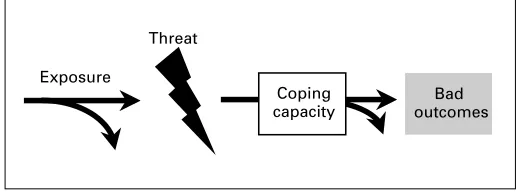
Chambers’s definition supplies a basic ‘ anatomy ’ of vulnerability that can be adapted for the study of old-age vulnerabilities. It is useful because it separates and inter-relates different analytical domains that need to be distinguished for understanding who is vulnerable in old age and why (cf. Prowse 2003 : 6). Figure 1 summarises a framework that is loosely based on Chambers’s definition and which distinguishes threats, exposure, coping and outcomes. Vulnerability is a probabilistic concept ; it captures therelationshiporproximityof a subject to harm. A person’s risk of suffering harm – her vulnerability – is the incremental outcome of a set of distinct but related risks, namely : the risk of being exposed to a threat, the risk of a threat materialising, and the risk of lacking the defences to deal with a threat.
capacity), all of which have specific probabilities. Thus, differential exposure, the differential likelihood and magnitude of the threat, and differential coping capacities all impact on the risks of encountering a bad outcome and on the severity of that outcome. The different domains can interact to compensate for each other, or can be mutually exacerbating.2 There are thereforedegrees of vulnerability, both in a person’s proximity to harm and in the severity of the harm that she or he encounters. Certain individuals may be several contingencies away from a bad outcome, and we might think of them as either ‘ weakly ’ or ‘ prospectively ’ vulnerable (see Kreager 2006). Others have already met a ‘ bad end ’, and thus, strictly speaking, they are no longervulnerable, or only vulnerable to the sequelae of their injured state. Figure 1 suggests the points at which interventions might be made :beforea threat occurs, by reducing people’s susceptibility or the likelihood and magnitude of the threat, orafterwards, by bolstering people’s defences and preventing progression to a serious outcome (Hulme, Moore and Shepherd 2001 : 9 ; Office of the Deputy Prime Minister 2005).
To use an example from gerontology, most people reaching their sixties are at risk of reduced income, and for some this might precipitate poverty. Those who during their working life contributed to a pension scheme are much less exposed to a dramatic fall in their income, and those with a life-time of poorly paid, part-time, insecure or informal employment are most susceptible (e.g. Barrientos 2000 ; Gunnarsson 2002 ; Heslop and Gorman 2002 ; Lloyd-Sherlock 2000 ; Patsios 1999). Even among those who experience income loss upon retirement, not all are equally likely to encounter poverty, as some might have compensatory coping strategies, such as financial support from family members, social assistance programmes, selling assets, running down savings, or reduced consumption. Certain strategies for staving off poverty are less desirable and successful in the long run because they
Coping capacity
Bad outcomes Exposure
[image:5.431.91.352.64.161.2]Threat
jeopardise future consumption. Moreover, for some older people, additional disadvantages compound their lack of coping, for example, when loss of income is accompanied by illness that hastens the depletion of financial resources.
If the framework in Figure 1 is beguilingly neat, the example quickly draws attention to the complexities and ambiguities in real life that undermine the tidy distinctions. First, in certain contexts, some of the domains are very closely interlinked, particularly so with exposure and threats. Whilst some threats are independent of the population at risk (e.g. loved ones die irrespective of whether they are depended upon), others are inseparable from the factors that create susceptibility to them. In the example above, there is little to distinguish ‘ highly uncer-tain and irregular employment ’ as an exposure factor from ‘ loss of income on reaching retirement ’ as a threat. Secondly, it is often not clear to which domain many factors should be ascribed ; sometimes the decision logically depends on the ultimate outcome under investigation. One might be interested in vulnerability to ill healthper se; alternatively, ill health may be modelled as something that exposes a person to the threat of employment loss, or as a threat that precipitates loneliness. At other times the ambiguity is not so easily removed, as in deciding whether childlessness or the unavailability of services is an exposure factor or a facet of restricted coping resources.
The domains that shape vulnerability in old age
This section examines the different sources of risk that constitute the framework of vulnerability in later life and assesses their relative importance. Systematic analysis requires first that the nature of the vulnerability under study is clarified, for the term ‘ vulnerable ’ is often employed as an ill-defined descriptor of people or groups who are in some way disadvantaged, or as a euphemism for ‘ poor ’, ‘ dependent ’, ‘ frail ’ or ‘ isolated ’ (Delor and Hubert 2000 : 1558 ; Russell 1999 ; Wisner 1993 : 127). This is satisfactory if the analyst is interested in vulnerability as a general state of being, for which it is impossible to specify a particular kind of harm, and where uncertainty, insecurity, powerlessness or the absence of forward planning are dominant aspects of a subject’s situation (cf. Heslop and Gorman 2002 : 6).3But where particular outcomes can be specified, it is advantageous to use the framework in Figure 1 to investigate pathways to ‘ bad ends ’ and to identify possible points of intervention.
Outcomes
‘ What is it a person is vulnerable to ? ’ inevitably raises the supplementary question, ‘ Who defines vulnerability ? ’ Are there objective criteria by which vulnerability can be assessed, or is vulnerability chiefly a subjective experience ? Some authors posit the existence of universal needs that apply across societies ; where these needs are not fulfilled, serious harm results. For example, Doyal and Gough (1991) identified health and autonomy as basic universal needs, from which secondary needs can be derived, like adequate nutrition, housing, health care, physical and economic security (for an application to the quality of life in old age, see Wigginset al. 2004). Nussbaum (2000) talked of central human functional capabilities, like avoidance of premature death, bodily health and integrity, emotions, senses, affiliation and control over one’s environment (for a discussion in relation to older people, see Lloyd-Sherlock 2002b). It is possible to deduce negative outcomes from such lists of human needs,e.g. thelack ofadequate food, shelter, health care, freedom of expression or association, and to examine vulnerability in relation to these.
or cultural context. Relying on concepts like ‘ universal needs ’ or ‘ social exclusion ’ as outcomes against which to assess vulnerability overcomes the problem that people who are habitually disadvantaged tend to have low expectations and might therefore not regard themselves as vulnerable (Lloyd-Sherlock 2002b). Such objectivity, however, can also have draw-backs, especially when studying old age, for it fails to capture the adjust-ments that people make to their goals in response to change. Many people, for example, recognise that perfect health or complete autonomy are not realistic standards by which to judge their experiences in old age (Seckeret al. 2003 ; von Faber 2002). Defining people as vulnerable and in need of protection carries the dangers of overriding their priorities or their dis-empowerment. To exemplify, Kaufman (1994a; 1994b) found that older people rejected the medicalisation and surveillance that were prescribed to reduce their vulnerability to falls, malnutrition or health decline. Similarly, Russell (1999) encountered dissonance between her perception of certain older people as highly vulnerable and in need of services, and the older people’s own perception of vulnerability, which focused on the undermining of their independence by having services forced upon them.
health care ; oversupply of care and interference ; poverty ; exclusion from participation in society ; homelessness ; loss of autonomy and dependence ; institutionalisation ; lack of social contacts and loneliness.
Threats
By threats we mean specific events that have the power of propelling people towards bad outcomes, unless they have access to resources for mitigation. This article began by referring to disaster studies, which have conceptualised vulnerability with reference to a discrete and external threat or ‘ hazard ’, like a flood or drought. Concern with such environ-mental hazards is distant from the preoccupations of most researchers and policy-makers concerned with older people, although there is a growing realisation that natural and man-made hazards disproportionately affect them, partly because of their impaired mobility and partly because of the relatively low priority they receive in rescue and relief operations (e.g. HelpAge International 2001, no date ; Wisner 1993). If interpreted broadly to include ‘ shocks ’ or ‘ crises ’, however, the concept of a threat aptly captures the often discontinuous nature of late-life progression, as when illness or bereavement disrupt a person’s routine and force the mobilisation of coping resources to avert a serious decline in wellbeing (e.g. Crane, Fu and Warnes 2004 ; Steverink 2001 ; Wenger 1997). Indeed, precisely because certain threats are discrete, they are particularly useful for understanding vulnerability, because they throw into sharp relief the reliability and adaptability (or otherwise) of a person’s support network and coping strategies (cf. Scott and Wenger 1995 : 167ff.). In other words, it is often in situations in which need becomes manifest or well-established arrangements break down that vulnerability can best be assessed.
Some threats, like declines in health and physical strength, disability, loss of income, loss of a spouse or other network members, particularly affect older people in that they arise from the biological and social pro-cesses of ageing. Indeed, recognition of the predictable and shared nature of certain life-cycle risks underlies social- and health-insurance schemes for older people, as well as family- and community-based arrangements of inter-generational support (cf. Gough and Wood 2004). Others are not life-stage dependent, but might pose greater dangers to older people if their capacity to cope with them is diminished : they include natural and man-made environmental hazards, wars, crime and economic crises.
Exposure
outcome. Exposure – also referred to as a ‘ susceptibility ’ or ‘ risk factor ’ – is introduced into discussions of vulnerability as the link between a threat and a person or group ‘ at risk ’ of the threat by virtue of having certain characteristics or inhabiting certain environments. Lifecourse approaches in demography and social gerontology have contributed to our understanding of vulnerability by uncovering exposure factors, often with origins earlier in life, which correlate strongly with insecurity in old age. For example, being unmarried or childless frequently emerges as associated with vulnerability to lack of support, loneliness and poverty in old age (e.g. Grundy 2006). Mental illness and poor socialisation increase the risk of abuse at the hands of carers, institutionalisation, or home-lessness (e.g. Crane and Warnes 1997 ; Penhale and Kingston 1997). Recent work on social exclusion has drawn attention to the importance of en-vironmental factors in shaping older people’s vulnerability. Thus, Scharf et al. (2002 ; 2005) showed that people living in extremely deprived areas of Britain face considerably higher risks than the general older population of experiencing crime, social isolation and disaffection with their neighbourhood, and of being disadvantaged through the sparse availability of public and private services. Policies and societal values, such as ageism and age discrimination, can also be seen as contributing to people’s exposure (Office of the Deputy Prime Minister 2005).
Exposure is however arguably the most problematic of the domains in the vulnerability framework because its determination carries the danger of reducing vulnerability to a set of characteristics and of neglecting other key domains, especially coping capacities. The identification of so-called vulnerable ‘ risk groups ’ provides a useful preliminary sorting, although Wisner (2004 : 186) disparaged the practice as a ‘ laundry list ’ or ‘ taxo-nomic ’ approach to vulnerability (see also Delor and Hubert 2000 ; Webb and Harinarayan 1999). HelpAge International (2000) published ‘ vulnerable individual checklists ’ for use in refugee camps that quickly identify those older people who require most attention because of their deficient living arrangements, kin availability, health, mobility and basic needs. Policy makers generally also like to focus on exposure factors when designing risk prevention and mitigation strategies (Kemshall 2002 : 77 ; World Bank 2000 : 141). To acquire a deeper understanding of who is vulnerable and why, a concentration on risk groups is less effective, as the following example from Asia shows.
process of ageing, previous studies or reports in the mass media ’ (ibid. 465), and included several of the ‘ usual suspects ’, such as the ‘ old-old ’, the spouseless, those without children or living alone, as well as less commonly identified groups, like rural residents, people with no education (in settings where this is the norm), and women in general. The authors then analysed their survey data to examine ‘ the extent to which groups thought to be particularly vulnerable to experiencing these outcomes were doing so relative to [all older people] ’ (ibid. 462). In fact, only four to 16 per cent of the variance in the specified disadvantages was associated with the defined ‘ vulnerable groups ’. This was not surprising, because neither the reasons why women, uneducated elders or rural residents were supposedly more vulnerable, nor the factors mediating their vulnerability, were addressed.
Vulnerability is not intrinsic to personal characteristics, but arises from combinations of characteristics and, importantly, from interactions between exposure, threats and coping in specific contexts (Delor and Hubert 2000 ; Watts and Bohle 1993 : 121). Marianti’s (2002 ; 2004) research on widows in Java showed that Javanese culture, in contrast to cultures prevailing elsewhere (e.g. in Spain, India and Algeria), does not assign widows an exceptional status, much less a marginal one. There is considerable equality between men and women, and women control their own resources. If older widows are vulnerable, they are so as a result of a conflation of factors, such as lack of income, poor health and child-lessness, and widowhood per se makes at best a small contribution (see also Wisner 1993 : 131). But vulnerability is not invariable even among narrowly-defined risk groups. For example, not all childless and poor widows are prone to destitution or a bad death, because some manage to mobilise alternative sources of support ; in other words, some have strong coping capacities (Kreager and Schro¨der-Butterfill 2004).
Coping capacities
weaker notion of agency), which enable people with the same assets and exposure to end up in different positions. In other words, what makes a person more or less vulnerable is not only the relationships and assets that she brings to an event or crisis, but also her ability to mobilise resources and support during an event. This gives coping capacities an important relational and dynamic aspect.
In the context of old-age vulnerabilities, coping capacities fall into three broad groups : individual capacities, social networks, and formal social protection. Individual capacities include personal wealth and human capital, i.e. education, skills and health. Aside from shaping people’s accumulation of social and material resources over the life cycle (Broese van Groenou and van Tilburg 2003 ; Ogg 2005), human capital may influence older people’s capacity to seek support in old age. Individual capacities also include personal adaptations that older people undertake to reduce their vulnerability, e.g. exercising to regain mobility after an operation (von Faber 2002). All in all, however, individual coping capacities are rarely sufficient for dealing with the challenges of old age ; relational resources, be they social networks or links to formal sources of support, are usually more effective.
The importance of family networks for material, practical and emotional assistance in old age has been amply documented (e.g. Biddlecom, Chayovan and Ofstedal 2003 ; Grundy 2003 ; Knodel, Chayovan and Siriboon 1995 ; Phillipsonet al. 1998 ; Wenger 1995). It has been shown that, in Europe, lack of family support predisposes towards institutionalisation in old age (cf. Burholt 1998 ; Scott and Wenger 1995 : 164), whilst in Asia, it might lead to destitution and reliance on charity (Indrizal 2004 ; Marianti 2004 ; Vera-Sanso 2004). Of course, family networks are not always beneficial : some older people feel burdened by family conflict, whilst others provide intergenerational support which may reduce their capacity to support themselves (Evandrou and Falkingham 2004 : 194 ; Schro¨der-Butterfill 2004b; Wiggins et al. 2004 : 705). This underlines the fact that understanding old-age vulnerability requires examination not only of the size and composition of people’s networks, but also of the quality of relationships and the nature and direction of exchanges (see the example below from East Java ; and also Kreager 2006 ; van Eeuwijk 2006).
informal support arrangements are unlikely to protect from the worst outcomes in old age, as they rarely cover physical care or far-reaching material support. For example, community institutions in the developing world tend to operate on a basis of reciprocity, which means that older people who can no longer contribute are excluded and forced to rely on circumscribed and demeaning charity (cf. Schro¨der-Butterfill 2004a; Scott 1976). Even where exclusion is not the problem, the efficacy of informal support networks may be low if members are of the same age, wealth and status, and therefore suffer from similar threats and constraints. Put simply, poor people tend to have poor networks. Where, by contrast, informal institutions cut across economic strata – as in patronage arrange-ments or religious welfare institutions – they may create what Wood (2004 : 51 and 64ff.) has called ‘ dependent security ’ and maintain inequalities and disadvantage (see also Breman and Wiradi 2002).
The limitations of exclusive reliance on personal resources and informal networks to reduce vulnerability in old age make clear the importance of formal welfare provisions, like pensions and health and social services. These have the advantages of pooling risks across large numbers, of evening out individual differences in resources, and of economies of scale. The ability of formal welfare arrangements to reduce vulnerability to poverty, lack of instrumental support and health care has been well documented for countries of the North and South, although uneven coverage and quality are widespread (e.g. Gough and Wood 2004 ; HelpAge International and Gorman 2004 ; International Labour Organisation 2003 ; Lloyd-Sherlock 2002a; Ogg 2005). However, in Europe state provision is being stretched to its limits, and whilst coverage is expanding in many Asian countries (Adam, von Hauff and John 2002 ; Arifianto 2004 ; Asher 1998), it is unlikely to reach the European scale. Increasingly, therefore, attention is shifting to the interactions between family, community and state support, and to the question of whether formal support compensates for lack of informal support, or whether its distribution tends to reinforce inequalities in access to assistance (e.g. Lowenstein and Ogg 2003).
Case studies of old-age vulnerability in Britain and Indonesia
vulnerability, the paper now examines two specific and contrasting types of old-age vulnerability.
Vulnerability to homelessness in old age
Homelessness in old age has been the subject of several in-depth studies by Maureen Crane and Tony Warnes since the 1990s, and their published research results and policy and practice discussions form the basis of the present discussion.6They have analysed pathways into homelessness in later life, and although they did not employ the exact terminology used in this article, their study of homelessness fits naturally into the framework developed here. Being or becoming homeless is an unequivocally ‘ bad outcome ’, even if a few homeless people prefer it to other, less desired, living situations. As Crane, Fu and Warnes reflected, ‘ homelessness is an absolute social malaise that is intolerable. … becoming homeless is a dire condition and if protracted highly damaging to an individual’s identity, self-worth, morale and physical and mental health. The experience stigmatises not only the individual but also the society that permits (or fails to prevent) the occurrence ’ (2004 : 40, emphases in the original). Homelessness in old age is particularly pernicious, as people’s physical defences in the face of deplorable living conditions and poor nutrition are likely to be weak. Homelessness often entails a host of further maladies, such as exposure to violence and crime, morbidity, poor access to social and health services and low life expectancy (see Figure 2).
Early approaches to homelessness blamed specific causes, such as housing shortage, eviction or bereavement (see Crane and Warnes 1997 : 7, 29), but not everyone who loses her home or spouse becomes homeless ; nor has the large-scale provision of subsidised housing prevented or solved the problem. Rather, homelessness results from a vicious interaction of exposure factors, threats and multiple failures of coping capacities : ‘ A single incident may act as a ‘‘ trigger ’’,i.e. the actual event that causes a person to leave or to be evicted from their home, but other factors (states or events) are usually involved. … For example, a person may have a mental illness, not be able to manage independently, and receive support from a parent or a spouse. Whilst the support is maintained the person is unlikely to become homeless. If the parent or spouse dies, however, or there is a marital breakdown and no other support is available, the person may be vulnerable and become homeless ’ (Crane and Warnes 1997 : 29).
progressively more vulnerable as she accumulates exposure factors or threats and lacks compensatory safety nets. Crane and Warnes identified a number of common ‘ states ’ that predispose towards homelessness in old age. Several derive from earlier lifecourse stages, including disrupted or abused childhoods ; mental illness, poor socialisation and poor daily living skills ; having been in the army, navy, merchant marine or other highly structured working and living environments ; small social networks and/or living alone ; and alcohol or substance abuse (see Figure 2).7 In many instances, several factors coincided, as when depression resulted from a bad childhood, or social isolation led to alcohol abuse.
None of these states in themselves explain homelessness. For this it is necessary also to consider threats and the failure of coping capacities. Crane and her colleagues described several pathways into homelessness that shared typical features, chiefly the inability to cope independently after an event has derailed habitual patterns of coping and support. Common threats that trigger descent into rough sleeping were loss of a partner, parent or other key social contact ; loss of housing, particularly of tied accommodation ; and increased severity of mental illness, especially paranoia (leading to abandonment of accommodation). Retirement or loss of work, and ensuing financial or psychological pressures, physical illness and anti-social behaviour (leading to eviction) were also precursors to homelessness (see Figure 2). The following brief
Threats
Loss of carer or key social contact, increased severity of mental illness, loss of (tied) accommodation, retirement or loss of work, physical illness, anti-social behaviour
Coping
Compensatory family support, early detection of risk by social services, integrated social services, re-housing and assisted living
Outcomes
Homelessness, sequelae of homelessness: morbidity, early death, violence and abuse, lack of access to services, social exclusion
Exposure
employment in army or navy, social isolation
[image:15.431.64.382.55.274.2]Disturbed childhood, mental illness, poor socialisation, alcohol or substance abuse,
examples give an idea of the interaction of different risks resulting in homelessness :
One man became homeless at age 78 years when, following an accident, he was no longer able to occupy his room on the top floor of a Housing Association house. Initially he was moved into a room on the ground floor, but as this also served as the communal lounge, the arrangement proved unsatisfactory. According to the man’s account, the housing provider claimed that no alternative, appropriate housing was available, and thus he had to move into a hostel (Crane, Fu and Warnes 2004 : 12).
In the case of a homeless woman, extremely stressful life events triggered mental illness. The woman was divorced, bringing up a daughter alone and looking after her increasingly confused mother whilst keeping down two jobs. After her mother was first taken into social services care and then died, she developed progressively paranoid ideas, one result being that she quit her work. Ensuing financial difficulties meant that she was unable to keep up with mortgage and bill payments. She was taken to court and her house repossessed (Crane and Warnes 1997 : 32).
One never-married man lived alone in a council flat. He suffered from a speech impediment and took up drinking quite heavily after being made redundant at age 58 years. Following a hip operation he briefly received home care, but this was soon discontinued due to his drinking and unco-operative nature. Nonetheless, he managed on his own and was often visited by his sister. Eventually, however, he allowed another heavy drinker to move into his flat and, not long after, a group of men moved in, stole his benefit money and locked him out of the house (Crane, Fu and Warnes 2004 : 17).
Thirdly, the examples underline the role, and in this case failure, of formal support services in preventing homelessness. Many of the homeless people studied had been in contact with formal services, yet in some cases nothing or not enough had been done to protect them ; in other cases, offered help had been refused. In identifying specific combinations of exposure and threats which create vulnerability to homelessness – many of which could be monitored by housing providers, GPs or hospital staff – a vulnerability approach can point to the social support gaps and contribute to service delivery improvements (e.g. Crane 1998 : 179 ; Crane, Fu and Warnes 2004). As Crane and colleagues observed, British welfare services fail to provide integrated support to people with combined mental health, socialisation, substance abuse and anti-social behaviour problems and offer insufficient assisted-housing schemes to help people remain housed once they come off the streets (Crane, Fu and Warnes 2004 ; Crane and Warnes 2005). Seen in this light, vulnerability to homelessness in old age can be summarised as arising from the combined risks of manifest need for support, chiefly due to personal problems on the part of an older person, and a failure of formal social support. This clear-cut statement must be qualified, however, by the observation that not all homeless people whom professionals regard as vulnerable and in need of support share their assessment, and some refuse or obstruct assistance. This leads to the fourth point, that people’s needs and their vulnerability are often contested, which raises intractable ethical, practical and intellectual dilemmas for the management of vulnerability. Imposing standards of good or bad outcomes on others is undesirable and often fruitless, yet it is equally unacceptable not to intervene to alleviate states of ‘ absolute social malaise ’ and, more generally, to raise people’s expectations for their wellbeing in later life.
Vulnerability to a lack of care in old age
that frailty, illness or disability may one day force reliance on others. Outright dependence is considered to undermine social status and may deprive older people of any right to determine what happens to them. For this reason, older people strive to counterbalance dependence with reciprocal exchanges and to avoid dependence on the ‘ wrong kind ’ of support, that is, on individuals or institutions not customarily expected to provide far-reaching help, to whom the recipient would become indebted and socially subordinated (cf. Schro¨der-Butterfill 2004a: 132ff.).
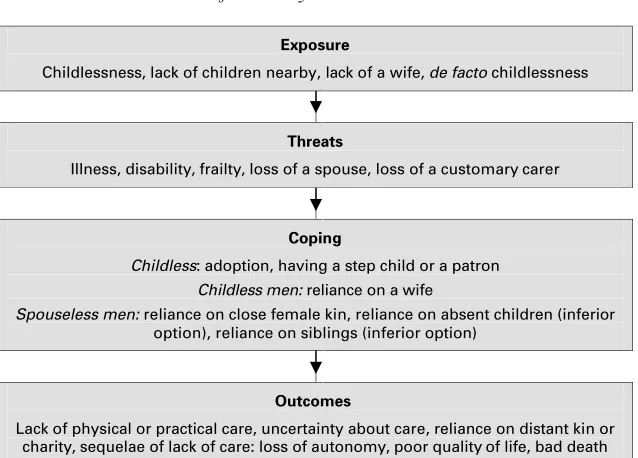
There is a recognisable hierarchy of preferences with regard to care provision. Domestic labour is highly gendered, with women responsible for shopping, cooking, cleaning and caring for sick family members. For men in need of care, it is most acceptable to rely on their wives, and for both men and women, reliance on co-resident or nearby daughters is welcome. Increasing kinship distance is associated with an increased feeling of ‘ awkwardness ’ in the event of dependence, so reliance on daughters-in-law and grandchildren is regarded as inferior to reliance on spouses or daughters. Care by other relatives is even less normative, and care by non-relatives usually stigmatising and, if forthcoming, generally of low quality (Marianti 2002 : 125ff. ; Schro¨der-Butterfill 2004a). Inadequate or inappropriate care may mean an undignified and unpleasant last period of life or an untimely death (see also van Eeuwijk 2006). The ‘ bad outcomes ’ surrounding old-age care in East Java are summarised in Figure 3. Assessing vulnerability to a lack of care is complicated by the fact that both ‘ supply ’ and ‘ demand ’ is uncertain : older people may or may not one day need care, and the required care may or may not be provided. The risk of needing care is affected by threats such as illness, disability, or general frailty.9 The risk of not receiving adequate care is affected by those threats that remove customary sources of care from networks, such as loss of a spouse or a child.
‘ prospectively vulnerable ’ with at least one exposure factor, and two-thirds of these had more than one exposure.
As Figure 3 shows, several acceptable pathways around these dis-advantages substantially reduced the number of older people who were vulnerable at the time of the study. In the case of childlessness, acquiring adoptees or step-children is not unusual, especially among the better off, whilst living with a rich patron was much rarer but a good solution for the poor. Many of the childless orde factochildless men had a wife to rely on. Among elders whose children were all absent, some had offspring within easy travelling distance who returned when the need arose, and some lived with an adult grandchild. Several of the widowed or divorced men lived with a daughter, daughter-in-law or granddaughter and were thereby assured of care should they need it. Some elders had several coping capacities, such as support from an adoptee and a wife. In addition to these preferred options, there were instances of older people relying on or looking to kin, especially siblings. All in all, only 16 of the 84 elders classed as ‘ prospectively vulnerable ’ to a lack of care in old age had no coping mechanism in place. They were either acutely vulnerable – a single crisis away from experiencing a lack of care – or they had already reached a ‘ bad end ’, that is, were suffering from ill health or frailty without being cared for, or were reliant on stigmatising
Exposure
Childlessness, lack of children nearby, lack of a wife, de facto childlessness
Threats
Illness, disability, frailty, loss of a spouse, loss of a customary carer
Coping
Childless: adoption, having a step child or a patron Childless men: reliance on a wife
Spouseless men: reliance on close female kin, reliance on absent children (inferior option), reliance on siblings (inferior option)
Outcomes
[image:19.431.63.382.50.279.2]Lack of physical or practical care, uncertainty about care, reliance on distant kin or charity, sequelae of lack of care: loss of autonomy, poor quality of life, bad death
charitable care by distant kin or neighbours (for examples see Marianti 2004 : 163 ff. ; Schro¨der-Butterfill 2004a: 134 ff. ; Schro¨der-Butterfill and Kreager 2005 : 42).
Even those with apparent coping capacities require further scrutiny, however, as social ties were not always reliable, and a single threat might undermine a coping strategy. To assess whether people’s coping capacities can protect them from vulnerability, two approaches are available. One relies on cross-sectional data and estimates the expanse and strength of the support network ; this reveals, for example, whether an older person has only a single acceptable option for care provision, or whether several links exist but are quite weak because of geographical or emotional distance. The other approach is to assess the reliability or flexibility of support networks with longitudinal data ; this reveals the ultimate incidence of ‘ bad ends ’ and, more importantly, raises our understanding of vulnerability by uncovering the dynamic interplay of exposure, threats and coping capacities. Two brief case studies illustrate the longitudinal approach.
Lubis, a man in his eighties, had no children of his own but had four stepchildren from two marriages, and he had also helped to raise two sons of a neighbour. None of his ‘ children ’ had stayed in the village. When interviewed in 1999, Lubis lived with his wife, who was 15 years younger. Lubis himself was in good health and therefore considered relatively invulnerable to a lack of care, although the couple’s material security was in doubt as they lacked steady income or regular support from children. By 2004, Lubis’s situation had changed dramatically. His wife had left him to join her daughter elsewhere, after which for cooked food Lubis for a while relied on distant relatives in the village. When he fell, however, he became frail and often needed accompanying to the toilet and washing ; the relatives soon tired of caring for him. One day Lubis was lured into a car under a pretext and taken to his great-nephew’s house in a nearby town. When Lubis realised he was being dumped on a relative he hardly knew, he put up a tearful but fruitless protest. He survived a few more months, and his wish to be buried in the village was not respected.
The two vignettes show how sudden threats make relatively secure older people more vulnerable, and they reveal people’s agency in reacting to new challenges. Sofia had a small and shrinking kin network, but her comparative wealth and generosity enabled her to forge new ties to fore-stall a potential lack of care in old age. Lubis’s more extensive network comprised mainly weak or contestable ties (i.e. to informally adopted and step-children). His poverty and low social status, worsened by his wife’s desertion, added to the unwillingness of kin and neighbours to care for him and deprived him of any bargaining power when it came to the final arrangements for his care.
A preliminary assessment of the longitudinal evidence on vulnerability to a lack of care suggests that, of those older people classed as ‘ prospec-tively vulnerable ’ in the study village, almost one-half (39 out of 84) were currently secure. These older people had apparently reliable access to care from a spouse, child (own or adopted), child-in-law or grandchild, or they had a close relationship with a sibling or patron. The other half, representing one-in-five of the older people in the village, were vulnerable to a lack of care in old age. They included those without coping capacities (some of which had already experienced a lack of care), as well as those with very limited or weak ties. A breakdown by economic status revealed that ‘ poverty in persons ’ went hand-in-hand with material poverty. Those who were vulnerable to a lack of care in old age amounted to one-quarter of those in social Strata I and II, but 58 per cent of those in Stratum III and 76 per cent in Stratum IV.11 Their uncertainty about practical or physical care was compounded by their inability to protect their independence through access to health services and good nutrition.
Conclusions
disadvantages accumulated over the lifecourse and the experience of threats in later life. Whether this interaction results in a better or worse outcome depends on the adequacy of the person’s coping resources. The study of vulnerability therefore requires attention not only to the ways in which exposure factors are created and distributed over time, but also to the ways in which individuals manage or fail to mobilise social, material and public resources to protect themselves from bad outcomes.
The two case studies presented have illustrated these points well. In the British case, the state has assumed a large responsibility for securing the welfare of older people, which raises the questions of how it is that some people slip through the welfare net and become homeless in old age, and what characteristics and threats place people at that risk. In Indonesia, by default the family and community are responsible for pro-viding support to needy members, but these informal networks operate unevenly. The issue thus becomes what determines the availability and reliability of support and care to older people. In the former case, personal disadvantages and the compartmentalisation and inflexibility of services emerged as important aspects of people’s vulnerability ; in the latter, demographic histories and economic and social status played key roles. On one level, the situations were very different, which under-lines the importance both of defining the nature of vulnerability and considering the specific social, cultural, economic and policy contexts.
Contrasting methodologies were used to study the different vulner-abilities. Crane and Warnes worked retrospectively from an out-come – homelessness – and uncovered the pathways leading to it. A lack of care in old age as an outcome is more elusive, as it often only manifests itself when the need for care arises, which might be close to the end of a person’s life, or indeed never. We were therefore forced to assess vulnerability prospectively on the basis of present network con-figurations, but were in some cases able to follow up support networks and see how good or bad outcomes unfolded. Longitudinal ap-proaches – be they life histories or panel designs – are clearly important tools for understanding vulnerability.
vulnerability means that outcomes are never inevitable or perfectly predictable. Some person or institution may step in, or a vulnerable subject may mobilise resources to avert a crisis. This complexity and indeterminacy make vulnerability a difficult phenomenon to study, but also one that is worth pursuing. Raising our understanding of this intellectually rich concept promises to make a valuable contribution to the improvement of older people’s lives.
Acknowledgements
Elisabeth Schro¨der-Butterfill is grateful to The Wellcome Trust, the Economic and
Social Research Council and The British Academy, and Ruly Marianti to the Royal
Netherlands Academy of Arts and Sciences, for generous funding without which our
research would not have been possible. The authors express sincere gratitude to
the Asia-Europe Foundation and European Alliance for Asian Studies for funding the
workshop entitled ‘ Old-Age Vulnerabilities – Asian and European Perspectives ’, which took place in Indonesia in July 2004, at which early versions of the papers in this special issue were presented. Peter Lloyd-Sherlock, Philip Kreager, Tom Scharf, Margaret von Faber, Tony Warnes and Hannah Zeilig provided useful comments on earlier drafts for which we are most grateful. For remaining shortcomings only we are to blame.
N O T E S
1 TheOxford English Dictionarydefiniton of vulnerable is ‘ may be wounded, is susceptible to injury or open to attack ’.
2 The emphasis of this paper is on bad outcomes, but of course the framework can equally well be used to account for why some people are secure and encounter a positive outcome.
3 This sense of vulnerability is captured in the statement by a middle-aged man in Bulgaria : ‘ To be well is to know what will happen with me tomorrow ’ (World Bank 2000 : 135).Notknowing ‘ what will happen tomorrow ’ seems a powerful indicator of vulnerability as a general state of being, albeit one that is difficult to analyse. 4 The ‘ disadvantages ’ included economic disadvantages (inadequate income, lack
of assets, dependence on children), health disadvantages (poor self-rated health, functional limitations, impairments) and social disadvantages (infrequent visits from children, small social networks, depression and loneliness).
5 The term ‘ coping ’ is from Chambers’s (1989 : 1) definition of vulnerability, although it is also used by other authors (e.g.Watts and Bohle 1993). It has been criticised as being too weak or fatalistic, for giving rise to an image of people merely ‘ getting by ’ or failing to get by (e.g.Prowse 2003 : 23 ; Wisner 2004 : 192). Other authors have sought terms that capture a stronger sense of agency : for example, Wisner (2004 : 191) talks of ‘ capabilities ’, and Moser (1998 : 3) of ‘ resilience ’, ‘ responsiveness in exploiting opportunities ’, even of ‘ means of resistance ’. We agree that in some contexts these terms are preferable; in others, even talk of coping is too positive, for sometimes people are merely able to stave off the worst possible outcome.
Manchester (see Crane 1998, 1999 ; Crane and Warnes 1997). This was followed by a study of the outcomes of resettlement of older people in west London (Crane and Warnes 2000). Most recently, the ESRC has supported research into the causes of homelessness in a sample of 125 newly homeless people aged 50 or more years in England, with comparative studies conducted by collaborators in Boston, Massachusetts, and Victoria, Australia (Crane, Fu and Warnes 2004 ; Crane et al.
2005).
7 For example, 58 per cent of the older homeless people who were interviewed reported coming from broken or disturbed homes ; 41 per cent had had mental health problems before homelessness ; 69 per cent of the men had spent time in the army or navy; 59 per cent of men and 39 per cent of women were never-married; only 39 per cent had children, of whom more than half had not had contact with their children in the past five years (Crane and Warnes 1997).
8 The work by Marianti (2002 ; 2004) focused on family and community networks of widows in an urban setting. Schro¨der-Butterfill’s research examined older people’s networks in a rural environment and combined ethnographic and quantitative methods ; the rural study was longitudinal with observations during four periods between 1999 and 2005 (for details see Marianti 2004 ; Schro¨der-Butterfill 2004a, 2004b).
9 Stroke, falls, poor eyesight, serious rheumatic pains and attendant mobility problems are quite common in the communities we studied. In a survey of older people in three rural Indonesian communities (including the one studied by Schro¨der-Butterfill), 16 per cent of people aged 60 or more years were classified as having poor health and thus needing some degree of care (unpublished results).
10 The location of the study areas is indicated on the map (Figure 1) in Kreager 2006 : 43.
11 For details of socio-economic stratification in the locality, see Kreager 2006.
References
Adam, E., von Hauff, M. and John, M. (eds) 2002.Social Protection in Southeast and East Asia. Friedrich Ebert Stiftung, Singapore.
Arifianto, A. 2004.Social Security Reform in Indonesia : An Analysis of the National Social Security Bill. SMERU Working Paper, SMERU Research Institute, Jakarta.
Asher, M. G. 1998. The future of retirement protection in Southeast Asia.International Social Security Review,51, 1, 3–30.
Bajekal, M., Blane, D., Grewal, I., Karlsen, S. and Nazroo, J. 2004. Ethnic differences in influences on quality of life at older ages : a quantitative analysis.Ageing & Society,24, 5, 709–28.
Bankoff, G. 2001. Rendering the world unsafe : ‘ vulnerability ’ as Western discourse.
Disasters,25, 1, 19–35.
Barrientos, A. 2000. Work, retirement, and vulnerability of older persons in Latin America.Journal of International Development,12, 495–506.
Benda-Beckmann, F. von and Benda-Beckmann, K. von 1994. Coping with insecurity.
Focaal,22/23, 7–31.
Biddlecom, A., Chayovan, N. and Ofstedal, M. B. 2003. Intergenerational support and transfers. In Hermalin, A. (ed.), The Well-Being of the Elderly in Asia : A Four-Country Comparative Study. University of Michigan Press, Ann Arbor, Michigan, 185–229. Blaikie, P., Cannon, T., Davis, I. and Wisner, B. 1994. At Risk : Natural Hazards, People’s
Breman, J. and Wiradi, G. 2002.Good Times and Bad Times in Rural Java. KITLV Press, Leiden, The Netherlands.
Broese van Groenou, M. and van Tilburg, T. 2003. Network size and support in old age : differentials by socio-economic status in childhood and adulthood.Ageing & Society,23, 5, 625–45.
Brooks, N. 2003.Vulnerability, Risk and Adaptation : A Conceptual Framework. Tyndall Centre Working Paper 20, University of East Anglia, Norwich, Norfolk.
Burholt, V. 1998. Pathways into residential care : service use, help and health prior to admission.Health Care in Later Life,3, 1, 15–33.
Cameron, L. and Cobb-Clark, D. 2001.Old-Age Support in Developing Countries : Labor Supply, Intergenerational Transfers and Living Arrangements. Working Paper 773, Department of Economics, University of Melbourne, Melbourne, Australia.
Chambers, R. 1989. Vulnerability, coping and policy. IDS Bulletin (Institute of Development Studies, University of Sussex),20, 2, 1–7.
Crane, M. 1998. The associations between mental illness and homelessness among older people : an exploratory study.Aging and Mental Health,2, 3, 171–80.
Crane, M. 1999.Understanding Older Homeless People : Their Circumstances, Problems and Needs. Open University Press, Buckingham.
Crane, M. and Warnes, A. M. 1997. Homeless Truths : Challenging the Myths About Older Homeless People. Help the Aged and Crisis, London.
Crane, M. and Warnes, A. M. 2000.Lessons from Lancefield Street : Tackling the Needs of Older Homeless People. National Homeless Alliance, London.
Crane, M. and Warnes, A. M. 2005. Exclusion and homelessness in Britain. Parity
(Australian Council of Homeless Persons),18, 1, 8–10.
Crane, M., Fu, R. and Warnes, A. M. 2004. Building Homelessness Prevention Practice : Combining Research Evidence and Professional Knowledge. Sheffield Institute for Studies on Ageing, University of Sheffield, Sheffield, 1–48.
Crane, M., Byrne, K., Fu, R., Lipmann, B., Mirabelli, F., Rota-Bartelink, A., Ryan, M., Shea, R., Watt, H. and Warnes, A. M. 2005. The causes of homelessness in later life : findings from a three nation study. Journal of Gerontology : Social Sciences, 60B, 3, S152–9.
Delor, F. and Hubert, M. 2000. Revisiting the concept of ‘ vulnerability ’.Social Science and Medicine,50, 1557–70.
Doyal, L. and Gough, I. 1991.A Theory of Human Need. Macmillan, London.
Evandrou, M. and Falkingham, J. 2004. Demographic change in Europe : implications for future family support for older people. In Kreager, P. and Schro¨der-Butterfill, E. (eds),Ageing Without Children : European and Asian Perspectives. Berghahn, Oxford, 176–97. Gabriel, Z. and Bowling, A. 2004. Quality of life from the perspectives of older people.
Ageing & Society,24, 675–91.
Gardner, K. 2002.Age, Narrative and Migration : The Life Course and Life Histories of Bengali Elders in London. Berg, Oxford.
Gough, I. and Wood, G. 2004.Insecurity and Welfare Regimes in Asia, Africa and Latin America : Social Policy in Development Contexts. Cambridge University Press, Cambridge.
Grundy, E. 2003. Looking beyond the household : intergenerational perspectives on living kin and contacts with kin in Great Britain. Paper presented to the meeting onKinship and Relationships Beyond the Household, Royal Statistical Society, London, 4 February. Grundy, E. 2006. Ageing and vulnerable elderly people : European perspectives.Ageing &
Society,26, 1, 105–34.
Gunnarsson, E. 2002. The vulnerable life course : poverty and social assistance among middle-aged and older women.Ageing & Society,22, 6, 709–28.
HelpAge International 2001.Emergencies and Ageing : A Position Paper. HelpAge International, London.
HelpAge International 2000. Older People in Disasters and Humanitarian Crises : Guidelines for Best Practice. HelpAge International, London.
HelpAge International 2002. Participatory Research with Older People : A Sourcebook. HelpAge International, London.
HelpAge International and Gorman, M. 2004.Age and Security : How Social Pensions Can Deliver Effective Aid to Poor Older People and Their Families. HelpAge International, London. Hermalin, A., Ofstedal, M. B. and Mehta, K. 2002. The vulnerable and their potential disadvantages. In Hermalin, A. (ed.),The Well-Being of the Elderly in Asia : A Four-Country Comparative Study. University of Michigan Press, Ann Arbor, Michigan, 461–518. Heslop, A. and Gorman, M. 2002.Chronic Poverty and Older People in the Developing World.
Chronic Poverty Research Centre Working Paper 10, University of Manchester, Manchester.
Hilhorst, D. and Bankoff, G. 2004. Introduction : mapping vulnerability. In Bankoff, G., Frerks, G. and Hilhorst, D. (eds),Mapping Vulnerability : Disasters, Development and People. Earthscan, London, 1–9.
Hulme, D., Moore, K. and Shepherd, A. 2001. Chronic Poverty : Meanings and Analytical Frameworks. Chronic Poverty Research Centre Working Paper 2, University of Manchester, Manchester.
Indrizal, E. 2004. Problems of elderly without children : a case study of the matrilineal Minangkabau, West Sumatra. In Kreager, P. and Schro¨der-Butterfill, E. (eds),Ageing Without Children : European and Asian Perspectives on Elderly Access to Support Networks. Berghahn, Oxford, 49–76.
International Labour Organisation 2003. Social Security and Coverage for All. Restructuring the Social Security Scheme in Indonesia : Issues and Options. International Labour Office, Jakarta.
Kaufman, S. 1994a. Old age, disease, and the discourse on risk : geriatric assessment in US health care.Medical Anthropology Quarterly,8, 4, 430–47.
Kaufman, S. 1994b. The social construction of frailty : an anthropological perspective.
Journal of Aging Studies,8, 1, 45–58.
Kemshall, H. 2002.Risk, Social Policy and Welfare. Open University Press, Buckingham. Knodel, J., Chayovan, N. and Siriboon, S. 1995. Familial support and the life course
of Thai elderly and their children. In Hareven, T. (ed.),Aging and Generational Relations over the Life Course. Walter de Gruyter, Berlin, 438–61.
Knodel, J. and Debavalya, N. 1997. Living arrangements and support among the elderly in Southeast Asia : an introduction.Asia-Pacific Population Journal,12, 4, 5–16.
Kreager, P. 2003. Understanding elderly vulnerability in Indonesia. IIAS Newsletter
(International Institute of Asian Studies, Leiden University, The Netherlands),32, 12. Kreager, P. 2006. Migration, social structure and old-age support networks : a comparison
of three Indonesian communities.Ageing & Society,26, 1, 37–60.
Kreager, P. and Schro¨der-Butterfill, E. (eds) 2004. Ageing Without Children : European and Asian Perspectives. Berghahn, Oxford.
Lloyd-Sherlock, P. 2000. Old age and poverty in developing countries : new policy challenges.World Development,28, 12, 2157–68.
Lloyd-Sherlock, P. 2002a. Aging and health policy : global perspectives. In Lee, K., Buse, K. and Fustukian, S. (eds),Health Policy in a Globalising World. Cambridge University Press, Cambridge, 195–207.
Lloyd-Sherlock, P. 2002b. Nussbaum, capabilities and older people.Journal of International Development,14, 8, 1163–73.
Lloyd-Sherlock, P. 2006. Identifying vulnerable older people : insights from Thailand.
Lowenstein, A. and Ogg, J. (eds) 2003. Old Age and Autonomy : The Role of Service Systems and Intergenerational Solidarity. OASIS project final report, University of Haifa, Haifa, Israel.
Marianti, R. 2002.Surviving Spouses : Support for Widows in Malang, East Java. Published Ph.D thesis, Amsterdam School for Social Science Research, Amsterdam University, Amsterdam.
Marianti, R. 2004. In the absence of family support : cases of childless widows in urban neighbourhoods of East Java. In Kreager, P. and Schro¨der-Butterfill, E. (eds), Ageing Without Children : European and Asian Perspectives. Berghahn, Oxford, 147–71.
Midgley, J. 1994. Social security policy in developing countries : integrating state and traditional systems.Focaal,22/23, 219–29.
Moser, C. 1998. The asset vulnerability framework : reassessing urban poverty reduction strategies.World Development,26, 1, 1–19.
Nussbaum, M. C. 2000.Women and Human Development : The Capabilities Approach. Cambridge University Press, Cambridge.
Office of the Deputy Prime Minister 2005.Excluded Older People : Social Exclusion Unit Interim Report. Office of the Deputy Prime Minister, London.
Ogg, J. 2005. Social exclusion and insecurity among older Europeans : the influence of welfare regimes.Ageing & Society,25, 1, 69–90.
Oliver-Smith, A. 1999. What is a disaster ? Anthropological perspectives on a persistent question. In Oliver-Smith, A. and Hoffman, S. (eds), The Angry Earth : Disaster in Anthropological Perspective. Routledge, New York, 18–33.
Patsios, D. 1999.Poverty and Social Exclusion Amongst the Elderly. Poverty and Social Exclusion Survey of Britain Working Paper 20, Townsend Centre for International Poverty Research, University of Bristol, Bristol, Avon.
Penhale, B. and Kingston, P. 1997. Elder abuse, mental health and later life : steps towards and understanding.Aging and Mental Health,1, 4, 296–304.
Phillipson, C., Bernard, M., Phillips, J. and Ogg, J. 1998. The family and community life of older people : household composition and social networks in three urban areas.Ageing & Society,18, 3, 259–89.
Prowse, M. 2003.Towards a Clearer Understanding of‘Vulnerability’in Relation to Chronic Poverty. Chronic Poverty Research Centre Working Paper 24, University of Manchester, Manchester.
Russell, C. 1999. Interviewing vulnerable old people : ethical and methodological implications of imagining our subjects.Journal of Aging Studies,13, 4, 403–17.
Scharf, T., Phillipson, C. and Smith, A. E. 2005. Aging in a difficult place : assessing the impact of urban deprivation on older people. In Wahl, H.-W., Tesch-Romer, C. and Hoff, A. (eds), New Dynamics in Old Age : Individual, Environmental and Societal Perspectives. Baywood, New York, forthcoming.
Scharf, T., Phillipson, C., Smith, A. E. and Kingston, P. 2002.Growing Older in Socially Deprived Areas : Social Exclusion in Later Life. Help the Aged, London.
Schro¨der-Butterfill, E. 2004a. Adoption, patronage, and charity : arrangements for the elderly without children in East Java. In Kreager, P. and Schro¨der-Butterfill, E. (eds),
Ageing Without Children : European and Asian Perspectives. Berghahn, Oxford, 106–46. Schro¨der-Butterfill, E. 2004b. Inter-generational family support provided by older people
in Indonesia.Ageing & Society,24, 4, 497–530.
Schro¨der-Butterfill, E. and Kreager, P. 2005. Actual andde factochildlessness in old age : evidence and implications from East Java, Indonesia.Population and Development Review, 31, 1, 19–55.
Scott, J. 1976. The Moral Economy of the Peasant. Yale University Press, New Haven Connecticut.
Secker, J., Hill, R., Villeneau, L. and Parkman, S. 2003. Promoting independence : but promoting what and how ?Ageing & Society,23, 3, 375–91.
Steverink, N. 2001. When and why frail elderly people give up independent living : the Netherlands as an example.Ageing & Society,21, 1, 45–69.
van Eeuwijk, P. 2006. Old-age vulnerability, ill-health and care support in urban areas of Indonesia.Ageing & Society,26, 1, 61–80.
Vera-Sanso, P. 2004. ‘ They don’t need it, and I can’t give it ’ : filial support in South India. In Kreager, P. and Schro¨der-Butterfill, E. (eds),Ageing Without Children : European and Asian Perspectives on Elderly Access to Support Networks. Berghahn, Oxford, 77–105.
von Faber, M. 2002.Maten van Succes bij Ouderen : Gezondheid, Aanpassing en Sociaal Welbevinden
[Measures of Success Among Older People : Health, Adapation and Social Well-Being]. Published PhD thesis, Faculty of Social and Behavioural Sciences, University of Amsterdam, Amsterdam.
Walker, A. 2004. The ESRC Growing Older research programme. Ageing & Society, 24, 5, 657–74.
Watts, M. J. and Bohle, G. 1993. Hunger, famine and the space of vulnerability.Geojournal, 30, 2, 117–25.
Webb, P. and Harinarayan, A. 1999. A measure of uncertainty : the nature of vulnerability and its relationship to malnutrition.Disasters,23, 4, 292–305.
Wenger, G. C. 1990. The special role of friends and neighbors.Journal of Aging Studies,4, 2, 149–69.
Wenger, G. C. 1995. A comparison of urban with rural support networks : Liverpool and North Wales.Ageing & Society,15, 1, 59–81.
Wenger, G. C. 1997. Social networks and the prediction of elderly people at risk.Aging and Mental Health,1, 4, 311–20.
Wiggins, R. D., Higgs, P. F. D., Hyde, M. and Blane, D. 2004. Quality of life in the third age : key predictors of the CASP-19 measure.Ageing & Society,24, 5, 693–708.
Wisner, B. 1993. Disaster vulnerability : scale, power and daily life.Geojournal,30, 2, 127–40. Wisner, B. 2004. Assessment of capability and vulnerability. In Bankoff, G., Frerks, G. and Hilhorst, D. (eds), Mapping Vulnerability : Disasters, Development and People. Earthscan, London, 183–93.
Wood, G. 2004. Informal security regimes : the strength of relationships. In Gough, I. and Wood, G. (eds),Insecurity and Welfare Regimes in Asia, Africa and Latin America : Social Policy in Development Contexts. Cambridge University Press, Cambridge, 49–87.
World Bank 2000.World Development Report 2000/2001 : Attacking Poverty. Oxford University Press for the World Bank, New York.
Zaman, M. Q. 1999. Vulnerability, disaster, and survival in Bangladesh : three case studies. In Oliver-Smith, A. and Hoffman, S. (eds),The Angry Earth : Disaster in Anthropological Perspective. Routledge, New York, 192–209.
Accepted 30 August 2005 Address for correspondence :
Dr Elisabeth Schro¨der-Butterfill, St Antony’s College, Oxford OX2 6JF, UK.