S1
Supporting Information
for
A general and atom-efficient continuous-flow approach to
prepare amines, amides and imines via reactive
N
-chloramines
Katherine E. Jolley,
1Michael R. Chapman,
1and A. John Blacker*
1,2Address:
1School of Chemistry, Institute of Process Research and Development,
University of Leeds, Leeds, LS2 9JT, United Kingdom and
2School of Chemical and
Process Engineering, University of Leeds, Leeds, LS2 9JT, United Kingdom
Email: A. John Blacker -
[email protected]
*Corresponding author
Details of reactor assembly, NaOCl titration and NMR spectra
Table of contents
S1. Batch reaction screening for addition of N-chloromorpholine to styrene ... S2 S2. Differential scanning calorimetry (DSC) of N-chloro-N-methyl-p-toluenesulfonamide ... S3 S3. Kinetic study of N-(4-methoxybenzoyl)morpholine formation ... S4 S4. Experimental Section ... S5
S4.1 General procedures ... S5
S4.2 Single-stage heated CSTR assembly ... S14
S4.3 Multi-stage CSTR assembly ... S15
S4.4 NaOCl titration ... S16
S5. GC conditions and calibration profiles ... S16
S6. Relevant 1H and 13C NMR spectra ... S19
S2
[image:2.595.72.529.212.544.2]S1. Batch reaction screening for addition of
N
-chloromorpholine to styrene
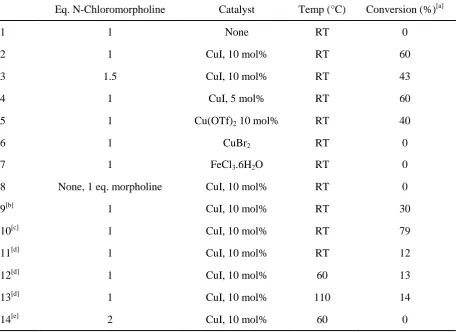
Table S1. Batch addition of N-chloromorpholine to styrene. Reaction time 24 h
Eq. N-Chloromorpholine Catalyst Temp (°C) Conversion (%)[a]
1 1 None RT 0
2 1 CuI, 10 mol% RT 60
3 1.5 CuI, 10 mol% RT 43
4 1 CuI, 5 mol% RT 60
5 1 Cu(OTf)2 10 mol% RT 40
6 1 CuBr2 RT 0
7 1 FeCl3.6H2O RT 0
8 None, 1 eq. morpholine CuI, 10 mol% RT 0
9[b] 1 CuI, 10 mol% RT 30
10[c] 1 CuI, 10 mol% RT 79
11[d] 1 CuI, 10 mol% RT 12
12[d] 1 CuI, 10 mol% 60 13
13[d] 1 CuI, 10 mol% 110 14
14[e] 2 CuI, 10 mol% 60 0
[a] Conversion determined by 1H NMR spectroscopy. [b] 1:1 toluene:water as solvent. [c] Additional CuI 10 mol% and 1 eq. N-chloromorpholine added after 8 hours. [d] Reaction time = 1 hour. [e] Reaction time = 4 hours.
Various other non-precious metal catalysts reported in the literature were examined (Cu(OTf)2 [1]
, FeCl3
[2]
S3
S2. Differential scanning calorimetry (DSC) of
N
-chloro-
N
-methyl-
p
-toluenesulfonamide
[image:3.595.145.454.165.551.2]N-Chloro-N-methyl-p-toluenesulfonamide (2.3 mg, 0.01 mmol) was analysed by DSC. The sample was heated from 10 → 250°C at a step-rate of 10 °C min−1.
Figure S1. DSC curve for N-chloro-N-methyl-p-toluenesulfonamide.
Melting point = 78 °C
ΔH = 15 kJ mol−1
Decomposition at 160–200 °C
S4
S3. Kinetic study of
N
-(4-methoxybenzoyl)morpholine formation
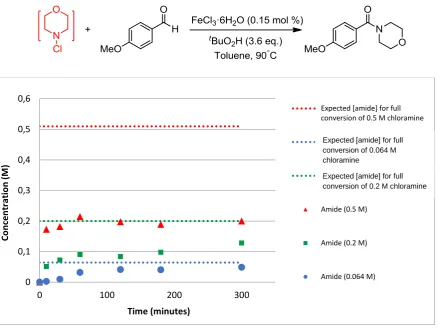
Figure S2. Effect of reaction concentration on formation of N-(4-methoxybenzoyl)morpholine.
0 0,1 0,2 0,3 0,4 0,5 0,6
0 100 200 300
Co n ce n tr ation (M ) Time (minutes)
Expected [amide] for full conversion of 0.5 M chloramine
Expected [amide] for full conversion of 0.2 M chloramine
Expected [amide] for full conversion of 0.064 M chloramine
Amide (0.5 M)
Amide (0.2 M)
Amide (0.064 M)
Expected [amide] for full conversion of 0.064 M chloramine
[image:4.595.75.515.102.430.2]S5
S4. Experimental Section
S4.1 General procedures: All commercially obtained chemicals were used as received from
suppliers without purification. Sodium hypochlorite was obtained as an aqueous solution with 10–
15% available chlorine purchased from Sigma-Aldrich. The accurate NaOCl concentration was
determined by titration (see below) and diluted to the required concentration with DI water. CDCl3
purchased from Sigma-Aldrich was used for NMR analysis. NMR spectra (1H and 13C) were obtained
on either a Bruker Advance 500 MHz or 400 MHz spectrometer and were referenced to either TMS or
CHCl3. GC analysis was carried out on an Agilent HP 6890 with FID. Differential scanning
calorimetry experiments were carried out using a Perkin Elmer Pyris 1 differential scanning
calorimeter. Mass spectrometry analysis was carried out using a Bruker HCT ion trap mass
spectrometer coupled with an Agilent 1100 HPLC (LRMS) or a Bruker MaXis Impact spectrometer
with Ultimate 3000 UPLC (HRMS). IR spectroscopy was carried out using a Bruker ALPHA FT-IR
spectrometer. Melting points were determined using a Stuart Melting Point Aparatus SMP30. For
continuous reactions, Harvard syringe pumps (model 981074) or Watson Marlow 323S peristaltic
pumps were used.
General procedure for continuous N-chloramine synthesis using the single-stage CSTR: Previously
reported in reference [3]. The required number of reactors were connected in series using PTFE
tubing (1/8” outer diameter, 1
/16” inner diameter). A 1 M solution of the amine in toluene was prepared
along with a 1.1 M aqueous solution of NaOCl. The solutions were pumped into the stirred reactor at
equal flow rates to give the required residence time. The reaction solution was collected from the
reactor in reactor volume fractions. The organic phase of each fraction was separated and analysed
directly by 1H NMR spectroscopy as a solution in toluene (100 μL organic solution added to an NMR
tube containing 4.5 cm3 CDCl3). Due to the hazards associated with N-chloramines and their
volatility, isolation of the product is not advised. Products were therefore obtained as solutions in
S6 N-Chloro-N-methylbenzylamine (5): Data compares with that previously reported for this compound
[3, 5]. 1H NMR (CDCl3, 300 MHz) δ ppm 7.32-7.28 (m, 5H, CHAr), 3.99 (s, 2H, CH2), 2.88 (s, 3H,
CH3); 13
C NMR (CDCl3, 125 ppm) δ ppm 139.37 (CAr), 128.58 (2 × CHAr), 128.49 (2 × CHAr),
127.32 (CHAr), 55.85 (CH2), 35.68 (CH3). The compound was not stable during mass spectrometry
analysis and hence LCMS and HRMS data were not obtainable.
N-Chloro-α-methylbenzylamine (6): Data compares with that previously reported for this compound
[3, 5]. 1H NMR (CDCl3, 500 MHz) δ ppm 7.55-7.49 (m, 5H, CHAr), 4.44-4.43 (br m, 1H, NH),
4.32-4.28 (m, 1H, CH), 1.66 (d J = 7.5 Hz, 3H, CH3); 13
C NMR (CDCl3, 125 ppm) δ ppm 142.15 (CAr),
128.77 (2 × CHAr), 128.23 (CHAr), 127.08 (2 × CHAr), 64.75 (CH), 21.32 (CH3). The compound
was not stable during mass spectrometry analysis and hence LCMS and HRMS data were not
obtainable.
N-Chloro-N,α-dimethylbenzylamine (7): Data compares with that previously reported for this
compound [3, 6]. 1H NMR (CDCl3, 500 MHz) δ ppm 7.34-7.29 (m, 5H, CHAr), 3.89 (q J = 6.6 Hz,
CH), 2.80 (s, 3H, CH3NCl), 1.54 (d J = 6.6 Hz, CH3CH) ; 13
C NMR (CDCl3, 125 ppm) δ ppm 141.88
(CAr), 128.42 (2 × CHAr), 127.85 (CHAr), 127.67 (2 × CHAr), 71.68 (CH), 49.90 (CH3), 20.64
(CH3). The compound was not stable during mass spectrometry analysis and hence LCMS and HRMS
data were not obtainable
N-Chloro-2-methylpiperidine (8): Data compares with that previously reported for this compound,
however due to volatility and stability the product could not be separated entirely from its toluene
solution [3,5,7]. 1H NMR (CDCl3, 500 MHz) δ ppm 3.67-3.65 (m, 1H, CH2NCl), 3.09-3.04 (m, 1H,
CHAHB), 2.82 (br s, 1H, CHAHB), 2.82 (br s, 1H, CH), 1.84-1.61 (m, 4H, 2 × CH2), 1.57-1.44 (m, 2H,
CH2), 1.38 (d J = 6.1 Hz, CH3); 13
C NMR (CDCl3, 125 ppm) δ ppm 66.67 (CH2), 64.39 (CH2), 35.79
(CH2), 27.89 (CH2), 24.01 (CH3). The compound was not stable during mass spectrometry analysis
and hence LCMS and HRMS data were not obtainable.
Batch formation of N-benzyl-p-toluenesulfonamide (10): (i) To benzylamine (8.0 g, 74.6 mmol),
S7 112 mmol) in DCM (72 mL). The reaction mixture was stirred and allowed to warm to room
temperature until complete conversion was observed by TLC (silica gel, 1:1 EtOAc/petroleum ether
40–60). Then, saturated aqueous NaHCO3 was added to the reaction solution and the product was
extracted with DCM (3 × 50 mL). The DCM phases were combined, dried over Na2SO4, filtered and
the solvent removed by rotary evaporation to leave the product as a white solid (17.9 g, 68.5 mmol,
92%). 1H NMR (CDCl3, 500 MHz) δH (300 MHz, CDCl3) 7.75 (2H, d J = 8.3 Hz, CHAr), 7.31-7.24
(5H, m, CHAr), 7.20-7.18 (2H, m, CHAr), 4.89 (1H, t J = 6.1 Hz, NH), 4.10 (2H, d J = 6.2 Hz, CH2),
2.43 (3H, s, CH3).
N-Chloro-N-methyl-p-toluenesulfonamide (11). Prepared according to the general procedure in
reference [3]. 1) Tube reactor with 4 static mixers, a 6 mL reactor volume and a residence time of
3 min. 1.5 M NaOCl aq. at 1 mL/min and 1 M N-benzylmethylamine in EtOAc at 1 mL/min. 2) CSTR
with a reactor volume of 50 mL, and residence time of 25 min. 1.1 M NaOCl aq. at 1 mL/min and 1
M N-methyl-p-toluenesulfonamide in toluene at 1 mL/min were used. The product was isolated for
each reactor volume by separation of the organic phase for each reactor volume of solution and
removal of the solvent by rotary evaporation to give a white solid (1 reactor volume gives 666 mg,
3.0 mmol, quantitative yield). 1H NMR (CDCl3, 500 MHz) δ ppm 7.82 (d, J=8.4 Hz, 2H, CHAr), 7.42
(d, J=8.4 Hz, 2H, CHAr), 3.09 (s, 3H, NCH3), 2.48 (s, 3H, Ar-CH3); 13C NMR (CDCl3, 125 MHz) δ
ppm 145.75 (CAr), 129.80 (2CHAr), 129.78 (2 CHAr), 128.28 (CAr), 45.51 (NCH3), 21.70 (ArCH3).
N-Benzyl-N-chloro-p-toluenesulfonamide (12).To N-benzyl-p-toluenesulfonamide (2.1 g, 8.0 mmol)
was added toluene (8 mL) and the solution cooled to 0 °C. Aqueous NaOCl (0.8 M, 20 mL, 16 mmol)
was slowly added. The reaction mixture was stirred until complete consumption of starting material
by TLC (silica gel, 1:1 EtOAc/petroleum ether 40–60) and 1H NMR spectroscopy. The organic phase
of the reaction solution was separated. The aqueous phase was washed with EtOAc (10 mL). The
organic phases were combined, dried over Na2SO4, filtered and the solvent removed by rotary
evaporation to leave the pure product as a white solid (1.6 g, 5.4 mmol, 68%). Mp 131-132°C; IR νmax
3267.42, 3066.4, 3030.9, 2967.7, 2919.9, 1594.2, 1166.2, 1084.2, 1010.8, 846.0, 799.5, 787.1, 758.9,
S8 (2H, d J = 8.2 Hz, CHAr), 7.35-7.34 (5H, m, CHAr), 4.35 (2H, s, CH2), 2.50 (3H, s, CH3);
13
C NMR
(CDCl3, 125 MHz) δ ppm 145.63 (CAr), 133.73 (CAr), 129.87 (2 × CHAr), 129.67 (2 × CHAr),
129.09 (2 × CHAr), 128.63 (2 × CHAr), 60.53 (CH2), 21.78 (CH3). Compound is present as amine by
mass spectrometry: LRMS: 284.6 (M+ - Cl + H + Na) HRMS m/z (ESI): M+ - Cl + H + Na, 284.0701
C14H15NNaO2S requires M 284.0721.
General procedure for batch reaction of N-chloramine with styrene (13): The desired quantity of a
1 M solution of N-chloromorpholine in toluene was purged with nitrogen and to it was added styrene
(required equivalents) and the catalyst and ligand as required (1–10 mol %). The reaction mixture was
stirred under nitrogen at room temperature for 24 hours. Following this, toluene was removed by
rotary evaporation. The residue was purified by column chromatography to give the product.
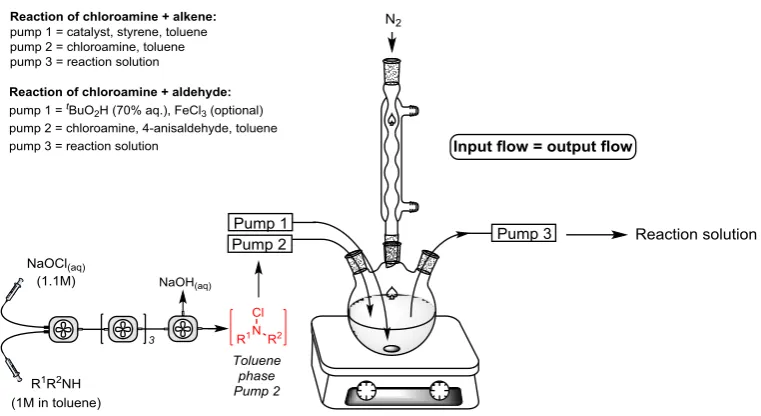
General procedure for continuous reaction of N-chloramine with styrene (13). A round-bottomed flask
connected to a reflux condenser and nitrogen supply. A 2 M solution of styrene in toluene containing
Cu(acac)2 (2 mol %) and 1,10-phenanthroline (2 mol %) was prepared and fed into the reactor by
pump 1. A second solution of N-chloramine (2 M in toluene/diglyme 3:1) was fed by pump 2. Pump 3
was used to pump the reaction solution out of the reactor. The flow rates of the three pumps were
chosen to give the required reactor volume and residence time for the reaction, and so that the flow
rate of pump 3 (outflow from reactor) equalled the total flow rate of pumps 1 and 2 (reactor input).
The reactor was heated to 100 °C and stirred under nitrogen. The reaction solution was collected in
reactor volume (residence time) fractions. A small sample from each fraction was removed and
analysed by 1H NMR spectroscopy to monitor conversion. Fractions collected at steady state were
combined and the product isolated as described for the general batch procedure above.
4-(2-Chloro-2-phenylethyl)-morpholine: Purification by column chromatography (silica gel, 0-100%
EtOAc in petroleum ether 40-60) to give the product as an orange oil. For a reaction with 41%
conversion by 1H NMR spectroscopy, isolation by chromatography gave the pure product in 15% yield. IR νmax 2958.7, 2854.7, 2809.2, 1494.0, 1453.0, 1307.8, 1146.5, 1113.6, 1006.4, 866.4, 763.1,
696.8, 530.3 cm-1; 1H NMR (500 MHz, CDCl3) δ ppm 7.40-7.26 (5H, m, CHAr), 4.97 (1H, d J = 7.7
Hz, CH), 3.69-3.66 (4H, m, 2 × CH2N), 3.02 (1H, dd J = 13.5, 8.0 Hz, CHCH A
S9 13.5, 6.1 Hz, CHCHAHBN), 2.53-2.48 (4H, m, 2 × CH2O);
13
C NMR (125 MHz, CDCl3) δ ppm
140.34 (CAr), 128.61 (2 × CHAr), 128.45 (CHAr), 127.29 (2 × CHAr), 66.85 (2 × CH2N), 66.48
(CH), 59.95 (CH2), 53.72 (2 × CH2O); LRMS m/z (APCI+) 226.1 (M +
+ H), 190.1 (M+ – Cl – H);
HRMS m/z (ESI): M+ + H, 226.9505 C12H17ClNO requires M 226.0999.
N-(2-Chloro-2-phenylethyl)-N,4-dimethylbenzenesulfonamide (14): Purification by column
chromatography (silica gel, 0-60% EtOAc in petroluem ether 40-60) to give the product as a white
solid. For a reaction with 93% conversion by 1H NMR spectroscopy, isolation by chromatography
gave the pure product in 77% yield. Mp 56-57.5°C; IR νmax 3063.6, 3030.7, 2918.6, 1596.9, 1453.9,
1330.8, 1156.5, 1087.5, 990.4, 934.0, 743.5, 713.0, 694.0, 646.8, 548.0 cm-1; 1H NMR (500 MHz,
CDCl3) δppm 7.64 (2H, d J = 8.3 Hz, CHArCSO2), 7.43-7.29 (7H, m, CHAr), 5.11 (1H, t J = 7.3 Hz,
CHCl), 3.59 (1H, dd J = 14.5, 7.4 Hz, CHAHB), 3.41 (1H, dd J = 14.5, 7.3 Hz, CHAHB), 2.63 (3H, s,
CH3N), 2.42 (3H, s, CH3Ar); 13
C NMR (125 MHz, CDCl3) δppm 143.64 (CAr), 138.73 (CAr), 134.79
(CAr), 129.80 (2 × CHAr), 128.81 (2 × CHAr), 127.51 (2 × CHAr), 127.34 (2 × CHAr), 61.34 (CH),
58.05 (CH2), 36.98 (CH3), 21.53 (CH3); LRMS m/z (ESI) 346.2 (M+ + Na); HRMS m/z (ESI): M+ +
H, 324.0805 C16H19ClNO2S requires M 324.0825, M+ + Na, 346.0625 C16H18ClNNaO2S requires M
346.0644.
N-(2-Chloro-2-phenylethyl)-N-benzyl-4-methylbenzenesulfonamide (15): Purification by column
chromatography (silica gel, 0-75% EtOAc in petroleum ether 40-60). Mp 92-93°C; IR νmax 3064.7,
3026.3, 1597.7, 1494.5, 1454.2, 1322.9, 1149.9, 951.8, 898.1, 812.5, 731.6, 696.6, 653.3 cm-1; 1H
NMR (500 MHz, CDCl3) δ ppm 7.70 (2H, d J = 8.3 Hz, CHAr), 7.32-7.28 (5H, m, CHAr), 7.25-7.23
(3H, m, CHAr), 7.19-7.17 (2H, m, CHAr), 4.98 (1H, t J = 7.3 Hz, CHCl), 4.4 (1H, d J = 15.2 Hz,
CHAHBAr), 3.96 (1H, d J = 15.2 Hz, CHAHBAr), 3.69 (1H, dd J = 15.0, 7.2 Hz, CHCHAHBN), 3.53
(1H, dd J = 15.0, 7.5 Hz, CHCHAHBN), 2.44 (3H, s, CH3); 13
C NMR (125 MHz, CDCl3) δ ppm
143.66 (CAr), 138.66 (CAr), 136.92 (CAr), 135.36 (CAr), 129.80 (2 × CHAr), 128.75 (CHAr),
128.67 (2 × CHAr), 128.64 (2 × CHAr), 126.46 (2 × CHAr), 127.93 (CHAr), 127.54 (2 × CHAr),
S10 422.2 (M+ + Na); HRMS m/z (ESI): M+ + H, 400.1113 C22H23ClNO2S requires M 400.1138, M
+
+ Na,
422.0934 C22H22ClNNaO2S requires M 422.0957.
General procedure for the batch addition of N-chloromorpholine (16) to p-anisaldehyde (17): To a
round-bottomed flask with condenser, purged with nitrogen was added N-chloromorpholine (1 M in
toluene). To this was then added the required equivalents of 4-anisaldehyde, t BuO2H (70% aq.) and
FeCl3·6H2O. The reaction mixture was stirred under nitrogen at the required temperature and
monitored by GC (calibrated to decane external standard). Then the reaction mixture was cooled to rt
followed by the addition of saturated aqueous K2SO3. The product was extracted with Et2O. The
organic phases were combined, dried over Na2SO4, filtered and the solvent removed by rotary
evaporation to give the crude as an orange oil. For a batch reaction with 77% conversion by 1H NMR
spectroscopy, isolation by chromatography gave the pure product in 54% yield. Reactions were
monitored by calibrated GC analysis. GC method: H2 10 psi, injector 250 °C, FID 250 °C, oven:
60 °C hold 3 min., 10 °C/min. to 200 °C, 200 °C hold 2 min. Amide: 16.7 min., aldehyde: 7.8 min, decane (external standard) 3.0 min. Sample preparation: 10 μL of 0.1 M decane in EtOAc, 10 µL
reaction solution (organic phase), 980 μL MeOH. For GC calibration see below.
Continuous addition of N-chloromorpholine (16) to p-anisaldehyde (17): A round-bottomed flask
connected to a reflux condenser and nitrogen supply. A solution of N-chloromorpholine (0.2 M) and
4-anisaldehyde (0.2 M where 1 equiv is required, 0.6 M where 3 equiv are required) in toluene was
prepared and fed into the reactor by pump 1. A second solution of t-BuO2H (70% aq.) was fed into the
reaction by pump 2. Pump 3 was used to pump the reaction solution out of the reactor. The flow rates
of the 3 pumps were chosen to give the required reactor volume, residence time and stoichiometry for
the reaction, also, so that the flow rate of pump 3 (outflow from reactor) equalled the total flow rate of
pumps 1 and 2 (reactor input). The reactor was heated to 110 °C and stirred under nitrogen. The
reaction solution was collected in reactor volume (residence time) fractions. A small sample from
S11 steady state were combined and the product isolated as described for the general batch procedure
above.
N-(4-Methoxybenzoyl)morpholine (18): Data compares with that previously reported for this
compound [8]. 1H NMR (500 MHz, CDCl3) δ ppm 7.39 (2H, d J = 8.8 Hz, CHAr), 6.92 (2H, d J = 8.8
Hz, CHAr), 3.83 (3H, s, CH3), 3.69-3.63 (8H, m, 4 × CH2); 13
C NMR (125 MHz, CDCl3) δ ppm
170.41 (CO), 160.91 (CAr), 129.21 (2 × CHAr), 127.36 (CAr), 113.80 (2 × CHAr), 66.94 (CH3 + 2 ×
CH2), 55.37 (2 × CH2O).
General batch procedures for imine formation with Et3N base: To a round-bottomed flask was added
the required amount of N-chloramine in toluene (1 M). The solution was stirred at room temperature
and to it was slowly added Et3N (5 equiv). The reaction mixture was stirred for 42 hours. A saturated
aqueous solution of NaHCO3 was added to the mixture. The organic phase was separated, and the
aqueous phase washed with EtOAc (3 washes). The organic phases were combined, dried over
Na2SO4, filtered and the solvent removed by rotary evaporation to leave the crude product as a
colourless oil, that was analysed by 1HNMR.
General batch procedures for imine formation with NaOMe base: To a round-bottomed flask was
added the required amount of N-chloramine in toluene (1 M). The solution was stirred at room
temperature and to it was added an equal volume of MeOH followed by the slow addition of NaOMe
(2 equiv). The reaction mixture was stirred, and conversion followed by 1H NMR spectroscopy or GC
analysis. Then MeOH was removed by rotary evaporation. To the residue was added water and
EtOAc. The aqueous phase was removed and washed with further EtOAc (3 washes). The organic
phases were combined, dried over Na2SO4, filtered and the solvent removed by rotary evaporation to
leave the crude product as a colourless oil, which was analysed by 1HNMR.
General batch procedures for imine formation with NaOH base: To a round-bottomed flask was added
the required amount of N-chloramine in toluene (1 M). The solution was stirred at room temperature
and to it was added an equal volume of aqueous NaOH (25% w/w) and tetrabutylammonium bromide
S12 followed by 1H NMR spectroscopy or GC analysis. Once complete conversion of starting material
was achieved, the organic phase was removed and dried by rotary evaporation to leave the crude
product as a colourless oil. The reaction proceeded cleanly and further product purification was not
required. The product was analysed by 1HNMR.
General procedure for continuous imine formation with NaOMe base: The multi-stage CSTR was set
up as outlined in Section 4.3 with the required number of stages and pumps. For homogenous
solutions syringe pumps were used, for heterogeneous (slurry) solutions, a peristaltic pump was used.
Two solutions were prepared: N-chloramine in toluene (1 M) and a slurry of NaOMe in MeOH (2 M).
The solutions were fed into the reactor at equal flow rates such that the required residence time is
achieved. The reaction solution was collected from the final stage of the reactor in reactor volume (1
residence time) fractions. A sample from each fraction was analysed by 1H NMR spectroscopy or GC
analysis to determine conversion.
General procedure for continuous imine formation with NaOH base: Three solutions were prepared:
N-chloramine in toluene (1 M), aqueous NaOH (40% w/w) and TBAB in water (10 mol % TBAB
relative to N-chloramine, volume of water = 0.5 × volume of N-chloramine solution). The solutions
were fed into the reactor at flow rates such that the flow rate of each of the aqueous solutions is half
that of the N-chloramine solution and the total flow rate gives the required residence time. For
example, for a 10 mL reactor volume and a 10 min residence time the total flow rate should be
1 mL min−1 with the N-chloramine solution at 0.5 mL min−1, and each of the aqueous solutions at
0.25 mL min−1. The reaction solution was collected from the final stage of the reactor in reactor
volume (1 residence time) fractions. A sample from each fraction was analysed by 1H NMR
spectroscopy or GC analysis to determine conversion. The TBAB and NaOH solutions should not be
mixed via a T-piece and should be kept separate until entering the first CSTR stage. TBAB is not
soluble in the NaOH solution and if these mix in a tube the TBAB precipitates and blocks the tube.
S13 5 °C/min to 100 °C, 100 °C hold 3 min, 50 °C/min to 300 °C. Imine 8.5 min., amine 4.6 min. Sample preparation: 10 μL reaction solution (organic phase), 990 μL MeOH.
Benzylidene(methyl)amine (19): Data compares with that previously reported for this compound [9].
1
H NMR (500 MHz, CDCl3) δ ppm 8.29 (1H, s, N=CH), 7.71-7.59 (2H, m, CHAr), 7.41-7.40 (3H, m,
CHAr), 3.52 (3H, s, CH3); 13
C NMR (125 MHz, CDCl3) δ ppm 162.49 (CH=N), 136.27 (CAr), 130.51
(CHAr), 128.61 (2 × CHAr), 127.88 (2 × CHAr), 48.24 (CH3). Calibrated GC analysis: HP5 30 m,
0.32 mm, 0.25 μm. H2 10psi, injector 60 °C, FID 250 °C, oven: 40 °C hold 2 min, 5 °C/min to 70 °C,
70 °C hold 4 min, 100 °C/min to 250 °C, 250 °C hold 1 min. Imine 6 min., amine 6.9 min. dodecane (external standard) 10.7 min. Sample preparation: 10 μL of 0.1 M dodecane in EtOAc, 10 µL reaction
solution (organic phase), 980 μL MeOH.
(E)-N-(α-Methylbenzylidene)methylamine (20): Data compares with that previously reported for this
compound [10]. The 1H NMR spectrum showed the imine to be present as a single isomer (E) with no
evidence of a second set of peaks for the Z isomer. 1H NMR (500 MHz, CDCl3) δ ppm 7.76-7.74 (2H,
m, CHAr), 7.38-7.36 (3H, m, CHAr), 3.35 (3H, s, CH3N), 2.24 (3H, s, CH3CN); 13C NMR (125 MHz,
CDCl3) δ ppm 167.05 (C=N), 141.24 (CAr), 129.39 (CHAr), 128.21 (2 × CHAr), 126.43 (2 × CHAr),
39.52 (CH3N), 15.10 (CH3C).
2-Methyl-1,2-dehydropiperidine (21): Data compares with that previously reported for this compound
[11]. 1H NMR (500 MHz, CDCl3) δ ppm 3.67-3.65 (m, 1H, CH2NCl), 3.09-3.04 (m, 1H, CH A
HB),
2.82 (br s, 1H, CHAHB), 2.82 (br s, 1H, CH), 1.84-1.61 (m, 4H, 2 × CH2), 1.57-1.44 (m, 2H, CH2),
1.38 (d J = 6.1 Hz, CH3); 13
C NMR (125 MHz, CDCl3) δ ppm 168.11 (C=N), 49.25 (CH2), 30.27
(CH2), 27.60 (CH2), 21.68 (CH2), 21.48 (CH2), 19.65 (CH2).
Iridium-catalyzed asymmetric reduction of (E)-N-(α-methylbenzylidene)methylamine (20): To a
nitrogen-purged flask was added (E)-N-(α-methylbenzylidene)methylamine (135 mg, 1 mmol),
[IrCp*Cl2]2 (4 mg, 0.005 mmol), (R,R)-TsDPEN (4 mg, 0.01 mmol). To this mixture was then added
S14 2 hours. Following this the reaction solution was filtered through silica (1:1 EtOAc/petroleum ether
40–60) and the resulting solution dried by rotary evaporation to leave the crude product as a pale
yellow oil. The crude was analysed by chiral GC to confirm formation of the product and to determine
conversion and enantiomeric excess.
GC method: CP-Chirasil-Dex-CB, 25 m 0.25 mm, 0.25 μm. H2 7.5 psi, injector 250 °C, FID 250 °C,
oven: 80 °C hold 1 min, 100 °C/min to 100 °C, 13 min hold, 100 °C/min to 200 °C, 5 min hold. (R
)-amine 16.6 min. (S)-amine 17.1 min.
S4.2 Single-stage heated CSTR assembly
A three-necked round-bottomed flask equipped with a condenser was employed as a laboratory scale
CSTR and was heated using an aluminium heating block. Reactants were pumped into the CSTR
through one neck and out of the opposing neck at equal flow rate to maintain a constant volume, via
1
[image:14.595.108.489.425.633.2]/16” OD PTFE tubing (see Figure S3).
S15
S4.3 Multi-stage CSTR assembly
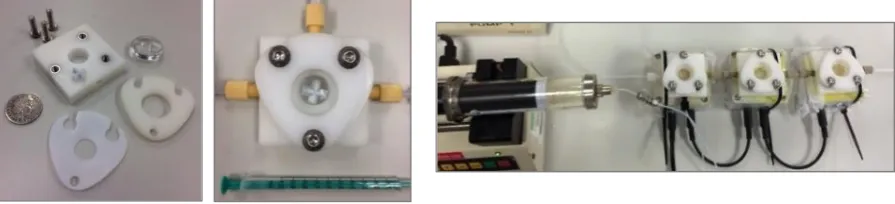
A laboratory scale cascade CSTR developed within our group (and described elsewhere) [4] was
employed to generate and dispense N-chloroamines as described within the manuscript. For clarity,
[image:15.595.75.523.186.288.2]the reactor assembly is reproduced in Figure S4 below.
S16
S4.4 NaOCl titration
Acetic acid (1 mL) and potassium iodide (350 mg) were diluted to 50 mL using DI water. To this solution was added NaOCl solution as obtained from Sigma-Aldrich (1 mL). Na2S2O3 (0.1 M) was
then titrated into the aqueous solution of potassium iodide, acetic acid and NaOCl until the orange solution became colourless. The concentration of the initial NaOCl solution was determined using the equation supplied below:
HOCl + 2I- → I2 + Cl
+ OH- I2 + 2S2O3
→ S4O6
+ 2I
-S5. GC conditions and calibration profiles
GC Method: HP-5 column 30 m × 0.32 mm × 0.25 μm, H2 10 psi, split ratio 5:1, T = 35 °C 3 min, 10 °C/min to 200 °C, 200 °C 3 min, 280 °C 3 min.
Morpholine: 2.2 min
Piperidine: 1.8 min
N-Benzylmethylamine: 7.1 min
N-Methyl-p-toluenesulfonamide: 6.1 min
Dibutylamine: 3.4 min
Dibenzylamine: 16.2 min
S17 Calibrations
p-Anisaldehyde:
N-(4-Methoxybenzoyl)morpholine:
y = 1,1531x R² = 0,9927
0 10 20 30 40 50 60
0 10 20 30 40 50
Co n c. al d e h yd e /c o n c. d e can e
Peak area aldehyde/peak area decane
y = 0,9328x R² = 0,9739
0 5 10 15 20 25 30 35
0 10 20 30 40
Co n c. am id e /c o n c. d e can e
S18 N-Benzylmethylamine:
N-Benzylidenemethylamine:
y = 2,5623x R² = 0,9559
0 2 4 6 8 10 12
0 1 2 3 4 5
Co n c. am in e /c o n c. d o d e can e
Peak area amine/peak area dodecane
y = 2,6213x R² = 0,9541
0 2 4 6 8 10 12
0 1 2 3 4 5
Co n c. i m in e / c o n c. d o d e can e
S19
S6. Relevant
1H and
13C NMR spectra.
S31
7.
References
[1] M. T. Bovino, S. R. Chemler, Angew. Chem. Int. Ed. 2012, 51, 3923-3927.
[2] Q. Li, M. Shi, C. Timmons, G. Li, Org. Lett. 2006, 8, 625-628.
[3] Blacker, A. J.; Jolley, K. E. Beilstein J. Org. Chem. 2015, 11, 2408-2417.
[4] M. R. Chapman, M. H. Kwan, G. King, K. E. Jolley, M. Hussain, S. Hussain, I. E. Salama, C.
González Nino, L. A. Thompson, M. E. Bayana, A. Clayton, B. N. Nguyen, N. J. Turner, N.
Kapur, A. J. Blacker, Org. Process Res. Dev. 2017, 21, 1294–1301.
[5] Barker, T. J.; Jarvo, E. R. J. Am. Chem. Soc. 2009, 131, 15598-15599.
[6] Zhong, Y. -L.; Zhou, H.; Gauthier, D. R.; Lee, J.; Askin, D.; Dolling, U. H.; Volante, R. P.
Tetrahedron Lett. 2005, 46, 1099-1101.
[7] Davis, B. G.; Maughan, M. A. T.; Chapman, T. M.; Villard, R.; Courtney, S. Org. Lett.2002,
4, 103-106.
[8] Porcheddu, A.; de Luca, L. Adv. Synth. Catal. 2012, 354, 2949-2953.
[9] Knöpke, L. R.; Nemati, N.; Köckritz, A.; Brückner, A.; Bentrup, U. ChemCatChem 2010, 2,
273-280.
[10] Samec, J. S. M.; Mony, L.; Bäckvall, J.-E. Can. J. Chem. 2005, 83, 909-916