to prepare amines, amides and imines via
reactive N-chloramines
Katherine E. Jolley
1, Michael R. Chapman
1and A. John Blacker
*1,2Full Research Paper
Open AccessAddress:
1School of Chemistry, Institute of Process Research and
Development, University of Leeds, Leeds, LS2 9JT, United Kingdom and 2School of Chemical and Process Engineering, University of Leeds, Leeds, LS2 9JT, United Kingdom
Email:
A. John Blacker* - [email protected]
* Corresponding author
Keywords:
continuous flow; CSTR; N-chloramine; synthetic methods; telescoping
Beilstein J. Org. Chem. 2018, 14, 2220–2228. doi:10.3762/bjoc.14.196
Received: 16 April 2018 Accepted: 10 August 2018 Published: 24 August 2018
This article is part of the Thematic Series "Integrated multistep flow synthesis".
Guest Editor: V. Hessel
© 2018 Jolley et al.; licensee Beilstein-Institut. License and terms: see end of document.
Abstract
Chloramines are an important class of reagents, providing a convenient source of chlorine or electrophilic nitrogen. However, the instability of these compounds is a problem which makes their isolation and handling difficult. To overcome these hazards, a con-tinuous-flow approach is reported which generates and immediately reacts N-chloramines directly, avoiding purification and isola-tion steps. 2-Chloramines were produced from the reacisola-tion of styrenes with N-alkyl-N-sulfonyl-N-chloramines, whilst N-alkyl or
N,N’-dialkyl-N-chloramines reacted with anisaldehyde in the presence of t-BuO2H oxidant to afford amides. Primary and second-ary imines were produced under continuous conditions from the reaction of N-chloramines with base, with one example subse-quently reduced under asymmetric conditions to produce a chiral amine in 94% ee.
Introduction
N-Chloramines are versatile reagents, however, their availabili-ty is restricted by their stabiliavailabili-ty, so useful would be in situ methods to produce and use them [1,2]. The continuous-flow methodology is useful in this context, enabling control over reaction exotherms and improved measures for containment. To evaluate the use of N-chloramines in the laboratory requires multiphase flow methods, and until recently these have been
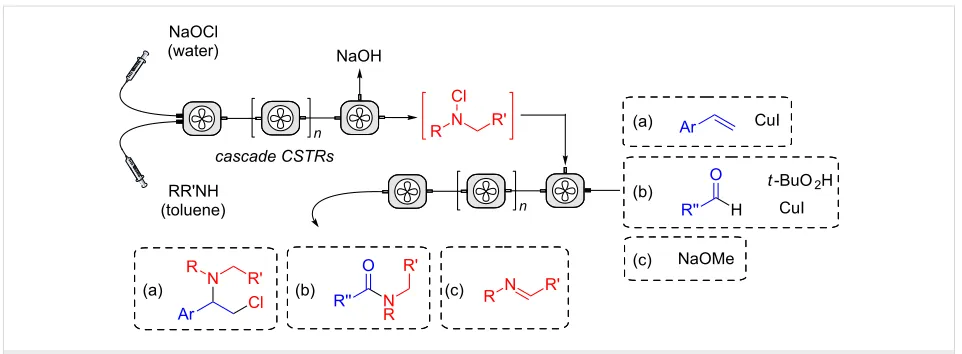
Figure 1: Continuous-flow process to produce and react N-chloramines.
lower flow rates and therefore longer tres for slow reactions [7,8]. The use of CSTRs to carry out sequential or multistep reactions has been exploited by Ley and others [9-11]. The strategy is useful, since it has the potential to eliminate time-consuming and costly product isolations. In these systems, the reactants and products are fluids which are contacted with solid-supported reagents that after some time require regeneration, which is not convenient within chemical manufac-ture.
Chloramine itself is unstable, though has been produced safely at large scale using continuous-flow methods; in fact, chlor-amine has been used as an intermediate in the manufacture of hydrazine using the Raschig process [12,13]. N-Alkyl-N -chlor-amines are equally unstable, yet have only been prepared in batch via reaction of a primary or secondary amine with Cl2 gas, N-chlorosuccinimide, chloramine-T or hypochlorite salts [14,15]. Whilst Cl2 gas is atom efficient it is difficult to handle, with associated toxicity, and the acid byproduct which leads to N-chloramine hydrolysis [16]. On the other hand,
N-chlorosuccinimide or chloramine-T are commonly employed, being commercially available, stable and straightforward to handle, though both exhibit poor atom economy [17-21]. Sodi-um hypochlorite (NaOCl) solutions are less widely used, yet readily available, economic and provide an atom efficient reagent for N-chloramine formation [22-24].
A continuous-flow process for the oxidation of alcohols using NaOCl as a phase-transfer catalyst was recently reported [25]. We have published a communication that describes the continu-ous mixing of aquecontinu-ous NaOCl and an organic solution of sec-ondary amine, using either a tubular reactor with in-line static mixers or a single stage CSTR [26]. The reactor was selected to provide a tres for optimal conversion. This was achieved accord-ing to reaction kinetics and hydrophobicity of the amine, which
affects its partition between phases. Herein, we report improve-ments to this process and the use of N-alkyl-N-chloramine in subsequent continuous-flow reactions (Figure 1).
These reagents can be used as electrophilic or radical amination agents in a wide range of reactions [14]. In the present study, we opted to evaluate the addition of N-alkyl-N-chloramines with (a) alkenes to produce amines, (b) aldehydes to give amides, (c) reaction with a base to afford imines. Several alkenes are known to react with N-haloamines to form aziridines and other N-heterocycles. Typically, the reactions require a catalyst (e.g., Cu, I2) [17,18,27], whilst more active reagents such as chloramine-T with osmate catalysts have been used to make 1,2-aminoalcohols and diamines [28-33]. Im-proved methods for the formation of amides remain an impor-tant goal for the pharma industry. In this regard, the reaction of
Figure 2: Left: Laboratory scale CSTR developed by our group [8]. Right: 5-stage CSTR configuration using co-feeds of amine in toluene and aqueous NaOCl.
Table 1: Continuous N-chloramine formation.
entry starting material product reactora (vol/mL) tres (min) conversion (%)b productivity (mol L−1 h−1)
1 1 5 SM (6) 20 89 1.3
2 1 5 CSTRc (50) 25 100 1.2
3 1 5 CSTRd (10) 5 94 5.6
4 2 6 CSTRd (10) 10 92 2.8
5 3 7 CSTRd (10) 30 93 0.9
6 4 8 CSTRd (10) 10 100 3.0
aSM = static mixer. bDetermined by 1H NMR spectroscopy. c1-Stage CSTR. d5-Stage CSTR.
Results and Discussion
N
-Chloramine formation
N-(Di)alkyl-N-chloramines have been prepared in continuous organic–aqueous biphasic flow using either static mixers or a single-stage CSTR [26]. The choice of reactor and definition of
tres for this reaction is governed by both the thermodynamic phase partition parameter of reactants and mixing efficiency which control mass transfer between each phase (and thus, reac-tion rate). We decided to exploit a multi-stage cascade CSTR
developed by our group recently [8], which enables efficient mixing over long tres (Figure 2).
Using a 5-stage variant, various unsymmetrical N-chloramines were produced with unprecedented productivities (Table 1).
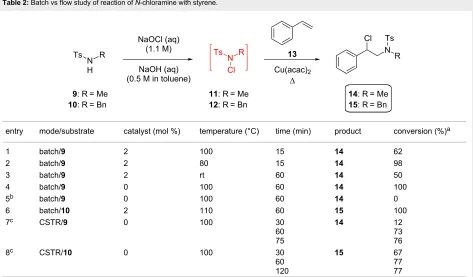
[image:3.595.60.537.389.736.2]Table 2: Batch vs flow study of reaction of N-chloramine with styrene.
entry mode/substrate catalyst (mol %) temperature (°C) time (min) product conversion (%)a
1 batch/9 2 100 15 14 62
2 batch/9 2 80 15 14 98
3 batch/9 2 rt 60 14 50
4 batch/9 0 100 60 14 100
5b batch/9 0 100 60 14 0
6 batch/10 2 110 60 15 100
7c CSTR/9 0 100 30
60 75
14 12
73 76
8c CSTR/10 0 100 30
60 120
15 67
77 77
aConversion measured by 1H NMR spectroscopy. bReaction carried out in either air or presence of TEMPO (1 equiv) led to the same result. c1-Stage CSTR, co-feed with styrene in toluene and substrate in toluene/diglyme 3:1.
volume of that in Table 1, entry 2, provides a much shorter
tres than the in-line static mixer (SM) with comparable conver-sion of N-benzyl-N-methylamine (1) to the N-alkyl-N -chlor-amine 5 at steady state, representing a productivity value of 5.6 mol L−1 h−1. The same reactor geometry was used to chlori-nate primary, secondary acyclic and cyclic amines 2–4 in conversions between 92–100%, with productivities ranging be-tween 0.9–3 mol L−1 h−1 (Table 1, entries 4–6). In each case, separation of the product-rich toluene phase avoided N -chlor-amine isolation and allowed direct deployment in further reac-tions.
Reaction of
N
-chloramine with alkene
Initially our study tested the reaction of N-chloromorpholine (16) to styrene (13) varying Cu catalyst loading and a range of temperatures. The anti-Markovnikov addition product was ob-served with 10% CuI catalyst loading, at ambient temperature. However, it required 24 hours (see Supporting Information File 1, S1), and this slow reaction prevents sensible translation of the process into continuous flow. Despite trying alternative catalysts or other conditions no improvement was found. Instead, the more electron-poor N-chloro-N-methyl-p- toluene-sulfonamide (11) was investigated as substrate. Differential scanning calorimetry (DSC) was used to assess the thermal stability of 11, which melts at 78 °C and decomposes between
160–200 °C. This profile peaks at 188 °C, corresponding to an enthalpy of decomposition of −84.7 kJ mol−1 (see Supporting Information File 1, S2). A maximum safe operating tempera-ture of 110 °C was implemented to avoid thermal decomposi-tion and thermal runaway.
The direct reaction of N-chloramine 11, or the benzyl-substi-tuted variant 12, led to a single regioisomer of the amine prod-uct in a lower reaction time than the analogous reaction using
16 (15 minutes vs 24 hours in batch mode; Supporting Informa-tion File 1, Table S1, entry 2 and Table 2, entries 1–5. The products 14 and 15, prepared in batch, were isolated in 78 and 68% yield, respectively, and characterized (see Supporting Information File 1, S4). These standards enabled monitoring of the steady-state conversion in continuous flow by 1H NMR.
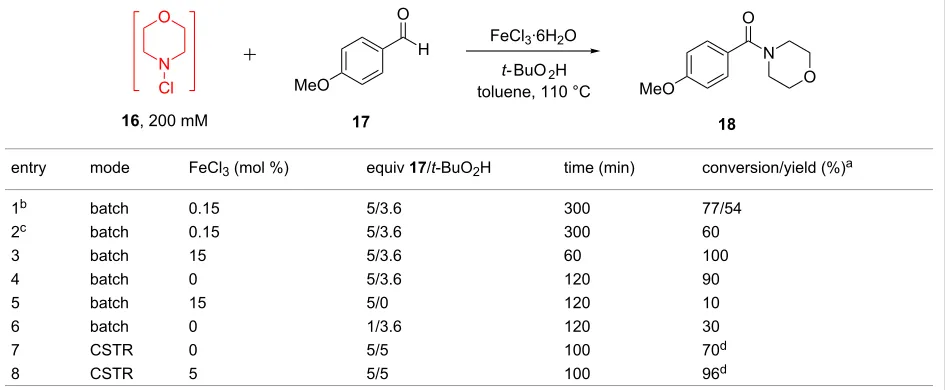
Table 3: Batch vs flow study of reaction of N-chloramine with an aldehyde.
entry mode FeCl3 (mol %) equiv 17/t-BuO2H time (min) conversion/yield (%)a
1b batch 0.15 5/3.6 300 77/54
2c batch 0.15 5/3.6 300 60
3 batch 15 5/3.6 60 100
4 batch 0 5/3.6 120 90
5 batch 15 5/0 120 10
6 batch 0 1/3.6 120 30
7 CSTR 0 5/5 100 70d
8 CSTR 5 5/5 100 96d
aConversion measured by gas chromatography as the average of three runs. bLiterature conditions quoted as 88% [34]. c[16] = 200 mM.
dConversion recorded at steady state.
stream of toluene containing styrene (13) enabled the continu-ous production of alkylated amine products 14 and 15 (Table 2, entries 7 and 8, respectively). In each case the tres was compa-rable with batch (reaction of 11 = 75 minutes, 12 = 60 minutes), with steady-state conversions or 76 and 77% observed, respec-tively.
Reaction of
N
-chloramine with aldehyde
Reaction of N-chloramines with aromatic and aliphatic alde-hydes to form amides has been reported by Porcheddu [34]. Under these literature conditions, FeCl3 catalyst (0.15 mol %),
t-BuO2H oxidant (3.6 equiv) and excess aldehyde 17 (5 equiv) were employed to react with dilute N-chloramine 16 (0.064 M in MeCN), delivering amide 18 in 77% conversion and 54% isolated yield. Our interests were to improve the produc-tivity of this system, by exploiting higher concentrations of
N-chloramine produced in flow mode (200 mM). Table 3 summarizes a comparative study between batch and continuous flow for this reaction.
Initial tests involving 200 mM substrate concentration afforded amide 18 in 60% conversion (Table 3, entry 2). Increasing the catalyst loading to 15 mol % led to a quantitative conversion of
[image:5.595.63.538.541.736.2]18 within 1 hour reaction time. Unexpectedly, a control reac-tion omitting the FeCl3 catalyst resulted in 90% conversion following a two-hour reaction time (Table 3, entry 4). Removing the t-BuO2H oxidant reduced the reaction rate signif-icantly, leading to 10% conversion under otherwise identical conditions (Table 3, entry 5), whilst fewer equivalents of alde-hyde 17 led to 30% product formation (Table 3, entry 6). Notably, other oxidants such as H2O2 and NaOCl failed to
Figure 3: Continuous-flow amide 18 formation using 1-stage CSTR. Blue squares: FeCl3 included; red circles: FeCl3 not included.
produce any amide product. Likewise, attempts to couple morpholine in place of its N-chloro derivative reached only 19% conversion.
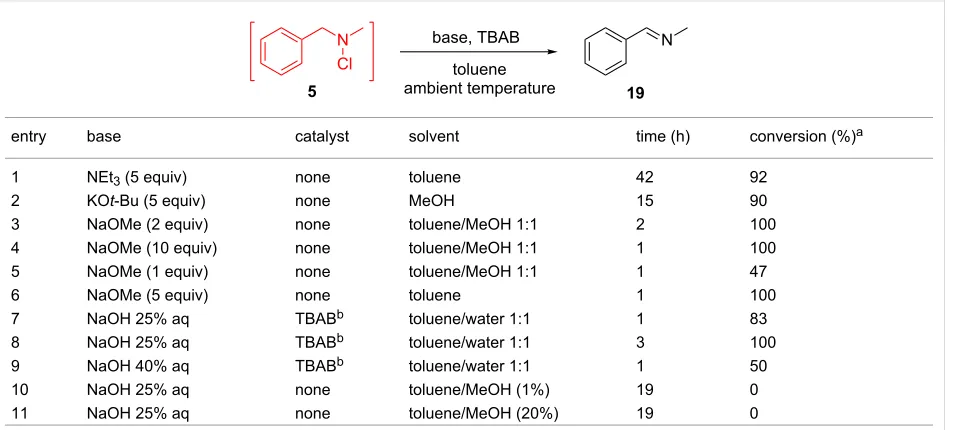
Table 4: Batch optimization study of the dehydrochlorination of N-chloramines.
entry base catalyst solvent time (h) conversion (%)a
1 NEt3 (5 equiv) none toluene 42 92
2 KOt-Bu (5 equiv) none MeOH 15 90
3 NaOMe (2 equiv) none toluene/MeOH 1:1 2 100
4 NaOMe (10 equiv) none toluene/MeOH 1:1 1 100
5 NaOMe (1 equiv) none toluene/MeOH 1:1 1 47
6 NaOMe (5 equiv) none toluene 1 100
7 NaOH 25% aq TBABb toluene/water 1:1 1 83
8 NaOH 25% aq TBABb toluene/water 1:1 3 100
9 NaOH 40% aq TBABb toluene/water 1:1 1 50
10 NaOH 25% aq none toluene/MeOH (1%) 19 0
11 NaOH 25% aq none toluene/MeOH (20%) 19 0
aMeasured by 1H NMR spectroscopy. bReaction temperature = 60 °C.
Reaction of
N
-chloramine with base
The base-induced dehydrochlorination of N-chloramines is a facile route to imines, which may be used for further functional-ization. Our study began by examining a host of bases to convert N-chloramine 5 to benzylidene(methyl)amine (19) as a model reaction system (Table 4).
To achieve a complete conversion, NEt3 was required in large excess (5 equiv) over 42 hours, which proved unsuitable for continuous flow (Table 4, entry 1). Whilst KOt-Bu and NaOMe bases allowed rapid imine formation (Table 4, entries 2–6), though their low solubility in MeOH or toluene would require slurry pumping in flow mode which is undesirable. In addition, the isolation procedure is not straightforward, requiring multiple unit operations. To avoid this, a phase-transfer catalyst (TBAB) was used along with NaOH (Table 4, entries 7–9). This reagent, in a toluene/water mixture, promoted full conversion to imine
19 (Table 4, entry 8). The separation of the toluene phase provi-ded the imine product, which may be deployed directly in further reactions.
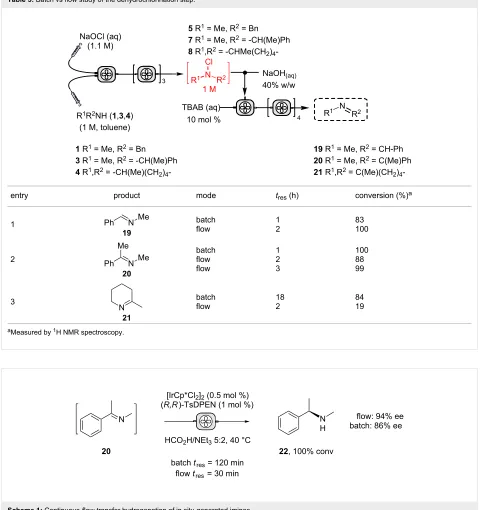
To validate the batch protocol N-chloramines 5 and 7 under-went smooth dehydrochlorination to produce imines 19 and 20
in 83 and 100% conversion after 1 hour (Table 5, entries 1 and 2). The cyclic N-chloramine 8 was converted in batch mode to the corresponding imine 21, though required 18 hours to reach 84% conversion (Table 5, entry 3). The rapid nature of the imine formation prompted us to investigate a fully continuous protocol to both N-chlorinate and subsequently dehydrochlori-nate amines, which would represent a mild and atom-efficient
alternative method of amine oxidation. A 5-stage cascade CSTR was employed to link N-chloramine generation with base-promoted imine formation. A 1 M stream of N-chloramine 5 in toluene was mixed in the first CSTR with separate flows of aqueous NaOH and TBAB (10 mol % relative to substrate) and
tres was adjusted by changing the number of subsequent CSTR chambers (n) (Table 5, entry 1). It is noteworthy that attempts to mix NaOH and TBAB solutions via a T-piece prior to the mixing chamber were not successful, as a precipitate forms from the mixture leading to reactor blockage. A quantitative conversion of 5 to imine 19 was realized using the NaOH/ TBAB protocol with a tres of 2 hours with good productivity (0.25 mol L−1 h−1, Table 5, entry 1). Under analogous condi-tions, N-chloramine 7 was converted to imine 20 in 88% conversion, which could be improved to 99% conversion by extending tres to 3 hours (Table 5, entry 2). However, the same conditions proved only able to convert 19% of the
N-chloramine 8 at steady state with tres of 2 h (Table 5, entry 3). To achieve a higher conversion an impractical tres would be required if the same batch conditions were used. In this regard, the use of heated CSTRs would be useful to explore.
Table 5: Batch vs flow study of the dehydrochlorination step.
entry product mode tres (h) conversion (%)a
1
19
batch flow
1 2
83 100
2
20
batch flow flow
1 2 3
100 88 99
3
21
batch flow
18 2
84 19
aMeasured by 1H NMR spectroscopy.
Scheme 1: Continuous-flow transfer hydrogenation of in situ generated imines.
Under batch conditions, a tres of 120 minutes gave quantitative reduction of the imine, affording the R-isomer in 86% ee.
Translating the procedure to continuous flow, a fresh solution of imine 20 and catalyst mixture were pumped into a heated CSTR over a 30-minutes tres, affording chiral amine 22 in 94% ee with complete conversion. It is unclear why a higher optical activity was seen using continuous flow. However, it is known that [IrCp*Cl2]2 can slowly racemise this amine which may be more of a problem in batch with the longer reaction time [48].
Conclusion
A continuous-flow approach to prepare and handle unstable
N-chloramines is reported. The method exploits the superior mixing of a CSTR compared with classical batch, to enable fast
dehy-drochlorination with a base to afford imines reported within our study. Of these examples, the latter was further explored by immediate asymmetric-transfer hydrogenation of an in situ formed imine under continuous-flow conditions, as a poten-tially productive route to chiral amines.
Supporting Information
Supporting Information File 1
Details of reactor assembly, NaOCl titration and NMR spectra.
[https://www.beilstein-journals.org/bjoc/content/ supplementary/1860-5397-14-196-S1.pdf]
Acknowledgements
The research for this work has received funding from the Inno-vative Medicines Initiative joint undertaking project Chem21 under grant agreement n°115360, resources of which are composed of financial contribution from the European Union’s Seventh Framework Programme (FP7/2007-2013) and EFPIA companies in kind contribution.
ORCID
®
iDs
Katherine E. Jolley - https://orcid.org/0000-0001-6223-9808 A. John Blacker - https://orcid.org/0000-0003-4898-2712
References
1. Urben, P. In Bretherick’s Handbook of Reactive Chemical Hazards, 7th ed.; Bretherick, L., Ed.; Academic Press: Oxford, 2007; pp 15–20. 2. Antelo, J. M.; Arce, F.; Parajo, M. J. Phys. Org. Chem. 1996, 9,
447–454.
doi:10.1002/(SICI)1099-1395(199607)9:7<447::AID-POC778>3.0.CO;2 -X
3. Wiles, C.; Watts, P. Eur. J. Org. Chem. 2008, 1655–1671. doi:10.1002/ejoc.200701041
4. Zhang, Y.; Born, S. C.; Jensen, K. F. Org. Process Res. Dev. 2014, 18,
1476–1481. doi:10.1021/op500158h
5. Wiles, C.; Watts, P. Green Chem. 2012, 14, 38–54. doi:10.1039/C1GC16022B
6. Nagy, K. D.; Shen, B.; Jamison, T. F.; Jensen, K. F.
Org. Process Res. Dev. 2012, 16, 976–981. doi:10.1021/op200349f 7. Mo, Y.; Jensen, K. F. React. Chem. Eng. 2016, 1, 501–507.
doi:10.1039/C6RE00132G
8. Chapman, M. R.; Kwan, M. H. T.; King, G.; Jolley, K. E.; Hussain, M.; Hussain, S.; Salama, I. E.; González Niño, C.; Thompson, L. A.; Bayana, M. E.; Clayton, A. D.; Nguyen, B. N.; Turner, N. J.; Kapur, N.; Blacker, A. J. Org. Process Res. Dev. 2017, 21, 1294–1301. doi:10.1021/acs.oprd.7b00173
9. Pastre, J. C.; Browne, D. L.; Ley, S. V. Chem. Soc. Rev. 2013, 42,
8849–8869. doi:10.1039/c3cs60246j
10. Ley, S. V. Chem. Rec. 2012, 12, 378–390. doi:10.1002/tcr.201100041 11. Wegner, J. C.; Ceylan, S.; Kirschning, A. Adv. Synth. Catal. 2012, 354,
17–57. doi:10.1002/adsc.201100584
12. Worley, S. D.; Wojtowicz, J. A. Kirk-Othmer Encyclopedia of Chemical Technology; John Wiley & Sons Inc., 2000.
13. Rothgery, E. F. Kirk-Othmer Encyclopedia of Chemical Technology;
John Wiley & Sons Inc., 2000.
14. Kovacic, P.; Lowery, M. K.; Field, K. W. Chem. Rev. 1970, 70,
639–665. doi:10.1021/cr60268a002
15. Wille, U. In Science of Synthesis; Enders, D.; Schaumann, E., Eds.; Thieme: Stuttgart, 2009; Vol. 40b, pp 846–847.
16. Seppelt, K.; Sundermeyer, W.
Z. Naturforsch., B: Anorg. Chem., Org. Chem., Biochem., Biophys., Bio l. 1969, 24, 774–775. doi:10.1515/znb-1969-0622
17. Lyalin, B. V.; Petrosyan, V. A. Russ. J. Electrochem. 2000, 36,
164–169. doi:10.1007/bf02756901
18. Heuger, G.; Kalsow, S.; Göttlich, R. Eur. J. Org. Chem. 2002, 1848–1854.
doi:10.1002/1099-0690(200206)2002:11<1848::AID-EJOC1848>3.0.C O;2-V
19. Grandl, J.; Sakr, E.; Kotzyba-Hibert, F.; Krieger, F.; Bertrand, S.; Bertrand, D.; Vogel, H.; Goeldner, M.; Hovius, R.
Angew. Chem., Int. Ed. 2007, 46, 3505–3508. doi:10.1002/anie.200604807
20. Kostyanovsky, R. G.; Gella, I. M.; Markov, V. I.; Samojlova, Z. E.
Tetrahedron 1974, 30, 39–45. doi:10.1016/S0040-4020(01)97214-X 21. Campbell, M. M.; Johnson, G. Chem. Rev. 1978, 78, 65–79.
doi:10.1021/cr60311a005
22. Lindsay-Smith, J. R.; McKeer, L. C.; Taylor, J. M. Org. Synth. 1989, 67,
222–228. doi:10.15227/orgsyn.067.0222
23. Larionov, O. V.; Kozhushkov, S. I.; de Meijere, A. Synthesis 2003, 1916–1919. doi:10.1055/s-2003-41037
24. Zhong, Y.-L.; Zhou, H.; Gauthier, D. R.; Lee, J.; Askin, D.;
Dolling, U. H.; Volante, R. P. Tetrahedron Lett. 2005, 46, 1099–1101. doi:10.1016/j.tetlet.2004.12.088
25. Vanoye, L.; Yehouenou, L.; Philippe, R.; de Bellefon, C.; Fongarland, P.; Favre-Réguillon, A. React. Chem. Eng. 2018, 3,
188–194. doi:10.1039/C7RE00155J
26. Blacker, A. J.; Jolley, K. E. Beilstein J. Org. Chem. 2015, 11,
2408–2417. doi:10.3762/bjoc.11.262
27. Thakur, V. V.; Talluri, S. K.; Sudalai, A. Org. Lett. 2003, 5, 861–864. doi:10.1021/ol027530f
28. Sharpless, K. B.; Chong, A. O.; Oshima, K. J. Org. Chem. 1976, 41,
177–179. doi:10.1021/jo00863a052
29. Ando, T.; Kano, D.; Minakata, S.; Ryu, I.; Komatsu, M. Tetrahedron
1998, 54, 13485–13494. doi:10.1016/S0040-4020(98)00827-8 30. Chemler, S. R.; Bovino, M. T. ACS Catal. 2013, 3, 1076–1091.
doi:10.1021/cs400138b
31. Göttlich, R. Synthesis 2000, 1561–1564. doi:10.1055/s-2000-7605 32. Noack, M.; Göttlich, R. Eur. J. Org. Chem. 2002, 3171–3178.
doi:10.1002/1099-0690(200209)2002:18<3171::AID-EJOC3171>3.0.C O;2-L
33. Cadoni, R.; Porcheddu, A.; Giacomelli, G.; de Luca, L. Org. Lett. 2012,
14, 5014–5017. doi:10.1021/ol302175v
34. Porcheddu, A.; De Luca, L. Adv. Synth. Catal. 2012, 354, 2949–2953. doi:10.1002/adsc.201200659
35. Grogan, G.; Turner, N. J. Chem. – Eur. J. 2016, 22, 1900–1907. doi:10.1002/chem.201503954
36. Hussain, S.; Leipold, F.; Man, H.; Wells, E.; France, S. P.;
Mullholland, K. R.; Grogan, G.; Turner, N. J. ChemCatChem 2015, 7,
37. Wakchaure, V. N.; Kaib, P. S. J.; Leutzsch, M.; List, B.
Angew. Chem., Int. Ed. 2015, 54, 11852–11856. doi:10.1002/anie.201504052
38. Spindler, F.; Blaser, H.-U. In The Handbook of Homogenous Hydrogenation; de Vries, J. G.; Elsevier, J., Eds.; Wiley-VCH, 2008; pp 1193–1214.
39. Blacker, A. J. In The Handbook of Homogenous Hydrogenation;
de Vries, J. G.; Elsevier, C. J., Eds.; Wiley-VCH, 2008; pp 1215–1244. 40. Wills, M. In Topics in Current Chemistry; Guinella, G., Ed.; Springer
International Publishing: Switzerland, 2016; Vol. 14, pp 1–36. 41. Bartsch, R. A.; Cho, B. R. J. Am. Chem. Soc. 1979, 101, 3587–3591.
doi:10.1021/ja00507a025
42. Cho, B. R.; Namgoong, S. K.; Bartsch, R. A. J. Org. Chem. 1986, 51,
1320–1324. doi:10.1021/jo00358a030 43. Cho, B. R.; Namgoong, S. K.; Kim, T. R.
J. Chem. Soc., Perkin Trans. 2 1987, 853–856. doi:10.1039/P29870000853
44. Zhu, R.; Xu, Z.; Ding, W.; Liu, S.; Shi, X.; Lu, X. Chin. J. Chem. 2014,
32, 1039–1048. doi:10.1002/cjoc.201400471 45. Liu, L.-W.; Wang, F.-Y.; Tian, F.; Peng, L.; Wang, L.-X.
Org. Process Res. Dev. 2016, 20, 320–324. doi:10.1021/acs.oprd.5b00345
46. Scott, J. D.; Willams, R. M. Chem. Rev. 2002, 102, 1669–1730. doi:10.1021/cr010212u
47. Zhang, Y.; Feng, J.; Jia, Y.; Wang, X.; Zhang, L.; Liu, C.; Fang, H.; Xu, W. J. Med. Chem. 2011, 54, 2823–2838. doi:10.1021/jm101605z 48. Blacker, A. J.; Stirling, M. J.; Page, M. I. Org. Process Res. Dev. 2007,
11, 642–648. doi:10.1021/op060233w
License and Terms
This is an Open Access article under the terms of the Creative Commons Attribution License
(http://creativecommons.org/licenses/by/4.0). Please note that the reuse, redistribution and reproduction in particular requires that the authors and source are credited.
The license is subject to the Beilstein Journal of Organic Chemistry terms and conditions:
(https://www.beilstein-journals.org/bjoc)
The definitive version of this article is the electronic one which can be found at:
![Figure 2: Left: Laboratory scale CSTR developed by our group [8]. Right: 5-stage CSTR configuration using co-feeds of amine in toluene andaqueous NaOCl.](https://thumb-us.123doks.com/thumbv2/123dok_us/1983727.159981/3.595.60.537.389.736/figure-laboratory-developed-right-configuration-toluene-andaqueous-naocl.webp)