This is a repository copy of What is the Commons Worth? Estimating the Value of Wikimedia Imagery by Observing Downstream Use.
White Rose Research Online URL for this paper: http://eprints.whiterose.ac.uk/132898/
Version: Accepted Version
Proceedings Paper:
Erickson, K, Rodriguez Perez, F and Rodriguez Perez, J (2018) What is the Commons Worth? Estimating the Value of Wikimedia Imagery by Observing Downstream Use. In: Proceedings of the International Symposium on Open Collaboration. OpenSym ’18: The 14th International Symposium on Open Collaboration, 22-24 Aug 2018, Paris, France. ACM (Association for Computing Machinery) . ISBN 978-1-4503-5936-8
https://doi.org/10.1145/3233391.3233533
© 2018 Copyright held by the owner/author(s). Publication rights licensed to ACM. This is an author accepted version of a paper accepted for publication in the Proceedings of the International Symposium on Open Collaboration, uploaded in accordance with the
publisher's self archiving policy.
Reuse
Items deposited in White Rose Research Online are protected by copyright, with all rights reserved unless indicated otherwise. They may be downloaded and/or printed for private study, or other acts as permitted by national copyright laws. The publisher or other rights holders may allow further reproduction and re-use of the full text version. This is indicated by the licence information on the White Rose Research Online record for the item.
Takedown
If you consider content in White Rose Research Online to be in breach of UK law, please notify us by
What is the Commons Worth? Estimating the Value
of Wikimedia Imagery by Observing Downstream
Use
∗
Kristofer Erickson
†Felix Rodriguez Perez
‡Jesus Rodriguez Perez
§July 1, 2018
Abstract
The Wikimedia Commons (WC) is a peer-produced repository of freely licensed images, videos, sounds and interactive media, containing more than 45 million files. This paper attempts to quantify the societal value of the WC by tracking the downstream use of images found on the platform. We take a random sample of 10,000 images from WC and apply an automated reverse-image search to each, recording when and where they are used ‘in the wild’. We detect 54,758 down-stream uses of the initial sample and we characterise these at the level of generic and country-code top-level domains (TLDs). We analyse the impact of specific variables on the odds that an image is used. The random sampling technique enables us to estimate overall value of all images contained on the platform. Drawing on the method employed by Heald et al (2015), we find a potential contribution of USD $28.9 billion from downstream use of Wikimedia Commons images over the lifetime of the project.
Keywords: Wikimedia Commons, peer production, economic valuation, Cre-ative Commons, public domain, curation, open licensing
∗Author accepted version. Forthcoming in OpenSym ’18: The 14th International
Sympo-sium on Open Collaboration, August 22–24, 2018, Paris, France. ACM, New York, USA. https://doi.org/10.1145/3233391.3233533
†Associate Professor of Media and Communication, University of Leeds ‡Independent scholar, Glasgow UK
1
Introduction
Established in 2003, the Wikimedia Commons (WC) is a significant volunteer-led
repos-itory of free-to-use public domain images. As of March 2018 it contained 45,583,565
files, of which 43,039,140 were images (Wikimedia Commons, 2018). Every illustration
or photograph contained in the WC – referred to in copyright law as a ‘work’ – is
available on a free and open basis. This is because either the original term of copyright
protection in the work has expired, or the creator of the work has made it available
under an open license. As of March 2018 the most commonly used open license on
the WC was CC-BY-SA 3.0, which allows use for any purpose, including commercially,
as long as the user provides credit to the original author of the work and continues
to offer it under the same open license. Other commonly used licenses on the WC
allow free use without the viral share-alike clause or the attribution requirement. This
feature makes the WC very different from commercial image libraries where copyright
law normally forbids unauthorised use and distribution of works.
Given the size and scope of the WC, there has been surprisingly limited empirical
investigation of its economic and societal impact. Indeed, much of the cross-disciplinary
scholarly work available has tended to use the WC as a valuable site for data-mining
and other experimental research, or as a case study in collective governance (Dobusch,
2012; Vaidya et al. 2015). Searching for scholarly articles on the topic of the WC
is also hindered by the fact that many scholarly scientific papers contain citations to
illustrations and images available on the WC, vastly increasing the amount of false
positives in search results.1
The WC is clearly an important resource for science and
1
humanities researchers. But does it have a wider societal impact, and if so, can we
attempt to quantify the size of its potential influence?
This paper attempts to characterise the downstream use of image files contained
on the WC by performing an automated reverse-image search on a sample of 10,000
randomly-selected image files. We record information about the images prior to the
search (image size, quality, license parameters) as well as information about the URLs
where images appear (quantity of downstream uses, domain type, language of target
page).
We find an overall quantity of 54,758 downstream uses of images from our sample.
We estimate a series of logistic regressions to study variables that are significant in the
odds of uptake of WC images. Overall, we find that license type is a significant factor
in whether or not an image is used outside of the WC. Public domain files and licenses
(those without attribution or share-alike clauses) are associated with increased odds of
downstream use. This is consistent with other economic studies of the public domain
(Buccafusco and Heald, 2013; Erickson, 2018). We also find that for commercial use,
prior appearance of the file elsewhere on Wikipedia has a significant positive effect,
suggesting that human curation and selection are important in promoting key images
to widespread use. We suggest further experimentation using a purposive sample of
‘quality’ and ‘valued’ images to test for the impact of human curation on the WC.
The paper proceeds as follows: we first review work on economic value and
in-centives in peer-produced resources, with a focus on the role of intellectual property
licensing on wider commercial usage. We then describe the approach and research
method for calculating social welfare represented by downstream use of WC images
and report the result. We close by offering suggestions for further research and policy
considerations from the findings generated by this preliminary study.
2
Background and Related Work
Two important economic questions emerge from the study of online peer production.
The first question relates to the incentives that animate participation of volunteers in
the creation of public goods; the second question relates to the overall societal effects of
the availability of peer-produced resources. A significant amount of scholarly research
from management and organisational studies has addressed the first question; there
has been limited investigation of the second. In this section, we briefly review both
literatures with a focus on the role that intellectual property might play, both internally
to peer production and externally in wider societal usage.
2.1
Incentives
One enduring question in studies of commons-based peer production has been where
volunteer labour comes from. In his seminal legal analysis of the copyright public
domain, James Boyle bracketed the question by suggesting it didn’t matter, as long
as evidence, such as the presence of Wikipedia, showed that it would happen – ‘E
pur si muove’ (Boyle, 2003). In certain legal scholars’ view, maintaining a vibrant
public domain in creative works is important for enabling the existence of innovative
commons, regardless of how individual communities operate internally (Lessig, 2006).
and altruistic incentives were important for participants, alongside economic incentives
(Hars and Ou, 2001). Copyleft, which encourages openness by requiring all modified
and extended code to be made freely available, is associated with an ideology of
com-munitarian sharing (Stallman, 2002). In contrast, Von Hippel and Von Krogh (2003)
suggested that volunteer participation could still be explained by economic incentives,
because contributing to private-collective innovation offers strategic benefits not
avail-able to free riders. In a large-scale review of research on open software, Von Krogh
et al. (2012) suggested that social norms, self-regulating institutions and communities
could be important factors in sustaining open practices. In their study of management
concerns for firms that participated in open source communities, Dahlander and
Mag-nusson (2008) found that open licensing could be an impediment to commercialisation if
private incentives clashed with open source norms. Similarly, in a case study of
engage-ment with open source communities by mobile phone manufacturer Nokia, Stuermer
et al. (2009) found that the requirement to protect certain proprietary corporate
infor-mation disrupted community development. Overall, the literature on private-collective
innovation suggests that while both firms and individuals may derive benefits from
par-ticipation in collaborative projects, the open licensing environment sometimes presents
a challenge to commercialisation.
2.2
Economic impacts
In characterising the public domain, Boyle (2003) identified anecdotal examples of
suc-cessful commons-based creative production. But what is the overall volume of such
to increase the availability of works that would otherwise not circulate due to
copy-right. For example, Buccafusco and Heald (2013) found that audiobooks made from
public domain bestsellers published between the years 1913–22 were significantly more
available than those made from copyrighted bestsellers during the ten-year period after
1923. Pollock et al. (2010) analysed the economic contribution of the public domain
in a variety of mediums using historical datasets. When calculating the welfare benefit
represented by copyright term expiry, the authors counted the marginal increase in
sales represented by wider availability of works. They found that public domain status
reduced the mean price of printed books by 5-15% at retail, but increased their
cir-culation. By combining price with usage estimates, the authors were able to estimate
the net social welfare represented by the expiration of copyrights. Another study by
Heald et al. (2015) attempted to measure the social value of public domain imagery
using data on page-level Wikipedia visitorship combined with equivalent license pricing
from Getty Images. The authors selected a sample of biographical pages across a time
period which included in-copyright and public domain photographs. Subject pages
accompanied by a freely available public domain image were found to draw an
addi-tional 22% traffic usage. Based on industry standard advertising rates for equivalent
commercial websites, the authors estimated a consumer surplus for the availability of
public domain photographs of between USD $208M and USD $232M annually. In this
study, we extend the methodology used by Heald et al. to assess the economic value
represented by free availability of images from the WC. We do this by first detecting
3
Approach and Methods
3.1
Data collection
We used the MediaWiki API query command to gather a random sample of 10,000
image pages from the WC database in February 2018. In the Wikimedia Commons
database, each page is assigned a ”random index”, which is a random floating point
number uniformly distributed between 0 (inclusive) and 1 (exclusive). Because
Spe-cial:random returns the next article whose random index is greater than the selected
random number, the size of ‘gaps’ between index numbers will bias selection so that
certain pages have a higher probability of being selected if different samples are taken
repeatedly.2
This means that the MediaWiki function has limitations if used in repeat
studies, but we consider the randomisation sufficient for the purposes of this study,
which uses one-shot rather than panel data. For each page returned by our query, we
recorded relevant variables (see Table 1). We extracted further information for each
file using the API commands imageInfo, globalusage, extlinks, revisions and
pageim-ages. The main variables of interest were image size, author, source, license type, and
linked usage elsewhere on Wikipedia. We also recorded the URL, filename and image
description as text strings. Data collection stopped after we reached 10,000 unique
images, having first removed duplicate entries.
In the second phase of data collection, we made use of the Selenium open source
browser automation framework to repeatedly search for downstream uses of image
2
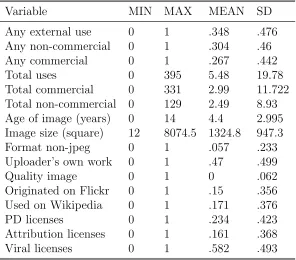
Table 1: Summary statistics for main variables drawn from 10,000 image pages on Wikimedia Commons
Variable MIN MAX MEAN SD
Any external use 0 1 .348 .476
Any non-commercial 0 1 .304 .46
Any commercial 0 1 .267 .442
Total uses 0 395 5.48 19.78
Total commercial 0 331 2.99 11.722 Total non-commercial 0 129 2.49 8.93 Age of image (years) 0 14 4.4 2.995 Image size (square) 12 8074.5 1324.8 947.3
Format non-jpeg 0 1 .057 .233
Uploader’s own work 0 1 .47 .499
Quality image 0 1 0 .062
Originated on Flickr 0 1 .15 .356
Used on Wikipedia 0 1 .171 .376
PD licenses 0 1 .234 .423
Attribution licenses 0 1 .161 .368
files.3
Using this tool, we subjected the URL of each image file to a reverse image
search using the public Google web interface. This was accomplished by running a
script to complete fields for each query, emulating a human search. The results of
the reverse image search were recorded with each case being a URL returned by the
search. This process yielded 54,758 URLs. For each returned hit, we recorded the rank
in the search results, and extracted the domain information for each URL, recording
it in a separate field. We carried out human review to further sort TLDs according
to their overall type (country code or generic top-level domain) as well as purpose
(commercial TLDs compared to .GOV, .EDU, etc.). Usage results obtained in the
second phase of data collection were merged with the first dataset by matching back to
unique image IDs. This enabled us to record as a continuous variable the total number
of results returned for each original image. We then performed a series of regression
analyses, first with any use as a binary outcome variable and then with commercial
and non-commercial use as the outcome variable, reported below.
4
Discussion
We found that 34.8% of images in our sample were used externally at least once. This
figure does not include previous use on Flickr if an image was obtained from that
website. It includes all other detected external uses from URLs besides the page on
WC where the original image was hosted. The most frequent user was Wikipedia:
some 17.1% of images in our sample were also featured in Wikipedia articles. The
3
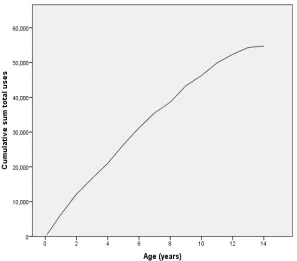
Figure 1: Cumulative sum of 54,758 total uses by years since upload.
mean age of uploaded images was 4.4 years. External use varies with age as shown
in Figure 1. Newer images (those uploaded more recently than the mean of 4.4 years
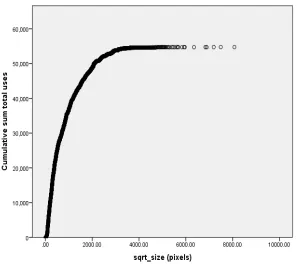
ago) accounted for 48.4% of all detected uses. Smaller images account for more of the
observed uses, with those below the mean size of 1325 pixels square accounting for
63.9% of all detected uses. Most images hosted on the WC were in JPEG format. In
our sample, only 5.7% of images were in a different format, with the most common
alternative formats being .PNG and .GIF.
Nearly all of the images in our sample (98.8%) were accompanied by copyright
license information. Approximately 47% of images in our sample were the authors’
Figure 2: Cumulative sum of 54,758 total uses by years since upload.
Some 15% of the sample consisted of freely-licensed images that were pulled from
commercial hosting site Flickr (functionality available in the WC Upload Wizard from
December 2012), with licensing information automatically accompanying those files
across to the WC. In other cases, the uploader specified a license at the point of
upload, or reproduced the licensing information in the case of third-party images (such
as those marked PD-old for out-of-copyright works).
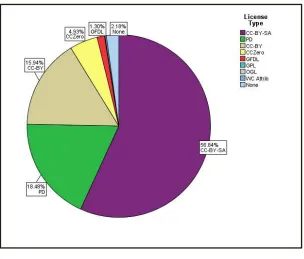
Figure 3 shows the share of different licenses used in our sample. This information
was obtained by extracting the license data from the individual image pages on the
WC. The license establishes the uses that can be made of the image without
Figure 3: License types used
Share-Alike (CC-BY-SA) was the most commonly selected license for images (56.8%),
followed by PD marks and other public domain dedications (18.5%) and Creative
Com-mons Attribution licenses (15.9%). Less commonly used licenses included the GNU
Free Documentation License (GFDL) and software documentation marked with GPL
licenses. Some 2.2% of files did not have a valid license, either because they were not
accompanied by adequate information, or because the chosen license conflicted with
the information provided (e.g. an attribution license with no known author).
We examined how images were used downstream of the WC by automatically
searching for matches and recording information about the domains where images
were found. The reverse image-search process detected 54,758 external uses, excluding
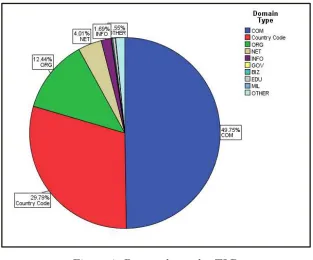
Figure 4: Detected uses by TLD
where the use was detected, as summarised in Figure 4. Some 49.7% of the detected
uses were found on .COM domains, while .ORG domains (including Wikipedia) made
up 12.44% of uses. Some 29.8% of uses were detected on country-level domains (such
as .ca or .ru). A human reviewer further categorised uses according to whether they
were found on a commercial domain (.COM) or a commercial country code (such as
.co.uk). Within the original sample of 10,000 images, some 26.7% were found to have
at least one commercial use, while 30.4% were found to have at least one use that
we deem non-commercial (any remaining ccTLDs and non-commercial generic TLDs).
Further analysis could improve the determination of commerciality, as TLDs can only
provide a rough guide. Alternative approaches include crawling the target URLs for
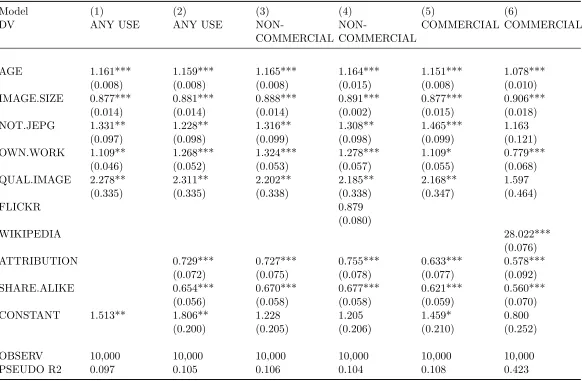
Next, we performed a series of binary logistic regressions taking any detection of
use as the dependent variable (1=use detected, 0=otherwise). Table 2 presents the
results of 6 regressions using 3 different DVs: Any detected use, non-commercial use
and commercial use.
The first model includes only the main control variables (image characteristics and
age). Variables of interest are license type (attribution-style, share-alike, or public
domain) as well as human curation (’Quality’ tag designation). In all models the
estimates are shown as odds ratios, with values greater than 1 indicating an increase
in the odds of use and values lower than 1 indicating reduced odds.
The age of an image slightly increases the odds of use on commercial and
non-commercial domains, suggesting an effect related to discovery time. Larger image size
reduces the odds of use. ‘Quality’ images have singificantly increased odds of use,
as do unusual file formats (non-JPEG files). An image’s origin on Flickr does not
significantly effect its odds of use (Flickr is counted as a commercial external use,
so this variable is excluded from other models). By contrast, inclusion on Wikipedia
significantly increases the odds that an image is used commercially. We interpret this to
indicate the importance of Wikipedia in providing context and exposure to prospective
users.
Compared to public domain files, those issued with an attribution or share-alike
requirement have significantly reduced odds of being used externally. Attribution
and share-alike requirements reduce the odds of commercial use more than for
non-commercial use, suggesting that these are important impediments for prospective
Table 2: Binary logistic regressions with dichotomous measures of external use as the outcome variable
Model (1) (2) (3) (4) (5) (6)
DV ANY USE ANY USE
NON-COMMERCIAL
NON-COMMERCIAL
COMMERCIAL COMMERCIAL
AGE 1.161*** 1.159*** 1.165*** 1.164*** 1.151*** 1.078*** (0.008) (0.008) (0.008) (0.015) (0.008) (0.010) IMAGE.SIZE 0.877*** 0.881*** 0.888*** 0.891*** 0.877*** 0.906***
(0.014) (0.014) (0.014) (0.002) (0.015) (0.018) NOT.JEPG 1.331** 1.228** 1.316** 1.308** 1.465*** 1.163
(0.097) (0.098) (0.099) (0.098) (0.099) (0.121) OWN.WORK 1.109** 1.268*** 1.324*** 1.278*** 1.109* 0.779***
(0.046) (0.052) (0.053) (0.057) (0.055) (0.068) QUAL.IMAGE 2.278** 2.311** 2.202** 2.185** 2.168** 1.597
(0.335) (0.335) (0.338) (0.338) (0.347) (0.464)
FLICKR 0.879
(0.080)
WIKIPEDIA 28.022***
(0.076) ATTRIBUTION 0.729*** 0.727*** 0.755*** 0.633*** 0.578***
(0.072) (0.075) (0.078) (0.077) (0.092) SHARE.ALIKE 0.654*** 0.670*** 0.677*** 0.621*** 0.560***
(0.056) (0.058) (0.058) (0.059) (0.070) CONSTANT 1.513** 1.806** 1.228 1.205 1.459* 0.800
(0.200) (0.205) (0.206) (0.210) (0.252)
4.1
Estimating value
Having established the usage rate of Wikimedia images and identified some of the
variables influencing downstream use, it is possible to make estimates of the overall
economic value of the project. One method of establishing the value represented by free
and open projects is to compare them with equivalent commercial offerings. Consumer
willingness to pay (WTP) for commercial services can be used as a benchmark to
establish the consumer surplus represented by free and open alternatives such as the
WC (Heald et al. 2015).
For commercial comparison, a relevant market is the image licensing industry.
Vi-sual content company Getty Images, which holds one of the largest commercial image
catalogues in the world, reported 2017 revenue of USD $868 million (Seattle Times,
2016). Image libraries acquire copyright in images from photographers and sell to
customers which include advertising agencies, press publishers and corporate
commu-nications departments. The image library business model relies on economies of scale
to reduce search costs and increase choice for buyers. Significant investment goes
into maintaining a user-friendly, searchable platform of images to help prospective
customers find exactly what they are looking for. Digitalisation has offered new
oppor-tunities for companies like Getty to find and license images to consumers; it has also
given rise to alternative ways of curating and distributing photographs and images.
Since the downstream use of images from WC measured in our study is limited
to digital uses located on the web, we apply the pricing of web images only. Getty
currently offers a 1-year, royalty-free license for commercial editorial use of a digital
more expensive ’creative’ rate because editorial more closely approximates the usage
observed for our sample, which includes political figures, landmarks and public events.
Based on the mean commercial usage rate of 2.99 for our sample, we can estimate
the total commercial use for the entire WC catalogue as [43,039,140 * 2.99 * $175] or
approximately USD $22.5 billion over the lifetime of the project. This figure does not
include use on non-commercial TLDs such as .ORG or generic country code TLDs,
which make up the other 45.4% of the observed uses. Getty and other image libraries
are happy to license non-commercial use of their images, typically for a reduced price.
The lowest license price we could obtain for non-commercial editorial use of an image
from Getty was USD $60. Using the same operation but with different price and
mean usage of [43,039,140 * 2.48 * $60] we obtain a figure of USD $6.4 billion for
the additional non-commercial uses. Both estimates include total use over the 14-year
period since the establishment of the WC.
Our valuation approach is limited by several assumptions. We assume that
down-stream users would be willing to pay the equivalent of a commercial license to use an
image if no free alternative was available from the WC. We also make the assumption
that images licensed by Getty are aesthetically equivalent to the free images used from
WC. We attempt to address these issues by taking the lowest available license rate
from Getty for editorial use, where aesthetic differences are judged to be less
signifi-cant. Our approach could be improved with greater information about the nature of
downstream use (for example if advertising code or e-commerce functionality is present
on the page). More information about aesthetic differences between Getty and WC
5
Conclusions
This paper has tracked downstream digital use of images hosted on the WC. We find
a mean rate of online use of 5.48 uses per image. Using commercial TLDs as a proxy
for commercial use, we estimate a mean commercial usage of 2.99 per image. The
odds that a given image from the WC will be used is significantly influenced by the
license type issued by its uploader. Images with attribution and share-alike licenses
have significantly reduced odds of being used externally compared to images fully in
the public domain.
One aim of our paper is to propose a method to assess the economic contribution of
volunteer produced, openly licensed content. We offer this approach as an alternative
to traditional copyright industry accounts of economic value. Studies of
commons-based projects such as this could be helpful to evaluate future policy proposals that
may reduce the availability of works in the public domain.
Based on real-world pricing of image licenses from commercial provider Getty
im-ages, we estimate a total value of all online uses (commercial and non-commercial) of
USD $28.9 billion. The actual societal value of the WC is likely considerably greater,
and would include direct personal uses as well as print, educational and embedded
soft-ware applications not detectable by our reverse image search approach. Getty routinely
charges license fees of $650 or more for creative use (such as magazine covers),
signifi-cantly higher than the rate for editorial use. Our valuation method could be improved
with more information about usage rates of commercial stock photography as well as
potential qualitative differences between stock and Commons-produced imagery.
curation plays an important role in the overall value represented by the WC. These are
internal mechanisms used by WC contributors to identify images of importance. Users
can flag images in various ways, such as ‘valued’ ‘quality’ or ‘featured’ images. Such
human flagged images make up a very small proportion of the overall WC, and our
random sample did not capture enough of each to carry out a full analysis. In future,
we suggest combining a purposive sample of quality and featured images to generate
data on the value of human curation to the overall WC. This approach might also
be used in combination with aesthetic comparison between WC and Getty images, to
establish whether significant qualitative differences exist between professional content
and images available in the Commons.
Acknowledgments:
The authors would like to thank the three anonymous reviewers for their helpful
com-ments. We are grateful to Swagatam Sinha for additional comments on economic
val-uation approaches. This research was partly supported by a grant from the Wikipedia
Free Knowledge Advocacy Group (Grant number FKAGEU 002).
References
James Boyle. 2003. The second enclosure movement and the construction of the public
domain. Law and contemporary problems 66, 1/2 (2003), 33–74.
enter the public domain?: Empirical tests of copyright term extension. Berkeley
Technology Law Journal (2013), 1–43.
Wikimedia Commons. 2018. Media Statistics. https://commons.wikimedia.org/
wiki/Special:MediaStatistics
Linus Dahlander and Mats Magnusson. 2008. How do firms make use of open source
communities? Long range planning 41, 6 (2008), 629–649.
Leonhard Dobusch. 2012. Strategy as a Practice of Thousands: The case of
Wikime-dia. In Academy of Management Proceedings, Vol. 2012. Academy of Management
Briarcliff Manor, NY 10510, 1–1.
Kristofer Erickson. 2018. Can Creative Firms Thrive Without Copyright? Value
Gen-eration and Capture from Private-Collective Innovation. Business Horizons (2018),
1–19.
A Hars and S OU. 2001. Working for Free?–Motivations of Participating in Open
Source Projects, 00 (c), 1–9. In 34th Annual Hawaii International Conference on
System Sciences (HICSS-34), Hava´ı. 25–39.
Paul Heald, Kristofer Erickson, and Martin Kretschmer. 2015. The Valuation of
Un-protected Works: A Case Study of Public Domain Images on Wikipedia. Harv. JL
& Tech. 29 (2015), 1.
Eric von Hippel and Georg von Krogh. 2003. Open source software and the
“private-collective” innovation model: Issues for organization science. Organization science
Lawrence Lessig. 2006. Re-crafting a public domain. Yale JL & Human. 18 (2006),
56.
Rufus Pollock, Paul Stepan, and Mikko V¨alim¨aki. 2010. The Value of the EU Public
Domain. Technical Report. Faculty of Economics, University of Cambridge.
Richard Stallman. 2002. Free software, free society: Selected essays of Richard M.
Stallman. Free Software Foundation.
Matthias Stuermer, Sebastian Spaeth, and Georg Von Krogh. 2009. Extending
private-collective innovation: a case study. R&d Management 39, 2 (2009), 170–191.
Seattle Times. 2016. Corbis sale to Chinese company may be boon
to Getty. https://www.seattletimes.com/business/technology/
corbis-sale-to-chinese-company-may-be-boon-to-getty/
Gaurav Vaidya, Dimitris Kontokostas, Magnus Knuth, Jens Lehmann, and Sebastian
Hellmann. 2015. DBpedia commons: structured multimedia metadata from the
wikimedia commons. InInternational Semantic Web Conference. Springer, 281–289.
Georg Von Krogh, Stefan Haefliger, Sebastian Spaeth, and Martin W Wallin. 2012.
Carrots and rainbows: Motivation and social practice in open source software