This is a repository copy of
Students’ Knowledge Acquisition and Ability to Apply
Knowledge into Different Science Contexts in Two Different Independent Learning
Settings.
.
White Rose Research Online URL for this paper:
http://eprints.whiterose.ac.uk/117782/
Version: Accepted Version
Article:
Cukurova, Mutlu, Bennett, Judith Merryn orcid.org/0000-0002-5033-0804 and Abrahams,
Ian Zoller (2018) Students’ Knowledge Acquisition and Ability to Apply Knowledge into
Different Science Contexts in Two Different Independent Learning Settings. Research in
Science and Technological Education. pp. 17-34. ISSN 1470-1138
https://doi.org/10.1080/02635143.2017.1336709
[email protected] Reuse
Items deposited in White Rose Research Online are protected by copyright, with all rights reserved unless indicated otherwise. They may be downloaded and/or printed for private study, or other acts as permitted by national copyright laws. The publisher or other rights holders may allow further reproduction and re-use of the full text version. This is indicated by the licence information on the White Rose Research Online record for the item.
Takedown
If you consider content in White Rose Research Online to be in breach of UK law, please notify us by
StudentsÕ Knowledge Acquisition and Ability to Apply Knowledge
into Different Contexts in Two Different Independent Learning
Settings
!
This paper reports on a study that explored the effectiveness of two different learning settings: (i) guided independent learning and (ii) un-guided independent learning with independent research, in enabling students in an undergraduate Macromolecules course to acquire knowledge in one chemistry context and apply it successfully in another. The study involved a sample of 144 chemistry students commencing their first term of undergraduate study at a northern university in England. Students were asked to complete pre- and post-intervention tests containing ten diagnostic questions of which four measured studentsÕ knowledge acquisition in one context and six measured their ability to apply it successfully in another. Diagnostic questions had been designed using a Delphi approach. Paired t-tests and chi-square tests were used to analyse the significance of any change in studentsÕ responses to the diagnostic questions and the number of responses evidencing misconceptions respectively. Whilst it was found that guided independent learning settings improved studentsÕ knowledge and ability to apply knowledge in novel situations, un-guided independent learning had no statistically significant effect. It was also found that un-guided independent learning led to a statistically significant increase in the number of student misconceptions in one of the diagnostic questions. The results of this study suggest that guidance in independent learning activities is a key necessity.
Keywords: Independent Learning; Knowledge Acquisition; Ability to Apply Knowledge; Misconceptions
Introduction and Aim
Independent learning is defined as that learning in which the learner, in conjunction with relevant
others, can make the decisions necessary to meet the learnerÕs own learning needs (Kesten, 1987).
Although, this definition comes from an almost thirty-year-old source, it has been accepted and used by
many recent scholars who study independent learning (Bates & Wilson, 2002; Black, 2007; Bullock &
Muschamp, 2006; Laurillard, 2013; Seery, 2012). For almost three decades now, there has been an
extensive movement internationally to change teaching in higher education (HE) through a range of
innovations, which promote independent learning. Independent learning has increased in importance as its
role in the continuing development of an education system that promotes high quality, and lifelong learning
gains recognition. Its significance may be considered as even bigger in HE as university education is the
last step of formal education for the majority of the university graduates. Hence, it may be regarded as the
last opportunity to develop independent learning abilities, which will possibly be the key method of
There is a broad acceptance (Bates & Wilson, 2002; Gorman, 1998; Kesten, 1987) that learners develop
values, attitudes, knowledge and skills needed to make responsible decisions and take appropriate actions in
regard to their own learning during independent learning activities. The principles of independent learning
are reflected in the design of several instructional approaches, such as problem-based learning (Barrows,
1985) project-based learning (Blumenfeld et al., 1991), inquiry learning (Minner, Levy, & Century, 2010),
learning through information and communication technologies (Mok & Chen, 2001), online learning
(Heckman & Annabi, 2005), and flipped classrooms (Alvarez, 2011). Hence, literature reviews of
independent learning (see, for instance, Meyer, Haywood, Sachdey, & Faraday, 2008) usually rely on
findings generated from variety of teaching strategies including those cited above. Previous studies
investigated those teaching approaches, showed that independent learning, when it is applied in the settings
of aforementioned teaching approaches, can generate increased academic achievement (Albanese & Mitcell,
1993; Davies, Dean, & Ball, 2013; Vernon & Blake, 1993), improved motivation and confidence (Alvarez,
2011), and, has been reported, by learners, to be a more satisfying learning experience, compared to more
traditional types of teaching strategies (Belland, Ertmer, & Simons, 2006; Fulton, 2012).
However, there is little agreement on how independent learning activities should be applied, and they are often
considered to be hard to manage by teachers (Abrahams, Reiss, & Sharpe, 2014). In order to shed light on the
application of independent learning approaches in their specific contexts, we investigated an independent learning
approach which has features from teaching approaches mentioned earlier and involves two different independent
learning activites (i) guided independent learning and (ii) un-guided independent learning with independent
research. It was applied in a first year undergraduate module, in the Chemistry department of a university situated in
north England. We aimed to answer two main research questions:
1) What are the impacts of guided and un-guided independent learning activities, on first year tertiary level
studentsÕ knowledge acquisition and their ability to transfer this knowledge into new contexts?
2) What are the impacts of guided and un-guided independent learning activities, on first year tertiary level
Independent Learning Activities in Instructional Strategies
Instructional support provided during learning has been referred to variously as: Ôinstruction
methodsÕ (Cronbach & Snow, 1977; Tobias, 1982), Ôinstructional strategiesÕ or Ôteaching strategiesÕ (Merill,
2002; Weston & Cranton, 1986), Ôdirect instructionÕ (Klahr & Nigam, 2004) and ÔscaffoldingÕ (Pea, 2004).
We have opted to use the term Ôinstructional strategyÕ as the word strategy refers to a plan of action
designed to achieve a long-term or overall aim which we feel best reflects the aims of the lecturer. Indeed, it
has been argued (Salomon, 2004) that instruction strategies either activate or impede the cognitive
processes necessary for learning.
Promoting independent learning with variety of instruction strategies is important (Evans, 1991). This
requires educators building up a repertoire of strategies, which promote independent learning and gradually
engaging students in becoming more independent in their learning. Although, the usual approach to
teaching at university has been traditional, didactic and lecture-based (Berrett, 2012) which promotes the
dependence of students to their teachers in their learning; for almost the last thirty years there has been an
extensive movement internationally to change tertiary level teaching through innovative teaching strategies
which involve independent learning activities. Even though, the importance of these activities has been
widely accepted, the way that they have been practiced is still a topic under discussion. One often broadly
varied feature of such application of teaching approaches that involve independent learning activities is the
amount of guidance required to be provided to the learners.
Guidance in Instruction Strategies
Derek Hodson claims that independent learning activities in the sciences should only be used
among students that are already familiar and happy with relevant scientific concepts (1991), otherwise they
simply become too confusing and unproductive, with no clear linkages between activities and learning
(1993). Taber (2011) argues that if students are left on their own to find solutions to problems they come
across, it is very unlikely that those solutions are different then those scientifically accepted ones. In a
similar vein, Sweller, Kirschner and Clark (2007) suggest that students should be carefully guided towards
accurate constructions, understandings and solutions during independent learning activities. However, strict
independent learning activities, which is to build abilities allowing learners to be independent learners such
as their ability to reason and think independently.
Possibly both, researchers who argue that students should discover their own solutions independently and
those who argues that students should be strictly guided towards the solutions, would accept the usefulness
of the concept of scaffolding (Pea, 2004) in instruction strategies. Pea describes scaffolding situations as
Òthose in which the learner gets assistance or support to perform a task beyond his or her own reach if
pursued independently when unassistedÓ (pp. 430; emphasis in the original text). However, the problem in
such arguments is that these types of descriptions are too general and open to discussions. As Clark (2009)
states they do not provide enough information about Òexactly when, how, and how much support should be
given and should be ÔfadedÕ without cognitively overloading unassisted learnersÓ (pp. 160). Pea (2004)
suggests in his scaffolding theory that guidance should be provided when there is Òindependent evidence
that the learner cannot do the task or goal unaidedÓ (p. 443). On the other hand, Kirschner et al. (2006,
2007) who support the strict guidance during instruction strategies argue that learners must be provided
with a complete demonstration of how to perform all aspects of a task that they have not learned and
automated previously, even if a learner could solve a problem with adequate mental effort, they argue that
to provide a complete description of when and how is more effective way of learning.
Previous Research on Guidance in Instruction Strategies
The effects of variations in guidance on learning have been reviewed in a combination of
laboratory and field-based studies by Mayer (2004), by Kirschner, Sweller, and Clark (2006), and by
Sweller et al. (2007). All those researchers concluded that providing guidance during instruction strategies
is a more effective approach than allowing students time to find the solutions themselves at improving
students both, knowledge acquisition and their understanding of key concepts.
More specifically, Fender and Crowley (2007) investigated children between ages 3- and 8-years-old who
explored a novel task solo or with parents and found that children whose parents had explained were most
likely to have a conceptual understanding of concepts as opposed to procedural understanding of the task.
Similarly, Klahr and Nigam (2004) found that many more students learned from instruction with strict
broader, richer scientific judgments many students who learned about experimental design from guided
instruction strategy performed well while only a few of those children who discovered the method
independently managed to do so. Rappolt-Schlichtmann, Tenenbaum, Koepke, and Fischer (2007) showed
that students provided guidance through modeling more complex reasoning about why objects sink or float
presented more complex judgments compared to no guidance group, although their predictions about
whether objects would sink or float were mostly correct from the start for both groups of students.
Strand-Cary and Klahr (2008) found that at each of the three grade levels they investigated, many more students
learned Control of Variables Strategy (CVS), which is often seen as a central strategy in science, in the
guided condition than in the unguided condition in which students were received neither instruction about
good and bad experiments nor any probe questions. On the other hand, in long term, strict guidance in
instruction, as Dean and Kuhn (2007) found, is neither a necessary nor sufficient condition for robust
acquisition of knowledge or for maintenance of it over time. It was also found that while the guided
students performed better on the definitional knowledge test. On the explanation test there was no
difference between the two groups of students who were taught in guided and unguided teaching strategies
(Swaak, de Jong, & van Joolingen, 2004). The authors show that unguided strategies, when sufficient
learning time and freedom for students in the assignments to engage in activities provided, can also result in
substantial learning gains.
Further investigations of instruction strategies which involve both, guided and unguided independent
learning activities is required for better comprehension and application of such approaches and their impact
on student learning in specific contexts.
Student Misconceptions
Nowadays, it is established in the literature that students often develop ideas that are different from those
accepted by the scientific community and intended by their facilitators (BouJaoude, 1992; Ebenezer &
Fraser, 2001; Taber, 1999; Treagust, 1988; Zoller, 1990). These ideas have been given various names, such
as alternative frameworks, misconceptions, misunderstandings or alternative conceptions (Gabel & Bunce,
1994; Griffiths, 1994; Nakleh, 1992). Even though each description has a slight difference, such as that
compared with alternative conceptions (Griffiths, Thomey, Cooke & Normore, 1988), in essence they all
refer to studentsÕ ideas which differ from the scientifically accepted ones. As the second research question
of this study is aimed at measuring the impact of the independent learning activities investigated on
studentsÕ misconceptions, we reviewed the literature on students common misconceptions related to the
content of the Macromolecules module and used this piece of literature while coding student answers to
diagnostic questions.
The Structure of the Macromolecules course
The Macromolecules course was unique amongst studentsÕ first-year courses in being taught in
independent learning. The course did not involve any lectures and students were asked to work alone to find
out solutions for the given problems and tasks. In this course, students were expected to take responsibility
for their own learning and to discover their own solutions.
The course had two components; the first involved guided and the second involved unguided independent
learning activities. In the guided component students were provided with a workbook based on the
lecturerÕs previous lecture notes which had been adapted to fit in with the principles of independent
learning. Students started by working through the workbook, reading the sections, finding further
information via weblinks etc., and then they attempted to answer questions provided by the lecturer which
were designed to enable studentsÕ to acquire knowledge of, and understanding about, the chemical ideas in
the topic. In guided component, students were able to interact with and ask questions to their lecturers on a
discussion board on the virtual learning environment (VLE). Once they had worked through the material on
the guided component of the course, they were asked to answer the assessed tutorial questions on the VLE.
They were allowed to use whatever resources they chose to help them to answer.
For the second, unguided, component of the course, they were asked to carry out an independent
investigation into an aspect of polymer chemistry and then present their findings either, in the format of a
written article or short video. The polymer chemistry topics were suggested by the lecturer in the
introductory lecture and students chose the topic which piqued their curiosity among the options suggested.
studied the course for ten weeks (one semester) and spent five weeks on guided and five weeks on unguided
settings.
Methodology
This study set out to evaluate the
effectiveness of two styles of independent learning
on studentsÕ knowledge and their ability to apply
knowledge into different contexts, hence, pre- and
post-test design (Bryman, 2008) is seen appropriate
for data collection. To avoid sample bias it was
agreed with the course leader that they would
strongly encourage the students to complete the pre- and post-tests although, for ethical reasons, tests were
not compulsory. Students took the same questionnaire with ten diagnostic questions at the beginning of
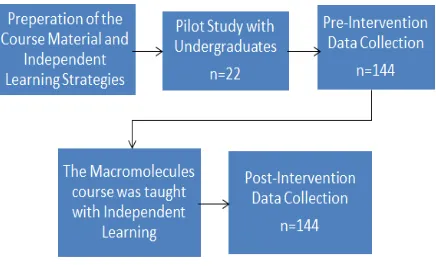
their first week and ten weeks later during the last week of the term. Figure 1 summarizes the research
design. Diagnostic questions were prepared by the researchers and validated using a Delphi approach
(Clayton, 1997) involving three chemistry education researchers and three university lecturers, from two
different UK universities. First, the module leader was asked to generate questions related to investigated
chemical ideas and the learning objectives of the course. 10 questions each for guided and unguided parts of
the module were prepared. Other lecturers and chemistry education researchers reviewed these questions. In
main study, three questions from guided and seven questions from the unguided part of the study were
agreed by all lecturers and chemistry education researchers, hence they were used in the main study.
Since all of the first year undergraduate students were taking part in this study, the questionnaires were
piloted with twenty-two students from four other similar chemistry departments in the UK. Ten students in
the pilot study studied the content of the Macromolecules module in similar unguided settings whereas the
rest studied in guided settings in their departments. In pilot study, studentsÕ feedback on the questions
regarding their clarity, difficulty or typographic features were also taken into account and questions were
[image:8.612.318.536.144.279.2]revised before they were used in the main study.
Main study
The main study was designed specifically to probe studentsÕ knowledge acquisition and ability to apply
knowledge into different contexts. It aimed to investigate the effectiveness of the two different independent
learning activities at teaching the content of Macromolecules module. The diagnostic questions that aimed
to measure studentsÕ ability to apply knowledge were explorative, whilst those questions that sought to
measure knowledge acquisition were descriptive in nature. Every diagnostic question was related to a
learning objective of the Macromolecules course. The questions can be categorized into four groups
according to whether they related to guided or unguided independent learning and knowledge acquisition or
ability to apply knowledge to novel contexts:
Group 1: The Isomerisation and Combustion questions were devised to measure any impact of the guided
independent learning on the student ability to apply knowledge of geometric isomerisation and hydrogen
bonding to novel contexts.
Group 2: The KevlarÕs Strength question was designed to measure any impact of guided independent
learning on studentsÕ knowledge acquisition on intermolecular bonds.
Group 3: The Branching, Biodegradability-Biocompatibility, Chelate (coordinate bonding) and Fashion
(structure-property relationship) questions were designed to measure any impact of the unguided
independent learning on student ability to apply knowledge of these chemical ideas to novel contexts.
Group 4: The Recycling, PIC and Functional Group questions were designed to measure any impact of the
unguided independent learning on student knowledge acquisition on recycling and functional groups.
As can be seen the different number of questions exist in different groups. Three questions are about the
chemical ideas studied with the guided independent learning and seven about the chemical ideas studied
with unguided independent learning activities. Among them, four measured studentsÕ knowledge
acquisition in one context and six measured their ability to apply it successfully in another. These numbers
are the result of the Delphi study since among twenty diagnostic questions suggested by the module leader,
those considered as appropriate by all experts, were used in the main study.
Qualitative analysis
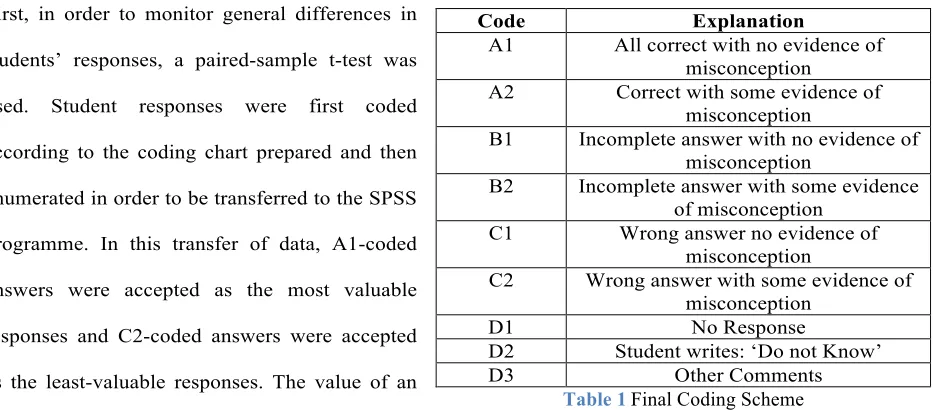
Data was first coded into four categories A, B, C, and D in addition to which each category was allocated a
further code, either 1 or 2, representing a response with no evidence of misconception and one with
evidence of misconception respectively. Table 1 shows the final coding scheme. A chemistry education
researcher and a postgraduate chemistry education student did the coding independently. Ten per cent of all
answers are double coded and where there was disagreement, the researchers discussed the data and revised
their codes accordingly.
Reporting changed responses
First, in order to monitor general differences in
studentsÕ responses, a paired-sample t-test was
used. Student responses were first coded
according to the coding chart prepared and then
enumerated in order to be transferred to the SPSS
programme. In this transfer of data, A1-coded
answers were accepted as the most valuable
responses and C2-coded answers were accepted
as the least-valuable responses. The value of an
answer is judged by its proximity to the expected correct answer. As every numerical representation of the
ÔvalueÕ of an answer, this enumeration is a hypothesis. Using SPSS differences between studentsÕ pre- and
post-intervention responses were compared using a paired-sample t-test and a chi-square test both at the
0.05 level of significance.
In order to provide some insights regarding how the data was treated, we provide an example of student
answer below. The quote was given to the branching question by student 72, and is coded as C2 (wrong
answer with some evidence of misconception).
HDPE is more flexible, it has branches which can bond and connect in different ways more that
LDPE, so it is more elastic.
Code Explanation
A1 All correct with no evidence of misconception
A2 Correct with some evidence of misconception
B1 Incomplete answer with no evidence of misconception
B2 Incomplete answer with some evidence of misconception
C1 Wrong answer no evidence of misconception
C2 Wrong answer with some evidence of misconception
D1 No Response
D2 Student writes: ÔDo not KnowÕ
[image:10.612.80.547.271.476.2]D3 Other Comments
LDPE is more flexible than HDPE hence the answer is not correct. Also, the answer reveals that the student
thinks that more side chains mean more intermolecular bonding which is a misconception related to the
content of the Macromolecules module.
Results
Recycling process
The question about the recycling process was designed to probe the gain in studentsÕ knowledge regarding
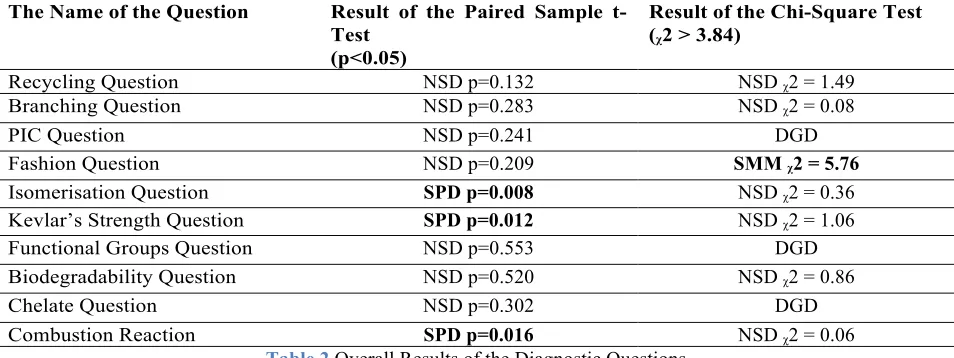
the recycling process. Results of the paired t-test show that the studentsÕ knowledge acquisition about the
recycling process was not significant p=0.132 (p<0.05).
The number of responses which showed evidence of a misconception had decreased from 21 to 16 after the
Macromolecules course. This decrease was not statistically significant, ᵪ2 = 1.49 ( ᵪ2 > 3.84)
Some students gave responses with the same misconception after they had completed the Macromolecules
course. The most common misconceptions, which were presented by 37 students, seemed to be Òevery
plastic is made of crude oilÓ and Òwe can recycle every plasticÓ. Furthermore, the difference between re-use
and recycling still appeared to be problematic for some students (22/144) after the Macromolecules course,
as it was one of the most frequent misconceptions for students before the course.
In a comprehensive study on studentsÕ understanding of the recycling process (Kortland, 1992), it was
found that the depletion of raw materials was seldom, if ever, mentioned by students. In this current The Name of the Question Result of the Paired Sample
t-Test (p<0.05)
Result of the Chi-Square Test (ᵪ2 > 3.84)
Recycling Question NSD p=0.132 NSD ᵪ2 = 1.49
Branching Question NSD p=0.283 NSD ᵪ2 = 0.08
PIC Question NSD p=0.241 DGD
Fashion Question NSD p=0.209 SMM ᵪ2 = 5.76
Isomerisation Question SPD p=0.008 NSD ᵪ2 = 0.36
KevlarÕs Strength Question SPD p=0.012 NSD ᵪ2 = 1.06
Functional Groups Question NSD p=0.553 DGD
Biodegradability Question NSD p=0.520 NSD ᵪ2 = 0.86
Chelate Question NSD p=0.302 DGD
[image:11.612.68.545.176.355.2]Combustion Reaction SPD p=0.016 NSD ᵪ2 = 0.06
Table 2 Overall Results of the Diagnostic Questions
research study, however, this point was frequently mentioned by students. One possible reason for this
difference could be the age difference between the two samples as Kortland used younger students aged
13-14 in his study.
Branching
This question probed studentsÕ ability to apply knowledge of branching to the context of HDPE and LDPE
polymersÕ physical properties. The improvement in studentsÕ responses was not statistically significant at
the p<0.05 level, p=0.283. The change in the number of student answers containing misconceptions was not
statistically significant either, ᵪ2 = 0.08 ( ᵪ2 > 3.84)
The result suggests that the Macromolecules course had no impact on studentsÕ ability to apply their
knowledge of branching to a novel context. The most common misconception was that students thought
that more branching meant more intermolecular bonding. In the post-intervention analysis, some students
still continued to believe this. This finding can be related to a general intuitive rule (Tirosh & Stavy, 1999)
that Ôthe more of A (the salient quantity), the more of B (the quality in question)Õ. This finding suggests, as
has been previously reported (Barke, Hazari, & Yitbarek, 2009), that students transfer and confuse terms
from the macroscopic area of matter with the sub-microscopic area of the smallest particles. In their
responses to this question, the students thought that more-branched molecules can interact better with each
other, just as at the macro level it would be very possible to expect that the branched parts of materials stick
together more easily than the smooth parts of materials. However, this explanation does not correspond to
the behaviour of polymers at the molecular level.
Plastic identification codes (PIC)
This question was designed to measure studentsÕ knowledge acquisition about the everyday life applications
of polymers. Comparison of the pre- and post-intervention surveys showed a p value greater than 0.05
(p=0.241), which shows that the increase in the studentsÕ knowledge acquisition about applications of PIC
Fabrics
The Fashion and Fabrics question explored studentsÕ ability to apply knowledge of hydrogen bonding in the
context of PTFE and Nylon structures. There was not, at the 0.05 level (p=0.209), a statistically significant
change suggesting that studentsÕ ability to apply knowledge of hydrogen bonding to different contexts was
not improved during the Macromolecules course.
In terms of studentsÕ misconceptions the post-intervention data showed that there were statistically
significantly more responses with some evidence of a misconception, ᵪ2 = 5.76, (ᵪ2 > 3.84).
The most common problem encountered by the students in this question was that could not transfer their
thinking from the micro to the macro level or vice versa. However, the question asked the students to
transfer their thinking from the atomic (micro) level (the water-repellent chemistry of those polymers) to the
macro and tangible level (the waterproof and breathable features of the materials). Previous studies (Gabel,
1994, 1998) have found that students struggle to comprehend and use the transfer between those levels The
reasons for this may vary, such as lack of experience with the macro type (Hodson, 1990; Nelson, 2002), or
the existence of misconceptions about the particulate nature of matters that can impede understanding the
nature of the sub-microscopic level (Harrison & Treagust, 2000).
Isomerisation
This question was designed to measure studentsÕ ability to apply their knowledge of the cis- and trans-
stereochemistry of polymers in the context of how polymers behave in chemical reactions. There was a
significant positive change, p=0.08 (p<0.05) between pre- and post-intervention student responses, which
indicates that some studentsÕ ability to apply knowledge of geometric isomerisation to a novel context has
improved.
In terms of student misconceptions, whilst 14/144 of the responses contained misconceptions the most
common of which related to trans-isomers have more steric hindrance with a further six students stating that
cis- and trans- isomers could have different numbers of monomers or different numbers of double bonds,
overall the change in the number of responses containing a misconception was not statistically significant,
Kevlar
This question focused on studentsÕ knowledge acquisition of the intermolecular bonds in polymers.
Comparison of the pre- and post-intervention surveys shows that the p value is smaller than 0.05 (p=0.01),
which suggests that student knowledge about intermolecular bonding in Kevlar has increased by a
statistically significant amount.
There was no statistically significant, ᵪ2 = 1.06 (ᵪ2 > 3.84) change in the number of student misconceptions.
The most frequent misconception being that students associated the physical strength of Kevlar with its
atom-atom interaction in the molecules (intramolecular bonds) instead of atom-atom interactions among
different molecules (intermolecular bonds). In other words, some students thought that if in the molecule
there is a strong bond between atoms, the molecule should be physically strong. These students associated
KevlarÕs physical strength with its chemical inertness. This finding is similar to previous studies (Peterson
& Treagust, 1989; Peterson, Treagust, & Garnett, 1989; Taber, 1994, 1995) that have found that students
struggle to understand the relationship between intermolecular bonding and physical properties.
Functional groups
This question was designed to measure studentsÕ knowledge acquisition about functional groups.
Comparison of the pre- and post-intervention surveys shows that the p value is bigger than 0.05 (p=0.553),
which suggests that the studentsÕ knowledge about the functional groups had not changed statistically
significantly.
Biodegradability and biocompatibility question
This question investigated studentsÕ ability to apply their knowledge of biodegradability and
biocompatibility to human body context. The change in the responses before and after the Macromolecules
course was not statistically significant, p=0.52 (p<0.05). This suggests that the studentsÕ ability to apply
their knowledge of biodegradability and biocompatibility to novel contexts had not changed.
In terms of studentsÕ misconceptions, there was no significant change in the post-test results, ᵪ2 = 0.86 ( ᵪ2 >
In the pre-test investigation, two themes of misconceptions were identified. First, biocompatibility was
thought by two students as polymersÕ ability to bond to the human body. Second, biodegradability was
confused with the dissolution of polar polymers in polar solvents. There was no change in the number of
these misconceptions were mentioned in the post-intervention results.
Chelate forming question
This question measured studentsÕ ability to apply knowledge of coordinate bonds to novel contexts.
Comparison of the pre- and post-intervention surveys shows that the p value is greater than 0.05, (p=0.302),
which shows that improvement in studentsÕ ability to apply knowledge of coordinate bonding was not
statistically significant.
Combustion reaction question
This question probes studentsÕ ability to apply their knowledge of combustion reactions to the context of
burning plastics. Comparison of the pre- and post-intervention surveys showed that the p value is smaller
than 0.05 (p=0.016). These results suggest that the student ability to apply their knowledge to a novel
situation has increased significantly.
Referring to the literature on studentsÕ ideas about combustion reactions, it can be seen that the number of
students who are Ôchemical reaction thinkersÕ (Watson, Prieto, & Dillon, 1995, 1997) increased whilst the
numbers of Ôtransmutation thinkersÕ and Ômodification thinkersÕ (Watson et al., 1995, 1997) decreased
during the Macromolecules course. The most common misconception was that four students thought that in
combustion reactions productsÕ mass is always smaller than reactants.
Discussion
In this current study we have examined the effectiveness of a teaching approach, which involves
two different independent learning activities relative to the lecturerÕs stated learning objectives and within
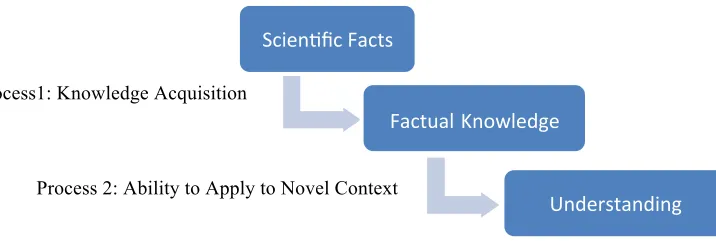
the natural learning environment. To do this a three stage model of learning was used in which there are two
processes (see figure 2). Our learning model was inspired from Darmofal, Soderholm, and Brodeur (2002)Õs
circumstances. We have examined the impact of the strategy on process 1) the knowledge acquisition and
on process 2) the ability to apply knowledge to novel context.
The effectiveness of guided and unguided independent learning
Following guided independent learning it was found that studentsÕ knowledge acquisition (process 1), as
well as their ability to apply knowledge (process 2), had increased and that this increase was statistically
significant. In contrast it was found that following the unguided independent learning there had been no
statistically significant change in terms of either studentsÕ knowledge acquisition (process 1) or their ability
to apply knowledge (process 2).
There are two main results of this research study: first, independent learning activities applied in the
Macromolecules courseÕs guided component was effective at improving studentsÕ knowledge acquisition
and their ability to apply knowledge in different contexts. Second, when students are left alone to do
independent investigations, without enough support provided, their knowledge acquisition related to
specific learning outcomes of the course and their ability to apply this knowledge did not change
statistically significantly.
Although similar benefits of guided independent learning have been discussed in other innovative teaching
approaches investigated in the literature review (Bell, 2010; Bergmann, Overmyer, & Wilie, 2012;
Finkelstein, Hanson, Huang, Hirschman, & Huang, 2010; Geier et al., 2008; Kelly & Finlayson, 2007;
Seery, 2012; Tan, 2004), the vast majority of the literature that show these mentioned benefits of
Scien1fic Facts
Factual
Knowledge
Understanding
Process1: Knowledge Acquisition [image:16.612.79.437.145.266.2]Process 2: Ability to Apply to Novel Context
independent learning activities are from complex teaching approaches which makes it hard to attribute these
benefits to independent learning activities themselves.
Regarding the second result, that students are not likely to become effective independent learners on their
own and independent learning should be promoted (and/or taught) by the lecturers for students to be
independent learners is argued by some scholars in the literature (Bates & Wilson, 2002; Black, 2007).
Although there are a variety of reasons discussed in the literature for the failure of unguided teaching
strategies (see, for instance, Tobias and Duffy (2009) such as unguided independent learning, the main
reason to emerge from the current study was that the majority of the undergraduate students who undertook
this course appeared to fail to make the required interaction with the key ideas of the investigated topic and
focused instead on the extraneous context. Moreover, students often gather information from secondary and
tertiary sources which also include information differs from scientifically accepted ones during unguided
independent activities (Cukurova & Bennett, 2014).
Student misconceptions
In order for understanding to be meaningful in a scientific context the knowledge applied in novel situations
should be the correct knowledge. If the knowledge applied in novel situations is a misconception, the
answer generated would be incorrect in a scientific context. We have found that there was no statistically
significant change in student responses with a sign of misconception during guided independent learning.
However, during unguided independent learning, whilst there was no statistically significant change in five
out of six questions, in one case there was statistically significant increase in the number student responses
with a sign of misconception. These ideas containing a misconception are most likely to have developed
because the students used a variety of secondary and tertiary scientific information sources Ð particularly
from the internet Ð during their personal investigations, and they did not have enough comprehension to
separate the ideas with a sign of misconception from those with no sign of misconception.
The findings of this research study provided some evidence that student misconceptions may increase
through unguided independent research. Ribeiro (1992) argues that teachers should be checking that
students have understood in the way they intended them to, in order to eliminate possible misconceptions of
independent learning makes it hard for teachers to check whether their students acquired the knowledge
they intended them to. This in turn can cause an increase in the number of misconceptions. Furthermore,
Ribeiro, Periera, and Maskill (1990) argued that the best way of becoming aware of the shortcomings of
oneÕs own knowledge is to rub it up against that of others. However, unguided independent learning
approach applied in the Macromolecules course appears not to stimulate enough discussions among
students, which can provide a better chance of knowing their shortcomings, creating cognitive conflicts, and
remedy their misconceptions.
Conclusions
The finding of this study, like that of others (Bell, 2010; Bergmann et al., 2012; Finkelstein et al.,
2010; Geier et al., 2008; Kelly & Finlayson, 2007; Seery, 2012; Tan, 2004) supports the view that
independent learning activities can be beneficial in increasing studentsÕ knowledge of chemical ideas and
their ability to apply knowledge in different contexts. Although the findings of the many studies from the
literature can be criticized that their mentioned benefits come from complex teaching approaches, hence
hard to be attributed to independent leaning activities only, findings of this research study come from a
teaching approach which only involved independent learning strategies and can, to a greater extend, be
attributed to independent learning.
The independent learning approach applied in the second part of the Macromolecules course does not seem
to contribute to studentsÕ knowledge of and understanding about of chemical ideas. For the second part of
the course, students were asked to carry out an independent investigation into an aspect of polymer
chemistry and then present their findings in the format of a written article or short video (see Structure of
the Macromolecules course). It has been argued by many scholars (Bates & Wilson, 2002; Black, 2007;
Bullock & Muschamp, 2006; Laurillard, 2013; Williams, 2003) that students do not become effective
independent learners on their own and independent learning should be promoted. However, this research
study shows that unguided independent student investigations, under the settings applied in the
Macromolecules courseÕs second part, may perhaps lead to an increase in the number of studentsÕ
misconceptions. As Mayer has pointed out, it has been the accepted practice by some teachers to consider
active learning, and passive methods do not always lead to passive learning (Mayer, 2008). Chi (2009)
explained that although activities requiring hands-on active participation (such as the unguided independent
learning approach applied in the Macromolecules course) from learners guarantee a level of engagement
greater than passive reception of information, these activities do not guarantee that learners will be engaged
to the extent necessary to make sense of the materials for themselves. The assumption of if we allow
students to interact with a specific environment this interaction may lead to learning of desired knowledge,
is very unlikely to be the case. As the new knowledge is channeled by the current knowledge and
understanding, repetition of the learning process without required guidance will very possibly lead to an
increasingly idiosyncratic way of understanding the world (Taber, 2011) and this idiosyncratic way of
understanding is conceivably different than those scientifically accepted ways.
We would caution that simply because people are able to construct their own understandings with little or
no guidance in the context of everyday activities, such unguided independent learning activities were not
found to be effective in the context of formal undergraduate Macromolecules course. The reasons might be
that the content and context of formal education are extraordinary (Geary, 2008), and require more
assistance to reach at scientifically accurate constructions, understandings, and solutions (Sweller et al.,
2007). It is important here to stress that the investigated learning outcomes in this research were related to
studentsÕ knowledge and understanding. The effectiveness of the teaching approaches similar to the one
investigated here, at achieving other learning outcomes including an improvement at skills and intellectual
attributes should be probed separately.
We would also like to make it clear that posing ten questions to students in a pre-test post-test experimental
design, covering eight chemical ideas is a significant limitation of this study. However, given our findings
we suggest that the independent learning activities can provide students benefits such as scientifically
correct knowledge acquisition of, and understanding about chemical ideas, if they are provided with
required guidance like in the settings of the first part of Macromolecules course. However, further research
studies which investigate independent learning strategies on their own is needed to be able to draw better