IJSRR, 8(2) April. – June., 2019 Page 1022
Research article Available online www.ijsrr.org
ISSN: 2279–0543
International Journal of Scientific Research and Reviews
Integration of Modern Methods of Teaching and Learning System In
Higher Education
Rane Nita Trimbak
Department of Marine Sciences Goa University, Taleigao Plateau, Taleigao-Goa 403206 India Email: [email protected] Mob. 9881499936
ABSTRACT
Higher education system in India is one of the third largest educational systems in the world. Education promotes mobilization and encourages people to participate in development activities. It represents vital means for any country to nurture its economic development and social cohesion. It is aimed at multi dimensional development of the personality of the student. Ideals of education should be correlated with the ideals of life. The world scenario indicates that there is an increasing interest in quality assurance in higher education and is the main concern in policy framing which has been made mandatory to obtain accreditation for higher educational institutions (HEIs) by the National Assessment and Accreditation Council to improve quality education. IQAC is responsible for initiating, planning and supervising various activities which are necessary to increase the quality of the education imparted in the institutions. Analysis of the current practices of accrediting agencies of various countries reveals a great deal of diversity. Variations can be seen in the methodology, the nature of the process, the unit of assessment, the outcome of assessment and the policy on disclosure of the outcome.Quality assurance has a major role to play in signaling excellence of students. The need for quality assurance in higher education has become more pressing in the context of the massification of tertiary education. In the 21st century internationalization constitutes both a necessary and a critical element for all higher education systems. Higher education services should cross the national borders to be in par with international context.
KEY WORDS :
Higher Education, Quality assurance, policy, development, methodology*
Corresponding Author
Rane Nita Trimbak
Research Scholar
Department of Marine Sciences, Goa University Taleigao Plateau, Taleigao-Goa, India
IJSRR, 8(2) April. – June., 2019 Page 1023
INTRODUCTION
Education is major aspect in development of any modern society. It is generally seen as the
foundation of society that brings economic wealth, social prosperity and political stability. Higher
education is the aspect of education that is acquired by students after the completion of their
secondary education. In today's competitive world, mostly people are not satisfied with their basic
education and enter for higher education. In Higher education the students are organized for building
upon their knowledge and skills which can be applied to solve different problems in their life. Higher
educational institutions have the capacity to give quick responses to different problems in the society
1
. After graduation the students become leaders of tomorrow and get dispersed from the world of
higher education into their specific career 2.
India ranks third in terms of largest system of higher education in the world after USA and
China, that has been witnessing healthy growth in terms of number of institutions and enrolment of
the students. Due to rapid expansion of privatized institutions the access to higher education has
become possible but is a matter of concern on quality and significance in higher education. Higher education can play a crucial role in sustainable development of any nation but there is need to strengthen the higher education system not in terms of expansion but in achieving excellence to face the world of work. It has a large higher education sector with a long academic tradition. There are a small number of high quality institutions and centers that can form the basis of quality sector in
higher education 3.
MATERIALS AND METHODS
Analysis of the data collected from sources AISHE Reports 2010-2018 (MHRD Govt. of
India)4.
RESULTS AND DISCUSSION
Present system of Higher Education in India
India educates approximately 10 per cent of its young people in higher education compared
with more than half in the major industrialized countries. Almost all of the world's academic systems
resemble a pyramid, with a small high quality tier at the top and a massive sector at the bottom. India
has a tiny top tier 3. Countries scientific, economic and technological development depends on higher
education system. It provides opportunities for lifelong learning.The change in mind-set is necessary
to achieve the vision which is a sustained, long-term effort to transform education at all levels of the
IJSRR, 8(2) April. – June., 2019 Page 1024
traditional disciplines. Higher education institutions bear a profound, moral responsibility to
increase the awareness, knowledge, skills, and values needed to create a sustainable future 6.
Department of Higher Education frames and shapes the policies to be implemented in higher
education in their respective states. The University Grants Commission is a statutory body which
was established in 1956, is responsible maintaining standards of higher education in the country.
Statutory Councils established by UGC promotes, provide grants, set standards and establishes
professional education in different areas of the country. The colleges in every state are either run by
the state governments or by the private trusts. Opening of University affiliation systems to private
investors after 1992, has resulted in increase in number of higher education institutions.
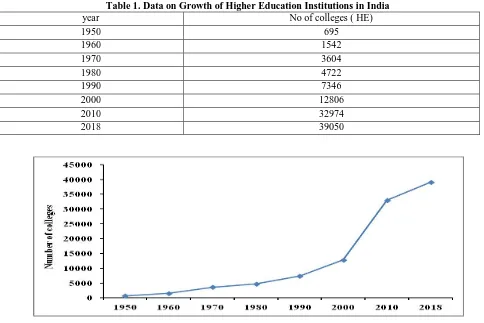
Higher Education has witnessed phenomenal growth over the last many decades. In 1950
there were 695 colleges in India which witnessed a steady growth of 39050 up to 2018 (Table 1).
Figure 1 gives the overall statistics of the colleges in India which shows an increasing trend of
educational institutions for higher education from 1950 to 2018 as per the available reports. It was
observed that the growth in the total enrolment in higher education was slow but steady from 1950 to
1980, but after 1990 the growth was very impressive (AISHA MHRD 2018)4.
Table 1. Data on Growth of Higher Education Institutions in India
year No of colleges ( HE)
1950 695
1960 1542
1970 3604
1980 4722
1990 7346
2000 12806
2010 32974
2018 39050
Source: AISHE - 2013 MHRD
IJSRR, 8(2) April. – June., 2019 Page 1025
The percentage of students taking higher education is hardly about 13 % whereas the same is varying between 28 to 90 %, across the world. The lowest % being 28 % and the same is as high as 90 % in developed countries. Enrolment in higher education in 1950 was only 3.97 lakh but in 2018 it enrolment increased to 357 lakh, our achievement is noteworthy. Data on the growth of enrolment
of boys and girls in HE is presented in Table 2 It is evident from the table that the increase in
enrolment of female was substantially higher than that of male. There was increase in the number of
girls student seeking higher education from 1990 till 2018 as per the available records ( MHRD
Report 2010-2018)4
Table 2 Growth of enrolment of boys and girls in HE (Fig in 000)
Year Girls Boys
1950 43 354
1960 170 880
1970 431 1522
1980 749 2003
1990 1437 3488
2000 3306 5093
2010 7049 9924
2017 16700 19000
Source: AISHE - 2013 MHRD
Fig. 2 Growth of enrolment of boys and girls in Higher Education (in 000)
Institutes of Sciences, Engineering, Management, Architecture, Pharmacy, Applied arts and
Crafts and Catering Technology are funded by Central and State government and monitored by
Technical Education cell under the Department of higher education Government of India
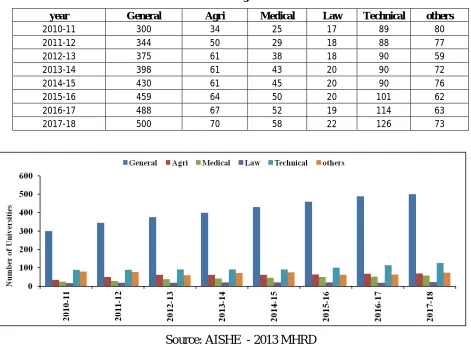
The data presented in Table 3 revealed that the major chunk of our product of higher
education is from the general stream and the students graduating from the technical/professional
courses constitute just about one-third of the total number of students graduating from the institutions
of higher education (Fig. 3). Present education system has failed to produce trained and efficient
labor force capable of employment/self-employment. We are producing a large number of graduates
and post-graduates capable of white-collar jobs only. Since the supply of such jobs is less than their
IJSRR, 8(2) April. – June., 2019 Page 1026 Table 3 Data on different categories of universities in India
year General Agri Medical Law Technical others
2010-11 300 34 25 17 89 80
2011-12 344 50 29 18 88 77
2012-13 375 61 38 18 90 59
2013-14 398 61 43 20 90 72
2014-15 430 61 45 20 90 76
2015-16 459 64 50 20 101 62
2016-17 488 67 52 19 114 63
2017-18 500 70 58 22 126 73
Source: AISHE - 2013 MHRD
Fig.3 Graph on number of universities as per specialization of courses in India
The quality of higher education is related to employability, traditional academic standards,
and is in terms of the quality of the educational process and to the value added by higher education
for a given set of inputs. A high quality university education was identified in terms of inputs to the
system (selection of students), process (teaching, learning, research) and outcomes ( in relation to
employability). Themes to emerge included self-learning, high quality university academics,
innovation and research, sometimes with an explicit link to preparation for entry into the workforce7.
National Assessment and Accreditation Council (NAAC) of India was established as an autonomous
body in September 1994 by the University Grants Commission (UGC), as an outcome of the
recommendations of the National Policy on Education (1986). It was intended both to assess and
accredit institutions of higher education and to assess the quality of education offered by them. In
independent India, the various regulations on minimum requirements for the establishment and
expansion of institutions of higher education are well established.
Inspite of progress in the field of education our higher education institutions are not yet the best in
IJSRR, 8(2) April. – June., 2019 Page 1027
education, students are encouraged to take greater responsibility for their learning outcomes. As
India’s enrolment numbers grow, and access to higher education expands, the learner-oriented
method has helped to sensitize educators to bring out difference in learning styles and also student
expectations have shown diversity. The approach has enabled institutions to devise new and
innovative ways to reach diverse learners, and it has also helped students discover and exercise their
distinctive learning styles to channelize an educational pathway.
Drawbacks of Higher Education system with respect to methods of teaching
The success of any education system depends on the effective teaching/learning process.
Teacher plays a crucial role in imparting and maintaining the standard of education. The role of
teacher assumes greater significance in this deteriorating scenario of higher education. It is a difficult
task for the teacher to improve the quality, quantity and equality in higher education at the same
time. It is said that good teacher can bring the entire world to the classroom. The teacher has to play
multidimensional role to heterogeneous group. Quality has become a key word in higher education.
This can be made possible with modern methods of teaching and imparting knowledge. The
responsibility to ensure the skills, understanding and output of the student is the main responsibility
of higher education 8.
The problems of higher education in India are massive affiliating system, rigid academic
structure, various subjects, and low level of government funding 3. Standards of the majority of the
institutions in terms of structure and faculty are poor and declining. The low quality of teaching and
learning is arguable. The greatest challenge faced by higher education in India is the acute shortage
of quality faculty. Most faculties are untrained in teaching methodologies; also we have an Outdated,
rigid curricula and skills development. Very few opportunities for learning are available in
interdisciplinary field. The teaching methods are focused on input and rote learning due to which
students have very little opportunity to develop transversal skills, such as problem-solving critical
thinking, reasoning etc. Student: Teacher ratio is high as a result of it there is tremendous pressure on
the educators; there is lack of research experience at early stage 3. The overall scenario of our
higher education system does not match with the global quality standards as which gives
importance to the overt curriculum and neglects the covert curriculum is not sufficiently equipped to
achieve its objective. We are producing a large number of graduates and post-graduates capable of
administrative and managerial job. Since the supply of such jobs is less than their demand,
unemployment is the outcome of the present system of education 9.
Curriculum transaction process in higher education and quality of Higher education in Relation
IJSRR, 8(2) April. – June., 2019 Page 1028
It is believed that teaching and learning in schools were for short-term information
accumulation meant to last only until examination. But rote learning still in practice in our
educational system. Moreover, teachers remain unable to integrate teaching, learning and
assessment10. Hence, continuous assessment required for supporting meaningful learning is also
lacking. It is now felt that the quality of education that promotes rote learning and ignores the
development of higher order cognitive abilities cannot be rated as high 11. The NCF (2005) aims to
guide the development and transaction of curriculum in schools and to address the problems of
transmission of information and rote learning. It includes guidelines for curriculum transaction to
make learning active, social and meaningful. The guidelines of Five year plan are: Connecting
knowledge to life outside the school; Ensuring that learning shifts away from rote methods;
Enriching the curriculum so that it goes beyond textbooks; Making examinations more flexible and
integrating them with classroom life; and Nurturing an overriding identity informed by caring
concerns within the democratic polity of the country.
Integration of modern methods of teaching learning in Higher Education
A sound education system is the prerequisite for the development of any nation. This is a
well-known fact that our education system still relies on traditional methods and there is a need to
combine the traditional teaching with modern teaching aids for a better and advanced education
system. In the traditional teaching method, teachers illustrate the concept to the students with the
help of chalks and blackboard. The main objective of traditional teaching is to pass the examination.
Use of high tech equipment in the educational institutions is increased with a rapid rate.
There are lots of modern gadgets which can be used for improving the teaching in the classroom.
Blackboard and LCD projectors can be used simultaneously. Teaching complex mathematical
concepts involving equations be done using blackboard while theoretical subjects can be taught on a
LCD projector with the help of power point presentation. Practical based subjects like sciences and
engineering can also be taught best with the help of chalk and board and modern methods, the
teacher can explain the theory on a blackboard and for better understanding of the procedure of the
experiment videos or animations can be used. Teachers can teach the subject first through traditional
chalk and board method and then take the help of modern teaching methods for revising the subject.
Modern methods of teaching include:
New instructional models in every classroom may be reconfigured for charging tablets and
connecting USB ports, classrooms rich with interactive whiteboards, document cameras and lecture
capture systems will support active learning environments. Telepresence systems, video and web
IJSRR, 8(2) April. – June., 2019 Page 1029
from anywhere in the world. In a flipped classroom, students can learn at their own pace, equipped
with notebooks, tablets and smart phones, using classroom extensions that can be accessed at any
time, and from any place. Adding network access and digital projectors to classrooms encourage the
use of interactive content. New technology provides the means through which new instructional
models take hold and flourish14.
1. Use of computers or laptops with wi-fi connection in the classroom- This is the most important
tool of modern teaching methods. Teacher demonstrates the subject on his laptop/computer which is
connected to the laptops/computers of the students through wi-fi connection. This type of teaching is
seen mostly in the higher education institutions which have good infrastructure.
2. Use of LCD projector in the classroom- The teacher prepares the power point presentation of the
content of teaching and is displayed on the LCD screen with the help of a projector. The relevant
videos of the subject projector can be displayed through the on the projector.
3. Use of interactive whiteboards in the classroom- On whiteboard a teacher or student can draw,
write or manipulate images which provide a very interactive and interesting platform. The main
advantage of whiteboards is that it can show anything on it which can be seen on the computer.
4. Other means of modern methods like Use of special websites or blogs for teaching in the
classrooms are: Use of microphones for delivering the lecture in the classroom and use of e-library.
Modern teaching methods have several advantages such as, it creates more interest among the
students with the use of interesting animations and videos, helps the students to understand the
subject better and retain the concept for longer time, helps teacher to complete the syllabus in lesser
time as they don't have to waste their time in writing on the blackboard and the modern teaching
methods are more explanatory. The abovementioned techniques and technologies help create a much
more exciting classroom; they at the same time are also useful tools to develop an instructor’s own
capacities and professional development. Some ideas that are worthy of exploration include the
following. Modern methodology in US Developments in ICT and their Application in Education has
influenced in improving access, enhancing quality of educational provisions and making education
more learner-centered is the fast and revolutionary developments in technology applications in
learning situations made possible by the developments in Information and Communication Sciences.
The developments in this area have been fast and extensive. The following areas of technological
development facilitated by the philosophy of openness have impacted all forms of education and
training. 1. Technology mediated Open Distance Learning, 2. Open Educational Resources, 3.
Learning Management Systems 4. Cheaper computing 5. Improved access to Internet, 6. Mobile
IJSRR, 8(2) April. – June., 2019 Page 1030
In the interactive mode of teaching, students will be more equal participants in research based
teaching and, hence, in the process of discovery, innovation and learning through and from mistakes.
One of the effects is that they will learn to act and think as experts and will have a better notion of
professional identity 12. This will provide them with a higher sense of agency and purpose as they are
going through the curriculum. There is strong evidence that active learning methods enhance the
effectiveness of teaching and instruction 13 in a way that imparts deep understanding of concepts. A
transformation to active learning will allow students to spend a significant portion of their class time
on activities that require them to interrogate information in a variety of ways, from using electronic
clickers to answer questions, to completing worksheet exercises and exploring problems through
discussion with fellow students. Such interactive techniques also make learning more engaging,
challenging, authentic and satisfying, whilst leading to better retention of learning outcomes.
Innovative learning technologies include Digital and online technology which can fundamentally
redefine the nature of the classroom. If delivered appropriately and to a high standard, courses that
blend pedagogically-sound learning technologies can be highly effective, and participating students
derive high levels of satisfaction. Classroom and laboratory time can be more interactive when study
materials are available online before classes; teachers can get real-time information about students’
learning; space and place can become flexible concepts, enabling participation from across campuses
and across geographies; and international perspectives can be brought directly into the classroom.
We have the opportunity to create and expand our professional teaching toolkits. Open
Educational Resources (OER), Massive Open Online Courses (MOOCs), hundreds of YouTube
videos including those presented as TED talks, are some of the instructional material available to the
students. Instructors need to be creative, committed and passionate about their profession and their
role. Teachers have a key role to play in the making ourselves fully equipped to make our classrooms
engaging, exciting and enriching. As new pedagogies and new technologies keep emerging,
discarding old ways and adapting to new ways becomes essential. Our students must learn to be
independent critical thinkers, to be societally and ethically responsible, and to have a broad
understanding of the world.
Budget allocation by Govt. of India as per 2012 plan is about 6 % which is not going to be
adequate, and therefore allocation must be made appropriately, i.e. minimum 10 % in order to
improve the scenario. Government should also provide sufficient funds, annual schemes for unaided
institution for enhancing overall support.
These are some of the points if we practice in a near future for increasing percentage of
students seeking higher education, the scenario will certainly increase and students in turn will start
IJSRR, 8(2) April. – June., 2019 Page 1031
CONCLUSION
India has the third largest system of higher education in the world had traditional and typical
education with Arts, Medical and Engineering. In the present and the modern education there are so
many fields of education which are being promoted and developed which have given the students
vast variety and alternatives as per their capability and their own personal interest. In a society of
diversity, there was rapid expansion of privatized institutions that access higher education but it
alarms at quality and significance in higher education. Higher education can play a crucial role in
sustainable development of any nation but there is need to strengthen the higher education system
not in terms of expansion but in achieving excellence to face the world of work. It was observed that
the growth in the total enrolment in higher education was slow but steady from 1950 to 1980, but
thereafter from year 1990 the growth was very impressive. UGC is the governing body of higher
education, Department of higher education controls the government funded Institutes of Sciences,
Engineering, Management, Architecture, Pharmacy, Applied arts and Crafts and catering
Technology. The overall scenario of higher education in India at present does not match with
the global quality standards . The present system of higher education which gives importance to the
overt curriculum and neglects curriculum which is not sufficiently equipped to achieve its objective.
Our education system still relies on traditional methods and there is a need to combine the traditional
teaching with modern teaching aids for a better and advanced education system. The main objective
of traditional teaching is to pass the examination but the modern teaching learning methods using
high tech equipment will make it active and interactive. The National Assessment and Accreditation
Council (NAAC) of India were established to assess and accredit the institutions of higher education
and to assess the quality of education offered by them. Variations can be seen in the methodology,
the nature of the process, the unit of assessment, and the outcome of assessment.
ACKNOWLEDGEMENT
The author (Nita T. Rane) is grateful to the Head, Department of Marine Sciences, Goa
University for providing opportunity to present the research paper in the International conference and
produce the manuscript. Author also Dr. G. C. Pradhan, Associate Professor. State Council of
Educational Research and Training (SCERT), Govt. of Goa, Porvorim-Goa for his valuable guidance
in bringing out this manuscript.
REFERENCES
1. Calder W and Clugston R M. Progress Toward Sustainability in Higher Education , ELR
News & Analysis, Environmental Law Institute®, Washington, DC. Reprinted with
IJSRR, 8(2) April. – June., 2019 Page 1032
2. Toor W. “The Road Less Traveled: Sustainable Transportation for Campus,” Planning for
Higher Education, March-May, 2003; 137-140.
3. Sanklecha N. Current Scnerio of Higher Education in India. International journal of
Engineering Technology and research, 2017; 4(8) 571-574
4. AISHE MHRD Govt. of India Report. 2013- 2018
5. McIntosh M. Cacciola K. Clermont S. and Keniry J. State of the Campus Environment: A
National Report Card on Environmental Performance and Sustainability in Higher Education.
Reston, 2001.
6. Cortse A. The critical role of education in creating a sustainable future. Tufts University,
2003;15-22.
7. West A. Noden P. and Gosling R. Quality in Higher Education: An international perspective
8. The views of transnational corporations Centre for Educational Research London School of
Economics and Political Science London UK 2000; 1-38
9. Nagoba B.S. and Mantri S.B. Role of Teachers in Quality Enhancement in Higher Education,
JKIMSU, 2015; 4(1): 177-182
10.Pradhan G. Towards improving quality of Higher Education in India . Review of Research
2014; 1-10
11.Gohain, M.P. CCE has Improved Scores, not teaching. New Delhi: The Times of India,
2014.
12.Venkataraman K. Learning by Rote Prevalent in Top Schools too. The Hindu. Retrieved
2011, from:
http://www.thehindu.com/todays-paper/tp-opinion/learning-by-rote--in-top-schools-too/article270756
13.Holmes N. G. Wieman C. E. and Bonn D. A. Teaching critical thinking. PNAS 2015; 112
(36): 11199-11204
14.Freeman S, Eddy SL. McDonough M. Smith MK. Okoroafor N. Jordt H. and Wenderoth MP.
Active learning increases student performance in science, engineering, and mathematics.Proc
Natl Acad Sci U S A. 2014; 111(23):8410-5
15.Bailey M. Aftab M. and Smith N. Hidden Value - Towards an Understanding of the Full
Value and Impact of Engaging Students in User-Led Research and Innovation Projects
between Universities and Companies. In Proceedings of the 3rd International Conference for