Soul And Mind As Quantum States Of An
Embedded Human System
Durg Vijay Rai, Gaurav Kumar
1
Abstract: A human system is a tri-unity with soul, mind and body comprises with various integrated organ system. Soul and mind are the main source of energy that control the physiological and spiritual processes of the human body in which the brain is regarded as microprocessor and worked together with mind. The soul is considered as super-controller and universal consciousness energy state in the body. The present study is designed to understand the quantum states of soul and mind of embedded human system and their relationships. The quantum states and flow of energy are illustrated using band theory and feedback circuit. The role, effect and relationships of yoga, meditation and spirituality were also analyzed. It has been found that soul is an ultimate source of positive energy, modulates the mind and physiological functions of the body and helps to establish a secure communication with the spirituality. The mind with both positive and negative energies, plays an important role for controlling the physiological processes of the body. The yoga, meditation and spirituality provides positive energy to the body, mind and soul and helps to eliminate the negative energy generated by the components of the embedded human body. The study provides deep insight about the relationship, interaction and coordination of soul, mind and body. We hope that the present study will provide a support in understanding the scientific basis of internal energy and informational knowledge to bridge the gap between modern and Vedic sciences in overall integrated multidimensional function of the human system.
Keywords: Soul, Mind, Human body, Spirituality, Vedas, Meditation, Quantum states, embedded system
—————————— ——————————
1.
INTRODUCTION
Human body is self-controlled and auto-regulated body system. It is composed of soul, mind and eleven organs systems (circulatory, respiratory, digestive, excretory, nervous, endocrine, immune, integumentary, skeletal, muscle and reproductive systems). It has dedicated function and depends, directly or indirectly on each other. The human body is a complex systems that control many physiological function of organs simultaneously to perform different specific tasks. It is also a standalone device that has real-time performance (Rai et al. 2019). The brain is a
microprocessor or microcontroller, stored memory and worked together with mind as software that provide program instructions to execute different specific functions. The soul is super controller as capacity to function during individual life.
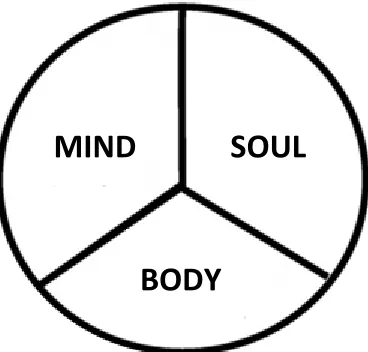
Human body consist of sensors which are provider of information/knowledge and mind is well known to take decision to execute the information obtained from the body as well as soul becomes seeker of ultimate knowledge. The function of soul, mind and body are interdependent and can be observed as a Tri-Unity (Fig. 1).
Fig. 1: Human body as a Tri-Unity
Body contains sense organs (indriya) i.e. eye for sight, nose for smell, ears for hearing, tongue for taste, and skin for touch (Truong Thi Ngoc Anh and Dr. C.Neela Devi 2019). These sensors sense the anatomical and physiological changes and provide information to maintain the body functions. Mind is a combination of characters, thoughts and feelings. It is an important element of the body and experiences to think and feel the faculty of consciousness and thought (Happé 1994). Soul directs intuition, conscience communication and establishes a secure link
BODY
MIND
SOUL
_____________________________
,2School of Biological Engineering and Sciences, Shobhit
University, Gangoh, Saharanpur, Uttar Pradesh, India
1,2School of Biological Engineering and Sciences, Shobhit
University, Meerut, Uttar Pradesh, India
School of Biomedical Engineering, Indian Institute of
Technology (BHU), Varanasi, UP, India
*Corresponding Author: Durg Vijay Rai, Email:
[email protected]; Contact:
INTERNATIONAL JOURNAL OF SCIENTIFIC & TECHNOLOGY RESEARCH VOLUME 8, ISSUE 01, JANUARY 2020 ISSN 2277-8616
551
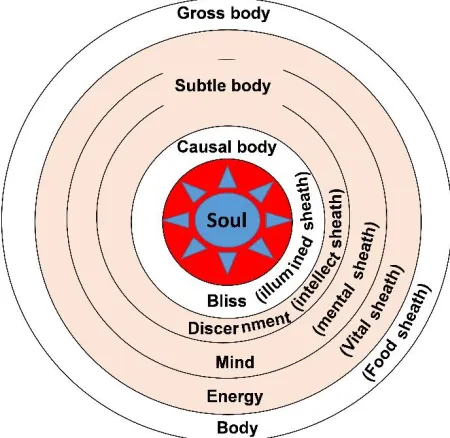
Earlier Vedic report1-4 suggest that the human being is composed of three bodies namely causal, subtle or astral body and physical or gross body (Fig. 2). The five sheaths (bliss, discernment, mind, energy and body) reside in these three bodies (Satpathy 2018). Bliss sheath resides in causal body. Causal body acquires bliss or peace from bliss sheath or Anandmaya Kosh. It controls the formation and growth of the other two bodies i.e. subtle and gross bodies, and determine every aspect of rebirth. Causal body is
associated with the state of dreamless sleep and samadhi and the doorway to the higher consciousness. It carries the information, experience and knowledge acquired during the past lives. The causal body also attached with allure and intense desires for the worldly objects and pleasures. The soul resides in the causal body. After death, causal and astral bodies are being separated from the gross body and soul is detached from the causal body.
Fig. 2: Three bodies and five sheaths of human body
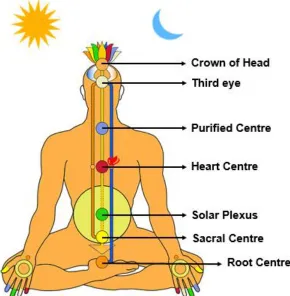
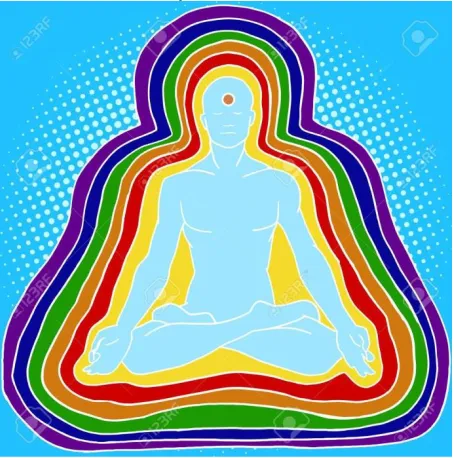
Subtle or astral body contains three sheaths intellect (Gyanamaya kosh), mind (Manomaya kosh) and vital (Pranamaya kosha) sheath. Vital sheath is composed of vital energy which is responsible for our physiological functions namely breathing, skeletal, muscular, digesting, metabolizing, endocrinal, circulation, and neural. The subtle body surrounds the gross or physical body as an aura of energy which are controlled by the seven chakras (whirlpool of energy) which is the main energy centers in human body (Fig. 3). These whirlpool of energy control particular parts of the body, energizing particular organs and bring harmonious relationship within the human system. It cannot seen through naked eyes but, can be feel during the meditation or yogic practices that can activate during awakening of the Kundalini yoga (Bittlinger 1999). The
Fig. 3: Seven centres of vital sheath present in subtle body
Mind is the intellect and the state of a person that enables them to be aware of the world and their experiences, to think, and to feel; the faculty of consciousness and thought. The mind is one of the higher tattvas of state. Nature (Prakriti tattva) above the elements and the senses. It is considered the lord of the senses because it directs the senses and keeps them moving among the external objects. According to the Vedas, the mind represents the air element in the body. It forms part of the subtle body. The mind forms part of the mental sheath (manomaya kosa) in the body. It stores the latent impressions (samskaras) which become part of the casual body at the time of death. The concept of mind is enunciated through many terms such as awareness, comprehension, understanding, insight, resolution, reflection, impulse and will. According to advaita vedanta the mind is neither atomic nor infinite in size, but it is of medium in size and it pervades the body of the particular individual to which it belongs. The mind is an internal organ and produced from the sattva part of all the five subtle elements together. The mind is also said to be two-fold, that is pure and impure. The impure mind is driven by desire and volition; the pure mind is devoid of desire. The mind alone is the cause of bondage and liberation to humans. Attached to objects it leads to bondage and freed from objects it leads to liberation.
According to yoga, there are five states of mind i.e. dull or donkey mind, restless or monkey mind, occasionally steady mind or butterfly mind, one-pointed or candle mind and fully concentrated mind. The dull mind drives us into a state of dissatisfaction. It is dull, sleepy, lethargic and lacking vigor. The restless mind is totally restless, unable to concentrate or decide, jumping from one thought to another, from one emotion to the next and from object to object. The butterfly
mind is 50% temporarily distracted, and 50% temporarily focused. In this state, mind oscillates between thoughts of clarity and thoughts of confusion. The one pointed mind is ready to focus and pay attention, very relaxed but not sleepy. The fully concentrated mind is not distracted by random thoughts but is fully absorbed in the object of concentration. In such a state no new impressions can distract our mind and the old one can no longer influence our present state. The knowledge is available for practicing towards higher mental states.
INTERNATIONAL JOURNAL OF SCIENTIFIC & TECHNOLOGY RESEARCH VOLUME 8, ISSUE 01, JANUARY 2020 ISSN 2277-8616
553
feel. A lower level of mind is a healthier level of mind and meditation, neuro-feedback, hypnosis, and guided imagery have all been shown to help people control their brain waves more efficiently for better health, greater performance, and a more positive experience of life. The delta wave obtained in the unconscious state. The beta wave associated with conscious state. The Alpha state is also considered by almost all experts to be the initial link between the conscious and the subconscious mind. The Theta wave associated with deeper states of meditation, spiritual experiences or higher states of consciousness i.e. subconscious mind. This state is also associated with the REM state of sleep, where dreams occur and considered a reservoir of creativity. Gamma brainwaves are the fastest of brain waves and relate to simultaneous processing of information from different brain areas and associated with superconscious state. Soul is unborn, eternal, ever-existing and primeval. The soul is small atomic fragmental part of the supreme spirit i.e. god. Soul undergoes no changes like the body and does not at any time become old, as the body does. As body takes six kinds of transformations, the soul is free from these changes. The soul is full of knowledge and always full with consciousness (Halligan 2013). However, consciousness of individual soul is different from the consciousness of the Supreme soul. Because, individual soul’s consciousness is forgetful where supreme soul’s consciousness has all knowledge like past, future and present. According to Kaöha Upaniñad, there are two kinds of souls - the minute particle or atomic soul (anu-ätmä or jévätmä) and the Supersoul (vibhu-ätmä or Paramätmä). Both souls are situated in the body of the living being, and only one Supersoul has become free from all material desires as well as lamentations. Atomic soul is covered by the illusory energy, hence become separated from the association of the Supreme soul. The change of body by the atomic individual soul to another body is made possible
by the grace of the Supersoul which fulfills all desires of the atomic soul. The supersoul always watching and guiding the atomic soul which is struggling very hard with material desires, doshas and gross body. The soul can never be cut to pieces by any weapon, nor burned by fire, nor moistened by water, nor withered by the wind. The individual soul is unbreakable, insoluble, and can be neither burned nor dried and is everlasting, present everywhere, unchangeable, immovable and eternally the same. After liberation from material contamination (gross body), the atomic soul prefers to remain as a spiritual spark of the Supreme soul and the intelligent souls want to enter into the spiritual planets for liberation and associate with the personality of Godhead. As sunlight maintains the entire universe, likewise, soul light maintains the material body. The material body begins to decompose when soul left the body; hence it is the sprit soul which maintain the body. An attempt has been made to propose in conformity of band theory the three excited state energy as quantum state in response to body mind and soul consciousness of human body. The transitions between three state and feedback circuit are discussed. The yoga, meditation and spirituality are highlighted with their relationship to health. The positive energy is suggested to further contribute towards health and to build a good human beings.
BAND THEORY
The embedded nature of human body can be understand with solid state mechanism where the quantum state of soul and mind exchange the energy with human body (Fig. 4). The human body has low energy and placed in ground excited state. Mind always remains in meta-excited state and has combination of positive and negative energies, whereas, soul has 100% positive energy and always remained in the super excited state with high energy.
Fig. 4: Band theory of body mind and soul.
The energy of soul, mind and body can be categorized into emission, reflected and scattering energy (Fig. 5). The soul has 100% of emission energy that can be exchanged with mind. The mind constitutes of 50% of emission energy, 25% of reflected energy and 25% of scattering energy. These energy of mind can be exchanged between soul and body. The body has low emission energy i.e. 40% and high reflected (30%) and scattering (30%) energy. These energy can be emitted due to 26 components of the body including five great elements (earth, water, air, fire and sky), five
Fig. 5: Broadening of quantum states of soul, mind and body
FEEDBACK CIRCUIT
Human body has remained a control place to receive the information through five sensors (eye, ear, skin, nose and tongue). These sensing organs provide array of information which generates about 50k messages in mind. The mind processes these messages to take right or wrong decision which is executed through the body. Mind becomes active
to think and to modulate for few selection of messages to implement for the action to the body. Mind sometimes takes the support the ideas and action from soul consciousness to execute the action via body. It is well understood that soul at higher consciousness always send positive messages to the body via mind to translate it for the action along with a switch mechanism (Fig. 6).
Fig. 6: Feedback circuit of body mind and soul
The feedback information starts from the body to mind and reaches to soul and visa-versa to regulate and process the information of different level of organizational knowledge at ultimate action from the body.
YOGA AND BODY
Yoga is a group of physical, mental, and spiritual practices. It is originated in pre-Vedic Indian traditions and mentioned
INTERNATIONAL JOURNAL OF SCIENTIFIC & TECHNOLOGY RESEARCH VOLUME 8, ISSUE 01, JANUARY 2020 ISSN 2277-8616
555
Yoga is more than just a form of exercise. Regular Yoga practice has a number of benefits. It strengthen the body, energizing the mind and purify the soul. It enhance the brain wave coherence and boost the self-confidence. It has positive effect on memory and intelligence as well as increases both physical and mental performance. Different types of yoga exercise provide emotional stability by enhancing the serotonin hormone which is known to induce sense of happiness and good mood. Yoga is considered as psycho-somatic-spiritual discipline for achieving harmony & union between our soul, mind and body as well as the ultimate union of our individual consciousness with the universal consciousness (Varambally and Gangadhar 2012). It has the potential to tranquilize and balance the mind. According to yoga, the body and mind is considered as one single composite unit. Whereas, human body and its function are treated as the two aspects of the same organism i.e. life force and the Kundalini. The life force is responsible for the several functions being carried out within the human body. The Kundalini is considered as an evolutionary energy and it can be activated, stimulated and reaches to its highest possible spiritual potential through yogic practices. The level of human body organization is Human Organism -> Systems -> Organs -> Tissues -> Cells -> Molecules -> Atoms -> energy. Yoga affects every cell of the body. There are essentially eleven organ systems that are responsible for structure and function in the human body (Goodman 2004). These systems in the human body
are often affected by a number of diseases. In order to treat them and to keep the body hale and hearty, an individual can always resort to yoga. It is well established that yoga is very effective for prevention as well as management of all-pervading stress and stress-related disorders (Madanmohan 2008). Recent studies demonstrated that yoga practice leads to decrease in blood pressure and heart rate (Satish et al. 2018), Dyspnea-related distress and improves functional performance in people with chronic obstructive pulmonary disease (Donesky-Cuenco et al. 2009) and bronchial asthma (Vempati et al. 2009). It positively balances autonomic nervous system (Streeter et al. 2012) and improves dexterity, strength and musculoskeletal coordination of the practitioners (Visweswaraiah 2013).
MEDITATION AND MIND
Meditation is an ancient practice and an integral part of Yoga. It is a set of techniques that are intended to encourage a heightened state of consciousness and focused attention. There are two main types of meditation i.e. concentrative meditation and mindfulness meditation. The concentrative meditation can be practiced by focusing all of the attention on a specific object (breath, specific word or mantra etc.) while tuning out everything else around you (Fig. 7).
Fig. 7: Different level of concentration of mind
The Mindfulness meditation is a mental training practice and simply the act of paying attention to whatever you are experiencing, as you experience it (like your own emotions, thoughts, and sensations) in the present moment. Mind and body are entirely different, but they are interconnected and definitely affect each other. It is well understood that a healthy mind always reside in a healthy body. If someone is unhappy or in stressed for an extended time their bodies also become weaker and susceptible to illness. In the other hand, if body is healthy it positively affects the mind. Meditation is a tool for healthy, peaceful mind and it can benefit the health by removing the negative thoughts and
al. 2011). It is well established that different type of meditation improves the ability to perform tasks requiring focus and cognition (Zeidan et al. 2010), the emotional stability and make the subject less likely to be influenced by any negative people in their life (Wachs and Cordova 2007). It increases the creativity (Ostafin and Kassman 2012) and the ability to memorize things and to store and consolidate new information (Manjunath and Telles 2004). Studies suggested that transcendental and mindfulness meditation help to make better decisions by improving the brain’s decision-making centers (Alfonso et al. 2011), to overcome powerful alcohol and drug related addictions (Zgierska et al. 2008) and improve the cardiovascular health (Paul-Labrador et al. 2006). Additionally, meditation strengthen the human immune system, provide resistance from infections and viruses (Morgan et al. 2014) and reduce the mental and physical pain better than morphine (Siegel and Barros 2009).
SPIRITUALITY AND HEALTH
Spirituality is the person’s inner truth or blissful experience. It is the quality that involves deep feelings and beliefs of a religious nature, rather than the physical parts of life. The spirituality can be differentiated on the basis of devotion, practice and duty. Devotional spirituality is the easiest and sweetest mode of the spiritual path. The person enjoy his life by spending time with god. He gets wisdom just by his attachment to his god and does not need to rely on books for that. The practice based spirituality needs a master or guru that helps to find their path of spiritual progress. The duty based spirituality can be achieved by a person by
doing philanthropy for his society. Here the person’ heart is filled with love and compassion and he born for some duty and takes up responsibilities with heart. He does not worry about the benefits of his work. Through spiritual pursuit, a person tries to connect with a supreme divine or what most people call almighty God. Such people resort to techniques like silence, prayer, meditation and yoga mostly as individual or collective practice, usually under the directions of a spiritual Guru. Others believe in the self-less service to the mankind as a major pathway for seeking god. The effect of spirituality on health is an emerging area of active research in recent days (Puchalski 2001). Recent research has demonstrated that spirituality can be helpful in preventing and curing the mental and physical illnesses. Some studies suggest that regular spiritual practices provides longer lives. It also provides mental strength and social support in coping with the illness pain, and life stresses. Spiritual commitment tends to enhance recovery from illness and surgery. Spirituality and religions can play important role in promoting healthy life style. According to Association of American Medical Colleges spirituality can be defined as ―Spirituality is recognized as a co-factor that contributes to health in many persons. The concept of spirituality is found in all cultures and societies. It is expressed in an individual's search for ultimate meaning through participation in religion and/or belief in God, family, naturalism, rationalism, humanism, and the arts. All of these factors can influence how patients and health care professionals perceive health and illness and how they interact with one another‖.
Fig. 8: Energy flow in body, mind and soul through yoga, meditation and spirituality
The yoga and meditation helps to establish a secure connection with soul and to understand spirituality. The yoga, meditation and spirituality conduct a source of positive energy in body, mind and soul (Fig. 8). The energy gain by soul, mind and body from spirituality, meditation
INTERNATIONAL JOURNAL OF SCIENTIFIC & TECHNOLOGY RESEARCH VOLUME 8, ISSUE 01, JANUARY 2020 ISSN 2277-8616
557
the physiology of human body. The energy generated during the yogic practice transferred to the mind that ultimately transferred to the soul which helps to establish a connection with spirituality. Bidirectional approach: Meditation directly impacts the mind. It helps to remove the negative energy from mind. Positive energy gain by mind through meditation has bidirectional flow i.e. towards soul and body.
CONCLUSION
The study suggests three prominent quantum states of the human body i.e, body, mind and soul. Every quantized state generates information/energy which are transferred from the body’s sense organs to the mind and from mind to the soul and vice-versa. The hypothesis of solid state mechanism of human body provides explanation of three quantum states and the transition of energy which helps to understand the physical, biological, physiological, psychological, and spiritual phenomena of the human body. The study explain the possible functions mediated through soul, mind and human body and flow of energy between them as feedback circuit. The effect of yoga, meditation and spirituality on the improvement of physiological process of the body. The soul and mind are in the quantized state which modulate the physiological and psychological processes on creativity and consciousness of mind in the function of human body. The yoga, meditation and spirituality are source of positive energy that helps to charge the mind and soul and to maintain the physiological process in a healthy way. Finally the study brings the scientific approach to fill-up the gap between modern and Vedic science to understand the human life.
ACKNOWLEDGEMENT
The work is dedicated to Dr. Shobhit Kumar ji, Chairman, Shobhit University, we are thankful to Shri Kunwar Shekhar Vijendra Ji, Chancellor, Shobhit University, for promoting science and spirituality in the university. The obligations are extended to prof. Raj Bahadur Vice-Chancellor, Baba Farid University of Health Science, Faridkot (Punjab) for encouragement of interdisciplinary research. We acknowledge to Mahamandleshwar Swami Martandpuri ji, Chairman, Center for spiritual studies and research, Shobhit University for continuous guidance and help. It would be appreciated the academic inputs of Prof. S.K. Pathak, former Principal, Kunwar Shekhar Vijendra Ayurved Medical College and Research Centre, Shobhit University, Gangoh Saharanpur, Uttar Pradesh.
REFERENCES
[1] Alfonso JP, Caracuel A, Delgado-Pastor LC, Verdejo-García A (2011) Combined goal management training and mindfulness meditation improve executive functions and decision-making performance in abstinent polysubstance abusers. Drug Alcohol Depend. doi: 10.1016/j.drugalcdep.2010.12.025
[2] Bamber MD, Kraenzle Schneider J (2016) Mindfulness-based meditation to decrease stress and anxiety in college students: A narrative synthesis of the research. Educ. Res. Rev.
[3] Bittlinger a (1999) The psychology of kundalini yoga. Anal Psychol
[4] Donesky-Cuenco D, Nguyen HQ, Paul S, Carrieri-Kohlman V (2009) Yoga Therapy Decreases Dyspnea-Related Distress and Improves Functional Performance in People with Chronic Obstructive Pulmonary Disease: A Pilot Study. J Altern Complement Med. doi: 10.1089/acm.2008.0389 [5] Goodman A a (2004) Understanding the Human
Body : An Introduction to Anatomy and Physiology. Endocrine
[6] Halligan FR (2013) Bhagavad Gita. In: Encyclopedia of Psychology and Religion
[7] Happé FGE (1994) An advanced test of theory of mind: Understanding of story characters’ thoughts and feelings by able autistic, mentally handicapped, and normal children and adults. J Autism Dev Disord. doi: 10.1007/BF02172093
[8] Hofmann SG, Grossman P, Hinton DE (2011) Loving-kindness and compassion meditation: Potential for psychological interventions. Clin. Psychol. Rev.
[9] Lykins ELB, Baer RA (2009) Psychological Functioning in a Sample of Long-Term Practitioners of Mindfulness Meditation. J Cogn Psychother. doi: 10.1891/0889-8391.23.3.226
[10]Madanmohan M (2008) Effect of Yogic Practices on Different Systems of Human Body. IcyerCom
[11]Manjunath NK, Telles S (2004) Spatial and verbal memory test scores following yoga and fine arts camps for school children. Indian J Physiol Pharmacol
[12]Morgan N, Irwin MR, Chung M, Wang C (2014) The effects of mind-body therapies on the immune system: Meta-analysis. PLoS One. doi: 10.1371/journal.pone.0100903
[13]Ostafin BD, Kassman KT (2012) Stepping out of history: Mindfulness improves insight problem solving. Conscious Cogn. doi: 10.1016/j.concog.2012.02.014
[14]Paul-Labrador M, Polk D, Dwyer JH, et al (2006) Effects of a randomized controlled trial of transcendental meditation on components of the metabolic syndrome in subjects with coronary heart disease. Arch Intern Med. doi: 10.1001/archinte.166.11.1218
[15]Prätzlich M, Kossowsky J, Gaab J, Krummenacher P (2016) Impact of short-term meditation and expectation on executive brain functions. Behav Brain Res. doi: 10.1016/j.bbr.2015.10.012
[16]Puchalski CM (2001) The role of spirituality in health care. Proc (Bayl Univ Med Cent)
[17]Rai D V, Dubey S, Kumar G (2019) Soul and Mind as Functional Control in the Management of Human Body: A Scientific Approach. J Biol Eng Res Rev 6:37–43
[18]Satish V, Rao RM, Manjunath NK, et al (2018) Yoga versus physical exercise for cardio-respiratory fitness in adolescent school children: A randomized controlled trial. Int. J. Adolesc. Med. Health
[19]Satpathy B (2018) Pancha Kosha Theory of Personality. Theor Artic Int J Indian Psychol. doi: 10.25215/0602.105
Publica. doi: 10.1590/s0102-311x2009000300029 [21]Streeter CC, Gerbarg PL, Saper RB, et al (2012)
Effects of yoga on the autonomic nervous system, gamma-aminobutyric-acid, and allostasis in epilepsy, depression, and post-traumatic stress disorder. Med Hypotheses. doi: 10.1016/j.mehy.2012.01.021 [22]Truong Thi Ngoc Anh, Dr. C.Neela Devi (2019) MIND
AND ITS DEVELOPMENT PROCESS WITH REFERENCE TO YOGĀCĀRA DOCTRINE. Rev Res. doi: 10.9780/2249894X
[23]Varambally S, Gangadhar BN (2012) Yoga: A spiritual practice with therapeutic value in psychiatry. Asian J Psychiatr. doi: 10.1016/j.ajp.2012.05.003 [24]Vempati R, Bijlani R, Deepak KK (2009) The efficacy
of a comprehensive lifestyle modification programme based on yoga in the management of bronchial asthma: A randomized controlled trial. BMC Pulm Med. doi: 10.1186/1471-2466-9-37
[25]Visweswaraiah NK (2013) Yoga for occupational health and rehabilitation. Indian J Physiol Pharmacol [26]Wachs K, Cordova J V. (2007) Mindful relating:
Exploring mindfulness and emotion repertoires in intimate relationships. J Marital Fam Ther. doi: 10.1111/j.1752-0606.2007.00032.x
[27]Zeidan F, Johnson SK, Diamond BJ, et al (2010) Mindfulness meditation improves cognition: evidence of brief mental training. Conscious Cogn. doi: 10.1016/j.concog.2010.03.014