The Construct Of Validity Sibling Rivalry:
Confirmatory Factor Analysis Second Order In
The Science Of Sibling Rivalry
Fitriana Oktaviani, Fatwa TentamaAbstract: The purpose of this study is to describe sibling rivalry in the context of development, to analyze the construct validity and construct reliability of the sibling rivalry scale, and to find aspects that make up the sibling rivalry scale construct. Sibling rivalry is measured by two aspects that are jealousy between siblings and competition between siblings. The data collection methods using the Sibling rivalry scale. The data is t aken from 40 children (20 pairs of siblings) aged 5-12 years, sibling rivalry scale filled by mothers. This research was analyzed by the Smart PLS 3.2.0 program with reflective constructs through the 2nd CFA order. Based on the results of the analysis of the construct validity and the construct reliability, the aspects and indicators that form sibling rivalry are declared valid and reliable. It shows that all aspects and indicators are able to reflect and form sibling rivalry. The dominant aspect affecting sibling rivalry construction is jealousy between siblings. Thus, the model can be accepted because the theory that describes sibling rivalry is in accordance with the empirical data obtained.
Index Terms: CFA 2nd Order, construct reliability, construct validity, Partial Least Square, sibling competition, sibling jealousy, sibling rivalry
—————————— ——————————
1. INTRODUCTION
Siblings have an important role since childhood, from being a playmate to being a source of social support [1]. However, the existence of two children makes parents have to share the attention for their children, this distribution of attention can cause sibling rivalry in children against their siblings, especially anger and jealousy [2]. Sibling competition is an important topic in the socio-emotional development and characteristics of children. The positive and negative effects on children can continue throughout their lives [3], [4], [5]. The results of research [6] stated that if sibling rivalry does not end in childhood, but sibling rivalry continues into adulthood, there will be risks to financial competition, relationships and care, where the competition can replace competition to get parental attention that occurs early in life. As a result of jealousy toward siblings, children may experience feelings of insecurity and loneliness, and these feelings can reflect their behavior as introversion and distance themselves from their parents [7]. Likewise, as a result of ambivalence in children, children can exhibit positive behaviors such as attraction and closeness to babies and negative behaviors such as being attached, aggressive, or stressed [8]. Because siblings play such an important role in the development of one another and conflict resolution skills [9]. exploring your aggression and correlation is very important.Sibling conflicts can also benefit the child, such as negotiating, compromising and resolving conflicts. These experiences can help in developing better perspective-taking skills [10], [11]. state that children will have a better understanding of a person's motives, feelings and behavior during a fight. When a child can understand the actions and thoughts of another person during a fight, it will affect how the child thinks and behaves because the child finds that there are other ways of looking at a similar situation. Thus, sibling rivalry will affect the mindset of children. Finally, when children argue with their siblings, it can be related to take an effective perspective, which is a form of social understanding [11].
Most of the available literature on sibling rivalry comes from sibling relationship. Research on sibling relationships was initiated by Adler [12]. Concerning the personality of children and their relationship to birth order where a smaller age gap between siblings can increase the intensity of competition. Adler argues that social comparisons such as differences in the treatment of parents of each child affect the dynamics of sibling relationships and personality development. [13]. introduced sibling rivalry, with his presentation saying sibling rivalry was an aggressive response to a new baby that was so distinctive and a common characteristic of family life. The concept of sibling rivalry also continues to develop as stated by several figures [14]. Explained that sibling rivalry is influenced by the consistent or inconsistent behavior of parents in applying the rules without discrimination between siblings [15]. explains sibling rivalry is influenced by differences that cause competition and jealousy. Sibling rivalry is the fear of losing resources like parents, jealousy is the fear of losing love and attention due to his brother's source [16]. argues that the cause of sibling rivalry is that the same needs and interests of siblings of the same sex can cause sibling competition. This is supported by Jones [17]. that the fiercest competition is between siblings with first and second sexes who are close. When a person is compared to a sibling, such as when a child who is sociable is compared to a sibling who is silent, competition between siblings can be encouraged [17]. Besides that, [18]. suggested that sibling rivalry arises when the difference in age between siblings is too close to the age range of 1-3 years, the presence of younger siblings is considered to take up too much time and attention from parents, appearing at the age of 3-5 years then appearing again at the age of 8-12 years. Sibling rivalry has the meaning of antagonistic behavior or hostility that occurs between siblings, often marked by disputes over the time, attention, love, and affection parents give to each of their children. Sibling rivalry itself gives rise to competition among siblings in a family fighting several reasons such as time, attention, love, affection and parental consent that can give it to their children [19], [20]. explained that sibling rivalry is an event of tension and conflict between siblings who fight over the love of parents, status in the family and the like. Furthermore [21] explained that sibling rivalry is not merely a contest for
___________________
Fitriana Oktaviani, Master in Psychology Ahmad Dahlan University, Yogyakarta, PH-082295054489. E-mail: [email protected]
3738
parental love, but for recognition of children's values and specialties regarding the efforts made by children to regain their feelings of being special regarding their siblings as a component in forming identity. Then [22] argues sibling rivalry is a feeling of envy, competition or revalry, and hatred that arises between two or more siblings begins immediately after the younger brother or sister is born. In the development of sibling rivalry, a number of scales have been developed to measure the relationship between siblings including items related to sibling rivalry. [23] Developed the Sibling Relationship Inventory (SRI) to measure the understanding of siblings aged 5-12 years about their relationship with their siblings. On this scale, sibling rivalry is considered a sub-scale. But the sibling sub-scale in SRI only covers matters relating to the treatment of parental differences. Likewise, in the Sibling Relationship Scale (SRS) developed by Furman and Buhrmester [24] and modified by Jones [17], sibling competition is represented by subscales such as jealousy and the desire for equality. The Sibling Envy and Jealousy Scale developed by Webster [25] directly measures sibling competition but does not measure for preschoolers. Aktürk and Demircan think [26] the reliability and validity of the Preschool Children Sibling Rivalry Scale (PSRS) using LISREL 8.80. The scale is given to parents in the form of a report. The criteria for parents is to have children aged 3-6 years, by having one or more siblings. This study was conducted with 544 parents, through an analysis of exploratory factors, six factors were obtained: warmth or closeness, parental relationships, competition, regression and anxiety, antagonism, and negative behavior changes. Subsequently the validation study was conducted with 203 parents, using a final version of the scale consisting of 39 items. The results of the Confirmatory Factor Analysis (CFA) verify six factors. Cronbach's alpha value for the six factors ranged from 0.63 to 0.82. The research results of Aktürk and Demircan [26] can be used to find out the factors that influence sibling rivalry. Mander [27] presented about sibling rivalry in the Fifth Conference of the Institute of Psychotherapy and Counseling. He explained that sibling rivalry develops around the attention of the mother or father reflected in the competitive feelings experienced by the child when first confronted with the knowledge that there are other children who take the time and attention of their parents and their imagination about who between him and his siblings is better or preferred [27]. Mander [27] suggests two aspects of sibling rivalry that occur in children in the family. These two forms are jealousy between siblings and competition between siblings. There are several ways in which children respond to their jealousy, those are (1) trying to interfere with their sibling relationships with parents, (2) seeking support from other parties (such as friends or other siblings), (3) saying bad things about their siblings, (4) avoid social situations, (5) develop other sources that make him happy (like playing with other toys and spending more time with friends). During his life, siblings interact with each other and compete for the limited resources in the form of material and also the attention of parents. The competition between siblings comes from comparisons made by people around them, such as parents, teachers, friends and others. Furthermore, Mander [27] explained that competition between siblings can be in the form of competition for food, toys, approval and attention. The conceptual frameworks based on these two aspects can be seen in figure 1.
Based on Figure 1, the research hypothesis was drawn up as follows:
H: The aspect of sibling rivalry, namely jealousy between siblings and competition between siblings is able to form the sibling rivalry construct.
One approach that can be used in testing the construction of a measuring instrument is Confirmatory Factor Analysis. Confirmatory Factor Analysis (CFA) is one of the main approaches in factor analysis. CFA can be used to test the aspect of a construct. This test is used to measure the model (model measurement) in that it can describe the aspect and indicators of behavior in reflecting latent variables namely sibling rivalry by looking at the factor loading of each aspect that forms a construct. Confirmatory Factor Analysis (CFA) is also used to test the validity of the extracts and the reliability of the constructs of the indicators (items) forming latent constructs [28]. The CFA used in this study is a second order confirmatory factor analysis (2nd Order CFA), a measurement model that consists of two levels. The first level of analysis is carried out from the latent construct of the aspect to its indicators and the second analysis is carried out from the latent construct to its aspect construct [28]. Based on the description that has been described, it can be concluded that sibling rivalry is an important thing in relationships between siblings. Considering the importance of sibling rivalry, the formulations of the problem in this study are: 1) whether the sibling rivalry construct is valid and reliable; 2) whether aspects of jealousy between siblings and competition between siblings are able to form construct or sibling rivalry variables. The purposes of this study are to: 1) test the construct validity and construct reliability of sibling rivalry scale; 2) find aspects that can form construct or variable sibling rivalry.
2
RESEARCH
METHOD
2.1 Research Subject
In this study sibling rivalry scale is filled by the mother of two children. The subjects in this study were 40 children (20 pairs of siblings), with the following criteria:
a. Who has a mother of 34-40 years old who has 2 female children.
b. The age range of children ranges from 1-3 years. c. The ages for both children range from 4-12 years. d. Moslem
2.2 Research Design
The design in this study is semi-construction, where the scale design will be done by theoretical collaborative studies with information directly obtained from field data. The advantage of using this semi-construction design is to strengthen existing theories and reproduce as many behavioral indicators as possible. Then, testing the psychometric properties, including content validity analysis, discriminating power, confirmatory factor analysis, and testing for concurrent external validity.
Figure 1. The conceptual aspects of Sibling rivalry. Jealousy between
siblings
Brotherly competition
2.3 Instrumen
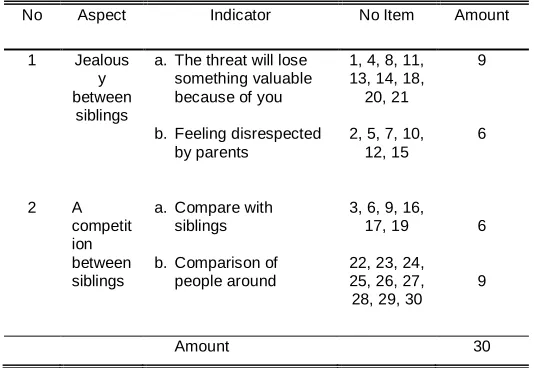
The instrument used to measure sibling rivalry in this study is the sibling rivalry scale which researchers arrange themselves based on 2 aspects of sibling rivalry from Mander [27], namely jealousy between siblings and competition between siblings. This scale was developed by researchers in the form of a rating scale with a total of 30 items. Each aspect consists of 15 items. Rating on this scale is 1-5, where the greater the number chosen indicates the higher level of sibling rivalry. Vice versa, the smaller the number chosen, it shows the lower sibling rivalry level. The statements examples from manifestations of jealousy between siblings are "Saying bad things about brother or sister" and "Angry when criticized by mother". Examples of statements from the form of competition between siblings are "Achievement of brother or sister school compared to family members", "Crying when losing to play with brother or sister". Blue print of sibling rivalry scale can be seen in table 1
TABLE1.
BLUE PRINT OF SIBLING RIVALRY SCALE
No Aspect Indicator No Item Amount
1 Jealous y between
siblings
a. The threat will lose something valuable because of you
b. Feeling disrespected by parents
1, 4, 8, 11, 13, 14, 18, 20, 21
2, 5, 7, 10, 12, 15
9
6
2 A competit ion between siblings
a. Compare with siblings
b. Comparison of people around
3, 6, 9, 16, 17, 19
22, 23, 24, 25, 26, 27, 28, 29, 30
6
9
Amount 30
2.4 Construction Validity and Reliability
This study examines the outer model to assess the validity and reliability of the instrument using the Smart PLS 3.0 program. The validity test is performed using the Confirmatory Factor Analysis (CFA) method that defines how each indicator relates to its latent variable. The convergent validity of the measurement model can be seen from the correlation between the indicator score and the variable score. The indicator is considered valid if it has an Average Variance Extracted (AVE) value above 0.5 showing all outer loading aspect of a variable that has a factor loading value above 0.5. Discriminant validity can be seen from the root value of AVE for each variable is greater when compared to the value of the correlation between variables with other variables. The next is a reliability test with the aim to show internal consistency in the measuring instruments used. The trick is to look at the value of composite reliability and Cronbach’s alpha where according to Cooper the value that must be owned is> 0.7 [29].
2.5 Data Analysis
The data in this study were analyzed using the Smart PLS 3.2.8 program with reflective constructs through the 2nd Order CFA. According to Hartono and Abdillah [30] PLS is a variance-based structural equation analysis (SEM) that can
simultaneously test measurement models to test the validity and reliability.
3 RESULT
Based on the results of the analysis of the outer model test on the scale of quality of work life conducted using the Smart PLS 3.2.8 program, it can be seen the results as shown in the figure below.
Figure 2. Sibling Rivalry Outer Model Test Output Outer Rivalry
3.1 Convergent Validity
Based on the test of convergent validity on the outer model, it was found that the value of factor loading from variables to aspects has a value> 0.5 shown in table 2.
TABLE2.
LOADING FACTOR (ASPECT-INDICATOR)
Aspect Value of Loading Factor Information
Jealousy 0.884 Valid
Competence 0.846 Valid
Based on the test of convergent validity on the outer model, it was found that the loading factor value from aspects to the indicators has a value> 0.5, which is shown in table 3.
TABLE3.
LOADING FACTOR (VARIABLE-ASPECT)
Item Value of Loading Factor Information
s.c.t.2 0.811 Valid
s.c.a.4 0.816 Valid
3740
s.c.a.8 0.677 Valid
s.c.a.11 0.626 Valid
s.c.a.21 0.732 Valid
s.k.o.3 0.708 Valid
s.k.o.6 0.681 Valid
s.k.o.17 0.717 Valid
s.k.o.20 0.667 Valid
s.k.s.23 0.812 Valid
s.k.o.24 0.664 Valid
s.k.o.27 0.779 Valid
Based on the convergent validity test values show the average variance extracted or AVE in the sibling rivalry construct of 0.512 with the average variance extracted or AVE value in each aspect can be seen in table 4.
TABLE 4.
AVERAGE VARIANCE EXTRACTED (AVE) VALUE OF SIBLING RIVALRY CONSTRUCT
Aspect AVE value Information
Jealousy 0.525 Sig
Competence 0.519 Sig
3.2 Discriminant Validity
Based on the discriminant validity test values, the root results of the Average Variance Extracted or AVE in each aspect are higher than the average variance extracted root or AVE in other aspect, so that the discriminant validity criteria are met. Root Value Variance Average Extracted (AVE) construct sibling rivalry can be seen in table 5.
TABLE5.
AVERAGE VARIANCE EXTRACTED ROOT VALUE (AVE) SIBLING RIVALRY CONSTRUCT
Aspect Jealousy Competence
Jealousy 0.725 0.628
Competence 0.628 0.720
The construct validity in SEM (Confirmatory Factor Analysis or CFA) shows that both aspects are valid with a loading factor value (λ) ≥ 0.5.
3.3 Construction Reliability Test
Based on the results of the construct reliability test that has been done, the Composite Reliability and Cronbach’s Alpha values> 0.7 can be obtained so that the items used in this
study are reliable.
TABLE 6.
THE VALUE OF COMPOSITE RELIABILITY AND CRONBACH'S ALPHA CONSTRUCT SIBLING RIVALRY
Variable Composite Reliability
Cronbach’s alpha
Information
Sibling rivalry
0.904 0.880 Reliable
The results of construct reliability testing using Confirmatory Factor Analysis 2nd Order in table 6 above show that constructs have good reliability and give meaning that the aspect that measure constructs or latent variables sibling rivalry meet un aspect criteria [31]. This is indicated by the value of Composite Reliability 0.904 and Cronbach’s Alpha 0.880. The validity and reliability test of the extract produced valid and reliable items that were able to reflect sibling rivalry forms, namely the items in numbers 2, 4, 5, 8, 11, 21, 3, 6, 17, 20, 23, 24, 27 while the items that are unable to reflect sibling rivalry are the items in numbers 1, 7, 9, 10, 12, 13, 14, 15, 16, 18, 19, 22, 25, 26, 28, 29, and 30. Based on the processing and analysis of research data on the aspect of sibling rivalry variables or constructs formed using the 2nd Order Confirmatory Factor Analysis, the results show that the model is acceptable, because all aspects are able to reflect the variables or constructs that are formed.
4 DISCUSSION
13 items is 0.93. Next [25] Webster uses a sibling jealousy scale consisting of three items from Davis' Sibling Relationship Survey which is added to three items made by Webster [25]. Cronbach's alpha coefficient is .88. The total correlation of items ranged from 0.58-0.79 for jealousy and from 0.30-0.77. In addition, the findings of this study are in line with the research results of Aktürk and Demircan [26]. In his research [26] used the Preschool Children Sibling Rivalry Scale (PSRS). On that scale there is a competition aspect to measure sibling rivalry. The competition is organized as a sub- aspect based on [24], [17], and [25]. The competition aspect obtained a Cronbach alpha coefficient of 0.71. Furthermore, the results of the Confirmatory Factor Analysis (CFA) obtained the value of the loading factor (variable-aspect), namely: 1.00 and the value of the loading factor (ie. aspects) 0.62, 0.94, and 0.52. The discriminant validity obtained in this study is 0.256, [26]. Using the estimated correlation between factors must be lower than 0.85. The findings from this study are also supported by Neubauer [15], he explains sibling rivalry is influenced by differences that cause competition and jealousy [15] states that sibling rivalry is the fear of losing love and source attention because of his brother. Then, Shaffer [22], argues sibling rivalry is a feeling of envy, competition and hatred arising between two or more siblings begins immediately after a younger brother or sister is born.
5 CONCLUSION
Based on the results of the analysis and discussion, it can be concluded that: 1) sibling rivalry contract fulfills good validity and reliability, 2) all aspects can significantly form sibling rivalry, where aspects that have a dominant influence on sibling rivalry are jealousy between siblings with loading values factor (0.884). Thus, the findings of this study can provide theoretical implications for the development of sibling rivalry theory and practical implications can help parents, especially mothers, to know the level of sibling rivalry possessed by their children, especially for children aged 4-12 years.
ACKNOWLEDGMENT
The author would like to thank Ahmad Dahlan University and the Master of Psychology Programe University of Ahmad Dahlan for supporting the implementation of this research.
REFERENCES
[1] S.M. McHale, K.A. Updegraff, and S.D. Whiteman,―Sibling Relationships and Influences in Childhood and Adolescence,‖ Journal of Marriage and Family, vol. 74, no.5, pp. 913-930, 2012 [2] K. Strohm, Sibling of Children with Special Needs, 2006. [3] N. Gottesman, The Bully at Home. Parent & Child, 2013. [4] A. Milevsky, Sibling Relationships in Childhood and
Adolescence. New York: Columbia University Press, 2011. [5] J.D. Sparrow,―Coping with Sibling Rivalry,‖ Scholastic
Parent & Child, vol.14, no.1, pp. 48–51, 2006
[6] R. Donrovich, P. Puschmann, and K. Matthijs,―Rivalry, Solidarity, and Longevity Among Siblings: A Life Course Approach to the Impact of Sibship Composition and Birth Order on Later Life Mortality Risk, Antwerp,‖ Demographic Research, vol. 31, pp. 1167-1198, 2014, doi: 10.4054/DemRes.2014.31.38.
[7] H. Yavuzer, First 6 Years of Your Child (29th ed.). İstanbul: Remzi Bookstore, 2013.
[8] N. Howe, and H.E. Recchia, Siblings and Sibling Rivalry:
Encyclopedia of Infant and Early Childhood Development. Colorado: Academic, 2008.
[9] K. Gass, J. Jenkins, and J. Dunn,―Are Sibling Relationships Protective? A Longitudinal Study,‖ Journal of Child Psychology and Psychiatry, vol. 48, no.2, pp.167– 175, 2007, doi:10.1111/j.1469-7610.2006.01699.x
[10]J. Perner, T. Ruffman, and S.R. Leekam,―Theory of Mind is Contagious: You Catch it from Your Sibs,‖Child development, vol. 65, no.4, pp. 1228-1238, 1994.
[11]J. Dunn, and C. Slomkowski, Conflict and the Development of Social Understanding: Cambridge Studies in Social and Emotional Development. Conflict in Child and Adolescent Development, pp. 70-92, New York, NY, US: Cambridge University Press, 1992.
[12]A. Adler, ―The Meaning of Life.‖ The Lancet, vol. 217, no.5605, pp. 225–228, 1931
[13]D.M. Levy, Study in Sibling Rivalry. American Orthopsvchiatric Association Research Monograph. 2, 1937
[14]M. Ihinger, ―The Referee Role and Norms of Equity: A Contribution Toward a Theory of Sibling Conflict,‖ Journal of Marriage and the Family, vol. 37, no.3, pp. 515–524, 1975, doi:10.2307/350515.
[15]P.B. Neubauer,―The Importance of the Sibling
Experience,‖ The psychoanalytic study of the child, vol. 38, pp.325–336, 1983
[16]S.V. Reit, Sibling rivalry. New York: Ballantine Books, 1985
[17]R. Kastenbaum, Human developing: A Lifespan Perspective. Boston: Allyn and Bacon, Inc, 1979.
[18]J.M. Vivona,―Sibling Differentiation, Identity Development,
and the Lateral Dimension of Psychic Life,‖ Journal of the American Psychoanalytic Association, vol.55, no.4, pp.1191-1215, 2007, doi:10.1177/000306510705500405 [19]W.A. Boyle, Sibling Rivalry and Why Everyone Should
Care About This Age Old Problem, 1999
[20]R. Kastenbaum, Human developing: A Lifespan Perspective. Boston: Allyn and Bacon, Inc, 1979.
[21]. J.M. Vivona,―Sibling Differentiation, Identity
Development, and the Lateral Dimension of Psychic Life,‖ Journal of the American Psychoanalytic Association, vol.55, no.4, pp.1191-1215, 2007, doi:10.1177/000306510705500405
[22]D.D.R. Shaffer and K. Kipp, Developmental Psychology: Childhood and Adolescence: Childhood and Adolescence. Boston: Cengage Learning, 2010.
[23]F. Boer, P.M. Westenberg, S.M. McHale, K.A. Updegraff, and C.M. Stocker,―The Factorial Structure of the Sibling Relationship Inventory (SRI) in American and Dutch Samples,‖ Journal of Social and Personal Relationships, vol.14, no.6, pp. 851–859, 1997, doi:10.1177/0265407597146009.
[24]W. Furman and D. Buhrmester,―Children’s Perceptions of the Qualities of Sibling Relationships,‖Child Development, vol.56, pp. 448–461, 1985, doi:10.2307/1129733.
[25]R.G. Webster, Sibling Rivalry and Interpersonal Guilt. Doctoral dissertation. 1998
[26]A.A. Aktürk and H.O. Demircan,―Development of Preschool Children Sibling Rivalry Scale (PSRS),‖ Child Indicators Research, vol.11, no.1, pp.117-136, 2018. [27]G. Mander, ―Some Thoughts on Sibling Rivalry and
3742
[28]H. Latan Structural Equation Modeling Concepts and Applications Using LISREL 8.80 (in Indonesia) Bandung: Alfabeta, 2012
[29]HM. Jogiyanto, Concept and Application of Variant Based Structural Equation Modeling in Business Research (in Indonesia). Yogyakarta: UPP STIM YKPN, 2011
[30]J. Hartono and W. Abdillah, The Concept and Application PLS (Partial Least Square) for Empirical Research. Issue I, BPFE, Yogyakarta, 2009