A Survey on Explainability: Why should we believe the
accuracy of a model?
PRARTHANA DUTTA, NARESH BABU MUPPALANENI, and RIPON PATGIRI
∗,
NationalInstitute of Technology silchar, India
The world has been evolving with new technologies and advances day-by-day. With the advent of various learning technologies in every field, the research community is able to provide solution in every aspect of life with the applications of Artificial Intelligence, Machine Learning, Deep Learning, Computer Vision, etc. However, with such high achievements, it is found to lag behind the ability to provide explanation against its prediction. The current situation is such that these modern technologies are able to predict and decide upon various cases more accurately and speedily than a human, but failed to provide an answer when the question of why to trust its prediction is put forward. In order to attain a deeper understanding into this rising trend, we explore a very recent and talked-about novel contribution which provides rich insight on a prediction being made – “Explainability.” The main premise of this survey is to provide an overview for researches explored in the domain and obtain an idea of the current scenario along with the advancements published to-date in this field. This survey is intended to provide a comprehensive background of the broad spectrum of Explainability. CCS Concepts: •Computing methodologies→Machine learning;Artificial intelligence.
Additional Key Words and Phrases: Artificial Intelligence, Explainability, Deep Learning, Machine Learning.
1 INTRODUCTION
Advancements in technology in every field field of life have been witnessed by researchers across generations. John McCarthy in 1956 coined the term “Artificial Intelligence” (AI), and since then, it has been evolving as an elusive subject of concern in many research activities. AI has been witnessing their utility in various fields since decades and have been achieving desired and satisfactory achievements. There have been tremendous improvements in a wide range of domains such as commercial platforms, medical, marketing, etc. This has paved the way such that no human intervention is needed in most aspects of decision taking. With more and more advancements in the learning technologies and the models, the decisions or predictions made by these systems are accurate approximately 100%. Also, machine learning algorithms can correctly predict and its accuracy may rise to 100% in some favorable cases. Patgiriet al.[38] reports accuracy of 100% in conventional machine learning algorithms. Even though with such high and satisfactory accuracies,
∗Corresponding author
Authors’ address: Prarthana Dutta, [email protected]; Naresh Babu Muppalaneni, nareshmuppalaneni@gmail. com; Ripon Patgiri, [email protected], Department of Computer Science & Engineering, National Institute of Technology silchar, Silchar, Assam, India, 788010.
Permission to make digital or hard copies of all or part of this work for personal or classroom use is granted without fee provided that copies are not made or distributed for profit or commercial advantage and that copies bear this notice and the full citation on the first page. Copyrights for components of this work owned by others than ACM must be honored. Abstracting with credit is permitted. To copy otherwise, or republish, to post on servers or to redistribute to lists, requires prior specific permission and/or a fee. Request permissions from [email protected].
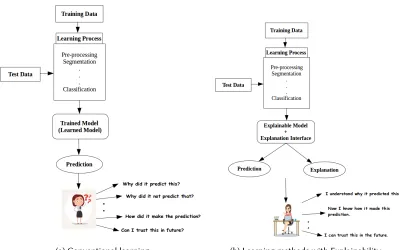
these technologies may face trust issues related to the model and the predictions [38, 40]. Hence, the main risk that is associated with these predictions is that even though the model was able to predict accurately for all the test cases, it might not work in the same accurate manner when the model is left in the wild for their respective domains to track and make life changing decisions (some of them are discussed in other sections). Thus a gap is found to exist between the prediction or decision made by an intelligent system and the reason associated with these decisions or predictions. The end users in most cases remain in a confused state of mind having various curiosities about the model and its prediction. A pictorial view of such a scenario is shown in Figure 1a. For this, the researchers have been thinking to take their research one step ahead by thinking if the system gave its end user a valid reason for making such decisions along with the predictions. They developed this idea that along with making the predictions, if the intelligent systems (making these predictions) are also able to give a proper explanation of its prediction, it would definitely prove to be much easier and more meaningful for end users to rely and trust the systems and take further actions based on this explanation. Thus, bridging the gap between the prediction and the reason for such prediction for humans to understand and interpret better is what we call an explainable system and the mechanism inbuilt in the model for explaining its decision is called asExplainability. Despite handling the trust issues associated with the model and its prediction, explainability also found its importance in other aspects such as providing understandability and transparency into the working algorithm and the model employed. The usability and application of explainability can be seen in a wide range of domains such as Healthcare, Education, Business, Military, etc., discussed in Section 2.1.
Since the discovery of various prediction models and algorithms, one never gains insights into the internal structure and the working of the model which led to the arrival of the desired prediction. It is mostly imagined as ablack-boxwith no understanding about its working. With the ability of peeping into this black-box and exploring its contents and working, one can explain the reason behind any prediction made by the model. In later times one can also try to modify its content, if necessary, for smooth running, prediction making and explaining (Section 4). Figure 1a describes a general architecture of a learning technology in making a prediction. The training data is fed into the learning process or architecture and the output induces a model of the training data. This model is then used to make predictions for new test data. The problem with this prediction is that, it is not accompanied with any justification or explanation for the specific prediction it made. The end user at times may be left in a confused state of mind dealing with various questions about the model and its prediction. They are unaware and unable to view anything that has been learnt within the model. The explainability feature comes into play in these scenarios by trying to generate a new learning process whose output is justified with the prediction. It allows the user to interrogate the internal model working and obtain justification against the prediction. This can be visualized from Figure 1b where the end user is able to gain insights into the working of the model via the explanation provided by the explainable model and the interface. The user now becomes aware of what the model has learnt.
(a) Conventional learning (b) Learning methods with Explainability
Fig. 1. (a) A general learning technology which provides the user with state-of-the-art performance measures but is unable to fulfil the users queries and leaves the user in a confused state of mind. (b) An explainable technology which is unified with an explainable model and interface along with the prediction
2 EXPLAINABILITY IN MACHINE LEARNING
The term eXplainable Artificial Intelligence is usually abbreviated asXAI. The term was first formulated by Lent and Mancuso in 2004 [53]. Before that it was addressed as “black-box”. The main aim behind the development of such a technique is twofold — Firstly, it provides transparency against the working models and algorithms in a way to gain insights into the black-box. Secondly, it aids in converting an untrustworthy model into a trustworthy one.
Arrietaet al.[4] have also defined it as “Given an audience an explainable Artificial Intelligence is one that produces details or reasons to make its functioning clear to understand.”
The survey of Adadiet al.[1] highlights the main concepts and terms related to XAI and provides us with a structured view of these concepts. The survey also highlights the need for an explainable model so that it can be utilized in every field possible.
In a very recent and elaborate survey published in 2019, by Arrietaet al.[4], the authors discuss the rising trend of explainability in Machine Learning. According to the authors, explainability could be achieved successfully either through models that are transparent, i.e. they are understandable by themselves, or by application of Post-hoc techniques to understand them. The self-understandable models include Logistic/Linear Regression, Decision Trees, K-Nearest Neighbors, etc. While coming to the Post-hoc technique, the authors made an elaborate and hierarchical categorization consti-tuting of the Model-Agnostic and Model-Specific techniques with their respective taxonomies. We narrowed down our survey by analyzing upon the Model-Specific Learning Technologies for Deep Learning Models such as Convolutional Neural Networks (CNN), Recurrent Neural Networks (RNN), etc. Studies show that Deep learning methods such as CNN, RNN etc. have been (proven their utility) achieving great heights in predicting the accuracies of complex data. Questioning on how these models generated the outputs or predictions remain unanswered. Without understanding how they arrived at such solutions, it won’t be relevant to employ the model out in the wild.
2.1 Need for Explainability in various domains
Though the AI is able to help the society in real life decision making problems, there are situations witnessed where the AI is seen to fail and is disowned in many situations. This calls for an urgent need for a valid and trustworthy explainable system that could be trusted blindly by the users and organizations. Some of the scenarios where one needs an explainable model while taking life changing decisions and have faced failure due to lack of explainability are shown in Table 1.
Table 1. Explainability studies carried out in Deep Learning models for providing visual and feature relevance explanation
Domain Situation Observation Cause of Failure
Education [28]
Selecting can-didates for in-terview
Practicing sexual and racial discrim-ination.
Inferred information from the last name and date of birth of the candidates. Military
[9, 17]
Separating friendly and enemy tanks
Poor accuracy on the test data The model was trained with friendly photos were taken on sunny days while enemy photos were taking on over-cast days.
Healthcare [7] Pneumonia risk predic-tion
Pneumonia risk patients with asth-matic history was nopt considered as a serious condition; which is clin-ically in correct.
Neural Network inferred that patients with asthma has low risk of dying and can be treated as outpatients. Husky Vs
Wolf [40]
Distinguishing between im-ages of wolves and Eskimo Dogs
Wolf not in a snowy background is predicted as Husky and Husky in a snowy background is predicted as Wolf.
Prediction was solely based on the presence or absence of snow in the background.
Transportation [32]
Self-driving Car
Self-driving Uber killed a women in Arizona
Misclassified a women (ob-ject) as a plastic bag or tum-bler in the air .
This discrimination came into notice later on when they learned that the system inferred that women are more likely to ask for time off work due to their family bonds. Again the program also deduced that non-Europeans may not have sufficient command over the English language to practice medicine. But the selection of candidates on the basis of these factors are not valid and hence the system was abandoned by the authority. The need for an explainable model is being witnessed in an incident related to the military domain [9, 17]. Alex A. Freitas tried to evaluate the performance of classification models based on predictive accuracy and comprehensibility in 2014. He performed a simple experiment of classifying images of takes as enemy tanks and friendly tanks. The predictive accuracy performance of the ANN was observed to be high and so they decided to set the model out for practical implementation. But it did not perform well in classifying the enemy and friendly tanks. Later on it was reported that all the friendly photos on the training data were taken on sunny days while all the enemy photos were taken on overcast days. Hence the learning model inferred its classification based on the color of the sky on the photos. An explainable model is obvious to explain that it discriminated the photos based on the color of the sky and not on the relevant features of the images. With this explanation against the classification, the authority could have decided whether or not to employ the model for practical applications.
A similar example was stated by Ribeiroet al.while trying to figure out the importance of explanation in matters of trusting the model [39]. They trained a classifier to distinguish between images of Wolves and Huskins. At first they used a logistic regression classifier to classify images of wolves and huskies. The images were picked up intentionally such that all images of wolves are taken on a snowy background while husky images are taken without snow in the background. This badclassifier was set to be tested on 10 images under two scenarios — First without explanation and second with explanation. These test images also intentionally contained one wolf and husky image without and with snowy background respectively. So the classifier classified 8 of the test samples correctly while the two images of the wolf and husky are misclassified i.e. wolf without the snowy background was classified as husky and husky with the snowy background was classified as a wolf. In the second phase of the experiment, explanations are provided against the prediction. Evaluators are asked the question whether the model could be trusted or not. The result is such that, without the explanation provided, 10 among 27 trusted the model as making the correct prediction. On the other hand, after the explanation were provided, only 3 among 27 trusted the bad model. So the importance of explanation in a prediction could be visualized from this experiment.
To investigate the utility of Machine Learning in medical applications, Caruanaet al.tried to conduct a study on pneumonia risk prediction in order to predict the probability of death in pneumonia risk patients [7]. It was to determine whether patients with pneumonia risk are required to be treated as serious and admitted to the hospital or treated as outpatients. It turned out that while training the model with the medical history of the patients, it incorrectly learned the rule which inferred:𝐴𝑠𝑡 ℎ𝑚𝑎(𝑝𝑎𝑡 𝑖𝑒𝑛𝑡) =⇒ 𝐿𝑜𝑤 −𝑅𝑖𝑠𝑘(𝑝𝑎𝑡 𝑖𝑒𝑛𝑡), i.e. patients with asthma in their medical
pedestrians, cyclists, etc. even in darkness. This was reported as failure in classification by experts. It was found that the car’s software misclassified the pedestrian to be a plastic bag or a tumbler and treated it as such.
2.2 Explainability and Accuracy
Debugging the intelligent system is an integral part of research. This help developers in a number of ways — correct the mistakes and shortcomings in the system, trust the system, etc. In [21] authors Kuleszaet al., performed an illusive study on how the models equipped with explainable models should explain their prediction the users. They analysed their study with two important aspects of explanation — ‘Soundness’ and ‘Completeness’. They interpreted Soundness as the truthfulness associated with each component of the system and Completeness as the ability to describe all the intrinsic systems. In their attempt to answer some of the research questions, they performed the experiment on a music recommendation system under four different circumstances, described as High Soundness and High Completeness (HH), Medium Soundness and Medium Completeness (MM), High Soundness and Low Completeness (HSLC) and Low Soundness and High Completeness (LSHC). They tried to answer queries relating to impact of soundness and completeness on the model’s mental health; beneficial information; obstacles; cost-benefit trade off and trust. Most complete models are proven to be beneficial for the mental health of the model. Complete systems also proven to be associated with low cost and high benefit incurred. Complete systems are also associated with the trust associated with the model. Hence, the end result indicated that completeness is inferior to soundness when the model tries to explain how it arrived at the prediction. With the development of the concept of explainability as a new learning technology, various myths and misconceptions are also associated with the concept. Most of these remain unobserved, which may pose a threat to the conclusions made by the model. Most of the misconception, as highlighted by many research studies, including the Defense Advanced Research Project Agency (DARPA) [13, 52] and others, such as [41], is the trade-off existing between the accuracy computed by the model along with the explanation provided by it. The accuracy of a model is, in most cases, independent of the complexity of the model. Though most of the research community believes that more complex structured algorithms produce more accurate results, i.e. the more complex is the model, the higher is the accuracy. This is not always true when one has to deal with the structured and meaningful data. When dealing with such data, both the simple and complex structured models show similar accuracy; but their explainability may vary.
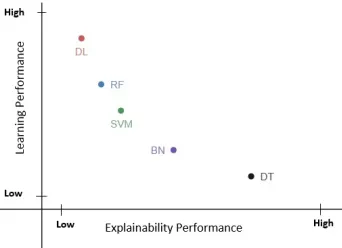
Coming to the Computer Vision applications, the Deep Learning models show higher performance with less ability to provide explainability. But there are also situations witnessed where explainability and accuracy in performance are found to be directly proportional in different Machine Learning algorithms with slight variation in their performance [14]. To visualize these scenarios where the DARPA project for XAI has provided a graphical view of the relationship of the Machine Learning Models towards explainability and their individual performance. From Figure 2 it is clear that though the Machine Learning models such as Deep Learning, Random Forests, Support Vector Machines has high accuracy and less explainability; while the other models such as Bayesian Belief Networks, Decision Trees, etc. can provide higher explainability but their accuracy does not seem to achieve heights as compared with the other ML models. So with XAI, the researchers need to develop or modify their models such that they attain higher accuracy along with providing a good explanation measure. Thus, one needs to increase explainability such that the accuracy results are not sacrificed.
Fig. 2. Relationship between Explainability and Performance Measure among the various Learning Models. This is an approximation graph presented by the DARPA project on their study on eXplainable Artificial Intelligence. Source [13].
So the models designed may be expected to provide explanation a majority portion of the original mode.
3 MATERIALS AND METHODS
There are a wide variety of materials and methods provided by the research community in the context of XAI. These materials and methods are dependent on the application domains of the models being used. There are various explanation techniques and frameworks which are developed by researchers across the globe to help them attain desired results. We have decided to put special emphasis on only a few application domain of Machine Learning that focuses mainly on visual explanation and feature relevance explanations. These explanation techniques and frameworks are explored in Section 3.1 and Section 3.2 respectively. The tables provided in these sections provide a brief idea of the correct approaches and frameworks employed in the relevant fields of explainability providing insights into the approaches, visualization techniques, datasets, etc.
3.1 Explanation Techniques in XAI in Deep Learning
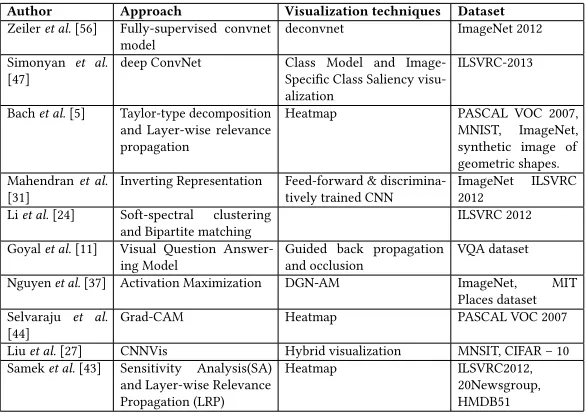
Many scholars have proposed a number of explanation methods and techniques for deep learning. One such taxonomy is provided recently by Arrietaet al.[4] which include — Explanation by Simplification, Feature Relevance Explanation, Visual Explanation, Local Explanation, Explanation of Example, Text Explanation, Visual Explanation, Architectural Modification, etc. Amongst them, we have chosen to survey on the Visual Explanation methods and Feature Relevance Explanation methods. Table 1 provides some of the approaches and visualization techniques employed in a few research works for providing explainability.
Table 2. Explainability studies carried out in Deep Learning models for providing visual and feature relevance explanation
Author Approach Visualization techniques Dataset
Zeileret al.[56] Fully-supervised convnet model
deconvnet ImageNet 2012
Simonyan et al. [47]
deep ConvNet Class Model and Image-Specific Class Saliency visu-alization
ILSVRC-2013
Bachet al.[5] Taylor-type decomposition and Layer-wise relevance propagation
Heatmap PASCAL VOC 2007,
MNIST, ImageNet, synthetic image of geometric shapes. Mahendranet al.
[31]
Inverting Representation Feed-forward & discrimina-tively trained CNN
ImageNet ILSVRC 2012
Liet al.[24] Soft-spectral clustering and Bipartite matching
ILSVRC 2012
Goyalet al.[11] Visual Question Answer-ing Model
Guided back propagation and occlusion
VQA dataset
Nguyenet al.[37] Activation Maximization DGN-AM ImageNet, MIT Places dataset Selvaraju et al.
[44]
Grad-CAM Heatmap PASCAL VOC 2007
Liuet al.[27] CNNVis Hybrid visualization MNSIT, CIFAR – 10 Sameket al.[43] Sensitivity Analysis(SA)
and Layer-wise Relevance Propagation (LRP)
Heatmap ILSVRC2012,
20Newsgroup, HMDB51
visualizing the class models and highlighting the areas of interest of the image of the particular class.
Aiming to view and understand the path followed by classifiers in arriving at the decisions, the research community contributed their ideas by exploring them in a number of ways. Bach, Binder et al.[5] proposed a general technique applicable to both neural network models and bag-of-words models for understanding the prediction by visualizing the pixels or prominent attributes that resulted in the prediction. According to the authors, while following the process of mapping the pixel values of the raw-image to the classifiers, there is no linear mapping among the various constituents of the process which leads to the absence of the explainability of the prediction being made. They proposed two pixels-wise decomposition approaches — Taylor-type decomposition and Layer-wise relevance propagation approach for the models, multi-layer neural networks and Bag of Words (BoW). Mahendranet al.developed a technique that provides explanation based on the visual content of the image [31]. They discover the method with a view to addressing the question of recovering an image based on a given encoding. The developed theinverting representation approach that is used to compute the inverse representation of the image. The experiment was conducted on the ImageNet [42] dataset and is found to work better as compared to recent trends [55]. While posing the question of whether different deep neural networks trained with different initialization, are able to performconvergent learning, Li, Yosinskiet al.[24] is able to gain insight into deep learning models. They used a matching approach or a soft-spectral clustering approach in order to align the units from differed networks.
in the prediction probability by occluding the input respectively. Nguyenet al.[37] used Activation Maximization (AM) as a feature relevance explanation method and visualized it using a Deep Generator Network (DGN). The AM is used to synthesize the preferred input neuron. Authors Sameket al.[43] developed two approaches for visualizing the deep learning models. They are —Sensitivity Analysis (SA)[6], [48] for explaining a model prediction via the locally evaluated gradient of the model andLayer-wise Relevance Propagation (LPR)[5] for explaining the decision of the classifier using decomposition technique. They used three different classification approaches to obtain an explanation for the decisions being made — annotated images (ILSVRC2012 [42]), text document classification (20Newsgroup [36]) and activity recognition in videos (HMDB51 [18]).
3.2 Framework for Explainability in Deep Learning
Trying to understand why a model chosen by us for a particular computation, made such a prediction is an important topic of interest which have been evolving in recent times. Understanding the underlying reason behind such prediction may be able to incur something which is called trust. This is indeed an important aspect in the learning technologies using which one can take the decision whether or not to employ the model under consideration. Explaining a prediction refers to providing qualitative understanding of the relationship between the components of an instance and the prediction made by a model in the form of textual or visual artifacts. Developing a technique that can clearly explain the predictions predicted by a classifier is a challenging task. It addresses two of the most common problems i.e. trusting a model and trusting a prediction. Helps in picking up the most relevant classifier from among a set of classifiers. Accuracy measure may not be always suffice to explain a model prediction, one also needs explainability for such prediction. The main aim is to provide insight as to why the model gave us such prediction (trust related task). Also measures faithfulness of explanations. The various characteristics that are required to be fulfilled by a model to provide a proper explanation of its prediction require a well-designed framework that encompasses all the required properties explained in [4].
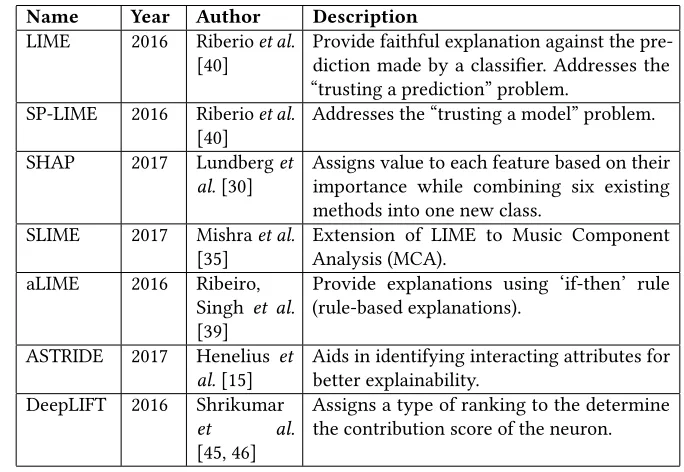
The authors developed an explainable model called LIME abbreviated as Local Interpretable Model-Agnostic Explanations, that can explain or detect features that contributed for such predic-tions. It thus provides a way of how humans can understand the working of the model and have faith in its prediction. It is inbuilt with characteristics such as interpretable, local fidelity, providing global perspective. In order to attain a deeper understanding into the model, the authors mainly focused on the aspect oftrust. They developed this framework with a view to answering questions such as whether the predictions should be trusted by any user; whether the explanations provided by the framework could be used in general for selection of a model from a pair; etc. Towards answering the query about trusting a prediction and trusting the model, the authors presented the LIME and SP-LIME frameworks respectively. LIME was able to provide more than 90% recall on the books and DVDs datasets for the two interpretable classifiers, Decision Trees and Logistic regression classifier. The results indicate that the explanations provided by LIME are faithful to the model. At the same time it also proved to be a powerful tool for associating the trust in the predictions and are good in generalizing.
Table 3. Explainability studies carried out in Deep Learning models for providing visual and feature relevance explanation
Name Year Author Description
LIME 2016 Riberioet al.
[40]
Provide faithful explanation against the pre-diction made by a classifier. Addresses the “trusting a prediction” problem.
SP-LIME 2016 Riberioet al. [40]
Addresses the “trusting a model” problem.
SHAP 2017 Lundberget
al.[30]
Assigns value to each feature based on their importance while combining six existing methods into one new class.
SLIME 2017 Mishraet al.
[35]
Extension of LIME to Music Component Analysis (MCA).
aLIME 2016 Ribeiro,
Singh et al. [39]
Provide explanations using ‘if-then’ rule (rule-based explanations).
ASTRIDE 2017 Henelius et
al.[15]
Aids in identifying interacting attributes for better explainability.
DeepLIFT 2016 Shrikumar
et al.
[45, 46]
Assigns a type of ranking to the determine the contribution score of the neuron.
singing voice systems — Decision Tree, Random Forest and Convolution neural Network and provided explanation towards the behavior of the model. aLIME for Anchor Local Interpretable Model-Agnostic Explanations is also an extension to LIME specifically designed to provide ‘anchors’ to a prediction make by the model. This framework was applied on the Part-of-Speech tagging, Image classification and Visual Question Answering models. This framework succeeds in achieving high precision and clear coverage bounds for model-agnostic models. With a view to investigate about the role of two or more attribute interactions in providing explanations for classifiers, authors Heneliuset al.devised the ASTRID framework. Thus, it is an Automatic STRuctrue IDentification method that inspects for the largest subset of attributes and attains identical accuracy when the classifier is trained on both the original attributes and a subset of attributes. The DeepLIFT (Learning Important FeaTures) is another framework developed in 2016 by Shrikumar and Shcherbina [46]. This framework computes the score of a neuron to determine its contribution in the prediction and the explanation. The score of each neuron is computed by taking the difference between a ‘reference activation’ and the activation of a neuron; thus determining the deviation of the neuron; employing it on a subset dataset of the ImageNet dataset. These scores are computed using the backpropagation approach. It was later modified in 2017 [45] by the authors by employing it on the MNSIT dataset.
Low Corruption (Class 2), Very High Corruption (Class 3) and Very Low Corruption (Class 4). In order to avoid biased model prediction, the𝑘- fold (𝑘 = 10) cross-validation technique was
applied on the dataset which splitted them into the training and testing sets. The accuracy is measured as the average of all the individual accuracy measures obtained from the𝑘-fold
cross-validation. They then employed the three popular Machine Learning approaches — Random Forest (RF), Artificial Neural Network (ANN) and Support Vector Machines (SVM). From among these models they tried to identify one model and its parameter specifications that produced unbiased and satisfactory accuracy. For comparing the three ML models, the method computed the overall accuracy as well as the class-wise accuracy. Upon experiment it was found that Random Forest was able to attain the best overall accuracy as well as class-wise accuracy among the other two models. For exploring the explainability of the prediction made by the Random forest, the variable having the most predictive power is computed using the “Actual Splitting Rate (ASR)”. The ASR computes the variable importance as the ratio of thesplitfactor to that of thecandidate to split factor. This allowed for obtaining the most relevant corruption predictor. According to this ASR, the Government Integrity was splitted 90.47% of the time as compared to Property Rights, Judicial
Effectiveness and Education Index which were splitted 78.84%, 77.94% and 53.93% of the times.
Thus the Government Integrity is addressed as the most relevant predictor for corruption. It thus provided Government Integrity as the most relevant explanation for the corruption prediction made by the Random Forest model.
4 INTERACTIVE EXPLANATION IN MACHINE LEARNING
Wrongly identifying or predicting a concept is a severe threat to the learning models. Researchers explored ways in which the end users can contribute to such misclassifications in a number of ways. Studying the role of the end users explicitly in Machine Learning models is found to promote better learning and performance of the model. Though the involvement of the end users is negligible in developing a model for various objectives, [2] carried out an extensive study that promotes for the contribution of end users to make the Machine Learning models more interactive and understandable thus providing a relevant explanation as required by the user using it for their beneficial tasks. The authors Amershiet al.present different instances that highlight the significance of involving the end user in building a powerful, interactive and efficient model. Kapooret al. proposed a way for interactive computation among the users and machines. They developed a system — ManiMatrix — that can effectively control the performance of the Machine Learning models in accordance with the user preference [16]. Using this application, the users can modify the decision boundary parameters in the confusion matrix via an interactive round of classification and visualization.
Kuleszaet al.in 2010 [20]). It is a task that can be performed from the users end to modify these models in an effective manner. Though a difficult task to exercise, by imbibing personalize machine learning systems into the learning model, is found to increase the understandability by 52% [21]. It is a system that explains the user about the predictions it made and the user debugs it for any correction in the learning model, thus personalizing the Machine Learning model’s behavior. The user tries to identify and correct the faults in the system’s reasoning that are responsible for the predictions that failed to meet the user’s expectation. So the user and the learning model work as a unit and share their understanding and also influence one another. Explanatory Debugging is a controllable and satisfying approach as it focuses on users who makes the corrections by explaining predictions.
In later years in 2017, Milleret al.suggests that the explainable module does not take into consideration the social science viewpoint while they are developing the explainability framework which may head up towards failure in later times. Therefor one also needs to put special emphasis on how people – rather than the developers – define, generate, select, evaluate and present their explanations [34]. While trying to explain and analyze this fact, Milleret al.cites “beware of inmates running the asylum.” The trend followed while developing the explainable AI, researchers and developers think and work by taking into consideration only their own psychological viewpoints in almost every case. But in actual scenario, it does not apply so. Since they are developing the explainable model for the audience and not for themselves, the research community should focus on people’s psychology and physiological condition in general keeping in mind that the explainable model would provide these explanations to the audience. Hence the authors suggested that these explainable models should be developed in a way by incorporating social and human behavioral science in order to build an explainable AI for the audience and let them evaluate the model quality. It is so because the end users need to believe and trust these explanations provided against the predictions. This trust and belief is to a large extent dependent on the people’s belief along with other psychological conditions. Thus, the author highlights that the research practitioners also should take into consideration the psychological and behavioral aspect of the people in general rather than providing explanation from the developer’s perspective. Claiming whether an explanation provided is a‘good’or‘bad’is determined only by the researchers point of view or perception which may not always be a success in real time. Whereas it can also be viewed from from other perspectives such as —philosophy, psychology or social science. So in 2018 Tim Miller [33] suggested that the explanations provided by the XAI would prove to be beneficial only when the explanations are derived from the psychology of the audience – keeping in mind their ways of thinking, selection, presentation, etc.
5 DISCUSSION
experiments can also be carried out to investigate the influence of latent features in explanation. One of such work can be found in [23] where they worked upon latent and unobserved features. Importance and necessity of the end users in debugging the intelligent system’s prediction is also an important aspect of the survey. Ways of debugging the systems have also been explored which brought into light the various challenges faced in the context. Addressing these barriers remain an unsolved research question yet to be looked upon. The role and importance of the psychological aspects of the people in proving to be beneficial for explainability models are also brought to light.
6 CONCLUSION
In this survey, we have explored the broad spectrum of explainability employed in Artificial Intelligence, Machine Learning and Deep Learning fields. Some of the noted contributions are marked and toured in this regard. Understanding explainability and its need is of course a major concern which is highlighted in this study. We presented some of the application domains that require the explainability as the actions taken after relying on the model’s prediction are life changing and risky. Introspecting through this survey will guide the upcoming researchers in the field of explainability and serve as a reference in future research.
REFERENCES
[1] Amina Adadi and Mohammed Berrada. 2018. Peeking inside the black-box: A survey on Explainable Artificial Intelligence (XAI).IEEE Access6 (2018), 52138–52160.
[2] Saleema Amershi, Maya Cakmak, William Bradley Knox, and Todd Kulesza. 2014. Power to the people: The role of humans in interactive machine learning.Ai Magazine35, 4 (2014), 105–120.
[3] Saleema Amershi, James Fogarty, Ashish Kapoor, and Desney Tan. 2010. Examining multiple potential models in end-user interactive concept learning. InProceedings of the SIGCHI Conference on Human Factors in Computing Systems. ACM, New York, NY, USA, 1357–1360.
[4] Alejandro Barredo Arrieta, Natalia Díaz-Rodríguez, Javier Del Ser, Adrien Bennetot, Siham Tabik, Alberto Barbado, Salvador García, Sergio Gil-López, Daniel Molina, Richard Benjamins, et al. 2020. Explainable Artificial Intelligence (XAI): Concepts, taxonomies, opportunities and challenges toward responsible AI. Information Fusion58 (2020), 82–115.
[5] Sebastian Bach, Alexander Binder, Grégoire Montavon, Frederick Klauschen, Klaus-Robert Müller, and Wojciech [40]. 2015. On pixel-wise explanations for non-linear classifier decisions by layer-wise relevance propagation.PloS one10, 7 (2015), 1–46.
[6] David Baehrens, Timon Schroeter, Stefan Harmeling, Motoaki Kawanabe, Katja Hansen, and Klaus-Robert MÞller. 2010. How to explain individual classification decisions.Journal of Machine Learning Research11, Jun (2010), 1803–1831. [7] Rich Caruana, Yin Lou, Johannes Gehrke, Paul Koch, Marc Sturm, and Noemie Elhadad. 2015. Intelligible models for healthcare: Predicting pneumonia risk and hospital 30-day readmission. InProceedings of the 21th ACM SIGKDD international conference on knowledge discovery and data mining. ACM, New York, NY, USA, 1721–1730.
[8] Anupam Datta, Shayak Sen, and Yair Zick. 2016. Algorithmic transparency via quantitative input influence: Theory and experiments with learning systems. In2016 IEEE symposium on security and privacy (SP). IEEE, San Jose, CA, USA, 598–617.
[9] Alex A Freitas. 2014. Comprehensible classification models: a position paper.ACM SIGKDD explorations newsletter15, 1 (2014), 1–10.
[10] L. H. Gilpin, D. Bau, B. Z. Yuan, A. Bajwa, M. Specter, and L. Kagal. 2018. Explaining Explanations: An Overview of Interpretability of Machine Learning. In2018 IEEE 5th International Conference on Data Science and Advanced Analytics (DSAA). IEEE, 80–89. https://doi.org/10.1109/DSAA.2018.00018
[11] Yash Goyal, Akrit Mohapatra, Devi Parikh, and Dhruv Batra. 2016. Towards transparent ai systems: Interpreting visual question answering models.arXiv preprint arXiv:1608.08974(2016).
[12] Riccardo Guidotti, Anna Monreale, Salvatore Ruggieri, Franco Turini, Fosca Giannotti, and Dino Pedreschi. 2018. A survey of methods for explaining black box models.ACM computing surveys (CSUR)51, 5 (2018), 1–42.
[13] David Gunning. 2017. Explainable artificial intelligence (xai).Defense Advanced Research Projects Agency (DARPA), nd Web2 (2017).
[14] David J Hand. 2006. Classifier technology and the illusion of progress.Statistical science(2006), 1–14.
[16] Ashish Kapoor, Bongshin Lee, Desney Tan, and Eric Horvitz. 2010. Interactive optimization for steering machine classification. InProceedings of the SIGCHI Conference on Human Factors in Computing Systems. 1343–1352. [17] Will Knight. [n.d.]. The U.S. Military Wants Its Autonomous Machines to Explain Themselves. https://rb.gy/wtgqdi. [18] Hildegard Kuehne, Hueihan Jhuang, Estíbaliz Garrote, Tomaso Poggio, and Thomas Serre. 2011. HMDB: a large video
database for human motion recognition. In2011 International Conference on Computer Vision. IEEE, 2556–2563. [19] Todd Kulesza, Margaret Burnett, Weng-Keen Wong, and Simone Stumpf. 2015. Principles of explanatory debugging to
personalize interactive machine learning. InProceedings of the 20th international conference on intelligent user interfaces. 126–137.
[20] Todd Kulesza, Simone Stumpf, Margaret Burnett, Weng-Keen Wong, Yann Riche, Travis Moore, Ian Oberst, Amber Shinsel, and Kevin McIntosh. 2010. Explanatory debugging: Supporting end-user debugging of machine-learned programs. In2010 IEEE Symposium on Visual Languages and Human-Centric Computing. IEEE, 41–48.
[21] Todd Kulesza, Simone Stumpf, Margaret Burnett, Sherry Yang, Irwin Kwan, and Weng-Keen Wong. 2013. Too much, too little, or just right? Ways explanations impact end users’ mental models. In2013 IEEE Symposium on Visual Languages and Human Centric Computing. IEEE, 3–10.
[22] Todd Kulesza, Simone Stumpf, Weng-Keen Wong, Margaret M Burnett, Stephen Perona, Andrew Ko, and Ian Oberst. 2011. Why-oriented end-user debugging of naive Bayes text classification.ACM Transactions on Interactive Intelligent Systems (TiiS)1, 1 (2011), 1–31.
[23] Himabindu Lakkaraju, Jon Kleinberg, Jure Leskovec, Jens Ludwig, and Sendhil Mullainathan. 2017. The selective labels problem: Evaluating algorithmic predictions in the presence of unobservables. InProceedings of the 23rd ACM SIGKDD International Conference on Knowledge Discovery and Data Mining. 275–284.
[24] Yixuan Li, Jason Yosinski, Jeff Clune, Hod Lipson, and John Hopcroft. 2015. Convergent Learning: Do different neural networks learn the same representations?. InProceedings of the 1st International Workshop on Feature Extraction: Modern Questions and Challenges at NIPS 2015 (Proceedings of Machine Learning Research), Dmitry Storcheus, Afshin Rostamizadeh, and Sanjiv Kumar (Eds.), Vol. 44. PMLR, Montreal, Canada, 196–212.
[25] Marcio Salles Melo Lima and Dursun Delen. 2020. Predicting and explaining corruption across countries: A machine learning approach.Government Information Quarterly37, 1 (2020), 101407.
[26] Stan Lipovetsky and Michael Conklin. 2001. Analysis of regression in game theory approach.Applied Stochastic Models in Business and Industry17, 4 (2001), 319–330.
[27] Mengchen Liu, Jiaxin Shi, Zhen Li, Chongxuan Li, Jun Zhu, and Shixia Liu. 2016. Towards better analysis of deep convolutional neural networks.IEEE transactions on visualization and computer graphics23, 1 (2016), 91–100. [28] Stella Lowry and Gordon Macpherson. 1988. A blot on the profession.British medical journal (Clinical research ed.)
296, 6623 (1988), 657.
[29] Jiasen Lu, Xiao Lin, Dhruv Batra, and Devi Parikh. 2015. Deeper lstm and normalized cnn visual question answering model.GitHub repository6 (2015).
[30] Scott M Lundberg and Su-In Lee. 2017. A unified approach to interpreting model predictions. InAdvances in neural information processing systems. 4765–4774.
[31] Aravindh Mahendran and Andrea Vedaldi. 2015. Understanding deep image representations by inverting them. In Proceedings of the IEEE conference on computer vision and pattern recognition. 5188–5196.
[32] Matt McFarland. [n.d.]. Uber shuts down self-driving operations in Arizona. https://rb.gy/vdhlwu.
[33] Tim Miller. 2019. Explanation in artificial intelligence: Insights from the social sciences.Artificial Intelligence267 (2019), 1–38.
[34] Tim Miller, Piers Howe, and Liz Sonenberg. 2017. Explainable AI: Beware of inmates running the asylum or: How I learnt to stop worrying and love the social and behavioural sciences.arXiv preprint arXiv:1712.00547(2017). [35] Saumitra Mishra, Bob L Sturm, and Simon Dixon. 2017. Local Interpretable Model-Agnostic Explanations for Music
Content Analysis.. InISMIR. 537–543.
[36] NewsGroup. [n.d.]. 20 newsgroups dataset for document classification. Accessed on March 2020 from http://people. csail.mit.edu/jrennie/20Newsgroups.
[37] Anh Nguyen, Alexey Dosovitskiy, Jason Yosinski, Thomas Brox, and Jeff Clune. 2016. Synthesizing the preferred inputs for neurons in neural networks via deep generator networks. InAdvances in neural information processing systems. 3387–3395.
[38] Ripon Patgiri, Sabuzima Nayak, Tanya Akutota, and Bishal Paul. 2019. Machine learning: a dark side of cancer computing.arXiv preprint arXiv:1903.07167(2019).
[39] Marco Tulio Ribeiro, Sameer Singh, and Carlos Guestrin. 2016. Nothing else matters: model-agnostic explanations by identifying prediction invariance.arXiv preprint arXiv:1611.05817(2016).
1135–1144. https://doi.org/10.1145/2939672.2939778
[41] Cynthia Rudin. 2019. Stop explaining black box machine learning models for high stakes decisions and use interpretable models instead.Nature Machine Intelligence1, 5 (2019), 206–215.
[42] Olga Russakovsky, Jia Deng, Hao Su, Jonathan Krause, Sanjeev Satheesh, Sean Ma, Zhiheng Huang, Andrej Karpathy, Aditya Khosla, Michael Bernstein, Alexander C. Berg, and Li Fei-Fei. 2015. ImageNet Large Scale Visual Recognition Challenge.International Journal of Computer Vision (IJCV)115, 3 (2015), 211–252. https://doi.org/10.1007/s11263-015-0816-y
[43] Wojciech Samek, Thomas Wiegand, and Klaus-Robert Müller. 2017. Explainable artificial intelligence: Understanding, visualizing and interpreting deep learning models.arXiv preprint arXiv:1708.08296(2017).
[44] Ramprasaath R Selvaraju, Abhishek Das, Ramakrishna Vedantam, Michael Cogswell, Devi Parikh, and Dhruv Batra. 2016. Grad-CAM: Why did you say that?arXiv preprint arXiv:1611.07450(2016).
[45] Avanti Shrikumar, Peyton Greenside, and Anshul Kundaje. 2017. Learning important features through propagating activation differences. InProceedings of the 34th International Conference on Machine Learning-Volume 70. JMLR. org, 3145–3153.
[46] Avanti Shrikumar, Peyton Greenside, Anna Shcherbina, and Anshul Kundaje. 2016. Not just a black box: Learning important features through propagating activation differences.arXiv preprint arXiv:1605.01713(2016).
[47] Karen Simonyan, Andrea Vedaldi, and Andrew Zisserman. 2013. Deep inside convolutional networks: Visualising image classification models and saliency maps.arXiv preprint arXiv:1312.6034(2013).
[48] Karen Simonyan, Andrea Vedaldi, and Andrew Zisserman. 2013. Deep inside convolutional networks: Visualising image classification models and saliency maps.arXiv preprint arXiv:1312.6034(2013).
[49] Jost Tobias Springenberg, Alexey Dosovitskiy, Thomas Brox, and Martin Riedmiller. 2014. Striving for simplicity: The all convolutional net.arXiv preprint arXiv:1412.6806(2014).
[50] Erik Štrumbelj and Igor Kononenko. 2014. Explaining prediction models and individual predictions with feature contributions.Knowledge and information systems41, 3 (2014), 647–665.
[51] Simone Stumpf, Vidya Rajaram, Lida Li, Weng-Keen Wong, Margaret Burnett, Thomas Dietterich, Erin Sullivan, and Jonathan Herlocker. 2009. Interacting meaningfully with machine learning systems: Three experiments.International Journal of Human-Computer Studies67, 8 (2009), 639–662.
[52] Matt Turek. [n.d.]. Explainable Artificial Intelligence (XAI). Accessed on 20/01/2020 from https://bit.ly/38YLErX. [53] Michael Van Lent, William Fisher, and Michael Mancuso. 2004. An explainable artificial intelligence system for
small-unit tactical behavior. InProceedings of the national conference on artificial intelligence. Menlo Park, CA; Cambridge, MA; London; AAAI Press; MIT Press; 1999, 900–907.
[54] Jesse Vig, Shilad Sen, and John Riedl. 2011. Navigating the tag genome. InProceedings of the 16th international conference on Intelligent user interfaces. 93–102.
[55] Carl Vondrick, Aditya Khosla, Hamed Pirsiavash, Tomasz Malisiewicz, and Antonio Torralba. 2016. Visualizing object detection features.International Journal of Computer Vision119, 2 (2016), 145–158.
[56] Matthew D Zeiler and Rob Fergus. 2014. Visualizing and understanding convolutional networks. InEuropean conference on computer vision. Springer, 818–833.