R E S E A R C H
Open Access
Exponentially stable solution of
mathematical model of agents dynamics on
time scales
Ewa Schmeidel
1*, Urszula Ostaszewska
1and Małgorzata Zdanowicz
1*Correspondence:
1Institute of Mathematics, University
of Bialystok, Białystok, Poland
Abstract
This work is an attempt at studying leader-following model on the arbitrary time scale. The step size is treated as a function of time. Our purpose is establishing conditions ensuring a leader-following consensus for any time scale basing on the Grönwall inequality. We give some examples illustrating the obtained results.
MSC: 34N05; 34D20; 93C10
Keywords: Time scales; Leader-following problem; Grönwall inequality; Multi-agent systems; Graph theory
1 Introduction
The aim of this paper is to propose conditions ensuring the consensus of a multi-agent sys-tem over an arbitrary time scale. We consider continuous- and discrete-time models and also models on time scales simultaneously consisting of both kinds of points, right-dense and right-scattered. Under some assumptions, we prove that consensus can be achieved exponentially if the graininess function is bounded. All theorems are still true if the grain-iness function approaches zero. Some existing results of discrete-time consensus are par-ticular cases of the results presented in this paper.
The leader-following problem has been investigated since 1970s. In 1974, DeGroot [1] studied an explicitly described model that resulted in the consensus. In 2000, Krause [2,
3] discussed the model of a group of agents who have to make a joint assessment of a certain magnitude. The coordination of groups of mobile autonomous agents based on the nearest-neighbor rules was considered by Jadbabaie et al. [4]. Blondel et al. [5,6], took into account Krause’s model with state-dependent connectivity. Girejko et al. [7,8], examined Krause’s model on discrete time scales. In 2007 there were published two important papers by Cucker and Smale [9,10]. The authors considered an emergent behavior in flocks. The Cucker–Smale model on isolated time scales was in the area of interests of Girejko et al. [8]. Girejko, Machado, Malinowska, and Martins [11] investigated sufficient conditions for consensus in the Cucker–Smale-type model on discrete time scales. In 2015, Wang et al. [12] published some results for the leader-following consensus of discrete-time linear multi-agent systems with communication noises.
Our results generalize and improve the results obtained in [13] and [14]. In [14] consen-sus on different types of discrete-time scales is considered under the assumption that the feedback control gainγ is constant.
2 Basis of time scales calculus
A time scale is a model of time [15–17], where the step size is a function of time. From mathematical point of view, it is an arbitrary nonempty closed subsetTof the setRof real numbers.
The mappingσ:T→Tdefined byσ(t) =inf{s∈T:s>t} withinf∅=supTis called the forward jump operator. Similarly, we define the backward jump operatorρ:T→T byρ(t) =sup{s∈T:s<t}withsup∅=infT. The following classification of points is used within the theory: a pointt∈Tis called right-dense, right-scattered, dense, and left-scattered ifσ(t) =t(fort<supT),σ(t) >t,ρ(t) =t(fort>infT), andρ(t) <t, respectively. We say thattis isolated ifρ(t) <t<σ(t) and thattis dense ifρ(t) =t=σ(t). The function
μ:T→[0,∞) is defined byμ(t) =σ(t) –tand called the graininess function. The delta (or Hilger) derivative off :T→Rat a pointt∈Tκ, where
Tκ :=
⎧ ⎨ ⎩
T\(ρ(supT),supT] if supT<∞,
T if supT=∞,
is defined in the following way.
Definition 1([16]) The delta derivativef(t) is the number (provided that it exists) with the property that given anyε> 0, there is a neighborhoodUoft(i.e.,U= (t–δ,t+δ)∩T for someδ> 0) such that
f
σ(t)–f(s)–f(t)σ(t) –s≤εσ(t) –s for alls∈U.
Moreover, we say thatfis delta (or Hilger) differentiable (or, shortly, differentiable) onTκ iff(t) exists for allt∈Tκ. Then the functionf:Tκ→Ris called the (delta) derivative off onTκ.
The following definitions will be further used, too.
Definition 2([16]) A functionf :T→Ris called regulated if its right-sided limits exist (finite) at right-dense points inTand its left-sided limits exist (finite) at left-dense points inT. A functionf :T→Ris called rd-continuous if it is continuous at right-dense points inTand its left-side limits exist (finite) at left-dense points inT.
Definition 3([16]) Letf :T→Rbe a regulated function. We define the indefinite integral off byf(t)t=F(t) +c, wherecis an arbitrary constant, andFis a preantiderivative off. We define the Cauchy integral off asabf(t)t=F(b) –F(a) for alla,b∈T.
Definition 5([16]) AnN×N-matrix-valued functionPon a time scaleTis called re-gressive (with respect toT) if
I+μ(t)P(t) is invertible for allt∈Tκ,
where byIwe denote theN×Nidentity matrix.
Similarly to the scalar case, the class of all regressive and rd-continuous matrix-valued functions is denoted byR. Notice that a constantN×N matrixPis regressive iff the eigenvaluesλiofPare regressive for all 1≤i≤N.
We use the Grönwall inequality in the proof of the main result.
Lemma 1([16]) Let z be rd-continuous,p∈R+,and p(t)≥0for t∈Tand c∈R.Then
z(t)≤c+
t
T0
p(τ)z(τ)τ for all t∈T
implies
z(t)≤cep(t,T0).
Herez(t) =ep(t,T0),T0∈T, is a solution of the initial value problem
z(t) =p(t)z(t), z(T0) = 1 onT. (1)
We assume that
infT=T0≥0 and supT=∞,
which implies thatTκ=T.
3 Mathematical model of agents dynamics
We consider a multi-agent system consisting ofNagents and the leader. The dynamics of each agent labeledi,i= 1, 2, . . . ,N, is given by the following equation:
x
i (t) =f
t,xi(t)
+γ(t)
N
j=1
aij
xj(t) –xi(t)
+γ(t)di
x0(t) –xi(t)
, (2)
wheret∈T,xi:T→R, andγ :T→Rrepresent the state and the feedback control gain
at timet, respectively. Hereaij∈R,di∈R,i,j= 1, 2, . . . ,N, andD:=diag[d1,d2, . . . ,dN]
is a diagonal matrix. Throughout this paper, we assume thataij=aji, which means that
the matrixA= [aij]N×N is symmetric. The functionf :T×R→Rdescribes nonlinear
dynamics. The leader, labeled asi= 0, for multi-agent system (2) is an isolated agent with trajectory described by
x0(t) =ft,x0(t)
Notice that the control lawγ(t)Nj=1aij(xj(t) –xi(t)) +γ(t)di(x0(t) –xi(t)) for theith agent
used in system (2)–(3) was studied by many authors, including Yu, Jiang, and Hu [18]. Letεi(t) =xi(t) –x0(t) denote the distance between the leader and theith agent. From
(2)–(3) we obtain
εi (t) =ft,xi(t)
–ft,x0(t)
+γ(t)
N
j=1
aij
εj(t) –εi(t)
–γ(t)diεi(t)
fori= 1, 2, . . . ,N. Setting
ε(t) =ε1(t),ε2(t), . . . ,εN(t) T
,
x(t) =x1(t),x2(t), . . . ,xN(t) T
,
and
Ft,x(t)=ft,x1(t)
,ft,x2(t)
, . . . ,ft,xN(t) T
,
Ft,x0(t)1
=ft,x0(t)
,ft,x0(t)
, . . . ,ft,x0(t) T
,
(4)
system (2)–(3) takes the following form:
ε(t) =Ft,x(t)–Ft,x0(t)1
–γ(t)Bε(t), ε(T0) =εT0 (5)
(for details, see [19]). Here1is the vector (1, . . . , 1)T. Recall thatB=L+Dis a symmetric matrix sinceAis a symmetric matrix andLis the Laplacian matrixL= [lij] withlii=
j=iaij
andlij= –aij,i,j= 1, . . . ,N,i=j.
If
–γ(t)B∈R,
in equation (1), then bye–γB(t,T0) we denote a solution of the initial value problem
ε(t) = –γ(t)Bε(t), ε(T0) =1.
By variation of constants (see [16]) the unique solution of equation (5) is given by
ε(t) =e–γB(t,T0)εT0+
t
T0 e–γB
t,σ(τ)Fτ,x0(τ)1
–Fτ,x(τ)τ. (6)
Definition 6 A functionF:T×RN→RNfulfills Lipschitz condition with respect to the
second variable if there exists a positive constantLsuch that
F(t,x) –F(t,y)≤Lx–y, t∈T. (7)
Definition 7 We say that equation (5), whereT0≥0,εT0∈R
N, is exponentially stable if
there exist positive constantscanddsuch that, for any rd-continuous solutionε(t,T0,εT0) of equation (5), we have
lim
t→∞ε(t,T0,εT0)=: lim
t→∞ε(t)≤cεT0lim
For some relevant result on the exponential stability in the discrete case, see [20] and [21].
Definition 8 The multi-agent system (2)–(3) is said to achieve the leader-following con-sensus exponentially if equation (5) is exponentially stable.
In 2005, Peterson and Raffoul [22] investigated the exponential stability of the zero solution to systems of dynamic equations on time scales. The authors defined suitable Lyapunov-type functions and then formulated appropriate inequalities on these functions that guarantee that the zero solution exponentially decays to zero. For the growth of gen-eralized exponential functions on time scales, see Bodine and Lutz [23].
4 Main results
Assume that the functionF:T×RN→RN defined by (4) satisfies Lipschitz condition
with respect to the second variable.
Letλi,i= 1, 2, . . . ,N, be the eigenvalues of the matrixB. ByTsandTdwe denote the sets
of right-scattered and right-dense points ofT, respectively. Notice that since by assump-tionsupT=∞, at least one of the setsTsorTdmust be unbounded.
Next, we rewrite the time scaleTin a useful way for estimation of the norm of a solution of the initial value problem (5) on a time scale consisting of scattered and right-dense points. To avoid confusion, we underline that any interval throughout this paper is an interval on the time scale, that is, any interval contains only points of the time scale. Set
T1=min
t:t∈[T0,∞)∩Tdand [T0,t)⊂Ts
,
T2i=inf
t:t∈[T2i–1,∞)∩Tsand [T2i–1,t)⊂Td
,
T2i+1=min
t:t∈[T2i,∞)∩Tdand [T2i,t)⊂Ts
fori= 1, 2, . . . . In case of [T2i–1,∞)∩Ts=∅for somei∈Nwe takeT2i=∞(see
Exam-ple9). If [T2i–1,t)∩Td= [T2i–1,T2i–1) =∅for somei∈N, then we also takeT2i=∞(see
Example6). Analogously, if [T2i,∞)∩Td=∅for somei∈N, thenT2i+1=∞. IfTj=∞
for somej∈N0, then we takeTj+i=Tj fori∈Nand [Tj+i,Tj+i+1) = (Tj+i,Tj+i+1] =∅(see
Example7). We see that ifσ(T0) =T0, thenT1=T0.
Example1 LetT={1} ∪[2, 3]∪[6,∞). HereT0= 1,T1= 2,T2= 3,T3= 6, andT4=∞.
We underline thatT2i+1∈Tdfor anyi∈N0, but it is possible thatT2i∈/ Tsfor some
i∈N0.
Example2 LetT=∞i=1[2i– 1, 2i]∪ {4i+j+11 :i,j∈N}. HereT0= 1,T1=T0, andTi=ifor
i∈ {2, 3, . . .}. We see thatT1=T0∈Td,T2i+1∈Td,T4i∈Td, andT4i+2∈Tsfori∈N.
Example3 LetT=∞i=1[2i– 1, 2i]∪ {4i+ 1 –j+11 :i,j∈N}. HereT0= 1,Ti=ifori∈N,
We can write
T={T0} ∪ ∞
j=0
(Tj,Tj+1] ={T0} ∪
∞
i=0
(T2i,T2i+1]∪(T2i+1,T2i+2]
wherein (T2i,T2i+1)⊂Tsand (T2i+1,T2i+2)⊂Td.
In the next lemma, for anyi∈N, we present the estimates of the norms of matrices e–γB(t,T2i) fort∈[T2i,T2i+1) ande–γB(t,T2i+1) fort∈[T2i+1,T2i+2).
Lemma 2 Suppose that,for i= 1, 2, . . . ,N,the following conditions are satisfied:
γ(t)λi∈(0,∞) for t∈T, (8)
0 <δ≤μ(t)γ(t)λi< 1 for t∈Ts,whereδis a constant. (9)
Then there exists a positive real numberM< 1such that
e–γB(t,T2i)≤
s∈[T2i,t)
M for t∈[T2i,T2i+1),i∈N0,
e–γB(t,T2i+1)≤M t
T2i+1|γ(s)|ds for t∈[T
2i+1,T2i+2),i∈N0,
where · denotes the spectral norm of the considered matrix at the point t.
Proof Obviously,Ts∪Td=T. We consider two cases: (i) t∈Ts;
(ii) t∈Td.
In case (i), notice that since matrixBis symmetric,I–μ(t)γ(t)Bis also a symmetric matrix at the point t. ThereforeI–μ(t)γ(t)Bequals the maximum of the absolute value of eigenvalues of the matrixI–μ(t)γ(t)B. This means that
e–γB(t,T2i)=
s∈(T2i,t]
I–μ(s)γ(s)B=
s∈(T2i,t]
max
i∈{1,2,...,N}1 –μ(s)γ(s)λi
for t∈ [T2i,T2i+1). Because of the positivity of μ on Ts and condition (8), we have |μ(s)γ(s)λi|=μ(s)γ(s)λi. Moreover, by (9),μ(s)γ(s)λi∈(0, 1) fori∈ {1, 2, . . . ,N}. We can
conclude
e–γB(t,T2i)=
s∈(T2i,t]
1 – min i∈{1,2,...,N}
μ(s)γ(s)λi
.
Again by (9), we have
–1 < – min
i∈{1,2,...,N}μ(s)γ(s)λi≤–δ< 0.
By the preceding we have
e–γB(t,T2i)≤
s∈(T2i,t]
(1 –δ) =
s∈(T2i,t]
M∗=
s∈[T2i,t)
M∗ fort∈[T
2i,T2i+1),
Remark1 If conditions (8)–(9) are satisfied, then
e–γB(t,T0)≤
s∈[T0,t)∩Ts
M fort∈T.
Proof SinceM∈(0, 1) andij=1TT22j–1j |γ(s)|ds+Tt
2i+1|γ(s)|ds≥0, we get
M
i j=1
T2j
T2j–1|γ(s)|ds+
t
T2i+1|γ(s)|ds≤
1 fort∈T.
From the above, inequalities (10) and (11) imply
e–γB(t,T0)≤
s∈[T0,t)∩Ts
M fort∈[T2i,T2i+1),
e–γB(t,T0)≤
s∈[T0,T2i+1)∩Ts
M fort∈[T2i+1,T2i+2),
wherei∈N0, and this is our claim.
The following result concerns the scalar case of exponential function on arbitrary time scale.
Lemma 4 Let eLM–1(·,T0) :T→R.Then eLM–1(t,T0) =eLM
–1i
j=1(T2j–T2j–1)
s∈[T0,t)∩Ts
1 +μ(s)LM–1
for t∈[T2i,T2i+1),and
eLM–1(t,T0) =
s∈[T0,T2i+1)∩Ts
1 +μ(s)LM–1·eLM–1(
i
j=1(T2j–T2j–1)+(t–T2j+1))
for t∈[T2i+1,T2i+2),where i∈N0.
We are now in a position to present the main theorem of this paper.
Theorem 1 Suppose that conditions(7)–(9)are satisfied and for any t∈T,
there exists a positive constantμ∗such thatμ(t)≤μ∗, (12)
lim t→∞e
LM–1i
j=1(T2j–T2j–1)M
i j=1
T2j
T2j–1|γ(s)|ds
s∈[T0,t)∩Ts
M+μ∗L= 0, (13)
and
lim t→∞e
LM–1(i
j=1(T2j–T2j–1)+(t–T2j+1))
·M
i j=1
T2j
T2j–1|γ(s)|ds+
t
T2i+1|γ(s)|ds
s∈[T0,T2i+1)∩Ts
M+μ∗L= 0. (14)
Proof Taking the norm of the both sides of equation (6), we obtain
Using properties of the norm, we get
ε(t)≤e–γB(t,T0)εT0+
Multiplying both sides of this inequality by
Usingσ(τ) =τ, we get
By Lemma1this leads to the inequality
e∗∗d (t,T0) :=e
Then equation(5)is exponentially stable.
Proof By (17) we get thatt→ ∞iffi→ ∞. Since 0 <M+μ∗L< 1 andM∈(0, 1), by properties of the functions Mt andet condition (19) implies conditions (13) and (14). Hence assumptions of Theorem1are satisfied. So, the statement holds.
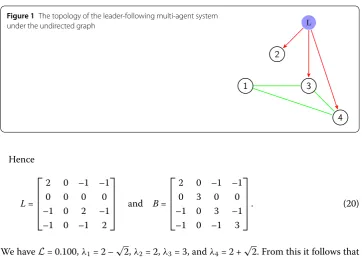
Figure 1The topology of the leader-following multi-agent system under the undirected graph
Hence
L=
⎡ ⎢ ⎢ ⎢ ⎣
2 0 –1 –1
0 0 0 0
–1 0 2 –1
–1 0 –1 2
⎤ ⎥ ⎥ ⎥
⎦ and B= ⎡ ⎢ ⎢ ⎢ ⎣
2 0 –1 –1
0 3 0 0
–1 0 3 –1
–1 0 –1 3
⎤ ⎥ ⎥ ⎥
⎦. (20)
We haveL= 0.100,λ1= 2 –√2,λ2= 2,λ3= 3, andλ4= 2 +√2. From this it follows that
λmin=min{λ1,λ2,λ3,λ4} ≈0.585 and
max1 – 0.462·0.250·0.585,e–0.585≤max{0.933, 0.557}= 0.933 =:M.
From the above we get
s∈Ts
M+μ∗L≈ s∈Ts
0.983 = 0
and
lim i→∞e
sum(i)≈ lim i→∞e
i
j=3(0.108j–3–0.070·0.250(i–2–2i–3+i–6))<∞.
All assumptions of Corollary1are satisfied, and thus equation (5) is exponentially stable. System (2)–(3) achieves consensus exponentially.
In Example4we have
lim i→∞e
LM–1i
j=1(T2j–T2j–1)≈ lim
i→∞e
0.108ij=3j–3<∞,
but this condition is not required for the exponential stability of (5) (see Example5).
Remark2 If conditions (7)–(9), (12), and (18) are satisfied and if
γ(t)≡γ ∈R (21)
and
LM–1+γlnM< 0, (22)
Proof If condition (21) holds, then
sum(i) =
i
j=1
LM–1(T
2j–T2j–1) +γ(T2j–T2j–1)lnM
=LM–1+γlnM i
j=1
(T2j–T2j–1).
By (22) we see thatsum(i) < 0 for anyi∈Nandesum(i) is a positive decreasing function
of the variable i∈N. Heres∈Ts(M+μ∗L) and esum(i) for any i∈Nare bounded. If
the cardinality of set Ts is infinity, thenlims→∞
s∈Ts(M+μ∗L) = 0. If the cardinality
of set Td is infinity, then lim
i→∞esum(i)= 0. Thus, by Theorem1, we obtain the
state-ment.
Example5 Let
T= ∞
i=3
i 2,
i 2+
1 i
.
HereTd=∞ i=3[2i,
i 2+
1
i) andTs={ i 2+
1
i :i∈N,i≥3},
T0=T1= 1.500, T2≈1.833, T3= 2.000, . . . ,
μ(t) = 1 2–
t 2+
1 2
√
t2– 2 fort∈Ts, μ∗= 0.500.
Moreover, let
f(t,x) = 0.250sinx
t2 , γ(t)≡2.000,
and let the matrixBbe given by (20) in equation (5). ThenL= 0.250,λmin≈0.585, and
max1 – 0.333·2.000·0.585,e–0.585≤max{0.390, 0.557}= 0.557 =:M.
Finally,
LM–1+γlnM≈0.449 – 1.170 = –0.721 < 0.
All assumptions of Remark2hold, and thus equation (5) is exponentially stable.
In Example5we have
lim i→∞e
LM–1i
j=1(T2j–T2j–1)≈ lim
i→∞e
0.449ij=11i
=∞,
Corollary 2 If conditions(7)–(9)and(18)are satisfied and if ∞
i=0
(T2i+2–T2i+1) <∞, (23)
then equation(5)is exponentially stable.
Proof Since (23) holds,
esum(i)= constant.
Hence, recalling that the cardinality of the setTsis infinity, by (18) we obtain
lim i→∞e
sum(i) s∈[T0,T2i)∩Ts
M+μ∗L
=lim i→∞c
∗
s∈[T0,T2i)∩Ts
M+μ∗L
=c∗
s∈Ts
M+μ∗L= 0,
wherec∗=esum(i).
For two possible cases of carrying out of assumption (23), see Examples4and7. Theorem1generalizes Theorem 2 [14]. In the following example we present an equa-tion on time scale for which Theorem 2 [14] cannot be applied, but our Corollary2of Theorem1can be.
Example6 Let
T={i:i∈N} ∪
i+ 1
j+ 1:i,j∈N,j≥2 .
HereTd={i:i∈N}andTs={i+ 1
j+1:i,j∈N,j≥2},
T0= 1, T1=∞, μ(t) =
(t–i)2
1 +t–i fort∈T
s, μ∗= 0.500.
Setf(t,x) = 0.250x,
γ(t) =
⎧ ⎨ ⎩ 1
μ(t) fort∈Ts,
0 fort∈Td,
andBis given by (20) in equation (5). We haveL= 0.250,λmin= 0.585, and
Hence
s∈Ts
M+μ∗L≈ s∈Ts
0.682 = 0.
All assumptions of Corollary2are satisfied, and thus equation (5) is exponentially stable.
Sincelim inft→∞μ(t) = 0, the results obtained in [14] cannot be applied.
The following examples show two different situations concerning time scale in which condition (23) is satisfied. In the first example,Tdis a bounded set. In the second one,Td
is unbounded.
Example7 Let
T= [1, 2]∪[3, 7]∪ {n:n∈N,n≥8}.
HereTd= [1, 2]∪[3, 7] is bounded, andTs={n:n∈N,n≥8}. We see that
T0= 1, T1=T0= 1, T2= 2, T3= 3,
T4= 7, T5= 8, T6=∞,
μ(t) = 1 fort∈Ts, μ∗= 1.
Let also
f(t,x) = 1
4√tsinx, γ(t) =cost+ 2,
and let the matrixBbe given by (20) in equation (5). ThenL= 0.250,λmin= 0.585 and
M:=max1 – 1·1·0.585,e–0.585≈0.557 < 1.
As a consequence,
s∈Ts
M+μ∗L≈ s∈Ts
0.807 = 0.
All assumptions of Corollary2are satisfied, and thus equation (5) is exponentially stable. This means that the multi-agent system (2)–(3) achieves the leader-following consensus exponentially.
Example8 Let
T= ∞
i=3
i 2+
1 i+ 1,
i 2+
1 i
.
Here eitherTd=∞ i=3[
i 2+
1 i+1,
i 2+
1 i) orT
s={i 2+
1
i :i∈N,i≥3}is an unbounded set. We
see that
μ(t) = 1 2–
2
(t+√t2– 2)(2 +t+√t2– 2) fort∈T
s, μ∗= 0.500.
Moreover,
f(t,x) = x
4t, γ(t) = 1 4t
2,
and the matrixBis given by (20) in equation (5). ThenL= 0.250,λmin= 0.585, and
max1 – 0.366·0.765·0.585,e–0.585< 0.836 =:M.
Hence
s∈Ts
M+μ∗L≈ s∈Ts
0.961 = 0.
All assumptions of Corollary2are satisfied, and thus equation (5) is exponentially stable. System (2)–(3) achieves consensus exponentially.
Notice that in Example8we have
lim i→∞e
LM–1i
j=1(T2j–T2j–1) = lim
i→∞e
0.299ij=1i(i1+1)
=e0.299<∞.
Remark3 If conditions (7)–(9) are satisfied,
∞
j=1 T2j
T2j–1
γ(s)ds<∞,
and
lim i→∞e
LM–1i
j=1(T2j–T2j–1)·
s∈[T0,T2i)∩Ts
M+μ∗L= 0,
then equation (5) is exponentially stable.
(See Example4.)
Remark4 Let conditions (7)–(9) be satisfied. If the cardinality of the setTsis finite and sum(i) < 0 for anyi∈N, then equation (5) is exponentially stable.
Example9 Let
T={1} ∪ {11} ∪[12,∞).
HereTd= [12,∞) is an unbounded set, whereasTs={1} ∪ {11}is bounded, and
Let
f(t,x) = 0.1x, γ(t) = 1,
and let the matrixBbe given by (20) in equation (5). ThenL= 0.100,λmin≈0.585, and
max1 – 0.585,e–0.585< 0.557 =:M.
Hence
sum(i)≈0.180(T2–T1) – 0.585 T2
T1
ds= –0.405(T2–T1) = –∞< 0.
All assumptions of Remark4are satisfied, and thus equation (5) is exponentially stable.
Notice that in Example9condition (18) does not hold.
Acknowledgements
Not applicable.
Funding
Ewa Schmeidel was supported by the Polish National Science Center grant on the basis of decision
DEC-2014/15/B/ST7/05270. Urszula Ostaszewska and Małgorzata Zdanowicz have been supported by the Polish Ministry of Science and Higher Education under a subsidy for maintaining the research potential of the Faculty of Mathematics and Informatics, University of Bialystok.
Availability of data and materials
Not applicable.
Competing interests
The authors declare that they have no competing interests.
Authors’ contributions
The main idea of this paper comes from Ewa Schmeidel. Proofs of theorems and examples are the joint work of all coauthors. All authors read and approved the final manuscript.
Publisher’s Note
Springer Nature remains neutral with regard to jurisdictional claims in published maps and institutional affiliations.
Received: 20 April 2019 Accepted: 28 May 2019 References
1. DeGroot, M.H.: Reaching a consensus. J. Am. Stat. Assoc.69, 118–121 (1974).https://doi.org/10.1080/01621459
2. Krause, U.: A discrete nonlinear and non-autonomous model of consensus formation. In: Communications in Difference Equations. ICDEA, vol. 1998. Gordon & Breach, Pozna ´n (2000).https://doi.org/10.1109/IYCE.2015.7180798
3. Hegselmann, R., Krause, U.: Opinion dynamics and bounded confidence: models, analysis, and simulation. J. Artif. Soc. Soc. Simul.5, 1–33 (2002)
4. Jadbabaie, A., Lin, J., Morse, A.S.: Coordination of groups of mobile autonomous agents using nearest neighbor rules. IEEE Trans. Autom. Control48(6), 988–1001 (2003).https://doi.org/10.1109/TAC.2003.812781
5. Blondel, V.D., Hendrickx, J.M., Tsitsikli, J.N.: On Krause’s multi-agent consensus model with state-dependent connectivity. IEEE Trans. Autom. Control54(11), 2586–2597 (2009).https://doi.org/10.1109/TAC.2009.2031211
6. Blondel, V.D., Hendrickx, J.M., Tsitsikli, J.N.: Continuous-time average-preserving opinion dynamics with opinion-dependent communications. SIAM J. Control Optim.18(8), 5214–5240 (2010).
https://doi.org/10.1137/090766188
7. Girejko, E., Machado, L., Malinowska, A.B., Martins, N.: Krause’s model of opinion dynamics on isolated time scales. Math. Methods Appl. Sci.39(18), 5302–5314 (2016).https://doi.org/10.1002/mma.3916
8. Girejko, E., Malinowska, A.B., Schmeidel, E., Zdanowicz, M.: The emergence on isolated time scales. In: 21st International Conference on Methods and Models in Automation and Robotics (MMAR), IEEExplore (2016).
https://doi.org/10.1109/MMAR.2016.7575317
9. Cucker, F., Smale, S.: On the mathematics of emergence. Jpn. J. Math.2(1), 197–227 (2007).
10. Cucker, F., Smale, S.: Emergent behavior in flocks. IEEE Trans. Autom. Control52(7), 852–862 (2007).
https://doi.org/10.1109/TAC.2007.895842
11. Girejko, E., Machado, L., Malinowska, A.B., Martins, N.: On consensus in the Cucker–Smale type model on isolated time scale. Discrete Contin. Dyn. Syst., Ser. B11(1), 77–89 (2018).https://doi.org/10.3934/dcdss.2018005
12. Wang, Y., Cheng, L., Wang, H., Hou, Z.G., Tan, M., Yu, H.: Leader-following consensus of discrete-time linear multi-agent systems with communication noises. In: 34th Control Conference (CCC), Hangzhou, China. Lecture Notes in Electrical Engineering, vol. 407. IEEE, New York (2015).https://doi.org/10.1109/ChiCC.2015.7260748
13. Ostaszewska, U., Schmeidel, E., Zdanowicz, M.: Leader-following consensus on discrete time scales. In: ICNAAM 2017, Thessaloniki, Greece. AIP Conference Proceedings. American Institute of Physics, New York (2018).
https://doi.org/10.1063/1.5044162
14. Ostaszewska, U., Schmeidel, E., Zdanowicz, M.: Emergence of consensus of multi-agents systems on time scales. Miskolc Math. Notes (to appear)
15. Aulbach, B., Hilger, S.: A unified approach to continuous and discrete dynamics. In: Qualitative Theory of Differential Equations (Szeged, 1988). Colloq. Math. Soc. Jámos Bolyai, vol. 53. North-Holland, Amsterdam (1990)
16. Bohner, M., Peterson, A.: Dynamic Equations on Time Scales. Birkhäuser, Boston (2001).
https://doi.org/10.1109/IYCE.2015.7180798
17. Bohner, M., Peterson, A.: Advances in Dynamic Equations on Time Scales. Birkhäuser, Boston (2003)
18. Yu, Z., Jiang, H., Hu, C.: Leader-following consensus of fractional-order multi-agent systems under fixed topology. Neurocomputing149, 613–620 (2015).https://doi.org/10.1016/j.neucom.2014.08.013
19. Schmeidel, E.: The existence of consensus of a leader-following problem with Caputo fractional derivative. Opusc. Math.39(1), 77–89 (2019).https://doi.org/10.7494/OpMath.2019.39.1.77
20. Berezansky, L., Migda, M., Schmeidel, E.: Some stability conditions for scalar Volterra difference equations. Opusc. Math.36(4), 459–470 (2016).https://doi.org/10.7494/OpMath.2016.36.4.459
21. Elaydi, S.N.: An Introduction to Difference Equations. Springer, New York (2005)
22. Peterson, A., Raffoul, Y.N.: Exponential stability of dynamic equations on time scales. Adv. Differ. Equ.2005, 858671 (2005).https://doi.org/10.1155/ADE.2005.133
23. Bodine, S., Lutz, D.A.: Exponential functions on time scales: their asymptotic behavior and calculation. Dyn. Syst. Appl.