University of Huddersfield Repository
Vallati, Mauro
Configuration and Learning Techniques for Efficient Automated Planning System
Original Citation
Vallati, Mauro (2011) Configuration and Learning Techniques for Efficient Automated Planning
System. In: Doctoral Consortium of 21st International Conference on Automated Planning &
Scheduling, 11th 16th June 2011, Freiburg, Germany. (Unpublished)
This version is available at http://eprints.hud.ac.uk/id/eprint/15375/
The University Repository is a digital collection of the research output of the
University, available on Open Access. Copyright and Moral Rights for the items
on this site are retained by the individual author and/or other copyright owners.
Users may access full items free of charge; copies of full text items generally
can be reproduced, displayed or performed and given to third parties in any
format or medium for personal research or study, educational or notforprofit
purposes without prior permission or charge, provided:
•
The authors, title and full bibliographic details is credited in any copy;
•
A hyperlink and/or URL is included for the original metadata page; and
•
The content is not changed in any way.
For more information, including our policy and submission procedure, please
contact the Repository Team at: [email protected].
Configuration and Learning Techniques for Efficient Automated Planning Systems
– Abstract–
Mauro Vallati
Universit`a degli Studi di Brescia, Dipartimento dell’Ingegneria dell’Informazione, Via Branze 38, 25123 Brescia, Italy [email protected]
Introduction
In this abstract we briefly present our thesis work, which is focused on three main directions: (i) speeding-up optimal SAT-based planners by exploiting learned domain knowl-edge, (ii) configuring a portfolio of planners for an input do-main, and (iii) the automated configuration of planning algo-rithms. The main results of such a work are three planning systems: MacroSatPlan (Gerevini, Saetti & Vallati 2010),
PbP(Gerevini, Saetti & Vallati 2009) andParLPG(Vallati, Fawcett, Gerevini, Hoos & Saetti 2011).
The paper is organized as follows. The second sec-tion briefly describesMacroSatPlan and the third section briefly describesPbP. Finally, in fourth section, we present
ParLPG: the system that we are currently focusing on.
MacroSatPlan
Planning as propositional satisfiability (SAT) is a powerful approach for computing optimal plans in terms of Graph-plan Graph-plan length. SatPlan(Kautz and Selman 1992) is one of the most popular and efficient planning system adopting this approach. First, it computes a lower bound k of the optimal plan length. Then, usingkas the planninghorizon, i.e., a fixed time step after which actions cannot be executed, it translates the planning problem into a SAT problem Π, which is then solved by an existing SAT solver. IfΠis satis-fiable, then the assignment to propositional fluents satisfying the SAT problem is translated into a plan of actions that is a solution of the original planning problem. Otherwise (Π
is unsatisfiable), the process is repeated using an increased value ofk.
A critical weakness of the approach is that often the initial value of kis much less than the optimal plan length, and hence many unsolvable SAT problems can be generated and processed.
Moreover, in many domains the planning performance can be improved by deriving and exploiting knowledge. Well known examples of such knowledge are macro actions. A macro-action is a sequence of domain actions that can be planned at one time like a single action. Using macro-actions the planning process is often faster, but the length of the computed solution plan can be worse than optimal.
MacroSatPlanis a SAT-based optimal planner which ex-ploits two types of knowledge learned for a given domain to
speedup the SAT solving: (i) a predictive model based on some problem features estimating the optimal plan length, and (ii) useful sets of learned macro-actions.
The predictive model is learned usingWEKA(Witten and Frank 2005), a well-known machine learning tool. Given a set of training problems for domain D, WEKA is used to identify a predictive model of the optimal plan length for a given problem in domainDfrom (i) the length of the opti-mal plan computed bySatPlan, (ii) some pre-identified fea-tures of the planning problem, and (iii) the length of the re-laxed plan computed byFF(Hoffmann and Nebel 2001).
Macro-FF (Botea et al. 2005) is the system selected for computing macro-actions. The computed macros are subsequently used by a modified version of the SAT-solver
MiniSAT(E`en and S¨orensson 2003), during planning phase. A preliminary experimental analysis shows that the learned knowledge is useful for speeding up the computa-tion of the optimal solucomputa-tion of the planning problem.
For further details, please see (Gerevini, Saetti & Vallati 2010).
Portfolio-Based Planner
PbP(Portfolio-based Planner) is a planner which automati-cally configures a portfolio of domain-independent planners. The configuration relies on some knowledge about the per-formance of the planners in the portfolio and the observed usefulness of automatically generated sets of macro-actions. This configuration knowledge is “learned” by a statistical analysis and consists of: an ordered selected subset of the planners in the initial portfolio, which are combined through a round-robin strategy; a set of useful macro-actions for each selected planner; and some sets of planning time slots. A planning time slot is an amount of CPU-time to be allocated to a selected planner (possibly with a set of macro-actions) during planning.
PbP has two variants: PbP.s focusing on speed, and
PbP.qfocusing on plan quality.PbP.sentered the learning track of the sixth international planning competition (IPC6), and was the overall winner of this competition track.
An experimental analysis about an improved implemen-tation of the competition version ofPbP.sand aboutPbP.q
confirms the effectiveness ofPbP.s, indicate thatPbP.q per-forms better than the IPC6 planners, and show that, contrary to the preliminary version ofPbP.s, the learned configura-tion knowledge is useful.
For a more detailed description about PbP, the interested reader can see (Gerevini, Saetti & Vallati 2009).
ParLPG
When designing state-of-the-art, domain-independent plan-ning systems, many decisions have to be made with respect to the domain analysis or compilation performed during pre-processing, the heuristic functions used during search, and other features of the search algorithm (e.g., the search neigh-borhood definition). These design decisions can have a large impact on the performance of the resulting planner.
By providing many alternatives for these choices and exposing them as parameters, highly flexible domain-independent planning systems are obtained, which then, in principle, can be configured to work well on different do-mains, by using parameter settings specifically chosen for solving planning problems from each given domain. How-ever, usually such planners are used with default configura-tions that have been chosen because of their good average performance, based on limited exploration within a poten-tially vast space of possible configurations. The hope is that these default configurations will also perform well on do-mains and problems beyond those for which they were tested at design time.
ParLPGuses a different approach, based on the idea of
automatically configuring a generic, parametrized planner using a set of training problems for domainD in order to obtain planners that perform especially well in this domain. Automated configuration of heuristic algorithms has been an area of intense research focus in recent years, produc-ing tools that have improved algorithm performance sub-stantially in many problem domains. These techniques have not yet been applied to the problem of planning. While the proposed framework could utilize any of these automatic configuration procedures, theFocusedILSvariant of the off-the-shelf, state-of-the-art automatic algorithm configuration procedureParamILS(Hutter et al. 2009) has been chosen for this work.
At the core of theParamILSframework lies Iterated Lo-cal Search (ILS), a well-known and versatile stochastic lo-cal search method that iteratively performs phases of a sim-ple local search, such as iterative improvement, interspersed with so-called perturbation phases that are used to escape from local optima. The FocusedILS variant of ParamILS
uses this ILS procedure to search for high-performance con-figurations of a given algorithm by evaluating promising configurations, using an increasing number of runs in order to avoid wasting CPU-time on poorly-performing configu-rations. ParamILSis able to adaptively limit the amount of
1. SetAto the action graph containing onlyastartandaend; 2. Whilethe current action graphAcontains a flaw or
a certainnumber of search stepsis not exceededdo
3. Select a flawσinA;
4. Determine the searchneighborhoodN(A, σ);
5. Weight the elements ofN(A, σ)using aheuristic function
E;
6. Choose a graphA0∈N(A, σ)according toEandnoisen; 7. SetAtoA0
; 8. ReturnA.
Figure 1:High-level description ofLPG’s search procedure.
runtime allocated to each algorithm run using knowledge of the best-performing configuration found so far, which helps to further limit the CPU-time wasted on low-performance configurations.
Recently,ParamILSwas used to configure several solvers for mixed integer programming (MIP) problems (Hutter, Hoos, & Leyton-Brown 2010) and for propositional satis-fiability (SAT) problems (Hutteret al.2007).
These previous applications of ParamILS, while yield-ing impressive results, were limited to optimizyield-ing the per-formance of algorithms designed to solve a single problem (SAT and MIP, respectively). The application of algorithm configuration techniques to planning differs in this respect, as each planning domain can be thought of as an indepen-dent problem. Given that end-users of planning tools tend to focus their attention on a single domain or group of related domains; being able to automatically configure a domain-independent planner to optimize performance on a given do-main of interest should have great utility to the planning community.
In ParLPG, ParamILS is used to configure the well-known, domain-independent, satisficing planner LPG
(Gerevini, Saetti, and Serina 2005).
LPGis a versatile system that can be used for plan gen-eration, plan repair and incremental planning. The planner is based on a stochastic local search procedure that explores a space of partial plans represented through linear action graphs, which are variants of the very well-known planning graph (Blum & Furst 1997).
Starting from the initial action graph containing only two special actions representing the problem initial state and goals, respectively,LPGiteratively modifies the current graph until there is noflawin it or a certain bound on the number of search steps is exceeded. Intuitively, a flaw is an action in the graph with a precondition that is not supported by an effect of another action in the graph.LPGattempts to resolve flaws by inserting into or removing from the graph a new or existing action, respectively.
Figure 1 gives a high-level description of the general search process performed byLPG. Each search stepselects a flawσin the current action graphA, defines the elements (modified action graphs) of the search neighborhoodofA
for repairingσ, weights the neighborhood elements using a
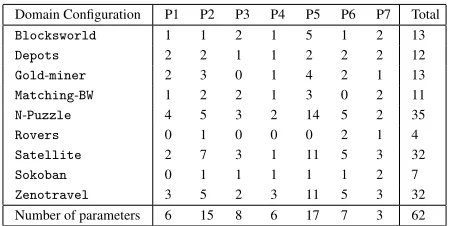
Domain Configuration P1 P2 P3 P4 P5 P6 P7 Total Blocksworld 1 1 2 1 5 1 2 13 Depots 2 2 1 1 2 2 2 12 Gold-miner 2 3 0 1 4 2 1 13 Matching-BW 1 2 2 1 3 0 2 11 N-Puzzle 4 5 3 2 14 5 2 35 Rovers 0 1 0 0 0 2 1 4 Satellite 2 7 3 1 11 5 3 32 Sokoban 0 1 1 1 1 1 2 7 Zenotravel 3 5 2 3 11 5 3 32
[image:4.612.61.289.52.165.2]Number of parameters 6 15 8 6 17 7 3 62
Table 1: Number of parameters of LPGthat are changed by
ParamILSin the configurations computed for nine domains inde-pendently considered. Each P1–P7 column corresponds to a differ-ent parameter category (or planner compondiffer-ent). The last line of the table indicates the number of parameters in each category.
possible local minima,LPGis a randomized procedure. Many components ofLPGcan be configured very flexibly via 62 exposed configurable parameters, which jointly give rise to over6.5×1017possible configurations. These
pa-rameters can be grouped into seven distinct categories, each of which corresponds to a different component ofLPG: P1 Preprocessing information(e.g., mutually exclusive
re-lations between actions).
P2 Search strategy(e.g., the use and length of a “tabu list” for the local search, the number of search steps before restarting a new search, and the activation of an alternative systematic best-first search procedure).
P3 Flaw selection strategy(i.e., different heuristics for de-ciding which flaw should be repaired first).
P4 Search neighborhood definition (i.e., different ways of defining/restricting the basic search neighborhood). P5 Heuristic function E(i.e., a class of possible heuristics
for weighting the neighborhood elements, with some vari-ants for each of them).
P6 Reachability informationused in the heuristic functions and in neighborhood definitions (e.g., the minimum num-ber of actions required to achieve an unsupported precon-dition from a given state).
P7 Search randomization(i.e., different ways of statically and dynamically setting the noise value).
Table 1 shows, for each parameter category of LPG, the number of parameters that are changed from their de-faults byParamILSin the derived domain-specific configu-rations. Domain-specific configurations ofLPGdiffer sub-stantially from the default configuration. Moreover, usually the changed configurations are considerably different from each other.
ParLPG was tested on problem instances from eight known benchmark domains used in the last four inter-national planning competitions (IPC-3–6), Depots, Gold-miner, Matching-BW, N-Puzzle, Rovers, Satellite, Sokoban, and Zenotravel, plus the well known domain Blocksworld.
For each domain, we used the respective random instance generator to derive three disjoint sets of instances: a train-ing set with 2000 relatively small instances (benchmarkT), a
testing set with 400 middle-size instances (benchmarkMS), and a testing set with 50 large instances (benchmark LS). The size of the instances in training setTwas decided such that the instances may be solved by the default configuration ofLPGin 20 to 40 CPU secondson average. For testing sets
MSandLS, the size of the instances was defined such the in-stances may on average be solved by the default configura-tion ofLPGin 50 seconds to 2 minutes and in 3 minutes to 7 minutes, respectively. This does not mean that all prob-lem instances can be solved byLPG; since thesize of the instances was decided according to the performance of the default configuration, and then random generators were used for deriving the actual instances.
For all configuration experiments we used theFocusedILS
variant of ParamILS version 2.3.5 with default parameter settings. Using the default configuration ofLPGas the start-ing point for the automated configuration process, 10 inde-pendent runs of FocusedILS were performed concurrently per domain, using random orderings of the training set in-stances.1 Each run ofFocusedILShad a total CPU-time cut-off of 48 hours, and a cutcut-off time of 60 CPU seconds was used for each run ofLPGperformed during the configuration process. The objective function used byParamILSfor eval-uating the quality of configurations was mean runtime, with timeouts and crashes assigned a penalized runtime of ten times the per-run cutoff. Out of the 10 configurations pro-duced by these runs, we selected the configuration with the best training set performance (as measured byFocusedILS) as the final configuration ofLPGfor the respective domain.
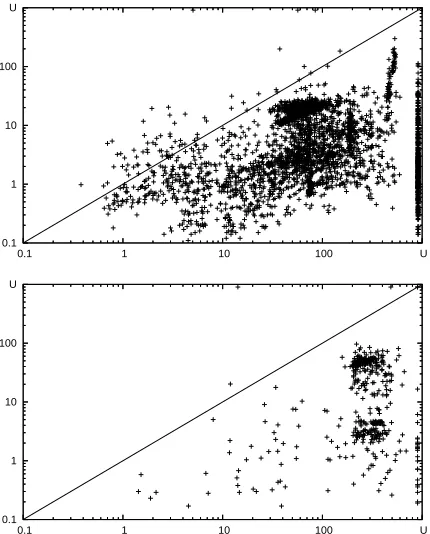
Figure 2 provides results in the form of a scatter-plot, showing the performance of automatically determined, domain-specific configurations (LPG.sd) and default config-uration (LPG.d) of LPG on the individual benchmark in-stances. We consider all instances solved by at least one of these planners. Each cross symbol indicates the CPU time used by LPG.d andLPG.sd to solve a particular problem instance of benchmarksMSandLS. When a cross appears under (above) the main diagonal,LPG.sdis faster (slower) thanLPG.d; the distance of the cross from the main diago-nal indicates the performance gap (the greater the distance, the greater the gap). The results in Figure 2 indicate that
LPG.sdperforms almost always better thanLPG.d, often by 1–2 orders of magnitude.
Future Work
There are several avenues for future work in this thesis. ConcerningParLPG, we intend to experimentally analyze the usefulness of the proposed framework for identifying configurations improving the planner performance in terms of plan quality. Moreover, we plan to apply the framework to metric-temporal planning domains, whichLPGsupports. Finally, it is important to investigate the use of other exist-ing or forthcomexist-ing highly parameterized planners. In par-ticular, preliminary results from ongoing work indicate that substantial performance gains can be obtained when
apply-1
0.1 1 10 100 U
0.1 1 10 100 U
0.1 1 10 100 U
[image:5.612.63.278.54.321.2]0.1 1 10 100 U
Figure 2:CPU time (log. scale) ofLPG.sdwith respect toLPG.d
for problems of benchmarksMS(upper plot) andLS(bottom plot). The x-axis refers to CPU seconds ofLPG.d; the y-axis to CPU seconds of the specificLPG.sdsolvers;Ucorresponds to runs that timed out with the given runtime cutoff.
ingParLPGapproach to a very recent, highly parameterized version of the IPC-4 winner Fast Downward (Helmert 2006). ConcerningMacroSatPlan, future work includes further experiments, the evaluation of different ways for exploit-ing the extracted knowledge, and the integration of Wizard (Newton et al. 2007) as an alternative system for learning macros.
ParLPG and a new version of PbP entered the learn-ing track of the seventh international plannlearn-ing competition (IPC7). The results will be announced in June 2011.
Acknowledgements
All the works described in this abstract are joint works with Alfonso E. Gerevini and Alessandro Saetti. ParLPGis the result of a joint work also involving Chris Fawcett and Hol-ger H. Hoos.
References
A. Botea, M. Enzenberger, M. M¨uller and J. Schaeffer. 2005. Macro-FF: Improving AI Planning with Automat-ically Learned Macro-Operators. JAIR, 24:581–621. E`en, N.; S¨orensson, N. 2003. An Extensible SAT-solver In
Proc. of SAT-03.
Richter, S. Helmert, M., and Westphal, M. 2007. Land-marks revisited. InProc. of 23rd Conf. on Artificial Intelli-gence (AAAI-07).
Hoffmann, J., and Nebel, B. 2001. The FF planning sys-tem: fast plan generation through heuristic search. JAIR, 14:253–302.
Kautz, H.; Selman, B. 1992. Planning as satisfiability. In
Proc. of ECAI-92.
Helmert, M. 2006 The Fast Downward Planning System
JAIR, 26:191–246.
Hutter, F.; Hoos, H.; Leyton-Brown, K.; and Stutzle, T. 2009 ParamILS: An Automatic Algorithm Configuration FrameworkJAIR, 36:267–306.
Blum, A., and Furst, M., L. 1997. Fast planning through planning graph analysis.Artificial Intelligence90:pp. 281– 300.
Gerevini, A.; Saetti, A.; and Serina, I. 2005. Integrating Planning and Temporal Reasoning for Domains with Du-rations and Time Windows. InProceedings of IJCAI-05. Newton, M. A. H.; Levine, J.; Fox, M.; and Long, D. 2007. Learning macro-actions for arbitrary planners and domains. InProc. of ICAPS-07.
Vallati, M.; Fawcett, C.; Gerevini, A.; Hoos, H.; and Saetti, A.. 2011. 7th IPC – Learning Track – Technical Report http://www.plg.inf.uc3m.es/ipc2011-learning/
Gerevini, A. E.; Saetti, A.; and Vallati, M. 2009. An Automatically Configurable Portfolio-based Planner with Macro-actions: PbP. InProc. of ICAPS09.
Gerevini, A. E.; Saetti, A.; and Vallati, M. 2010. Opti-mal SAT-based Planning with Macro-actions and Learned Horizons. InProc. of PlanSIG10.
Hutter, F.; Babi´c, D.; Hoos, H. H.; and Hu, A. J. 2007. Boosting verification by automatic tuning of decision pro-cedures. InFormal Methods in Computer-Aided Design, 27–34. IEEE CS Press.
Hutter, F.; Hoos, H. H.; and Leyton-Brown, K. 2010. Automated configuration of mixed integer programming solvers. InProc. of CPAIOR-10.
Richter, S. Helmert, M., and Westphal, M. 2007. Land-marks revisited. InProc. of 23rd Conf. on Artificial Intelli-gence (AAAI-07).