Volume 2011, Article ID 541283,9pages doi:10.1155/2011/541283
Research Article
A Salient Missing Link in RFID Security Protocols
Imran Erguler,
1, 2Emin Anarim,
2and Gokay Saldamli
31National Research Institute of Electronics and Cryptology, TUBITAK, 41470 Kocaeli, Turkey 2EE Department, Bogazici University, 34342 Istanbul, Turkey
3MIS Department, Bogazici University, 34342 Istanbul, Turkey
Correspondence should be addressed to Imran Erguler,[email protected]
Received 20 January 2011; Accepted 14 February 2011
Academic Editor: Damien Sauveron
Copyright © 2011 Imran Erguler et al. This is an open access article distributed under the Creative Commons Attribution License, which permits unrestricted use, distribution, and reproduction in any medium, provided the original work is properly cited.
In side channel analysis, an attacker utilizes some legitimate function queries in order to collect the corresponding responses of a cryptographic system while it is functioning in a normal mode. If those responses reveal some unwanted information about the secrecy or privacy, this leakage is called side channel information and these responses are called side channels. In this respect, careless deployments of “secure” RFID authentication protocols are not exceptions and subject to side channel attacks. Focusing on lightweight RFID security protocols; we examine the server responses for several RFID tags and realize that if the database querying is performed through a static process, the RFID system is subject to timing attacks that could easily jeopardize the system’s untraceability criteria. We demonstrate our attack on some well-known protocols and outline a countermeasure by precisely describing the database query mechanism. Furthermore, we analyze the success probability of the attack in terms of the system parameters such as the number of tags, number of cryptographic operations that have to be carried out, and server’s computational power.
1. Introduction
As a result of their low production costs and tiny size, RFID tags are considered as the replacement technology for bar codes and other means of traditional identification tools which traditionally find many applications in manufactur-ing, supply chain management, and inventory control. A typical RFID system consists of mainly three components: tags, one or more readers, and a back-end server. On top of this hardware, a set of networking rules including the authentication (or identification) protocols reside.
RFID technology raises significant privacy issues regard-ing the traceability concerns. While a person could be traced by tracking his/her mobile phone through a carrier, such a method is no more useful once the phone is turned off. However, this is not the case for someone carrying an RFID gadget. First of all, most users are not aware that they are car-rying RFID tags. In fact, even if they know it, tags could not be turned offin general and worse, it automatically responds to queries via radio signals. Therefore, in RFID systems, the attack scenarios and accompanying countermeasures are quite different than the typical wired or wireless systems.
Although public key cryptography has the necessary primitives to solve this sort of problems in various networks, it is not trivial to implement these primitives in networks having constraint devices such as RFID tags without breaking the cost boundaries. In fact, it is a challenging task to design authentication protocols for low-cost RFID tags resisting all of the known attacks and threats and at the same time fulfill the so-called RFID tag specifications. Therefore, solving this delicate task has recently aroused the interest of the security community, and many authentication protocols have been proposed for RFID security. Unfortunately, most of these, like [1–11], failed to address the requirements to a satisfactory extent partially because of not having a common adversary and system definitions.
this leakage is called side channel information and these responses are called side channels. In this respect, careless deployments of “secure” RFID authentication protocols are not exceptions and subject to side channel attacks.
Focusing on lightweight RFID security protocols, we examine the server responses for several RFID tags and realize that if the database querying is performed through a static process, the RFID system is subject to a timing attack that could easily jeopardize the system’s untraceability criteria. Supporting analysis and experiments of this obser-vation are presented with the following outline. InSection 2, after giving a brief update on related work, we describe the basic authentication protocol (BAP) as a building block used in describing our attack model. BAP will further be a basis for various RFID authentication protocols that are vulnerable to the attack. InSection 3, we present our attack model and give probability of its success in terms of the system parameters. Section 4 investigates security of some RFID protocols against the proposed attack. InSection 5, we propose solutions to fix the security flaw. Finally, we conclude inSection 6.
2. Background
2.1. Related Work. The potential security risks in RFID systems hinging the differences in computation time are mentioned in a few published work. Juels and Weis [12] introduced the idea that witnessing a reader’s success in identifying a tag could be used in distinguishing two different tags, that is, breaking the privacy of the protocol. For instance, opening a door with a proximity card or acceptance of a payment card can give this information. This ability of the adversary is also touched by Vaudenay [13] and it is formalized in Vaudenay’s privacy model. Moreover, Juels-Weis point that computation time of the reader can shed critical light on protocol design and showed that O-TRAP protocol [14] cannot provide strong privacy under this side channel information.
In [14], Burmester et al. briefly considered timing phenomenon by claiming: “In particular the time taken for each pass must be constant. This can be done by inserting an artificial delay on the trusted server”. Alternatively, Tsudik [10] has investigated the RFID security protocols against timing attacks targeting computations carried in the tag. It is stated that the time variance in tag computations corresponds to different states of the tags that might make them distinguishable. More recently, Erguler et al. [15] and Erguler and Anarim [16] have exploited the time differences in reader/server responses for different tag states in order to distinguish the tags. They have shown that two protocols described in [17,18] are vulnerable to such attacks.
At the time this paper was under review, Avoine et al. [19] had extended the Vaudenay’s privacy model by formalizing the computational time of the reader. The authors define a new privacy level—TIMEFUL—which is determined by leaked information from the computational time of the reader and add this notion to the privacy levels of model in [13]. Moreover, they present theoretical solutions to the time problem by assigning boolean decisions about
TIMEFUL-PRIVACY of a protocol. However, the parameters that may affect the success of the adversary, such as precision of reader time measurement, have been addressed as an engineering problem.
In this paper, we present the actual implementation results and probabilistic analysis for successful timing attack. To be more precise, we give the success probability of the attack in terms of the system parameters such as the number of tags, number of cryptographic operations that have to be carried out, and server’s computational power.
2.2. Notation and the BAP. In general, an RFID mutual authentication protocol requires at least three rounds: the reader initiates the communication (Round 1), the tag produces a challenge and sends it to the reader (Round 2), and the reader replies to the challenge (Round 3). In most lightweight RFID authentication protocols, including [1–3,
5,20–29] (Weis et al.’s the randomized access control scheme [20] performs an exhaustive search in identification of the tag), the server could need to query its entire database in order to authenticate responder tag in Round 2. In fact, this should not be confused with the simple database search since this querying corresponds to a cryptographic exhaustive search where every single query needs a cryptographic operation having a nontrivial time complexity. Therefore, the time complexity of the authentication phase becomes linear in time (i.e.,O(N) whereN denotes the number of tags in the system). We define these systems as follows.
Definition 1. An RFID system is called linear-time authen-tication system denoted with LAS if its server performs an exhaustive search to identify or authenticate a tag.
In order to measure the running time differences for different tag searches, it is sufficient to have an exhaustive search process which is identical for each search instance. In fact, for some cases it is possible to achieve some side channels even if the processes are not identical. However, we keep these cases out of our scope and formally define the exhaustive search process as follows.
Definition 2. LetP be the item to be searched, letSbe the set of the search space, and let (Ct)= {c1,c2,. . .,ct,. . .}be a sequence onS(i.e., (Ct) :N→S). If (Ct) is one-to-one onS
andCt =0 fort > N, then we call (Ct) the query sequence forP.
Note that the query sequence gives the order of the exhaustive search process. For instance, the query sequence having the general termCt = tfort ∈ Nwith the initial conditionc1=1 clearly gives the standard exhaustive search process as shown inFigure 1. If this is taken as the process for every search itemP, it would be possible to compare the measurements of search time differences.
Definition 3. An LAS RFID scheme is said to be static linear-time authentication system represented as SLAS if the query sequence for all searched items is identical.
the candidates amongst the whole database is the same for all sessions. As the number of tags in the system increases, variance in elapsed time of the reader responses corresponding to the different RFID tags can be measurable for an SLAS RFID scheme. If an adversary is able to access this time difference (an adversary may know the amount of time spent for the tag authentication procedures on the server by simply measuring the elapsed time between the tag’s authentication request and its response from the server. Note that this may not be a challenge response; it may be the protocol payload showing whether the server is succeeded or not, in identifying a legitimate tag), then this information will be used as a tool to trace the tags in our attack model.
2.3. BAP. BAP is a generic challenge response authentication protocol used as a basis for most of the RFID authentication protocols. We use the following notations:
T: RFID tag or transponder , R: RFID reader or transceiver, DB: The back-end server,
ID: Identity of a tag,
rR: Random nonce generated by readerR, rT: Random nonce generated by tagT,
Δ: Elapsed time between 2nd and 3rd message flow, N: Number of tags,
H(): One-way hash function.
A step by step description of the BAP that satisfies the LAS properties is given below.
Step 1. RchallengesT with a random noncerR.
Step 2. T chooses a random noncerT and computesM1 = fK(rR,rT), whereK is the secret information and different for each tag andf() is a symmetric cryptographic operation. Then it transmits the result withrTtoR.
Step 3. Rdelivers the messages fromT toDBwithrR.
Step 4. DBmaintains a list of pairs (ID;Ki) and identifiesT by performing an exhaustive search of all stored tag records by computingM1 = fKi(rR,rT) for each stored IDi in turn, until it finds a match with M1. If a match is found, DB regards the ID as the identity ofT.
Step 5. Rreplies to challenge ofT.
Note that throughout this text, BAP will be used in description of our attack model and will be a basis for many RFID authentication protocols that are vulnerable to the attack.
3. The Timing Attack
Timing attacks provide an attacker with secrets maintained in a security system by measuring the time it takes the system to respond to various queries. For instance, Kocher [30]
Process
Ct=t
Database
ki
Yes
No Tag
response m
Queryi
Return ID Check if
fki(m)≥IDi
Figure1: Standard exhaustive search having the general termCt=t.
designed a timing attack to recover secret keys used for RSA decryption. In addition, Brumley and Boneh presented a timing attack on unprotected OpenSSL implementations and showed that such attack was practical, that is, an attacker could measure the response-time variances of a secure Web server and could derive that servers RSA private key [31]. With a similar approach, since in different steps of the RFID protocols, tags, and the server execute different processes, if time taken to execute these steps differs based on the input of tags’ state or responses, an attacker can attempt to mount a timing attack to distinguish the tags by analyzing the time variances corresponding to their input. So, with precise measurements of the time difference, an attacker can easily trace the tags and break the untraceability property of the protocol.
corresponding protocol session and it may respond to a protocol message or challenge. For an RFID systemS, the privacy experiment, ExpprivS , consists of the following two phases:
(1)Learning Phase.in this phase, according to Juels-Weis privacy model [12], an adversary Amight initiate a communication with the readerR (ReaderInit) or a tag T (TagInit). Also, A has the ability to modify, insert, or delete messages that agree with the corresponding protocol’s procedures. In other words, A controls the communication channel between R and each T and may make any ReaderInit or TagInit calls in any interleaved order without exceeding its parameter bounds.
(2)Challenge Phase.in this phase, the adversaryAselects two tag candidates T0 and T1 and tests these with the identifers ID0 and ID1, respectively. Depending on a randomly chosen bit b ∈ {0, 1}, A is given a challenger identifier IDb from the set {ID0, ID1}. That is, A is given access to one of these tags randomly, called Tb. The adversary might again interact with the reader and the tags. Eventually, at some point,Adecides to terminate the experiment and returns the bitbas its guess for the value ofb. The success ofAin guessingbis equivalent to its success of breaking the untraceability, and is quantified as A’s advantage in distinguishing the tag’s identity compared to random selection. This is expressed formally as:
AdvExpA,S(k)=Prb=b−1 2
, (1)
wherekis the security parameter (i.e., the bit length of the unknown secret ID). An RFID system,S, achieves untrace-ability if AdvExpA,S(k)<ε(k) for some negligible functionε().
It is equivalent to say that an attack is successful in tracing the tags if the adversary has a nonnegligible advantage in guessing the selected tag. As an illustrative example, assume that the probability of a correct guess is 1/2 (i.e., Pr[b=b]= 1/2). In this case, AdvExpA,S(k) is zero. Thus, the adversary,A, does not have any advantage in guessingb.
Definition 4. Letγdenote the attacker’s precision in distin-guishing elapsed time of the reader responses and expressed in terms of seconds, that is, timing resolution.
In our attack model, we suppose the examined protocol is based on SLAS BAP which we call SBAP and for the privacy experiments, the adversary can follow the steps below.
In the learning phase, two tagsT0andT1are randomly selected and then the adversary observes successful authen-ticated protocols between the reader and the tags and notes respective elapsed time of the reader responses asΔ0andΔ1.
Learning Phase
(1)Arandomly chooses a pair of distinct tagsT0andT1.
(2)A initiates communication with R using Read-erInitand getsrR0.
(3)Ainitiates communication withT0usingTagInit. (4)AtransmitsrR0toT0.
(5)AdeliversT0response toR.
(6)Ameasures elapsed time,Δ0, between 2nd and 3rd message flow.
(7)A initiates communication with R using Read-erInitand getsrR1.
(8)Ainitiates communication withT1usingTagInit. (9)AtransmitsrR1toT1.
(10)AdeliversT1response toR.
(11)Ameasures elapsed time,Δ1, between 2nd and 3rd message flow.
Notice that in our attack,Aalways provides an answer. Thus in the challenge phase, if |Δ0−Δ1| < γ, he makes a random guess for the selected tagTb∗. On the other hand, if |Δ0−Δ1| ≥ γ, the adversary only observes a successful authentication between the legitimate reader and the selected tag and records time duration between the second and the third message flow, call itΔ∗. IfΔ∗≈Δ0, the challenge tag is
T0; otherwise the selected tag isT1.
Challenge Phase
(i) If|Δ0−Δ1|< γ, thenArandomly flips a coin for the value ofb.
(ii) If|Δ0−Δ1| ≥γ, then:
(1)AtakesT0andT1as its challenge candidates. (2)Ainitiates communication withRusing
Read-erInitand getsrR.
(3)AtransmitsrRto the selected tagTb∗. (4)AdeliversTb∗response toR.
(5)Ameasures elapsed time,Δ∗, between 2nd and 3rd message flow.
(6) IfΔ∗≈Δ0, Aguessesb=0 and decidesTb∗=
T0; otherwise, it guessesTb∗=T1.
Lemma 1. Suppose in exhaustive search of database for each item m, cryptographic operations are evaluated and each operation can be carried out in β seconds. Let n denote the maximum index difference of two candidate elementscx and cy of the query sequence(Ct), related to the tags Ti and Tj, respectively, such that the adversary cannot distinguish the tags by using the above attack. It is equivalent to say that
nmaxx,y∈[1,N]x−y such thatcx=itemi, cy=itemj,
AdvExpA,SBAP(k)< ε(k).
(2)
Proof. If |Δi −Δj| < γ, then the A cannot realize time
difference, and so does not have a nonnegligible advantage in distinguishing the tags. We know that|Δi−Δj| = |x− y| ·m·β, so|x−y| ·m·β < γmust be satisfied to give a negligible advantage to the adversary. Hence the maximum index differencencan be expressed as
n=
Definition 5. For privacy experiment Expz, supposeTiandTj are selected andcx=itemi,cy=itemjdenote the respective candidates in the exhaustive search process. Then the discrete random variableQExpz, describing the probability of being |x−y|> n, that is,Acan sense the time difference, is defined
Proposition 1. IfNdenotes number of tags in the database, then for any selected tags Ti and Tj, the A’s advantage by considering the described attack is expressed as
AdvExpA,SBAP(k)=1
Proof. Success probability of the attack depends on Pr[QExp = 1]. If QExp = 0, that is, |x − y| ≤ n, the adversary has zero advantage since he could just as well have flipped a coin to make the guess, which would have given him the same probability of correct guessing. On the other hand ifQExp =1, he can recognize the time difference of the reader responses and makes a correct guess for the privacy experiment with maximum advantage. Therefore, the correct guess probability can be expressed as
Prb=b=
The marginal probabilities of Pr[QExp] is derived as follows:
1000 2000 3000 4000 5000 6000 7000 8000 9000 10000 0.3
Figure2: Advantage of the adversary for differentnandN.
Notice that Pr[b=b|QExp=1]=1 and Pr[b=b|QExp=
InFigure 2, advantage of the adversary for differentnand Nvalues is shown. Note that asN n, AdvExpA (k) becomes closer to 1/2, which is the maximum advantage.
Remark 1. Since 2n/N > 2n/(N−1) > 1/NNi=1((min(i− 1,n) + min(N−i,n))/(N−1)), AdvExpA,SBAP(k)>1/2−n/N. Therefore, for N n, advantage of an adversary can be approximated as
AdvExpA,SBAP(k)≈1 2−
n
N . (10)
In order to illustrate the realization of the presented attack, we consider a real life scenario in a library, where tags are used to identify books and the protocol is an SBAP.
booki and bookj, respectively, in the database, that is, |x−y| =100000. Besides, we suppose that timing resolution of an adversary who attempts to apply the proposed attack is one millisecond and also to identify a single tag the server needs a single cryptographic operation which is performed in one microsecond. Thus,β=10−6,γ=10−3, andm=1.
In the light of given information, it is obvious that booki identification process will be faster than those of bookj’s. Moreover, by using (3) we obtain n = 1000. Becausen < |x−y| = 100000, the adversary can easily distinguish these two tags by comparing the elapsed time between 2nd and 3rd rounds of the protocols for each tag.
4. Analysis of Some RFID Schemes
In this section, we examine some RFID privacy schemes proposed in the literature: Those of Song and Mitchell (SM) [5], a challenge/response-based protocol by [3], the scheme of Duc et al. [22], and the model proposed by Ohkubo et al. (OSK) [2]. In our analysis, we do not consider whether or not these protocols have been cryptanalyzed previously by some different type attacks like denial of service, tag impersonation, replay attacks, or others; rather we focus on realization of our attack for these schemes. The common point of these models is that how the candidates are chosen from database in the search process is not defined exactly, and this makes them vulnerable against our attack. In the following parts, we assume that the system relies on a single computer which takes 2−20 seconds to carry out a cryptographic operation, that is,β = 2−20, the number of tags in the system, N, is 220 and γ = 2−10 seconds (i.e., ≈1 ms), unless otherwise is stated. Furthermore, below we only give the three message flows of the protocol since these parts interest us. Update of the secrets and other details can be found in the corresponding study.
4.1. The SM Protocol and Analysis. Song and Mitchell proposed an RFID authentication protocol in [5]. In this scheme, a server stores secrets ui andti for each tagTi as well as the most recent secrets ui andti. Initially, secret ui
is a string oflbits assigned to Ti, andti = H(ui). Firstly, the reader sends a random bit-stringr1to the tag. The tag generates a random bit-string r2, computes two messages M1 = ti ⊕r2 and M2 = fti(r1⊕r2), where f is a keyed hash function, and sends (M1,M2) back to the reader. The reader delivers (r1,M1,M2) to the back-end server for tag authentication. The server will search in its database for a record (uj,tj) or (uj,tj) such thatM2 = ftj(r1⊕M1⊕tj). If a match is found, the server computesr2 =M1⊕tj, and then computes M3 = uj ⊕(r2 l/2). Finally, the reader forwardsM3to tag.
The steps of our attack described in Section 3 can be directly applied on SM protocol. In exhaustive search process for each candidate, two cryptographic operations, ftj(r1 ⊕ M1⊕tj) andftj(r1⊕M1⊕tj), are executed, som=2. By using (3), we obtainn=512. Also from (9), AdvAExp,SM(k)=0.4995 is computed.
Besides, in [29] an improvement to SM protocol is proposed and to the best of our knowledge it has received no attacks yet. However, same weakness also exists in this protocol and it can be easily broken with our attack.
4.2. The Rhee’s Protocol and Analysis. A challenge-response authentication protocol based on a hash function is proposed in [3]. The scheme is vulnerable to our attack as the back-end database is required to perform an ID search to find the specific information related to the tag requesting authentication. The protocol can be summarized as follows.
The reader transmits Query and a random number Rreader. The tag generates a random numberRtag, computes H(IDRreaderRtag) generated by itself, and sends the result withRtagto the reader. The reader delivers the tag’s response to the end server. Next, for each ID stored in the back-end database, the back-back-end database concatenates ID,Rreader, and Rtag then hashes it and checks whether or not it is equal to hash result obtained from the tag to authenticate it. The search process continues till a match is found. If the authentication is successful, the back-end database sends H(IDRtag) to the reader and the reader forwards it to the tag.
In the brute force search of server for each candidate, one cryptographic operation is done, som=1. If we replace the values in (3), we getn=1024 and this leads to AdvExpA (k)= 0.499 for our attack.
4.3. The Duc et al.’s Protocol and Analysis. In [22], a challenge-response protocol for RFID was proposed by Duc et al. According to the protocol, the server stores the following values for each tag: EPCi, tag’s access pin PINi
and the tag keyKi. We can briefly describe the steps of the protocol as given below.
The reader firstly queries a request to tag. The tag gener-ates a random numberr, computesM1=CRC(EPCir)⊕Ki
and C = CRC(M1 ⊕ r). Then the tag sends the values (M1,C,r) back to the reader, which will forward these values to the server, where EPCiis electronic product code and CRC stands for cyclic redundancy code. For each tuple (EPCi,Ki) in back-end database, the server verifies thatM1⊕Kiequals
CRC(EPCr) andC=CRC(M1⊕r). If it can find a match, then the tag is successfully identified and authenticated. Next, the server computesM2=CRC(EPCiPINr)⊕Kiand sends M2to the tag through the reader.
Now let us apply the proposed attack on Duc et al.’s protocol. Since CRC computation consumes less time than hash or other symmetric encryption, we assume server can evaluate a CRC operation in 2−28 seconds so β = 2−28. Moreover, for each entry from database, one CRC is calculated;m=1. For these values,n=218is evaluated and from (9) it means AdvExpA (k)=0.28 for our attack.
4.4. The OSK Protocol and Analysis. The protocol proposed in [2] relies on hash chains. When a tag is queried by a reader, it sends a hash of its current identifier withH1 and then updates it using a second hash functionH2. Each tag stores in its memory a random identifier s1
i. The message
Table1: The configuration used in the experiments.
Operating system Windows XP SP3
CPU Intel Core2 Quad Q8300
Compiler MS Visual C#
Cryptographic library .net System.Security.Cryptography
sends an identification request to the tag and receives back rk
i = H1(ski) where ski is the current identifier of the tag.
Then tag replaces ski by ski+1 = H2(ski). On the server side, fromrik, the system identifies the corresponding tag. In order to do this, it constructs the hash chains from eachNinitial value until it finds the match with rik or until it reaches a given maximum limitδon the chain length. The thresholdδ is the number of read operations on a single tag between two updates of the database. A suited size forδcould be 128 as mentioned in [36].
Notice that OSK protocol does not exactly fit to the steps of BAP, because after identification of the tag, the reader does not send any message to the tag. Hence, how we can apply the proposed attack on OSK could arise in our minds. Although the reader does not respond in the third message flow, as presented in [12] the adversary can record the elapsed time till tag identification is realized by observing a validation event. For example, opening a door with a proximity card or acceptance of a payment card can be used as validation events. Nevertheless, one can argue that the work of attacker is more difficult than the cases of previous protocols. Therefore, we assume that the attacker’s time distinguishing capability may be lower and setγ = 1 seconds. In addition, according to OSK protocol for each trial, 2δ hash operations are computed. Forδ = 128, we getm = 256, and by using (3),n = 4096 is evaluated. As a result, from the equation for advantage of the adversary AdvExpA,OSK(k)=0.496 is obtained.
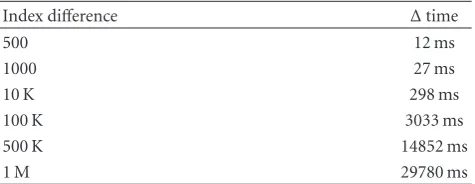
4.5. Experimental Results. We experimentally examine the capabilities of the proposed timing analysis by implementing the Rhee’s and Duc et al.’s protocols. These are chosen for simplicity though similar experimental result can be achieved for other mentioned protocols in this section.
The source code was compiled using the MS Visual C# compiler with default optimizations. All of the experiments were run under the configuration shown inTable 1. We used random keys generated by .net System.Random class key generation routine. We measured the time using stopwatch class and take the averages in order to measure elapsed time accurately.
In the implementation of Rhee’s protocol, we use the standard SHA-1 in MS .net System.Security.Cryptography class where we write a custom class for CRC implementation used in Duc et al.’s protocol. Our CRC routine uses a lookup table which reflects the lightweight feature of the protocol as it outperforms the SHA-1 implementation. In Tables 2
and3, timings for exhaustive search steps of the protocols are tabulated, where “index difference” stands for |x−y| as mentioned in Lemma 1. As formulated in the previous
Table2: Timing attack on Rhee’s protocol [3].
Index difference Δtime
500 12 ms
1000 27 ms
10 K 298 ms
100 K 3033 ms
500 K 14852 ms
1 M 29780 ms
Table3: Timing attack on Duc et al.’s protocol [22].
Index difference Δtime
500 0.7 ms
1000 1.1 ms
10 K 20 ms
100 K 97 ms
500 K 417 ms
1 M 807 ms
section, timing attacks could be very powerful in case a poor search process is chosen.
5. Countermeasures
Before giving our countermeasure against the proposed attack, we want to elaborate on some other obvious but not efficient techniques that remedy the security flaw.
With consideration of the previous parts, intuitively one can provide security against the proposed timing attack by realizing the condition that the server response time varia-tion for different tags is negligible, in other words, the server responds with an equal time and this is same for all tags. This condition can be achieved by using look-up tables as mentioned in [19] or artificially padding the delay in reader responses for all tags as reported in [14]. For the lookup-table model the server stores all possible answers of tags that are precomputed previously. Thus, in authentication phase the server avoids to make an exhaustive search, and instead responds in constant-time. Note that although this solution fixes the problem, constructing such a scheme with satisfying security and implementation requirements is impractical. In fact, if such a system exists, then clearly the use of exhaustive search in tag identification would be abandoned. On the other hand, inserting an artificial delay at the server side, determined by the worst case time, definitely eradicates the security flaw. However, this is clearly undesirable, because it reduces the efficiency of the overall system.
point of the exhaustive search process. We formulate this countermeasure as follows.
Countermeasure 1. Let an RFID system implements an SLAS scheme, having the same query sequence (Ct) for all of its search items such as{P0,P1,. . .,Pl}for some positive integer l. Choosing nonidentical random query sequences (Ct) for all search items gives the desired protection for the described attacks.
Although Countermeasure 1 gives a wide range of selec-tion having different implementation complexities, naturally, the simplest countermeasures come from setting minimal differences between query sequences. Observe that query sequences (Ct) can also be seen as permutations onNitems where N is the number tags. Thus, composing the query sequences with the following constant cyclic permutationπj
gives nonidentical shifted query sequences:
πj(i)=i+rjmodN, for randomrj, j=0, 1,. . .,l, 0<i≤N.
(11)
In other words, for all search items{P0,P1,. . .,Pl}we have the following general terms for the corresponding query sequences
Cπj(t), for j=0, 1,. . .,l. (12)
In fact, this modification corresponds to random selec-tion of the starting point of the exhaustive search process. Since we use different query sequences for different tag searches, for any selected two tags the index difference will also be different. Therefore, timing attacks would fail in measuring the time differences.
6. Conclusion
It is shown that exhaustive search process is crucial in RFID authentication protocols. Although the protocol might satisfy the necessary security requirements of the RFID sys-tem specifications, careless deployments of database search mechanisms could jeopardize the security of the whole system. Therefore, it should not be left to user’s choice and has to be described precisely in the system specifications. We believe our attempt would point out this salient missing link in RFID security protocols and address the potential pitfalls or side channels in realizations.
In order to support our observation through a careful analysis we give the minimum index difference of two selected tags in database such that the attacker succeeds. In addition, the success probability of the proposed attack model is derived in terms of the number of tags in the system, number of cryptographic operations carried out by the server, the computational power of the server, and the sensitivity of the attacker in timing.
As a countermeasure for the timing attack, we propose a dynamic search process which would fail in measuring the running time differences for different tag searches. We claim that choosing nonidentical random query sequences (Ct) for all search items gives the desired protection for the described attacks.
Acknowledgments
The authors would like to thank the anonymous reviewers for their constructive comments and suggestions on this work. Note that, G. Saldamli is partially funded by Bogazici University BAP project No: 5721.
References
[1] H. Y. Chien and C. H. Chen, “Mutual authentication protocol for RFID conforming to EPC class 1 generation 2 standards,”
Computer Standards and Interfaces, vol. 29, no. 2, pp. 254–259, 2007.
[2] M. Ohkubo, K. Suzuki, and S. Kinoshita, “Cryptographic approach to “privacy-friendly” tags,” RFID Privacy Work-6 shop, MIT, MA, USA, 2003.
[3] K. Rhee, J. Kwak, S. Kim, and D. Won, “Challenge-response based on RFID authentication protocol for distributed database environment,” in Proceedings of the International Conference on Security in Pervasive Computing (SPC ’05), D. Hutter and M. Ullmann, Eds., vol. 3450 ofLecture Notes in Computer Science, pp. 70–84, Springer, Berlin, Germany, 2005. [4] D. Nguyen Duc, J. M. Park, H. R. Lee, and K. J. Kim, “Enhancing security of EPCglobal Gen-2 RFID tag against traceability and cloning,” in Proceedings of the Symposium on Cryptography and Information Security, Hiroshima, Japan, January 2006.
[5] B. Song and C. J. Mitchell, “RFID authentication protocol for low-cost tags,” in Proceedings of the ACM Conference on Wireless Network Security (WiSec ’08), V. D. Gligor, J. Hubaux, and R. Poovendran, Eds., pp. 140–147, ACM Press, Alexandria, Va, USA, 2008.
[6] T. Dimitriou, “A lightweight RFID protocol to protect against traceability and cloning attacks,” in Proceedings of the Conference on Security and Privacy for Emerging Areas in Communication Networks (SecureComm ’05), IEEE, Athens, Greece, September 2005.
[7] D. Henrici and P. M¨uller, “Hash-based enhancement of loca-tion privacy for radio-frequency identificaloca-tion devices using varying identifiers,” inProceedings of the International Work-shop on Pervasive Computing and Communication Security (PerSec ’04), pp. 149–153, IEEE Computer Society, Orlando, Fla, USA, March 2004.
[8] D. Molnar and D. Wagner, “Privacy and security in library RFID: issues, practices, and architectures,” inProceedings of the ACM Conference on Computer and Communications Security (CCS ’04), B. Pfitzmann and P. Liu, Eds., pp. 210–219, ACM Press, Washington, DC, USA, October 2004.
[9] J. C. Ha, J. H. Ha, S. J. Moon, J. M. Gonzalez Nieto, and C. Boyd, “Low-cost and strong-security RFID authentication protocol,” in Proceedings of the EUC Workshops, vol. 4809 ofLecture Notes in Computer Science, pp. 795–807, Springer, Berlin, Germany, 2007.
[10] G. Tsudik, “A family of dunces: trivial RFID identification and authentication protocols,” Cryptology ePrint Archive Report 2006/015, 2007.
[11] C. C. Tan, B. Sheng, and Q. Li, “Serverless search and authentication protocols for RFID,” inProceedings of the 5th Annual IEEE International Conference on Pervasive Computing and Communications (PerCom ’07), pp. 3–12, March 2007. [12] A. Juels and S. Weis, “Defining strong privacy for RFID,” in
[13] S. Vaudenay, “On privacy models for RFID,” in Proceedings of the Advances in Cryptology (ASIACRYPT ’07), vol. 4833 of
Lecture Notes in Computer Science, pp. 68–87, Springer, Berlin, Germany, 2007.
[14] M. Burmester, T. V. Le, and B. D. Medeiros, “Provably secure ubiquitous systems: universally composable RFID authentica-tion protocols,” inProceedings of the Conference on Security and Privacy for Emerging Areas in Communication Networks (SecureComm ’06), IEEE, 2006.
[15] I. Erguler, M. Akgun, and E. Anarim, “Cryptanalysis of a lightweight RFID authentication protocol—LRMAP,” in
Proceedings of the Western European Workshop on Research in Cryptology (WeWORC ’09), Graz, Austria, July 2009.
[16] I. Erguler and E. Anarim, “Scalability and security conflict for RFID authentication protocols,”Wireless Personal Communi-cations. In press.
[17] B. Song and C. J. Mitchell, “Scalable RFID pseudonym protocol,” in Proceedings of the 3rd International Conference on Network and System Security (NSS ’09), pp. 216–224, IEEE Computer Society Press, October 2009.
[18] J. Ha, J. Ha, S. Moon, and C. Boyd, “LRMAP: lightweight and resynchronous mutual authentication protocol for RFID system,” in Proceedings of the International Conference on Ubiquitous Convergence Technology (ICUCT ’07), F. Stajano, H.-J. Kim, J.-S. Chae, and S.-D. Kim, Eds., vol. 4412 of
Lecture Notes in Computer Science, pp. 80–89, Springer, Berlin, Germany, 2007.
[19] G. Avoine, I. Coisel, and T. Martin, “Time measurement threatens privacyfriendly RFID authentication protocols,” in
Proceedings of the Workshop on RFID Security (RFIDSec ’10), Istanbul, Turkey, June 2010.
[20] S. Weis, S. Sarma, R. Rivest, and D. Engels, “Security and privacy aspects of low-cost radio frequency identification systems,” in Proceedings of the International Conference on Security in Pervasive Computing (SPC ’03), D. Hutter, G. Mller, W. Stephan, and M. Ullmann, Eds., vol. 2802 ofLecture Notes in Computer Science, pp. 201–212, Springer, Berlin, Germany, 2003.
[21] Y. An and S. Oh, “RFID system for users privacy protection,” inProceedings of Asia-Pacific Conference on Communications, pp. 516–519, Perth, Australia, 2005.
[22] D. N. Duc, J. Park, H. Lee, and K. Kim, “Enhancing security of EPC global gen-2 RFID tag against traceability and cloning,” in Proceedings of the Symposium on Cryptography and Information Security (SCIS ’06), The Institute of Electron-ics, Information and Communication Engineers, Hiroshima, Japan, 2006.
[23] K. Osaka, T. Takagi, K. Yamazaki, and O. Takahashi, “An efficient and secure RFID security method with ownership transfer,” inProceedings of the Computational Intelligence and Security (CIS ’06), Y. Wang, Y. Cheung, and H. Liu, Eds., vol. 4456 ofLecture Notes in Computer Science, pp. 778–787, Springer, Berlin, Germany, 2006.
[24] S. Lee, T. Asano, and K. Kim, “RFID mutual authentication scheme based on synchronized secret information,” in Pro-ceedings of the Symposium on Cryptography and Information Security (SCIS ’06), The Institute of Electronics, Information and Communication Engineers, Hiroshima, Japan, 2006. [25] P. Peris-Lopez, J. C. Hernandez-Castro, J. M. Estevez-Tapiador,
and A. Ribagorda, “An efficient authentication protocol for RFID systems resistant to active attacks,” inProceedings of the Emerging Directions in Embedded and Ubiquitous Computing (EUC ’07), vol. 4809 ofLecture Notes in Computer Science, pp. 781–794, Springer, Berlin, Germany, 2007.
[26] S. Fouladgar and H. Afifi, “A simple privacy protecting scheme enabling delegation and ownership transfer for RFID tags,”
Journal of Communications, vol. 2, no. 6, pp. 6–13, 2007. [27] H. Y. Chien and C. W. Huang, “A lightweight RFID protocol
using substring,” in Proceedings of the IFIP International Conference on Embedded and Ubiquitous Computing (EUC ’07), vol. 4808 ofLecture Notes in Computer Science, pp. 422– 431, Springer, Berlin, Germany, 2007.
[28] T. Lim, T. Li, and T. Gu, “Secure RFID identification and authentication with triggered hash chain variants,” in
Proceedings of the 14th International Conference on Parallel and Distributed Systems (ICPADS ’08), pp. 583–590, IEEE Computer Society, Melbourne, Australia, 2008.
[29] S. Cai, Y. Li, T. Li, and R. Deng, “Attacks and improvements to an RFID mutual authentication protocol and its extensions,” inProceedings of the 2nd ACM Conference on Wireless Network Security (WiSec ’09), pp. 51–58, ACM Press, Zurich, Switzer-land, 2009.
[30] P. Kocher, “Timing attacks on implementations of Diffi e-Hellman, RSA, DSS and other systems,” in Proceedings of the Advances in Cryptology (CRYPTO ’96), N. Koblitz, Ed., vol. 1109 ofLecture Notes in Computer Science, pp. 104–113, Springer, Berlin, Germany, 1996.
[31] D. Brumley and D. Boneh, “Remote timing attacks are prac-tical,” inProceedings of the 12th Usenix Security Symposium (SECURITY ’04), pp. 1–14, Washington DC, USA, 2004. [32] T. van Deursen and S. Radomirovi´c, “Security of RFID
protocols—a case study,”Electronic Notes in Theoretical Com-puter Science, vol. 244, pp. 41–52, 2009.
[33] G. Avoine, “Adversarial model for radio frequency identifi-cation,” Cryptology ePrint Archieve Report 2005/049, 2005, http://eprint.iacr.org.
[34] T. Van Le, M. Burmester, and B. De Medeiros, “Universally composable and forward-secure RFID authentication and authenticated key exchange,” inProceedings of the 2nd ACM Conference on Computer and Communications Security (CCS ’07), pp. 242–252, Singapore, March 2007.
[35] T. V. Deursen, S. Mauw, and S. Radomirovic, “Untraceability of RFID protocols,” inProceedings of the Information Security Theory and Practices. Smart Devices, Convergence and Next Generation Networks (WISTP ’08), vol. 5019 ofLecture Notes in Computer Science, pp. 1–15, Springer, Berlin, Germany, 2008. [36] G. Avoine, E. Dysli, and P. Oechslin, “Reducing time