Contents lists available atScienceDirect
Developmental Cognitive Neuroscience
journal homepage:www.elsevier.com/locate/dcn
Elevated physiological arousal is associated with larger but more variable
neural responses to small acoustic change in children during a passive
auditory attention task
S.V. Wass
⁎, K. Daubney, J. Golan, F. Logan, E. Kushnerenko
⁎ University of East London, Water Lane, London, E15 4LZ, UKA R T I C L E I N F O
Keywords: Auditory attention Intra-individual variability Physiological stress
A B S T R A C T
Little is known of how autonomic arousal relates to neural responsiveness during auditory attention. We pre-sented N = 21 5-7-year-old children with an oddball auditory mismatch paradigm, whilst concurrently mea-suring heart rate fluctuations. Children with higher mean autonomic arousal, as indexed by higher heart rate (HR) and decreased high-frequency (0.15-0.8 Hz) variability in HR, showed smaller amplitude N250 responses to frequently presented (70%), 500 Hz standard tones. Follow-up analyses showed that the modal evoked response was in fact similar, but accompanied by more large and small amplitude responses and greater variability in peak latency in the high HR group, causing lower averaged responses. Similar patterns were also observed when examining heart rate fluctuations within a testing session, in an analysis that controlled for between-participant differences in mean HR. In addition, we observed larger P150/P3a amplitudes in response to small acoustic contrasts (750 Hz tones) in the high HR group. Responses to large acoustic contrasts (bursts of white noise), however, evoked strong early P3a phase in all children and did not differ by high/low HR. Our findings suggest that elevated physiological arousal may be associated with high variability in auditory ERP responses in young children, along with increased responsiveness to small acoustic changes.
1. Introduction
The Autonomic Nervous System (ANS) is the neural substrate of the body’s stress response (Cacioppo et al., 2000). It has two main com-ponents: the Sympathetic Nervous System (SNS), involved in quick response mobilising (‘fight or flight’) (Cacioppo et al., 2000), and the Parasympathetic Nervous System, involved in slow-acting, response-dampening (‘rest or digest’) responses (Ulrich-Lai and Herman, 2009). Although the two interact largely in opposition, their function is non-additive (Janig and Habler, 2000;Lacey, 1967). One widely used per-ipheral index of ANS function is heart rate, which receives contribu-tions from both the SNS and PNS, with faster HR indexing greater SNS and less PNS activity (McCabe, 2000). In addition, ‘high-frequency’ activity in the respiration range (e.g. 0.15-0.8 Hz) is thought to index PNS activity (Bush et al., 2011). Although some researchers have dif-ferentiated ‘high-frequency’ from ‘low-frequency’ activity (< 0.15 Hz), treating the latter as an index of SNS activity (Berntson et al., 1997), more recent research has criticised this differentiation (Reyes del Paso et al., 2013;Billman, 2013).
Research has shown that fluctuations in both long- (Richards, 1985)
and short-term (de Barbaro et al., 2016a;Wass et al., 2016) physiolo-gical arousal associate with fluctuations in visual attention (Arnsten, 2009;Liston et al., 2009;Wass, 2018). Behaviourally, increased auto-nomic arousal (increased SNS and decreased PNS) associates with de-creased voluntary attention control and inde-creased responsivity to salient targets, whereas lower arousal is associated with increased vo-luntary (endogenous) attention control (Arnsten, 2009; Liston et al., 2009;Broadbent, 1971;Alexander et al., 2007). These findings have been observed from animal research (Usher et al., 1999) and recordings of ANS function in adults (Holzman and Bridgett, 2017;Thayer et al., 2009), children and infants (Richards, 2010; Richards et al., 2011; Bacher and Robertson, 2001), including experimental manipulations of stress (Liston et al., 2009).
Non-human primate research in this area has focused on the Locus Coeruleus (LC), a brainstem area implicated in ANS control (Usher et al., 1999;Sara and Bouret, 2012). At times of elevated physiological stress, tonic firing rates in the LC are increased (McCall et al., 2015). With higher tonic firing rates, phasic (stimulus-evoked) responses be-come more inconsistent (Usher et al., 1999;Aston-Jones and Cohen, 2005).Neural gain, the degree to which neural signals are amplified or
https://doi.org/10.1016/j.dcn.2018.12.010
Received 1 March 2018; Received in revised form 3 December 2018; Accepted 19 December 2018
⁎Corresponding authors.
E-mail addresses:[email protected](S.V. Wass),[email protected](E. Kushnerenko).
Available online 21 December 2018
1878-9293/ © 2018 The Authors. Published by Elsevier Ltd. This is an open access article under the CC BY-NC-ND license (http://creativecommons.org/licenses/BY-NC-ND/4.0/).
suppressed contingent on relevance, is lower during elevated arousal (Aston-Jones and Cohen, 2005). Atypical neural gain (Hauser et al., 2016) and hyper-tonic arousal (Sonuga-Barke et al., 2010;Imeraj et al., 2012) have both been hypothesised to be core deficits in ADHD. Phasic, stimulus-evoked activity in the LC has been associated with evoked brain components such as the P3 (Murphy et al., 2011;Nieuwenhuis et al., 2005). However, no previous research, to our knowledge, has examined the relationship between arousal and variability in neural evoked responses, in human participants (Wass, 2018).
Most previous research into physiological arousal and attention has studied attention in the visual domain. Relatively few studies have examined the relationship between physiological arousal and auditory attention - despite that auditory attention is considered a key gateway skill during language acquisition, for example (Choudhury and Benasich, 2011; Bishop, 2007). Understanding relationships between physiological arousal and auditory attention may, for example, be helpful for recognising differences in auditory processing that have been noted as a function of socio-economic status (SES) (Stevens et al., 2015, 2009), and which have been implicated in understanding in-dividual differences in language learning capacity (Bishop, 2007; Tonnquist-Uhlen, 1996; Montgomery and Windsor, 2007). In-vestigating this was the aim of the present paper.
We used a version of an auditory oddball paradigm in which fre-quently presented 500 Hz tones were interspersed with two rare var-iants: 750 Hz tones and broadband white noise (Kushnerenko et al., 2002a,2007). Typically, in response to frequently presented standards, two main components can be observed in children under the age of 10 years: the P150 (P2), positive component, peaking at about 100–200 ms, and the N250 (N2), negative component peaking at about 250–350 ms or even later if merged with the subsequent N450 at faster presentation rates (Čeponien et al., 1998). The functional significance of these obligatory components in children remains to be clarified.
In adults, the source of the P2 has been located by magnetoence-phalography (MEG) to the superior temporal gyri (Hariº et al., 1987). In addition, some results indicate that the P2 at least partially reflects auditory driven output of the reticular activating system and conse-quently associated with the maintenance of behavioural arousal (Knight et al., 1980;Rif et al., 1991;Robinson, 1999). The P2 modulation in response to infrequent deviant in oddball paradigms was observed only in young children but not in adults ({Ruhnau, 2013 #3165, Ruhnau et al., 2010). The N2 elicited by frequent repetitive stimuli (‘basic’ N2; Näätänen and Picton, 1986) was reported mainly in children and often denominated N250 according to its latency (Čeponiené et al., 2001; Čeponien et al., 2002; Ceponien et al., 1998; Korpilahti and Lang, 1994). In children, the N2 amplitude was found larger in response to complex rather than simple tones (Čeponiené et al., 2001). It is assumed to originate bilaterally in the auditory cortex of the superior temporal lobes with frontal predominance (Čeponien et al., 2002;Gomot et al., 2000). There are several studies reporting smaller N250 amplitudes in children born prematurely (Fellman et al., 2004;Gomot et al., 2007), in infants with craniofacial anomalies associated with a risk for a devel-opmental delay (Ceponien et al., 1998; Balan et al., 2002), and in language-impaired (Tonnquist-Uhlen, 1996), and dysphasic children (Korpilahti and Lang, 1994).
In addition the rare, or ‘oddball’ stimuli allowed us to investigate auditory change detection to both small- and large-spectral changes (Kushnerenko et al., 2013a). The response to larger spectral changes (noises or so called ‘novel’ sounds) is usually very consistent across subjects, representing early negativity (N1/Mismatch Negativity/ MMN), followed by a large positivity (P3a) and a late negativity (LN) commencing at about 400 ms (Wetzel and Schröger, 2014). The P3a is only elicited when auditory change is large enough to trigger in-voluntary (bottom-up, saliency-driven) attention mechanisms and is sometimes linked to a behavioural distraction from the task and im-pairment in performance (Wetzel and Schröger, 2014).
The brain response to smaller acoustic changes (deviants) in
children, called the Mismatch response (MMR), can be characterized by either negative (nMMR or Mismatch negativity, MMN (Näätänen et al., 1978) or positive (pMMR) components, usually seen as an increases in N250 or P150 amplitudes in response to deviants compared to stan-dards. Coexistence of positive and negative MMRs in children and in-fants presented a riddle for more than a decade for developmental re-searchers. Recently, however, there has been development in understanding these two components, presumably indexing different functional characteristics (Kushnerenko et al., 2002a,2007). It has been proposed that the mismatch response associated with high attentional demands in the sound discrimination exhibits a positive polarity (pMMR) and is considered a less mature MMR response. The mismatch response associated with low attentional demands (more automatic) exhibits a negative polarity (i.e., MMN) and is considered the more mature MMR (Garcia-Sierra et al., 2016).
Both MMN and pMMR co-exist in the same age group (4–6 year old pre-schoolers) with larger and easier deviants eliciting adult-like MMNs, whereas smaller deviants elicit P-MMRs (Lee et al., 2012). Therefore, auditory change detection can occur with high or low at-tentional demands that are mediated by language experience ( Garcia-Sierra et al., 2016;Rivera-Gaxiola et al., 2005;Friedrich et al., 2009), discriminability of the stimuli (Lee et al., 2012;Cheng et al., 2015) and maturational factors (Kushnerenko et al., 2002a; Morr et al., 2002; Maurer et al., 2003). There has been also been a discussion of whether pMMR can represent an early phase of the P3a component elicited in response to attention-getting stimuli (Kushnerenko et al., 2002a,2007). However, this still requires further investigation.
Our research participants were 5-7-year-old children. We predicted that heightened levels of arousal would be associated with increased distractibility, potentially triggering attention mechanisms to a larger extent, in response to small acoustic changes. Therefore we predicted that a more P3a-like response, manifesting as a higher amplitude P150 component, would be observed in children with higher physiological arousal. Based on previous research (Aston-Jones and Cohen, 2005) we also predicted that increased physiological arousal would result in more variable trial-to-trial brain responses to the same stimulus.
2. Method
Participants: 39 participants were originally tested for the study. Their mean (std) age on the day of testing was 73.6 (sd 12.2) months. Although detailed demographic data were not collected it should be noted that the recruitment area for this study, Stratford in East London, is a demographically mixed area of London. The nature of our study meant that data from a number of participants were unavailable due either to technical problems with one of the recording streams, to in-sufficiently good quality data recording from one of the measures, or to technical problems sending event codes between the two streams. Technical problems with the ECG recording systems led to the loss of data N = 8 participants. Further technical problems led to problems with sending event codes between with ECG and EEG recording equipment (N = 7). Insufficiently good quality EEG data led to the loss of data from 8 participants. In total, ECG data were available for N = 30 participants; EEG data were available for N = 34 participants; both ECG and EEG data were available from N = 21. The age of participants who contributed both usable ECG and EEG data was 71.9 (sd 11.9) months on the day of testing.
Equipment: EEG was recorded using a high-density 128-channel HydroCel Geodesic Sensor Net (HGSN) produced by EGI (EGI, Eugene, OR). The size of the HGSN was chosen based on the child’s head cir-cumference. The EEG signal was referenced to the vertex, recorded at a 500 Hz sampling rate with band-pass filters set from 0.1 to 100 Hz using a Kaiser Finite Impulse Response filter. Prior to recording the im-pedance of each electrode was manually checked to ensure that they were below 100 kΩm.
recording at 1000 Hz. Disposable Ag–Cl electrodes were used, placed in a modified lead II position. Stimuli were presented using E-Prime. In order to ensure accurate time-synchronisation between the EEG and ECG recording systems, simultaneous event codes were sent con-currently from E-Prime via TTL pulses to the EEG and ECG recording systems during stimulus presentation.
Procedure: The experiment consisted of 4 blocks of 100 trials. Each block consisted of: 70 ‘standard’ 500 Hz tones; 15 ‘deviant’ 750 Hz tones; 15 ‘noise’ (white-noise segments). The harmonic tones of 500 and 750 Hz fundamental frequency were constructed from the three lowest partials, with the second and third partials having a lower intensity than the first one by 3 and 6 dB, respectively. The harmonic tones were used instead of sinusoids for two reasons. Firstly, because it has been shown previously that complex tones result in larger N250 amplitudes in children then sinusoids (Čeponiené et al., 2001). Secondly, we aimed to use the same paradigm that was used in a number of longitudinal and cross-sectional studies in infants and children in order to increase our understanding of the observed previously effects (Kushnerenko et al., 2007). The duration of the sounds was 100 ms, including 5-ms rise and 5-ms fall times. The interstimulus (offset-to-onset) interval was 700 ms. The order in which the trials were presented was pseudo-randomised in order to ensure that two deviant and noise trials were always separated by at least two standard trials. In between blocks, 60-second videos were presented of actors reciting nursery rhymes to the camera, in order to allow participants to rest and to minimise the cumulative effect of fatigue over consecutive blocks. The total paradigm, including pre-paration, recording, breaks and EEG cap removal, lasted approximately one hour per participant. The proposal was approved, prior to the commencement of the study, by the University Research Ethics Com-mittee at the University of East London.
Data analysis: The vertex-referenced EEG was algebraically re-computed to an average reference. The signal was off-line low-pass filtered at 30 Hz using a Kaiser Finite Impulse Response filter and seg-mented into epochs starting 100 ms before and ending 600 ms after the stimulus onset. Channels contaminated by eye or motion artifacts were rejected manually, and trials with more than 20% bad channels were excluded. The average (std) [min-max] proportion of channels excluded per trial was 0.09 (0.12) [0.01-0.45] for standard trials; 0.09 (0.10) [0.01-0.37] for deviant trials; 0.06 (0.09) [0.001-0.32] for noise trials. The mean (range) (std) number of trials included was 248 (210–270) (19) for standard; 50 (42–56) (4) to deviant; 54 (48–60) (4) for noise. This number of accepted trials has proven to be sufficient for this type of paradigm (Kushnerenko et al., 2013a;Guiraud et al., 2011; Dehaene-Lambertz and Dehaene, 1994; Friederici et al., 2007; Kushnerenko et al., 2013b,2008).
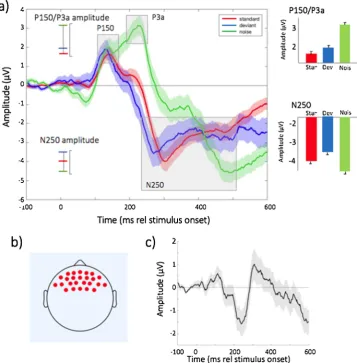
The valid ERPs obtained for each stimulus type were first averaged to create a per-participant mean waveform. The electrode locations used are shown inFig. 1b. Because P150 and the early phase of the P3a represent an overlapping double-peaked component in response to white noise (Fig. 1a), the amplitude and latency of the maximum po-sitive change was measured between 100 and 300 ms post stimulus onset.1 The following negative peak representing merged N250 and
N450 components, will be called throughout N250 and was measured as the maximum negative change between 200 and 500 ms post sti-mulus onset. The late negativity (LN) in response to white noise was measured in the time window from 400 to 600 ms. The amplitude was calculated as the mean amplitude +/- 20 ms around the peak ampli-tude. The time windows were defined based on the longitudinal and cross-sectional research using the same paradigm (Kushnerenko et al., 2007,2002b) and the average of fronto-central channels was used as the largest MMN/P3a/LN were expected to occur over this area (Gumenyuk et al., 2005,2004).
Raw ECG data were parsed to identify heart beats using a variable amplitude thresholding criterion. The amplitude threshold was in-spected and adjusted between participants using the data visualisation illustrated in the SM (see Fig. S1). Then, automatic artefact rejection criteria were used to automatically identify artefactual beats: if the time interval between beats was less than 400 ms or greater than 1100 ms, or if the rate of change between that beat and the preceding beat exceeded 400 ms. This level was set, following visual inspection, as greater than the maximum rate of change of heart rate in vagally mediated HR changes (see Fig. S1). Following automatic parsing, data were visually inspected in order to identify erroneously identified beats. The criteria used to identify short- and large-scale variability in HR are described in the Supplementary Materials.
3. Results
In Analysis 1 we examine how between-participant variability in HR related to neural evoked responses on the Standard (Figs. 2,3), Deviant (Fig. 4) and Noise (Fig. 5) conditions. In Analysis 2 we examine how within-participant variability in HR – fluctuations in HR within the testing session – associated with altered patterns of evoked neural re-sponses.
3.1. Preliminary analyses – descriptive
Fig. 1shows the grand average ERPs (Fig. 1a), the electrode loca-tions used to calculate all ERPs (Fig. 1b) and the deviant-standard waveform (Fig. 1c). ERPs to standard and deviant both consist of the P150 followed by N250, the latter being more negative displaced in the deviant compared to the standard. This can be seen in the deviant-standard difference wave with the negative peak around 200 ms. ERPs to white-noise segments also represent a typical waveform consisting of a large and prolonged positive peak (merged P150 and early phase of P3a), followed by a merged N250 and Late Negativity (LN).
Fig. S2, in the Supplementary Materials, shows the raw HR data collected during the experiment, rank ordered by mean HR obtained across the entire trial. The participants showed generally consistent inter-individual differences in mean HR across the recording session. It can also be seen that, in addition to differences in mean HR, partici-pants showed differences both in the level of high-frequency heart rate variability (regular, vagally mediated changes in HR with the respira-tion cycle, known as Respiratory Sinus Arrhythmia) (Anrep et al., 1935; Porges, 2017) as well as low-frequency variability, often considered an index of sympathetic nervous system activity (Berntson et al., 1997; Billman, 2013). In the Supplementary Materials we present analyses to examine these other aspects of variability in the time series. In the main text we focus on mean HR (Analysis 1) and within-participant
1The reason for not analysing P150/P3a separately is that in children these
components are often inseparable. Firstly, due to large inter-individual differ-ences the latency windows for these peaks overlap and therefore analysing these two peaks in two separate windows we are at risk to miss the component’s maximum amplitude if it is elicited earlier or later than on the average. Secondly, inKushnerenko et al. (2002a,b) it has been shown that there is a superposition of the positive and negative ERP components in infants and young children in the same latency range (see also Morr et al, 2002 for cor-roborating evidence) and an emerging negative component is often seen riding on top of the wider positivity dividing it into two subcomponents P150 and an early P3a. In the absence of this negative peak (presumably emerging N1) the response is often seen as one positive peak, so in fact the separation of this positive component into two might be artificial.Kushnerenko et al. (2002a,b,
(footnote continued)
variability in HR (Analysis 2).
3.2. Analysis 1 – between-participant variability in HR
In Analysis 1 we examine how between-participant variability in HR related to participant responses on the Standard (Figs. 2,3), Deviant (Fig. 4) and Noise (Fig. 5) conditions.
3.2.1. Standard
Fig. 2c shows the mean ERP responses for the standard trials, sub-divided using a median split by mean HR across the testing session. Although the latency of the N250 component is similar between the two groups, the amplitude is lower for the high HR group. Topoplots (Fig. 2a and b) indicate that this effect was observed consistently across all fronto-central channels. Fig. 2d shows the bivariate relationship between mean HR and N250 peak amplitude. (For this, and all sub-sequent bivariate relationships reported below, normality plots were conducted; but these have not been reported throughout for reasons of space. Because not all data were found to be parametrically distributed, the more conservative nonparametric Spearman’s test was used throughout, for consistency.) The bivariate relationship between mean HR and N250 peak amplitude was found to be ρ(20) = .49, p = .027, suggesting that higher mean HR is associated with lower amplitude N250 responses on Standard trials.
In order further to investigate why smaller average N250 responses were observed in participants with higher HR, we investigated the
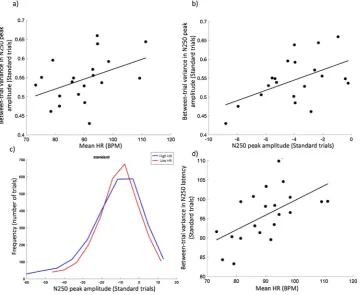
hypothesis that participants with higher HR might show increased be-tween-trial variabilityin evoked responses. First, the peak amplitude ERP responses were calculated trial by trial, and pooled into high HR and low HR groups, based on a median split. Individual trials more than 2 IQR +/- the mean were excluded. Separate histograms were computed for each distribution and compared (Fig. 3c). The median results are similar: -10.2μV for both the high and low HR groups. But the high HR group shows both more high and low values than the low HR group, along with a longer tail. In order to quantify these differences ex-Gaussian distributions were fitted, as described in the Supplemenary Materials section 2.iii (Lacouture and Cousineau, 2008). In brief, these analyses suggested that the model responses were similar across the two populations (as shown by similar μ components of the ex-Gaussian), but that bothτ(exponential component) and σ (the variance of the
Gaus-sian component) were larger in the high HR group.
[image:4.595.119.477.57.421.2]Second, we calculated the average between-trial variance in N250 amplitude, by computing the N250 peak amplitude individually for each trial presented, log transforming the data, and calculating the standard deviation between trials. A significant relationship was ob-served between mean HR and between-trial variance in N250 ampli-tude ρ(20) = .46, p = .045, suggesting that participants with higher mean HR showed greater between-trial variance in N250 amplitude (Fig. 3a). A marginally non-significant bivariate relationship was identified when comparing between-trial variance in N250 peak am-plitude and N250 amam-plitude, suggesting that participants with greater between-trial variance in N250 amplitude showed lower average N250
Fig. 2.a and b) - topoplots for responses to the Standard trials, split by the participants’ mean HR across the entire testing session. The figure above each time plot indicates the mean time of each bin, in ms, relative to stimulus onset. Only the time intervals 100–200 ms and 250–350 ms, corresponding to the main ERP peaks, are shown. Results for other time intervals are shown in the SM (Fig. S6). The colour bar indicates the voltage, in μV. a) High HR group; b) Low HR group. c) ERP response to the Standard trials, subdivided into the low HR group (red) and the high HR group (blue) and downsampled to 20 ms. Shaded areas represent the error bars, calculated as the Standard Error of the Mean. d) Scatterplot showing the significant relationship observed between mean HR and peak amplitude of the N250 on Standard trials.
[image:5.595.39.403.431.726.2]peak amplitude responses ρ(20) = .42, p = .067 (Fig. 3b). Identical relationships were observed between mean HR and the latency of the peak amplitude: participants with higher mean HR showed increased variability in the latency of the peak N250 response ρ(20) = .60, p = .005 (Fig. 3d) and participants with increased variability in the latency of the peak N250 response showed smaller average amplitude N250 responses ρ(20) = .62, p = .003.
Overall, these results suggest that the modal responses are similar across the two populations, but that response variability was larger in the high HR group. Thus, despite the fact that large amplitude
responses were marginally more common in the high HR group (Fig. 3c), the greater between-trial variability both in the peak ampli-tude and the latency of the peak ampliampli-tude in the high HR group (Fig. 3a and d) leads to lower average response amplitudes.
3.2.2. Deviant
[image:6.595.70.526.56.343.2]Fig. 4c shows the mean ERP responses for the deviant trials, sub-divided using a median split by mean HR across the testing session. It can be seen that the P150/P3a component appears to show a larger positivity in the high HR group. The topoplots (Fig. 4a and b) indicate that this effect
[image:6.595.68.529.446.572.2]Fig. 4.a) and b) - topoplots for responses to the Deviant trials, split by the participants’ mean HR across the entire testing session and binned into 100 ms time intervals. The figure above each time plot indicates the mean time of each bin, in ms, relative to stimulus onset. Only the time intervals 100–200 ms and 250–350 ms, corresponding to the main ERP peaks, are shown. Results for other time intervals are shown in the SM (Figure S6). The colour bar indicates the voltage, in μV. a) High HR group; b) Low HR group. c) ERP response to the Deviant trials, subdivided into the low HR group (red) and the high HR group (blue) and downsampled to 20 ms. Shaded areas represent the error bars, calculated as the Standard Error of the Mean. d) histogram showing the distributions of ERP P150/P3a amplitude responses observed across Deviant trials, sub-divided into the low average HR group (red) and the high average HR group (blue). e) Bar chart showing the P150 standards observed for the Standard and Deviant trials, split by low HR and high HR groups. Error bars represent the Standard Error of the Mean. The star indicates the results of the mixed ANOVA described in the main text (p < .05).
was observed consistently across fronto-central channels. In order to assess whether a larger P150/P3a was observed to the deviant relative to the standard trials, the P150/P3a peak amplitude was directly compared be-tween the standard and deviant conditions, and subdivided by participant mean HR (Fig. 4e). A mixed ANOVA with P150/P3a amplitude as the DV, condition (Standard vs Deviant) as within-participants factor and HR group (Low vs High) as between-participants factor indicated a significant interaction between condition and group F(1,19) = 9.9, p = .025, partial
η2= .24. Post-hoc analyses using paired-sample t-tests indicated that the
P150/P3a was higher to deviant than standard trials in the high HR group t(9) = 2.30, p = .047, Cohen’s d = 0.79 but not the low HR group t (10) = 1.01, p = .34, Cohen’s d = 0.28.
In order further to investigate why larger average P150/P3a re-sponses were observed in participants with higher HR, we again in-vestigated between-trial variability in evoked responses. Peak ampli-tude ERP responses were calculated trial by trial, and pooled into high HR and low HR groups, based on a median split. Individual trials more than 2 IQR +/- the mean were excluded. Separate histograms were computed for each distribution and compared (Fig. 4d). Ex-Gaussian distributions were fitted (see Supplementary Materials section 2.iii) (Lacouture and Cousineau, 2008). These results suggest that, whereas the modal responses were again similar between the two groups (shown by the similar μ components), the increased mean P150/P3a amplitudes observed in the high HR group were associated with a sub-group of trials with a high response amplitude, manifesting as an increasedτ
(exponential component).
3.2.3. Noise
Fig. 5c shows the mean ERP responses for the Noise trials, sub-divided using a median split by mean HR across the testing session. Fig. 5a and b show topoplots split by mean HR. An identical series of analyses were conducted to those reported for the Standard and Deviant condition, including a mixed ANOVA with condition (Standard vs De-viant) as within-participants factor and HR group (Low vs High) as between-participants factor were conducted, but no significant group differences were observed. In addition neither the latency (ρ(20) = .17, p = .47) or the amplitude (ρ(20) = .21, p = .36) of the Late Negativity component showed a significant relationship to mean HR.
3.2.4. Relationship between HR variability and ERP responses
In the Supplementary Materials we examine how low- and high-frequency variability in our ECG data relate to the ERP responses ob-served. Robust individual differences in both low- (< 0.15 Hz) and high- (0.15-0.8 Hz) frequency variability could be obtained, as in-dicated by strong correlations between time and frequency domain estimates (Fig. S7). As expected (Cacioppo et al., 2000), high-frequency variability, which is thought to index vagal/parasympathetic influence, showed strong associations with mean HR (ρ=-0.76) (Fig. S7d) (lower HR associated with increased high-frequency variability). Virtually identical patterns of association with the ERP responses were observed for high-frequency variability as were observed for mean HR: increased high-frequency variability was associated with larger N250 Standard responses and reduced P150/P3a Deviant responses (Figs. S8, S9). In addition, increased low-frequency variability was also associated with smaller amplitude N250 Standard responses (Figure S8b), although no relationship was observed between low-frequency variability and P150/P3a Deviant responses (Fig. S8e).
3.3. Analysis 2 – within-participant changes in HR
Our main analyses presented above look at between-participant differences based on mean HR recorded across the entire testing ses-sion. In addition, we also looked at whether similar patterns could be identified when we examined within-participant variability – i.e. fluc-tuations in HR within a particular individual, within a testing session. Results for this analysis are given in the Supplementary Materials
section 2.iv (Fig. S10). In brief, highly comparable patterns of results were observed. Trials where HR was high showed smaller amplitude N250 Standard responses – albeit with a smaller effect size than the between-participant analyses. For P150/P3a Deviant responses, a di-rectionally similar result (larger amplitude associated with higher HR) was observed but the effect was not significant. Of note, because these analyses examine within-participant variability (comparing high and low HR trials within a testing session, separately for each participant), these findings are entirely independent of the results in the Analysis 1, which examine between-participant differences.
4. Discussion
We used an ERP paradigm to measure passive auditory attention in 5-7-year-old children whilst concurrently measuring between- and within-participant variability in heart rate (HR). Our results had two main features of interest: first, children with higher physiological arousal showed smaller amplitude N250 responses to Standard tones, which follow-up analyses suggested was due to increased within-par-ticipant variability in neural responsiveness in the high-arousal group. Second, children with higher physiological arousal showed larger am-plitude P150/P3a responses to Deviant tones. Responses to noise showed a response with much larger early P3a phase across all children, with no significant differences related to heart rate. We shall discuss our two main findings in turn.
First,Fig. 2illustrates the significant negative relationship observed between mean HR and N250 response amplitudes to 500 Hz tones. High-frequency variability in HR, thought to index Respiratory Sinus Arrhythmia (Parasympathetic Nervous System control) was associated negatively with mean HR (Fig. S7d) and showed the same pattern: more high-frequency variability associated with larger N250 amplitude (Fig. S8). We also examined within-participant variability in HR in a separate analysis that controlled for differences in mean HR. Consistent with the results of Analysis 1, we found that, within each testing session, trials with higher HR showed reduced N250 responses to standard tones (Fig. S10), albeit with a smaller effect size than noted in the between-par-ticipant analyses.
Between participants, elevated HR was associated with increased trial-to-trial variability for both response amplitudes (Fig. 3b) and re-sponse latencies (Fig. 3d). Previous research has reported that when single-trial ERPs are averaged, the amplitude of a peak in the average ERPs is inversely related to the trial-to-trial variability in latency of that peak (Thomas et al., 1989), consistent with the relationship we ob-served in our data (Fig. 3c). Our results were consistent with this. Thus, despite that the response histogram showed more high-amplitude evoked responses in the high HR group (Fig. 3c), the averaged evoked responses in the high HR group were lower (Ouyang et al., 2016).
One possible artifactual explanation of our findings is that the children with higher HR moved more during testing, which may have contributed to the increased variability in our results (Georgieva et al., 2017). However, this appears unlikely because our participants were seated during recording, and any trials containing gross movement artefact were excluded by our artefact rejection techniques. Further, it is unclear how movement artefact would contribute to the presence both of larger, and smaller N250 responses, as well as to both smaller average ERPs in one condition and larger ERP responses in another.
which neural signals are amplified or suppressed contingent on re-levance, is reduced (Aston-Jones and Cohen, 2005;Hauser et al., 2016; Aston-Jones et al., 2007). Our results may be consistent with this – albeit that ERPs represent the summed activity of populations of neurons (Harris et al., 2014), whereas most previous research has measured re-sponses from single-cell recordings (Usher et al., 1999).
The present results may also, potentially, be consistent with beha-vioural research focusing on conditions such as ADHD that has identi-fied links between arousal and response time variability (Johnson et al., 2007;Kofler et al., 2013;Hicks et al., 1989;Wainstein et al., 2017). For example, Wainstein and colleagues recorded pupil size, which is thought to index physiological arousal (Loewenfeld, 1993) in children with ADHD and found that, at times when pupil size was higher, re-sponse time variability on a visuospatial working memory task was increased. Bluschke and colleagues have also identified increased intra-participant variability in neural responses during a conflict monitoring in patients with ADHD (Bluschke et al., 2017).
The second novel aspect of our findings was the elevated P150/P3a response that we observed in the high-arousal group in response to rare, 15% 750 Hz deviant tones. This larger mean response was observed despite the fact that the trial-to-trial variability in the high HR group was higher (Fig. 4d); and, as discussed above, greater trial-to-trial variability is typically associated with aloweraveraged response. The enhanced P150 (P2) in response to deviants has repeatedly been re-ported in the literature (Näätänen et al., 1978; Maurer et al., 2003; Seery et al., 2014) and was referred to as positive mismatch response (pMMR). Several hypotheses about its nature and functional sig-nificance have been discussed (Wetzel and Schröger, 2014; Ruhnau et al., 2013). One hypothesis interpreted positive MMR as an inverted MMN (Maurer et al., 2003), however the mechanism of such inversion is not clear. Another proposal suggests that the positive MMR reflects an early P3a, a mechanism governing or initiating an attention shift to the distracting stimuli in environment (Kushnerenko et al., 2002b; Čeponienė et al., 2004). One more proposed explanation was based on the close temporal proximity (or overlap) of the positive MMR and the P2, and suggested that the positive mismatch response reflects a mod-ulation of the P2 component (Ruhnau et al., 2010).
Finally, there is an interpretation offered independently by two re-search teams (Kushnerenko et al., 2002a; Morr et al., 2002; Kushnerenko et al., 2002b), which does not rule out the above dis-cussed ones. Since scalp-recorded ERPs represents contributions from different concurrent generators with different relative strengths or maturation rates, the observed ERP waveform represents a sum of the overlapping superimposed positive and negative deflections, with one potentially obscuring another depending on the relative strength of the generator (Kushnerenko et al., 2002a, b). Morr and colleagues illu-strated how polarity of the resulting mismatch response would depend on relative strengths of positive and negative generators depending on deviance size and children age (Morr et al., 2002).
Interpreting our results, we hypothesize that here we also have inter-relation between negative (N250/MMN) and positive generators (P150/P3a). For example, in response to ‘noise’ (Fig. 1a), which is thought to trigger the involuntary attention shift due to the saliency of the stimulus (Wetzel and Schröger, 2014), one can see that the P150 is almost merged with the following P3a. We can hypothesize that in trials with high HR, the overall brain excitability was higher and therefore more prone to involuntary attention. Thus, even small acoustic con-trasts (frequency deviant) could potentially elicit a P3a-like response, which due to a larger amplitude could obscure the N250/MMN gen-erator response and contribute to the scalp-recorded amplitude of the P150. The increased positivity in high HR group could be reflecting higher attentional demands as discussed in several recent studies (Garcia-Sierra et al., 2016;Rivera-Gaxiola et al., 2005) and less auto-matic auditory change detection (which should have resulted in nega-tive MMN) in high arousal state.
Although novel, our findings are consistent with previous research
into the relationship between physiological arousal and change detec-tion. Whereas the detection of sought-for stimuli (targets on a stimulus detection task) is generally thought to show an inverted-U-shaped re-lationship with physiological arousal, with optimal performance ob-served at intermediate levels (Aston-Jones and Cohen, 2005;Yerkes and Dodson, 1908;McGinley et al., 2015), it is known that during hyper-arousal, neural systems involved in exogenous, salience-driven or-ienting become more active. This leads to a shift from ‘top-down’, more frontally mediated control at lower levels of physiological arousal to ‘bottom-up’ control by low-level aspects of the sensory stimulus at higher levels of arousal (Arnsten, 2009;Liston et al., 2009). Consistent with this, greater neural responsiveness to small acoustic changes has been shown in adults with PTSD (Morgan and Grillon, 1999), and heightened physiological arousal has also been discussed in relation to auditory hypersensitivity in Autism Spectrum Disorders (Jones et al., 2009); although see (Rogers and Ozonoff, 2005).
Overall, our findings demonstrate the complex relationships be-tween physiological arousal and cognitive performance (Arnsten, 2009; de Barbaro et al., 2016b). Sensitivity to small acoustic changes may confer advantages in certain learning situations – reduced sensitivity to change has been identified, for example, as a risk factor for conditions such as dyslexia (Baldeweg et al., 1999) and SLI (Rinker et al., 2007). However, inconsistent stimulus responses have, independently, been implicated in a diverse range of conditions, such as ADHD and ASD (Geurts et al., 2008). Further investigating the relationship between physiological arousal and auditory attention, and its potential long-term impact on learning in cognitive domains such as language, should be a goal for future research.
Conflict of interest
None.
Acknowledgements
This research was supported by the University of East London Summer Internship Scheme and by ESRC Future Research Leaders Fellowship Nr ES/N017560/1 to SW. We are grateful for the support of all participating families.
Appendix A. Supplementary data
Supplementary material related to this article can be found, in the online version, at doi:https://doi.org/10.1016/j.dcn.2018.12.010.
References
Alexander, J.K., et al., 2007. Beta-adrenergic modulation of cognitive flexibility during stress. J. Cogn. Neurosci. 19 (3), 468–478.
Anrep, G.V., Pascual, W., Rossler, R., 1935. Respiratory variations of the heart rate. I. The reflex mechanism of the respiratory arrhythmia. R. Soc. Lond. Proc. Series B 119, 191–217.
Arnsten, A.F., 2009. Stress signalling pathways that impair prefrontal cortex structure and function. Nat. Rev. Neurosci. 10 (6), 410–422.
Aston-Jones, G., Cohen, J.D., 2005. An integrative theory of locus coeruleus-nor-epinephrine function: adaptive gain and optimal performance. Annu. Rev. Neurosci. 28, 403–450.
Aston-Jones, G., et al., 2007. The locus coeruleus and regulation of behavioral flexibility and attention: clinical implications. In: Ordway, G.A., Schwartz, M.A., Frazer, A. (Eds.), Brain Norepinephrine: Neurobiology and Therapeutics. Cambridge University Press, Cambridge, UK.
Bacher, L.F., Robertson, S.S., 2001. Stability of coupled fluctuations in movement and visual attention in infants. Dev. Psychobiol. 39 (2), 99–106.
Balan, P., et al., 2002. Auditory ERPs reveal brain dysfunction in infants with plagioce-phaly. J. Craniofac. Surg. 13 (4), 520–525.
Baldeweg, T., et al., 1999. Impaired auditory frequency discrimination in dyslexia de-tected with mismatch evoked potentials. Ann. Neurol. 45 (4), 495–503. Berntson, G.G., et al., 1997. Heart rate variability: origins, methods, and interpretive
caveats. Psychophysiology 34 (6), 623–648.
Bishop, D., 2007. Using mismatch negativity to study central auditory processing in de-velopmental language and literacy impairments: where are we, and where should we be going? Psychol. Bull. 133 (4), 651.
Bluschke, A., et al., 2017. Neuronal intra-individual variability masks response selection differences between ADHD subtypes—a need to change perspectives. Front. Hum. Neurosci. 11, 329.
Broadbent, D., 1971. Decision and Stress. Academic, London.
Bush, N.R., et al., 2011. Differentiating challenge reactivity from psychomotor activity in studies of children’s psychophysiology: considerations for theory and measurement. J. Exp. Child Psychol. 110 (1), 62–79.
Cacioppo, J.T., Tassinary, L.G., Berntson, G.G., 2000. Handbook of Psychophysiology, 2nd ed. Cambridge University Press, Cambridge, UK.
Čeponien, R., Cheour, M., Näätänen, R., 1998. Interstimulus interval and auditory event-related potentials in children: evidence for multiple generators. Electroencephalogr. Clin. Neurophysiol. Potentials Sect. 108 (4), 345–354.
Ceponien, R., Cheour, M., Näätänen, R., 1998. Interstimulus interval and auditory event-related potentials in children: evidence for multiple generators. Electroencephalogr. Clin. Neurophysiol. Potentials Sect. 108 (4), 345–354.
Čeponien, R., Rinne, T., Näätänen, R., 2002. Maturation of cortical sound processing as indexed by event-related potentials. Clin. Neurophysiol. 113 (6), 870–882. Čeponiené, R., et al., 2001. Children's auditory event-related potentials index sound
complexity and “speechness”. Int. J. Neurosci. 109 (3-4), 245–260.
Čeponienė, R., et al., 2004. Event-related potentials associated with sound discrimination versus novelty detection in children. Psychophysiology 41 (1), 130–141. Cheng, Y.-Y., et al., 2015. Feature-specific transition from positive mismatch response to
mismatch negativity in early infancy: mismatch responses to vowels and initial consonants. Int. J. Psychophysiol. 96 (2), 84–94.
Choudhury, N., Benasich, A.A., 2011. Maturation of auditory evoked potentials from 6 to 48 months: prediction to 3 and 4 year language and cognitive abilities. Clin. Neurophysiol. 122 (2), 320–338.
de Barbaro, K., Clackson, K., Wass, S.V., 2016a. Infant attention is dynamically modulated with changing arousal levels. Child Dev. 88 (2), 629–639.
de Barbaro, K., Clackson, K., Wass, S.V., 2016b. Stress reactivity may enhance basic learning processes in infants. Dev. Psychobiol. 1, 1–15.
Dehaene-Lambertz, G., Dehaene, S., 1994. Speed and cerebral correlates of syllable dis-crimination in infants. Nature 370 (6487), 292.
Fellman, V., et al., 2004. Atypical auditory event-related potentials in preterm infants during the first year of life: a possible sign of cognitive dysfunction? Pediatr. Res. 56 (2), 291–297.
Friederici, A.D., Friedrich, M., Christophe, A., 2007. Brain responses in 4-month-old in-fants are already language specific. Curr. Biol. 17 (14), 1208–1211.
Friedrich, M., Herold, B., Friederici, A.D., 2009. ERP correlates of processing native and non-native language word stress in infants with different language outcomes. Cortex 45 (5), 662–676.
Garcia-Sierra, A., Ramírez-Esparza, N., Kuhl, P.K., 2016. Relationships between quantity of language input and brain responses in bilingual and monolingual infants. Int. J. Psychophysiol. 110, 1–17.
Georgieva, S., et al., 2017. Topographical and spectral signatures of infant and adult movement artifacts in naturalistic EEG. bioRxiv 206029.
Geurts, H.M., et al., 2008. Intra-individual variability in ADHD, autism spectrum dis-orders and Tourette’s syndrome. Neuropsychologia 46 (13), 3030–3041. Gomot, M., et al., 2000. Maturation of frontal and temporal components of mismatch
negativity (MMN) in children. Neuroreport 11 (14), 3109–3112.
Gomot, M., et al., 2007. Left temporal impairment of auditory information processing in prematurely born 9-year-old children: an electrophysiological study. Int. J. Psychophysiol. 64 (2), 123–129.
Guiraud, J.A., et al., 2011. Differential habituation to repeated sounds in infants at high risk for autism. Neuroreport 22 (16), 845–849.
Gumenyuk, V., et al., 2004. Effects of auditory distraction on electrophysiological brain activity and performance in children aged 8–13 years. Psychophysiology 41 (1), 30–36.
Gumenyuk, V., et al., 2005. Electrophysiological evidence of enhanced distractibility in ADHD children. Neurosci. Lett. 374 (3), 212–217.
Hariº, R., et al., 1987. Neuromagnetic responses of the human auditory cortex to on-and offsets of noise bursts. Audiology 26, 31–43.
Harris, K.C., Vaden, K.I., Dubno, J.R., 2014. Auditory-evoked cortical activity: con-tribution of brain noise, phase locking, and spectral power. J. Basic Clin. Physiol. Pharmacol. 25 (3), 277–284.
Hauser, T.U., et al., 2016. Computational psychiatry of ADHD: neural gain impairments across Marrian levels of analysis. Trends Neurosci. 39 (2), 63–73.
Hicks, R.E., Mayo, J.P., Clayton, C.J., 1989. Differential psychopharmacology of me-thylphenidate and the neuropsychology of childhood hyperactivity. Int. J. Neurosci. 45 (1-2), 7–32.
Holzman, J.B., Bridgett, D.J., 2017. Heart rate variability indices as bio-markers of top-down self-regulatory mechanisms: a meta-analytic review. Neurosci. Biobehav. Rev. Imeraj, L., et al., 2012. Altered circadian profiles in attention-deficit/hyperactivity
dis-order: an integrative review and theoretical framework for future studies. Neurosci. Biobehav. Rev. 36 (8), 1897–1919.
Janig, W., Habler, H., 2000. Specificity in the organization of the autonomic nervous system: a basis for precise neural regulation of homeostatic and protective body functions. Prog. Brain Res. 122, 351–368.
Johnson, K.A., et al., 2007. Response variability in attention deficit hyperactivity dis-order: evidence for neuropsychological heterogeneity. Neuropsychologia 45 (4), 630–638.
Jones, C.R., et al., 2009. Auditory discrimination and auditory sensory behaviours in autism spectrum disorders. Neuropsychologia 47 (13), 2850–2858.
Knight, R.T., et al., 1980. The effects of frontal and temporal-parietal lesions on the au-ditory evoked potential in man. Electroencephalogr. Clin. Neurophysiol. 50 (1-2), 112–124.
Kofler, M.J., et al., 2013. Reaction time variability in ADHD: a meta-analytic review of 319 studies. Clin. Psychol. Rev. 33 (6), 795–811.
Korpilahti, P., Lang, H., 1994. Auditory ERP components and mismatch negativity in dysphasic children. Electroencephalogr. Clin. Neurophysiol. 91 (4), 256–264. Kushnerenko, E., et al., 2002a. Maturation of the auditory change detection response in
infants: a longitudinal ERP study. Neuroreport 13 (15), 1843–1848.
Kushnerenko, E., et al., 2002b. Maturation of the auditory event-related potentials during the first year of life. Neuroreport 13 (1), 47–51.
Kushnerenko, E., et al., 2007. Processing acoustic change and novelty in newborn infants. Eur. J. Neurosci. 26 (1), 265–274.
Kushnerenko, E., et al., 2008. Electrophysiological evidence of illusory audiovisual speech percept in human infants. Proc. Natl. Acad. Sci. 105 (32), 11442–11445. Kushnerenko, E., Van den Bergh, B., Winkler, I., 2013a. Separating acoustic deviance
from novelty during the first year of life: a review of event-related potential evidence. Front. Psychol. 4.
Kushnerenko, E., et al., 2013b. Brain responses to audiovisual speech mismatch in infants are associated with individual differences in looking behaviour. Eur. J. Neurosci. 38 (9), 3363–3369.
Lacey, J.I., 1967. Somatic response patterning and stress: some revisions of activation theory. In: Appley, M.H., Trumbull, R. (Eds.), Psychological Stress. Appleton-Century-Crofts, New York 1967.
Lacouture, Y., Cousineau, D., 2008. How to use MATLAB to fit the ex-Gaussian and other probability functions to a distribution of response times. Tutor. Quant. Methods Psychol. 4 (1), 35–45.
Lee, C.-Y., et al., 2012. Mismatch responses to lexical tone, initial consonant, and vowel in Mandarin-speaking preschoolers. Neuropsychologia 50 (14), 3228–3239. Liston, C., McEwen, B.S., Casey, B.J., 2009. Psychosocial stress reversibly disrupts
pre-frontal processing and attentional control. Proc. Natl. Acad. Sci. U.S.A. 106 (3), 912–917.
Loewenfeld, I.E., 1993. The Pupil: Anatomy, Physiology, and Clinical Applications Vol. 1 Iowa State University Press, Detroit, Ames.
Maurer, U., et al., 2003. Development of the automatic mismatch response: from frontal positivity in kindergarten children to the mismatch negativity. Clin. Neurophysiol. 114 (5), 808–817.
McCabe, P.M., 2000. Schneiderman, and Field. Stress, Coping, and Cardiovascular Disease. Lawrence Erlbaum Associates, Inc.
McCall, J.G., et al., 2015. CRH engagement of the locus coeruleus noradrenergic system mediates stress-induced anxiety. Neuron 87 (3), 605–620.
McGinley, M.J., David, S.V., McCormick, D.A., 2015. Cortical membrane potential sig-nature of optimal states for sensory signal detection. Neuron 87 (1), 179–192. Montgomery, J.W., Windsor, J., 2007. Examining the language performances of children
with and without specific language impairment: contributions of phonological short-term memory and speed of processing. J. Speech Lang. Hear. Res. 50 (3), 778–797. Morgan, C.A., Grillon, C., 1999. Abnormal mismatch negativity in women with sexual
assault-related posttraumatic stress disorder. Biol. Psychiatry 45 (7), 827–832. Morr, M.L., et al., 2002. Maturation of mismatch negativity in typically developing infants
and preschool children. Ear Hear. 23 (2), 118–136.
Murphy, P.R., et al., 2011. Pupillometry and P3 index the locus coeruleus-noradrenergic arousal function in humans. Psychophysiology 48 (11), 1531–1542.
Näätänen, R., Picton, T., 1986. N2 and automatic versus controlled processes. Electroencephalogr. Clin. Neurophysiol. Suppl. 38, 169–186.
Näätänen, R., Gaillard, A.W., Mäntysalo, S., 1978. Early selective-attention effect on evoked potential reinterpreted. Acta Psychol. (Amst) 42 (4), 313–329.
Nieuwenhuis, S., Aston-Jones, G., Cohen, J.D., 2005. Decision making, the P3, and the locus coeruleus–norepinephrine system. Psychol. Bull. 131 (4), 510.
Ouyang, G., Sommer, W., Zhou, C., 2016. Reconstructing ERP amplitude effects after compensating for trial-to-trial latency jitter: a solution based on a novel application of residue iteration decomposition. Int. J. Psychophysiol. 109, 9–20.
Porges, S.W., 2017. Respiratory sinus arrhythmia: physiological basis. Quant. Methods Clin. Implications 101–115.
Reyes del Paso, G.A., et al., 2013. The utility of low frequency heart rate variability as an index of sympathetic cardiac tone: a review with emphasis on a reanalysis of previous studies. Psychophysiology 50 (5), 477–487.
Richards, J.E., 1985. Respiratory Sinus Arrhythmia predicts heart rate and visual re-sponses during visual attention in 14 and 20 week old infants. Psychophysiology 22 (1), 101–109.
Richards, J.E., 2010. The development of attention to simple and complex visual stimuli in infants: behavioral and psychophysiological measures. Dev. Rev. 30 (2), 203–219. Richards, J.E., et al., 2011. Infant attention, arousal and the brain. In: Oakes, L.M. (Ed.),
Infant Perception and Cognition. Oxford University Press, Oxford, UK. Rif, J., et al., 1991. Auditory attention affects two different areas in the human
supra-temporal cortex. Electroencephalogr. Clin. Neurophysiol. 79 (6), 464–472. Rinker, T., et al., 2007. Abnormal frequency discrimination in children with SLI as
in-dexed by mismatch negativity (MMN). Neurosci. Lett. 413 (2), 99–104.
Rivera-Gaxiola, M., Silva-Pereyra, J., Kuhl, P.K., 2005. Brain potentials to native and non-native speech contrasts in 7-and 11-month-old American infants. Dev. Sci. 8 (2), 162–172.
Robinson, D.L., 1999. The technical, neurological and psychological significance of ‘al-pha’,‘delta’and ‘theta’waves confounded in EEG evoked potentials: a study of peak latencies. Clin. Neurophysiol. 110 (8), 1427–1434.
Ruhnau, P., et al., 2010. The modulation of auditory novelty processing by working memory load in school age children and adults: a combined behavioral and event-related potential study. BMC Neurosci. 11 (1), 126.
Ruhnau, P., et al., 2013. Processing of complex distracting sounds in school-aged children and adults: evidence from EEG and MEG data. Front. Psychol. 4, 717.
Sara, S.J., Bouret, S., 2012. Orienting and reorienting: the locus coeruleus mediates cognition through arousal. Neuron 76 (1), 130–141.
Seery, A., Tager-Flusberg, H., Nelson, C.A., 2014. Event-related potentials to repeated speech in 9-month-old infants at risk for autism spectrum disorder. J. Neurodev. Disord. 6 (1), 43.
Sonuga-Barke, E.J., et al., 2010. Context-dependent dynamic processes in attention def-icit/hyperactivity disorder: differentiating common and unique effects of state reg-ulation deficits and delay aversion. Neuropsychol. Rev. 20 (1), 86–102. Stevens, C., Lauinger, B., Neville, H., 2009. Differences in the neural mechanisms of
se-lective attention in children from different socioeconomic backgrounds: an event-related brain potential study. Dev. Sci. 12 (4), 634–646.
Stevens, C., et al., 2015. Atypical auditory refractory periods in children from lower socio-economic status backgrounds: ERP evidence for a role of selective attention. Int. J. Psychophysiol. 95 (2), 156–166.
Thayer, J.F., et al., 2009. Heart rate variability, prefrontal neural function, and cognitive performance: the neurovisceral integration perspective on self-regulation, adapta-tion, and health. Ann. Behav. Med. 37 (2), 141–153.
Thomas, D.G., Neer, C.M., Price, J.M., 1989. Analyses of single-trial N1 amplitude and latency variability and their influence on the average evoked potential. Electroencephalogr. Clin. Neurophysiol. Potentials Sect. 74 (3), 228–235. Tonnquist-Uhlen, I., 1996. Topography of auditory evoked long-latency potentials in
children with severe language impairment: the P2 and N2 components. Ear Hear. 17 (4), 314–326.
Ulrich-Lai, Y.M., Herman, J.P., 2009. Neural regulation of endocrine and autonomic stress responses. Nat. Rev. Neurosci. 10 (6), 397–409.
Usher, M., et al., 1999. The role of locus coeruleus in the regulation of cognitive per-formance. Science 283 (5401), 549–554.
Wainstein, G., et al., 2017. Pupil size tracks attentional performance in attention-deficit/ hyperactivity disorder. Sci. Rep. 7 (1), 8228.
Wass, S.V., 2018. How orchids concentrate? The relationship between physiological stress reactivity and cognitive performance during infancy and early childhood. Neurosci. Biobehav. Rev. 90, 34–49.
Wass, S.V., Clackson, K., de Barbaro, K., 2016. Temporal dynamics of arousal and at-tention in infants. Dev. Psychobiol. 64, 1–17.
Wetzel, N., Schröger, E., 2014. On the development of auditory distraction: a review. Psych J. 3 (1), 72–91.