R E S E A R C H
Open Access
Dynamic tuning of the IEEE 802.11 distributed
coordination function to derive a theoretical
throughput limit
Yi-Hung Huang
1*and Chao-Yu Kuo
2Abstract
IEEE 802.11 is the most popular and widely used standard for wireless local area network communication. It has attracted countless numbers of studies devoted to improving the performance of the standard in many ways. In this article, we performed theoretical analyses for providing a solution to the maximum throughput problem for the IEEE 802.11 distributed coordination function, and an algorithm using a binary cubic equation for obtaining a much closer approximation of the optimal solution than previous algorithms. Moreover, by studying and analyzing the characteristics of the proposed algorithm, we found that the effects of backoff counter consecutive freeze process could be neglected or even disregarded. Using the NS2 network simulator, we not only showed that the proposed theoretical analysis complied with the simulated results, but also verified that the proposed approach outperformed others in achieving a much closer approximation to the optimal solution.
Keywords:IEEE 802.11, distributed coordination function, performance analysis
1. Introduction
Advances in wireless communication technology have increased the demand for wireless networks. The IEEE 802.11 standard [1] defines the specifications for medium access control (MAC) and the physical layers in a wire-less local area network (WLAN). The IEEE 802.11 stan-dard provides two mechanisms for the MAC protocol: the point coordination function (PCF) and the distributed coordination function (DCF). The PCF utilizes a basic access mechanism that supports contention-free services. Therefore, the PCF requires a base station that coordi-nates channel access among nodes. On the other hand, the DCF utilizes an access mechanism that supports con-tention-based services. The DCF access mechanism dic-tates that all the nodes should randomly access channels using the carrier sense multiple access/collision avoid-ance (CSMA/CA) mechanism. This mechanism employs the acknowledgment (ACK) feature to detect transmis-sion failures. In other words, if an ACK response is not received, it is assumed that packet transmission has
failed. The nodes wait for an interframe space (IFS), and then invoke the binary exponential Backoff algorithm, which uses a uniform random distribution called a con-tention window (CW) to generate a random Backoff value within the range of [0, CW - 1].
In this study, the initial value of CW is set to CWmin
(the minimum CW). Subsequently, the CW value is doubled when packet transmission fails. For a node to obtain a Backoff value, it must first determine whether the channel is in use. If the channel is not busy, then the Backoff value decreases by 1 in every time slot and the node transmits the data when the Backoff value reaches zero. However, if the channel is busy, then the Backoff counter freezes. When the channel is in an idle state, it waits for a DCF IFS (DIFS) time period after which the Backoff value begins to decrease again. If the packet transmission continues to fail, then the CW
value increases to CWmax (the maximum CW); when
the node receives an ACK packet, CW is reset to CWmin. If a node receives an error packet, it must wait
for an extended IFS (EIFS) time period. Then, the node determines again whether the channel is in an idle state. If it is, then after a DIFS time, the Backoff value decreases by 1 after each idle slot.
* Correspondence: [email protected] 1
Department of Mathematics Education, National Taichung University of Education, Taichung 40306, Taiwan
Full list of author information is available at the end of the article
Currently, the methods of improving Backoff perfor-mance can be divided into two categories: (1) adjusting the CW size according to the number of times that col-lisions have occurred [1-3], and (2) dynamically adjust-ing the CW size by detectadjust-ing changes in the network environment [4-7]. In the first type of method, the adjustment of CW size only occurs after a collision; the consequences are that the cost for collision must first be paid before the method can find the most appropriate CW size, and that this entire process is repeated when the data are transferred successfully. In contrast, the second type of method immediately adjusts to the most appropriate CW size when network environment changes are detected. Therefore, such a method has the ability to find the appropriate CW size without the cost of collision, and clearly outperforms the first type of method in many ways. For the reasons mentioned above, this article proposed an algorithm called the dynamic contention window (DCW) algorithm by adopting the second approach. Unlike other algorithms, DCW uses a binary cubic equation that has the ability to quickly and efficiently calculate the most appropriate CW size according to the network environment.
The rest of this article is organized as follows. Pre-vious related work is presented in Section 2. Various theoretical analyses are performed in Section 3. The proposed DCW algorithm and consecutive freeze pro-cess (CFP) analysis are presented in Section 4. Simula-tions and performance evaluaSimula-tions of our proposed algorithm are conducted in Section 5. Finally, we con-clude our work in Section 6
2. Related work
To the best of our knowledge, most studies on perfor-mance analysis of IEEE 802.11 MAC protocols use the results presented in [4] for their theories or discussions [8-13].
The following equation is derived from the analytic work in [4]:
EColl×E[Nc]=(E[Nc]+ 1)×E
Idle (1)
Here, the E[Coll] is the expected value of collision time; E[Nc] is the expected value of the number of
nodes that are involved in a collision; andE[Idle] is the expected value of idle time. As long as the actual values forE[Coll] andE[Nc] can be measured and substituted
into (1), then the value ofE[Idle] can be solved.
E[Idle] =
1−pM
1−1−pM ×tslot (2)
whereM is the total number of nodes in the network, thetslotthe total duration spent in a time slot, andpis
the Backoff value sampled from a geometric distribution with parameter p. First, we use (1) to solve E[Idle], which we then substitute into (2) to solve p. Using this value ofp, we can derive the value of parameter pfor the geometric distribution from the Backoff value of maximum throughput.
When solving (1) and (2), an optimal solution cannot be solved directly; instead, a numerical method is needed to approximate the optimal solution. Therefore, the effectiveness of this method is fully dependent on how fast the numerical method can find the approxima-tion of the optimal soluapproxima-tion. Addiapproxima-tionally, ref. [4] assumes that the values of E[Coll] andE[Nc] in (1) and
(2) can be derived by measuring the network condition. Unfortunately, this is not entirely true in practice. There is no collision detection capability due to the character-istics of the wireless networks.
Based on the solutions of (1) and (2) and by observing the solution while solving the value ofp, the values ofE [Nc] andE[Coll] mostly remain constant [4]. Therefore,
(1) can be further simplified as follows:
E[Coll] = (Idle,Nc)= (
E[Nc]+ 1)·E
Idle·tslot
E[Nc]
(3)
whereF(Idle, Nc) is a constant. Although (3) can be
used to replace (1), a numerical method is still needed for this equation to approximate the optimal solution. The performance of this approach is fully dependent on the efficiency of the numerical method when finding the approximation of the optimal solution. Therefore, to save the time consumed by the numerical method, we propose a binary cubic equation with the ability to obtain a much closer approximation of the optimal solu-tion in less time.
3. Analysis of proposed method
In this study, we assume that (1) each node is in a satu-rated condition (i.e., always having a packet to transmit) and (2) the channel is error-free. Packet loss is caused solely by collisions in the process of packet transmis-sion. The hidden terminal problem is not considered in this article.
3.1. Analysis of collision probability
First, we divided the timeline into discrete time slots, where the probability of transmission for each time slot is equal to τ, in accord with [14,15]. Therefore, τ= 2/E
[CW], where E[CW] is the expected value of the CW.
Suppose that there are Mnodes in the network, where
τx (x = 1,2,...,M) is the probability of transmission for
that do not receive ACK. The collision probability can then be defined as follows:
Collision probability = 1−
M
Each time slot can be classified into three states: idle (no data transmission), successfully transmitted, and col-lision. Therefore, the probability of each state can be calculated as follows.
The probability of an idle time slot is calculated as (5) and referred to asPi:
M
x=1
(1−τx)=Pi (5)
The probability of a successfully transmitted time slot is calculated as (6) and referred to asPs:
The probability of a collision time slot is calculated as (7) and referred to asPc:
Pc= 1−Pi−Ps (7)
Because collision only occurs when there are at least two nodes simultaneously transmitting data in a single time slot. Therefore, we definekas the average number of nodes involved in a collision, wherek can be calcu-lated as follows:
Therefore, the value of Collxfor all the nodes involved
in a simultaneous data transmission is incremented by 1. Hence, when a collision occurs in a time slot, it is necessary to calculate the average number of nodes involved in the collision to facilitate calculation of the collision probabilityPc. In addition, the collision
prob-ability in (4) can be rewritten using (5)-(8):
Collision probability = 1−
M
By dividing the numerator and denominator, respec-tively, by the total number of time slots in the network (referred as total_slot), (4) can be represented by the probabilitiesPs,Pi, andPc. In other words, if there are
three simultaneous data transmissions, the time slots will collide and each of the three nodes involved in this collision will increase their Collxvalue by 1. However, Pcrepresents the collision probability that occurs in a
time slot. Therefore, when a collision occurs in a time slot, we calculate the value of k, which represents the average number of nodes involved in simultaneous data
transmissions during that time. Therefore,
Pc×k=
When the system converges into a stable state, we assume thatτ1 = τ2 =τ3 = ... = τM =τ. Hence, we can
rewrite (5), (6), and (7) as follows.
The probability of an idle time slot is calculated as (10) and referred to asPi:
M
x=1
(1−τx)=Pi=(1−τ)M (10)
The probability of a successfully transmitted time slot is calculated as (11) and referred to asPs:
M
The average number of nodes involved in simulta-neous data transmission during a collision is given as follows:
is the expected value of
the binomial distribution. Therefore, it is equal to M× τ. We then substitute (10), (11), and (12) into (9) and derive the collision probability as follows:
Collision probability = 1−PsPs+(1−Pi−Ps)×k
of transmission,τ, during a time slot under conditions of a fully utilized throughput environment. The result of (13) also shows that it is easy to calculate and analyze the collision probability.
3.2. Analysis of maximum throughput
According to [14], throughput is defined as follows:
throughput = Ps×payload
Pi×tslot+Ps×tsuccess+Pc×tcoll (14)
where payload is the time spent to transmit data,tslot
is an idle slot time (aSlotTime), andtsuccessis the time
spent to transmit a packet successfully. Notably,tsuccess
= DATA + SIFS + ACK + DIFS when the algorithm does not utilize the RTS/CTS method. Furthermore, tcoll is the time spent during packet collision, andtcoll
= DATAmax + DIFS when the algorithm does not
uti-lize the RTS/CTS method. DATAmax is the maximum
waiting time when a packet collision occurs. Most
other studies have assumed that DATAmax is equal to
DATA. However, according to the IEEE 802.11 stan-dard presented in [1], nodes involved in a collision must wait for one more EIFS in addition to DATA.
Hence, this article assumes that DATAmax = DATA +
EIFS × (M - k)/M, where M is the total number of
nodes in the network and kis the average number of
nodes involved in simultaneous data transmissions.
This assumption makes it clear that there are knodes
on an average that are busy transmitting data, and that the transmission nodes are unable to receive any other packets from other nodes. Therefore, because the transmission nodes need not wait for another EIFS, the number of transmission nodes must be deducted from the equation.
By substituting (7), (10), and (11) into (14) and simpli-fying, we get the following:
throughput = t M×τ×payload
coll
(1−τ)M−1+(1−τ)×(tslot−tcoll)+M×τ×(tsuccess−tcoll) (15)
To solve the maximum throughput, we differentiate τ
in (15) (as shown in Appendix A). To reduce the com-plexity of solving the maximum throughput, we assume thattcollis a constant. This gives us the equation below:
1−M×τ
(1−τ)M = 1− tslot
tcoll
(16)
The right-hand side of (16) assumes a value between 0 and 1 because tcoll>tslot. The left-hand side of (16) is
equal to 1 whenτ= 0; however, it is 0 ifτ= 1/M. When 0 <τ < 1/M, the left-hand side becomes a decreasing function that varies between 1 and 0. Therefore, the optimal solution forτcan be obtained.
The Abel-Ruffini theorem (also known as Abel’s
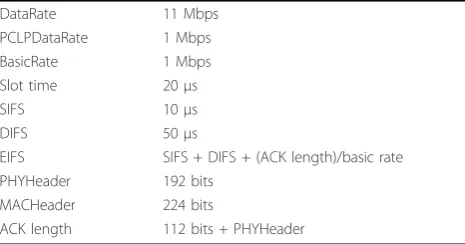
impossibility theorem) [16] states that there is no gen-eral algebraic solution to polynomial equations of the fifth degree or higher. For this reason, an algebraic solu-tion is impossible with (16) when M is greater than 5. Therefore, with the network parameters provided in Table 1 we adopt a numerical method to solve (16) while all nodes in the network are transmitting constant length data packets, and observe the relation between the CW (2/τ) andM.
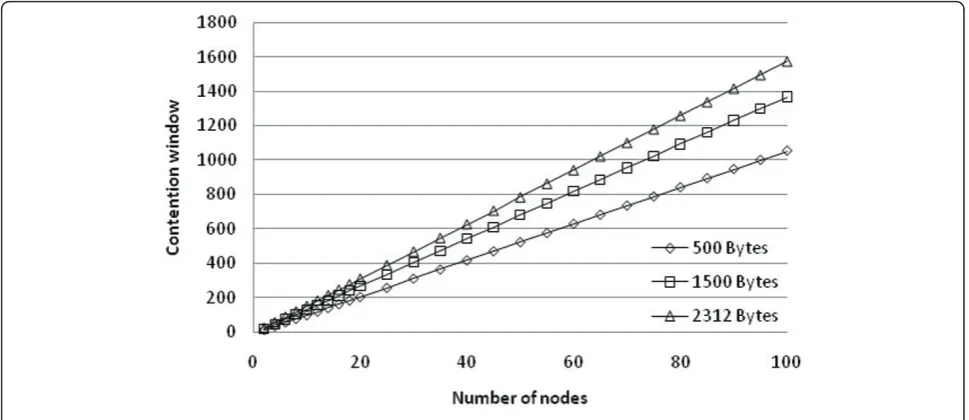
In Figure 1, the x-axis represents the number of
nodes, they-axis represents the CW (2/τ), and the num-bers 500, 1500, and 2312 represent constant packet sizes in bytes. Figure 1 clearly shows that the relationship between the CW (2/τ) andM is linear (other packet size have the same linear relationship). Therefore, we con-ducted regression analyses to solve the relationship between the CW (2/τ) and M, the results of which are shown in Table 2. (The results of different packet sizes are illustrated in Appendix C.)
In Table 2 the value of R2 is almost equal to 1. This verifies that the result of the regression analysis is almost consistent with the solution of (16).
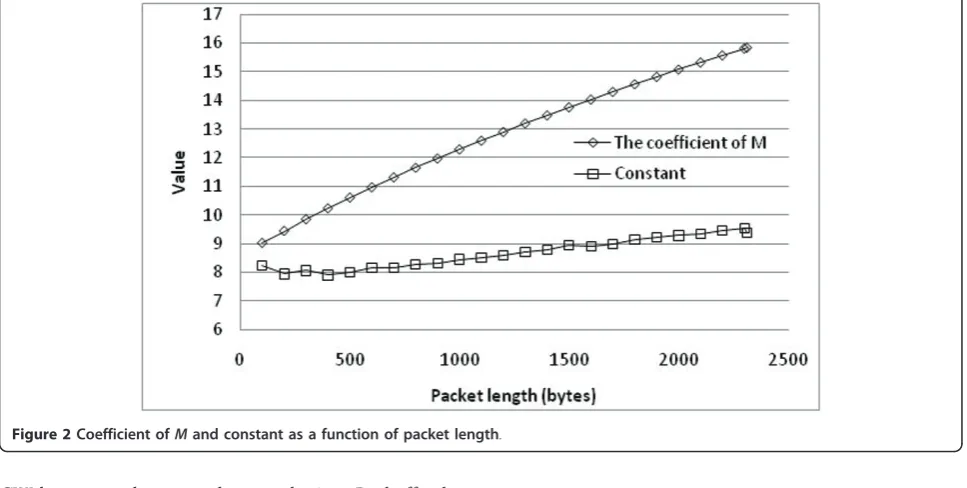
The results of Appendix C indicate that different packet sizes lead to different results for regression analysis. Figure 2 shows the relationship of the packet size to the first-degree coefficient and the constant in Appendix C.
In Figure 2, thex-axis represents the length of the packet, and they-axis represents the first-degree coeffi-cient and the constant. The curves for the coefficoeffi-cient ofM and constant represent the first-degree coefficients and the constant, respectively. The results of Figure 2 clearly show that the packet length is linearly related to both the first-degree coefficient and the constant term. Therefore, by applying quadratic regression analysis to Figure 2, we obtained the coefficients of determination for the coeffi-cients ofMand the constant term in Table 3.
As shown in the table, the R2 values are both greater than 0.975. This implies that the quadratic fit to the results in Figure 2 is good. In order to obtain the CW size of maximum throughput, we must first substitute
Table 1 WLAN parameters
DataRate 11 Mbps
PCLPDataRate 1 Mbps
BasicRate 1 Mbps
Slot time 20μs
SIFS 10μs
DIFS 50μs
EIFS SIFS + DIFS + (ACK length)/basic rate PHYHeader 192 bits
MACHeader 224 bits
the packet length into Table 3 to solve the number of nodes and the coefficients of the linear equation of the CW, and then substitute the number of nodes into the target linear equation. We thereby obtain the CW size of maximum throughput. Therefore, in the next section, we propose the DCW algorithm.
4. DCW algorithm
In order to achieve maximum throughput with the ana-lyses from Appendix C and Table 3 with the network environment parameters presented in Table 1 we com-bined the equations from Appendix C and Table 3 into (17). Here, the size of the CW is strongly related to the number of nodes (M) and the packet length (X).
CW =
−3.71095×10−7X2 + 3.9512×10⁻³X + 8.6886M
+1.32129×10−7X2 + 4.1818×10⁻⁴X + 7.8933
(17)
In (17), we only need to substitute the packet length
into X and the number of nodes into M to obtain the
CW size of maximum throughput.
The proposed DCW algorithm (DCW) is shown in Figure 3.
When transmitting data using DCW, it is called upon to obtain the Backoff value regardless of the suc-cess or failure (data retransmission required) of data
transmission. After each aSlotTime, the Backoff Time reduces an aSlotTime, and if the medium is busy dur-ing an aSlotTime, the reduction of an aSlotTime from Backoff Time is stopped until the medium is once again idle. When the medium becomes idle, it must wait for a DIFS time before continuing the countdown of the Backoff Time. The countdown goes on until the Backoff Time reaches 0, after which data transmission begins.
There have already been many methods proposed by other authors to estimate the number of nodes in the network [17,18], by applying these methods in the pro-posed DCW. DCW is then suitable for network environ-ments in which the number of nodes changes dynamically.
4.1. Backoff counter CFP
In IEEE 802.11, when a node completes its data trans-mission, it obtains another Backoff value via the Backoff procedure before it starts another round of data trans-mission. If the Backoff value obtained from the Backoff procedure is 0, it indicates that the node that has a Backoff value of 0 may transmit data packets immedi-ately without reducing its value, while it also indicates that other nodes may not reduce their Backoff values. However, a transiting node that consecutively obtains a Backoff value of 0 will result in all other nodes to freeze their reduction in the Backoff procedure. This type of phenomenon is referred to as a Backoff Counter CFP [15,19].
The occurrence probability of CFP is determined by the number of nodes and the CW size. There are two conditions in CFP. First, if a node successfully transmits its data packets, the CFP occurrence probability is 1/
Figure 1CW as a function of the number of nodes.
Table 2 Regression analysis
Packet size (bytes)
Regression analysis (2/τ)
Coefficient of determination (R2)
500 10.6M-8.0068 1
1500 13.762M-8.9413 1
CW because only one node may obtain a Backoff value of 0 (condition (1)). Second, if multiple nodes transmit data packets simultaneously, the average CFP occur-rence probability is 1 - (1 - 1/CW)k (when a collision occurs, kis the average number of nodes that partici-pates in the collision) (condition (2)). This is because
there are k nodes on average trying to transmit data
packets simultaneously, and hencek nodes on average
may obtain a Backoff value of 0.
The DCW did not take the phenomenon of CFP into consideration during the analysis process. This is because the occurrence probability of CFP is very low in DCW; in particular, when the number of nodes increases, the occurrence probability of CFP declines.
In DCW, CW = C1 * M + C2, where M is the
num-ber of nodes, C1 and C2 are constants (8.5 <C1 < 16.3; -9.8 <C2 < -7.9), and the range of packet lengths is 1-2312 bytes. Therefore, when the number of nodes increases, the CW also increases in concert. Yet the occurrence probability of CFP in condition (1) decreases when the number of nodes increases. As for the occurrence probability of CFP in condition (2), the knodes on average that participate in a colli-sion must be used for the analysis. Thus, we set the
value of M in (9) to be a value that approaches
infi-nity, and then check whether kapproaches a constant
value.
lim
M→∞
M×τ−M×τ ×(1−τ)M−1 1−Pi−Ps
= 2 C1−
2 C1
e 1
−C1
1−e 2
−C1 − 2
C1
e 2
−C1
(18)
In (18), e denotes a natural number. The detailed
proof is available in Appendix B. From (18), the value of
kapproaches a constant value as the number of nodes
increases.
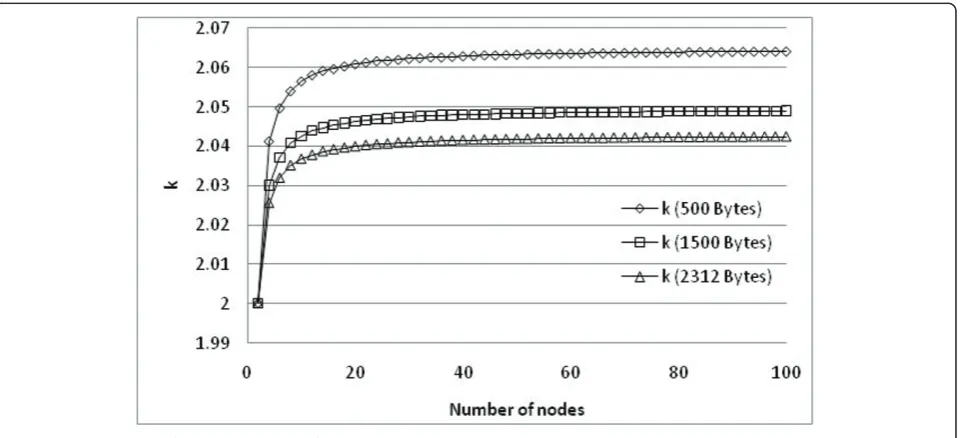
Figure 4 uses the network environment parameters presented in Table 1;x-axis represents the number of nodes, y-axis represents the kvalue, and the numbers 500, 1500, and 2312 represent packet sizes in bytes. The results of different packet lengths are presented in Appendix C.
From the results obtained from Appendix C and Fig-ure 4, the range forkis 2-2.081. This is because shorter the data packet length, the larger the value of k. How-ever, it is impossible to have a data packet less than 1 byte. Therefore, the maximum value ofkis the same as the data packet length of 1 byte. Therefore, the occurrence probability of CFP in condition (2) is less than 1 -(1 - 1/CW)2.81, although CW increases as the number of
Figure 2Coefficient ofMand constant as a function of packet length.
Table 3 Coefficient ofMand constant
Regression analysis (X: packet length) Coefficient of determination (R2)
nodes increases where the occurrence probability of CFP in condition (2) becomes increasingly smaller.
From the above analysis on the occurrence probability of CFP, the occurrence probability of CFP is very low when using the DCW method. This also implies that in situations where the number of nodes propagates, the impact of CFP may be neglected.
5. Simulations
5.1. Environmental settings
In this article, we use NS2 [20] as the simulation tool and use the network environment parameters presented in Table 1 as simulation parameters. Each simulation runs for 100 simulated seconds. The simulation uses the normalized throughput indicated in (14) and the
backofftime()
//
M
: number of nodes
//
X
: packet length
//
C1
: the coefficient of
M
//
C2
: the coefficient of constant
//
CW
: contention window
// aSlotTime: the value of the correspondingly named PHY characteristic
C1
= -3.71095
10
-7X
2+ 3.9512
10
-3X
+ 8.6886
C2
= 1.32129
10
-7X
2+ 4.1818
10
-4X
+ 7.8933
CW
=
C1
M
+
C2
// {0, 1, 2, …,
CW
-1} Randomly selected integer value
backoff_value
= Uniform (
CW
)
return
backoff_value
×aSlotTime
Figure 3DCW algorithm.
collision probability indicated in (4) as performance indicators.
5.2. Different data packet lengths
We are currently using DCW and different data packet lengths to verify the analyses of (9) and (14).
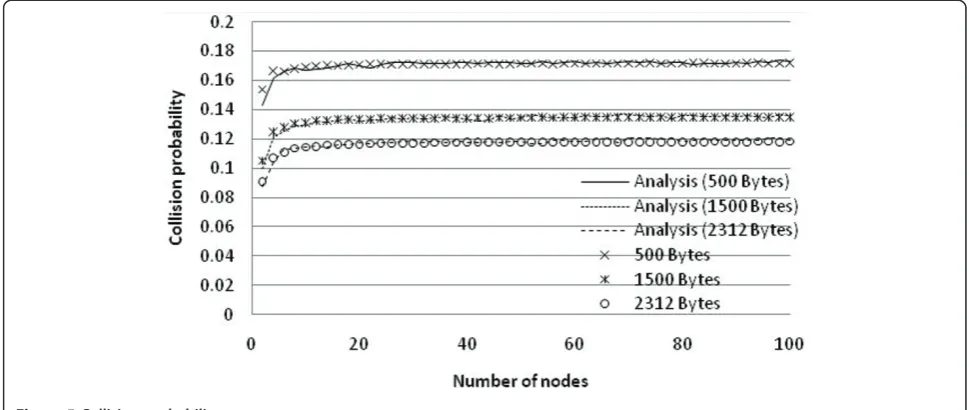
In Figure 5, the x-axis represents the number of
nodes, y-axis represents the collision probability, and the numbers 500, 1500, and 2312 are the numerical results for the corresponding packet sizes in bytes sub-stituted into (9), and 500, 1500, and 2312 are the simu-lation results for the corresponding packet sizes in bytes. The different data packet lengths show similar results, as shown in Figure 5. CW is an integer, and it is essential to round 2/τoff to an integer. For this reason, the analysis results show non-smooth characteristics. The results of Figure 5 show that the simulated and analytical results are very close.
Using the tdistribution and under 99% confidence
level, the experiments sampling error for 500, 1500 and 2312 bytes is within ± 0.141%, ± 0.193%, and ± 0.302%, respectively.
In Figure 6, the x-axis represents the number of
nodes,y-axis represents the normalized throughput, and the numbers 500, 1500, and 2312 are the numerical results for the corresponding packet sizes in bytes sub-stituted into (14), and 500, 1500, and 2312 are the simu-lated results using the corresponding packet sizes in bytes. The different data packet lengths show similar results, as shown in Figure 6. CW is an integer, and it is essential to round 2/τoff to an integer. For this reason, the analysis results also show non-smooth characteris-tics. The results of Figure 6 show that the simulated and analytical results are very close.
Using thetdistribution and under 99% confidence level, the experiments sampling error for 500, 1500, and 2312 bytes is within ± 0.656%, ± 0.559%, and ± 0.733%, respectively.
5.3. Comparison between different algorithms
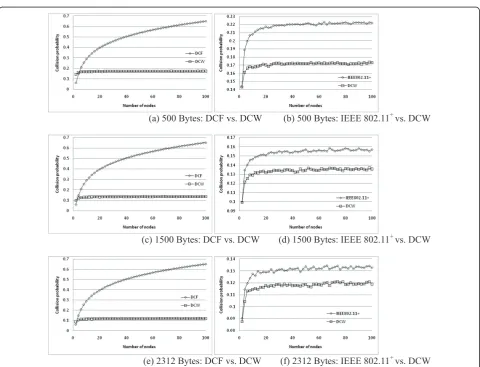
We compare DCW with other algorithms to verify that the DCW is able to provide a relatively close approxi-mation to the maximum throughput. In order to show the differences in IEEE 802.11+ [4] and DCW, the scale for they-axis in Figure 7a, c, e (DCF versus DCW) as well as Figure 7b, d, f (IEEE 802.11+ versus DCW) is
dif-ferent. IEEE 802.11+ is very close to the maximum
throughput; however, by narrowing the distance between the y-axis scale spans, we can clearly see that the DCW provides an even closer approximation to the maximum throughput than IEEE 802.11+.
In Figure 7, thex- andy-axes represent the number of nodes and the collision probability, respectively. The DCF curve uses the standard IEEE 802.11 algorithm, and the curve for IEEE 802.11+ uses the algorithm pre-sented in [4] where the number of nodes is known. Similar results are obtained for different packet lengths, as shown in Figure 7. From these results, the collision probability is lower in DCW than in the other two algo-rithms. The DCF shows lower collision probability only when the number of nodes is between 2 and 4.
Using the tdistribution and under 99% confidence
level, the DCF experiments sampling error for 500, 1500, and 2312 bytes is within ± 0.134%, ± 0.265%, and
± 0.444%, respectively, and the IEEE 802.11+
experi-ments sampling error for 500, 1500, and 2312 bytes is within ± 0.154%, ± 0.248%, and ± 0.291%, respectively.
In Figure 8, thex- andy-axes represent the number of nodes and the normalized throughput, respectively. The
Figure 6Normalized throughput.
(a) 500 Bytes: DCF vs. DCW (b) 500 Bytes: IEEE 802.11+vs. DCW
(c) 1500 Bytes: DCF vs. DCW (d) 1500 Bytes: IEEE 802.11+vs. DCW
(e) 2312 Bytes: DCF vs. DCW (f) 2312 Bytes: IEEE 802.11+vs. DCW
Figure 7Collision probability.(a)500 bytes: DCF versus DCW.(b)500 bytes: IEEE 802.11+versus DCW.(c)1500 bytes: DCF versus DCW.(d)
DCF curve uses the standard IEEE 802.11 algorithm, and the curve for IEEE 802.11+uses the algorithm presented in [4] where the number of nodes is known. Similar results are obtained for the different packet lengths, as shown in Figure 8. From these results, the normalized throughput is higher in DCW than in the other two algorithms.
Although IEEE 802.11+ and DCW show similar results
when the packet lengths are 1500 and 2312 bytes, DCW still shows relatively high normalized throughput.
Using the tdistribution and under 99% confidence
level, the DCF experiments sampling error for 500, 1500, and 2312 bytes is within ± 0.413%, ± 0.556%, and
± 0.768%, respectively, and the IEEE 802.11+
experi-ments sampling error for 500, 1500, and 2312 bytes is within ± 0.664%, ± 0.669%, and ± 0.678%, respectively.
6. Conclusions
In this article, we take the influence of EIFS into consid-eration whereas previous literatures did not. In doing so, we are able to provide analysis results that are much
closer to simulated results. An observation of the results clearly indicates that the influence of EIFS should not be ignored. Moreover, this article also proposes an algo-rithm that is distinct from others that only use numeri-cal methods. This algorithm is able to find the CW size of maximum throughput immediately by substituting the packet length and number of nodes into a binary cubic equation. From the mathematical analyses pro-vided in this article, it is shown that the influence of CFP is extremely small or even negligible using pro-posed algorithm.
For studies in the near future, other parameters of network environments can be considered for multidi-mensional experiments. For example, different values for DataRate can be used for a more realistic wireless net-work environment.
Appendix A
The inference process of maximum throughput is differ-entiated byτin (15).
(a) 500 Bytes: DCF vs. DCW (b) 500 Bytes: IEEE 802.11+vs. DCW
(c) 1500 Bytes: DCF vs. DCW (d) 1500 Bytes: IEEE 802.11+vs. DCW
(e) 2312 Bytes: DCF vs. DCW (f) 2312 Bytes: IEEE 802.11+vs. DCW
Figure 8Normalized throughput. (a)500 bytes: DCF versus DCW.(b)500 bytes: IEEE 802.11+versus DCW.(c)1500 bytes: DCF versus DCW.(d)
∴When tColl
(1−τ)M−1+(tslot−tColl)−τ×(M−1)× tColl
(1−τ)M= 0, the
through-put assumes an extreme value
∴ tColl
tColl is proven.
Appendix B
When collision occurs, the average number of nodes that participate in a collision isk. When the number of
nodes approaches infinity and DCW is used, k
approaches a constant value. From the results of (17), when the packet length is fixed,
CW =C1×M+C2, (B1)
where CW is the contention window,C1 andC2 are
constants, and M is the number of nodes. Thus, the
probability of transmissionτis
τ = 2/E[CW] = 2/CW = 2/(C1×M + C2) (B2)
When the number of nodesM approaches infinity,
lim
infinity, Ps approaches 2
C1
, when M approaches
infinity, we obtain the following using (B2), (B3), and (B4):
From the results of (B5), when the number of nodes
approaches infinity and DCW is used, k approaches a
constant value.
Appendix C
Equation 16 uses the network parameters provided in Table 1 and packet size in the range of 1-2312 bytes. When solving the relationship between contention win-dow (2/τ) and M, we obtain the results presented in
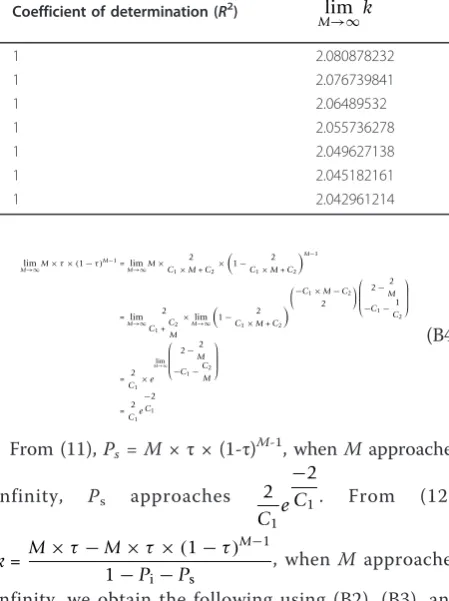
table 4 using regression analysis, where lim
M→∞k is
obtained by (B5):
Acknowledgements
This study was supported in part by the National Science Council, Taiwan, under Grant NSC99-2221-E-142-007.
Table 4 Regression analysis results and limits ofk
Packet size (100-500 bytes) Regression analysis (2/τ) Coefficient of determination (R2) lim
M→∞k
1 8.5684M-8.1523 1 2.080878232
100 9.0133M-8.2238 1 2.076739841
500 10.6M-8.0068 1 2.06489532
1000 12.289M-8.4472 1 2.055736278
1500 13.762M-8.9413 1 2.049627138
2000 15.084M-9.2797 1 2.045182161
Author details
1Department of Mathematics Education, National Taichung University of Education, Taichung 40306, Taiwan2Department of Computer Science and Engineering, National Chung Hsing University, Taichung 402, Taiwan
Competing interests
The authors declare that they have no competing interests.
Received: 15 April 2011 Accepted: 20 September 2011 Published: 20 September 2011
References
1. IEEE Computer Society, IEEE standard 802.11, wireless LAN medium access control (MAC) and physical layer (PHY) specifications (New York, 1999) 2. H Minooei, H Nojumi, Performance evaluation of a new backoff method for
IEEE 802.11. Comput Commun.30(18), 3698–3704 (2007). doi:10.1016/j. comcom.2007.07.003
3. L Yun, L Ke-Ping, Z Wel-Liang, C Qian-Bin, A novel random backoff algorithm to enhance the performance of IEEE 802.11 DCF. Wirel Personal Commun.36(1), 29–44 (2006). doi:10.1007/s11277-006-6176-8
4. F Cali, M Conti, E Gregori, Dynamic tuning of the IEEE 802.11 protocol to achieve a theoretical throughput limit. IEEE/ACM Trans Netw.8(6), 785–799 (2000). doi:10.1109/90.893874
5. R Bruno, M Conti, E Gregori, A simple protocol for the dynamic tuning of the backoff mechanism in IEEE 802.11 networks. Comput Netw.37(1), 33–44 (2001). doi:10.1016/S1389-1286(01)00197-9
6. Y Chetoui, N Bouabdallah, Adjustment mechanism for the IEEE 802.11 contention window: an efficient bandwidth sharing scheme. Comput Commun.30(13), 2686–2695 (2007). doi:10.1016/j.comcom.2007.06.006 7. B-J Kwak, N-O Song, LE Miller, Performance analysis of exponential backoff.
IEEE/ACM Trans Netw.13(2), 343–355 (2005)
8. L Bononi, M Conti, E Gregori, Runtime optimization of IEEE 802.11 wireless LANs performance. IEEE Trans Parallel Distrib Syst.14(12), 1–15 (2003) 9. R Bruno, M Conti, E Gregori, Optimization of efficiency and energy
consumption in p-persistent CSMA-based wireless LANs. IEEE Trans Mobile Comput.1(1), 10–31 (2002). doi:10.1109/TMC.2002.1011056
10. F Cali, M Conti, E Gregori, IEEE 802.11 protocol: design and performance evaluation of an adaptive backoff mechanism. IEEE J Sel Areas Commun. 18(9), 1774–1786 (2000). doi:10.1109/49.872963
11. Y Kwon, Y Fang, H Latchman, A novel MAC protocol with fast collision resolution for wireless LANs, inProceedings of the IEEE INFOCOM’03,2, 853–862 (2003)
12. T-H Lee, A Marshall, B Zhou, An optimization scheme for energy efficient ad-hoc wireless networks operating in error-prone channel conditions, in Proceedings of the World Congress on Engineering 2009, vol. 1. (London, UK, 2009). WCE 2009, July 1-3
13. AHM Rad, J Huang, M Chiang, VWS Wong, Utility-optimal random access without message passing. IEEE Trans Wirel Commun.8(3), 1073–1079 (2009) 14. G Bianchi, Performance analysis of the IEEE 802.11 distributed coordination
function. IEEE J Sel Areas Commun.18(3), 535–547 (2000). doi:10.1109/ 49.840210
15. G Bianchi, I Tinnirello, Remarks on IEEE 802.11 DCF performance analysis. IEEE Commun Lett.9(8), 765–767 (2005). doi:10.1109/LCOMM.2005.1496609 16. RG Ayoub, Paolo Ruffini’s contributions to the quintic. Arch History Exact
Sci.23(3), 253–277 (1980). doi:10.1007/BF00357046
17. AL Toledo, T Vercauteren, X Wang, Adaptive optimization of IEEE 802.11 DCF based on Bayesian estimation of the number of competing terminals. IEEE Trans Mobile Comput.5(9), 1283–1296 (2006)
18. G Bianchi, I Tinnirello, Kalman filter estimation of the number of competing terminals in an IEEE 802.11 network. inProc Infocom 2003,2, 844–852, (March 2003)
19. CH Foh, JW Tantra, Comments on IEEE 802.11 saturation throughput analysis with freezing of backoff counters. IEEE Commun Lett.9(2), 130–132 (2005). doi:10.1109/LCOMM.2005.02008
20. Network Simulator http://www.isi.edu/nsnam/ns/
doi:10.1186/1687-1499-2011-105
Cite this article as:Huang and Kuo:Dynamic tuning of the IEEE 802.11 distributed coordination function to derive a theoretical throughput limit.EURASIP Journal on Wireless Communications and Networking2011
2011:105.
Submit your manuscript to a
journal and benefi t from:
7Convenient online submission
7Rigorous peer review
7Immediate publication on acceptance
7Open access: articles freely available online
7High visibility within the fi eld
7Retaining the copyright to your article