DEVELOPMENT AND EVALUATION OF A WEB-BASED LEARNING SYSTEM BASED ON LEARNING OBJECT DESIGN AND GENERATIVE LEARNING TO
IMPROVE HIGHER-ORDER THINKING SKILLS AND LEARNING
TAN WEE CHUEN
DEVELOPMENT AND EVALUATION OF A WEB-BASED LEARNING SYSTEM BASED ON LEARNING OBJECT DESIGN AND GENERATIVE LEARNING TO
IMPROVE HIGHER-ORDER THINKING SKILLS AND LEARNING
TAN WEE CHUEN
A thesis submitted in fulfilment of the requirements for the award of the degree of
Doctor of Philosophy
Faculty of Education Universiti Teknologi Malaysia
iv
ACKNOWLEDGEMENT
In preparing this thesis, I was in contact with many people, researchers, academicians, and practitioners. They have contributed towards my understanding and thoughts. In particular, I wish to express my deepest appreciation to my thesis supervisors, Associate Professor Dr. Baharuddin Aris and Professor Dr. Mohd Salleh Abu for guidance, encouragement, critics and friendship. My sincere appreciation also extends to the experts and researchers whom I was contacted during my research. Their views and suggestions are useful indeed.
I am also indebted to Southern College and Lee Foundations for funding my Ph.D. study. I am also very thankful the librarians at UTM, National Institute of Education Singapore and National University of Singapore for their assistance in supplying the relevant literatures.
ABSTRACT
vi
ABSTRAK
TABLE OF CONTENTS
CHAPTER TITLE PAGE
DECLARATION i
DEDICATION iii
ACKNOWLEDGEMENTS iv
ABSTRACT v
ABSTRAK vi
TABLE OF CONTENTS vii
LIST OF TABLES ix
LIST OF FIGURES xviii
LIST OF ABBREVIATION xx
LIST OF APPENDICES xxi
1 INTRODUCTION
1.0 Introduction 1
1.1 Research Background 2
1.1.1 Higher Order Thinking Skills 3
1.1.2 HOTS and Computer Science 4
1.1.3 Generative Learning and HOTS 6
1.1.4 Learning Object Design 9
1.1.5 Generative Learning, HOTS, Learning Object Design and Web Technology
11
1.1.6 Instructional Design Model 13
1.2 Problem Statements 14
viii
1.4 Research Objectives 20
1.5 Research Questions 20
1.6 Research Theoretical Framework 21
1.7 The Framework of Instructional Design Model 27
1.8 Research Importance 29
1.9 Research Scope and Limitation 30
1.10 Operational Definition 31
1.11 Summary 35
2 LITERATURE REVIEW
2.0 Introduction 36
2.1 Higher Order Thinking Skills Learning Object 37 2.1.1 Higher-Order Thinking Skills Teaching
Programs and Practice
38
2.1.2 Definitions of HOTS Attributes of Learning Object
42
2.1.3 Instructional Strategies for HOTS Granularity of Learning Object
48
2.1.4 Technology and HOTS Metadata of Learning Object
51
2.1.5 Research Studies on HOTS 53
2.1.6 Research Studies of Using Technology to Improve HOTS
54
2.1.7 HOTS in Computer Science Learning 57
2.2 Learning Object 59
2.2.1 What is Learning Object Design? 60 2.2.2 Attributes of Learning Object 62 2.2.3 Granularity of Learning Object 63
2.2.4 Metadata of Learning Object 65
2.2.6 Research Studies on Learning Object Design 67 2.3 Generative Learning and Learning Object Design 69 2.4 Generative Learning, HOTS and Learning Object
Design
75
2.5 Web-Based Learning 76
2.5.1 Web-Based Learning and Learning Object Design
78
2.6 Learning of Computer System 80
2.6.1 Learning Problems of Computer System 80 2.6.2 How to Teach and Learn Computer System 83
2.7 Instructional Design Model 86
2.8 Summary 87
3 RESEARCH METHODOLOGY
3.0 Introduction 89
3.1 An Overview of the HOTS Assessment 89
3.2 Research Framework 95
3.2.1 Phase I: Analysis 97
3.2.2 Phase II: Design 100
3.2.3 Phase III: Development 101
3.2.4 Phase IV: Implementation 102
3.2.5 Phase V: Evaluation 102
3.2.5.1 Formative Evaluation 103
3.2.5.2 Summative Evaluation 106
3.3 Sampling 109
3.3.1 Learners Sampling 109
3.3.2 Expert Sampling 111
3.3.3 Lecturers Sampling 112
3.4 Research Instruments 112
x
3.4.2 Pre-test and Post-test 114
3.4.3 Rubric 115
3.4.4 Electronic Portfolio 116
3.4.5 Interview 117
3.5 Data Analysis 117
3.5.1 Analysis of Students’ Current Level of HOTS From the Conventional Teaching and
Learning of Computer System (CS)
118
3.5.2 Analysis of the Effectiveness of the Web-based Learning System in the Improvement of Students’ Learning
119
3.5.3 Analysis of the Effectiveness of the Web-based Learning System in the Improvement of HOTS
120
3.5.4 Analysis of the Effectiveness of the Web-based Learning System in HOTS Engagement
121
3.5.5 Analysis of the Effectiveness of the Web-based learning system as Perceived by the Lecturers and Students
121
3.6 Summary 122
4 SYSTEM DESIGN AND DEVELOPMENT
4.0 Introduction 123
4.1 Web-Based Learning in Southern College 123 4.2 Design and Development of the Web-based Learning
System
125
4.3 A Pedagogical Design Learning Conceptual Model: GLOOTT
127
4.4 GOOD Learning System 131
4.5.1 The Metadata Elements 136 4.6 The Design and Development of GOOD Learning
System
138
4.6.1 Students Log In 141
4.6.1.1 Upload Learning Objects 142
4.6.1.2 Design Learning 143
4.6.1.2.1 Implementation of GLOOTT Model in Learning Tasks of GOOD Learning System
143
4.6.1.3 Forum 154
4.6.1.4 Message from the Instructor 154 4.6.1.5 Others Feature That Support
Learning
155
4.6.2 Instructor Log In 156
4.6.2.1 Uploading Tasks 157
4.7 GOOD Learning System as Mindtool to Engage Learners in HOTS
159
4.8 Summary 161
5 DATA ANALYSIS AND RESULTS
5.0 Introduction 162
5.1 Data Analysis of Students’ Current Level of HOTS From the Conventional Teaching and Learning of Computer System
162
5.2 Analysis of the Effectiveness of GOOD Learning System in the Improvement of Students’ Learning
165
5.3 Analysis of the Effectiveness of GOOD Learning System in the Improvement of HOTS
167
xii
System in the Students’ HOTS Engagement 5.5 Analysis of the Effectiveness of GOOD Learning
System as Perceived by Instructors
177
5.6 Analysis of the Effectiveness of the Web-based Learning System as Perceived by Students
186
5.7 Summary 198
6 DISCUSSIONS AND CONCLUSION
6.0 Introduction 199
6.1 Research Summary 199
6.2 Discussion 201
6.2.1 Current Level of HOTS of Students from the Conventional Teaching and Learning of Computer System (CS)
202
6.2.2 Effectiveness of GOOD Learning System in the Improvement of Students’ Learning
202
6.2.3 Effectiveness of GOOD Learning System in Improving HOTS
203
6.2.4 Effectiveness of GOOD Learning System in HOTS Engagement
204
6.2.5 Effectiveness of GOOD Learning System as Perceived by the Lecturers
205
6.2.6 Effectiveness of GOOD Learning System as Perceived by the Students
206
6.3 Implications of the Research 208
6.4 Limitations of the Research 210
6.5 Suggestions for Further Research 211
6.7 Summary 214
REFERENCES 215
xiv
LIST OF TABLES
NUMBER OF TABLE
TITLE PAGE
1.1 Bloom Taxonomy of Thinking 32
2.1 Transitioning Learning Design 67
3.1 Data to be Collected and Research Design 96
3.2 The System Implementation Plan 102
3.3 Evaluation Plan 103
3.4 Number of Students and the Number of Lesson Maps They Had Designed
110
3.5 The Sections and Items in the WEF for Lecturer or Expert
113
3.6 The Sections and Items in the WEF for Students 114
3.7 Table for Record of Mean Score of Cognitive Operations of HOTS for Each Question
118
3.8 Table for Record of the Sum of the Students’ Scores and Percentage of Cognitive Operations for All Questions
119
3.9 Table for the Comparison of Mean Score of Each Cognitive Operation between Pre-Test and Post-Test
120
4.1 The Metadata Elements 136
5.1 Division of Questions According to the Bloom Taxonomy of Thinking
5.2 Mean Score of Each Taxonomy of Thinking for Each Question
163
5.3 The Students’ Scores and Percentage in the Taxonomy of Thinking of All Questions
164
5.4 Score of Pre-Test and Post-Test 166
5.5 Mean Scores of Pre-Test and Post-Test 166
5.6 T-Test Analysis for Mean Scores of Pre-Test and Post-Test
167
5.7 T-Test Analysis of Mean Scores for Each Cognitive Operation in Pre-Test and Post-Test
168
5.8 The HOTS Engagement of Students from Different Groups
170
5.9 Mean and Standard Deviation of Each Item in Section A
178
5.10 Mean and Standard Deviation of Each Item in Section B
178
5.11 Mean and Standard Deviation of Each Item in Section C
179
5.12 Mean and Standard Deviation of Each Item in Section D
179
5.13 Mean and Standard Deviation of Each Item in Section E
180
5.14 Mean and Standard Deviation of Each Item in Section E
180
5.15 Means and Standard Deviations of Each Item in WEF for the Lecturers
181
5.16 Aspects They Like in GOOD Learning System 183
5.17 Aspects They Don’t Like GOOD Learning System 183
5.18 Suggestions to Improve GOOD Learning System 184
xvi
Improving HOTS
5.20 The Suitability of GOOD Learning System in the Teaching and Learning of Computer System
185
5.21 The Suitability of GOOD Learning System the Teaching and Learning of Other Subjects
185
5.22 Mean and Standard Deviation of Each Item in Section A
186
5.23 Mean and Standard Deviation of Each Item in Section B
187
5.24 Mean and Standard Deviation of Each Item for WEF Student in
Section C
187
5.25 Mean and Standard Deviation of Each Item in Section D
188
5.26 Mean and Standard Deviation of Each Item in Section E
188
5.27 Means and Standard Deviations of Each Item in WEF for the Students
189
5.28 Comments from the Students About GOOD Learning System
190
5.29 Suggestions from the Students About GOOD Learning System
191
5.30 GOOD Learning System in Improving HOTS 192
5.31 GOOD Learning System in Developing Problem Solving Skills
192
5.32 Parts of GOOD Learning System that Engages Students in HOTS
193
5.33 Cognitive Operations of HOTS They Aware of in GOOD Learning System
194
5.34 The Effectiveness of GOOD Learning System in Improving CS
5.35 The Effectiveness of GOOD Learning System in the Understanding of the Vocabulary Used In Computer
195
5.36 The Effectiveness of GOOD Learning System in Developing the Concept of Computer
195
5.37 The Effectiveness of GOOD Learning System in Improving Your Problem Solving Skills in CS
196
5.38 Feedbacks from the Students about the Importance of HOTS in Learning CS
196
5.39 The Importance of HOTS Improvement in Learning Others Computer Science Subject
197
5.40 The Use of HOTS in the Posttest 197
5.41 Outcome of the Use of HOTS in the Posttest 197
5.42 GOOD Learning System in Helping Students in Learning CS
xviii
LIST OF FIGURES
FIGURE NO TITLE PAGE
1.1 Conceptual Model Derived from the Research Theoretical Framework
25
1.2 The Framework of ID Model Modified from ISDMELO (Baruque and Melo, 2003)
28
3.1 The Design Framework of HOTS Assessment (Adapted from Costa and Kallick, 2000)
92
3.2 Pre-Experimental Design, One-Group Pretest-Posttest Design 106 3.3 The Distribution of Lesson Maps of the Students 111
4.1 An Example of Interactive Learning Objects 133
4.2 An Example of Web Page Learning Objects 134
4.3 An Example of Learning Objects Designed as Table 134 4.4 An Example of Learning Objects Designed as Graphic 135 4.5 The Suggested Flow of Learning Activities in GOOD
Learning System
139
4.6 The Main Page of GOOD Learning System 140
4.7 The Introduction to GOOD Learning System 140
4.8 Home Page of Student Log In 141
4.9 Mr. TQ 141
4.10 Uploading Learning Objects of Students 142
4.12 GLOO Design in GOOD Learning system 144
4.13 Search Engine and Learning Objects in Library 145
4.14 Lesson Mapping in Learning Object Organizer 146
4.15 Course Map 149
4.16 Try It Out 150
4.17 Apply It 151
4.18 “How Am I Doing” Checklist 152
4.19 Chart of How Am I Doing Checklist 152
4.20 Reflection Worksheet 153
4.21 Forum 154
4.22 The Messages from the Instructor 155
4.23 Mr. TQ, the Information Agent in GOOD Learning System 156 4.24 Mr. TQ Helps Students to Reflect Their Learning Tasks 156
4.25 Upload Subject and Subtopics 157
4.26 Message to the Student 158
4.27 Thinking Task Generator 159
5.1 Chart of the Mean Score in the Taxonomy of Thinking for Each Question
164
5.2 Percentage of the Total Score for the Taxonomy of Thinking of All Questions
165
5.3 Mean Scores of Cognitive Operations for Pre-Test and Post-Test
169
5.4 The Engagement of HOTS from Each Chapter for Student P12
172
xx
P29
5.6 The Engagement of HOTS from Each Chapter for Student P2 173 5.7 The Engagement of HOTS from Each Chapter for Student P9 174 5.8 The Engagement of HOTS from Each Chapter for Student
P21
174
5.9 The Engagement of HOTS from Each Chapter for Student P24
175
5.10 The Engagement of HOTS from Each Chapter for Student P27
175
5.11 The Engagement of HOTS from Each Chapter for Student P18
176
5.12 The Engagement of HOTS from Each Chapter for Student P19
176
5.13 The Engagement of HOTS from Each Chapter for Student P30
LIST OF ABBREVIATION
HOTS - Higher Order Thinking Skills
LOTS - Lower Order Thinking Skills
CS - Computer System
ICT - Information Communication Technology
MOE - Ministry of Education
GLOOTT - Generative Learning Organizer and Thinking Task GLOO - Generative Learning Organizer
TT - Thinking Tasks
LOO - Learning Object Organizer
LOR - Learning Object Repository
LOs - Learning Objects
LMS - Learning Management System
LORI - Learning Object Review Instrument
WEF - Web-based Learning System Evaluation Form
ISDMELO - Instructional System Design Methodology based on e-Learning Object
ADDIE - Analysis, Design, Development, Implementation, Evaluation
DFD - Data Flow Diagram
ID - Instructional Design
ISD - Instructional Systems Development
IMS - Instructional Management System
MOODLE - Modular Object-Oriented Dynamic Learning Environment SCORM - Sharable Content Object Reference Model
xxii
LIST OF APPENDICES
APPENDIX TITLE PAGE
A Rubric of Higher Order Thinking Skills Evaluation 255
B “How Am I Doing” Checklist 257
C System Data Flow (DFD) diagram 258
D1 Web-Based Learning Evaluation Form : Expert/Lecturer
266
D2 Web-Based Learning Evaluation Form: Student 272
E Pre-Test And Post-Test Questions 275
F Interview 278
G Research Instrument Validation (GOOD Learning System Evaluation Form)
279
H Research Instrument Validation (GOOD Learning System Evaluation Form for Students)
281
I Research Instrument Validation (Pre-Test and Post-Test)
283
J Research Instrument Validation (Pre-Test and Post-Test)
284
K Research Instrument Validation (Rubric of HOTS) 285
L Research Instrument Validation (“How am I Doing” Checklist)
286
N Expert Validation: Design of the Web-based Learning System
288
O List of Papers Publication 289
P Content of Computer Hardware 290
Q Score of LOTS And HOTS For Pretest And Posttest 292
R Analysis of The Distribution of Students’ Scores In Pretest and Posttest
CHAPTER ONE
INTRODUCTION
1.0 Introduction
The emergence of World Wide Web has caused a lot of changes and innovations in the way people communicate, work, and learn. It has mesmerized educators for over a decade with its potential of distributed learning and universal educational resources delivery. An educational revolution is gradually taking place, which includes changes in the development and delivery of instruction. The changes provide an opportunity to improve the learning with the appropriate use of learning theories that are coupled with technologies.
While a lot of people are eagerly developing the Web-based learning environment, there are question marks on how to keep the online learners captivated and self-motivated to achieve the learning objectives and able to use higher order thinking skills (HOTS). One of the solutions is to identify the learners’ needs, and economically customize the individual learning in order to promote the successful learning (Wiley, 2000). This has brought to the transition from the one-size-fits-all approach to customization with the growing use of the learning object design (LTSC, 2000). Learning object is an instructional technology currently used by the educational technologists and instructional designers for the choice of the instructional design, development and delivery (Hodgins, 2001; Wiley, 2000).
This chapter provides a background study for the research project by providing an overview of learning objects and generative learning, higher order thinking skills (HOTS) and the instructional design model. Besides, the statements of problem, suggestions of problem solving, objectives of research, questions of research, suggested framework of instructional design model, framework of research theory, rational of research, importance of research, scope and limitation of research, and the definition of terminology used in research are discussed in this chapter.
1.1 Research Background
3
1.1.1 Higher Order Thinking Skills
Higher order thinking skills (HOTS) represent multi-faceted and complex cognitive processes that develop and improve the processing and construction of information (Resnick, 1987; Swartz, 2001). The term HOTS used in this research refers to the analysis, synthesis and evaluation according to Bloom’s Taxonomy of thinking (Bloom et al., 1956). Thus, the recall of knowledge, comprehension and application are classified as lower order thinking skills (LOTS) (Dori, Tal and Tsaushu, 2003; Bloom et al., 1956; Morgan, 1996). Skills such as analyzing, synthesizing and evaluating information in the learning process are important in order to develop HOTS (Bloom et al., 1956; Bloom, Hasting and Madaus, 1971; Ennis, 1987; Zohar, Weinberger and Tamir, 1994; Jonassen, 1992; Tal and Hochberg, 2003; Morgan, 1996). A lot of researchers have pointed out the increasing importance of HOTS in the teaching and learning process.
Problem solving requires the use of HOTS such as analysis, synthesis and evaluation. This is in line with the argument from Kallick (2001a) that the cognitive operations such as analyzing, inferring and evaluating are necessary in problem solving. According to Jonassen (1992), argumentation is an appropriate outcome for problem solving where students generate arguments and make reasoning to defend their solutions. This encourages them in using HOTS. Besides, reflective thinking is also often related to HOTS (Quellmalz, 1987; Vockell, and van Deusen, 1989; Fogarty and McTighe, 1993; Wai and Hirakawa, 2001; Fogarty, 2002; Harrigan and Vincenti, 2004). Reflective thinking helps students to be aware of their thinking as they perform tasks or learning and this engages them in HOTS. Hence, the reflective thinking was used as an important cognitive operation for scaffolding the encouragement of HOTS in this research.
evaluate in generating knowledge. The manipulation of information and ideas through these processes allows students to solve problem, generate knowledge and promote understanding.
1.1.2 HOTS and Computer Science
As technology changes at an ever-increasing speed, the students must have the ability to adapt to changes and become lifelong learners. This is especially true in the computing field. The students have to be good in both thinking and problem solving skills. However, most of the colleges focus more on rote lecturing, assignments and tests (Tan Wee Chuen, Baharuddin Aris and Mohd Salleh Abu, 2005). They rarely promote HOTS among the students in order to understand and apply problem solving and logical reasoning skills in the learning of Computer Science (Parham, 2003; Arup, 2004).
Harrigan and Vincenti (2004) noted that HOTS are important in college teaching and learning. A lot of studies have been conducted to study the teaching and learning process in Computer Science domain in higher education. Empirical results from the studies show that many students can not demonstrate HOTS in their learning (Chmura, 1998; Henderson, 1986; Arup, 2004). Most of the students resort to trial and error, and memorizing facts from their learning, rather than learning problem solving skills. However, these HOTS such as analysis, synthesis and evaluation thinking skills are found important in the learning of Computer Science. This was demonstrated by Parham (2003) in which there is a direct correlation between the students’ HOTS and their performance in their learning.
5
tends to regurgitate what the instructors have taught and does not imply the ability to use HOTS among the students. This is also proven by the studies from Maj, Veal, and Charlesworth (2000); Holmboe (1999) and Mirmotahari, Holmboe and Kaasboll (2003) that the college students are lacking of knowledge of computer technology and the basic skills to operate computer systems.
Another main problem of Computer Science students is the lack of deep understanding of the relationships in the facts they have learned (Scragg, Baldwin and Koomen, 1994; Mirmotahari, Holmboe and Kaasboll, 2003). Students are better in the practical skills than theoretical questions. In computer education, the prior knowledge of students is the foundation for further knowledge construction (Holmboe, 1999; White, 2001; Mirmotahari, Holmboe and Kaasboll, 2003; Scragg, 1991). New information must be linked to information already understood (Rosenberg, 1976; Hamza, Alhalabi and Marcovitz, 2000). Learners would generate and test ideas that either have been created from their prior knowledge.
The content of the computer has to stay abreast of the rapidly developing computer technology. HOTS are essential to the students in this rapidly changing technological society (Morgan, 1996). The growth of knowledge in computer needs more timeliness in teaching resources, expertise and preparation time (Wolffe et al., 2002). This leads to a large amount of information being drained to the students. Instructors and students have been burdened with the task of communicating massive and rapidly changing computer content. Consequently, the overemphasis on content has resulted in the lack of attention on the HOTS that are necessary for the students to successfully solve the complex scenarios (Arup, 2004).
2003; Reeves, 1998; Pogrow, 1988a, 1988b). In this context, the learner acts as a designer in the learning process (Jonassen, 1994; Jonassen and Reeves, 1996). Jonassen, Mayes and McAleese (1993) found that individual learns the most from the design of instructional materials. Therefore, if the students were given opportunity to construct or design their own learning, it creates an active learning environment. This process requires the students to think more meaningfully and therefore helps to develop their HOTS.
1.1.3 Generative Learning and HOTS
A lot of instructional strategies have been proposed to develop the HOTS. One of the most frequent proposals is generative learning. Generative learning is an important constructivist learning environment (Bannan-Ritland, Dabbagh and Murphy, 2000; Dunlap and Grabinger, 1996a; Duffy and Jonassen, 1992; Morrison and Collins, 1996; Grabowski, 1996; Bonn, and Grabowski, 2001; Jonassen, Mayes and McAleese, 1993; McLoughlin, 1998). According to Bonn, and Grabowski (2001), generative learning provides the necessary theoretical framework for research in a constructivist perspective. As described by CTGV (1993), the generative learning is the first key element of constructivism learning environment. In generative learning environment, learning is generative; learners focus on the construction of their own learning. In this research, the Web-based learning system used the generative learning to design the constructive learning environment.
7
respond to the exercises or examinations that require only facts recalling and simple understanding. Dunlap and Grabinger (1996b) pointed out that generative learning is a higher-level thinking activity. HOTS depict the dynamic role of learners in which they act as thinkers actively participate in constructing knowledge. Such a view of learning fits well with the empirical evidence from the studies of technology and Computer Science learning and teaching (refer Chapter 2 for further discussion).
Learning that emphasizes on the connection between the new and old concepts, and among the concepts is important to enhance understanding (Nickerson, 1995). The connection among the concepts is also important in learning Computer Science (Rosenberg, 1976; Hamza, Alhalabi and Marcovitz, 2000). However, the conventional teaching models in Computer Science often view learning as a passive transmission on knowledge. This results in misconception, lack of conceptual understanding and the poor understanding of the relationships in the concepts that the students learned (Hadjerrouit, 1999; Maj, Veal, and Charlesworth, 2000; Holmboe, 1999; Mirmotahari, Holmboe and Kaasboll, 2003; Scragg, Baldwin and Koomen, 1994). In contrast, generative learning provides a learning environment that enhances the learning through actively construct meaningful understanding by generating relationships among the concepts.
According to Dunlap and Grabinger (1996a), content is often presented to the learners in the format that promotes memorization rather than higher order thinking. Most of the schools are still examination-oriented. The teaching and learning often focus in answering specific questions in the examinations. With the generative learning, it promotes active processing in the linkage of the concepts and supportive environment that encourages them to think and construct knowledge from their understanding. Higher education institute is the most appropriate venue for this learning approach because their goals are to promote advanced knowledge acquisition and HOTS (Jonassen, Mayes and McAleese, 1993).
map functions as a tool to engage learners to generate and to organize the ideas in the content being studied. According to Jonassen (2000), concept map engages learners in the reorganization of knowledge, explicit description of concept and their interrelationships, deep processing of knowledge that promotes better remembering, retrieval and application of knowledge; and relating new concepts to existing ones that improves understanding. This is consistent with the theoretical perspective of generative learning.
The concept map used in this research is called as lesson map. It is an outline form of concept map as suggested by Alpert and Grueneberg (2000), and Dabbagh (2001). The lesson map used in this research enables the construction of concepts require HOTS when students organize the lesson map, select important and relevant concepts to add to the map, search the crosslink and indicate the relationships between concepts. These activities engage students in HOTS that are analysis thinking while they are organizing the concepts in hierarchical structure, synthesis thinking while they are searching crosslink and indicating the relationships between the concepts and evaluating while they are searching and judging the important and relevant of the concepts (Jonassen, 2000; Dabbagh, 2001; Alpert and Grueneberg, 2000).
9
Gao and Lehman (2003) noted that most of the researches in generative learning emphasize in the facts and concepts-level learning and deal little with HOTS. Therefore, further research on generative learning that focuses on HOTS is necessary.
1.1.4 Learning Object Design
Nowadays, most of the instructional designers understood the importance of pedagogical perspectives in the design and development of Web learning environments. According to Snow (1989), instructions differ in structure and completeness and highly structured instructions (linear sequence, restricted and high external control) seem to help those with low ability but hinder those with high ability. The concept of one-size-fits-all design is no longer suitable in the design and development in e-learning. The learning environment should be highly flexible in structures and hands control out of the hands of the systems or instructors to the learners. Therefore, the concept of learning object design fits this very well as it provides flexible paths to the users’ exploration in the teaching and learning process. The non-linearity of the learning object design allows students to access information in different patterns and to take control in their own action and learning.
A learning object is a small, reusable digital component that can be selectively applied alone or in combination by computer software, learning facilitators or learners themselves, to meet individual needs for learning or performance support (Shepherd, 2000). There are three interdependent components in the learning object design model: the learning object itself; metatagging (a standardized way to describe the content in code); a Learning Content Management System (LCMS) that stores, tracks, and delivers content.
Longmire, 2000a, 2000b; Robbins, 2002; Lau, 2002; Gibbons, Nelson and Richards, 2000; Hanaffin, Hill and McCarthy, 2000; South and Monson, 2000; Collis and Strijker, 2003). The design of instructions into learning objects can be deployed into multiple setting and learning goals. It is a current trend of computer-based instructions and learning that are grounded in the object-oriented paradigm of Computer Science.
The idea of information in small chunks which are reusable and flexible in a learning environment has received a lot of compliments from the educators and instructional designers of e-learning environment. According to Reigeluth and Nelson (1997), when teachers first gain access to instructional materials, they often break the materials down into their constituting parts and then reassemble these parts in ways that support their instructional goals. Thus, the notion of small and reusable units of learning content, learning components, and learning object design have the potential to provide the flexibility and reusability by simplifying the assembly and disassembly of instructional design and development.
11
1.1.5 Relationships between Generative Learning, HOTS, Learning Object Design and Web Technology
The current design and development of learning objects has overlooked the use of learning objects in supporting learning (Bannan-Ritland, Dabbagh and Murphy, 2000; Shi et al., 2004). Most of the discussions and researches in learning objects concentrate on the standards, metadata and others technical issues related to the development of the learning object system design. The evidence of the dynamic attributes of learning object design in learning is still not well addressed (Shi et al., 2004). The unique attributes of the learning objects lies in providing a customized, individualized and flexible learning environment. The required approach can be grounded in constructivist principles of learner centered, learner-controlled and learner-constructed learning. Thus, there is a need for research and development works to study the pedagogical issues of the learning object.
According to Wagner (2002), the development of learning objects involves a significant shift from behavioral to cognitive perspectives and from objectivist to constructivist perspectives. One of the principles of constructivism is that learners are active participants in the learning process (Jonassen, 1994; Reeves, 1998; Friesen, 2001; Bannan-Ritland, Dabbagh and Murphy, 2000). In addition, Collis and Strijker (2003) mentioned that the learning object design makes a pedagogical shift from the emphasis on learning as acquisition of predetermined content, towards the emphasis of learning as participating and contributing to the learning experience. Therefore, learners construct their own understanding from experiencing objects, activities and processes by exploring, analyzing, synthesizing and evaluating knowledge in self-directed or collaborative fashions rather than in a predetermined structure. These processes involve learners in HOTS.
well with a generative learning. Learning object design offers the flexible, reusable and generative learning environment by allowing learners to participate more actively in the construction of knowledge and understanding. Learners are able to generate the relationships between the learning objects that are flexible and reusable, and this engages them in HOTS.
Toh (2004) indicated that the learning object design has the potential to deal with the expanding growth of knowledge and skills. The attributes of the learning object that allow learner-centered, generative-oriented activities have not yet been fully explored and may reveal significant implications for the development of the educational technology. As the amount of information about the computer system is growing parallelly with the fast changing technology, learning object design can help to reduce the cost and time of the e-learning system development where it allows the reusable content between the courses that teaching in the same concept.
It is apparent that the learning object design with generative learning environment engages students in HOTS. This learning environment encourages and requires students to manipulate the content which is designed as small chunks of learning object. The HOTS occur when students analyze, synthesize, and evaluate to design their learning by connecting and generating the relationships between the learning objects with the use of concept mapping. This enables students to generate, to evaluate their ideas and to construct their learning actively.
13
generative learning can provoke learners’ thinking skills and developed their understanding (Schaverian and Cosgrove, 2000; Shepherd, Clendinning and Schaverian, 2002). The dynamic attributes of learning object design support the reuse of resources on the Web (Mohan and Brooks, 2003). In addition, the use of hypermedia that allows extensive links between learning objects supports learning (Dodds and Fletcher, 2003; Zhu, 1999). Hence, Web-based technologies are able to support the use of learning object design in learning. These reveal the great potential of the development of Web-based learning objects that incorporates with the generative learning to improve HOTS and learning.
1.1.6 Instructional Design Model
Instructional design (ID) theories are very important for the development of high quality instructional program that meets the users’ needs. According to Reigeluth (1996), instructional design is concerned with differentiating the methods of instruction that are suitable for different situations. ID plays an important role in the application of learning object design if it is to succeed (Wiley, 2000). The ID model of the design and development of this research is modified from the ISDMELO (Instructional System Design Methodology based on e-Learning Object) which is based on ADDIE model (Baruque and Melo, 2003). The ISDMELO methodology which is built on the fundamental of learning object-based instructional design has been developed for the design and development of Web-based educational content.
1.2 Problem Statements
In the information age, HOTS are important to facilitate people to cope with rapidly changing world. Learning to think is necessary in promoting life-long learning. The education system should nurture the productive growth by paying more emphasis on teaching for HOTS (Onosko, 1990). In addition, Morrison and Lowther (2001) pointed out that the school can no longer focus on a body of knowledge that a student needs to master. The emphasis of helping students to master in content should be shifted to a focus on thinking. When students develop their HOTS, they are more equipped to control their learning and to develop deep understanding of the content. Students need to have the ability to think so that they can learn instead of pure memorization of facts. HOTS are emphasized by Resnick (1987) as a different learning process as compared to rote learning and information withdrawal. This is of utmost important in view of the massive growth of knowledge in the ICT world.
Researchers in Computer Science education have noted that the predominant model of instruction that views learning the passive transmission has caused the lack of conceptual understanding in Computer Science (Arup, 2004; Scragg, Baldwin and Koomen, 1994; Tan Wee Chuen, Baharuddin Aris, and Mohd Salleh Abu, 2005). Some of the researchers even demonstrated that the problems are due to the inability of HOTS (Parham, 2003; Arup, 2004; Tan Wee Chuen, Baharuddin Aris, and Mohd Salleh Abu, 2005). Details about the problems of the learning of Computer System will be discussed in chapter 2.
“one-15
size-fits-all” learning environment is no longer suitable and satisfactory for the needs of the learners. Converting these to a digital deliverables through the Internet would not make any change to these passive learning materials and does not promise in fostering understanding as well as HOTS. Furthermore, Beaver and Moore (2004) noted that there is a wide range of educational software but most of them are not designed to encourage HOTS.
Numerous studies have documented the effectiveness of the incorporation of drill and practice computer programs into teaching and learning. However, Morgan (1996) highlighted that many drill and practice computer programs engage students only at lower levels of Bloom’s Taxonomy (Knowledge, Comprehension, Application). Morgan (1996) also pointed out that the use of technology in education must ensure that the technology is being used to engage students to HOTS. Thus, the shift of teaching and learning now is not to be a process of regurgitating and reproducing information but a process of constructing knowledge and learning environment that involves learners in HOTS. It is essential to understand that the design of e-learning is a design for promoting HOTS and not a design for teaching or delivering information.
As reviewed in literature study, limited research has been done on the learning object design and it’s effectiveness in learning. Current research and development of the learning object design are primarily focusing on establishment of technical issues (Bannan-Ritland, Dabbagh and Murphy, 2000; Tan Wee Chuen, Baharuddin Aris and Mohd Salleh Abu, 2004). There is little research on the pedagogical based learning objects in the design of Web-based learning, especially in Malaysia. To improve learning, the learning object design and the generative learning in instructional design based on ISDMELO was adapted as the elements of design and development of the Web-based learning system in this research.
implementation of the subject in the first year of Diploma in Computer Science. This research aims to design and develop a prototype of Web-based learning system in Computer Science that incorporates the learning object design and generative learning to improve the HOTS as well as the understanding of the students in their learning.
1.3 Research Rationale
As citizens in the information age, students need to have strong problem solving skill and thinking skill (Morgan, 1996). Hence, experiences that encourage and improve students in HOTS should become a common practice in education. This is important as the development of information technology has become ubiquitous in schools and colleges. The Malaysian Education Ministry has taken appropriate steps to ensure the students to be good thinkers. The curriculum design has focused in the development of HOTS.
The Malaysian Education Ministry has introduced Information Technology (IT) (Teknologi Maklumat) from the Form 1 to Form 6 in the secondary schools. One of the purposes is to develop HOTS such as analysis, synthesis and evaluation. Besides, it also aims to promote the problem solving skill that involves thinking skills as mentioned earlier (Zanariah Abdullah and Rosmayuzie Ab. Satar, 2001). This reveals the effort of the Malaysian Education Ministry in promoting HOTS through the teaching and learning of IT. It also shows the importance of HOTS in learning IT.
17
A lot of learning problems and issues have been identified and discussed from the research conducted in Computer Science domains (see Scragg, Baldwin and Koomen, 1994; Miron, O’Sullivan, and McLoughlin, 2000; Parham, 2003; Henderson, 1986; Maj, Veal and Charlesworth, 2000; Yurcik and Osborne, 2001; Holmboe, 1999; Magagnosc, 1994; Yehezkel et al., 2002; Skrien, 2001; Ivanov, 2003; Makkonen, 1997; Mirmotahari, Holmboe and Kaasboll, 2003). The learning problems are mainly due to the inability of students in HOTS and the lack of inter-relatedness among the concepts they have learned. Empirical evidence obtained by Parham (2003) demonstrated that the inability of students’ HOTS will affect their performance in Computer Science. Details of the learning problems were discussed in 2.6.
The students’ problem solving skills are essential in computer subject such as Computer System, in which they are required to analyze, synthesize and evaluate the complex scenarios. All these activities involve HOTS. Timely resources in the content of Computer System are needed due to the high pace of computer technology development. Students have been burdened with the task of communicating a large amount of the fast changing content. This has brought to the overemphasis on the content and has resulted in the lack of emphasis on the HOTS that is necessary for students to successfully deal with complex scenarios (Arup, 2004).
The literature and research findings clearly show the need to promote HOTS among the Computer Science students. In this research, Computer System subject has been chosen as a topic of study for the effectiveness of the Web-based learning system based on the result found in the preliminary study. This subject is taken by the Computer Science students as fundamental knowledge of computer technology.
engaged with the design and development of a more flexible and generative learning environment. The delivery of the learning materials in the form of chunks of lesson, organization and customization of the materials based on the learning objectives can now be realized with the use of learning object design. However, the current development on the learning object design in e-learning tends to overlook the use of learning object design in supporting learning (Bannan-Ritland, Dabbagh and Murphy, 2000; Shi et al., 2004). The pedagogical perspective in the design and development of learning object has been left behind and put in a less important place compared to the standard, metadata and technical issues.
Van Zele et al. (2003) pointed out that very little is known about the educational pitfalls or benefits of the learning object design, and the reports on its implementation and evaluation in higher education are lacking. In addition, Agostinho et al. (2003) noted that there is little research on how learning object design should be incorporated into constructivist and learner-centered approaches to learning. At present, the discussion of learning object design is commonly related to the concerns content, its values and management (Tan Wee Chuen, Baharuddin Aris and Mohd Salleh Abu, 2004). Currently most of the studies conducted in the use of learning object design emphasize more on the technical issues and the design for the use of instructors and trainers. Besides, the learning object design is still focusing on the potential in gaining profit and incentive from the e-learning industry, leaving behind the emphasis on the impact of the learning object design to learning. Thus, the pedagogical intent in learning design has to be addressed as the important issue in supporting and enhancing the learning process (Ramsay et al., 2004; Bannan-Ritland, Dabbagh and Murphy, 2000; Shi et al., 2004; Toh, 2004; Bradley and Boyle, 2004; Agostinho et al., 2003).
19
technology. Mere multimedia does not turn students into active participants during the lectures (Van Zele et al., 2003). The learning system should be designed towards a more student-driven and student-oriented interactive learning. Merely providing pre-determined structure of content will not aid significantly in learning. The one-size-fits- all traditional courseware no longer meets the requirement of personal knowledge construction. Learning object design and generative learning provide the environment that allows students to construct their own learning. This learning environment enables the students to be active participant in their learning and most importantly, engages them in HOTS.
Currently, common Web-based learning systems are more to enrich access to course materials, search course materials, post project or assignment, provide tutorials and learning support, and enable the Web discussion. There is lack of integration of Web technologies into actual teaching and learning (Reeve, 1996). The promise of the Web technologies must be accompanied with pedagogical perspective (McLoughlin, 1998). The use of communication technologies to support learners’ centered learning is well documented in the literature and research (eg. McLoughlin, 1998; Reeve, 1996).
A lot of literatures highlight the need for learner-controlled learning in the design of technological learning environment (eg. McLoughlin, 1998; Jonassen and Reeves, 1996). Web technology is conceived as enabling the students-centered learning. Web-based technologies are able and suitable to support the use of learning object design in learning (Hawryszkiewyez, 2002). The interactivity and flexibility of the Web enable the design of a Web-based learning tool that leverages the learning object design and generative learning. It provides an environment that enables students to explore and manipulate the learning objects so that students can continuously reconfigure to construct their knowledge.
assist the learning in Computer System as well as to improve the HOTS. A conceptual model is suggested, namely Generative Learning Object Organizer and Thinking Tasks (GLOOTT). This model incorporates the three important components, namely the learning object design, generative learning and HOTS in a technologically-supported learning environment. The model aims to facilitate the students to engage themselves in HOTS as well as to promote understanding in the Computer System.
A comprehensive study was conducted in this research to evaluate the effectiveness of GLOOTT model in improving learning and HOTS. Besides, the researcher hopes that this study will contribute to the framework of instructional design and development based on the learning object design and generative learning in the Web-based learning environment to improve the students’ HOTS.
1.4 Research Objectives
This research aims to achieve two main objectives:
(i) To design and develop a prototype of Web-based learning system that based on the learning object design and generative learning.
(ii) To evaluate the Web-based learning system in the aspects of: (a) The improvement of learning through test.
(b) The improvement of HOTS based on Bloom’s taxonomy. (c) The engagement of HOTS.
(d) The effectiveness of the Web-based learning system as perceived by the instructors and students.
1.5 Research Questions
21
(i) What levels ofHOTS are exhibited by the Computer Science students after the conventional teaching and learning of Computer System in the first year of Diploma of Computer Science course?
(ii) Is there any significant difference between the students’ score in the test before and after the use of the Web-based learning system?
(iii) Is there any significant difference between the students’ HOTS before and after the use of the Web-based learning system?
(iv) How do the students’ HOTS engagement change when they use the Web-based learning system?
(v) How effective is the Web-based learning system as perceived by the instructors?
(vi) How effective is the Web-based learning system as perceived by the students?
1.6 Research Theoretical Framework
The theoretical framework of this research incorporates a few important components from different perspectives. Learning object design was adapted for the instructional design structure, while the pedagogical perspective, the generative learning and HOTS were incorporated into the design of the Web-based learning system. The Web was used as a delivery medium for the system. All these aspects had been studied in detailed in order to meet the objectives of this research.
The Web-based learning environment in the system design is based on the generative learning from constructivism learning from Bonn and Grabowski (2001), Grabowski (1996), Bannan-Ritland, Dabbagh and Murphy (2000), Dunlap and Grabinger (1996a, 1996b), Duffy and Jonassen (1992), Morrison and Collins (1996), and Wittrock (1974; 1991; 1986). The features of the generative learning include:
(ii) Provide a learning environment that supports the construction of knowledge.
(iii) Learners are active participants in constructing their knowledge.
(iv) Design a learning environment that emphasizes on the construction of knowledge and allows learners to interpret their learning and build the mental model to represent the knowledge.
(v) Provide a learning environment that requires students to participate actively in the learning process and construct the knowledge meaningfully rather than in a predetermined structure.
(vi) Provide a generative learning environment that enables learners to construct and design their own learning.
(vii) Design learning activities that engage learners in HOTS.
(viii) Design the learning environment that allows students to generate organizational relationships between different components of the knowledge through learning aids such as concept mapping that engages students in HOTS. The generative learning environment also includes the activities for knowledge integration and elaboration such as problem solving.
(ix) Design activities to encourage students to actively participate in constructing meaningful understanding by generating relationships among the information received and apply it to support problem solving.
From the descriptions above, it is apparent that generative learning requires students to construct their learning in a meaningful way and this will engage them in HOTS. The generative learning environment encourages students to analyze, synthesize, and evaluate facts and ideas in the process of knowledge generation. Such learning environment engages students in HOTS.
23
Hochberg (2003), Parham (2003) and Swatrz (2001) with consideration on the curriculum of the Computer Science course for college students.
According to Dede (1990), learning environment that contains a highly developed information-gathering tool to stimulate the learners to actively construct knowledge will engage students in HOTS. Besides, the organization of information into an integrated system to show relationships among the information through concept mapping will encourage and assist students in HOTS (Ivie, 1998; Hollingworth and McLoughlin, 2002; Hobgood, 2002).
In addition to the HOTS activities mentioned above, reflection and thinking tasks were integrated into the system to provide a more comprehensive generative learning environment. Reflection was designed to scaffold the students so that they are conscious in applying the HOTS and aware of their learning. Quellmalz (1987), Fogarty (2002) and Harrigan and Vincenti (2004) pointed out that reflection will foster HOTS because it enables students to reflect on their learning. In addition, finding from Harrigan and Vincenti (2004) demonstrated the reflection engages students in HOTS.
According to Costa and Kallick (2001), thinking tasks such as problem solving, scenario generation and exercise are important to engage students in HOTS. In this research, the thinking tasks are scenario-based problem solving and multiple-choice question exercise to reinforce the students’ HOTS as well as to test their understanding. This aligns with the generative learning that advocates the inclusion of concept mapping and scenarios-based problem solving as generative learning activities.
learning from constructivism learning. This is further supported by Agostinho et al. (2003) that research should be conducted about the incorporation of the learning object design with the constructivism learning environment.
25
GLOOTT Model Reflection Reflection
Evaluation
Generative Learning
Object Organizer (GLOO)
Analysis
Synthesis
Thinking Tasks (TT)
TT
Try it Out Apply It
HOTS (Bloom
et al., 1956)
LO Design
Generative Learning (Grabowski, 1996)
Jonassen and Reeves (1996) stated that technology can be used as a mindtool that enables learners to act as designers to design and construct their learning, rather than as passive recipients in the learning process. Computer and information technology can stimulate students to become active learners and provide tools to manipulate their learning (Morgan, 1996). The GLOOTT model incorporates three important components, namely the learning object design, the generative learning based on Grabowski (1996) and HOTS based on Bloom Taxonomy of thinking (Bloom et al., 1956) in technology-supported learning environment. The Web-based environment is a promising technology that enables the designers to create flexible and powerful learning systems that support the design of GLOOTT model.
The GLOOTT model provides a pedagogically-enriched learning environment to engage students in HOTS and to promote their understanding. The GLOOTT model consists of Generative Learning Object Organizer (GLOO) and Thinking Task (TT) as depicted in Figure 1.1. TT consists of Try it Out that contains multiple-choice questions and Apply it that contains scenario-based problems. Details about the design and development of Web learning system would be discussed in Chapter 4.
27
1.7 The Framework of Instructional Design Model
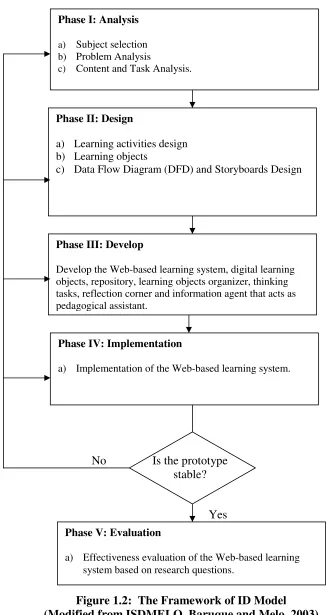
The instructional design (ID) model used in the research is modified from the ISDMELO (Instructional System Design Methodology based on e-Learning Object) (Baruque and Melo, 2003). Figure 1.2 illustrates the proposed framework of the instructional design model used in this research.
Figure 1.2: The Framework of ID Model (Modified from ISDMELO, Baruque and Melo, 2003)
No Phase I: Analysis
a) Subject selection
b) Problem Analysis
c) Content and Task Analysis.
Phase II: Design
a) Learning activities design b) Learning objects
c) Data Flow Diagram (DFD) and Storyboards Design
Phase III: Develop
Develop the Web-based learning system, digital learning objects, repository, learning objects organizer, thinking tasks, reflection corner and information agent that acts as pedagogical assistant.
Phase IV: Implementation
a) Implementation of the Web-based learning system.
Phase V: Evaluation
a) Effectiveness evaluation of the Web-based learning system based on research questions.
Yes Is the prototype
29
1.8 Research Importance
This research proposes a theoretical framework of Web-based learning system that provides the instructor with the flexible and reusable learning content in Computer System (CS). The Web-based learning system helps the instructor to identify students’ engagement of HOTS and their understanding. The findings will help the instructors, especially Computer Science instructors in planning the teaching and learning of CS using the Web.
This research also proposes a unique framework of instructional design model that provides an alternative of instructional design based on the learning object design and generative learning. The findings from this research would demonstrate the effectiveness of technology in improving students’ learning and HOTS. In addition, it also contributes in the design and development of the Web-based learning especially with the use of learning objects. Results from this study are important to show the effectiveness of the learning objects in learning as most of the current researches in learning object design mainly focus in technical and standard issues. Besides, the findings from this study would contribute to the existing evaluations of Web-based learning and learning object design. The results would also suggest that an empowered learning can be achieved by putting more emphasis on the pedagogical design learning environment rather than the technological aspects in order to develop a system that is able to encourage students to learn actively and improve their HOTS.
1.9 Research Scope and Limitation
This research aims to design and develop a Web-based learning system that incorporates the generative learning strategies and learning object design to provide a learning environment that engage students in HOTS. The cognitive operations of HOTS in this research are Analysis, Synthesis and Evaluation. The features and rationales of generative learning, learning object design and HOTS have been discussed previously in the rationale and theoretical framework of study.
The activities of generative learning used in this research are concept mapping and scenarios-based problems solving. These generative learning activities are well documented in the literature as discussed in the research background and research rationale. The use of learning object design in teaching and learning has received increasing attention in the recent years. The main advantages of the learning objects are flexibility and reusability. However, it is a widely belief that the learning object design does not add significant value to the learning if there is an overemphasis on the technical aspect rather than supporting learning. In this research, the learning object design was focused on how its application to support learning. The HOTS are widely discussed in the literature and research. The Bloom’s Taxonomy of Thinking is used to identify the students’ HOTS in this research because it is well documented in the literature and research in determining the level of HOTS.
31
research did not consider the interest and learning styles of the students that could affect their performance and learning. Moreover, the findings of this research should not be generalized to other students. It is important to point out that the main purpose of this research is to conceptualize and to design Web-based learning objects based on the pedagogical perspectives. The emphasis of this research is to study the effectiveness of the proposed design in learning rather than the technical issues relating to the learning object design.
1.10 Operational Definition
The following are definitions of some terminologies used in this dissertation for clearer comprehension of the issues in this research.
(i) Learning Object
A learning object is an object or set of resources that can be used to facilitate the learning of certain subject (Mills, 2002). It is flexible and reusable. It is stored and accessed using meta-data attributes. A learning object is a self-contained, reusable chunk of instruction that can be assembled with other objects. A learning object can teach facts, concepts, principles, procedures and processes.
(ii) Granularity
The meaning of granularity in this research is the size (content) of the learning objects (Wiley, 2002a; Wiley, 2002b). It is the amount of information and content to be included into a learning object.
(iii) HOTS
Madaus, 1971) with the consideration of the curriculum in learning Computer System.
(iv) Bloom’s Taxonomy of Thinking
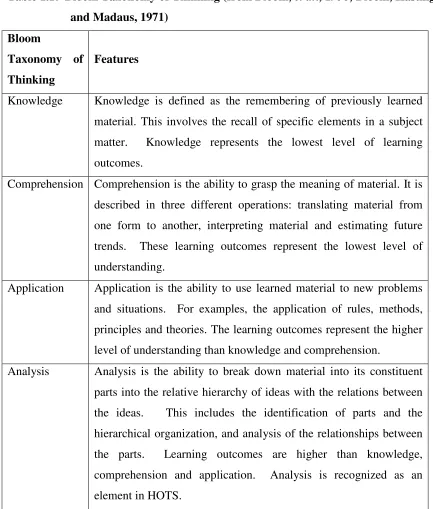
Table 1 describes the features of the Bloom Taxonomy of Thinking used in this research (Bloom et al., 1956).
Table 1.1: Bloom Taxonomy of Thinking (from Bloom, et al., 1956; Bloom, Hasting and Madaus, 1971)
Bloom
Taxonomy of Thinking
Features
Knowledge Knowledge is defined as the remembering of previously learned material. This involves the recall of specific elements in a subject matter. Knowledge represents the lowest level of learning outcomes.
Comprehension Comprehension is the ability to grasp the meaning of material. It is described in three different operations: translating material from one form to another, interpreting material and estimating future trends. These learning outcomes represent the lowest level of understanding.
Application Application is the ability to use learned material to new problems and situations. For examples, the application of rules, methods, principles and theories. The learning outcomes represent the higher level of understanding than knowledge and comprehension.
33
Synthesis Synthesis is the ability to put parts together to form a whole. This involves the process of arranging, combining and working with parts them in such a way as to constitute a new pattern or structure. The learning outcomes emphasize on the formation of new patterns or structures and creative behavior. Synthesis is recognized as an element in HOTS.
Evaluation Evaluation is defined as the ability to judge the values of materials for some purposes or solutions. The judgments are based on definite criteria either those determined by the students or those given to them. The learning outcomes are at the highest cognitive hierarchy. Evaluation is recognized as a cognitive operation in HOTS.
(v) Learning improvement
In this study, the improvement of learning is defined as the improvement of the score in the test that was designed based on the learning goals of Computer System.
(vi) Effectiveness
In this study, the evaluation of the Web-based system effectiveness is focused on the improvement of students’ learning and HOTS before and after the use of the system through the one group pretest and posttest. (vii) Generative Learning
analysis, synthesis, and evaluation skills. Thus, it is important to integrate these skills into learning in order to promote HOTS. In the generative learning environment, students are active in constructing meaningful understanding of information found and generating relationships among the information.
(viii) GLOOTT Model
GLOOTT refers to Generative Learning Object and Thinking Tasks. It is a pedagogically-enriched conceptual model that was designed based on learning object, generative learning and HOTS.
(ix) GOOD Learning System
GOOD learning system refers to Generative Object-Oriented Design Learning System. It is the Web-based learning system designed based on the system conceptual model, namely GLOOTT Model in this research. (x) Computer System (CS)
CS is a core subject of the first year Diploma in Computer Science course in Southern College.
(xi) Lesson Mapping
Lesson mapping is the mapping of concepts in the learning of CS based on the design of concept mapping. It is the generative learning activity designed in the Web-based learning system that aims to engage students in HOTS. It is an outline form of concept map suggested by Alpert and Grueneberg (2000), and Dabbagh (2001).
(xii) Electronic Portfolio
Electronic portfolio is the portfolio that is saved in electronic format (Lankes, 1995). The electronic portfolio used in this research contains only the record of “How am I doing” checklist list in the Web-based system. The checklist is used to record the students’ engagement of HOTS when they use the Web-based learning system.
(xiii) Learning Object Design
35
flexible pieces of learning content that could be assembled and reassembled as needed. Learning objects are small reusable components such as video, tutorials, procedures, stories, animations, simulations and so on.
1.11 Summary