BALCI, SUMEYRA. Investigation of Possible Changes in Beta Decay Rates Due to the Influence of the Sun. (Under the direction of Christopher Gould.)
There is a growing interest in searching for seasonal effects on nuclear decay rates.
Based on this interest, a data set taken at the Nuclear Reactor Program in Burlington
Laboratory at North Carolina State University has been studied. A Radium-226 source was
used to calibrate a gamma ray spectrometer system on a weekly basis over a 17-year period.
The data have been analyzed by subtracting yearly means and by performing a regression
analysis with a SAS program. We find a seasonal variation at the 5𝜎 level, which is however
not in phase with the earth-sun distance. A natural explanation, that the variation is due to
changes in Radon in the room, is considered, and found to be not consistent with the size of
© Copyright 2013 by Sumeyra Balci
Investigation of Possible Changes in Beta Decay Rates Due to the Influence of the Sun
by Sumeyra Balci
A thesis submitted to the Graduate Faculty of North Carolina State University
in partial fulfillment of the requirements for the Degree of
Master of Science
Physics
Raleigh, North Carolina
2013
APPROVED BY:
Daniel Stancil John Blondin
Christopher Gould
DEDICATION
BIOGRAPHY
The author was born and raised in Konya, Turkey. She completed her Bachelor’s of Science
in Physics at Fatih University in Istanbul, Turkey with honors with a degree in June 2009.
Soon after, she went to the U.S. to pursue a graduate degree in Physics at North Carolina
State University, in Raleigh, NC, USA. During that time, she discovered an interest in
Nuclear Physics, started her research and wrote a Masters thesis on it.
ACKNOWLEDGEMENTS
First and foremost I would like to thank to my advisor Prof. Christopher Gould for all
his contributions in the form of corrections, suggestions and valuable guidance throughout
my research. I am thankful to my committee members: Prof. John Blondin and Prof. Daniel
Stancil for their interest in my work.
I would like to thank Prof. Dave Dickey and Joy Smith for their help during SAS
analysis. Also special thanks to laboratory manager Scott Lassell for his patience and support
and Gerry Wicks for carrying out a direct radon measurement.
Last but not least, I would like to express my appreciation to my lovely family for
their encouragement for my life and my friends, especially Seyma Nur Ozcan, for their love
TABLE OF CONTENTS
LIST OF TABLES
………...vii
LIST OF FIGURES
……….viii
Chapter 1. Introduction
………...1
1.1 Introduction to Radioactivity
………..1
1.2 Radioactive Decay Law
………...1
1.3 Types of Decay
………...3
1.3.1 Alpha Decay
………..4
1.3.2 Beta Decay
……….5
1.3.3 Gamma Decay
………...7
1.4 Literature Review
………..8
Chapter 2. Nuclear Reactor Program
……..……….10
2.1 PULSTAR Reactor and Neutron Activation Analysis Program
……10
2.2 Detectors and Electronics
………13
2.3 Radium Beta Decay Source
………23
2.4 Analysis the Spectra
………..25
Chapter 4. Possible Explanations for the Seasonal Variation
…………..37
4.1 Sun-Earth Distance
………37
4.2 Radon Background in the Laboratory
………..39
Chapter 5. Summary and Future Work
………..44
REFERENCES
………..………46
LIST OF TABLES
Table 2.1 Nuclides, Half-lives, Decay Modes, and Daughter Nuclides…………... 25
Table 3.1 SAS Output: Parameter Estimates……… 33
LIST OF FIGURES
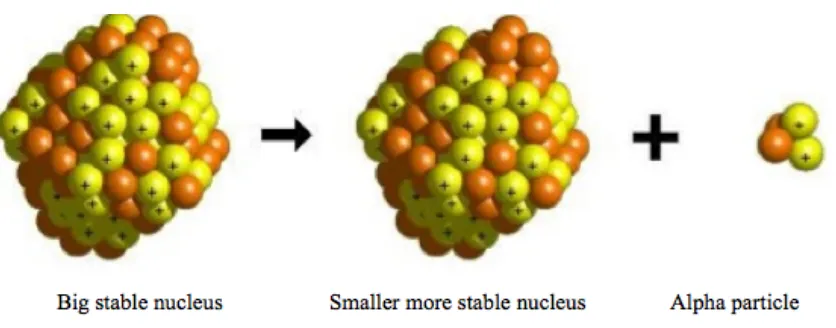
Figure 1.1 Alpha decay of a nucleus. An unstable nucleus becomes more stable by
emitting the alpha particle………
4
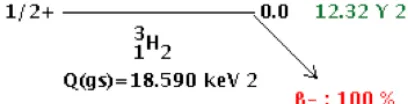
Figure 1.2 The decay level schematic of Tritium (or 3H)……….. 5
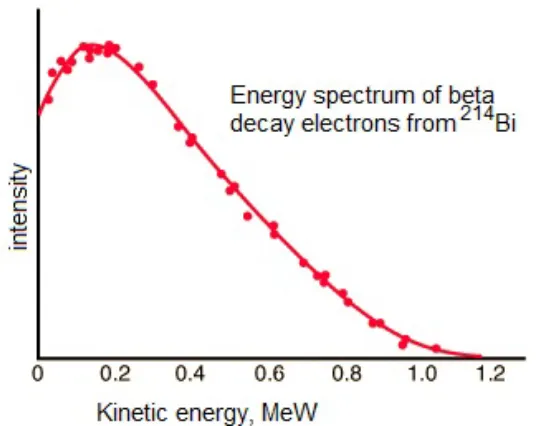
Figure 1.3 Energy spectrum of beta decay electrons from Bismuth-214. The x-axis
represents the kinetic energy in MeV and the y-axis represents
intensity. The figure shows that energies of electrons have a continuous
spectrum………
7
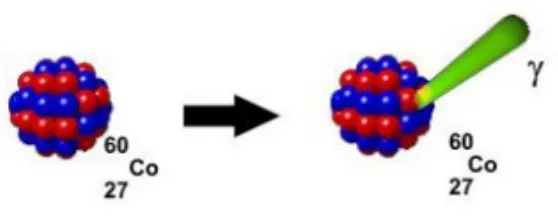
Figure 1.4 Gamma decay of Co-60. The atomic number and the mass number do
not change in this decay mode………..
8
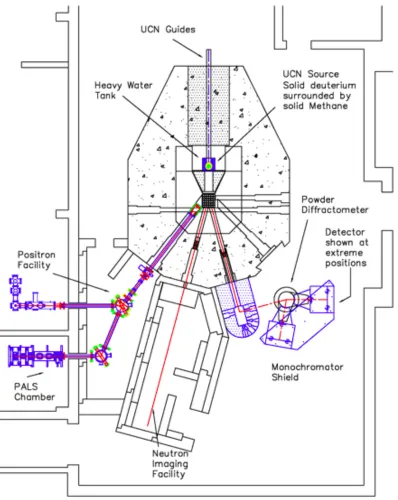
Figure 2.1 Schematic of PULSTAR Reactor. There are 4 types of facilities
working currently. Neutron Powder Diffraction Facility (NPDF),
Neutron Imaging Facility (NIF), Intense Positron Beam (IPB),
Ultra-Cold Neutron Source (UCNS). Their locations are shown in the
schematic………..
11
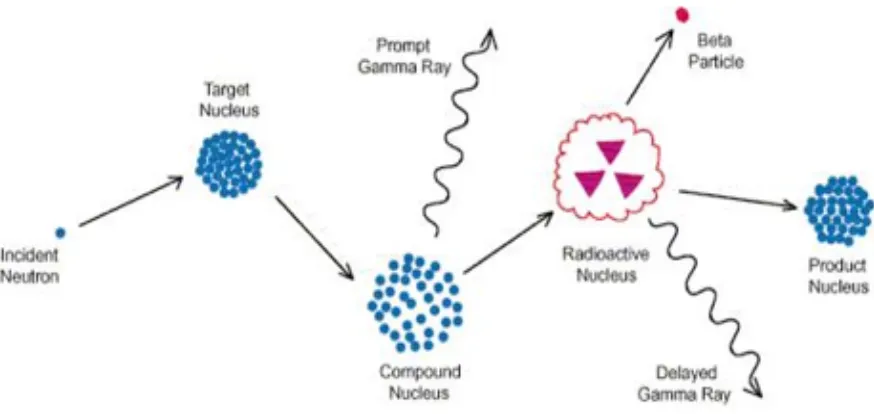
Figure 2.2 Neutron activation process. An incident neutron is absorbed by a target
nucleus and a compound nucleus is formed. The compound nucleus
emits prompt gamma ray and also a radioactive nucleus may be
formed. The radioactive nucleus emits a beta particle and delayed
gamma rays………...
12
Figure 2.3 Range of the resistivity and conductivity for insulators,
semiconductors, and conductors. Semiconductors are in the shaded
region. [15]………
13
Figure 2.4 The picture of the High Purity Germanium Detector in Burlington
Laboratory at NCSU. The detector cryostat is inserted into the liquid
nitrogen dewar below. The detector housing contains the germanium
crystal and a solid-state preamplifier all cooled to −196!C…………....
15
Figure 2.5 Another picture of the HPGe Gamma Detector used in Burlington
Laboratory at North Carolina State University……….
17
Figure 2.6 The level scheme for the decay of Bismuth-214 to Polonium-214. The
first excited state of Polonium-214 is at 609.3 keV………..
19
Figure 2.7 Nuclear Instrumentation Module (NIM) bin, which contains a high
voltage power supply, a Gamma Spectroscopy Research Amplifier, and
a Canberra Multiport Multi-Channel Analyzer (MCA). The picture
shows the electronics for three parallel detector systems……….
21
Figure 2.8 Genie 2000 3.2 software used to analyze the MCA spectra………. 22
Figure 2.9 Chart of Nuclides and color code of the interactive chart of nuclides.
Half-lives of the elements are stated in seconds………...
24
Figure 2.10 A picture of a sample page of the data collected in the Burlington
Laboratory at North Carolina State University over a 17-year period….
Figure 3.1 SAS output: The raw data for the 42% efficiency detector. The data
collection starts from 1996 and ends in 2013………...
29
Figure 3.2 SAS output: The data set created by subtracting yearly means from the
data of Figure 3.1. The resulting data set has zero yearly mean………...
30
Figure 3.3 SAS Output: A plot of the detrended data of Figure 3.2 and fitted
sinusoids using the fundamental (one cycle/year, 365.25 days/year) and
one harmonic (two cycles/year, (365.25)/2 days/year). The red line (the
fit) is not smooth due to the small harmonic term………
36
Figure 4.1 The graph of the comparison between variation in the data (red curve)
and the earth-sun distance (blue curve). The x-axis represents the 12
months of a year and the y-axis represents percentage of the amplitude.
The observed variation is smaller, and not in phase with the variation in
the earth-sun distance………
39
Chapter 1
Introduction
1.1 Introduction to Radioactivity
Radioactivity was for the first time discovered by H. Becquerel in 1896 and with the
nuclear atom theory of E. Rutherford in 1911, studies made in this field gained speed.
Radioactivity can be defined as a process where an unstable element is transformed to a
stable and different element physically and chemically by releasing various particles or
emitting radiation. Unstable nuclei are transformed to a more stable state by releasing
high-energy particles like alpha (α), beta (β) and gamma (γ). The α particles are Helium (!!𝐻𝑒)
nuclei with two neutrons and two protons. The β particles are high-energy electrons. In some radioactive processes, the products that are the opposite particles of electrons called positrons
appear. A gamma ray is a photon, typically with high energy. More detailed information
about these three kinds of radiation is given in Ref. [1]
1.2 Radioactive Decay Law
Physically, it is impossible to know when an atom in a radioactive sample will decay.
Radioactive decay occurs randomly and arbitrarily depending on time with characteristics
According to the decay law of radioactivity, λ is a constant whatever the age of the nucleus. For instance, its value for Radon is λ = 0.0075/ hour= 0.000125/ minute [2]. The decay number that occurs in unit time interval in a radioactive nucleus is defined as the decay
activity of nucleus. If there are N radioactive nuclei at time t, and in any moment dt no nuclei
are added to the sample, the number of nuclei decaying in the dt time interval will be
proportional to N.
𝑑𝑁 𝑡 =−𝜆𝑁 𝑡 𝑑𝑡
The minus sign in the equation indicates that the number of nuclei decreases with
time. By solving the differential equation above, the exponential radioactive decay law is
obtained and shown below
𝑑𝑁(𝑡)
𝑁(𝑡) = −𝜆 𝑑𝑡
𝑁 𝑡 = 𝑁!𝑒!!"
Here, t in the equation represents time, N(t) is the number of nuclei at time t, N0 represents
the number of nuclei at the beginning (time t=0) and λ is the decay constant of the radioactive sample.
If both parts of the decay law equation are multiplied by λ, an expression for the activity is found as
𝜆𝑁 𝑡 = 𝜆𝑁!𝑒!!"
Nλ in the expression above is called decay activity of sample and gives decay number
per unit time. It is indicated with I and its unit is decays/second.
Here; 𝐼 (= 𝜆𝑁) is the activity at time t and 𝐼! (= 𝜆𝑁!) is the activity at time t = 0. [2]
The reciprocal of the decay constant, tm, is the mean life (or average life) of the
radioactive nuclei and it is stated as below
𝑡! =1 𝜆
The method that is most widely used for representing the rate of radioactive decay is
by means of the half-life, t1/2. It can be stated as the time required for the number of
radioactive nuclei of a given kind to decay to half its initial value [3]. This time is
independent of the amount of the radioactive nuclide present, due to the exponential nature of
the decay. So if N is the set equal to !!N0, then the corresponding time t1/2 is given by
ln12= −𝜆𝑡!/!
or
𝑡!/! = ln2 𝜆 =
0.6931 𝜆
So the half-life is inversely proportional to the decay constant and also directly
proportional to the mean life, i.e.,
𝑡!/! = 0.6931𝑡!
1.3 Types of Decay
nucleus decays from an excited state to a lower state without any change in the type of
nucleus.
1.3.1 Alpha Decay
The nucleus emits an alpha particle consisting of two protons and two neutrons
(Figure 1.1). In this way, as seen in equation below, the atomic number of the decayed
nucleus decreases by 2 and its mass number by 4. (Atomic number of the nucleus, mass
number, and neutron number are Z, A, N respectively.) Rutherford proved that an alpha
particle is actually a He nucleus.
𝑋! → ! ! 𝑋! !!!! !!! !!! 𝐻𝑒 ! !
Alpha decay is seen more frequently in nuclei of which the mass number is bigger
than 190 in general. Its energy spectrum is discrete, typically varying between 4 and 10MeV.
Beause it is a charged particle, it interacts intensely with electrons of the matter it passes
through. [4]
1.3.2 Beta Decay
Beta decay is of three kinds: beta-minus decay, beta-plus decay, and electron capture.
Beta-minus decay; if instability of a radionuclide is a result of a neutron surplus in the
nucleus, a neutron is converted into a proton and emits an electron and an anti-neutrino,
which can be shown as
𝑛→𝑝+𝑒!+𝜈
!
The atomic number of a radionuclide that makes beta emission in this way increases
by one. This decay is called an isobaric decay as its mass number does not change as seen in
the reaction below (𝜈! is an anti-neutrino) [5].
𝑋! →
!
! 𝑋′
!!!
!!!! +𝑒!+𝜈!
Schematic of beta-minus decay for Tritium is shown in Figure 1.2.
Beta-plus decay; if instability of atom is the result of lack of neutron or proton
surplus, the weak interaction converts a proton into a neutron while emitting a positron and a
neutrino, which can be shown as (𝜈! is neutrino and 𝑒! is positron)
𝑝→𝑛+𝑒!+𝜈
!
In this way, the atomic number of the radionuclide that releases the positron decreases
by one [5].
𝑋! → !
! 𝑋′
!!!
!!!! +𝑒!+𝜈!
Electron capture occurs if one of the electrons in a near orbit (K, L) is captured. The
electron and the proton combine creating a neutron and a neutrino. (It is shown in the
equation below). In this decay, no particle is released from the nucleus but the proton number
decreases by one as in positron decay. The mass number remains the same. (In the equations
below; 𝑝,𝑒!,𝑛,𝜈
! are proton, electron, neutron, and neutrino respectively)
𝑝+𝑒! → 𝑛+𝜈 ! 𝑋! +𝑒! → ! ! 𝑋′ !!! !!!! +𝜈!
In all three beta decays stated above, though the numbers of protons and neutrons
change by one unit, their mass numbers remain constant. Particles called neutrino and
anti-neutrino are emitted by these three decays. The existence of anti-neutrinos was first proposed by
Pauli in 1930 and later, they were called neutrino by Fermi [6]. Energies of electrons released
Figure 1.3. Energy spectrum of beta decay electrons from Bismuth-214. The x-axis represents the kinetic energy in MeV and the y-axis represents intensity. The figure shows that energies of electrons have continues spectrum.
1.3.3 Gamma Decay
Alpha or beta decay often does not proceed to the ground state of a nucleus. The
nuclide that is formed in the decay may remain in a semi-stable state, which releases the
excitation energy in the form of gamma radiation. Gamma decay is seen in Figure 2.2. The
atomic number and mass number of a nuclide decaying in this manner do not change.
Half-life of gamma decay is very short when compared to other decays: less than 10-9
seconds in general. However, some meta-stable states have half-lives of an hour and even a
Figure 1.4. Gamma decay of Co-60. The atomic number and the mass number do not change in this decay mode.
1.4 Literature Review
In the past few years there have been new thoughts about nuclear decay rates. These
ideas start with Jerkins et al. [8] and Fischbach et al. [9] who find that there is a periodic
annual modulation in the decay rates measurements. Other studies argued that these changes
in nuclear decay rates were due to environmental influences and caused by other systematic
effects [10]. However the group, which started these investigations, countered that the
variations cannot be explained by environmental effects such as temperature, pressure,
humidity etc. [11].
Then these kinds of experiments are re-examined by several people. Norman et al.
[12] could not find any evidence for seasonal variation. Another study examined and found
correlation between decay rates and winter-summer changes [13]. In Cooper at al. [14] some
data are analyzed and no significant variations are found from the exponential decay. Not
subject of investigation in nuclear decay rates [13].
To study these questions further, we obtained a unique data set from the Nuclear
Reactor Program at North Carolina State University. As part of the Neutron Activation
Analysis program, daily calibrations of High Purity Germanium Detectors have been carried
out with a Radium-226 source. These calibrations extend back over 17 years.
As a result, we are able to undertake a search for seasonal variations in an unusually
complete set of decay rate data. In this thesis I present an analysis of these data, and present
some estimates of whether the seasonal effects I see could be due to Radon in the room
Chapter 2
Nuclear Reactor Program
2.1 PULSTAR Reactor and Neutron Activation Analysis Program
A nuclear reactor is a device designed to initiate, control and maintain a chain
reaction. It produces a steady flow of neutrons generated by the nuclear fission of heavy
nuclei.
The PULSTAR reactor is a 1-MW pool-type nuclear research reactor. It is in the
Burlington Laboratory at North Carolina State University and is administered by the Nuclear
Reactor Program. The fuel of the PULSTAR is 4% enriched, pin-type fuel consisting of UO!
(Uranium dioxide) pellets with Zircaloy cladding. This fuel gives the PULSTAR Reactor
response characteristics that are very similar to commercial light water power reactors. These
characteristics allow teaching experiments to measure moderator temperature and power
reactivity coefficients including Doppler feedback. In Figure 2.1 a schematic of nuclear
Figure 2.1. Schematic of PULSTAR Reactor. There are 4 types of facilities working currently. Neutron Powder Diffraction Facility (NPDF), Neutron Imaging Facility (NIF), Intense Positron Beam (IPB), Ultra-Cold
Neutron Activation Analysis is one of the most sensitive analytical methods used for
the quantitative multi-component examination of major, minor, and trace components in
samples from almost every imaginable field of technical and scientific interest. The neutron
irradiation and activation utilized by the 1-MW PULSTAR Nuclear Reactor facility (as an
intense neutron source) is shown in Figure 2.2. During neutron irradiation, some stable
isotopes of elements that form the samples are turned into radioactive isotopes by neutron
capture.
Figure 2.2. Neutron activation process.2 An incident neutron is absorbed by a target nucleus and a compound
nucleus is formed. The compound nucleus emits prompt gamma ray and also a radioactive nucleus may be formed. The radioactive nucleus emits a beta particle, delayed gamma rays.
2.2 Detector and Electronics
Germanium is a semiconductor element. (See Figure 2.3 for details about
Germanium’s place in semiconductors.) It is a good material for detectors and widely used in
gamma-ray spectroscopy.
Figure 2.3. Range of the resistivity and conductivity for insulators, semiconductors, and conductors. Semiconductors are in the shaded region. [15]
Semiconductor gamma-ray detectors contain mainly some solid materials in which
electrons and holes are produced when a gamma ray is absorbed. Then an electric field in the
detectors have been the mainstay of high-resolution gamma-ray spectroscopy for almost 50
years and also why they are used in our study [16].
Its applications are found not only in nuclear physics but also in astrophysics, nuclear
nonproliferation, and medical imaging [17]. The Germanium detector used in this study is
shown in Figure 2.4 and Figure 2.5.
The PULSTAR reactor is used for doing neutron activation analysis and for that
reason people who are working in the Burlington Laboratory have been calibrating the
detectors for almost 18 years. In this research, advantage of these data sets of measurements
on HPGe Gamma Detectors (High Purity Germanium Gamma Detectors) is taken in order to
As shown in Figure 2.4 and Figure 2.5, the detector has a cylindrical shape. The
radioactive source, Radium-226 in our case, is placed in one of the plastic cases (right on the
detector) and this plastic case is put in the detector from the side. The Radium source should
be put on the middle of the cylindrical Germanium plate symmetrically. The detector shield
has a side door that should be closed while the detector is working. It also has a top cover not
shown in the picture. There is a liquid Nitrogen dewar for cooling the detector located under
When radioactive Radium-226 decays (for more information see Table 2.1) gamma
rays are emitted. By looking at the energy of the gamma ray, it can be determined what
isotopes were present. In this study, a 609.3 keV gamma ray (first excited state of
Polonium-214) means that there is Polonium-214 present after two beta decays. The decay scheme
(from Bismuth-214 to Polonium-214) is shown in Figure 2.6. Counting how many 609.3 keV
gamma rays are emitted in a fixed time tells us whether there is any variation in the beta
Figure 2.6. The level scheme for the decay of Bismuth-214 to 214. The first excited state of
Now let’s talk about the electronics used in this experiment. When the gamma rays
are detected by the Germanium crystal (solid crystal), the gamma rays ionize as positive
charges inside of the Germanium. If all of the gamma ray energy is positive then a certain
amount of current comes out the crystal. It gives a signal and it is converted to a voltage in a
preamplifier and then comes over to the MCA (multi channel analyzer). This MCA converts
that analog signal of the voltage into a digital signal, which can be displayed graphically.
Figure 2.7. Nuclear Instrumental Module (NIM) bin, which contains a high voltage power supply, a Gamma Spectroscopy Research Amplifier, and a Canbarra Multiport Multi-Channel Analyzer (MCA). The picture shows the electronics for three parallel detector systems.
Therefore the signal comes out first to the preamplifier then goes to the multi channel
analyzer, which gives a spectrum. After that point a computer program (called Genie 2000
3.2) is used. This software is a widely used program that connects the detector to electronics
to us). The bottom window shows the entire spectrum and it is just the zoomed area of the
peak part of the top window. It is called the interactive peak fit. Actually, there is a fit to the
data, which is called Gaussian fit on the top graph of the bottom window (the x-axis is energy
and the y-axis is the counts). The bottom graph of the bottom window is about residual. The
line between these two graphs in the bottom window separates the number of counts and the
residuals. We are not interested in the residuals now because the most important thing is the
number of counts used to look for the seasonal variation in this study.
2.3 Radium Beta Decay Source
As discussed in Chapter 1, if N is the number of radioactive nuclei present any time t;
the decay rate is given by
𝑑𝑁
𝑑𝑡 = −𝜆 𝑁(𝑡)
In this study we are looking into whether there is an additional term in this equation (for
example, due to the changing earth-sun distance) so that the equation should be
𝑑𝑁
𝑑𝑡 = −𝜆 𝑁 𝑡 +𝑓(𝑡)
where 𝑓(𝑡) is an unknown function of time.
The National Nuclear Data Center provides information about the basic properties of
atomic nuclei. An interactive chart of nuclides is shown in Figure 2.9. In this chart it is seen
that the x-axis shows the number of neutrons and the y-axis shows the number of protons in a
Figure 2.9. Chart of Nuclides4 and color code of the interactive chart of nuclides. Half-lives of the elements are stated in seconds.
In this study, the radioactive decay process using HPGe Gamma Detector at
Burlington Laboratory is shown below in Table 2.1. Ra-226 undergoes three alpha decays
and two beta decays, and one more alpha decay before it reaches stability at Lead-210.
Table 2.1 Nuclides, Half-lives, Decay Modes, and Daughter Nuclides
Nuclide 𝐭𝟏/𝟐 Decay Mode Daughter Nucleus
Radium-226 1600.7 years Alpha Decay Radon-222
Radon-222 3.8 days Alpha Decay Polonium-218
Polonium-218 3.1 minutes Alpha Decay Lead-214
Lead-214 26.8 minutes Beta Decay Bismuth-214
Bismuth-214 19.9 minutes Beta Decay Polonium-214
Polonium-214 163 microseconds Alpha Decay Lead-210
2.4 Analysis the Spectra
In the Burlington Laboratory at North Carolina State University, energy calibration,
efficiency and resolution have been checked since 1996. The data sets have been collected
either every day or every few days. There are sets of data for eight different detectors having
efficiencies 21%, 23%, 24%, 25%, 26%, 38%, 42%, 65%.
The data set obtained from the 21% efficiency detector was collected from July 1997
to April 1999, the one obtained from the 23% efficiency detector was collected from
September 1996 to August 2003, the one obtained from the 24% efficiency detector was
collected from July 1997 to June 2003, the one obtained from the 26% efficiency detector
was collected from September 1996 to March 2002. The one obtained from the 25%
42% efficiency detector is collected from September 1996 until now, and the obtained from
the 68% efficiency detector is collected from July 2003 until now.
In this thesis, the data from the 42% efficiency detector (Figure 2.4 and Figure 2.5) is
examined and analyzed. This detector was used over the longest period of time and also had
the second highest detection efficiency. The detector was refurbished twice during the period
1996-2013.
The data collection is done to check that the Nuclear Reactor located in Burlington
Laboratory is working properly every day. A crystal (Radium-226) that emits gamma rays is
used. If the rate of the gamma rays does not change, the detector works properly. Because
radioactivity is a characteristic of the element, it does not change, so the detector should
detect the same everyday.
People working in the laboratory are collecting spectra for 300 seconds and making a
correction for lifetime versus dead time by using a program to analyze the data that subtracts
a background and fits to a peak (Figure 2.8). Then they record these counts on a piece of
paper that is shown in Figure 2.11. In this paper energy calibration, detector efficiency, and
detector resolutions are recorded. As stated earlier, only the counts from the 42% efficiency
Chapter 3
Analysis of the Data
In this chapter, data analysis will be described step by step. Because counts are not
taken everyday, the data sets are not equally spaced in time. Thus, the regression analysis is
an appropriate method to analyze the data sets due to the gaps in the date of the data
collected. In order to do the regression analysis, SAS (Statistical Analysis System) program
is used as a statistical program by following the suggestions of Prof. Dave Dickey.
First the data were written down on the Excel file with respect to counts by the date.
As stated in the previous chapter, the 42% efficiency detector started to work from
September 1996 and still continues, and in this analysis the data set until March 2013 was
used.
3.1 Results from the 42% Efficiency Detector
In Figure 3.1, the graph of the raw data is shown which needs to be cleaned and
detrended. The x-axis and the y-axis represent the time and the counts in 300 seconds
Figure 3.1. SAS output: The raw for the 42% efficiency detector. The data collection starts from 1996 and ends in 2013.
There is an obvious drop off at the end and long-term movement after 2011. The
reason for this unusual change in counts is the refurbishment of the detector. The detector
was sent out for repair in during that period. This part should be shifted prior to a least
squares analysis, using SAS. (For more information, the SAS code is in the Appendix)
Here in Figure 3.2 is a series created by subtracting yearly means as well as adjusting
have mean zero. We can now focus on the item of the interest, which is to look at the yearly
cycles.
Figure 3.2. SAS output: The data set created by subtracting yearly means from the data of Figure 3.1. The resulting data set has zero yearly mean.
Now let’s talk about how to look for a seasonal variation. There are 365.25 days in a
year. So the frequency we want to look for is
2𝜋
𝜔 is here the fundamental frequency which is one cycle per year. Then let’s create two
variables; sine1 and cosine1 (will shown as s1 and c1 respectively).
𝑠1= sin 𝜔𝑡 =sin 2𝜋𝑡
365.25 , (𝑡= 1,2,3,…,𝑛)
𝑐1=cos 𝜔𝑡 =cos 2𝜋𝑡
365.25 , (𝑡 =1,2,3,…,𝑛)
Both sin and cosine variables are needed because we need to get the amplitude (A)
and the phase shift (𝛿). Then they are lined up with the data. So we suppose to start with
𝐴 𝑠𝑖𝑛 𝜔𝑡+𝛿 =𝐴sin 𝛿 cos 𝜔𝑡 +𝐴cos 𝛿 sin 𝜔𝑡 , 𝛿= 𝑝ℎ𝑎𝑠𝑒 𝑠ℎ𝑖𝑓𝑡
=𝛽! cos𝜔𝑡+ 𝛽!sin(𝜔𝑡)
Thus, the amplitude and the phase shift can be fitted to the data correctly by the
sample regression on sin 𝜔𝑡 and cos 𝜔𝑡 . (There is not just pure sine wave. If we make an
analogy; when you listen to the music and you play the middle c, which is a note, on a piano,
and also you play that middle c on a guitar, they sound different. The middle c here is the
fundamental frequency, just like 𝜔 here. But the reason that the middle c sounds different on
the piano and on the guitar, is because of the harmonics.) Then we need the harmonic, which
is a wave that has frequency 2𝜔, or 3𝜔, etc… So these harmonics go through 2 cycles per
year, or 3 cycles per year, or etc… They change the wave shape but still that wave repeats
Then we needed to check and see if we can leave some of these high frequencies out.
We leave these harmonics if they are statistically insignificant, in other words if there is not a
contribution from these harmonics. So we used a statistical test, which is the t test in order to
do this. (A t test is a kind of statistical test that has a t distribution under the null hypothesis.
It is used to fit the data set identify the model that best fits the population from which the
data were sampled. The exact t test mainly arises when the models have been fitted to the
data using the regression analysis [19].) The idea of this statistical test is that suppose there
really is not a harmonic that (for instance) is the fifth one; and seek what is the probability of
getting an estimated coefficient for this. If something is unlikely under a hypothesis then this
hypothesis is rejected. In this case; if this probability were less than 0.05 (called alpha; the
levels of significance) a value which is the traditionally agreed upon by scientists [20] we
would reject the hypothesis. More information can be found in Weisberg et al. [21]. Based on
Table 3.1. SAS output: (Coefficients for the sinusoidal components where the 0 degree angle is at the beginning of the year) Parameter Estimates. Variables consist of intercept and fundamental frequencies and all 4 pair of harmonics. DF represents degree of freedom. Parameter estimate attempts to approximate the unknown parameter using the measurements. Standard error is actually standard error of the mean; refer to estimates of the unknown quantity. T value shows that t test used as a regression procedure, calculated by program
automatically. Pr > |t| (probability of giving t value in this model) is obtained by using a table (called the t test distribution table) that scientist are agreed on.
Repeatedly, in order to test the null hypothesis that a parameter is 0 in the model, t
estimates are different from 0 or not). It appears that other variables do not substantially
improve the model fit.
As a result, if we have five of these harmonics in there, it could be a good fit to the
data. But if we leave out the last three harmonics, it is still a pretty good fit to the data.
Consequently, leaving these last three harmonics really doesn’t do much in terms of helping
the model, so we left them out.
Then let’s do a smaller model that might contain s1, c1 as the fundamental
frequencies and s2, c2 as the harmonics. According to Table 3.2, the parameters s1 and c1 are
significantly important and, the s2 and c2 harmonics are borderline, one is bigger and one is
slightly smaller. Hence these s2 and c2 harmonics can be included in the model or not, and
they are included in order to be safe.
As a result, the Pr > |t| is the probability of getting a result like this from the data in
which there is no seasonal component (as modeled by 2 sinusoids) and under the standard
regression assumptions, namely the white noise errors, most of the modeled variation (i.e. the
power spectrum) is due to the fundamental frequency with statistically significant but minor
contribution from the first harmonic. A model with the 4 harmonics and a fundamental
frequency showed no need to go beyond the fundamental and 1 harmonic.
Consequently, it is clearly understood from the s1 and c1 frequencies that there is a
yearly pattern. There is almost zero probability to see the data like this if there were no
seasonal variation. In other words, here is a very strong evidence that there is a yearly cycle.
Something repeating close to being a pure sin wave. In Figure 3.3 the red line shows the
predicted value by using the equation below.
𝑌= 0.58208−40.30413 𝑠1−44.76426 𝑐1−12.35282 𝑠2+15.29218 𝑐2
In this equation, the parameter estimate of variable intercept is 0.58208, the parameter
estimate of variable s1 is -40.30413, the parameter estimate of variable c1 is 44.76426, the
parameter estimate of variable s2 is -12.35282 and the parameter estimate of variable c2 is
Chapter 4
Possible Explanations for Seasonal Variation
There could be lots of reason for changes in the detector count rates such as the
environmental influences about the detector system, some systematic effects, changes in the
temperature, pressure, humidity, etc. But as discussed in Chapter 3, we find the variation to
be seasonal. Hence, the reason of this change in the beta decay rates is examined in this
chapter. Two possible explanations will be discussed below.
4.1 Sun-Earth Distance
There are two important distance points between the earth and the sun. One is named
the aphelion, which occurs when the earth and the sun are the farthest apart. This happens
around July 4 and the distance is approximately 152,171,522 km (or 94,555,000 miles). The
other is called the perihelion, which occurs when the earth is the nearest to the sun. This
happens around January 3 and the distance between the earth and the sun is approximately
147,166,462 km (91,455,000 miles). These numbers are calculated by using the earth’s
elliptical orbit around the sun [22,23].
In order to compare the variation in the distance due to these aphelion and perihelion
(Astronomical Unit is 149.6×10!𝑘𝑚= 92.956×10!𝑚𝑖𝑙𝑒𝑠) [24] then r in AU is related to t
in months by
1
𝑟!−1=
1
1−0.017cos 2𝜋 11𝑡−1 !
−1
To relate this to the SAS analysis we see the equation below, where -40.30 is the parameter
estimate for the variable s1 and -44.76 is the parameter estimate for the variable c1. The
mean of the counts is taken as 27500 and t represents the time in months.
𝑆𝐴𝑆 𝑚𝑒𝑎𝑛=
−40.3sin 2𝜋 11𝑡−1 −44.76cos 2𝜋 11𝑡−1 27500
Then by using these calculations, graphs of the time versus !!!−1 and !"#$!"! can be
compared (Figure 4.1) The red line is the variation detected by using SAS, and the blue line
is the earh-sun distance variation in 12 months. We see the experimental variation we
detected is not in phase with the solar distance and has a much smaller magnitude. However,
just because they are out of phase, it does not mean that it is not still a geometric effect
associated with the motion and the wobble of the earth going around the sun. Our SAS
analysis corresponds to a phase shift of 228 degrees, or on a scale of 0-1, a phase of 0.633.
An in-phase variation with the earth-sun distance would give a phase shift about 0.008
(January 3), seemingly eliminating any association with the solar distance. However,
according to Sturrock et al. [13], the possibility of a north-south asymmetry of the flux from
the sun, owing to the tilt of the sun’s rotation with respect to the plane of the earth’s orbit
should also be considered. Combining the two possible effects, the earth-sun distance
0-0.183 or between 0.683-1 if the flux enhances the decay rate. The value we found falls
outside of that range. However, if the flux suppresses the decay rate, then the phase must fall
within the complementary range or between 0.183 and 0.063. Consequently, if the effect of
an as yet undetermined solar flux suppresses the decay rate, a possible solar-distance
explanation of the observed annual variation cannot be ruled out solely in the basis of the
data and the analysis presented.
Figure 4.1. The graph of the comparison between variation in the data (red curve) and the earth-sun distance (blue curve). The x-axis represents the 12 months of a year and the y-axis represents percentage of the amplitude. The observed variation is smaller, and not in phase with the variation in the earth-sun distance.
4.2 Radon Background in the Laboratory
Radon is a commonly occurring radioactive, colorless, odorless, tasteless, noble gas,
-‐0.04 -‐0.03 -‐0.02 -‐0.01 0.00 0.01 0.02 0.03 0.04
1 2 3 4 5 6 7 8 9 10 11 12
known situation, Radon can be found all over the U.S. Generally, the radon background can
be caused by the natural radioactivity of uranium in soil, rock or water. Radon gets into the
air you breathe. Here in this study, we are interested in the radon signal getting into the
detector. In fact, the radon atoms leak (in other words escape) into the room with random
directions and increase the radon background in the room/basement where the experiments
are carried out. There is a health limit of the radon background determined by United States
Environmental Protection Agency and this limit is approximately 148 Bqm-3 (equals to 4
pCi/L)5 The reason we test it for Radon is that it is the only one is in the gas phase and other
radioactive elements used in the experiment are in the solid phase. Because Radon is a gas it
expends all around the room.
To explore the Radon question further, we asked the NRP staff to perform two
additional measurements in June 2013. One is the Radon background in the room (measured
directly) and the other one is the background counts, which are from the detector with no
source presents. The Radon background in the laboratory was measured and found to be 7
Bqm-3 (G. Wicks, private communication). The measured background counts were around 30
in 300 second, associated with a very small but noticeable peak in the spectrum. This can be
compared with the annual variation seen in the SAS analysis which is of order 60 counts in
300 seconds.
The aim of the calculations that will be shown below is to test whether the radon
background in the basement is consistent with the observed seasonal variation or not.
Following the procedure from Gould et al. [26], the 609 keV gamma ray flux from the
experiment is found from
𝜙 = 𝑁 𝐸!
𝑘 𝐸! ∈ 𝐸! 𝑚 𝑇
= 60 (609𝑘𝑒𝑉)
(2.84×10!!𝑒𝑟𝑔 𝑔!! 𝛾!! 𝑐𝑚!)(0.2)(1,277×10!𝑔)(300𝑠) =26.4×10!!𝛾𝑐𝑚!!𝑠!!
The definitions in the equation are
𝜙 =𝑓𝑙𝑢𝑥 (𝑔𝑎𝑚𝑚𝑎 𝑟𝑎𝑦𝑠 𝑚!!𝑠!!)
𝑁 =𝑁𝑢𝑚𝑏𝑒𝑟 𝑜𝑓 𝑡ℎ𝑒 𝑒𝑠𝑡𝑖𝑚𝑎𝑡𝑒𝑑 𝑐𝑜𝑢𝑛𝑡𝑠 = 60 𝑖𝑛 𝑡𝑖𝑚𝑒 𝑡 300𝑠
𝐸! =𝐸𝑛𝑒𝑟𝑔𝑦 𝑜𝑓 𝑡ℎ𝑒 𝑔𝑎𝑚𝑚𝑎 𝑟𝑎𝑦 0.609𝑀𝑒𝑉 =0.96×10!!𝑒𝑟𝑔𝑠
𝑘= 𝑇ℎ𝑒 𝑐𝑜𝑢𝑛𝑡𝑠 𝑡𝑜 𝑓𝑙𝑢𝑒𝑛𝑐𝑒 𝑓𝑢𝑛𝑐𝑡𝑖𝑜𝑛 (= 2.84×10!!𝑒𝑟𝑔 𝑔!!𝛾𝑐𝑚!!)
𝜖 =𝑃ℎ𝑜𝑡𝑜𝑝𝑒𝑎𝑘 𝑒𝑓𝑓𝑖𝑐𝑖𝑒𝑛𝑐𝑦 ~0.2
𝑚= 𝑀𝑎𝑠𝑠 𝑜𝑓 𝑡ℎ𝑒 𝑑𝑒𝑡𝑒𝑐𝑡𝑜𝑟 𝑖𝑛 𝑔𝑟𝑎𝑚𝑠
The flux 𝜙 striking the detector can be related to the radon decay rate 𝜌 by assuming
a uniform density for the Radon in a spherically symmetric room of radius rmax and
integrating over the appropriate solid angle for each volume element in the room. The result
is
𝜙 =𝜌𝑟!"#
Now we need to substitute 26.4×10!!𝛾𝑐𝑚!!𝑠!! for 𝜙 and solve the equation for 𝜌
(Then 𝜌 will be compared with the experimental value of the Radon background in the
room). But first 𝑟!"# should be determined and there are two possible geometries for the
value of the 𝑟!"#.
First option is that the detector is closed by side and top. So 𝑟!"# would be the radius
of the inside of the detector and it can be taken as approximately 10cm. Solving the equation
by assuming a completely enclosed detector is shown below
𝜌= 𝑟𝜙 !"# =
26.4×10!!𝛾𝑐𝑚!!𝑠!!
10𝑐𝑚 = 26.4×10!!𝛾𝑐𝑚!!𝑠!!
𝜌= 26.4×10!𝐵𝑞𝑚!!
This value is very high compared to the EPA limit (which is around 148 Bq per cubic
meter) and not consistent with the direct measurement. So it is not a plausible estimate.
Another option is that the detector is not shielded. So for a room spherically
symmetric has the value of the 𝑟!"# can be taken approximately 3m (=300cm). Solving the
equation by assuming the unshielded detector is shown below
𝜌= 𝜙 𝑟!"# =
26.4×10!!𝛾𝑐𝑚!!𝑠!!
300𝑐𝑚 = 8.8×10!! 𝛾𝑐𝑚!!𝑠!!
𝜌 =8.8 𝐵𝑞𝑚!!
This value is close to what was measured directly but is inconsistent with the
geometry of the detector, which is shielded. As a consequence, the modeling of Radon
variation in the room is not due to Radon unless there is an additional source or a mechanism
Chapter 5
Summary and Future Works
In this chapter, a summary of the thesis is stated and future work is defined. The
PULSTAR reactor located at North Carolina State University is the source of this study.
Radium-226 is used as a radioactive source and High Purity Germanium Detector is used for
detection of the gamma rays. The people working in the laboratory have taken the data sets
for 17 years and we take advantage of these data sets in this thesis. Analyzing the variances
and the regression method is used by SAS program. The results show that there is a yearly
cycle in the data. After doing some calculations and comparisons, no relation is found with
the Radon background in the laboratory, also no simple explanation for a relation with the
earth-sun distance in a year is found.
As a consequent, these arguments have not presented any evidence of the solar origin
yet. The most we can say is that these two possible explanations can be ruled out. We are
going to look now at the 38% efficiency detector to see if it confirm of refutes the effect we
saw with the 42% efficiency detector.
As a future study, other data sets (which are taken from the 21%, 23%, 24%, 25%,
26%, 38%, 65% efficiency detectors) should be examined and analyzed, in hope of
Another idea for the future is making a comparison between the reactors on and the
reactor off while taking data with the detector, so that changes in the background can be
REFERENCES
[1] J.K.Shultis and R.E.Faw, Fundementals of Nuclear Science and Engineering (CRC Press, Florida, 2007)] [Salvatore Califano, Pathways to Modern Chemical Physics, (Springer, New York, 2012), p.135–166.
[2] K.S. Krane, Introductory Nuclear Physics (John Wiley and Sons, New York, 1988)
[3] S. Glasstone and A. Sesonske, Nuclear Reactor Engineering (Chapman & Hall, New York, 1994), Vol.2, p. 30.
[4] J.K.Shultis and R.E.Faw, Fundementals of Nuclear Science and Engineering (CRC Press, Florida, 2007) p.77.
[5] J. M. Freeman, G. J. Clark,J. S. Ryder,W. E. Burcham,G.T.A. Squier and J.E. Draper. Accurate Fermi Beta Decay Measurements and the Magnitude of the Weak Interaction Vector Coupling Constant. Atomic Masses and Fundemental Constants 4:105-111, 1972
[6] G.F. Knoll, Radiation Detection and Measurement (Wiley, New York, 2010)
[7] M.F. L'Annunziata, Radioactivity: Introduction and History (Elsevier, Amsterdam, 2007) p.191.
[9] E.Fischbach, J.B. Buncher, J. T. Gruenwald, J.H. Jenkins, D. E. Krause and J.J. Mattes and J.R. Newport. Time-Dependent Nuclear Decay Parameters: New Evidence for New Forces? , Space Science Reviews, 145:285-335, July 2009.
[10] T.M. Semkow, D.K. Haines, S.E. Beach, B.J. Kilpatrick, A.J. Khan, K. O'Brien. Oscillations in radioactive exponential decay, Physics Letters B 675:415-419, May 2009.
[11] J.H. Jenkins, D.W. Mundy and E. Fischbach. Analysis of environmental influences in nuclear half-life measurements exhibiting time-dependent decay rates, Nucl. Inst. &
Meth. , 620:332-34, August 2010.
[12] E.B. Norman, Ed.Browne, H.A. Shugart, T.H. Joshi and R.B. Firestone. Evidence against correlations between nuclear decay rates and Earth–Sun distance, Astroparticle
Physics, 31:135-137, March 2009
[13] P.A. Sturrock, J.B. Buncher, E. Fischbach, D. Javorsek, J.H. Jenkins and J.J.Mattes. Concerning the phases of annual variations of nuclear decay, The Astrophysical
Journal, 737:65, August 2011.
[14] P.S.Cooper. Searching for modifications to the exponential radioactive decay law with the Cassini spacecraft, Astroparticle Physics, 31:267-269, March 2009.
[15] A. Owens, Compound Semiconductor Radiation Detectors (CRC Prees, Florida, 2012), p.2.
[17] E. L. Hull, R. H. Pehl, Amorphous germanium contacts on germanium detectors,
Nuclear Instruments and Methods in Physics Research Section A: Accelerators,
Spectrometers, Detectors and Associated Equipment, 538:651-656, February. 2005.
[18] S. Glasstone and A. Sesonske, Nuclear Reactor Engineering (Chapman & Hall, New York, 1994), Vol.2, p. 10.
[19] N.H. Bingham and H.D. Zeh, Regression Linear models in statistics (Springer, New York, 2010), p.33-59
[20] R.Schumacker and S.Tomek. Understanding Statistics Using, (Springer, Newyork, 2013), Chap. 7, p.137-168.
[21] S.Weisberg, Applied Linear Regression (Wiley, New York, 1985), p.29.
[22] N.A. Barricelli Preferential perihelion and aphelion distances, and planetary formation.
Earth Moon and Planets 34:1-33, January 1986.
[23] (The Council for the Central Laboratory of the Research Councils), Planetary and
Lunar Coordinates 2001-2020 (Willmann-Bell, Virginia, 2000)
[24] J.H.Shirley and R.W. Fairbridge, Encyclopedia of Planetary Sciences, (Kluwer, Dordrecht, 1997), Vol.18, p.48.
[25] C. T. Angell, A. C. Kaplan, J. D. Seelig, E. B. Norman, and M. Pedretti. Concepts in nuclear science illustrated by experiments with radon. American Journal of Physics,
[26] C.R. Gould, E.I. Sharapov, and A.A. Sonzogni. γ-ray fluxes in Oklo natural reactors.
SAS Code 1
***data.sas;options formdlim='' ls=80 orientation=portrait;
libname in '.';
%let pct=42pct;
data in.count&pct;
infile "&pct.Weekdays.csv" dlm=',' dsd missover firstobs=2;
input date :mmddyy10. count;
format date date9.;
If date>lag(date) then order=0; else order=1; *check for out
of order dates - errors;
run;
proc print data=in.count&pct; *check for out of order dates - errors;
where order=1;
run;
run;
ods listing close;
ods pdf file="&pct Count Data with Means and Plots.pdf";
proc means data=in.count&pct;
DM "GRAPH;CANCEL;"; ** to close the graph window; proc datasets library=work mt=cat nolist;
delete gseg;
run;
axis1 label=(h=3 a=90 'Count') value=(h=2)
minor=(n=3)
offset=(3);
axis2 label=(h=3 'Date')
value=(h=2)
minor=(n=2) offset=(3);
symbol1 c=black i=spline font= v=dot;
*symbol2 c=black i=hiloj font= v=circle;
*symbol3 c=black i=hiloj font=marker v=U; *symbol4 c=black i=hiloj font= v=square;
*symbol5 c=black i=hiloj font=marker v=P;
*symbol6 c=black i=join font= v=diamond;
*symbol7 c=black i=join font=marker v=C;
***use this to send to printer; *goptions dev=psl ftext=zapf
rotate=landscape lfactor=2;
***use this to see in window; goptions dev=win ftext=zapf
rotate=landscape lfactor=2;
proc gplot data=in.count&pct;
'01feb2011'd); format date year4.;
Title "&pct All Data Reference Lines at Oct 1,2001 and Feb
01,2011";
run;
quit;
proc gplot data=in.count&pct; where count between 26000 and
29000;
plot count*date / vaxis=axis1 haxis=axis2 href=('01oct2001'd,
'01feb2011'd);
format date year4.;
Title "&pct 26000-29000 Reference Lines at Oct 1,2001 and Feb
01,2011";
run;
quit;
Ods pdf close;
title;
SAS Code2
**models.sas;
%let pct=42pct;
ods html close;
ods listing close;
ods pdf file="&pct Models.pdf" style=journal;
title "&pct Models.pdf";
*libname in 'C:\temp\ChrisGould';
*libname in 'C:\Users\seyma\Desktop\42%SAS'; libname in '.';
Data Dave;
** (1) Remove outliers **;
set in.count&pct;
if (. <count< 26000) and (year<2003) then count=.; if count > 29000 then count=.;
lastpart = date> "01apr2011"d;
freq = 2*constant('pi')*date/365.25;
s1=sin(freq); c1=cos(freq);
s2=sin(2*freq); c2=cos(2*freq);
s3=sin(3*freq); c3=cos(3*freq); s4=sin(4*freq); c4=cos(4*freq);
s5=sin(5*freq); c5=cos(5*freq);
year = year(date);
run;
goptions reset=all;
axis1 label=(h=2 a=90 'Count')
value=(h=2)
minor=(n=3)
offset=(3);
axis2 label=(h=2 'Date')
value=(h=2)
minor=(n=2);
symbol1 c=black i=spline font= v=dot; *symbol2 c=black i=hiloj font= v=circle;
*symbol3 c=black i=hiloj font=marker v=U;
*symbol4 c=black i=hiloj font= v=square;
*symbol5 c=black i=hiloj font=marker v=P;
*symbol6 c=black i=join font= v=diamond; *symbol7 c=black i=join font=marker v=C;
***use this to send to printer; *goptions dev=psl ftext=zapf
rotate=landscape lfactor=2;
***use this to see in window; goptions dev=win ftext=zapf rotate=landscape lfactor=2;
proc gplot data=Dave; plot count*date/ vaxis=axis1
haxis=axis2;
format date year4.;
proc glm data=Dave; class year; model count = year lastpart; output out=out1 residual = count_yrmean;
proc gplot data=out1; plot (count count_yrmean)*date/
vaxis=axis1 haxis=axis2;
symbol1 v=none i=join c=black;
format date year4.; run; quit;
**(3) Compute spectrum using sinusoids;
proc reg data=out1; model count_yrmean=s1 c1 s2 c2 s3 c3 s4 c4
s5 c5;
Harmonics2: test s3=0, c3=0, s4=0, c4=0, s5=0, c5=0; run;
** (4) It seems harmonics 3 through 5 are not needed. Refit
and test;
proc reg data=out1; model count_yrmean=s1 c1 s2 c2; output out=out2 predicted = P;
run;
proc gplot; plot (count_yrmean p)*date/overlay vaxis=axis1
haxis=axis2;
symbol1 v=none i=join c=black w=1; symbol2 v=none i=join c=red w=3;
format date year4.;
run;
** (5) Try ARMA(1,1) error term;
proc arima data=out1;
i var=count_yrmean crosscor = (s1 c1);
run; quit; ods pdf close;
ods listing;