TAXONOMY LEARNING FROM MALAY TEXTS USING
ARTIFICIAL IMMUNE SYSTEM BASED CLUSTERING
MOHD ZAKREE BIN AHMAD NAZRI
TAXONOMY LEARNING FROM MALAY TEXTS USING
ARTIFICIAL IMMUNE SYSTEM BASED CLUSTERING
MOHD ZAKREE BIN AHMAD NAZRI
A thesis submitted in fulfilment of the
requirements for the award of the degree of
Doctor of Philosophy (Computer Science)
Faculty of Computer Science and Information System
Universiti Teknologi Malaysia
DEDICATION
To almarhum ayahanda and bonda To my wife
May this inspires our sons and daughter Wan Nur Aqila, Muhammad and Anas
May Allah bless us all
ACKNOWLEDGEMENT
In the name of Allah, the Most Gracious and the Most Merciful. I thank to Allah for
granting me strength and guidance throughout my journey to complete this study.
I could not have completed this work without the help and assistance of a large number
of people and organizations.
The author has been truly blessed to have the guidance of two stellar advisors who have
defined my PhD experience. My grateful thanks to Prof. Dr. Hjh. Siti Mariyam Hj. Shamsuddin
for her wisdom and encouragement. Your supervisory approach has provided me the freedom to
explore new ideas. I’m grateful to Prof. Madya Dr. Azuraliza Abu Bakar for her guidance and
support throughout the duration of my studies. I have counted you both as mentor and friends
these past years. The author would also like to thank Prof. Dr. Jon Timmis of the University of
York for inspiring me to explore immune system.
I am also indebted to Universiti Kebangsaan
Malaysia (UKM) for funding my
PhD study. Dr Pouzi Hamzah at Universiti Malaysia
Terengganu and Dr. Tang Enya Kong at Universiti Sains Malaysia also deserve special
thanks for their assistance in supplying
the relevant tools and other research materials.
I would like to thank the Data Mining and Optimization Research Group of Universiti
Kebangsaan Malaysia, particularly Prof. Dr. Abdul Razak Hamdan, Assoc. Prof. Dr. Salwani
Abdullah, Tri Basuki Kurniawan, Nasser, Saif, Yahya, Salam and Hamza for providing much
needed study breaks, discussions, rants, debates and most importantly as anchors for my sanity.
Finally, my wife Wan Noraidah Mohammad for your intimate understanding and patience for
me whilst writing up my thesis.
ABSTRACT
In taxonomy learning from texts, the extracted features that are used to describe
the context of a term usually are erroneous and sparse. Various attempts to overcome
data sparseness and noise have been made using clustering algorithm such as
Hierarchical Agglomerative Clustering (HAC), Bisecting K-means and Guided
Agglomerative Hierarchical Clustering (GAHC). However these methods suffer low recall. Therefore, the purpose of this study is to investigate the application of two hybridized artificial immune system (AIS) in taxonomy learning from Malay text and develop a Google-based Text Miner (GTM) for feature selection to reduce data sparseness. Two novel
taxonomy learning algorithms have been proposed and compared with the benchmark methods (i.e., HAC, GAHC and Bisecting K-means). The first algorithm is designed through
ABSTRAK
TABLE OF CONTENTS
CHAPTER TITLE
PAGE
DECLARATION
DEDICATION
ACKNOWLEDGEMENTS
ABSTRACT
ABSTRAK
TABLE OF CONTENTS
LIST OF TABLES
LIST OF FIGURES
LIST OF ABBREVIATIONS
LIST OF APPENDICES
ii
iii
iv
v
vi
vii
xv
xix
xxi
xxii
1 INTRODUCTION
1
1.1 Introduction
1.2
Background of the Problem
1.3 Problem
Statement
1.4
Aim of the Research
1.5 Objective of Study
1.6 Scope of the Research
1.7 Theoretical
Framework
1.9 Definition of Terms
1.9
Summary and Thesis Outline
2
ONTOLOGY LEARNING FROM TEXT
2.1
Ontology
2.1.1 Taxonomy: A lightweight Ontology
2.2 Taxonomy Learning
2.3 Framework of Taxonomy Learning from Texts
2.4 Term
2.4.1 Contextual Features
2.4.1.1 Syntactic Dependencies
2.4.1.2 Pseudo-syntactic Dependencies
2.5 Synonym Acquisition and Concept Formation
2.6 Taxonomy Learning from Texts
2.6.1 Linguistic Approach
2.6.2 Statistical and Clustering
2.6.2.1 Formal Concept Analysis (FCA)
2.6.2.2
Hierarchical
Agglomerative
Clustering
2.6.2.3
Bisecting
K
-Means
2.6.3 Hybrid Approach
2.6.3.1 The Web as Secondary Information
Resource
2.7 Evaluation
2.8 Summary and Discussion
16
18
20
22
23
24
26
28
28
29
30
32
34
36
38
39
42
43
45
3 IMMUNE
SYSTEM
48
3.1
Introduction
3.2 Immunology: The Immune System
3.2.1
Innate
Immunity
3.2.2 Adaptive immunity
3.2.2.1
Gene
Libraries
3.2.2.2 B-cells and Clonal Selection
3.2.2.3
T-cells
3.2.2.4 Negative Selection and Two-Signal
Activation
3.2.2.5 Immune Networks and Memory
3.2.3 Adaptive Immunity and Engineering
3.3 Artificial Immune Systems
3.4 Artificial Immune Systems Applications
3.4.1 Data and Text Mining
3.4.1.1 Immune Systems Solutions for
Classification
3.4.1.2 Immune Systems Solutions for
Clustering
3.4.1.3 Clonal Selection Solutions in
Clustering
3.4.1.4 Clonal Selection Solutions in
Hierarchical Clustering
3.4.2 aiNet: An Artificial Immune Network for
Hierarchical Clustering
3.4.3 AIS for Taxonomy Learning
3.5 Summary
59
60
61
63
64
65
65
67
70
71
73
76
77
4 RESEARCH
METHODOLOGY
78
4.1 Introduction
78
4.2 Operational Framework
79
4.2.1 Problem Definition
81
4.2.1.1 Distribution Similarity
81
4.2.2 Malay Lexico-Syntactic Patterns
84
4.2.3 Development of Clustering Methods for
Comparison
84
4.2.4
GCAINT
85
4.2.5
CLOSAT
86
4.3 Engineering CLOSAT and GCAINT
4.4 Evaluation
4.4.2 Method Comparative Performance
4.4.3 Hypothesis Testing
4.4.4 Lexical Relevancy and Taxonomic
4.4.5 Confusion Matrix
4.5 Experimental Design
4.5.1 Text Collection
4.5.1.1 Information Technology texts
4.5.1.2 Plant Biochemistry Texts
4.5.1.3 Fiqh (Islamic Jurisprudence) Texts
4.5.1.4 The General Corpora
4.5.2 Dataset Preparation
4.5.3 Gold Standard
4.6 Development Tools
4.7 Summary
89
93
94
94
95
98
99
101
103
104
104
105
105
108
110
110
5
GCAINT: GUIDED CLUSTERING AND AINET FOR
TAXONOMY LEARNING
112
5.1
Introduction
5.2 Motivations
5.2.1 Hybridizing aiNet with GAHC
5.3 The GCAINT
5.3.1 Algorithms and Processes
5.3.1.1 Stage 1: Pre-Processing
5.3.1.2 Stage 2: Taxonomy Induction Using
Modified GAHC
5.3.1.3 Stage 3: Taxonomy Learning Using
aiNet
5.4 Experimental Setup
5.5 Experimental Results
5.5.1 Normality Test
5.5.2 Analysis of Variance
5.5.3 The Extracted Hypernym Oracle
5.5.4 Experiment 1: GCAINT with Vanilla
Parameter
5.5.5 Experiment 2: GCAINT with Tuned
Parameter
5.5.5.1
Significance
Test
5.5.6 Experiment 3: Comparison with Available
Clustering Methods
5.6 Experiment 4: Sensitivity Analysis of GCAINT
Parameters
5.6.1 GCAINT Parameter
5.6.2 Experiment Protocols
5.6.3 Parameter Analysis
5.6.3.1 Number of Antibodies to
Proliferates (nc)
5.6.3.2 Affinity Threshold (
σ
d)
5.6.3.3 Affinity Threshold (
σ
s )
5.6.3.4 Clone Coefficient (
μ
)
5.6.3.5 Mutation Coefficient (
ω
)
5.6.3.6 Improvement Coefficient (nm)
5.6.3.6 Taxonomy Suppression (
σ
f)
5.7 Summary
133
134
135
136
137
139
140
143
144
145
146
147
148
149
150
151
152
153
154
6
CLOSAT:CLONAL SELECTION ALGORITHM FOR
TAXONOMY LEARNING
155
6.1
Introduction
6.2 Motivations
6.2.1 CLONALG for Taxonomy Learning
6.3 The CLOSAT Schematic Design
6.3.1 The CLOSAT Algorithm
6.3.1.1 Preprocessing
6.3.2 The CLOSAT Algorithm
6.4 Experimental Setup
6.5 Experiment Results and Analysis
6.5.1 Normality Test
6.5.2 Analysis of Variance
6.5.3 Analysis of Variance
6.5.4 Experiment 5: CLOSAT with Vanilla
Parameter
6.5.5 Experiment 6: CLOSAT with Tuned
Parameter
6.5.5.1 CLOSAT Performances on Fiqh
Datasets
6.5.5.2 CLOSAT Performances on The
IT Datasets
6.5.5.3 CLOSAT Performances on The
Bio Datasets
6.6 Experiment 7: Sensitivity Analysis of CLOSAT
Parameters
6.6.1 CLOSAT Parameters
6.6.2 Experiment Protocols
6.6.3 Results and Analysis
6.6.3.1 Number of Antibodies to
Proliferates (nc)
6.6.3.2 Affinity Threshold (
σ
d)
6.6.3.3 Affinity Threshold (
σ
s )
6.6.3.4 Clone Coefficient (
μ
)
7
THE TEXT MINER AND THE AUTOMATIC
PARAMETER TUNER
190
7.1
Introduction
7.2 Experimental Setup
7.3 The Google-Based Text Miner
7.3.1 Experiment 9: Google-based Text Minner
Results
7.4 Automatic Parameter Tuning
7.4.1 Particle Swarm Optimization (PSO)
7.4.2 Tuning the Parameters
7.4.3
Affinity
Measurement
7.4.4
Tuning
GCAINT
7.4.4.1 Experiment 9: Results and
Hypothesis Testing
7.4.5
Tuning
CLOSAT
7.4.5.1
Experiment
10:
Results
and
Hypothesis Testing
7.5 Summary
190
191
192
194
198
201
203
205
205
207
212
212
216
8
DISCUSSION AND FUTURE WORK
217
8.1
Introduction
8.2 Summary of the Research
8.3 Discussion on the Findings of the Research
8.3.1 Affecting Factors
8.3.2 Guided Clustering with aiNet for Taxonomy
Learning (GCAINT)
8.3.3 Clonal Selection Algorithm for Learning
Concept Hierarchy (CLOSAT)
8.3.4 The Google-Based Text Miner
8.3.5 Automatic Parameter Tuning
8.4 Research Contributions
8.4.1 The Advancement of Bahasa Melayu as the
Language of Knowledge
8.4.2 New Immune-inspired Methods in
Distribution Similarity Approach
8.4.2.1 CLOSAT: A Robust Hierarchical
Clustering Method
8.4.2.2 GCAINT: A Robust and Reliable
Classifier
in
a
Clustering
Method
8.4.3 Automatic Parameter Tuning using PSO
8.4.4 Affinity Measurement Comparison Study
8.4.5 Solutions for Data Sparsity in Learning
Taxonomy from Malay Texts
8.4.5.1 A New Malay Text Miner Using
Google APIs
8.4.6
Publications
8.5 Future Research
8.6 Summary
242
243
243
244
245
245
246
246
247
248
249
REFERENCES 251
Appendices
A-I 268-285
LIST OF TABLES
TABLE NO
TITLE
PAGE
2.1
Syntactic Features Used on Different Method
27
3.1
A time-line of immune-based clustering algorithm
(2000-2010)
68
3.2
A time-line of immune-based hierarchical clustering
algorithm (2000-2009)
72
4.1
IT domain knowledge as formal context
82
4.2
Similarities between the extracted terms
83
4.3
Mapping between GCAINT, CLOSAT and the immune
system component
88
4.4
A confusion matrix for analyzing the learned taxonomy
98
4.5
Vanilla parameter based on de Castro and von Zuben
(2000a) work
99
4.6
Comparison of texts size and number of
concepts/classes
102
4.7
Obtained dataset (1
stset) using Cimiano’s sysntatic
pattern and Hearst Pattern
107
4.8
Gold Standards and Comparison
109
5.1
Mapping between GCAINT and the immune system
116
5.2
Obtained datasets (contextual features and HO) after
pre-processing
118
5.5
Vanilla parameter based on de Castro and von Zuben
(2000a) work
136
5.6
Best results comparison between GAHC and GCAINT (on
vanilla parameter)
136
5.7
Tuned parameters for GCAINT
138
5.8
Results of GAHC, GCAINT and tuned-GCAINT
138
5.9
Comparative performance between GCAINT and other
methods on Fiqh
CIM141
5.10
Comparative performance between GCAINT and other
methods on IT
CIMdomain
141
5.11
Comparative performance between GCAINT and other
methods on BIO
CIM142
5.12
Mann-Whitney test on FTO
143
5.13
GCAINT parameters and ranges
145
5.14
GCAINT tuning parameters value
146
6.1
Test results for normality
170
6.2
Vanilla parameter based on li et al. (2009)
172
6.3
CLOSAT with vanilla parameter
172
6.4
Comparing CLOSAT and other clustering methods
173
6.5 The
parameters
173
6.6 Mann-Whitney
test
174
6.7
Comparative performance between CLOSAT and other
methods on Fiqh
CIMdomain
175
6.8
Comparative performance between CLOSAT and other
methods on IT
CIMdomain
176
6.9
Comparative performance between CLOSAT and other
methods on BIO
CIMdomain
177
6.10
CLOSAT parameters and ranges
179
6.11
CLOSAT parameters and ranges
181
7.1
Results of GTM on Fiqh dataset
195
7.3
Results of GTM on Biochemistry Dataset
196
7.4
Results of the hypothesis test under the 5% level of
significance for each of the dataset
197
7.5
The range parameter value for GCAINT and CLOSAT
199
7.6
Parameters value based on de Castro and von Zuben (2000)
parameter
199
7.7
Results of CLOSAT and GCAINT using de Castro and von
Zuben (2000) parameters
199
7.8
Results of CLOSAT and GCAINT using de Castro and von
Zuben (2000a) parameters compared with other methods
200
7.9
The value of PSO parameters
204
7.10
Obtained datasets (contextual features and HO) after
pre-processing
206
7.11
Tuned parameters for GCAINT
208
7.12
Results for different setting
209
7.13
Tuned parameters for GCAINY
210
7.14
The comparison results between tuned and non-tuned
GCAINT
210
7.15
Wilcoxon rank sum test for hypothesis test on GCAINT
211
7.16
CLOSAT scores using different set of distance metric
213
7.17
Tuned parameters for CLOSAT
214
7.18
Comparison results
214
7.19
Wilcoxon rank sum test for hypothesis test on CLOSAT
215
8.1
Nature of the Gold Standard
223
8.2
False positives of hypernym-hyponym pairs and
comparison of FTO
227
8.3
False positives of lexical in HO and comparison of LF and
FTO
8.4
The nature of the taxonomic relationship and comparison of
FTO
234
8.5
Percentage change of context atributes after using the GTM
237
LIST OF FIGURES
FIGURES NO
TITLE PAGE
1.1
The traditional framework for learning taxonomy from
texts
12
1.2
Thesis outline and research objectives mappings
15
2.1
An example of taxonomy
18
2.2
The Ontology Learning Layer Cake
22
2.6
Standard HAC algorithm by Dunham (2003)
37
2.7
Guided Agglomerative Hierarchical Clustering Approach
43
3.1
B-cell and the basic unit of an antibody, or immunoglobulin
55
4.1
General Framework of the Research
79
4.2
Layered Framework of AIS
80
4.3
Cluster tree built by conceptual clustering algorithm such
as Hierarchical Agglomerative Clustering
83
4.4
Proposed hybrid GCAINT
85
4.5
Proposed hybrid CLOSAT
87
4.6
Dataset generation from texts
106
5.1
The overall process of GCAINT
118
5.2
An abstract of GAHC algorithm
121
5.3
Modified GAHC Algorithm for CGAINT
123
5.4
Modified aiNet
125
5.7
Description of the experimental process
131
5.8
Influence of
n
c to FTO148
5.9
Influence of
σ
d to FTO149
5.10
Influence of
to FTO
150
5.11
Influence of
µ
to FTO
151
5.12
Influence of to FTO
152
5.13
Influence of
to FTO
5.14
6.1
Proposed hybrid CLOSAT
159
SAT
esented in XML
153
153
Influence of
to FTO
6.2
The overall process of CLO
160
6.3
Summarized CLOSAT Algorithm
162
6.4
The clonal selection algorithm
163
6.5
A snapshot of IT taxonomy repr
166
6.6
A snapshot of IT taxonomy using Space Tree
166
6.7
The experimental setup
168
6.8
Influence of
n
c to FTO182
6.9
Influence of
σ
d to FTO183
6.10
Influence of
to FTO
184
6.11
Influence of
µ
TO
per
tup
page using Google Desktop
7.3
pseudocode
ing using PSO
and solution
INT over all dataset
to F
186
6.12
Influence of to FTO
187
6.13
Influence of
to FTO
188
7.1
Chapter 7 Ex
imental Se
191
7.2
A snapshot of the search results
Search utility
The text miner
193
194
7.4
Procedure for parameter tun
204
7.5
Rejection region
211
8.1
Problems overview
220
LIST OF ABBREVIATIONS
aiNet
-
Artificial Immune Network
AIRS
-
Artificial Immune Recognition System
AIS
-
Artificial Immune System
CAIT
-
Center for Artificial Intelligence Technology of UKM
DMO
-
Data Mining and Optimization Research Group of UKM
CLONALG
-
Clonal Selection Algorithm
OL -
Ontology
Learning
PSO -
Particle
Swarm
Optimization
LIST OF APPENDICES
APPENDICES TITLE
PAGE
A Overall
research
plan
268
B
Summary of justification for the adopted approach,
method and technique
271
C
Summary of Problem definition phase
275
D
Framework of AIS Engineering in Taxonomy Learning
from Texts
276
E
Example of CLOSAT Output
278
F
Example of GCAINT Output
280
G
Example of Erroneous Output
281
H
Sample of CLOSAT Dataset
284
CHAPTER 1
INTRODUCTION
1.1 Introduction
One of the keystones of the Semantic Web vision is to represent information in a
structured form so that the computers can "understand" and subsequently solve complex
problems. Ontology is one of the main components of Semantic Web which provides a
common vocabulary for a specific domain of interest. It describes properties of a term or
word so that machines, applications or services can effectively share information and
knowledge, thus ensuring interoperability among machines.
However, the progress towards Semantic Web is slowed down due to the
knowledge acquisition bottleneck. The manual ontology modeling, as described by
researchers is a process that is labor-intensive, tedious, complex, time-consuming and
expensive (Alesso and Smith, 2005; Gulla and Brasethvik, 2008; Yeh and Sie, 2006;
Cimiano, 2006). One of the most important components of ontology is taxonomy or also
known as concept hierarchy or thesauri.
2
(semi-)automatic support in constructing taxonomy on the basis of unstructured textual
resources is referred to as taxonomy learning from texts.
Different learning approaches and methods from a spectrum of fields such as
statistical analysis, machine learning and natural language processing have been
proposed for partially or completely automatic construction of taxonomies.
Alexander
Maedche and Steffen Staab (2000) distinguish taxonomy learning from text techniques
into: i) pattern-based extraction; ii) Association rules; iii) Conceptual clustering; iv)
Ontology pruning; and v) Concept learning. However, based on available resource and
research scope, it can be concluded that the association rules, ontology pruning and
concept learning will not be studied in this research because of the following reasons.
Concept learning technique is used to update a given taxonomy while ontology pruning
technique is used to elicit an ontology by using a core ontology as guidance. Association
rules are used on the data mining process to discover taxonomic relations stored in
databases or text by a ready-made taxonomy as background knowledge. Thus, these
techniques are used when an existing ontology or taxonomy are already exists to ‘assist’
the learning process. Since this research do not rely on any existing taxonomy, all these
three techniques are not suitable for this research. Therefore, this research will
concentrate on pattern-based extraction and conceptual clustering. Moreover, the nature
or ‘behavior’ of texts makes conceptual clustering much more appealing than other
techniques. For example, a document may have either a huge amount of irrelevant noise
such as spelling errors or grammatical mistakes which lead to either sparseness or noise
in the extracted features.
Furthermore, (semi-)automatic acquisition of taxonomy from Malay text is
conspicuous by its absence in the research literature. Common features and linguistic
patterns extracted from English text corpora have not been tested on Malay text.
Therefore, this research is motivated by the believe that any learning system that is to
retrieve an acceptable set of results from Malay texts must adapt to the data sparsity and
noise. Currently, Artificial Immune System (AIS) has been the attention to many
researchers in dealing with data sparseness. AIS is inspired from the human immune
system, and it is known for its robustness, reliability and adaptability. Thus, the natural
immune system exhibits many properties that are of interest to this area of taxonomy
learning from text.
3
Therefore, this thesis is concerned with the design, implementation and
evaluation of two hybrid conceptual clustering methods which are based on Artificial
Immune System (AIS) for learning taxonomy from Malay text. Both algorithms
proposed in this thesis perform taxonomy learning tasks over sets of documents.
1.2 Background of the Problem
The realization of the Semantic Web depends on the broad availability of
semantic resources, often incorporated in ontology. Taxonomy is one of the important
components of ontology. The (semi-) automatic acquisition of taxonomy based on the
actual terminology used by a community is a major step towards the creation of (full)
ontology. However, several issues still need to be resolved in order to construct ontology
effectively and efficiently. First of all, the knowledge acquisition bottleneck problem.
Much research has been devoted to develop methods to (semi-) automatic acquisition of
taxonomies from text. This type of text mining is considered by Cimiano (2006) as a
process of reverse engineering because it is a task of reconstructing the world model of
an author(s) from the document(s) he has written. This task is inherently complex and
challenging mainly due to two reasons. First, there is only a small part of the authors’
domain knowledge available (i.e., in the text) in the recreation process. Second, the
‘small’ domain knowledge in the text is rarely mentioned explicitly, except in a
dictionary. Taxonomy learning from texts thus can be seen as working with the
‘unknown symbols’ for which the appropriate sense needs to be identified as some sort of
reverse engineering.
Taxonomy learning from texts is the use of content found in texts, for data mining
tasks such as clustering. According to Cimiano (2006), making explicit the knowledge
implicitly contained in texts is a great challenge. The (semi-)automatic taxonomy
acquisition from text is basically an
advanced text mining that aims to identify
knowledge structure in the form of taxonomy as knowledge can be found in texts at
4
different levels of explicit. Thus, common methods exploits regular patterns to such as
‘computer is a machine’ to discover taxonomic relations. However, it seems that the
more technical and specialized the texts are, the less basic knowledge will be found
stated in an explicit manner (Cimiano, 2006). Thus, conceptual clustering is an
alternative technique to derive knowledge from texts. This technique is based on
distributional hypothesis (Harris, 1954) that assumes that terms are similar to the extent
to which they share similar linguistic contexts. In other words, Harris’s hypothesis states
that the meaning of words corresponds to their use in texts. Although, many techniques
and methods have been implemented based on Harris’ (1968) distributional hypothesis in
learning taxonomy from texts, new techniques are expected to produce better quality in
terms of recall and precision. Though several methods have achieved the goal in
taxonomy learning from text, some draw backs still exist.
Conceptual clustering methods which have been used for taxonomy induction are
hierarchical agglomerative clustering (HAC) algorithms, divisive algorithms such as
Bisecting K-Means and Formal Concept Analysis (FCA). FCA and HAC attract a lot of
attentions since the clustering result is presented in the form of a tree structure or lattice.
These methods are based on Harris’s distributional hypothesis (Harris, 1954) to
automatically derive taxonomies from texts. Even though these methods have produced
good results, there are few issues shared by these methods such as data sparseness.
Cimiano (2006) states that certain contextual features which are extracted from the texts
are accidental and erroneous due to missing data or grammatical mistakes, thus not
corresponding to real-world or semantic similarities. On the other hand, these approaches
suffer from the incapability to appropriately label the obtained clusters.
Various attempts to overcome data sparseness have been made as can be seen in
Buitelaar et al. (2003), Cimiano et al.(2004a; 2004b), Reinberger and Spyns (2005) and
Blohm and Cimiano (2007). Cimiano (2005) for example, introduces a novel algorithm
called Guided Agglomerative Hierarchical Clustering (GAHC) and a technique called
smoothing in another different taxonomy learning system which is based on Formal
Concept Analysis (FCA). GAHC exploits WordNet and Hypernym Oracle (HO) to guide
the clustering process in order to create reasonable clusters even without enough data.
The HO is populated by pairs of hypernym/hyponym. In order to find the hypernym and
hyponym, GAHC uses pattern matching-based approach. GAHC produces better results
5
compared to other unsupervised techniques such as HAC or FCA (Cimiano, 2006). The
smoothing technique is used in order to overcome data sparseness by using the
conditional probability to filter the extracted terms before the similarity between terms
are measured using cosine metric.
However, approaches based on pattern matching as being used in GAHC suffer
from a very low recall which is due to the fact that the lexico-syntactic patterns are very
rare. The more technical and specialized the texts are, the less basic knowledge will be
found stated in an explicit manner (Cimiano, 2006). Besides, Lian Tze and Hussein
(2006) states that WordNet too often includes many rare senses while missing
domain-specific senses. In this study, the WordNet has been functionally tested thoroughly and it
is found that WordNet is unsuitable to be translated as representation of Malay senses.
This is because translation is not merely an act of linguistic transfer, but it also involves
the interaction of cultures and that transference of culture which imposes far greater
problems than linguistic transfer (Elkateb et al., 2006). For example, ‘prophetess’ exists
in WordNet which is completely taboo in the Malay/Muslim world. Moreover, the
smoothing technique used by Cimiano (2005) doesn’t improve the results of the
FCA-based approach (Ryu et al., 2006).
Furthermore, the discovery of taxonomy from Malay texts is conspicuous by its
absence in the research literature, yet it is a very real issue. The Malay language belongs
to the Austronesian family of languages (Nik Safiah, 1995). Even though the Malay
language has the same Subject-Verb-Object grammatical structure as English, to Malay
grammarian Malay is different from English. Azhar (1988) has shown evidence in his
work from an Englishmen’s opinion that Malay is different from English because Malay
is a context-dependent and terse language, i.e. brief, direct to the point and ‘effectively
cut short’ language. Ontology engineers need guidelines about the effectiveness,
efficiency and trade-offs of different methods in order to decide which techniques to
apply in which settings. But there is no comparative work that systematically analyze
different techniques and algorithms on learning concept hierarchies from Malay text.
This scenario is a major impediment for this study as it leads to lack of guidelines
problem (Cimiano, 2006). Lack of guideline refers to the lack of research on related
fields resulting in no guidelines about the effectiveness, efficiency and trade-offs of
different methods to support the automatic creation of ontology from Malay text. While
6
this research is based on the assumption that existing taxonomy learning from texts
methods can be applied to Malay texts but how should such a system be realized?
In summary, the proposed solution to these problems must be robust for the
following issues that make this a taxing task as highlighted by Cimiano (2005 & 2006)
as follows.
1.
The texts content is noisy therefore the extracted features can be erroneous, i.e.
not all derived features are correct,
2.
Not all the extracted features are ‘relevant’ in the sense that the extracted
features will help to discriminate between the different objects (terms); and
3.
The assumption of completeness of information will never be fulfilled, i.e. the
text collection will never be ‘big enough’ to find all the possible occurrences
(Ziph, 1932).
Artificial Immune System (AIS) has been the attention to many researchers in dealing
with data sparseness and noise. Previous work has shown that an AIS, has attributes that
fulfill these criteria. There are a number of motivations for using the immune system as
inspiration for both taxonomy learning and text mining which include robustness,
reliability, recognition, diversity, memory, self regulation, and learning (Dasgupta,
1999). This sophisticated natural system provides insight for solving the data sparseness
and noise faced by GAHC. It is believed that these features will give the system the
ability to adapt to noise and incomplete data. The fundamental challenge in learning
taxonomy from Malay texts is the selection of features that are best to represent a
concept. With the assumption that the existing English syntactic features and
lexico-syntactic pattern may work on Malay text, the available clustering methods and the
proposed approaches will be used to test this basic notion. However, it is believed that
Malay language has its own unique characteristics that need to be identified to
complement existing syntactic features and lexico-syntactic patterns introduced in Hearst
(1992) and Cimiano (2006).
1.3 Problem Statement
7
The solution of the taxonomy learning from Malay texts problem can be briefly
described as follows:
Given a Malay texts, the challenges is to (semi) automatic acquisition of
taxonomy from the texts while it is a norm in this approach that the extracted
datasets from the text are sparse and contains noise. At the same time, the
computational method must be capable of producing better taxonomy in terms
of F-measure of taxonomic overlap (i.e., FTO) which is defined by taxonomic
recall and precision.
In light of the above statement, a robust system is required since the existing
unsupervised conceptual clustering algorithms for learning taxonomy are not fault
tolerance especially when handling data sparsity and noise. Therefore, it is desirable to
come up with a new technique for taxonomy learning that is robust to noise and data
sparsity. In order to derive knowledge in a form of taxonomy from texts
(semi)-automatically, researchers have proposed conceptual clustering methods which are
based on Harris (1968) distributional hypothesis. However, there are two main issues in
learning taxonomy from texts.
First, a robust conceptual algorithm that can cope with data sparsity and noise and
second, an efficient feature selection mechanism. The first issue is raised as the extracted
attributes for some terms can be accidental or erroneous which leads to noise in data.
Furthermore, data sparseness is always an issue when learning taxonomy from texts.
Thus, if existing clustering technique such as bisecting K-means is used for learning
taxonomy from text, only specific aspect of the whole dataset is taken into account (de
Castro et al., 2007.) Artificial Immune System (AIS) has been known for its mechanism
of clonal expansion and network suppression that can produce more accurate data
representations in handling data sparseness. Even though AIS is known for its
robustness, to date, AIS has not been applied and tested in learning taxonomy from texts.
The second issue is about answering the question of how to provide the necessary
attributes (features) for every terms in an effective and efficient ways. The feature
selection issue is still not solved if the source is in Malay. As potential way out of this
problem, Cimiano’s methodology that acquires collective knowledge from the Web
8
using Google can be adopted. In particular, a modified Google-based text miner can be
developed to test whether it is effective in developing a better taxonomy.
A new immune-inspired algorithm may surpass the existing taxonomy learning
technique and methods in precision and recall, and is able to cope with data sparsity
and noise for better performance and robust taxonomy learning system. Therefore, it
is necessary to demonstrate that the immune-inspired algorithm and the
Google-based text miner indeed make a significant difference in building better taxonomy
models. In this thesis, the question of whether the immune-inspired mechanism
matters, i.e., does it lead to building better taxonomy, where by “better” we assume
superior clustering and later classification performance. The following are the
research questions that will be addressed to answer the above problem statement.
i.
How to model AIS in learning taxonomy from texts?
ii.
How to design a new hybrid method between Guided Agglomerative
Hierarchical Clustering and aiNet and Clonal Selection Algorithm and
Bisecting K-mean?
iii.
How can the Artificial Immune System improve the result compared to
the existing clustering methods?
iv.
Is Harris’s distributional hypothesis applicable in learning taxonomy from Malay
texts?
v.
Can hybridization of Artificial Immune System with other conceptual clustering
methods leads to better result?
vi.
Which affinity measurement should be used in the proposed learning system that
will lead to better result?
vii.
Can a Google-based Text Miner help to overcome data sparseness for better
result?
viii.
Can English lexico-syntactic pattern be exploited in learning taxonomy from
Malay texts?
ix.
How to optimize the proposed immune-inspired learning algorithm parameters?
The research questions are based on the effects of dataset (i.e., extracted from texts),
metric set and feature selection and extraction technique. Based on the research
questions above, the following hypotheses have been stated.
9
i.
The proposed immune-based learning system improves the quality of generated
taxonomy, compared to the available comparison methods.
ii.
The hybridization of Artificial Immune System with other conceptual clustering
methods leads to better result compared to existing approaches.
1.4 Aim of the Research
The aim of this research is to develop and enhance the hybrid artificial immune
system that will improve the conceptual clustering performance, able to deal with data
sparseness for taxonomy learning from Malay texts.
1.5 Objectives of the Study
In order to achieve the aim of this research, it is guided by the following objectives.
1.
To propose a new hierarchical clustering algorithm based on the Artificial
Immune System that is able to handle data sparsity robustly for learning
taxonomy from Malay texts.
2.
To develop an immune-inspired hybrid model for learning taxonomy from Malay
texts.
3.
To investigate the effect of the proposed feature selection scheme which consists
of a new pseudo-syntactic pattern and Google-Based text miner for developing
context distribution from Malay texts to overcome data sparsity?
4.
To evaluate and validate the performance of the proposed hybrid methods and
feature selection approaches with benchmark methods on three different sets of
data in learning taxonomy from texts.
10
1.6 Scope of the Research
This research will engage in an in-depth learning taxonomy from Malay texts
using bio-inspired algorithm. Thus, the research work in this study is focused to validate
the effectiveness of (semi-)automatic acquisitions of taxonomy from Malay texts using
immune-inspired algorithm and linguistic pattern-based approach.
There are three main
paradigms exploited to induce taxonomies from textual data (Buitelaar et al, 2003). The
first one is the application of lexico-syntactic patterns to detect hyponymy relations. The
second paradigm is based on Harris’ distributional hypothesis for synonym extraction
and term clustering. The third paradigm is from the information retrieval community and
relies on a document-based notion of term subsumption. The scope of this study is
limited to the combination of first and second paradigm. Thus,
the proposed methods
will be compared to the available state-of-the-art hierarchical clustering technique
.
The
mathematical definitions of these measurements are presented in Chapter 4. The
proposed methods will be compared to the available state-of-the-art hierarchical
clustering technique
.
The mathematical definitions of these measurements are presented
in Chapter 4.
This research also concerns on studying the effect of using the existing
grammatical features and lexico-syntactic pattern to the performance of the learning
algorithm from Malay texts. In order to extract features from the texts, two techniques
will be applied in this study. The techniques are the syntactic dependency technique
which has been used by Cimiano et al. (2006) and the lexico-syntactic pattern introduced
by Hearst (1992). New grammatical features and lexico-syntactic patterns for Malay will
also be investigated. In this research, only the hypernym/hyponymy or IS-A relation
serves as a basis for the natural sub-concept/super-concept. Other relations than IS-A is
beyond the scope of this research.
It is beyond the scope of this investigation to perform any testing regarding
differing Malay Natural Language Processing tools and as such is left for future
11
research. As with other immune-inspired learning algorithms, the scope of discussions in
this thesis is narrowed down to the working of antibodies and antigens in clonal selection
and immune network.
Therefore, the scopes of the study can thus be enumerated as follows.
i.
The study focuses on the (semi-) automatic acquisition of taxonomy from three
Malay texts representing three different domains which are:
a.
Fiqh (Islamic Jurisprudence).
b.
Biochemistry.
c.
Information Technology (IT).
ii.
This research investigates the use of Google-based feature extraction in order to
overcome data sparseness.
iii.
To investigate the best affinity measurement for the proposed algorithms, three
affinity measurements are tested which are Hamming, Jaccard and Rand
Coefficient.
iv.
For the purpose of comparison, five clustering techniques are developed as
follows.
a.
Guided Agglomerative Hierarchical Clustering.
b.
Bi-Secting K-Means.
c.
Hierarchical Agglomerative Clustering: Single Linkage.
d.
Hierarchical Agglomerative Clustering: Average Linkage.
e.
Hierarchical Agglomerative Clustering: Complete Linkage.
v.
The quality of the produced taxonomies is measured by using measurements
introduced by Cimiano (2006). The measurements are Cimiano’s Taxonomic
Overlap measurements which are Lexical Precision (LP), Lexical Recall (LR),
Lexical F1 (F1), Precision Taxonomic Overlap Precision (PTO), Recall
Taxonomic Overlap (RTO) and F-Measure Taxonomic Overlap (FTO).
1.7 Theoretical Framework
12
The theoretical framework of the research is based on Maedche and colleagues’
method (Kietz et al., 2000). The research framework depicted in Figure 1.1 consists of
four activities:
Figure 1.1:
The traditional framework for learning taxonomy from texts
Activity 1. Select sources. The sources are documents which are heterogeneous in their
format and contents. The documents can be domain text or generic text documents. In
this study, the World Wide Web and general corpus provide the general documents since
it is the largest repository in the world.
Activity 2. Preprocessing. During the pre-processing phase, the main technique used is
natural language processing (NLP). Generally, the NLP involved in this study are
tokenization, part-of-speech tagging, shallow syntactic analysis (or parsing), term and
word extraction and stemming. Using NLP tools, meaningful features or attributes for
each term are extracted. Extracting meaningful features in this study consists of
preprocessing of the documents and construction of a vector space.
Activity 3. Concept and Relation Learning. Its goal is to acquire concepts which are
extracted from texts by means of mainly NLP tools that use pattern-based extraction and
conceptual clustering such as Bisecting K-Means or Hierarchical Agglomerative
Clustering. In this study, the learned concepts will only be linked with Subclass-Of
relation or also known as IS-A relation.
Relations between concepts of the domain are
learnt by means of pattern-based extraction.
Activity 4. Evaluation. Its goal is to evaluate the resulting taxonomy by comparing it
with a reference taxonomy.
Pre-processing Select
Sources
Concept and Relation Learning
Evaluation
13
1.8 Definition of Terms
i) Robust or Robustness
The hierarchical clustering method is robust if it can produce an acceptable clustering
performance regardless of data behavior such as sparsity or noise.
ii) Data Sparsity or Data Sparseness
Refers to a situation in which the extracted contextual features from texts are sparse and
insufficient to identify similarities between terms. Since the contextual feature for a
term is represented in binary, data sparseness also refers to a string of binaries that is
populated primarily with zeros.
iii) Noise Tolerance
The ability of a method to recognize the antigens without the need of an absolute
recognition as the method is tolerant to noise.
iv) Vanilla Parameter
In information technology, vanilla is an adjective meaning plain, basic or standard. In the
context of this research, the vanilla parameter refers to the values which are commonly
used by researchers to find optimal solution in their experiment.
1.9
Summary and Thesis Outline
14
This chapter has presented the motivation of the research by reviewing the
background of the problem, as well as an outline of the purpose and objective of the
research. In addition, the potential contribution of the research has also been
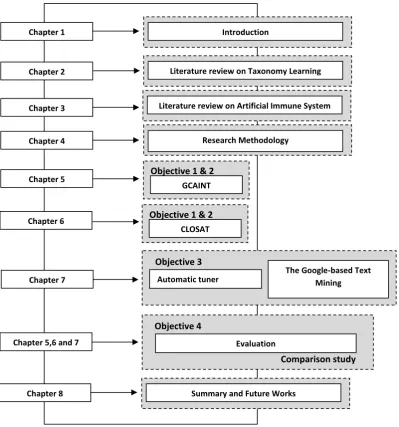
highlighted. This thesis consists of eight chapters as depicted in Figure 1.2. Figure
1.2 also shows the mapping between the research objectives and the chapters in the
thesis.
The structure of this thesis is as follows.
i.
The first chapter gives a brief introduction to the research and briefly explains
the problem statement, research objectives, research scope and brief
discussion on the research methodology.
ii.
Chapter 2 reveals the background to the research with a formal and
mathematical definition of taxonomy. This chapter presents in detail the field
of taxonomy learning from textual data, in particular describing the history
and state-of-the-art in this area.
iii.
Chapter 3 introduces the basics necessary to understand the immune system.
The aim of this chapter is it serves to impart technical knowledge to the
reader to allow for comprehension of the later chapters. Secondly it serves to
provide evidence that the use of an AIS and the chosen problem domain are
both justified in the context presented in this thesis.
iv.
Chapter 4 describes the methodological approach of the research.
v.
Chapter 5 presents the methodology, implementation and experimental results
for the first taxonomy induction approach which makes use of the proposed
immune-inspired algorithm named GCAINT (Guided Clustering with
Artificial Immune Network).
vi.
Chapter 6 presents the methodology, implementation and experimental results
for the second taxonomy induction approach named CLOSAT – Clonal
Selection Algorithm for Taxonomy Learning.
vii.
Chapter 7 presents the methodology, implementation and experiment results
for a new approach in feature selection from Malay texts by using a
Google-Desktop search engine. The methodology and implementation of the
automatic parameter tuning is presented in this chapter.
15
viii.
Finally in Chapter 8, the thesis further discuss the results and interpretation of
the obtained taxonomy. This chapter concludes by offering some thoughts on
the use of intelligent systems for taxonomy learning in the long term.
Objective 4
Evaluation
Comparison study Chapter 5,6 and 7
Chapter 5
Chapter 6 Objective 1 & 2
CLOSAT Objective 1 & 2
GCAINT
Literature review on Artificial Immune System Literature review on Taxonomy Learning
Research Methodology Introduction Chapter 1
Chapter 2
Chapter 3
Chapter 4
The Google‐based Text Mining
Objective 3
Automatic tuner
Summary and Future Works Chapter 8
Chapter 7
REFERENCES
(2010). Innate. EczemaNet Glossary. American Academy of Dermatology.
Acilar AM & Arslan A (2009) A collaborative filtering method based on artificial immune network Expert Systems with Applications 36 (4): 8324-8332
Aggarwal C & Yu P (2007).On Privacy-Preservation of Text and Sparse Binary Data with Sketches Proceedings of the 2007 SIAM International Conference on Data Mining, Minneapolis, Minnesota, 2007.
Aickelin U & Cayzer S (2002). The Danger Theory and Its Application to Artificial Immune Systems. International Conference on Artificial Immune Systems.
Al-Hammadi Y, Aickelin U & Greensmith J (2010) Performance Evaluation of DCA and SRC on a Single Bot Detection. Journal of Information Assurance and Security 5 265-275.
Alesso HP & Smith CF (2005) Developing Semantic Web Services. A K Peters.Natick, Massachusetts
Anderberg, M.R. (1973). Cluster Analysis for Applications. New York. New York: Academic Press.
Apidianaki M (2009). Data-Driven sense induction for disambiguation and lexical selection in translation. Dublin: Dublin City University.
Azhar MS (1988) Discourse-Syntax of “YANG” In Malay (Bahasa Malaysia). Dewan Bahasa dan Pustaka.Kuala Lumpur
Baedi J, Arabshahi H, Armaki MG & Hosseini E (2010). Optical Design of Multilayer Filter by using PSO Algorithm. Research Journal of Applied Sciences, Engineering and Technology 2 (1): 56-59.
Baroni M & Bisi. S (2004).Using cooccurrence statistics & the web to discover synonyms in a technical language. The 4th International Conference on Language Resources and Evaluation, 2004, 5, 1725-1728.
Barrière C (2004). Knowledge-Rich Contexts Discovery Advances in Artificial Intelligence. Belrin/Heidelberg: Springer.
Batty D, Johnson JA, Mortensen CH & Rainey KC (2010). Taxonomy. Ethnographic Thesaurus. The American Folklore Society.
Beil F, Ester M, Fraser S & Xu X (2002).Frequent term-based text clustering. KDD '02 Proceedings of the eighth ACM SIGKDD international conference on Knowledge discovery and data mining New York, 2002, ACM.
Bentley P (2001) Digital Biology. Headline. London.
Benz D. (2007). Collaborative ontology learning. Master, University of Freiburg.
Berek C & Milstein C (1988) The Dynamic Nature of the Antibody Repertoire., 1988(105):5-26. Immunology Reviews 105 5-26.
Bersini H & Varela F (1990).Hints for Adaptive Problem Solving Gleaned from Immune Networks. Proceedings of the First Conference on Parallel Problem Solving from Nature, 1990, 343-354.
Bersini H (2002). Self-Assertion versus self-recognition: a tribute to Francisco Varela.In:Timmis J & Bentley Pj, eds Proceedings of the 1st international conference on artificial immune systems (ICARIS, University of Kent at Canterbury, 2002, University of Kent.107–112.
Bezerra GB, Barra TV, Castro LNd & Zuben FJV (2005). Adaptive Radius Immune Algorithm for Data Clustering Artificial Immune Systems. Berlin/Heidelberg: Springer.
Bezerra GB & de Castro LN (2003).Bioinformatics Data Analysis Using an Artificial Immune Network. Proc. of Second International Conference on Artificial Immune Systems (ICARIS 2003), Edinburgh, UK, 2003, Lecture Notes in Computer Sciences, Springer, 22-33.
Bezerra GB, de Castro LN & von Zuben FJ (2004). A Hierarchical Immune Network Applied to Gene Expression Data. Artificial Immune Systems. Berlin / Heidelberg: Springer
Bhríde FMG, McGinnity TM & McDaid LJ (2005). Landscape Classification and Problem Specific Reasoning for Genetic Algorithms. International Journal of Systems and Cybernetics. 34 (9/10): 1469-1495.
Biemann C (2005) Ontology Learning from Text - a Survey of Methods. LDVForum 20 75-93.
Birattari M, Sttzle T, Paquete L & Varrentrapp K (2002). A racing algorithm for configuring
metaheuristics. . Proceedings of the Genetic and Evolutionary Computation Conference. San Francisco: Morgan Kaufmann Publishers Inc.
Bisson G, Nedellec C & Canamero L (2000).Designing clustering methods for ontology building :The Mo’K workbench. Proceedings of the ECAI Ontology Learning Workshop., Berlin, 2000, 13-19.
Blohm S & Cimiano P (2007). Using the Web to Reduce Data Sparseness in Pattern-Based Information Extraction Knowledge Discovery in Databases: PKDD 2007. Berlin/Heidelberg: Springer.
Boicu M, Tecuci G, Stanescu B, Marcu D & Cascaval C (2001).Automatic Knowledge Acquisition from Subject Matter Experts. In Proceedings of the 2001 International Conference on Tools With Artificial Intelligence, Dallas, USA., 2001.
Borsje J. (2007). Rule Based Semi-Automatic Ontology Learning. Master, Erasmus University Rotterdam.
Brewster C, Iria J, Zhang Z, Ciravegna F, Guthrie L & Wilks Y (2007).Dynamic Iterative Ontology Learning. Recent Advances in Natural Language Processing (RANLP 07), Borovets, Bulgaria, 2007.
Brewster C, Jupp S, Luciano J, Shotton D, Stevens RD & Zhang Z (2008).Issues in learning an ontology from text. Bio-Ontologies 2008: Knowledge in Biology, Toronto, ON, Canada, 2008, BioMed Central.
Brocke S, Veromaa T, Weissman I, Gijbels K & Steinman L (1994). Infections and multiple sclerosis: A possible role for superantigens? Trends Microbiol. 2 250-254.
Brown P, Pietra V, Pietra V & Mercer R (1991).Word-sense disambiguation using statistical methods. In . [1, 2]. 29th Annual Meeting of the Association for Computational Linguistics, Berkeley,
California, USA, 1991, ACL.
Brunzel M (2007). Learning of Semantic Sibling Group Hierarchies - K-Means vs. Bi-secting-K-Means Data Warehousing and Knowledge Discovery. Berlin / Heidelberg: Springer.
Budi, I. & Bressan, S. (2003). Association rules mining for name entity recognition. In: the Fourth International Conference on Web Information Systems Engineering (WISE 2003) (pp. 325-328). Rome, Italy: IEEE Xplore.
Buitelaar P, Cimiano P & Magnini B (2003). Ontology Learning from Text:An Overview. Ontology Learning from Text: methods, evaluation and applications. Amsterdam: IOI Press.
Burgun A & Bodenreider O (2001).Aspects of the Taxonomic Relation in the Biomedical Domain. International Conference on Formal Ontology in Information Systems, Ogunquit, Maine, USA 2001, ACM, 222-233.
Burnett FM (1959) The Clonal Selection Theory of Aquired Immunity. Cabridge University Press.
Campelo F, Guimaraes FG, Igarashi H, Ramirez JA & Noguchi S (2006) A modified immune network algorithm for multimodal electromagnetic problems. IEEE Transactions on Magnetics Volume 42 (4): 1111-1114.
Caraballo SA (1999).Automatic construction of a hypernym-labeled noun hierarchy from text. 7th Annual Meeting of the Association for Computational Linguistics, College Park, Maryland 1999, In Proceedings of the 37th Annual Meeting of the Association for Computational Linguistics, ACM, 120-126.
Cayzer S, Smith J, Marshall JAR & Kovacs T (2005).What Have Gene Libraries Done For AIS? 4th International Conference on Artificial Immune Systems (ICARIS 2005), Banff, Canada, 2005, Lecture Notes in Computer Science, 3627, 86-99.
Cha S-H, Yoon S & Tappert CC (2005).On Binary Similarity Measures for Handwritten Character Recognition. Eighth International Conference on Document Analysis and Recognition (ICDAR'05), Seoul, Korea. , 2005.
Chan K, Saltelli A & Tarantola. S (1997). Sensitivity analysis of model output: variancebased methods make the difference. . Proceedings of the 29th conference on Winter simulation (Winter Simulation Conference). New York: ACM Press.
Chau DH, Myers B & Faulring A (2008). Feldspar: A System for Finding Information by Association. CHI 2008. Florence, Italy: ACM.
Chen J & Li Q (2006). Concept Hierarchy Construction by Combining Spectral Clustering and
Subsumption Estimation. Web Information Systems – WISE 2006. Berlin / Heidelberg: Springer
Cheng Y & Church GM (2000).Biclustering of expression data. Proceedings of the 8th international conference on intelligent systems for molecular biology, 2000, 93-103.
Chung S, Jun J & McLeod D (2006).A Web-Based Novel Term Similarity Framework for Ontology Learning. Ontologies, Databases and Applications of Semantics (ODBASE) 2006 International Conference, Montpellier, France, 2006, 4725/2006, Springer Berlin / Heidelberg, 1092-1109.
Chye TS (1990) Biokimia Tumbuhan Hijau. Dewan Bahasa dan Pustaka.Kuala Lumpur
Cimiano P (2005).Ontology Learning from Text.In:Kushmerick N, Ciravegna F, Doan A, Knoblock C & Staab S, eds Machine Learning for the Semantic Web, 2005.
Cimiano P (2006) Ontology Learning and population from Text. Springer Berlin
Cimiano P, Hotho A & Staab S (2004a).Clustering concept hierarchies from text. . The fourth international conference on Language Resources and Evaluation, Lisbon, Portugal, 2004a, In Proceedings of LREC.
Cimiano P, Hotho A & Staab. S (2004b).Comparing conceptual, divisive and agglomerative clustering for learning taxonomies from text. Proceedings of the European Conference on Artificial Intelligence (ECAI), 2004b, 435-439.
Cimiano P, Staab S & Handschuh S (2004c).Towards the Self Annotating Web. 13th International World Wide Web Conference (WWW 2004), New York, 2004c, ACM.
Cimiano P, Hotho A & Staab S (2005a) Learning Concept Hierarchies from Text Corpora Using Formal Concept Analysis. Journal of Artificial Intelligence Research 24 305–339.
Cimiano P, Pivk A, Schmidt-Thieme L & Staab S (2005b). Learning Taxonomic Relations from Heterogeneous Sources of Evidence. Ontology Learning from Text: Methods, Evaluation and Applications. IOS Press.
Cimiano P & Staab S (2005).Learning Concept Hierarchies from Text with a Guided Agglomerative Clustering Algorithm. International Conference on Machine Learning 2005 (ICML 2005) Bonn Germany, 2005, Workshop on Learning and Extending Ontologies with Machine Learning Methods.
Cimiano P, Valker J & Studer R (2006) Ontologies on Demand? - A Description of the State-of-the-Art, Applications, Challenges and Trends for Ontology Learning from Text. Information,
Wissenschaft und Praxis 57 (6-7): 315-320.
Cimiano P, Mädche A, Staab S & Völker J (2009). Ontology Learning. Handbook of Ontologies.Springer Verlag.
Coelho GP, de França FO & von Zuben FJ (2008). A multi-objective multipopulation approach for biclustering. Artificial Immune System. Berlin/Heidelberg: Springer.
D. Dasgupta ZJaFG (2003).Artificial Immune System (AIS) Research in the Last Five Years. Proceedings of the IEEE Congress on Evolutionary Computation (CEC), Canberra, Australia, 2003.
Dahab MY, Hassan HA & Rafea A (2006).TextOntoEx: Automatic Ontology Construction from Natural English Text. AIML 06 International Conference, Sharm El Sheikh, Egypt, 2006, 51-57.
Dasgupta D (1999) Artificial Immune Systems and Their Applications. Springer-Verlag.Berlin
Davies MN, Secker A, Freitas AA, Clark E, Timmis J & Flower DR (2008) Tuning amino acid groupings for GPCR classification , September 15, 2008; 24(18). Bioinformatics 24 (18): 3113-3118.
de Castro LN & von Zuben FJ (2000a). An evolutionary immune network for data clustering. 6th
Brazilian Symposium on Neural Networks (SBRN 2000), Rio de Janiero, 2000a, IEEE Computer Society, 84-89.
de Castro LN & von Zuben FJ (2000b).The clonal selection algorithm with engineering applications. Proceedings of Genetic and Evolutionary Computation, Las Vegas, USA, 2000b, 36–37.
de Castro LN & von Zuben FJ (2001). aiNet: an artificial immune network for data analysis. In: Abbass Ha, Saker Ra & Newton Cs (eds.) Data mining: a heuristic approach. USA: Idea Group Publishing
de Castro LN & von Zuben FJ (2002) Learning and Optimization Using the Clonal Selection Principle. IEEE Transactions on Evolutionary Computation 6 (3).
de Castro LN & Timmis J (2002a).An artificial immune network for multimodal function optimization. Proceedings of the 2002 Congress on Evolutionary Computation, 2002. CEC '02., 2002a, 1, IEEE, 699 - 704
de Castro LN & Timmis J (2002b) Artificial Immune Systems: A new Computational Intelligence Approach. Springer. London
de Castro LN & Timmis J (2002c). Hierarchy and Convergence of Immune Networks: Basic Ideas and Preliminary Results. Proc. First International Conference on Artificial Immune System (ICARIS 2002).
de Castro PAD, de Franca FO, Hamilton M. F, Coelho GP & von Zuben FJ (2009) Query expansion using an immune-inspired biclustering algorithm. Natural Computing.
de Castro PAD, França FOd, Ferreira HM & Zuben FJV (2007). Applying Biclustering to Text Mining: An Immune-Inspired Approach. Artificial Immune Systems Berlin/Heidelberg: Springer.
de Vel O, Anderson A, Corney M & Mohay G (2001) Mining e-mail content for author identification forensics. ACM SIGMOD Record 30 (4): 55-64.
Dittami S (2009). Shapiro-Wilk Normality Test.
Dolan W, vanderwende L & Riichardson S (1993).Automatically deriving structured knowledge bases from online dictionaries. Proceedings of the Pasific Asociation for Computational Linguistics (PACLING), 1993, 5-14.