Consumer Attitudes Regarding Information
Technology Usage
Khalil MD NOR
University of Technology Malaysia, FPPSM
Department of Management, Malaysia [email protected]
Liliana Mihaela MOGA
Dunarea de JosUniversity Galati, RomaniaDurmus YORUK
Afyon KocatepeUniversity,
Department of Business Administration, Turkey [email protected]
Abstract
This paper intends to formulate the hypotheses for the factors that influence individuals to adopt Information Technology as a mean to conduct the traditional services. The hypotheses are developed based on previous works utilizing the theories on technology acceptance and on related findings from empirical studies on information technologies, e-commerce and e-banking.
Keywords: consumer, electronic services, hypotheses, influence factors, theories of
technology acceptance
JEL Code: M15
Introduction
The increasing use of online services indicates the needs for researchers to identify important factors that influence individuals to use electronic means to perform these services. These factors are essential as they may influence individuals’ attitude towards the services, later the intention to use and finally lead them to use the services. Previous studies have shown that researchers have extensively studied factors that can be used to predict individuals’ acceptance to a new technology. These studies have led to the development of several theories, which are grouped and called as the theories of technology acceptance. These competing theories are widely used not only to predict individuals’ intention to adopt information technology but also other online services such as e-commerce, m-commerce and e-banking. Three theories that we feel relevant in building the hypotheses in this paper are the Information Diffusion Theory, the Technology Acceptance Model and the Decomposed Theory of Planned Behavior.
Methodology
Previous literature and empirical studies related to technology acceptance was reviewed. Based on these reviews, was established constructs that may influence individuals’ acceptance toward information technology (IT) in particular e-banking. We propose an online survey to empirically test the proposed model in order to confirm factors that predict individuals’ intention to adopt the electronic version to conduct traditional services.
1. Innovation Diffusion Theory
gathering and synthesizing the information will then lead to a more understanding of the technology and the consequences of adopting the technology or in other words reducing the uncertainty effects of the technology. The result of this uncertainty reduction process is the individuals’ beliefs about the technology and these beliefs then will determine whether they accept or reject the technology.
The determinants suggested by Rogers (1995) as the critical factors that determine the adoption of an innovation are listed in Figure 1 below [16]. He defines each determinant as follows:
1. Relative advantage: “the degree to which an innovation is perceived as being better than the idea it supersedes”;
2. Compatibility: “the degree to which an innovation is perceived as consistent with the existing values, past experiences, and needs of potential”;
3. Complexity: “the degree to which an innovation is perceived as relatively difficult to understand and use;
4. Trialability: “the degree to which an innovation may be experimented with on a limited basis”; 5. Observability: “the degree to which the results of an innovation are visible to others”.
Figure 1: Innovation Diffusion Theory
Empirically, the theory has been widely applied in the IT related studies. For instance, the theory has been used in investigating factors that may influence users to use operating systems (Karahanna et al., 1999), Smart Card (Plouffe et al. 2001) and online trading (Lau, 2002) [7], [14], [8]. This theory has also been utilized in the development of research instrument to examine the decision making process to adopt an IT innovation by Moore and Benbasat (1991) [12]. Some of the constructs in this theory have also been used by researchers as the antecedents of attitude toward using a technology such as by Taylor and Todd (1995) [18]. Later, researchers as and Tan and Teo (2000), Gerrard and Cunningham (2003) and Md Nor and Pearson (2007, 2008) had tested the theory on the e-banking adoption [17], [6], [10].
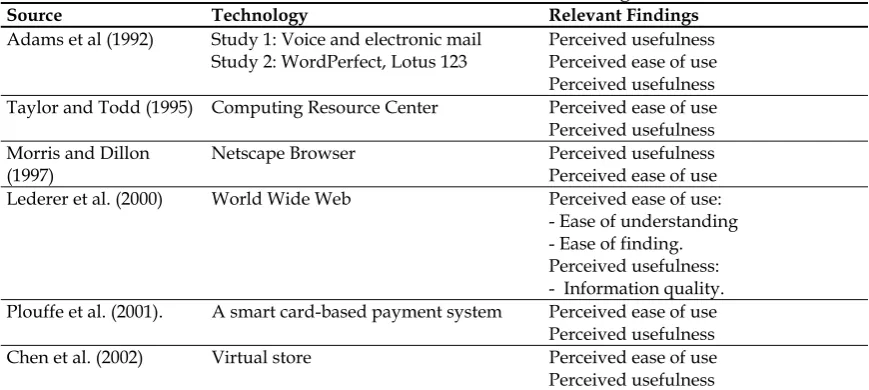
Some of the empirical studies that have used the theory or IDT’s attributes are summarized Table 1 below:
Table 1: Selected studies utilizing IDT and IDT’s construct
Source Technology Construct
Moore and Benbasat (1991)
(Instrument Development)
Personal Work Station
Relative advantage, compatibility, complexity (perceived ease of use) and trialability.
Taylor and Todd
(1995) Computing Resource Center Relative advantage (perceived usefulness), perceived ease of use and compatibility.
Behavioral Intention/
Attitude Relative
Advantage
Compatibility
Complexity
Trialability
Source Technology Construct Parthasarathy and
Bhattacherjee (1998)
Online service Perceived usefulness and compatibility.
Karahanna et al.
(1999) Microsoft Window 3.1 Perceived ease of use, perceived usefulness, visibility, result demonstrability, image and trialability.
Plouffe et al. (2001). A smart card-based payment system
Relative advantage, compatibility, image, visibility, and
Trialability Chen et al. (2002) Virtual store Compatibility.
Lau (2002) Online trading Perceived usefulness, perceived ease of use, complexity,
relative advantage, compatibility and observability.
Technology Acceptance Model
Another widely used theory in technology acceptance studies is the Technology Acceptance Model (TAM). The theory is considered simple but with high predicative power (Figure 2). The Technology Acceptance Model postulates that individuals’ attitude influences intention, and the intention will then lead to behavior. Specifically, according to TAM, an individual adoption behavior is determined by his or her intention to use a particular system. This intention is determined by the attitude, which is influenced by the perceived usefulness and perceived ease of use of the system (Davis, 1989) [4]. He defines perceived usefulness as the extent to which an individual believes that using a particular system will enhance his or her job performance. And perceived ease of use is defined as the extent to which an individual believes that using a particular system will be free of effort.
Figure 2: Technology Acceptance Model
In addition to the two main constructs that predict the attitude and later the intention to use a system, the theory also postulates that other external variables may also affect perceived ease of use and usefulness. For instance, perceived ease of use may be influenced by some external variables such as system features, training, documentation and user supports (Davis, Bagozzi, & Warshaw, 1989) [4]. Davis et al., also provide situation where external variables may influence an individual’s perceived usefulness. Given two computer programs, which are equally easy to use, the computer program that produces better quality graphs or improve users’ productivity may have a higher influence on an individual’s perceived usefulness.
As mentioned previously, TAM has been widely used and received a considerable attention and empirical support among IT researchers. The model has been tested on various technologies and settings. For instance, Adams, Nelson, & Todd (1992) had used TAM in two studies [1]. The first study was on voice and electronic mail and the second study on WordPerfect and Lotus 123.
They found that TAM scales were reliable and valid for measurement of perceived ease of use and perceived usefulness. In the first study, they found that perceived usefulness was a significant determinant of usage. In the second study, they found that perceived ease of use was significant predictor of the usage of WordPerfect and Lotus 123, while perceived usefulness was only
Perceived Usefulness
Perceived Ease of Use
Intention to Use Attitude
significant predictor of the usage of Lotus 123. In a study of Computing Resource Center, Taylor & Todd (1995) discovered that hypothesized paths of perceived ease of use to perceived usefulness, perceived ease of use to attitude, perceived usefulness to attitude, and behavioral intention to actual usage were all significant [18]. In another study conducted by Morris and Dillon (1997) investigating the determinants of Netscape Browser usage, the constructs perceived usefulness and perceived ease of use were found to be significant in influencing the attitude [13]. Perceived usefulness and attitude were also found significant in influencing the behavioral intention. Finally, behavioral intention influences on the actual usage was also found significant. In a study on world wide web (www), Lederer, Maupin, Sena, & Zhuang’s findings (2000) supported the effect of perceived usefulness and perceived ease of use on usage [9]. They also found that ease of understanding and ease of finding were significant antecedents of perceived ease of use. And the significant antecedent of usefulness was information quality. In the smart card-based payment system, Plouffe et al. (2001) found that both perceived ease of use and perceived usefulness significantly affected the intention to adopt IT [14]. The same findings were also found by Chen et al. (2002) regarding the usage of Virtual Store. Previously discussed studies utilizing TAM are shown in the Table 2 below [3].
Table 2: Selected studies utilizing TAM and TAM’s construct
Source Technology Relevant Findings
Adams et al (1992) Study 1: Voice and electronic mail Study 2: WordPerfect, Lotus 123
Perceived usefulness Perceived ease of use Perceived usefulness Taylor and Todd (1995) Computing Resource Center Perceived ease of use
Perceived usefulness Morris and Dillon
(1997)
Netscape Browser Perceived usefulness Perceived ease of use Lederer et al. (2000) World Wide Web Perceived ease of use:
- Ease of understanding - Ease of finding. Perceived usefulness: - Information quality. Plouffe et al. (2001). A smart card-based payment system Perceived ease of use Perceived usefulness Chen et al. (2002) Virtual store Perceived ease of use
Perceived usefulness
The Decomposed Theory of Planned Behavior
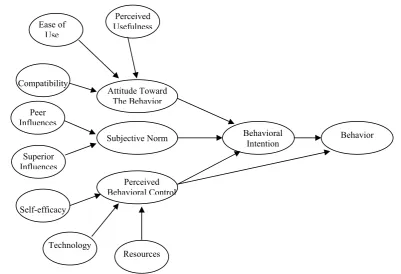
The last theory in the technology acceptance domain that we reviewed is the Decomposed Theory of Planned Behavior (DTPB). The theory is based on the Theory of Planned Behavior. TPB is based on the work of Taylor and Todd (1995) [18s]. Due to the deficiency in explaining the make up of attitude, subjective norm and perceived behavioral, Taylor and Todd (1995) decomposed these three constructs. Based on the foundation theory it is based on i.e., the theory of planned behavior, the theory postulates that the intention to use a technology is influenced by attitude, subjective norm and perceived behavioral control. Taylor and Todd (1995) decomposed attitude into perceived usefulness, ease of use and compatibility; subjective norm into peer influences and superior influences; and perceived behavioral control into self-efficacy, technology and resources.
Figure 3: Decomposed Theory of Planned Behavior
In a study on electronic brokerage acceptance, Bhattacherjee (2000) found that attitudinal-decomposed factors (i.e., usefulness and ease of use) were significantly related to attitude of using the Electronic Brokerage [2]. Social-decomposed factors (i.e., interpersonal influence and external influence) were significantly related to subjective norm. Control-decomposed factors (i.e., self-efficacy and facilitating conditions) were significantly related to behavioral control. Finally, attitude, subjective norm and behavioral control were found to have significant effects on intention. In another study, Lau (2002) found that the actual behavior of online trading was influenced by behavioral intention [8]. Attitude, subjective norm, and perceived behavioral control were significant determinants of behavioral intention. Perceived usefulness, perceived ease of use, relative advantage, compatibility and observability were significantly correlated with attitude. Competitor influence, customer influence, decision maker influence, and employee influence were significantly correlated with subjective norm. Finally, resource facilitating condition and technology facilitation condition were significantly correlated with perceived behavioral control.
Table 3: Selected studies utilizing DTPB and DTPB
Source Technology Construct
Taylor and
Todd (1995) Computing Resource Center
Main constructs:
Attitude, subjective norm, and perceived behavioral control Decomposed constructs:
Perceived usefulness, peer influences, superior influences, self-efficacy, resources
Lau (2002) Online Trading Main constructs:
Attitude, subjective norm, and perceived behavioral control Decomposed constructs:
Perceived usefulness, perceived ease of use, compatibility, competitor influence, customer influence, decision maker, influence, employee influence, resource facilitating, condition technology, facilitation condition
Conclusion
This paper has provided an overview of three theories and related empirical studies that previous researchers have used to examine individuals’ acceptance of various technologies including e-banking. The summaries of some of the studies were also provided. The theories we reviewed in this paper are not considered to be exhaustive as there are many other models and theories, in addition to the introduction of specific constructs to the main theories that are being used by
Behavioral
Intention Behavior
Attitude Toward The Behavior
Subjective Norm
Perceived Behavioral Control
Perceived Usefulness Ease of
Use
Compatibility
Peer Influences
Superior Influences
Technology Self-efficacy
suggest that researchers look from three main perspectives in their attempt to understand factors that influence individuals to accept IT i.e., individual, technology and environment.
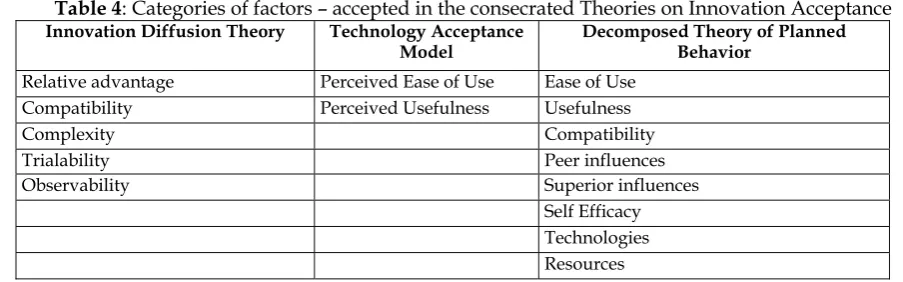
Table 4: Categories of factors – accepted in the consecrated Theories on Innovation Acceptance
Innovation Diffusion Theory Technology Acceptance
Model Decomposed Theory of Planned Behavior
Relative advantage Perceived Ease of Use Ease of Use
Compatibility Perceived Usefulness Usefulness
Complexity Compatibility
Trialability Peer influences
Observability Superior influences
Self Efficacy
Technologies
Resources
Based on the theories and previous studies reviewed, we proposed factors that should be included in the main model in predicting the adoption of IT in particular e-banking. The factors are as shown in Table 4 above. They are relative advantage (perceived usefulness), complexity (ease of use), compatibility, trialability, observability, peer influences, superior influences, self-efficacy, technologies and resources. Reviewing these factors also indicates that there are other important factors that need to be included in the main model such as trust and security and factors related to national attributes. Therefore the final proposed model should be developed by taking into consideration these factors.
Acknowledgements: The research is the result of the Financing contract no. 957/19.01.2009, (CNCSIS
Code 1852), financed by PNII, Ideas – Exploratory Research Projects – Modelling of the Factors with Impact on e-Banking Adoption” – CNCSIS, contractor: The Bucharest Academy of Economic Studies;
References
1. Adams, D.A., Nelson, R.R., & Todd, P.A. (1992). Perceived usefulness, ease of use, and usage of information technology: A replication. MIS Quarterly, 16(2), 227-248.
2. Bhattacherjee, A. (2002). Individual trust in online firms: Scale development and initial test. Journal of Management Information Systems, 19(1), 211-241.
3. Davis, F.D. (1989). Perceived usefulness, perceived ease of use, and user acceptance of information technology. MIS Quarterly, 13(3), 319-340.
4. Chen. L., Gillenson, M.L., & Sherrell, D.L. (2002). Enticing online consumers: An extended technology acceptance perspective. Information & Management, 39, 705-719.
5. Davis, F.D., Bagozzi, R.P., & Warshaw, P.R. (1989). User acceptance of computer technology: A comparison of two theoretical models. Management Science, 35(8), 982-1003.
6. Gerrard, P., & Cunningham, J. B. (2003). The diffusion of Internet banking among Singapore consumers. International Journal of Bank Marketing, 21(1), 16-28.
7. Karahanna, E., Straub, D.W., & Chervany, N.L. (1999). Information technology adoption across time: A cross-sectional comparison of pre-adoption and post-adoption beliefs. MIS Quarterly, 23(2), 183-213.
8. Lau, S.M. (2002). Strategies to motivate brokers adopting on-line trading in Hong Kong financial market. Review of Pacific Basin Financial Markets and Policies, 5(4), 471-489.
9. Lederer, A.L., Maupin, D.J., Sena, M.P., & Zhuang, Y. (2000). The technology acceptance model and the World Wide Web. Decision Support Systems, 29(3), 269-282.
10. Md Nor, K. and Pearson, J. M. (2007). The Influence of Trust On Internet Banking Acceptance, Journal of Internet Banking and Commerce, 12(2), 1-10.
11. Md Nor, K. and Pearson, J.M. (2008). An Exploratory Study Into The Adoption of Internet Banking in A Developing Country: Malaysia, Journal of Internet Commerce, 7(1), 29-73.
12. Moore, G.C., & Benbasat, I. (1991). Development of an instrument to measure the perceptions of adopting an information technology innovation. Information Systems Research, 2(3), 192-222.
13. Morris, M.G., & Dillon, A. (1997). How user perceptions influence software use. IEEE Software, 14(4), 58-65.
14. Plouffe, C.R., Hulland, J.S., & Vandenbosch, M. (2001). Research report: Richness versus parsimony in modeling technology adoption decisions – Understanding merchant adoption of a smart card-based payment system. Information Systems Research, 12(2), 208-222.
15. Rogers, E.M. (1983). The diffusion of innovations. New York: Free Press.
16. Rogers, E.M. (1995). Diffusion of innovations. New York: Free Press.
17. Tan, M., and Teo, T.S.H. (2000). Factors influencing the adoption of Internet banking. Journal of the Association for Information Systems, 1, 1-42.