R E S E A R C H
Open Access
A comparative study on the convergence
rate of some iteration methods involving
contractive mappings
Shahin Fathollahi
1, Adrian Ghiura
2, Mihai Postolache
2*and Shahram Rezapour
1*Correspondence:
2Department of Mathematics and
Informatics, University Politehnica of Bucharest, Bucharest, 060042, Romania
Full list of author information is available at the end of the article
Abstract
We compare the rate of convergence for some iteration methods for contractions. We conclude that the coefficients involved in these methods have an important role to play in determining the speed of the convergence. By using Matlab software, we provide numerical examples to illustrate the results. Also, we compare mathematical and computer-calculating insights in the examples to explain the reason of the existence of the old difference between the points of view.
MSC: 47H09; 47H10
Keywords: contractive map; fixed point; iteration method; rate of convergence
1 Introduction
Iteration schemes for numerical reckoning fixed points of various classes of nonlinear op-erators are available in the literature. The class of contractive mappings via iteration meth-ods is extensively studied in this regard. In , Plunkett published a paper on the rate of convergence for relaxation methods []. In , Bowden presented a talk in a symposium on digital computing machines entitled ‘Faster than thought’ []. Later, this basic idea has been used in engineering, statistics, numerical analysis, approximation theory, and physics for many years (see, for example, [–] and []). In , Argyros published a paper about iterations converging faster than Newton’s method to the solutions of nonlinear equations in Banach spaces [, ]. In , Lucet presented a method faster than the fast Legen-dre transform []. In , Berinde used the notion of rate of convergence for iterations method and showed that the Picard iteration converges faster than the Mann iteration for a class of quasi-contractive operators []. Later, he provided some results in this area [, ]. In , Babu and Vara Prasad showed that the Mann iteration converges faster than the Ishikawa iteration for the class of Zamfirescu operators []. In , Popescu showed that the Picard iteration converges faster than the Mann iteration for the class of quasi-contractive operators []. Recently, there have been published some papers about introducing some new iterations and comparing of the rates of convergence for some it-eration methods (see, for example, [–] and []).
In this paper, we compare the rates of convergence of some iteration methods for con-tractions and show that the involved coefficients in such methods have an important role
to play in determining the rate of convergence. During the preparation of this work, we found that the efficiency of coefficients had been considered in [] and []. But we ob-tained our results independently, before reading these works, and one can see it by com-paring our results and those ones.
2 Preliminaries
As we know, the Picard iteration has been extensively used in many works from different points of view. Let (X,d) be a metric space,x∈X, andT: X→Xa selfmap. The Picard iteration is defined by
xn+=Txn
for alln≥. Let{αn}n≥,{βn}n≥, and{γn}n≥be sequences in [, ]. Then the Mann iter-ation method is defined by
xn+=αnxn+ ( –αn)Txn (.)
for alln≥ (for more information, see []). Also, the Ishikawa iteration method is de-fined by
xn+= ( –αn)xn+αnTyn,
yn= ( –βn)xn+βnTxn
(.)
for all n≥ (for more information, see []). The Noor iteration method is defined by
xn+= ( –αn)xn+αnTyn,
yn= ( –βn)xn+βnTzn, (.)
zn= ( –γn)xn+γnTxn
for alln≥ (for more information, see []). In , Agarwalet al.defined their new iteration methods by
xn+= ( –αn)Txn+αnTyn,
yn= ( –βn)xn+βnTxn
(.)
for all n≥ (for more information, see []). In , Abbaset al.defined their new iteration methods by
xn+= ( –αn)Tyn+αnTzn,
yn= ( –βn)Txn+βnTzn, (.)
for alln≥ (for more information, see []). In , Thakuret al.defined their new iteration methods by
xn+= ( –αn)Txn+αnTyn,
yn= ( –βn)zn+βnTzn, (.)
zn= ( –γn)xn+γnTxn
for alln≥ (for more information, see []). Also, the Picard S-iteration was defined by
xn+=Tyn,
yn= ( –βn)Txn+βnTzn, (.)
zn= ( –γn)xn+γnTxn
for alln≥ (for more information, see [] and []).
3 Self-comparing of iteration methods
Now, we are ready to provide our main results for contractive maps. In this respect, we assume that (X,·) is a normed space,x∈X,T:X→Xis a selfmap and{αn}n≥,{βn}n≥ and{γn}n≥are sequences in (, ).
The Mann iteration is given byxn+= ( –αn)xn+αnTxnfor alln≥.
Note that we can rewrite it asxn+=αnxn+ ( –αn)Txnfor alln≥.
We call these cases the first and second forms of the Mann iteration method.
In the next result we show that choosing a type of sequence{αn}n≥in the Mann iteration has a notable role to play in the rate of convergence of the sequence{xn}n≥.
Let{un}n≥ and{vn}n≥ be two fixed point iteration procedures that converge to the same fixed pointpandun–p ≤anandvn–p ≤bnfor alln≥. If the sequences
{an}n≥and{bn}n≥converge toaandb, respectively, andlimn→∞abn–n–ab= , then we say that{un}n≥converges faster than{vn}n≥top(see [] and []).
Proposition . Let C be a nonempty,closed,and convex subset of a Banach space X, x∈C,T:C→C a contraction with constant k∈(, )and p a fixed point of T.Consider the first case for Mann iteration.If the coefficients of Txnare greater than the coefficients
of xn,that is, –αn<αnfor all n≥or equivalently{αn}n≥is a sequence in(, ),then the Mann iteration converges faster than the Mann iteration which the coefficients of xnare
greater than the coefficients of Txn.
Proof Let{xn}be the sequence in the Mann iteration which the coefficients ofTxnare
greater than the coefficients ofxn, that is,
xn+= ( –αn)xn+αnTxn (.)
for alln. In this case, we have
xn+–p=( –αn)xn+αnTxn–p≤( –αn)xn–p+αnTxn–p
≤ –αn( –k)
for alln. Sinceαn∈(, ), –αn( –k) < –( –k). Putan= ( –( –k))nx–pfor
alln. Now, let{xn}be the sequence in the Mann iteration of which the coefficients ofxn
are greater than the coefficients ofTxn. In this case, we have
xn+–p=αnxn+ ( –αn)Txn–p≤αnxn–p+ ( –αn)Txn–p
≤ – ( –αn)( –k)
xn–p
for alln. Since –αn<αnfor alln≥, we get – ( –αn)( –k) < for alln≥. Putbn=
x–pfor alln. Note thatliman
bn =lim
(–(–k))nx–p
x–p = . This completes the proof.
Note that we can use –αn<αn, fornlarge enough, instead of the condition –αn<αn,
for alln≥. One can use similar conditions instead of the conditions which we will use in our results.
As we know, we can consider four cases for writing the Ishikawa iteration method. In the next result, we indicate each case by different enumeration. Similar to the last result, we want to compare the Ishikawa iteration method with itself in the four possible cases. Again, we show that the coefficient sequences{αn}n≥and{βn}n≥have effective roles to play in the rate of convergence of the sequence{xn}n≥in the Ishikawa iteration method.
Proposition . Let C be a nonempty, closed, and convex subset of a Banach space X, x∈C,T: C→C a contraction with constant k∈(, ),and p a fixed point of T.Consider the following cases of the Ishikawa iteration method:
xn+= ( –αn)xn+αnTyn,
yn= ( –βn)xn+βnTxn,
(.)
xn+=αnxn+ ( –αn)Tyn,
yn=βnxn+ ( –βn)Txn,
(.)
xn+=αnxn+ ( –αn)Tyn,
yn= ( –βn)xn+βnTxn,
(.)
and
xn+= ( –αn)xn+αnTyn,
yn=βnxn+ ( –βn)Txn
(.)
for all n≥.If –αn<αnand –βn<βnfor all n≥,then the case(.)converges faster
than the others.In fact,the Ishikawa iteration method is faster whenever the coefficients of Tynand Txnsimultaneously are greater than the related coefficients of xnfor all n≥.
Proof Let{xn}n≥be the sequence in the case (.). Then we have
yn–p=( –βn)xn+βnTxn–p
≤( –βn)xn–p+βnTxn–p
≤( –βn) +βnk
and
xn+–p=( –αn)xn+αnTyn–p
≤( –αn)xn–p+αnTyn–p
≤( –αn)xn–p+kαnyn–p
≤ –αn+kαn
( –βn) +βnk
xn–p
≤ –αn+αnk–αnβnk+αnβnk
xn–p
≤ –αn( –k) –αnβnk( –k)
xn–p
for alln≥. Sinceαn,βn∈(, ), –αn( –k) –αnβnk( –k) < –( –k) –k( –k) for
alln≥. Putan= ( –( –k) –k( –k))nx–pfor alln≥. If{xn}n≥is the sequence in the case (.), then we get
yn–p=βnxn+ ( –βn)Txn–p
≤βnxn–p+ ( –βn)Txn–p
≤ – ( –βn)( –k)
xn–p
and
xn+–p=αnxn+ ( –αn)Tyn–p
≤αnxn–p+ ( –αn)Tyn–p
≤αnxn–p+k( –αn)yn–p
≤αn+k( –αn)
– ( –βn)( –k)
xn–p
=αn+ ( –αn)k–k( –αn)( –βn)( –k)
xn–p
= – ( –αn)( –k) – ( –αn)( –βn)k( –k)
xn–p
for alln≥. Sinceαn,βn∈(, ), – ( –αn)( –k) – ( –αn)( –βn)( –k) < for alln≥.
Putbn=x–pfor alln≥. Since
–
( –k) –
k(k– ) < +
k( –k),
we get liman
bn =lim
(–(–k)–k(–k))nx–p
x–p = and so the iteration (.) converges faster
than the case (.). Now, let{xn}n≥be the sequence in the case (.). Then
yn–p=βxn+ ( –βn)Txn–p
≤βnxn–p+ ( –βn)Txn–p
≤βn+k( –βn)
xn–p
= – ( –βn)( –k)
and
xn+–p=( –αn)xn+αnTyn–p
≤( –αn)xn–p+αnTyn–p
≤ –αn+kαn
– ( –βn)( –k)
xn–p
= –αn+kαn–αn( –βn)k( –k)
xn–p
= –αn( –k) –αn( –βn)k( –k)
xn–p
for alln≥. Sinceαn,βn∈(, ) for alln≥, –( –k) < –αn( –k) < –( –k) and–k( –
k) < –αn( –βn)k( –k) < for alln. Hence,
–αn( –k) –αn( –βn)k( –k) < –
( –k)
for alln≥. Putcn= ( –( –k))nx–pfor alln≥. Thus, we obtain
liman
cn
=lim( –
( –k) –
k( –k))nx–p ( –( –k))nx
–p
=
and so the iteration (.) converges faster than the case (.). Now, let{xn}n≥be the se-quence in the case (.). Then we have
yn–p=( –β)xn+βnTxn–p
≤( –βn)xn–p+βnTxn–p
≤ –βn( –k)
xn–p
and
xn+–p=αnxn+ ( –αn)Tyn
≤αnxn–p+ ( –αn)Tyn–p
≤αnxn–p+k( –αn)yn–p
≤αn+k( –αn)
–βn( –k)
xn–p
≤αn+k( –αn) – ( –αn)βnk( –k)
xn–p
≤ – ( –αn) +k( –αn) – ( –αn)βnk( –k)
xn–p
≤ – ( –αn)( –k) – ( –αn)βnk( –k)
xn–p
for alln≥. Sinceαn,βn∈(, ) for alln, –( –k) < –αn( –k) < –( –k), and –k( –
k) < –( –αn)βnk( –k) < and so
–αn( –k) – ( –αn)βnk( –k) < –
for alln≥. Putdn= ( –( –k))nx–pfor alln≥. Then we have
liman
dn
=lim( –
( –k) –
k( –k))
nx–p
( –( –k))nx–p =
and so the iteration (.) converges faster than the case (.).
By using a similar condition, one can show that the iteration (.) is faster than the case (.).
Now consider eight cases for writing the Noor iteration method. By using a condition, we show that the coefficient sequences{αn}n≥,{βn}n≥, and{γn}n≥have effective roles to play in the rate of convergence of the sequence{xn}n≥in the Noor iteration method. We enumerate the cases of the Noor iteration method during the proof of our next re-sult.
Theorem . Let C be a nonempty,closed,and convex subset of a Banach space X,x∈C, T:C→C a contraction with constant k∈(, )and p a fixed point of T.Consider the case (.)of the Noor iteration method
⎧ ⎪ ⎨ ⎪ ⎩
xn+= ( –αn)xn+αnTyn,
yn= ( –βn)xn+βnTzn,
zn= ( –γn)xn+γnTxn
for all n≥.If –αn<αn, –βn<βn,and –γn<γnfor all n≥,then the iteration(.)
is faster than the other possible cases.
Proof First, we compare the case (.) with the following Noor iteration case: ⎧
⎪ ⎨ ⎪ ⎩
un+= ( –αn)un+αnTvn,
vn= ( –βn)un+βnTwn,
wn=γnun+ ( –γn)Tun
(.)
for alln≥. Note that
zn–p=( –γn)xn+γnTxn–p
≤( –γn)xn–p+kγnxn–p
= – ( –k)γn
xn–p
and
yn–p=( –βn)xn+βnTzn–p
≤( –βn)xn–p+kβnzn–p
≤( –βn) +kβn
– ( –k)γn
xn–p
≤ –βn( –k) –βnγnk( –k)
for alln≥. Also, we have
xn+–p=( –αn)xn+αnTyn–p
≤( –αn)xn–p+kαnyn–p
≤( –αn)xn–p+kαn
–βn( –k) –βnγnk( –k)
xn–p
≤ –αn+kαn
–βn( –k) –βnγnk( –k)
xn–p
≤ –αn+kαn–k( –k)βnαn–αnβnγnk( –k)
xn–p
≤ – ( –k)αn–k( –k)βnαn–αnβnγnk( –k)
xn–p
for alln≥. Sinceαn,βn,γn∈(, ) for alln, –( –k) < –αn( –k) < –( –k), –k( –k) < –αnβnk( –k) < –k( –k), and
–k( –k) < –αnβnγnk( –k) < –
k
( –k)
for alln. This implies that
– ( –k)αn–k( –k)βnαn–αnβnγnk( –k) < –
( –k) –
k( –k) – k
( –k)
for alln. Putan= ( –( –k) –k( –k))nx–pfor alln≥. Now for the sequences {un}n≥withu=xand{vn}n≥in (.), we have
wn–p=γnun+ ( –γn)Tun–p
≤γnun–p+k( –γn)un–p
= – ( –γn)( –k)
un–p
and
vn–p=( –βn)un+βnTwn–p
≤( –βn)un–p+kβnwn–p
≤( –βn) +kβn
– ( –γn)( –k)
un–p
≤ –βn+kβn–βn( –γn)k( –k)
un–p
≤ –βn( –k) –βn( –γn)k( –k)
un–p
for alln≥. Hence,
un+–p=( –αn)un+αnTvn–p
≤( –αn)un–p+kαnvn–p
≤( –αn)un–p+kαn
–βn( –k) –βn( –γn)k( –k)
un–p
≤( –αn) +kαn–αnβnk( –k) –αβn( –γn)K( –k)
un–p
≤ –αn( –k) –αnβnk( –k) –αβn( –γn)K( –k)
for alln. Sinceαn,βn,γn∈(, ) for alln, –k( –k) < –αnβnk( –k) < –k( –k) andk( –
k) < –αnβn( –γn)k( –k) < for alln. Hence,
–αn( –k) –αnβnk( –k) –αβn( –γn)k( –k) < –
( –k) – k( –k)
for alln. Putbn= ( –( –k) –k( –k))nu–pfor alln≥. Then we have
lim n→∞
an
bn
=( –
( –k) –
k( –k) – k
( –k))nx–p
( –( –k) –k( –k))nu–p = .
Thus,{xn}n≥converges faster than the sequence{un}n≥. Now, we compare the case (.) with the following Noor iteration case:
⎧ ⎪ ⎨ ⎪ ⎩
un+= ( –αn)un+αnTvn,
vn=βnun+ ( –βn)Twn,
wn= ( –γn)un+γnTun
(.)
for alln≥. Note that
wn–p=( –γn)un+γnTun–p
≤( –γn)un–p+kγnun–p
= – ( –k)γn
un–p
and
vn–p=βnun+ ( –βn)Twn–p
≤βnun–p+k( –βn)wn–p
≤βn+k( –βn) –βnγnk( –k)
un–p
≤ – ( –k)( –βn) –βnγnk( –k)
un–p
for alln≥. Hence,
un+–p=( –αn)un+αnTvn–p
≤( –αn)un–p+kαnwn–p
≤( –αn)un–p+kαn
– ( –k)( –βn) –βnγnk( –k)
un–p
≤( –αn) +kαn–k( –k)αn( –βn) –αnβnγnk( –k)
un–p
≤ – ( –k)αn–αn( –βn)k( –k) –αnβnγnk( –k)
un–p
for alln≥. Sinceαn,βn,γn∈(, ) for alln, –k( –k) < –αn( –βn)k( –k) < , and
–k( –k) < –α
nβn( –γn)k( –k) < –k( –k) and so
– ( –k)αn–αn( –βn)k( –k) –αnβnγnk( –k) < –
( –k) – k
for alln. Putcn= ( –( –k) – k( –k))nu–pfor alln≥. Then we have lim n→∞ an cn =( –
( –k) –
k( –k) –
k( –k))nx–p ( –
( –k) –
k( –k))
n
u–p
= .
Thus,{xn}n≥converges faster than the sequence{un}n≥. Now, we compare the case (.)
with the following Noor iteration case: ⎧
⎪ ⎨ ⎪ ⎩
un+= ( –αn)un+αnTvn,
vn=βnun+ ( –βn)Twn,
wn=γnun+ ( –γn)Tun
(.)
for alln≥. Note that
wn–p=γnun+ ( –γn)Tun–p
≤γnun–p+k( –γn)un–p
= – ( –γn)( –k)
un–p
and
vn–p=( –βn)un+βnTwn–p
≤( –βn)un–p+kβnwn–p
≤ –βn+kβn
– ( –γn)( –k)
un–p
≤ –βn+kβn–βn( –γn)k( –k)
un–p
≤ –βn( –k) –βn( –γn)k( –k)
un–p
and so
un+–p=( –αn)un+αnTvn–p
≤( –αn)un–p+kαnwn–p
≤( –αn)un–p+kαn
–βn( –k) –βn( –γn)k( –k)
un–p
≤ –αn+kαn–αnβnk( –k) –αnβn( –γn)k( –k)
un–p
≤ – ( –k)αn–αnβnk( –k) –αnβn( –γn)k( –k)
un–p
for all n. Since αn,βn,γn∈(, ) for alln, –k( –k) < –αnβnk( –k) < –k( –k), and
–k( –k) < –αnβn( –γn)k( –k) < for alln. This implies that
– ( –k)αn–αnβnk( –k) –αnβn( –γn)k( –k) < –
( –k) – k( –k)
for alln. Putdn= ( –( –k) – k( –k))nu–pfor alln≥. Then we get
lim n→∞ an dn =( –
( –k) –
k( –k) – k
( –k))nx
and so the sequence{xn}n≥converges faster than the sequence{un}n≥. By using similar proofs, one can show that the case (.) is faster than the following cases of the Noor iteration method:
⎧ ⎪ ⎨ ⎪ ⎩
un+=αnun+ ( –αn)Tvn,
vn= ( –βn)un+βnTwn,
wn= ( –γn)un+γnTun,
(.)
⎧ ⎪ ⎨ ⎪ ⎩
un+=αnun+ ( –αn)Tvn,
vn= ( –βn)un+βnTwn,
wn=γnun+ ( –γn)Tun,
(.)
⎧ ⎪ ⎨ ⎪ ⎩
un+=αnun+ ( –αn)Tvn,
vn=βnun+ ( –βn)Twn,
wn= ( –γn)un+γnTun,
(.)
and ⎧ ⎪ ⎨ ⎪ ⎩
un+=αnun+ ( –αn)Tvn,
vn=βnun+ ( –βn)Twn,
wn=γnun+ ( –γn)Tun
(.)
for alln≥. This completes the proof.
By using similar conditions, one can show that the case (.) converges faster than (.), (.) converges faster than (.), (.) converges faster than (.) and (.) converges faster than (.).
As we know, the Agarwal iteration method could be written in the following four cases:
xn+= ( –αn)Txn+αnTyn,
yn= ( –βn)xn+βnTxn,
(.)
xn+=αnTxn+ ( –αn)Tyn,
yn=βnxn+ ( –βn)Txn,
(.)
xn+=αnTxn+ ( –αn)Tyn,
yn= ( –βn)xn+βnTxn,
(.)
and
xn+= ( –αn)Txn+αnTyn,
yn=βnxn+ ( –βn)Txn
(.)
for alln≥. One can easily show that the case (.) converges faster than the other ones for contractive maps. We record it as the next lemma.
Lemma . Let C be a nonempty,closed,and convex subset of a Banach space X,x∈C, T:C→C a contraction with constant k∈(, )and p a fixed point of T.If –αn<αnand
Also by using a similar condition, one can show that the case (.) converges faster than (.). Similar to Theorem ., we can prove that for contractive maps one case in the Abbas iteration method converges faster than the other possible cases whenever the elements of the sequences{αn}n≥, {βn}n≥, and{γn}n≥ are in (, ) for sufficiently largen. Also, one can show that for contractive maps the case (.) of the Thakur-Thakur-Postolache iteration method converges faster than the other possible cases whenever el-ements of the sequences{αn}n≥,{βn}n≥, and{γn}n≥are in (, ) for sufficiently largen. We record these results as follows.
Lemma . Let C be a nonempty,closed,and convex subset of a Banach space X,u∈C, T:C→C a contraction with constant k∈(, ),and p a fixed point of T.Consider the following case in the Abbas iteration method:
⎧ ⎪ ⎨ ⎪ ⎩
un+=αnTvn+ ( –αn)Twn,
vn= ( –βn)Tun+βnTwn,
wn= ( –γn)un+γnTun
(.)
for all n.If –αn<αn, –βn<βn,and –γn<γnfor sufficiently large n,then the case(.)
converges faster than the other possible cases.
Also by using similar conditions in the Abbas iteration method, one can show that the cases
⎧ ⎪ ⎨ ⎪ ⎩
un+=αnTvn+ ( –αn)Twn,
vn=βnTun+ ( –βn)Twn,
wn= ( –γn)un+γnTun
(.)
and ⎧ ⎪ ⎨ ⎪ ⎩
un+=αnTvn+ ( –αn)Twn,
vn= ( –βn)Tun+βnTwn,
wn=γnun+ ( –γn)Tun
(.)
converge faster than the case ⎧
⎪ ⎨ ⎪ ⎩
un+=αnTvn+ ( –αn)Twn,
vn=βnTun+ ( –βn)Twn,
wn=γnun+ ( –γn)Tun.
(.)
Also the case ⎧ ⎪ ⎨ ⎪ ⎩
un+= ( –αn)Tvn+αnTwn,
vn= ( –βn)Tun+βnTwn,
wn= ( –γn)un+γnTun
(.)
converges faster than the cases ⎧
⎪ ⎨ ⎪ ⎩
un+= ( –αn)Tvn+αnTwn,
vn=βnTun+ ( –βn)Twn,
wn= ( –γn)un+γnTun
and ⎧ ⎪ ⎨ ⎪ ⎩
un+= ( –αn)Tvn+αnTwn,
vn= ( –βn)Tun+βnTwn,
wn=γnun+ ( –γn)Tun,
(.)
and ⎧ ⎪ ⎨ ⎪ ⎩
un+= ( –αn)Tvn+αnTwn,
vn=βnTun+ ( –βn)Twn,
wn=γnun+ ( –γn)Tun.
(.)
Lemma . Let C be a nonempty,closed,and convex subset of a Banach space X,u∈C, T:C→C a contraction with constant k∈(, )and p a fixed point of T.If –αn<αn,
–βn<βn,and –γn<γnfor sufficiently large n,then the case(.)in the
Thakur-Thakur-Postolache iteration method converges faster than the other possible cases.
Also by using similar conditions, one can show that the cases ⎧
⎪ ⎨ ⎪ ⎩
un+= ( –αn)Tun+αnTvn,
vn=βnwn+ ( –βn)Twn,
wn= ( –γn)un+γnTun
(.)
and ⎧ ⎪ ⎨ ⎪ ⎩
un+= ( –αn)Tun+αnTvn,
vn= ( –βn)wn+βnTwn,
wn=γnun+ ( –γn)Tun
(.)
converge faster than the case ⎧
⎪ ⎨ ⎪ ⎩
un+= ( –αn)Tun+αnTvn,
vn=βnwn+ ( –βn)Twn,
wn=γnun+ ( –γn)Tun.
(.)
Also the case ⎧ ⎪ ⎨ ⎪ ⎩
un+=αnTun+ ( –αn)Tvn,
vn= ( –βn)wn+βnTwn,
wn= ( –γn)un+γnTun
(.)
converges faster than the cases ⎧
⎪ ⎨ ⎪ ⎩
un+=αnTun+ ( –αn)Tvn,
vn=βnwn+ ( –βn)Twn,
wn= ( –γn)un+γnTun
and ⎧ ⎪ ⎨ ⎪ ⎩
un+=αnTun+ ( –αn)Tvn,
vn= ( –βn)wn+βnTwn,
wn=γnun+ ( –γn)Tun,
(.)
and ⎧ ⎪ ⎨ ⎪ ⎩
un+=αnTun+ ( –αn)Tvn,
vn=βnwn+ ( –βn)Twn,
wn=γnun+ ( –γn)Tun.
(.)
Finally, we have a similar situation for the Picard S-iteration which we record here.
Lemma . Let C be a nonempty,closed,and convex subset of a Banach space X,x∈C, T:C→C a contraction with constant k∈(, )and p a fixed point of T.If –αn<αn
and –βn<βnfor sufficiently large n,then the case(.)in the Picard S-iteration method
converges faster than the other possible cases.
4 Comparing different iterations methods
In this section, we compare the rate of convergence of some different iteration methods for contractive maps. Our goal is to show that the rate of convergence relates to the coef-ficients.
Theorem . Let C be a nonempty,closed,and convex subset of a Banach space X,u∈C, T:C→C a contraction with constant k∈(, )and p a fixed point of T.Consider the case (.)in the Abbas iteration method
⎧ ⎪ ⎨ ⎪ ⎩
un+= ( –αn)Tvn+αnTwn,
vn= ( –βn)Tun+βnTwn,
wn= ( –γn)un+γnTun,
the case(.)in the Abbas iteration method ⎧
⎪ ⎨ ⎪ ⎩
un+=αnTvn+ ( –αn)Twn,
vn= ( –βn)Tun+βnTwn,
wn= ( –γn)un+γnTun,
and the case(.)in the Thakur-Thakur-Postolache iteration method ⎧
⎪ ⎨ ⎪ ⎩
un+= ( –αn)Tun+αnTvn,
vn= ( –βn)wn+βnTwn,
wn= ( –γn)un+γnTun
for all n≥.If –αn<αn, –βn<βn,and –γn<γnfor sufficiently large n,then the case
Proof Let{un}n≥be the sequence in the case (.). Then we have
wn–p=( –γn)un+γnTun–p
≤( –γn)un–p+kγnun–p
= – ( –k)γn
un–p,
vn–p=( –βn)Tun+βnTwn–p
≤k( –βn)un–p+kβnwn–p
≤k( –βn) +βn
– ( –k)γn
un–p
≤k –βnγn( –k)
un–p,
and
un+–p=αnTvn+ ( –αn)Twn–p
≤αnkvn–p+kαnwn–p
≤αnk
–βnγn( –k)
un–p+k( –αn)
– ( –k)γn
un–p
≤kkαn–αnβnγnk( –k) + ( –αn)
– ( –k)γn
un–p
=kkαn–αnβnγnk( –k) + –αn– ( –αn)γn( –k)
un–p
=k –αn( –k) – ( –αn)γn( –k) –αnβnγnk( –k)
un–p
for alln. Sinceαn,βn,γn∈(, ) for sufficiently largen, we have
–( –k) < –αn( –k) < –
( –k),
–( –k) < –αnγn( –k) < , and –k( –k) < –αnβnγnk( –k) < –k( –k) for sufficiently
largen. Hence,
–αn( –k) – ( –αn)γn( –k) –αnβnγnk( –k) < –
( –k) – k( –k)
for sufficiently largen. Putan=kn( –( –k) –k( –k))nu–pfor alln. Now, let {un}n≥be the sequence in the case (.). Then we have
wn–p=( –γn)un+γnTun–p
≤( –γn)un–p+kγnun–p
= – ( –k)γn
un–p,
vn–p=( –βn)wn+βnTwn–p
≤( –βn)un–p+kβnwn–p
≤( –βn)
– ( –k)γn
+kβn
– ( –k)γn
un–p
≤ –βn( –k)
–γn( –k)
and
un+–p=( –αn)Tun+αnTvn–p
≤( –αn)kun–p+kαnvn–p
≤k( –αn)un–p+kαn
–βn( –k)
–γn( –k)
un–p
≤k –αn+αn
–βn( –k)
–γn( –k)
un–p
≤k –αn+
αn– ( –k)βnαn
( –γn) +kγn
un–p
≤k –αn+αn( –γn) +αnγnk–βnαn( –γn)( –k)
–αnβnγnk( –k)
un–p
≤k –αnγn( –k) –αnβn( –γn)( –k) –αnβnγnk( –k)
un–p
for alln. Sinceαn,βn,γn∈(, ) for sufficiently largen, we have
–( –k) < –αnγn( –k) < –
( –k),
–( –k) < –αnβn( –γn)( –k) < , and –k( –k) < –αnβnγnk( –k) < –k( –k) for
suffi-ciently largen. Hence,
–αnγn( –k) –αnβn( –γn)( –k) –αnβnγnk( –k) < –
( –k) – k( –k)
for sufficiently largen. Putbn=kn( –( –k) – k( –k))nu–pfor alln. Then
lim n→∞
an
bn
=k
n( –
( –k) –
k( –k))
nu–p
kn( –
( –k) –
k( –k))nu–p = .
Thus, the case (.) in the Abbas iteration method converges faster than the case (.) in the Thakur-Thakur-Postolache iteration method.
Now for the case (.), we have
wn–p= –γnun+γnTun–p
≤( –γn)un–p+kγnun–p
= – ( –k)γn
un–p,
vn–p=( –βn)Tun+βnTwn–p
≤k( –βn)un–p+kβnwn–p
≤k( –βn) +βn
– ( –k)γn
un–p
≤k –βnγn( –k)
un–p,
and
un+–p=( –αn)Tvn+αnTwn–p
≤( –αn)k
–βnγn( –k)
un–p+kαn
– ( –k)γn
un–p
≤k( –αn)k– ( –αn)βnγnk( –k) +αn–αnγn( –k)
un–p
≤k – ( –αn)( –k) –αnγn( –k) – ( –αn)βnγnk( –k)
un–p
for alln. Sinceαn,βn,γn∈(, ) for sufficiently largen, –( –k) < –( –αn)( –k) < ,
–( –k) < –αnγn( –k) < –( –k), and –k( –k) < –( –αn)βnγnk( –k) < for sufficiently
largen. Hence,
– ( –αn)( –k) –αnγn( –k) – ( –αn)βnγnk( –k) < –
( –k)
for sufficiently largen. Putcn=kn( –( –k))nx–pfor alln. Then we have
lim n→∞
bn
cn
=k
n( –
( –k) –
k( –k))nu–p kn( –
( –k))nu–p
=
and so the case (.) in the Thakur-Thakur-Postolache iteration method is faster than the case (.) in the Abbas iteration method.
By using a similar proof, we can compare the Thakur-Thakur-Postolache and the Agarwal iteration methods as follows.
Theorem . Let C be a nonempty,closed,and convex subset of a Banach space X,x∈C, T:C→C a contraction with constant k∈(, )and p a fixed point of T.If –αn<αn,
–βn<βn,and –γn<γnfor sufficiently large n,then the case(.)in the
Thakur-Thakur-Postolache iteration method converges faster than the case(.)in the Agarwal iteration method and the case(.)in the Agarwal iteration method is faster than the cases(.) and(.)in the Thakur-Thakur-Postolache iteration method.
Also by using similar proofs, we can compare some another iteration methods. We record those as follows.
Theorem . Let C be a nonempty,closed,and convex subset of a Banach space X,x∈C, T:C→C a contraction with constant k∈(, ),and p a fixed point of T.If –αn<αn,
–βn<βn,and –γn<γnfor sufficiently large n,then the case(.)in the Abbas iteration
method converges faster than the case(.)in the Ishikawa iteration method and the case (.)in the Ishikawa iteration method is faster than the cases(.)and(.)in the Abbas iteration method.
It is notable that there are some cases which the coefficients have no effective roles to play in the rate of convergence. By using similar proofs, one can check the next result. One can obtain some similar cases. This shows us that researchers should stress more the probability of the efficiency of coefficients in the rate of convergence for iteration methods.
Theorem . Let C be a nonempty,closed,and convex subset of a Banach space X,x∈C, T:C→C a contraction with constant k∈(, ),p a fixed point of T,andαn,βn,γn∈(, )
in the Mann iteration method,the case(.)in the Abbas iteration method is faster than the case(.)in the Mann iteration method,the case(.)in the Thakur-Thakur-Postolache iteration method is faster than the case(.)in the Mann iteration method,the case(.)in the Agarwal iteration method is faster than the case(.)in the Ishikawa iteration method, the case(.)in the Abbas iteration method is faster than the case(.)in the Ishikawa iteration method and the case(.)in the Thakur-Thakur-Postolache iteration method is faster than the case(.)in the Ishikawa iteration method.
5 Examples and figures
In this section, we provide some examples to illustrate our results.
Example LetX=R,C= [, ],x= ,αn= ., andβn= . for alln≥. Define the
mapT:C→Cby the formulaT(x) = (x+)for allx∈C. It is easy to see thatTis a
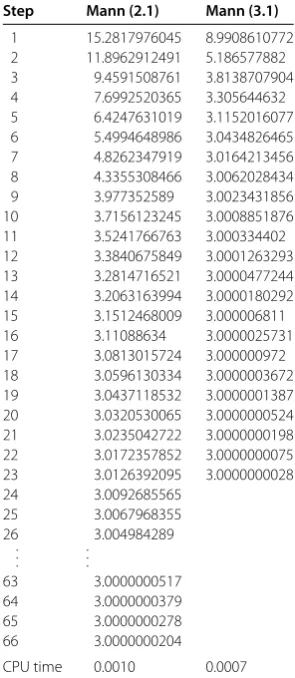
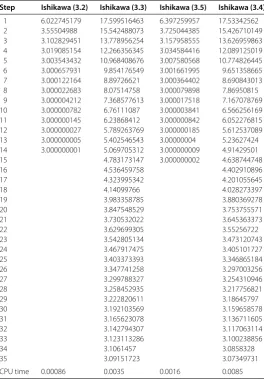
con-traction. In Tables -, we first compare two cases of the Mann iteration method and also four cases of the Ishikawa and Agarwal iteration methods separately. From a mathematical point of view, one can see that the Mann iteration (.) is more than . times faster than the Mann iteration (.), the Ishikawa iteration (.) is more than . times faster than the Ishikawa iteration (.), the Ishikawa iteration (.) is more than . times faster than the Ishikawa iteration (.), the Ishikawa iteration (.) is more than times faster
Table 1 Cases of Mann iteration
Step Mann (2.1) Mann (3.1)
1 15.2817976045 8.9908610772 2 11.8962912491 5.186577882 3 9.4591508761 3.8138707904 4 7.6992520365 3.305644632 5 6.4247631019 3.1152016077 6 5.4994648986 3.0434826465 7 4.8262347919 3.0164213456 8 4.3355308466 3.0062028434 9 3.977352589 3.0023431856 10 3.7156123245 3.0008851876 11 3.5241766763 3.000334402 12 3.3840675849 3.0001263293 13 3.2814716521 3.0000477244 14 3.2063163994 3.0000180292 15 3.1512468009 3.000006811 16 3.11088634 3.0000025731 17 3.0813015724 3.000000972 18 3.0596130334 3.0000003672 19 3.0437118532 3.0000001387 20 3.0320530065 3.0000000524 21 3.0235042722 3.0000000198 22 3.0172357852 3.0000000075 23 3.0126392095 3.0000000028 24 3.0092685565
25 3.0067968355 26 3.004984289
. . .
. . .
63 3.0000000517 64 3.0000000379 65 3.0000000278 66 3.0000000204
Table 2 Cases of Ishikawa iteration
Step Ishikawa (3.2) Ishikawa (3.3) Ishikawa (3.5) Ishikawa (3.4)
1 6.022745179 17.599516463 6.397259957 17.53342562 2 3.55504988 15.542488073 3.725044385 15.426710149 3 3.102829451 13.778956254 3.157958555 13.626959863 4 3.019085154 12.266356345 3.034584416 12.089125019 5 3.003543432 10.968408676 3.007580568 10.774826445 6 3.000657931 9.854176549 3.001661995 9.651358665 7 3.000122164 8.89726621 3.000364402 8.690843013 8 3.000022683 8.07514758 3.000079898 7.86950815 9 3.000004212 7.368577613 3.000017518 7.167078769 10 3.000000782 6.76111087 3.000003841 6.566256169 11 3.000000145 6.23868412 3.000000842 6.052276815 12 3.000000027 5.789263769 3.000000185 5.612537089 13 3.000000005 5.402546543 3.00000004 5.23627424 14 3.000000001 5.069705312 3.000000009 4.91429501
15 4.783173147 3.000000002 4.638744748
16 4.536459758 4.402910896
17 4.323995342 4.201055645
18 4.14099766 4.028273397
19 3.983358785 3.880369278
20 3.847548529 3.753755571
21 3.730532022 3.645363373
22 3.629699305 3.55256722
23 3.542805134 3.473120743
24 3.467917475 3.405101727
25 3.403373393 3.346865184
26 3.347741258 3.297003256
27 3.299788327 3.254310946
28 3.258452935 3.217756821
29 3.222820611 3.18645797
30 3.192103569 3.159658578
31 3.165623078 3.136711605
32 3.142794307 3.117063114
33 3.123113286 3.100238856
34 3.1061457 3.0858328
35 3.09151723 3.07349731
CPU time 0.00086 0.0035 0.0016 0.0085
Table 3 Cases of Agarwal iteration
Step Agarwal (3.13) Agarwal (3.14) Agarwal (3.16) Agarwal (3.15)
1 3.663643981 4.231276342 4.038158759 4.165185499 2 3.034148064 3.125898552 3.08652991 3.112771857 3 3.001785887 3.013368608 3.007415671 3.011314821 4 3.000093479 3.001425297 3.000637055 3.001139398 5 3.000004893 3.000152024 3.000054738 3.000114779 6 3.000000256 3.000016216 3.000004703 3.000011563 7 3.000000013 3.00000173 3.000000404 3.000001165 8 3.000000001 3.000000184 3.000000035 3.000000117
9 3 3.00000002 3.000000003 3.000000012
10 3.000000002 3 3.000000001
11 3 3
Figure 1 CPU time.
than the Ishikawa iteration (.), the Ishikawa iteration (.) is more than . times faster than the Ishikawa iteration (.), the Agarwal iteration (.) is . times faster than the Agarwal iteration (.), the Agarwal iteration (.) is . times faster than the Agarwal iteration (.), the Agarwal iteration (.) is . times faster than the Agarwal itera-tion (.) and so on. We first add our CPU time in Tables - for each iteraitera-tion method. Also, we provide Figure by using at least times calculating of CPU times for our faster cases in the methods. From a computer-calculation point of view, we get a different an-swer. As one can see in the CPU time table, we found that the Agarwal iteration (.) and the Mann iteration (.) are faster than the Ishikawa iteration (.). This note emphasizes the difference of the mathematical results and computer-calculation results which have appeared many times in the literature.
The next example illustrates Lemma ..
Example LetX=R,C= [, ],x= ,αn= .,βn= ., andγn= . for all
n≥. Define the mapT:C→Cby the formulaT(x) =√xfor allx∈C. Table shows us that the Abbas iteration (.) converges faster than the other cases, the Abbas iteration (.) is . times faster than the Abbas iteration (.), the Abbas iteration (.) is . times faster than the Abbas iteration (.), the Abbas iteration (.) is . times faster than the Abbas iteration (.) and . times faster than the Abbas iteration (.) and the Abbas iteration (.). One can get similar results about difference of the mathematical and computer-calculating points of views for this example.
The next example illustrates Theorem ..
Example LetX=R,C= [, ],x= ,αn= .,βn= ., andγn= . for alln≥.
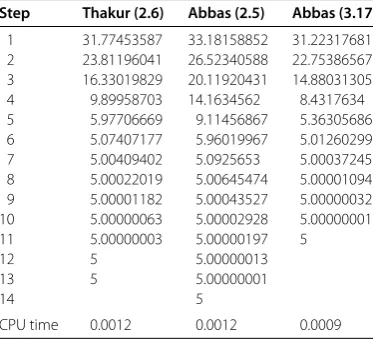
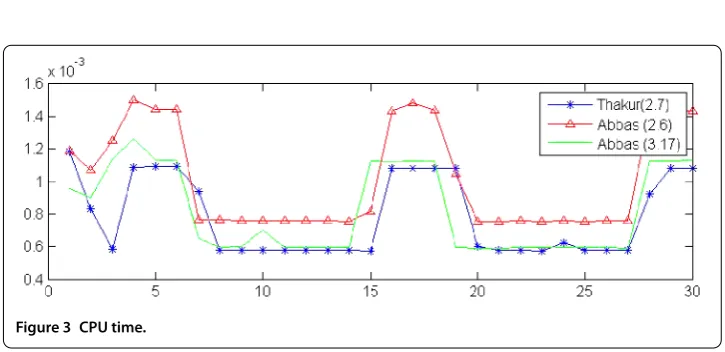
Define the mapT:C→CbyT(x) =√x– x+ for allx∈C(see []). Table shows the Abbas iteration (.) converges . times faster than the Thakur-Thakur-Postolache iteration (.) and the Thakur-Thakur-Postolache iteration (.) is . times faster than the Abbas iteration (.) from the mathematical point of view. Again, we get different results from the computer-calculating point of view by checking Table and Figures and .
Table 4 Cases of Abbas iteration
Step Abbas (3.17) Abbas (3.18) Abbas (3.19) Abbas (3.20) Abbas (3.21) Abbas (3.22) Abbas (3.23) Abbas (3.24)
1 20.933947 23.074444 29.706456 30.294581 42.622758 43.000492 74.725586 74.829373 2 3.501533 3.915728 4.912771 5.052334 6.872931 6.975246 14.057893 14.097781 3 1.650123 1.789347 2.07514 2.127569 2.605814 2.644699 4.919453 4.938021 4 1.218545 1.278689 1.392374 1.417334 1.596596 1.615195 2.581994 2.592232 5 1.080705 1.109014 1.161005 1.174049 1.254442 1.264388 1.750749 1.757015 6 1.030883 1.044439 1.069469 1.076461 1.115609 1.121158 1.389425 1.39348 7 1.011982 1.018426 1.030642 1.034379 1.054109 1.057231 1.212285 1.214975 8 1.004673 1.007695 1.013649 1.015622 1.025684 1.02743 1.119022 1.120821 9 1.001827 1.003223 1.006106 1.007132 1.012273 1.013239 1.067815 1.069015 10 1.000715 1.001351 1.002737 1.003264 1.005884 1.006411 1.038999 1.039794 11 1.00028 1.000567 1.001228 1.001495 1.002825 1.00311 1.022548 1.02307 12 1.000109 1.000238 1.000551 1.000685 1.001357 1.00151 1.013078 1.013417 13 1.000043 1.0001 1.000247 1.000314 1.000653 1.000733 1.007599 1.007818 14 1.000017 1.000042 1.000111 1.000144 1.000314 1.000356 1.00442 1.00456 15 1.000007 1.000018 1.00005 1.000066 1.000151 1.000173 1.002572 1.002661 16 1.000003 1.000007 1.000022 1.00003 1.000073 1.000084 1.001498 1.001554 17 1.000001 1.000003 1.00001 1.000014 1.000035 1.000041 1.000872 1.000907 18 1.000001 1.000005 1.000006 1.000017 1.00002 1.000508 1.00053 19 1.000001 1.000002 1.000003 1.000008 1.00001 1.000296 1.00031 20 1 1.000001 1.000001 1.000004 1.000005 1.000172 1.000181
21 1 1 1.000001 1.000002 1.000002 1.0001 1.000106
22 1 1 1 1.000001 1.000001 1.000058 1.000062
23 1 1 1 1 1.000001 1.000034 1.000036
24 1 1 1 1 1.00002 1.000021
25 1 1 1 1.000012 1.000012
26 1 1 1 1.000007 1.000007
27 1 1 1.000004 1.000004
28 1 1 1.000002 1.000002
29 1 1 1.000001 1.000001
30 1.000001 1.000001
31 1 1
32 1 1
33 1 1
34 1 1
35 1 1
36 1 1
37 1 1
Table 5 Comparison between Thakur iteration and Abbas iteration
Step Thakur (2.6) Abbas (2.5) Abbas (3.17)
1 31.77453587 33.18158852 31.22317681 2 23.81196041 26.52340588 22.75386567 3 16.33019829 20.11920431 14.88031305 4 9.89958703 14.1634562 8.4317634 5 5.97706669 9.11456867 5.36305686 6 5.07407177 5.96019967 5.01260299 7 5.00409402 5.0925653 5.00037245 8 5.00022019 5.00645474 5.00001094 9 5.00001182 5.00043527 5.00000032 10 5.00000063 5.00002928 5.00000001 11 5.00000003 5.00000197 5
12 5 5.00000013
13 5 5.00000001
14 5
Figure 2 Convergence behavior of the iteration methods of Thakur equation (2.6), Abbas equation (2.5), and Abbas equation (3.17).
Figure 3 CPU time.
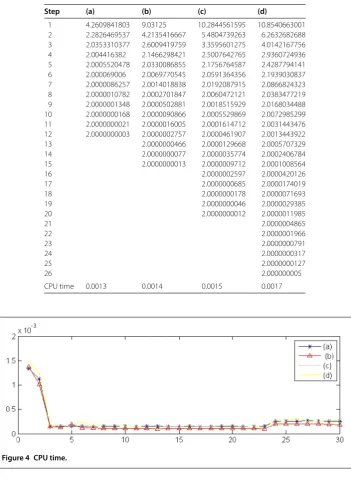
Example LetX=R,C= [, ], andx= . Define the mapT: R→Rby T(x) =
x
+ for allx∈C. Consider the following coefficients separately in the Thakur-Thakur-Postolache iteration (.):
(a) αn=βn=γn= –(n+),
(b) αn=βn=γn= –n+,
(c) αn=βn=γn= –
(n+)
,
(d) αn=βn=γn= –
(n+)
Table 6 Cases of Thakur iteration
Step (a) (b) (c) (d)
1 4.2609841803 9.03125 10.2844561595 10.8540663001 2 2.2826469537 4.2135416667 5.4804739263 6.2632682688 3 2.0353310377 2.6009419759 3.3595601275 4.0142167756 4 2.004416382 2.1466298421 2.5007642765 2.9360724936 5 2.0005520478 2.0330086855 2.1756764587 2.4287794141 6 2.000069006 2.0069770545 2.0591364356 2.1939030837 7 2.0000086257 2.0014018838 2.0192087915 2.0866824323 8 2.0000010782 2.0002701847 2.0060472121 2.0383477219 9 2.0000001348 2.0000502881 2.0018515929 2.0168034488 10 2.0000000168 2.0000090866 2.0005529869 2.0072985299 11 2.0000000021 2.0000016005 2.0001614712 2.0031443476 12 2.0000000003 2.0000002757 2.0000461907 2.0013443922
13 2.0000000466 2.0000129668 2.0005707329
14 2.0000000077 2.0000035774 2.0002406784
15 2.0000000013 2.0000009712 2.0001008564
16 2.0000002597 2.0000420126
17 2.0000000685 2.0000174019
18 2.0000000178 2.0000071693
19 2.0000000046 2.0000029385
20 2.0000000012 2.0000011985
21 2.0000004865
22 2.0000001966
23 2.0000000791
24 2.0000000317
25 2.0000000127
26 2.000000005
CPU time 0.0013 0.0014 0.0015 0.0017
Figure 4 CPU time.
Competing interests
The authors declare that they have no competing interests.
Authors’ contributions
All authors contributed equally to this work. All authors read and approved the final manuscript.
Author details
1Department of Mathematics, Azarbaijan Shahid Madani University, Tabriz, Iran.2Department of Mathematics and
Informatics, University Politehnica of Bucharest, Bucharest, 060042, Romania.
Acknowledgements
The basic idea of this work has been given to the fourth author by Professor Mihai Postolache during his visit to University Politehnica of Bucharest in September 2014. The first and fourth authors was supported by Azarbaijan Shahid Madani University.
References
1. Plunkett, R: On the rate of convergence of relaxation methods. Q. Appl. Math.10, 263-266 (1952) 2. Bowden, BV: Faster than Thought: A Symposium on Digital Computing Machines. Pitman, London (1953) 3. Byrne, C: A unified treatment of some iterative algorithms in signal processing and image reconstruction. Inverse
Probl.20(1), 103-120 (2004)
4. Dykstra, R, Kochar, S, Robertson, T: Testing whether one risk progresses faster than the other in a competing risks problem. Stat. Decis.14(3), 209-222 (1996)
5. Hajela, D: On faster than Nyquist signaling: computing the minimum distance. J. Approx. Theory63(1), 108-120 (1990)
6. Hajela, D: On faster than Nyquist signaling: further estimations on the minimum distance. SIAM J. Appl. Math.52(3), 900-907 (1992)
7. Longpre, L, Young, P: Cook reducibility is faster than Karp reducibility in NP. J. Comput. Syst. Sci.41(3), 389-401 (1990) 8. Shore, GM: Faster than light: photons in gravitational fields - causality, anomalies and horizons. Nucl. Phys. B460(2),
379-394 (1996)
9. Shore, GM: Faster than light: photons in gravitational fields. II. Dispersion and vacuum polarisation. Nucl. Phys. B 633(1-2), 271-294 (2002)
10. Stark, RH: Rates of convergence in numerical solution of the diffusion equation. J. Assoc. Comput. Mach.3, 29-40 (1956)
11. Argyros, IK: Iterations converging faster than Newton’s method to the solutions of nonlinear equations in Banach space. Ann. Univ. Sci. Bp. Rolando Eötvös Nomin., Sect. Comput.11, 97-104 (1991)
12. Argyros, IK: Sufficient conditions for constructing methods faster than Newton’s. Appl. Math. Comput.93, 169-181 (1998)
13. Lucet, Y: Faster than the fast Legendre transform: the linear-time Legendre transform. Numer. Algorithms16(2), 171-185 (1997)
14. Berinde, V: Picard iteration converges faster than Mann iteration for a class of quasi-contractive operators. Fixed Point Theory Appl.2004(2), 97-105 (2004)
15. Berinde, V, Berinde, M: The fastest Krasnoselskij iteration for approximating fixed points of strictly pseudo-contractive mappings. Carpath. J. Math.21(1-2), 13-20 (2005)
16. Berinde, V: A convergence theorem for Mann iteration in the class of Zamfirescu operators. An. Univ. Vest. Timi¸s., Ser. Mat.-Inform.45(1), 33-41 (2007)
17. Babu, GVR, Vara Prasad, KNVV: Mann iteration converges faster than Ishikawa iteration for the class of Zamfirescu operators. Fixed Point Theory Appl.2006, Article ID 49615 (2006)
18. Popescu, O: Picard iteration converges faster than Mann iteration for a class of quasi-contractive operators. Math. Commun.12(2), 195-202 (2007)
19. Akbulut, S, Ozdemir, M: Picard iteration converges faster than Noor iteration for a class of quasi-contractive operators. Chiang Mai J. Sci.39(4), 688-692 (2012)
20. Gorsoy, F, Karakaya, V: A Picard S-hybrid type iteration method for solving a differential equation with retarded argument (2014). arXiv:1403.2546v2 [math.FA]
21. Hussain, N, Chugh, R, Kumar, V, Rafiq, A: On the rate of convergence of Kirk-type iterative schemes. J. Appl. Math. 2012, Article ID 526503 (2012)
22. Ozturk Celikler, F: Convergence analysis for a modified SP iterative method. Sci. World J.2014, Article ID 840504 (2014)
23. Thakur, D, Thakur, BS, Postolache, M: New iteration scheme for numerical reckoning fixed points of nonexpansive mappings. J. Inequal. Appl.2014, 328 (2014)
24. Berinde, V: Iterative Approximation of Fixed Points. Springer, Berlin (2007)
25. Chugh, R, Kumar, S: On the rate of convergence of some new modified iterative schemes. Am. J. Comput. Math.3, 270-290 (2013)
26. Mann, WR: Mean value methods in iteration. Proc. Am. Math. Soc.4, 506-510 (1953) 27. Ishikawa, S: Fixed points by a new iteration method. Proc. Am. Math. Soc.44, 147-150 (1974)
28. Noor, MA: New approximation schemes for general variational inequalities. J. Math. Anal. Appl.251, 217-229 (2000) 29. Agarwal, RP, O’Regan, D, Sahu, DR: Iterative construction of fixed points of nearly asymptotically nonexpansive
mappings. J. Nonlinear Convex Anal.8(1), 61-79 (2007)