i
THE PROBABILITY THAT AN ELEMENT OF A NON-ABELIAN GROUP FIXES A SET AND ITS APPLICATIONS IN GRAPH THEORY
MUSTAFA ANIS EL- SANFAZ
A thesis submitted in fulfilment of the requirements for the award of the degree of
Doctor of Philosophy (Mathematics)
Faculty of Science Universiti Teknologi Malaysia
iii
iv
ACKNOWLEDGMENT
It has been a very rewarding process writing my thesis both for its challenge and also for what i have learned along the way. For that, I would like to express my greatest appreciation to my thesis advisor, Professor Dr. Nor Haniza Sarmin, for her unlimited support, patience, and for her time and effort that went into helping me with my research.
Also, I would like to thank Dr Sanna Saleh for her help and support.
v
ABSTRACT
vi
ABSTRAK
vii
TABLE OF CONTENTS
CHAPTER TITLE PAGE
DECLARATION ii
DEDICATION iii
ACKNOWLEDGEMENT iv
ABSTRACT v
ABSTRAK vi
TABLE OF CONTENTS vii
LIST OF FIGURES x
LIST OF SYMBOLS xi
LIST OF APPENDICES xiii
1 INTRODUCTION 1
1.1 Background of the Study 1
1.2 Objectives of the Research 2
1.3 Problem Statements 3
1.4 Scope of the Research 4
1.5 Significance of the Research 4
1.6 Research Methodology 5
1.7 Thesis Organization 6
2 LITERATURE REVIEW 9
2.1 Introduction 9
viii
2.2.1 Fundamental Concepts of Group Theory 10 2.2.2 The Commutativity Degree 14
2.3 Graph Theory 19
2.3.1 Fundamental Concepts of Graph Theory 19 2.3.2 Relevant Studies of Graph Theory to
Group Theory 21
2.4 Conclusion 25
3 THE PROBABILITY THAT A GROUP ELEMENT
FIXES A SET 26
3.1 Introduction 26
3.2 Preliminary Results 26
3.3 The Probability That a Dihedral Group Element
Fixes a Set 29
3.4 The Probability That a Metacyclic 2-Group
Element Fixes a Set 32
3.5 Conclusion 46
4 GENERALIZED CONJUCACY CLASS GRAPH
AND ORBIT GRAPH 47
4.1 Introduction 47
4.2 Preliminary Results 47
4.3 Generalized Conjugacy Class Graph 48 4.3.1 Generalized Conjugacy Class Graph of
Dihedral Groups 48
4.3.2 Generalized Conjugacy Class Graph of
Metacyclic 2-Groups 50
4.4 Orbit Graph 60
4.4.1 Orbit Graph of Dihedral Groups 60 4.4.2 Orbit Graph of Metacyclic 2-Groups 62
ix
5 THE GENERALIZED COMMUTING AND
NON-COMMUTING GRAPHS 75
5.1 Introduction 75
5.2 Preliminary Results 75
5.3 The Generalized Commuting Graph of Dihedral
Group 77
5.4 The Generalized Commuting Graph of Metacyclic
2-Groups 78
5.5 The Generalized Non-Commuting Graph 87 5.6 The Generalized Non-Commuting Graph of
Dihedral Groups 87
5.7 The Generalized Non-Commuting Graph of
Metacyclic 2-Groups 88
5.8 Conclusion 94
6 CONCLUSION 96
6.1 Summary of the Research 96
6.2 Suggestions for Further Research 97
REFERENCES 98
x
LIST OF FIGURES
FIGURE NO TITLE PAGE
1.1 Thesis Organization 8
5.1 Generalized Commuting Graph of Type (3) for
0 ≤i≤ 80
5.2 Generalized Commuting Graph of Type (3) 81 5.3 Generalized Commuting Graph of Type (4) for
0 ≤i≤ 82
5.4 Generalized Commuting Graph of Type (5) for
0 ≤i≤ 83
5.5 Generalized Commuting Graph of Type (6) for
0 ≤i≤ 84
5.6 Generalized Commuting Graph of Type (8) 85 5.7 Generalized Non-commuting Graph of Metacyclic
2-Group of Type (3) 89
5.8 Generalized Non-Commuting Graph of Metacyclic
2-group of Type (4) 90
5.9 Generalized Non-Commuting Graph of Metacyclic
2-Group of Type (5) when α> 3 92
5.10 Generalized Non-Commuting Graph of Metacyclic
xi
LIST OF SYMBOLS
S - A non-empty set - Belong to
Z G - Center of the group G
- The chromatic number
- The clique number of the graph
P G - The commutativity degree of the group G
,
g h - The commutator of gand h, that is, g h, g h gh1 1
n
K - Complete graph of n vertices
n
D - Dihedral groups of order 2n
- The independent number of the graph
- The dominating number of the graph
e
K - Empty graph
- For all
c
G - Generalized conjugacy class
- Graph
- Greater than or equal
H G - His a subgroup of G
1 - Identity element of the groupG
:
G H - The index of Hin G
lcm ,a b - The least common multiple of a and b
- Less than or equal
xii
0
K - Null graph
K G - The number of conjugacy classes in G
K - The number of orbits of in G
G - The orbit graph
GC - The generalized commuting graph
GN - The generalized non-commuting graph
cl x - Orbit of xin G
G - Order of the group G
G
P - The probability that a group element fixes a set
E - Set of edges of
V - Set of vertices of
- The set of all subsets of commuting elements of size two
G
C s - The stabilizer of the element s Sunder a group action of G on the set S
xiii
LIST OF APPENDICES
APPENDIX TITLE PAGE
1
CHAPTER 1
INTRODUCTION
1.1 Background of the Study
A group Gacts on itself by conjugation if there is a function :G G G
such that g x, xgx 1 for all ,
x G the conjugacy class of xin G is defined
as cl 1: .
x gxg g G If Gacts on a set S,then there exists :G S S,such
that the orbit of s under the group action is O s gs g: G S. Now if a group
Gacts regularly on S,then there exists g G,such that gs1 s2, where s s1, 2 S.
These actions are used to find the commutativity degree and its generalizations, which are the focus in the first part of this research.
2
The second part of this research deals with graph theory. The idea of graphs came from a variety of real situations that can easily be described by drawing diagram consisting of a set of points and lines linking these points [3]. This concept was introduced in 1736 by Leonard Euler who considered the Kőnigsberg bridge problem. Euler solved this problem by drawing a graph with vertices and edges [3]. Years later, the usefulness of graph theory has been proven to a large number of diverse fields.
In 1990 Bertram et al. [4] introduced a new graph which relates to conjugacy classes. The vertices of this graph are non-central conjugacy classes in which two vertices are adjacent if they are not coprime. Many researches have been done using this algebraic graph theory. Recently, Erfanian and Tolue [5] introduced a new graph, namely conjugate graph in which the vertices are non-central elements of a group. Two vertices of this graph are adjacent if the elements represented by these vertices are conjugate with one another.
In 1975, the idea of non-commuting graphs comes from an old question of Erdős on the size of the cliques and answered in the affirmative by Neumann [6]. In [7], it is mentioned that the commuting graph is a graph whose vertices are non-central elements of a group, where two vertices are adjacent whenever they commute.
1.2 Objectives of the Research
The main objectives of this research are stated in the following:
3
(ii) To find the probability that a group element fixes a set for metacyclic 2- groups and dihedral groups.
(iii) To apply the results that are obtained from (ii) to graph theory, namely to the orbit graph, generalized conjugacy class graph, the generalized non-commuting graph and the generalized commuting graph.
(iv) To determine some graph properties such as the chromatic number, clique number, dominating number and independence number for the graphs in (iii).
1.3 Problem Statements
The commutativity degree has been generalized and extended by many authors, such as the probability that an automorphism of a finite group fixes an arbitrary element in the group, the probability that the commutator of two randomly chosen elements in a group is equal to a given element in the same group and the probability that an automorphism of a finite group fixes a subgroup element.
In this research, the following questions will be answered:
(i) What other extension can be made on the commutativity degree, based on the
set of all commuting elements of G G in the form of (a,b) where a
2? b
4
(iii) How can the results obtained from the probability be applied to graph theory?
(iv) Can new graphs be introduced based on the obtained results from the probability?
(v) What are some graph properties that can be obtained?
1.4 Scope of the Research
This research consists of two parts. The first part focuses on the commutativity degree and its generalizations. This study covers some finite non-Abelian groups including metacyclic 2-groups and dihedral groups. One of the objectives in this research is to find the probability that a group element fixes a set under two group actions, namely conjugate action and regular action. The set under
study is a non-empty subset of G G in the form of (a, b), where a and b commute and |a|=|b| = 2.
The second part of this research focuses on graph theory. The probability under study in the first part is then applied to graph theory. The graphs under considerations in this research include orbit graph, graph related to conjugacy classes, non-commuting graph, commuting graph and conjugate graph. Some graph properties are obtained which include the chromatic number, clique number, independent number and dominating number.
1.5 Significance of the Research
5
The major contribution of this research is to provide new theoretical results on the commutativity degree by defining the probability that a group element fixes a set. This probability is computed for some finite non-abelian groups in the scope of this research. The results obtained from this probability are then linked to graph theory. Graph theory has many applications in chemistry, physics, computer science and engineering. In addition new graphs in this research are introduced. Besides, some new results on graph properties are obtained.
1.6 Research Methodology
In this research, commutativity degree is extended to the probability that a group element fixes a set, in which the set under consideration is a non-empty subset of G G in the form of (a, b), where a and b commute and |a| = |b| = 2. The orbits, which are computed using two group actions on the set namely, conjugate action and regular action are used to determine the probability. This probability is the ratio of the orbits to the order of the set under examination. Beuerle [8] classified all non-Abelian metacyclic p-groups, where p is any prime. These classifications are used to obtain the probability that a group element fixes a set.
6
1.7 Thesis Organization
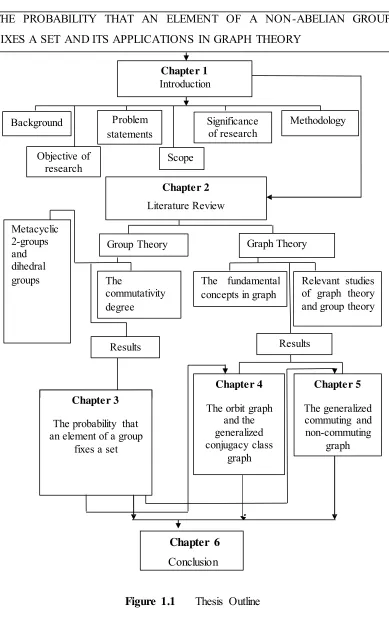
There are six chapters in this thesis. In the first chapter the introduction to the whole thesis is provided. This chapter includes research background, problem statement, research objectives, scope and significance of findings of the thesis, research methodology and thesis organization.
In Chapter 2, the literature review of this research is presented. In this chapter, some earlier and recent works related to commutativity degree and its generalizations are provided. This chapter also provides some fundamental concepts of group theory and graph theory. A background about graph theory is stated, where different type of graphs and their algebraic properties are given.
In Chapter 3, the probability that an element of a group fixes a set is computed for some finite non-Abelian groups which include metacyclic 2-groups and dihedral groups. The probability is found under two group actions, namely conjugate and regular action.
In Chapter 4, the results that are found in Chapter 3 are then applied to graph theory, particularly to the orbit graph and generalized conjugacy class graph. These graphs are found for some finite groups which include metacyclic 2-groups and dihedral groups. Some graph properties are also obtained for the orbit graph and generalized conjugacy class graph of the groups.
7
8
Figure 1.1 Thesis Outline
THE PROBABILITY THAT AN ELEMENT OF A NON-ABELIAN GROUP FIXES A SET AND ITS APPLICATIONS IN GRAPH THEORY
Chapter 1
Introduction
Background Problem
statements Scope Significance of research Objective of research Chapter 2 Literature Review Metacyclic 2-groups and dihedral groups Chapter 4
The orbit graph and the generalized conjugacy class graph Methodology y
Group Theory Graph Theory
The
commutativity degree
The fundamental concepts in graph
Relevant studies of graph theory and group theory
Chapter 3
The probability that an element of a group
fixes a set
Results Results
Chapter 5
The generalized commuting and non-commuting
graph
97
independent number are found. Moreover, a result that linked between the probability under conjugate action and the null graph is provided.
In this study, a new graph called the generalized commuting graph is introduced. The generalized commuting graph is null whenever the group is Abelian. The generalized commuting graph is found for all groups in the scope of this research. In addition, a new graph called the generalized non-commuting graph is also introduced. It is proven that the generalized non-commuting graph is null for all abelian groups. The generalized non-commuting graph is also obtained for all groups in the scope of this research.
6.2 Suggestions for Furthe r Research
Based on this research, further studies on the probability that an element of a group fixes a set can be done. The probability can be obtained for other groups such as 2-generated 2-groups, metacyclic p-groups where p is odd prime, metabelian groups and nilpotent groups. This probability can be obtained under some group action on the set including, regular action, conjugate action and faithful action. Moreover, the order of the set can be changed to higher order and the probability can be obtained under group action on the set.
The results obtained from the probability, which obtained under some group actions on the set under consideration can be applied to graph theory. Where the relation between the elements of the set and it is size are applied to some graphs including, the orbit graph, generalized conjugacy class graph, the generalized commuting graph and the generalized non-commuting graph. Moreover, some work in the characterization problems can be done such as, to characterize the groups which have complete graphs as their generalized commuting graphs. In addition some graph properties can be obtained to the mention graphs. Also, new graphs can
be introduced based on the size and the relation between the elements of the set ,
98
REFERENCES
1. Miller, G, A. Relative Number of Non-invariant Operators in a Group. Proc.Nat.Acad.Sci. USA. 1944. 30(2):25-28.
2. Erdos, P. and Turan, P. On Some Problems of a Statistical Group Theory, IV, Acta Math. Acad Sci. Hungaricae 1968. 19: 413–435.
3. Bondy, J and Murty, G. Graph Theory with Application, 5th ed. North Holand, Boston New York. 1982.
4. Bertram, E. A., Herzog, M., and Mann, A. On a Graph Related to Conjugacy Classes of Groups. Bull. London Math. Soc. 1990. 22: 569-575.
5. Erfanian, A and Tolue, B. Conjugate Graphs of Finite Groups. Discrete Mathematics, Algorithms and Applications. 2012. 4(2): 35-43.
6. Neumann, B. H. A Problem of Paul Erdos on Groups. J. Austral. Math. Soc. 1976. 21: 467–472.
7. Brauer, R and Fowler, K. A. On Groups of Even Order. Annals of Mathematics, 1955. 62(3): 565-583.
8. Beuerle, J. R. An Elementary Classification of Finite Metacyclic P-Groups of Class at Least Three. Algebra Colloq. 2005. 12(4): 553–562.
9. Gallian, J. A. Contemporary Abstract Algebra, 5th ed, Houghton Mifflin Company, Boston New York. 2002.
10. Nicholson, W. K. Introduction to Abstract Algebra, 4th ed, Wiley and Sons.Inc. 2011.
11. Rotman, J. J. Advanced Modern Algebra, Pearson Education, Inc. Upper Saddle River, New Jersey 07458. 2002.
12. Beardon, A, F. Algebra and Geometry. Cambridge University Press. 2005. 13. Goodman, F, M. Algebra Abstract and Concrete .Stressing Symmetry. Person
99
14. Durbin, J. R. Modern Algebra: An Introduction. John Wiley and Sons. Inc. 2009.
15. Ries, C. Abstract Algebra: An Introduction to Groups Rings and Fields. World Scientific. 2011.
16. King, B. W. Presentation of Metacyclic Groups. Bull Aust Math Soc. 1973. 8(1): 103–131.
17. Gustafson, W. H. What is the Probability That Two Group Elements Commute?, The American Mathematical Monthly.1973. 80 (9): 1031–1034. 18. MacHale, D. How Commutative Can a Non-Commutative Group Be?, The
Mathematical Gazette.1974. 58: 199–202.
19. Sherman, G.J. What is the Probability an Automorphsim Fixes a Group Element?. The American Mathematical Monthly1975. 82 (3): 261–264
20. Achar, P. N. Generalized Conjugacy classes. Rose Hulman Mathematical Sciences Series no. 9701 1997.
21. Pournaki, M. R., and Sobhani, R. Probability That Commutator of Two Group Elements is Equal to a Given Element. J. Pure Appl. Algebra.2008. 212:727-734
22. Alghamdi, A. M., Russo, F. G. A Generalization of the Probability that the Commutator of Two Group Elements is Equal to a Given Element. Bull. Iran Math. Soc. 2012. 38(4): 973-986
23. Gasteks, A., Kuzmanovich, J. Commutativity Degree of a Finite Group. Wake Forest University, North Carolina: Master’s Thesis. 2010
24. Moghaddam, M. R. R., Saeedi, F. and Khamseh, E. The Probability of an Automorphism Fixing a Subgroup Element of a Finite Group. Asian-European Jo. 2011. 4(2): 301-308
25. Barzgar, R., Erfanian, A. and Farrokhi, M. Probability of Mutually Commuting Two Subsets of a Finite Group. In press. 2011
26. Moradipour, K., Sarmin, N. H., and Erfanian, A. Conjugacy Classes and Commuting Probability in Finite Metacyclic P-Groups. ScienceAsia 2012. (38): 113-117.
27. Moradipour, K., Sarmin, N. H., and Erfanian, A. The precise Value of Commutativity Degree in Some Finite Groups. Malaysian Journal of
100
28. Moradipour, K., Sarmin, N. H., and Erfanian, A. Conjugacy Classes and Commutativity Degree of Metacyclic 2-Groups. Comptes Rendus de
L’Academie Bulgare des Sciences, 2013. 66(10): 1363-1372.
29. Nath, R. K. Commutativity Degree of a Class of Finite Groups and Consequences. Bull. Aust. Math. Soc. 2013. 88: 448-452.
30. Lescot, P. Central Extensions and Commutativity Degree. Comm. Algebra. 2001. 29(10): 4451-4460.
31. Godsil, C and Royle, G. Algebraic Graph Theory. 5th ed. Springer, Boston NewYork. 2001.
32. Xu, J. Theory and Application of Graphs. 5th ed. The American Mathematical Monthly. 2003.
33. Abdollahi, A., Akbari, S., and Maimani, H. R. Non-commuting Graph of a Group. Journal of Algebra 2006. 89(98): 468-492.
34. Tolue, B and Erfanian, A. Relative Non-Commuting Graph of a Finite Group.Journal of Algebra and Its Applications. 2013. 12(2): 1-11.
35. Moghaddamfar, A. R. and Shi, W. J. and Zhou, W. and Zokayi, A. R. On the Non-commuting Graph Associated With a Finite Group. Sib. Math. J. 2005. 46(2): 325–332.
36. Moghaddamfar, A. R. About Noncommuting Graphs. Sib. Math. J. 2006. 7(5): 911–914.
37. Darafsheh, M. R, Groups with the Same Non-Commuting Graph. Discrete Applied Mathematics.2009. 157: 833-837.
38. Iranmanesh, A and Jafarzadeh, A. On the Commuting Graph Associated with the Symmetric and Alternating Groups. Journal of Algebra and Its Applications. 2008, 7(1): 129–146.
39. Hegarty, P and Zhelezov, D.Can Connected Commuting Graphs of Finite
Groups Have Arbitrary Large Diameter? arXiv:1204.5456v3 [math.GR]. 2012.
40. Raza, R and Faizi, S. Commuting Graphs Of Dihedral Type Groups. Applied Mathematics E-Notes. 2013, 13: 221-227.
101
42. Chillag, D., Herzog, M.and Mann, A. On The Diameter of a Graph Related to Conjugacy Classes of Groups. Bull. London Math. Soc. 1993. 25: 255-262. 43. Beltran, A and Felipe, M. J. On the Diameter of a p-Regular Conjugacy Class
Graph of Finite Groups. Comm. Algebra. 2003. 31(9): 4393–4403.
44. Moreto, A., Qian, G and Shi, W. Finite Groups Whose Conjugacy Class Graphs Have Few Vertices. Arch. Math. 2005. 85: 101–107.
45. You, X., Qian, G.and Shi, W. A New Graph Related to Conjugacy Classes of Finite Groups.arXiv:math/0510015 2005.
46. Bianchi, M., Herzog, M., Pacifici, E.and Saffirio, G. On the Regularity of a GraphRelated to Conjugacy Classes of Groups. European Journal of Combinatorics.2012. (33): 1402-1407.
47. Ilangovan, S and Sarmin, N. H. On Graphs Related to Conjugacy Classes of Some Two-groups. AIP Conf. Proc. 2013. 1522: 872-874.
48. Moradipour, K., Sarmin, N. H., and Erfanian, A. On Graph Associated to Conjugacy Classes of Some Metacyclic 2-Groups. Journal of Basic and
Applied Scientific Research. 2013. 3(1): 898–902.
49. Omer, S. M. S., Sarmin N. H. and Erfanian, A. Generalized Conjugacy Class Graphs for Some Finite Non-abelian Groups. International Conference on Mathematics, Engineering and Industrial Applications (ICoMEIA 2014). AIP
Conf. Proc. 2015. 1660, 050074.
50. Omer, S. M. S., Sarmin, N. H. and Erfanian,A. The Orbit Graph for Some Finite Solvable Groups. AIP Conf. Proc. 2014. 1602, 863.