Towards an underground utilities 3D data model for
land administration
Jingya YAN1,†* https://orcid.org/0000-0001-8321-1329, Siow Wei JAW1,2,3, Kean Huat SOON4, Andreas WIESER5and Gerhard SCHROTTER6
1 ETH Zurich, Future Cities Laboratory, Singapore-ETH Centre; [email protected]
2 Geoscience & Digital Eaeth Centre (INSTeG), Research Institute for Sustainable Environment,
Universiti Teknologi Malaysia, Malaysia; [email protected]
3 Department of Geoinformation, Faculty of Built Environment and Surveying, Universiti Teknologi Malaysia,
Malaysia
4 Singapore Land Authority, Singapore; [email protected]
5 ETH Zurich, Institute of Geodesy and Photogrammetry; [email protected]
6 Geomatik + Vermessung Stadt Zurich, Zurich, Switzerland; [email protected]
1
2
3
4
5
6
7
8
9
10
11
12
13
14
15
16
17
18
* Correspondence:[email protected]
Abstract: With the pressure of the increasing density of urban areas, some public infrastructures are moving to the underground to free up space above, such as utility lines, rail lines and roads. In the big data era, the three dimensional (3D) data can be beneficial to understand the complex urban area. Comparing to spatial data and information of the above ground, we lack of the precise and detailed information about underground infrastructures, such as the spatial information of underground infrastructure, the ownership of underground objects and the interdependence of infrastructures in the above and below ground. How to map reliable 3D underground utility networks and use it in the land administration? First, to explain the importance of this work and find a possible solution, this paper observes the current issues of the existing underground utility database in Singapore. A framework for utility data governance is proposed to manage the work process from the underground utility data capture to data usage. This is the backbone to support the coordination of different roles in the utility data governance and usage. Then, an initial design of the 3D underground utility data model is introduced to describe the 3D geometric and spatial information about underground utility data and connect it to the cadastral parcel for land administration. In the case study, the newly collected data from mobile Ground Penetrating Radar is integrated with the existing utility data for 3D modelling. It is expected to explore the integration of new collected 3D data, the existing 2D data and cadastral information for land administration of underground utilities.
Keywords: 3D Data Model, Data governance, Underground Utility Networks, Underground Mapping, Utility Cadastre, Land Administration
19
1. Introduction 20
Rapid urbanization creates a strong need to optimize land use in densely populated cities. 21
Attention is thus shifting from the very limited available space above ground to generation and 22
increased use of underground spaces. Comparing to the above ground, underground is an unseen 23
space. The trench for the building and maintenance of underground infrastructure needs a large 24
amount of cost, as well as faces with high risks. A prerequisite for including the underground in 25
urban planning is the availability of sufficiently complete, accurate and up-to-date 3D maps of the 26
underground. However, such maps are not yet widely available, if at all, and the required data 27
acquisition is much more challenging than for spaces above ground. 28
With a population of more than five million living in an area of 720 square kilometres, Singapore 29
has revealed a plan for placing infrastructure underground. Currently, a data sharing platform, which 30
is called GeoSpace, is maintained by Singapore Land Authority (SLA) and used by government 31
agencies (e.g. utility owners, land developers, and land owners) to establish a 2D map of Singapore 32
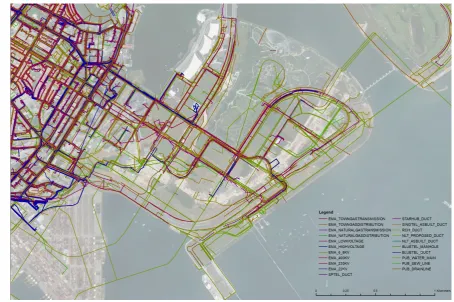
underground including utility services. Figure1shows an example in Marina Bay region of Singapore 33
includes water supply, sewage, drainage, telecommunication and power grid networks. All the existing 34
data are the 2D format. All of them overlay each other to make a chaotic visualization.
Figure 1. An example of utility data in Marina Bay region of Singapore (Source: Singapore Land Authority, 2018).
35
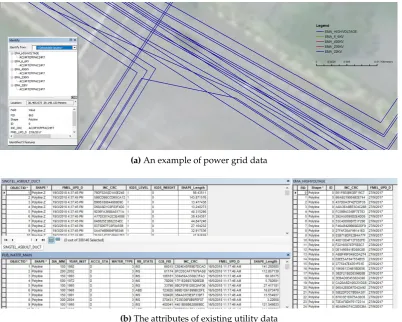
To observe the existing data, we zoom in to a corner of the Marina Bay region. Figure2apresents 36
five layers of different power grid networks. In the real world, the five different power grid networks 37
may be located at the same place and different depth. But these data have the same x, y value in the 38
database, which is impossible to identify them in the vertical space and distinguish them in 2D. All of 39
the existing data is as-build data. We can not trust them to present the real situation of underground 40
utility networks. From figure2b, the limited attributes are provided from the current database. Only 41
the main water pipes have a diameter. Most of them have 2D geospatial information. Also, data owners 42
have more details of existing utility data. But most of them are 2D data as well. Depending on the 43
requirement of the application, some data owners try to collect 3D data. There are some issues during 44
the data capture to usage. Without the utility survey standard, some of them only use the traditional 45
survey method to get the 3D points data of pipelines and overlay on the existing data. Nobody can 46
guaranty the quality of these data. Meanwhile, because of the limitation of the existing data model, it is 47
difficult to integrate 3D data with the existing 2D data. The update is once per six months. In general, 48
some issues prevent these data from being sufficient for urban planning, land administration, and 49
on-site work. In fact, many existing databases, not only the ones in Singapore, contribute incompletely 50
to the spatial understanding of the underground because of similar restrictions. In particular: 51
• The data are often only 2D i.e., lacking depth information entirely, or 2.5D (i.e. featuring depth as 52
an attribute to a horizontal position rather than as an independent coordinate. Furthermore, the 53
depth information may be sparse with depths measured at few locations only, e.g. at accessible 54
(a)An example of power grid data
(b)The attributes of existing utility data
Figure 2.The issues of existing utility data (Source: Singapore Land Authority, 2018).
depth relative to a specific surface with unknown elevation or height relative to an established 56
height datum. 57
• It is unknown whether the data represents the current situation, the possibly different as-built 58
state, or just the as-designed state. Furthermore, the geometric accuracy and the completeness of 59
the area often unknown. 60
• Much of the attribute information (e.g. diameter, material, installation date) required to support 61
specific applications are not available or not represent the appropriate level of detail. 62
• There is a lack of standards for organizing the data and semantic information of underground 63
utilities, impairing data sharing and use of the shared data. 64
Overall, the reliable and accurate 3D data of utility networks is sorely demanded. Therefore, the 65
Singapore-ETH Centre together with the SLA and the Geomatics Department of the City of Zurich 66
have started a related project under the name “Digital Underground” [1]. The initial goals of this 67
project are to develop a road map, a data model and a concept for deriving a unified and complete 68
3D map of the relevant underground structures (in particular of utilities and spaces like corridors or 69
tunnels). Collecting best practices for underground utility mapping is a special focus within the project. 70
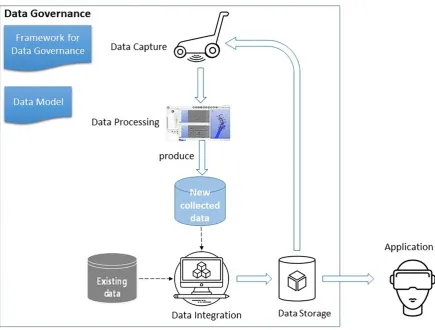
Figure3describes the workflow of data governance for 3D underground utility mapping. In the 71
data capture, different types of survey techniques (e.g. Ground Penetrating Radar (GPR), Gyro-based 72
system) are explored and compared to find the optimal underground utility survey approach. After 73
the data processing, the newly collected data should be integrated into the existing database aiming 74
to improve the information of underground utility. As the backbone of the 3D underground utility 75
map, the 3D consolidated database of underground utilities should be developed for data storage. 76
This is a loop workflow. The data capture could improve and update the database. At the same 77
time, the underground utility database should provide information to support data capture. In order 78
framework to manage different roles and communication between them in data governance. The 80
other is the underground utility data model, which is a conceptual model to describe the structure 81
and content of geodata independent from the used hard- and software systems. It will provide the 82
standard for the presentation of geometrical information, data quality management and various 83
applications. This paper focuses on the design of the framework of data governance and underground 84
utility data model. To ensure legal compliance, efficiency, and resilience of these utility networks, the 85
reliable 3D underground utility data could shed light on their ownership and operation [2]. Then, the 86
underground utility data can be used in various applications. To provide sufficiently and consistently 87
accurate information about underground utilities, it is necessary to fill the gap between engineering 88
practices and mapping disciplines. Meanwhile, we need to find the solution of how to use the existing 89
data and integrate it with newly collected data. 90
Figure 3.Workflow of underground utility mapping.
Here we focus on underground utilities, ignoring other underground structures which eventually 91
need to be represented in the same 3D database as the utilities. This work aims at bridging the gap 92
between underground utility surveying and data governance for land administration. Our proposal 93
addresses the following: 94
• The organization of different phases and roles from data capture to usage. It is necessary to 95
make a clear definition of different roles. During this work process, the communication between 96
different roles (e.g. data producers, owners and users) is very important. 97
• Different roles have different rights to access, change, delete or add data. These permissions 98
must be defined and maintained administratively. 99
• Building and updating the 3D map of the underground requires integration of datasets of a 100
different type, quality and source. Data may originate from recent surveying e.g., using GPR or 101
also be derived from other databases. This integration requires handling various data formats, 103
and quantifying and properly taking into account the respective data quality. 104
• The underground data need to be convertible into the data formats required by a variety of 105
different applications and end users without loss of relevant information. 106
Subsequently, we first introduce related works on 3D underground utility data acquisition and 107
reviews the underground utility data governance for land administration in some countries or regions. 108
In section 3 we propose a framework to resolve the above issues about data governance and explain 109
the design of a 3D underground utility data model. In section 4 we briefly summarize a Singapore case 110
study covering the work process from large scale GPR-based data acquisition to 3D visualization. We 111
conclude with a summary and an outlook on future work. 112
2. Related Works 113
2.1. The technologies for 3D underground utility data acquisition 114
Information about the buried utility networks can be retrieved without any excavation 115
underground utility mapping using non-destructive technologies. However, this is more challenging 116
than above ground mapping. Established approaches for surveying (e.g. photogrammetry, laser 117
scanning, total station measurements or global positioning system) require clear line-of-sight between 118
the instrument and the points to be measured, or between these points and the satellites. They are 119
applicable to (parts of) utility networks while those are exposed in an open pit, e.g. during construction. 120
In some special cases, and with considerable effort, it may even be possible to use such technologies 121
inside buried utilities. However, underground utility mapping comprising detection, location and 122
identification of buried utilities requires approaches without excavation [3,4]. Subsurface geophysical 123
technologies [5,6], such as Ground Penetrating Radar or Electromagnetic Locators can be used for 124
this purpose [4,7]. Also, gyroscope-based system [8] are available for measuring the trajectory of 125
certain utilities (newly laid pipelines with a suitable radius through which the measurement system 126
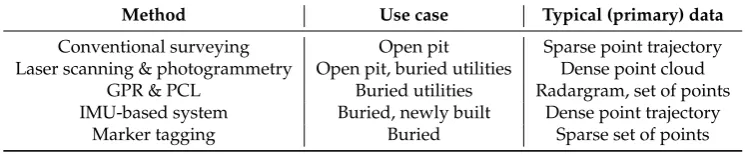
can travel). Table1lists the technologies used for utility mapping. In this paper, we focus on GPR 127
due to its popularity in underground utility mapping [4] and on a gyroscope-based system as it is not 128
limited by the depth of the pipeline, by nearby other utilities or by electromagnetic disturbances [8]. 129
Table 1.Data capture methods for underground utility services.
Method Use case Typical (primary) data
Conventional surveying Open pit Sparse point trajectory Laser scanning & photogrammetry Open pit, buried utilities Dense point cloud
GPR & PCL Buried utilities Radargram, set of points IMU-based system Buried, newly built Dense point trajectory
Marker tagging Buried Sparse set of points
2.1.1. Ground Penetrating Radar (GPR) 130
GPR is a widely used technology for characterizing structures in the underground. It is based on 131
recording the delay and power of electromagnetic (EM) signals scattered and reflected at discontinuities 132
of the permittivity. Such discontinuities are associated with differences in materials or differences in 133
material properties allowing to detect e.g. man-made objects, holes, and layers of different composition 134
or water content in the underground [9,10]. GPR is used for a variety of applications, among them 135
geophysical exploration, archaeology, and inspection of buried utility networks [11,12]. Depending 136
on the type of transmitted signals, impulse radar systems and continuous wave radar systems are 137
distinguished, with the former being more common [13]. The penetration depth, i.e., the maximum 138
depth at which discontinuities can be detected using GPR is on the order of a few centimeters to a 139
and the frequency which typically range from 10 MHz to 4 GHz. Lower frequencies require bigger 141
antennas but facilitate higher penetration depths. Higher frequencies, on the other hand, yield better 142
spatial resolution and thus allow correctly locating smaller objects or distinguishing objects at smaller 143
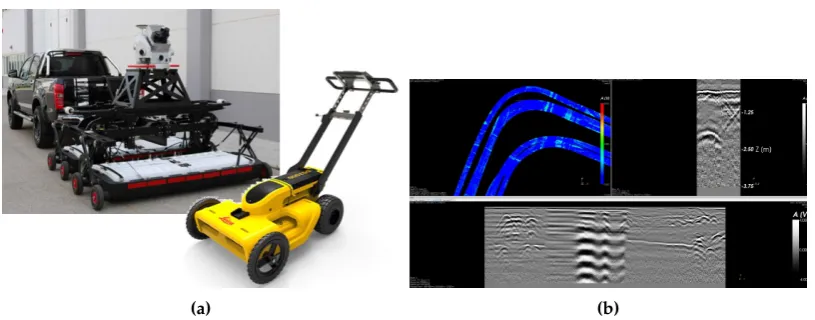
distances [11]. 3D information is obtained by moving the radar antennas along the ground surface, 144
recording data quasi-continuously, and subsequently analyzing the data tomographically. Figure4a 145
shows two examples of GPR instruments, one being integrated with a mobile mapping trailer, and the 146
other one a manually pushed cart. 147
Although GPR measurement can be very accurate, the responses may vary according to the 148
measurement. A so-called B-scan (i.e. a 2D distance-depth representation of the underground), see 149
Figure4bfor an example, can be very challenging and normally done by an experienced radargram 150
analyst. The experience can be generated from a series of signal traces along a trajectory. B-scan 151
normally represented by black and white colour indicative the different signal strengths and polarities 152
of the objects. These signals are analyzed for anomalous responses. If the positions of these anomalies 153
form a linear line, it is interpreted as a utility feature. The interpretation of B-scan is subjected to the 154
expertise of the radargram analyst or GPR specialist. Such interpretation experience can be gained 155
from regular used of system proper training provided by the manufacturer or consultant.
(a) (b)
Figure 4. Examples of GPR instruments (a) and GPR data (b); the data show a radargram of a longitudinal cross section of the top-most about 2.85 m along an asphalt paved road (bottom), a perpendicular cross section of one lane (top right) and the top view of the scanning tracks covered by GPR measurements (top left).
156
2.1.2. Gyroscope-based systems 157
Utilities with a diameter of more than about 5 cm through which a probe can travel may be 158
accessible to mapping with an inertial measurement unit (IMU). The IMU measures the 3-axis 159
acceleration and 3-axis rotation rates which can be integrated over time yielding position and 160
orientation changes of the unit. If the unit is mounted within a probe and the probe travels through 161
the utility (typically a pipe), it can record the trajectory of the probe – and thus the 3D coordinates of 162
points along the axis of the utility [8]. 163
The potential benefits of such a measurement system are that (i) it can acquire the as-built 164
information of the suitable utilities even if they are buried at a depth exceeding the penetration depth 165
of GPR, (ii) the location can be geometrically more accurate than using above-ground measuring 166
technologies for the location of underground structures, (iii) it can acquire data irrespective of 167
the properties of the surrounding underground (e.g. soil composition, water content) and of 168
electromagnetic fields, and (iv) that the probe can be equipped with additional sensors capturing 169
more information than just the coordinates (e.g. diameter, the radius of curvature, corrosion). Major 170
disadvantages are that (i) only pipes with sufficient diameter, sufficient minimum radius or curvature 171
be empty during the measurement i.e., the service of the utility is interrupted, (iii) the accuracy of 173
the 3D coordinates degrades rapidly with time such that only short parts of the utility, with known 174
coordinates of the start and end point, can be measured if high accuracy is needed, and (iv) additional 175
provisions may be required, e.g. short periods through which the probe remains stationary while 176
moving fast at others. Figure5bshows an example of such a probe and a 3D map of utilities mapped 177
using it. 178
(a) (b)
Figure 5.An example of a Gyroscope-based pipeline measurement system (a) and the 3D map of the measured pipes (b).
At present, GPR seems to be paramount importance for mapping the underground utilities. 179
However, there are others current technology that overcome the shortcoming of GPR available on 180
the market, such as laser scanning or gyro-based system. No single detection technique can detect 181
the entire type of utilities in every location. Hence, GPR is not the only solutions for underground 182
utility mapping, using more technologies increases the detection capability, coverage, efficiency and 183
accuracy. Irrespective of the data acquisition technologies chosen, the information extracted from 184
the measurements, in particular 3D locations, needs to be integrated with attributes of the respective 185
utilities, e.g. type and dimension, in a geospatial database to support 3D visualization, urban planning 186
and other applications. 187
2.2. The review of underground utility data governance 188
Some utility data models has been developed for storage, visualization, exchange, analysis in the 189
geospatial domain. Obviously, the general data model is not enough to reach all the requirements from 190
different users. In order to develop the 3D data model for the land administration of underground 191
utilities, this work reviews the underground utility data governance in land administration from some 192
countries and the existing data models that are related to underground utility networks and land 193
administration. 194
2.2.1. Underground utility data governance for land administration 195
The rapid urbanization and increasing complexity of urban spaces worldwide present an urgent 196
need to provide much more and precise information for land usage. Obviously, 2D cadastral 197
information and visualization are not enough for current land administration. During the past decade, 198
a number of works have been conducted to study on the 3D cadastre from various aspects, such as 199
legal, organization and technique [14–16]. The Land Administration Domain Model (LADM) [17] is an 200
important legal framework to define and integrate concepts and terminology of Land Administration 201
for 3D representations. As an international standard, the LADM provides a flexible conceptual schema 202
from three main aspects: organizations, rights and spatial in formations [15]. The integration of 203
2D and 3D information in the LADM can provide solutions for 3D cadastre. However, the LADM 204
only has two classes (LA_LegalSpaceutilityNetworkeandExPhysicalUtilityNetwork) specifically describe 205
information about the underground utility, which is not enough to define the 3D geometric and 206
topological characteristics and support to land administration of underground utility. 207
In recent years, some researchers or government agencies begin to consider the cadastre for 208
underground infrastructures. To analyze the impact of 4D cadastres in the registration of underground 209
The Netherlands and Queensland, Australia). Obviously, all of them are supported by a 4D cadastral 211
registration.Pouliot and Girardprovided a discussion about the integration of underground utility 212
networks in the land administration system. Based on the case study of Quebec, they discussed three 213
key questions in the following: 214
• Do we need to register underground objects? 215
• Should underground networks be registered in the Land Register, with the same specifications 216
as land parcels? 217
• Which information should be part of the registration process? 218
Some countries and institutions have implemented or at least conceptualized the 3D mapping of 219
underground utility network and their management in a related cadastral system. For instance, the 220
Canton of Zurich started to establish a comprehensive Canton-wide utility cadastre map based on the 221
Cantonal Act on Geoinformation of 2011 [19], derived from the Federal Act on Geoinformation of 2007 222
[20] and the Cantonal Regulation on Utility Cadastre of 2012[21]. The regulation sets a deadline for 223
each municipality to deliver and maintain a digital utility map latest until 2021. The City of Zurich 224
has its own utility cadastre since 1999 and set up a governance framework with the corresponding 225
utility providers [22]. Figure6shows an example of the utility map of the City of Zurich. The utility 226
cadastre is a subset of the utility documentation of the utility owners. The most important media 227
are included: gas, water, sewage, district heating, power, and telecommunications. SIA 405 [23] 228
is a well-defined standard by SIA (Swiss society of engineers and architects) for the exchange and 229
publication of utility data. The data model LKMap, part of SIA 405, was introduced to define a unified 230
visualisation/presentation of the utility map. The data is automatically delivered through well defined 231
interfaces at least once a week by the utility owners to the cadastre operator (GeoZ) (central data 232
storage). The utility owners are surveying and using partly 3D coordinates. During the exchange of 233
information between owners and the operator, the information is not yet considered.
Figure 6.Utility map of City of Zurich (Source: Geomatik + Vermessung Stadt Zurich).
234
A number of laws related to the exchange of information on utility location exist in the 235
Netherlands. In 2018, the law for storage and exchange of underground utility information was 236
amended. To accommodate the changes introduced by that law as well as the EU INSPIRE guidelines, 237
the KLIC-WIN program was launched. KLIC-WIN is a program (initiated by the digging sector in The 238
Netherlands) that guides, develops and implements changes triggered by the introduction of both the 239
WIBON, which is the law on information exchange of above ground and underground networks, and 240
the new EU INSPIRE guidelines for utility network information retrieval. KLIC-WIN aims to introduce 241
• Representation of utility information according to a new information model. 243
• The ability to (optionally) centrally store utility information at Kadaster. 244
• The gradual change of utility data formats for delivery to end users (from raster now to vector 245
data in 2019 and/or beyond). 246
Furthermore, Serbia extends its LADM based country profile to include utility information for 247
utility network cadastre [24]. Based on this data model, they will develop a system to register and 248
maintain the ownership of underground utility network. The United Kingdom begin to the registry of 249
underground utilities and create a national underground assets mapping platform in 2018. Moreover, 250
Canada has developed 3D maps of underground utility networks as well [16,25]. All of the current 251
work is just beginning and ongoing. This is a new challenge topic in recent years. 252
2.2.2. The 3D data model for underground utility networks 253
The CityGML utility network ADE [26] focuses mainly on three aspects: (i) the general 3D 254
geometric of network components; (ii) the 3D topographical structure of the entire utility network; (iii) 255
the functional information of different types of the network [26,27]. Based on the general concepts of 256
the utility network, different types of utility networks can be implemented with their specific function 257
[26]. Moreover, the interdependence between utility network features and city objects can be presented 258
in 3D space [28]. Because this data model is an extension of CityGML [29], which is the popular 259
standard for 3D city modelling (e.g. building), is beneficial to integrate information of utility network 260
to the infrastructures to support urban planning and the other city studies. However, it does not 261
consider the accuracy of the data. Some works begin to extend the existing data model to consider 262
much more details about utility networks, such as [30] represent geographical uncertainties of utility 263
locations based on CityGML Utility Network ADE. 264
The Industry Foundation Classes (IFC) utility model [31] is an ISO standard for data exchange 265
of buildings in the architecture and civil engineering domain [26]. In the utility part, it describes 2D 266
and 3D geometries of utility elements. Meanwhile, tow different ways of connection are defined to 267
describe the relationship between supply service components within the building, which is a logical 268
and physical connection. In addition, it has a comprehensive semantic definition of utility network 269
objects. However, this standard only focuses on the building level and lacks spatial information. 270
The INSPIRE Data Specification on Utility and Government Services – Technical Guidelines [32] 271
organize the basic information of utility network and administrative service of utility networks in a 272
city or country range. It is a part of INSPIRE, which is a standard of the European Union to describe 273
the spatial information of infrastructures. However, the INSPIRE Utility networks lack of definition of 274
3D geometric information of utility networks. 275
ESRI Utility Network model [33] provides a GIS-based utility solution to represent the basic logical 276
and physical structure of all types of utility networks, which is composed of edges and junctions. This 277
model is a general utility data model to represent the 2D geometric information and connections of the 278
utility networks. 279
Until now, there is not an international standard that has been widely used for 3D modelling of 280
underground utility [34]. Although some of existing standardized data models have been developed 281
to integrate multi-utility networks, they can not guarantee the information to be reliable [2]. In order to 282
develop a comprehensive utility database, we have the challenge to integrate different types of utility 283
datasets from multiple surveying techniques, as well as the existing 2D data. Table2compares four 284
popular utility data model relevant to the objectives of this work. Obviously, most of the existing utility 285
data models are to focus on the 3D representation, include 3D geometric and topological information. 286
The existing data models provide a good reference to describe the geometric and spatial information 287
of utility networks in 3D. Nevertheless, none of them considers the accuracy of data of underground 288
utility networks. On the one side, the survey technique directly impacts on the data accuracy. But 289
different applications might use data at different levels of accuracy. Hence, we need an ideally 3D utility 291
data model to support mapping procedures and control accuracy of underground utility network data. 292
Table 2.Comparison of model characteristics.
CityGML Utility Network ADE
ArcGIS Utility Networks
INSPIRE Utility Networks IFC 3D representation modelling
-3D geometries + - - ++
-Topological aspects ++ ++ ++ ++
-Hierarchical modelling ++ . ++ +
Land Administration - - -
-Data quality management - - -
--: no support, .: basic support, +: sophisticated support, ++: comprehensive support.
On the basis of their discussion and the situation of Singapore, it is necessary to register the 293
utility segments as the legal objects in the land administration system, which helps to identify the 294
ownership of underground utility. An integral approach needs to be developed based on legislative 295
and technology solutions. It is essential to establish a degree of reliability and consistency between 296
data produced by different service providers. It is essential to standardize the practices regarding the 297
use of those techniques and various information management. In the underground utility data model, 298
land parcel, as an important role in the land administration, should be connected to the underground 299
utility networks[16,35]. 300
3. Design of the 3D Data model for Underground Utility Networks 301
3.1. A Framework for Utility Data Governance 302
From data capture to usage, the whole work process includes several participants in different 303
stages. Hence, in order to improve the communication between different organizations at each phase, 304
our previous work [2] proposed a framework for underground utility data governance. After observing 305
the current work process in Singapore, this framework has been improved to organize the entire work 306
process (Figure7). This framework consists of five roles that are listed in the following: 307
• Data producer is the surveying constructor and/or surveyor in the data regulatory bodies’ 308
organization. In the utility survey phase, data producer captures data in the field work and 309
submit data to the utility network database. 310
• Data owner manages their collected data. This role could be companies or data regulatory bodies. 311
• Data regulatory bodies are government agencies, such as SLA or Public Utilities Board (PUB) of 312
Singapore. They manage their utility data based on their utility network data model. The data 313
regulatory bodies should provide clear permission for data integrator to use and the predefined 314
subset of utility data. 315
• Data integrator integrates all kinds of utility network data and manages the utility cadastre 316
information in a city or country. In the phase of utility cadastre management, the data integrator 317
should provide the required information for the application to users. This role builds a bridge 318
between the data regulatory bodies and users. 319
• Data users can use utility data for utility cadastre management applications. 320
In this work process, the surveyor as data producer captures data during the field work. After that, the 321
data will be submitted to data owner (e.g. PUB) who needs to manage their own utility networks data. 322
According to the requirements of government, the utility data will be submitted to data regulatory 323
bodies (e.g. PUB and SLA). There are two options for data submission. A general utility network data 324
model will be designed as a standard to manage underground utility data for data regulatory bodies. 325
Figure 7.The framework of underground utility network data governance.
they have their utility data model, they can continue to use it or change to use the standard one. A 327
consolidated 3D utility data model will be designed to support utility cadastre management. The data 328
integrator (e.g. SLA) needs to integrate data of different kinds of utility networks. The LADM plays as 329
a connection component to build a relationship between the general utility network data model and 330
utility cadastre data model in the utility cadastre management. Meanwhile, the LADM will connect 331
the underground utility network to the land administration of above ground. At last, the underground 332
3.2. 3D Underground Utility Data Model for Land Administration 334
Current work focuses on the conceptual design of a 3D underground utility data model and 335
connects it to land administration. In order to understand the demands of underground utility data 336
users, a workshop was organized to learn the work process and needs of land administration in 337
Singapore. This studying includes four application domains, land acquisition and purchase, planning 338
and coordination, land transfer and sale, and land leasing. Currently, the existing data sources are the 339
hardcopy of the utility network, 2D CAD and 2D geospatial information. There is an urgent demand 340
of 3D geospatial information of underground utility and space to evaluate underground environment 341
and support reallocation, land sales and the other applications. Therefore, the 3D underground utility 342
data model includes three packages to organize the basic information and structure of utility networks, 343
utility survey information, and the land administration information (Figure8). In order to connect 3D 344
underground utility data model to the information of land administration, these three packages inherit 345
from Singapore cadastral data model and LADM (ISO 19152). Meanwhile, the geometric and spatial 346
definition are inherited from Spatial schema data model ([36]).
Figure 8.The overview of packages of 3D underground utility data model.
347
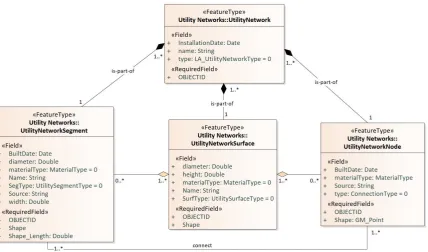
The Utility Networks package describes the basic information of utility networks, includes 348
geometric, spatial and physical information. Based on the partonomy (part–whole) relationships, 349
this work defines the hierarchy of utility networks in three levels (Figure9). The macro-level is the 350
whole utility networks, which is described byUtilityNetworkclass with the basic information of utility 351
networks, such as the type, material of utility networks. The meso-level is the surface of the utility 352
networks, which is the part of the utility networks. The surface could be the tunnel, duck, manhole 353
and the other types of space in the utility networks. Hence, the aims ofUtilityNetworkSurfaceclass are 354
to describe the types and 3D geometric information (e.g. diameter) of surface. The micro-level is the 355
basic elements of utility networks, includes nodes and segments of utilities. The node is a connection 356
point in the network, which is defined byUtilityNetworkNodeclass. The segment is the line segment of 357
level helps to transform 2D to 3D data as well. Figure10shows the relationships of different classes 359
in theUtility Networkpackage and basic attributes of each class. The values of utility networks type 360
inherit from LA_LegalSpaceUtilityNetwork in the LADM (ISO 19152) [17]. 361
Figure 9.Multilevel structure of utility network.
TheLA_UtilityNetworksclass aims to describe the land administration information of utilities. 362
On one side, it connects to the utility network surface in order to identify the land administration 363
information of different parts of utility networks. On the other side, it connects to the cadastral parcel 364
from Singapore cadastral data model and LADM [17]. The spatial relationship is used to describe 365
the relationship of cadastral parcels and utilities, includes contain, cross and touch. This class could 366
support ownership management of utilities and land administration management. 367
TheUtility Surveyclass aims to organize utility survey information. It could help to manage 368
survey status and accuracy of data. TheUtility Surveyclass inherits attributes of the survey from 369
Singapore cadastral data model. Furthermore, the ground conditions and survey methods are related 370
to the accuracy of data directly. Hence, theUtility Surveyclass integrates information from Standard 371
and Specification for Utility Survey in Singapore [37]. Meanwhile, theUtility Surveyclass builds 372
the connection between utility networks andLA_Point,LA_BoundaryFaceandLA_SpatialSourcein the 373
Surveying and Representationpackage. TheEvaluateattribute describes the method to check the accuracy 374
of surveying data. If the accuracy of the data is unknown, the value ofEvaluateis null. In future work, 375
the accuracy level should be defined to be based on the depth level, soil condition and survey method. 376
4. Case study 377
This initial study aims to integrate of GPR data and the existing underground utility data and 378
land cadastral data in the form of the geospatial database. It aims to find a reasonable work process 379
to bridge the gap between data capture and application. Moreover, this implementation can help to 380
improve the design of a 3D data model for underground utility. 381
4.1. Study area and datasets 382
This initial study was conducted at around Lorong 2, 3 and 4 at Toa Payoh, which is located in the 383
northern part of Singapore. This is one of the pilot study sites in our project to deploy mobile mapping 384
platform, namely Pegasus: Stream1combines a Stream EM GPR and Leica Pegasus Two photo and 385
laser scanner for massive 3D mapping of above and underground features. The data captured by the 386
Pegasus: Stream is geo-referenced using on-board GNSS receiver and IMU and a distance measurement 387
instrument (DMI). The Stream EM GPR contains large number of array antennae, with dual frequencies 388
(200MHz and 600MHz). The antennae transmit and receive in two distinct polarizations (HH and VV), 389
allowing the reconstruction of 3D underground utility network with a single pass of the GPR. Table3 390
shows the technical specification of the Stream EM GPR. 391
Table 3.Technical specifications of the Stream EM GPR.
Overall weight 228 kg (500 lbs) Max. acquisition speed 15 kph (9mph)
Positioning Survey wheel and/or GPS or Total Station Scan Rate per Channel
(@512 samples/scan) 87 scans/sec
Scan Interval 17 scans/m @ 200 MHz 33 scans/m @ 600 MHz Antenna Footprint Width 1.84m
Number of Channel 38 Antenna Central
Frequencies
200 MHz (34 channels 600 MHz (4 channels)
Antenna Spacing 6cm
Antenna Polarization Horizontal (HH) and Vertical (VV)
The scanning site is a 1.8 km long bi-directional 4-lane asphalt road in an inland area of Singapore 392
that has seen development since the 1960s. This study was conducted to investigate the feasibility 393
of GPR for large scale underground utility mapping for the purpose of improving the quality of 394
existing utility map information. The data were collected at a driving speed of about 15 km/h. All 395
the acquired data were post-processed and interpreted to detect and extract underground utilities 396
using a commercial off-the-shelf processing software come along with the GPR system. At the current 397
stage, we do not use point cloud data of above ground. The identified utilities were then transferred to 398
CAD/GIS format with x, y, z value as points and lines for 3D data modelling and visualization using 399
the same processing software. Figure11shows an example of GPR data in CAD (Figure11a) and GIS 400
(Figure11b) format. 401
(a)CAD (b)GIS
Figure 11.GPR data in CAD and GIS format.
The existing datasets from Geospace and cadastral data from Singapore Land Authority were 402
used as secondary data to obtain or improve the attributes of utilities that were extracted from the 403
radargram and to explore the relationship between the above land administration information and 404
underground utilities. These existing utility data are as-build data from utility services (e.g.: power, 405
water, gas, telecommunication and sewerage) and cadastral information in 2D form. Of these datasets, 406
it contains only a small portion of the information that has diameter with updated time and type. It 407
possesses challenges for land planning with such limited information. 408
4.2. 3D Visualisation 409
To develop the 3D utility data model for land administration, the underground utilities need to be 410
connected to the land parcels. Figure12explains the work process in this case study. The data model is 411
designed in UML and exported to XML format, which can be imported into ArcGIS as a geodatabase 412
schema. Based on the database schema, the GPR data can be loaded as utility network components 413
in polyline and point. According to the information from the existing utility data and GPR data, the 414
utilities can be modelled in 3D (multipath). The 3D modelling is realized manually in the ArcSence 415
and CityEngine. 416
In order to get the related land administration information, the utility networks data can be 417
integrated with cadastral parcel through their spatial relationships. Because the existing cadastral data 418
is in 2D, the current work only considers the pipeline within the cadastral parcel in 2D. In order to 419
improve the accuracy of data in 3D, the current cadastral data has to be extended to 3D so as to support 420
more spatial relationships (e.g. cross and touch). Figure13shows an example of 3D visualization of 421
Figure 12.Implementation process.
The information shown in the pop window includes spatial data from GPR and other attributes about 423
underground utility survey and land cadastral information above ground. 424
Figure 13.A result example of 3D visualization with land administration information.
4.3. Discussion 425
This is a simple implementation to explore the work process of 3D modelling of underground 426
utility from the GPR data and existing 2D data. Because GPR cannot capture the diameters, material 427
and some attributes of utilities, it is necessary to extract these information from the GeoSpace database 428
for 3D modelling. Depending on the spatial relationship (e.g. overlap, within) of the GPR data and 429
existing utility data, some of the utilities from GPR data can be connected to the existing utility data. 430
Because of two main limitations, there is a big challenge to improve the accuracy of data during the 431
may not be reliable enough for updating work. Second, the existing utility data is in 2D data, which is 433
difficult to identify utilities accurately. Hence, the future work needs to find the solution to detect much 434
more attributes of utilities from GPR data. In addition, the tentative integration of underground utility 435
and land cadastral data helps to improve the development of the data model for land administration. 436
5. Conclusions 437
This paper proposes to develop a consolidated 3D data model of underground utilities for land 438
administration. The work includes two parts. On the one hand, a framework for data governance is 439
designed to organize the workflow of utility data survey, management and application through five 440
roles. Through the understanding of current workflow in the utility data usage, this work needs to 441
clearly define the operations and rights of each role in the work process of 3D underground utility 442
mapping. On the other hand, a 3D data model of underground utilities is designed with 3D spatial 443
information, i.e. utility survey information, and land administration information of underground 444
utilities. In order to fill the gap between data capture and usage, this data model has the following 445
main tasks: 446
• Integrating utility networks data from varying non-destructive surveying technologies. Moreover, 447
it proposes an idea to manages the data accuracy based on the parameters, ground condition and 448
other information during the field survey. This is a first step towards bridging the gap between 449
data acquisition and data management for 3D underground utility mapping. 450
• Integrating the existing data and GPR data. As mentioned earlier, GPR data cannot get the 451
diameters and types of utilities. This way helps to improve the attributes of utilities from GPR 452
data. Moreover, it is also a process to transform utility data from 2D to 3D. 453
• In the data integration, the key step is to connect the utility network data model with the 454
LADM for 3D cadastral management of underground utility in Singapore. It is useful to support 455
ownership management applications and build the relationship between utilities and land 456
parcels. Such a reliable and consolidated centralized repository of underground utility data will 457
provide a crucial basis for land administration of underground infrastructures. 458
A case study is implemented based on the GPR data from the large scale mobile underground 459
utility mapping. The initial implementation transform GPR data from CAD to GIS format and 460
3D visualization of utilities based on the 3D utility data model. In order to get land administration 461
information, the utility networks have been connecting to the cadastral parcel. The accuracy and details 462
of utility networks need to be improved in future work, such as the spatial relationship between utilities 463
and cadastral parcels. To fully support the land administration of underground space, the 3D utility 464
data model should eventually be extended to include other underground objects and infrastructures in 465
the future, such as underground substations, pedestrian links, common services tunnels, road and rail 466
networks, etc. 467
This is an ongoing work and in the initial stage. Two main aspects of limitations need to be 468
improved in future work. First, for the accuracy of utility data. Obviously, the GPR data is not enough 469
to provide comprehensive 3D underground utility networks. The other kinds of data (e.g. Gyroscope) 470
should be integrated to provide more precise attributes for underground utilities. Moreover, the 471
details of the shapes and structures of utilities need to be improved. Second, the next step of the 472
data model development will improve the definition of land administration for underground utilities. 473
Additionally, in order to develop a comprehensive underground utility database, it is necessary to 474
explore the methods to use the existing data and integrate it with newly collected data. A showcase 475
will be developed to realize land administration of underground utility based on a 3D underground 476
utility data model. This will work with a selected agency as data regulatory body and the preferred 477
data integrator. They will help us to evaluate and improve the framework and definition of the data 478
model. After that, recommendations from this showcase will be used to extend the data model include 479
other underground infrastructures and develop the platform of underground space management to 480
Author Contributions:Conceptualization, Jingya YAN and Kean Huat SOON; methodology, Jingya YAN and 482
Kean Huat SOON; implementation, Jingya YAN; Data curation, Jingya YAN and Siow Wei JAW; writing—original 483
draft preparation, Jingya YAN; writing—review and editing, Siow Wei JAW, Kean Huat SOON, Gerhard 484
SCHROTTER and Andreas WIESER; visualization, Jingya YAN; supervision, Gerhard SCHROTTER and Andreas 485
WIESER. 486
Funding: UNDERGROUND-RELATED STUDIES AND PROJECTS FUND (USPF), Ministry of National 487
Development and is sponsored by Singapore Land Authority. 488
Acknowledgments:This publication has been realized as part of the project “Digital Underground: 3D Mapping 489
of Utility Networks” at the Future Cities Laboratory, established by ETH-Zurich and Singapore’s National 490
Research Foundation (NRF), and operating under the auspices of the Singapore-ETH Centre. 491
Conflicts of Interest:The authors declare no conflict of interest. 492
References 493
1. Jaw, S.W.; Van Son, R.; Khoo, V.H.S.; Schrotter, G.; Loo, R.W.K.; Teo, S.S.N.; Yan, J. The Need for a Reliable 494
Map of Utility Networks for Planning Underground Spaces; , 2018. 495
2. Yan, J.; Jaw, S.W.; Son, R.V.; Soon, K.H.; Schrotter, G. THREE-DIMENSIONAL DATA 496
MODELLING FOR UNDERGROUND UTILITY NETWORK MAPPING. ISPRS - International 497
Archives of the Photogrammetry, Remote Sensing and Spatial Information Sciences2018, XLII-4, 711–715. 498
doi:10.5194/isprs-archives-XLII-4-711-2018. 499
3. Hao, T.; Rogers, C.; Metje, N.; Chapman, D.; Muggleton, J.; Foo, K.; Wang, P.; Pennock, S.; 500
Atkins, P.; Swingler, S.; Parker, J.; Costello, S.; Burrow, M.; Anspach, J.; Armitage, R.; Cohn, A.; 501
Goddard, K.; Lewin, P.; Orlando, G.; Redfern, M.; Royal, A.; Saul, A. Condition assessment of the 502
buried utility service infrastructure. Tunnelling and Underground Space Technology2012, 28, 331–344. 503
doi:10.1016/j.tust.2011.10.011. 504
4. Lai, W.W.L.; Dérobert, X.; Annan, P. A review of ground penetrating radar application in civil engineering: 505
a 30-year journey from locating and testing to imaging and diagnosis.NDT & E International2018,96, 58–78. 506
5. Ni, S.H.; Huang, Y.H.; Lo, K.F.; Lin, D.C. Buried pipe detection by ground penetrating 507
radar using the discrete wavelet transform. Computers and Geotechnics 2010, 37, 440–448. 508
doi:10.1016/j.compgeo.2010.01.003. 509
6. Rogers, C.; Hao, T.; Costello, S.; Burrow, M.; Metje, N.; Chapman, D.; Parker, J.; Armitage, R.; Anspach, J.; 510
Muggleton, J.; Foo, K.; Wang, P.; Pennock, S.; Atkins, P.; Swingler, S.; Cohn, A.; Goddard, K.; Lewin, 511
P.; Orlando, G.; Redfern, M.; Royal, A.; Saul, A. Condition assessment of the surface and buried 512
infrastructure – A proposal for integration.Tunnelling and Underground Space Technology2012,28, 202–211. 513
doi:10.1016/j.tust.2011.10.012. 514
7. Lagüela, S.; Solla, M.; Puente, I.; Prego, F.J. Joint use of GPR, IRT and TLS techniques for 515
the integral damage detection in paving. Construction and Building Materials 2018, 174, 749–760. 516
doi:10.1016/j.conbuildmat.2018.04.159. 517
8. van Disseldorp, R. Unique Autonomous Pipeline Mapping System. 2nd Pipeline Technology Conference, 518
2007. 519
9. Sato, M. GPR and Its Application to Environmental Study2001. 520
10. Lunt, I.A.; Hubbard, S.S.; Rubin, Y. Soil moisture content estimation using ground-penetrating radar 521
reflection data. Journal of hydrology2005,307, 254–269. 522
11. Lai, W.W.L.; Chang, R.K.W.; Sham, J.F.C. A blind test of nondestructive underground void 523
detection by ground penetrating radar (GPR). Journal of Applied Geophysics 2018, 149, 10–17. 524
doi:10.1016/j.jappgeo.2017.12.010. 525
12. Desai, L. Underground Utility Survey2016. 2, 4. 526
13. Yelf, R.J. Application of ground penetrating radar to civil and geotechnical engineering.Electromagnetic 527
Phenomena2007,7, 18. 528
14. van Oosterom, P. Research and development in 3D cadastres. Computers, Environment and Urban Systems 529
2013,40, 1–6. doi:10.1016/j.compenvurbsys.2013.01.002. 530
15. van Oosterom, P.; Lemmen, C. The Land Administration Domain Model (LADM): Motivation, 531
standardisation, application and further development. Land Use Policy 2015, 49, 527–534. 532
16. Pouliot, J.; Girard, P. 3D Cadastre: With or Without Subsurface Utility Network?; International Federation 534
of Surveyors (FIG): Athens, Greece, 2016. OCLC: 831214525. 535
17. International Standards Organization. ISO 19152: Geographic information — Land Administration 536
Domain Model (LADM), 2012. 537
18. Döner, F.; Thompson, R.; Stoter, J.; Lemmen, C.; Ploeger, H.; van Oosterom, P.; Zlatanova, S. 4D cadastres: 538
First analysis of legal, organizational, and technical impact—With a case study on utility networks.Land 539
Use Policy2010,27, 1068–1081. doi:10.1016/j.landusepol.2010.02.003. 540
19. Kantonales Geoinformationsgesetz (KGeoIG), 2018. Available online:
541
www.zhlex.zh.ch/Erlass.html?Open&Ordnr=704.1 (accessed on 26 July 2019). 542
20. Geoinformation Act, GeoIA, 2007. Available online: www.admin.ch/opc/en/classified-compilation/20050726/index.html#fn1 543
(accessed on 26 July 2019). 544
21. Leitungskatasterverordnung (LKV), 2012. Available online:
545
www.zhlex.zh.ch/Erlass.html?Open&Ordnr=704.14 (accessed on 26 July 2019). 546
22. Adressliste fr Leitungserhebungen - Stadt Zrich, 2017. 547
23. Geodaten zu Ver- und Entsorgungsleitungen, 2012. www.webnorm.ch/null/null/sia%20405/d/2012/D/Product. 548
24. Radulovi´c, A.; Sladi´c, D.; Govedarica, M.; Risti´c, A.; Jovanovi´c, D. LADM Based Utility Network Cadastre 549
in Serbia. ISPRS International Journal of Geo-Information2019,8, 206. doi:10.3390/ijgi8050206. 550
25. Tan, L.C.; Looi, K.S. Towards a Malaysian multipurpose 3D cadastre based on the Land Administration 551
Domain Model (LADM)–an empirical study. Proceedings of the 5th FIG Land Administration Domain 552
Model Workshop, 2013, pp. 24–25. 553
26. Becker, T.; Nagel, C.; Kolbe, T.H. Integrated 3D Modeling of Multi-Utility Networks and Their 554
Interdependencies for Critical Infrastructure Analysis. InAdvances in 3D Geo-Information Sciences; Springer, 555
2011; pp. 1–20. bibtex: becker_integrated_2011. 556
27. Becker, T.; Nagel, C.; Kolbe, T.H. Semantic 3D modeling of multi-utility networks in cities for analysis and 557
3D visualization. InProgress and New Trends in 3D Geoinformation Sciences; Springer, 2013; pp. 41–62. 558
28. Hijazi, I.; Kutzner, T.; Kolbe, T.H. Use Cases and their Requirements on the Semantic Modeling of 3D 559
Supply and Disposal Networks. Kulturelles Erbe erfassen und bewahren-Von der Dokumentation zum 560
virtuellen Rundgang, 37. Wissenschaftlich-Technische Jahrestagung der DGPF, 2017, pp. 288–301. 561
29. Gröger, G.; Kolbe, T.H.; Nagel, C.; Häfele, K.H. OGC city geography markup language (CityGML) encoding 562
standard, Version 2.0, OGC doc no. 12-019. Open Geospatial Consortium2012. 563
30. Scholtenhuis, L.L.o.; Duijn, X.d.; Zlatanova, S. Representing geographical uncertainties of utility location 564
data in 3D.Automation in Construction2018,96, 483–493. doi:10.1016/j.autcon.2018.09.012. 565
31. Liebich, T. IFC 2x Edition 3. InModel implementation guide. version 2.0; AEC3 Ltd., 2009. 566
32. JRC. D2.8.III.6 INSPIRE Data Specification on Utility and Government Services – Technical Guidelines. 567
European Commission Joint Research Centre2013. 568
33. ESRI. What are geometric networks?, 2017. 569
34. Lieberman, J.; Ryan, A. OGC Underground Infrastructure Concept Study Engineering Report. OGC 570
Engineering Report, Open Geospatial Consortium, 2017. 571
35. Döner, F.; Thompson, R.; Stoter, J.; Lemmen, C.; Ploeger, H.; Oosterom, P.v.; Zlatanova, S. Solutions for 4D 572
cadastre – with a case study on utility networks. International Journal of Geographical Information Science 573
2011,25, 1173–1189. doi:10.1080/13658816.2010.520272. 574
36. International Standards Organization. ISO 19107:2003(en), Geographic information — Spatial schema, 575
2003. 576