The Impact of the Explicit Reflective Approach in Teaching the Nature of Science upon Turkish Students’ Perceptions of Science
Murat DEMİRBAŞ (Kırıkkale University, Faculty of Education Science Department, Kırıkkale, Turkey)
Funda BALCI (Kırıkkale University, Faculty of Education Science Department, Kırıkkale, Turkey)
1255
Author(s)
Murat DEMİRBAŞ
Kırıkkale University, Faculty of Education Science Department, Kırıkkale, Turkey
E-mail:[email protected]
Funda BALCI
Kırıkkale University, Faculty of Education Science Department, Kırıkkale, Turkey
E-mail:[email protected]
The Impact of the Explicit Reflective Approach in Teaching the Nature of Science upon Turkish Students’ Perceptions of Science
Abstract
How to teach science and how to train scientists are among frequently debated issues today. In this respect, many science teaching curricula have been developed and implemented in Turkey. It is observed that activities aimed at teaching the nature of science are included in curricula. In this study, the effectiveness of the explicit reflective approach, which is one of the methods employed in teaching the nature of science. The study was carried out in an elementary school selected from the city of Kırıkkale. The semi-experimental design was used in the research. As the data collection instrument, the “Views of Nature of Science Questionnaire” (VNOS-E) developed by Lederman et al. (2002) was employed in the study. The findings obtained were analyzed using the content analysis method, which is among qualitative data analysis techniques. In conclusion, it was observed that the explicit reflective approach had positive effects in improving students’ views of nature of science.
Keywords: Nature of Science, Teaching Nature of Science, Explicit Reflective Approach, Science and Technology Teaching
JEL Codes: C11, J12
Introduction
Developing and changing conditions in today’s world bring about transformations in numerous fields. Education is inevitably influenced by these developments. In order to train people for understanding and discussing these changes; the method of science teaching has been debated. As a result, curricula were changed in Turkey in 2005. New acquisitions were added especially to science and technology curricula such as science literacy, scientific process skills, attitudes and values. Thanks to these acquisitions, it was aimed to enable students to be aware of, understand and discuss scientific developments in today’s dynamic world.
Students should comprehend what is science and scientific knowledge, how knowledge is created and how to access it. This condition renders important teaching the nature of science (Köseoğlu, 2008). Serious deficiencies are also observed in the literature on the subject in Turkey. Especially in periodical international research reports such as TIMSS-R and PISA,
Turkey ranks very low. It is seen that Turkey’s position is continuously found to be low in terms of various sub-scales regarding the nature of science. For example, in the report published in 2009 on science literacy, Turkey ranked 42nd among 65 countries that were included in the scope of the survey, and 31st among 33 OECD countries (MEB, 2011).
1256 the nature of science at the beginning of the
research, changed at an “adequate” level. In the PhD thesis prepared by Ayvacı (2007), similarly, the nature of science was taught in accordance with the explicit-reflective and historical approaches. It was found in that study that these approaches contributed to students’ learning of some elements of the nature of science more than others.
The concept of “nature of science” generally refers to science as a way of knowing, values and beliefs on which scientific knowledge is based, and the development of scientific knowledge. In short, nature of science comprises the qualities of scientific activities and scientific knowledge. For example, while the operations of observing, hypothesizing and inferring are directly related to the scientific process, the issue of whether these processes are affected or not by the approaches in the mind of the scientist pertains to the nature of science (Bayrakçeken and Çelik, 2008). There exist various approaches employed while teaching the nature of science. The most common among them are the historical approach, implicit approach and explicit reflective approach.
In the current study, the explicit reflective approach was employed. This approach maintains that the target of improving students’ opinions of the nature of science “needs to be planned rather than being a side effect or a secondary output”. Some researchers, who argue that the explicit approach is effective in improving science teachers’ conceptions of nature of science, utilize special teaching methods that are aimed at different elements of the nature of science. However, other educators enrich such a teaching with some elements from the philosophy and history of science (Küçük 2006).
There exist numerous studies on the nature of science in the literature. These studies mostly examine students’ opinions on the nature of science after practicing one or more approaches to teach the nature of science through certain activities. Gürses et al. (2005), for example, examined the opinions of chemistry and classroom teacher candidates on science and the nature of science. It was observed that
participant teacher candidates were of the opinion that theories can change but laws cannot and that what laws imply are absolute knowledge. It was also determined that participants were unable to differentiate between theoretical and experimental concepts. Participants were observed to have misconceptions and lacks of knowledge in subjects of theory, law and proof. Researches, in conclusion, suggest that courses related to the nature and philosophy of science need to be attached more importance in education.
In the PhD thesis written by Muşlu (2008), the effectiveness of the explicit-reflective and implicit teaching techniques implemented in classes of 6th grade students in improving students’ views of the nature of science was investigated. It was observed that students began to express their opinions in several topics on which they had not have opinions. It was also determined that the activities were not effective on all of the participant students and that they changed their views of some issues.
In another study Kaya (2005), the impacts of the traditional teaching method and teaching approach based on discussion theory upon the academic achievements of 7th and 8th grade students and their views of the nature of science were investigated. In the experimental study, the Views of Nature of Science Questionnaire was administered to students before and after the teaching as pretest and posttest. According to the statistical analyses conducted at the end of the research; it was observed that the academic achievements and views of nature of science of the students in the experimental group, in which the science course had been taught with teaching activities based on the discussion theory, improved significantly than those of students in the control group.
Results of the studies conducted point to the fact that teaching the nature of science to students is of great importance. In what follows, the aim of this research is explained.
Aim of Research
1257 technology, science teaching curriculum has
also changed. Teaching the nature of science to students is among the objectives of this curriculum. In this respect, in studies conducted by Küçük (2006); Başol (2009), Doğan (2005) and Ayvacı (2007), effectiveness of the methods aimed at teaching the nature of science and opinions on the nature of science were examined. A student who knows the nature of science is capable of understanding science, its outcomes and its methods encountered in everyday life; participating in discussions and decision processes about science-related problems; valuing scientific works that are among the most effective products of the scientific culture; understanding the norms of this culture and learning science more effectively. In short, teaching the nature of science helps educators achieve the target of training scientists. In the study, the explicit reflective approach, which is among the methods employed to teach the nature of science, is addressed. The study seeks an answer to the question “Does the explicit reflective approach that is employed in science and technology teaching have an impact on students’ learning of the nature of science?”
Method
The study was carried out within the scope of elementary education Science and Technology course in the first semester of the 2010-2011 Academic Year. It lasted five weeks; four class hours a week. In the study, concepts that elementary education 6th grade students have about the nature of science were examined. The research was conducted using the “Semi-Experimental Method” (Karasar, 2002; Çepni, 2007). In some cases, random distribution of individuals to groups might be impossible or undesired. In such cases, the semi-experimental design is used as an alternative. In this method, individuals are not randomly allocated to experimental and control groups. That is, previously formed classes are taken, and one of them becomes the control group and the other the experimental group. In addition, priority is given to having participants who have similar characteristics (Gökdere, 2003). As part of the study, first, pretests are administered to both groups; while the experimental group is subjected to an experimental intervention, the
control group is not; and finally, the study is finalized after administering posttests. The course was taught to the experimental group using explicit reflective activities, whereas it was taught to the control group in line with the requirements of the science curriculum that is currently in effect.
Study Group
This study was carried out with the participation of 52 6th grade students attending Atatürk Elementary School located in the central district of the city of Kırıkkale. The experimental group had 27 students (15 boys and 12 girls) whereas the control group had 25 students (11 boys and 14 girls).
Assessment Instrument
The View of Nature of Science Questionnaire (VNOS-E) developed by Lederman et al. (2002) was employed in the study in order to determine students’ views of nature of science and to monitor the change in time. It is observed that this instrument has been employed for similar purposes in the domestic and international literature [e.g. Ayvacı (2007), Özbudak (2010), Doğan and Özcan (2010)]. In this respect, the items in the instrument were adapted into Turkish and the content validity of the scale was attained by taking opinions from field and language experts. The instrument was administered to both groups as pretest and posttest. It consists of seven open-ended questions.
Analysis of Data
In the study, the data, which were collected from pretest and posttest applications, were analyzed using the content analysis method (Büyüköztürk et al., 2012). Students’ responses were reviewed question by question; and similar responses were brought together in order to calculate frequencies. Since some responses pertain to more than one category, sometimes the same response was put under multiple groups. Then, pretest and posttest responses for each question were compared, and the differences between control and experimental groups were addressed.
Findings
1258 have been obtained if we had examined pretest
and posttest practices in both the control and experimental groups for each item; analyses are presented below only for those items in which serious changes were observed.
Findings related to the Pretest of the Experimental and Control Groups
Responses given to the question “Scientists try to provide us with more information about the world. So, what do you think scientists could change?” (Question 3) in the pretest by the experimental and control groups are analyzed as shown in Table 1.
Table-1: Responses given by experimental and control group students to the third question
Table 1 shows that the responses given in the pretest by both groups are very close to each other. For example; 15 responses given in the experimental group and 13 responses given in the control group are almost the same. That is, there was no difference between the groups in terms of their views of the nature of science. In
other words, they were at the same level in this regard.
Findings related to the Pretest and Posttest of Control Group Students
To the question “What is Science?” (Question 1); the responses given by control group students in pretest and posttest are analyzed as shown in Table2.
Table-2: Responses given to the first question by control group students in pretest and posttest Control group pretest f Control group posttest f It is the branch of science that examines living
beings and cells.
8 It is the branch of science that examines the nature, environment, our life, human beings, animals and the world.
7
It examines the world, our environment, nature and space.
7 It is a branch of science formed by logic. 4
It is a logical branch of science. 3 It deals with science. 4
It was born out of curiosity. 2 It is a quantitative branch of science. 2
It is scientific works that inform people. 5 Other 5
It is the branch of science that makes our lives easier and improves technology.
2
Other 4
It is seen in Table 2 that control group students gave similar responses in both applications to the question “What is science?”. For example, seven students in the pretest stated that “It examines the world, our environment, nature and space” and again seven students in the posttest responded that “It is the branch of science that examines the nature, environment, our life, human beings, animals and the world”.
While three students in the pretest said that “It is a logical branch of science”’, four students in the posttest stated similarly that “It is a branch of science formed by logic”. These findings indicate that the responses given in the pretest and posttest are quite similar to each other since explicit-reflective activities were not implemented in the control group.
Experimental group pretest f Control group pretest f
Finding cure for diseases 2 They can invent tools to make our lives
easier and change technology.
13
They can obtain further knowledge and change it.
6 Everything. 4
They can invent tools to make our lives easier and change technology.
15 Nothing. 1
Nothing. 1 They can change things related to the space. 5
Everything. 1 Other 6
1259 Findings related to the Pretest and Posttest of
Experimental Group Students
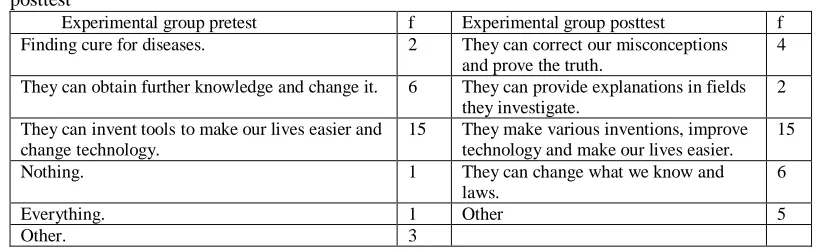
Responses given to the question “Scientists try to provide us with more information about the
world. So, what do you think scientists could change?” (Question 3) in the pretest and posttest by the experimental group students are analyzed as shown in Table 3.
Table-3: Responses given by experimental group students to the third question in pretest and posttest
Experimental group pretest f Experimental group posttest f
Finding cure for diseases. 2 They can correct our misconceptions
and prove the truth.
4
They can obtain further knowledge and change it. 6 They can provide explanations in fields they investigate.
2
They can invent tools to make our lives easier and change technology.
15 They make various inventions, improve technology and make our lives easier.
15
Nothing. 1 They can change what we know and
laws.
6
Everything. 1 Other 5
Other. 3
As shown in Table 3, while the responses in the pretest include general statements such as “nothing” and “everything”, this is not the case in the posttest. It could be stated that students started to think more thoroughly about the nature of science thanks to the explicit-reflective activities. While a response was given in the pretest arguing that laws could change, it appears that six students have obtained the opinion that laws can change in the posttest. That is, students realized that science has a nature that is open to constant change. They realized that what we regard today as rules might change in the future. A student in the posttest underlined the dynamic nature of science by giving the following response: “They can explain that some proven things (information) are actually different”. Along with these responses, some students talk about inventions in the pretest and posttest.
Conclusion and Discussion
In this study, students’ views of the nature of science were examined. As is seen in the findings, responses came from both groups were almost the same in the pretest. Therefore, it could be argued that the study group selected at the beginning of this research was homogeneous in terms of the views of the nature of science. Similar responses were observed in the pretest and posttest administered to the control group. The analysis in Table 2 supports this finding. On the other hand, when the responses given by the students
1260 teaching science. It could be argued that
attaining the targets in the curriculum would be easier and more permanent this way.
Reference
Ayvacı, H. (2007) “Bilimin Doğasının Sınıf Öğretmen Adaylarına Kütle Çekim Konusu İçerisinde Farklı Yaklaşımlarla Öğretilmesine Yönelik Bir Çalışma”. Doktora Tezi Karadeniz Teknik Üniversitesi, Türkiye.
Başol, M. (2009) “Tarihsel Yaklaşımın 7. Sınıf Öğrencilerinin Bilimin Doğasıyla İlgili Görüşlerini Geliştirmeye Etkisi”. Abant İzzet Baysal Üniversitesi, Türkiye.
Bayrakçeken, S. & Çelik, S. (2008) “Bilimin Doğası…”http://www.ppt2txt.com/r/4dbeddab
Erişim tarihi 13 Eylül 2011. Büyüköztürk, Ş, Akgün Ö. E., Karadeniz Ş.,
Demirel F., & Kılıç. E. (2012) “Bilimsel Araştırma Yöntemleri”, Pegem Akademi Yayıncılık, Ankara.
Çepni, S. (2007) “Araştırma ve Proje Çalışmalarına Giriş (Gözden geçirilmiş baskı)”. Celepler Matbaacılık, Trabzon, Türkiye. Doğan N. (2005) “Türkiye Genelinde Ortaöğretim Fen Branşı Öğretmen ve Öğrencilerinin Bilimin Doğası Üzerine Görüşlerinin Araştırılması”. Doktora Tezi, Gazi Üniversitesi, Türkiye.
Doğan N. & Özcan, M. B. (2010) “Tarihsel Yaklaşımın 7. Sınıf Öğrencilerinin Bilimin Doğası Hakkındaki Görüşlerinin Geliştirmesine Etkisi”, Ahi Evran Üniversitesi Kırşehir Eğitim Fakültesi Dergisi, V11, 4, Özel Sayı, pp.187-208.
Gökdere, M. (2003) “Bilimsel Araştırma yönte…”muratgokdere.net/forstudents/bil.aras.t ek.ppt Erişim tarihi 13 Kasım 2011. MEB(2011)http://earged.meb.gov.tr/dosyalar/pi sa/pisa_bulten2.pdf, Erişim tarihi 10 Ekim 2011 Erişim tarihi 09 Eylül 2011.
Gürses, A., Doğar, Ç. & Yalçın, M. (2005) “Bilimin Doğası ve Yüksek Öğrenim Öğrencilerinin Bilimin Doğasına Dair Düşünceleri”, Milli Eğitim Dergisi, sayı: 166. Kaya, O. N. (2005) “Tartışma Teorisine Dayalı Öğretim Yaklaşımının Öğrencilerin Maddenin Tanecikli Yapısı Konusundaki Başarılarına ve Bilimin Doğası Hakkındaki Kavramalarına Etkisi”. Doktora Tezi, Gazi Üniversitesi, Türkiye
Karasar, N. (2002) “Bilimsel Araştırma Yöntemi”. Nobel Yayın Dağıtım, Ankara. Köseoğlu F., Tümay H., & Budak E. (2008) “Bilimin Doğası Hakkında Paradigma Değişimleri ve Öğretimi ile İlgili Yeni Anlayışlar” GÜ, Gazi Eğitim Fakültesi Dergisi, Vol.28,2, p.221-237.
Küçük, M. (2006) “Bilimin Doğasının İlköğretim 7. Sınıf Öğrencilerine Öğretmeye Yönelik Bir Çalışma”, Doktora Tezi, Karadeniz Teknik Üniversitesi, Türkiye
Lederman, N.G., Abd-El-Khalick F., Bell, L.B. & Schwartz S.R. (2002) “Views of Nature of Science Questionnaire: Toward Valid and Meaningful Assessment of Learner’ Conceptions of Nature of Science”. Journal of Research in Science Teaching, Vol.39, No.6, pp.497-521.
Muslu, G. (2008) “İlköğretim 6. Sınıf Öğrencilerinin Bilimin Doğasını Sorgulama Düzeylerinin Tespiti ve Çeşitli Etkinliklerle Geliştirilmesi.” Doktora Tezi, Marmara Üniversitesi, Türkiye.