Conceptualization 1
Integrating endemic medicinal plants into the global value chains: The ecological degradation
2
challenges and Opportunities
3
Volenzo Tom*, John Odiyo, Offoro Kimambo 4
School of Environmental Sciences, University of Venda, Private Bag X5050 Thohoyandou 0950, 5
Republic of South Africa. 6
* Author for all correspondence: Email: [email protected]; Phone No: +27734561800
7 8
Abstract: Though innovations for sustainable management of natural resources have emerged over
9
time, the rising demand for nature based health solutions and integration of endemic flora into global 10
value chains could have adverse impacts on ecosystems. The ecological risks in the exploitation of 11
wild medicinal plant resources are exacerbated by a myriad of agrotechnological risks and challenges 12
that highly constrain their domestication. Successful exploitation and commercialization of medicinal 13
plants thus require a clear understanding of their demand and production systems or value chain 14
analysis. Accordingly there is need for innovative approaches towards their integration into global 15
value chains. Since quality and safety, traceability, certification, as well as, consumer tastes and 16
preferences are critical drivers in purchasing decisions by global consumers, they are inadvertently 17
exploited to weaken Indigenous knowledge (IK), undermine common property rights and entrench 18
value chains that favour a few elite buyers. This tend to create pervasive incentives for 19
overexploitation of medicinal plant resources and environmental degradation. Potential solution lies 20
in the recognition of drivers of vulnerability to environmental degradation and the innovative use of 21
policy bricolage, feedback loops and interactions between knowledge, power and agency on one 22
hand, and collective action and property rights institutions on the other hand. We conceptualise a 23
framework that can mediate a transformational agenda and enhance systematic understanding of 24
sustainability lenses in endemic medicinal plant resources value chains. This could in turn strengthen 25
IK, enhance collective action and promote participation of local actors with positive impact on the 26
utilisation and integration of endemic medicinal plant resources into global value chains. 27
Keywords: Bio-prospecting; Biopiracy; Collective Action; Common Property Resources; Ecosystem
28
sustainability; Natural Resource Management, Institutions, Property Rights, Value chain. 29
30
1.0 Introduction
31
Natural resources capital plays a critical role in provisioning of food, freshwater, fuel wood, 32
ecosystem services, such as, climate change regulation and non-material benefits or cultural services, 33
such as, sense of place, aesthetics, recreation and spiritual services[1]. Natural resource management 34
is thus a complex socio-political system concerning how local and non-local actors engage to pursue 35
their values around environmental systems, negotiate rights and arrive at a workable model of 36
collective action across scale (2). The observation is critical given that coupled and co-evolving 37
human-environment have implications for uncertainty and prediction of policy outcomes [3]. In the 38
integration of medicinal plants into the global value chain, the challenge lies in finding synergy 39
between environmental sustainability objectives amidst value, cultural and institutional divergences. 40
This raises the need for complimentary action among the multiple actors, as well as, close attention on 41
how to integrate the multiple dimensions of sustainability. 42
Transformational agenda seeks to address the root cause of vulnerability by introducing fundamental 43
changes to attributes of a system(4). In essence, pursuit of transformational agenda needs rethinking 44
and reframing of policy and practice, engaging multiple knowledges, as well as, questioning 45
subjectivities inherent in discourses and problem understanding. Such analytical frameworks need to 46
be inclusive of individual, community, state and non-state actors’ interests, aspirations and 47
interactions. 48
In spite of increasing international trade in medicinal plants, benefits to developing countries, 49
particularly to growers and producers, remain low. This is attributed to intermediaries, as well as, 50
lack of organisation and networking by the poor collectors of medicinal plants from the wild. This 51
increases transactional costs, a constraint exacerbated by increasing stringent health and safety 52
requirements in the main developed country markets [5]. In essence, stringent health and safety 53
requirements act as non-tariff barriers to market entry and full participation in the value chain by 54
majority of the developing countries. For example, the European Union directive 2001/83/EC (6), 55
requires provision of extensive documentation of physicochemical, biological and microbiological, as 56
well as, pharmacological and toxicological tests and results of clinical trials as proof of its quality, 57
safety and efficacy before placing plant based medicinal product on consumer shelves. Though some 58
exemptions on the scope of needed documentation are provided for clinically proven products 59
(directive 2001/83/EC; European Union, 2004), such exemptions only apply to EU member countries. 60
The importance of medicinal plants in the provision of health care is critical in many countries [7]. For 61
example, 80% of the South African population use traditional medicine to meet their primary health 62
care needs, with the diverse genetic base of the medicinal plants offering opportunity for bio-63
prospecting[8]. Though the use of medicinal plants is not a new phenomenon in several parts of the 64
World, there has been an increase in international and local screening initiatives to identify 65
pharmacologically active from medicinal plants [8,9]. This is also reflected in medicinal commodities 66
global value chain. The global trade value of medicinal and aromatic plants (MAPs) is in the range of 67
US$800 million per year. The demand is projected to grow at a rate of 15-25%, with an estimated 68
value of US$ 50 trillion by 2050 [10]. According to [7], 35,000 to 70,000 plant species have been used so 69
far as medicaments. This corresponds to 14-28% of the 250,000 plant species estimated to occur 70
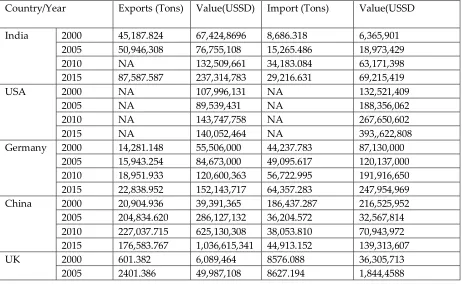
around the world. Table( 1) provides some statistics [11] on the value and trends in the global value 71
chain of Medicinal and aromatic plants (MAPs) 72
Table 1 : The world’s leading countries in the import and export of commodity group plants
,2000-73
2015.
74
Country/Year Exports (Tons) Value(USSD) Import (Tons) Value(USSD
India 2000 45,187.824 67,424,8696 8,686.318 6,365,901
2005 50,946,308 76,755,108 15,265.486 18,973,429
2010 NA 132,509,661 34,183.084 63,171,398
2015 87,587.587 237,314,783 29,216.631 69,215,419
USA 2000 NA 107,996,131 NA 132,521,409
2005 NA 89,539,431 NA 188,356,062
2010 NA 143,747,758 NA 267,650,602
2015 NA 140,052,464 NA 393,,622,808
Germany 2000 14,281.148 55,506,000 44,237.783 87,130,000 2005 15,943.254 84,673,000 49,095.617 120,137,000 2010 18,951.933 120,600,363 56,722.995 191,916,650 2015 22,838.952 152,143,717 64,357.283 247,954,969 China 2000 20,904.936 39,391,365 186,437.287 216,525,952 2005 204,834.620 286,127,132 36,204.572 32,567,814 2010 227,037.715 625,130,308 38,053.810 70,943,972 2015 176,583.767 1,036,615,341 44,913.152 139,313,607
UK 2000 601.382 6,089,464 8576.088 36,305,713
2010 903.028 15,343,734 9408.422 63,171,398 2015 1,492.596 32,611,446 10,298.794 61,679,145 Source: UN Comtrade, 2018, Only figures reported in Code HS 1211. NA, Not available
75
Commercialisation of medicinal plants normally follows bio-prospecting and patenting trajectories 76
[12]. Bioprospecting is the exploration of biological material for commercially valuable genetic and 77
biochemical properties [13]. Bioprospecting includes all studies to determine the chemical profile and 78
composition of medicinal plants [8]. This has prompted the government of South Africa to identify 79
and place medicinal plants as part of the newly launched biodiversity economy aimed at empowering 80
local communities that grow and sell these plants for medicinal purposes [14]). 81
Bio-prospecting is to a great extent anchored on indigenous knowledge systems hence institutions of 82
collective action [12]. In most cases, the isolation of active pharmacological agents in bioprospection is 83
patented and commercialised. However, commercialisation and patenting are often guided by policy 84
discourses that conflict with existing customary rights on access, use and control of medicinal plant 85
resources. Literature reveal that bioprospecting and subsequent commercialisation of medicinal 86
plants has had mixed outcomes in Africa and other parts of the world [15,16]. For example, the 87
increased vulnerability to extinction of a number of medicinal flora, such as, Hypoxis hemerocallidea is 88
attributed to high demand, destructive harvesting practices and inherent slow growth of the endemic 89
species [17]. The slow growth is an underlying risk in ecological degradation. 90
Integration of traditional medicinal plants into global value chain could negatively impact plant 91
genetic resource base and ecological sustainability at large. Since environmental vulnerability is 92
shaped by the ability to access resources across time, space and across actors, there is need for 93
innovative approaches in the commercialisation of medicinal plants. As endemic flora that thrives in 94
limited number of montane ecological niches, and one of the most exploited medicinal plants, African 95
cherry (Prunus africana (Hook.f) kalkman (hereafter referred to as Prunus africana), a member of 96
Rosacea family [15] , offers important lessons on the ecological risks associated with integration of 97
endemic medicinal plant species into the global value chain. 98
Our main contribution through this article is in resolving existing policy–practice gaps on 99
commercialisation of medicinal flora and paucity on pragmatic policies that guide the exploitation of 100
threatened endemic plant species [16]. By examining the concept of property rights and collective 101
action, and the closely related triumvirate of knowledge, power and subjectivity. We further attempt 102
at closing existing gaps on the role of institutional and environmental economics [16], in the 103
exploitation and integration of medicinal plants into the global value chain. We ultimately suggest a 104
conceptual framework with endless possibilities for forecasting and resolving social-policy 105
constraints and conflicts at several interfaces in the bioprospection and commercialisation of 106
medicinal flora. The conceptual framework from the article, can be used as a tool for reflective 107
planning and Sustainability Impact Assessments in the integration of medicinal flora into global value 108
chains. 109
2.0 The triumvirate of knowledge, power and subjectivity in Natural Resource Management
110
Control over natural resources and more so over land, is an important means by which people stake 111
and maintain claims to social and political power. For example, the elite domination in natural 112
resource exploitation can be extended by offering pervasive money making incentives to the poor and 113
which have negative consequences, such as, cutting of green wood and harvesting out of season or in 114
prohibited areas [18]. Understanding the triumvirate of knowledge, power and subjectivity is thus 115
critical in transformative initiatives in natural resource management. 116
Attention to ecological risks is critical in the sustainable exploitation of medicinal plant species. 117
Though the nexus model is critical in the identification of relationships and interdependencies in 118
environmental resource management, it fails to explain how risk and behaviour, compromise and 119
negotiation can be achieved in creating the interdependencies at planning and policy phases [19]. The 120
contextualise this in the following section by exploring the triumvirate of Knowledge, power and 122
subjectivity and their potential to mediate or constrain Natural Resource Management outcomes. 123
Power relations connote strategies by which people or political class try to direct and control the 124
conduct of others. This is exercised through allocation and control of resources [20]. Authority and 125
knowledge are thus self-reinforcing phenomena. Authority is either legitimised, reinforced or 126
challenged through use of knowledge[4]. In the same manner, knowledge claims may be a source of 127
legitimacy and power. In this way power is equated to influence [18]. 128
Subjects are cognitive attributes defined by positions of individuals in a social system. Practices, 129
discourses, policies and actions define subjects around which actors assert their agenda and protect 130
their interests in face of social and environmental change [4]. Discourses may for example legitimise 131
particular knowledge and subjectivities. The discourses with less formal local institutions are critical 132
vehicles for contestation within and between institutions and interactions between localites and larger 133
scale institutions [18]. 134
Authority draws from formalized institutions and organizations at different scales, legitimacy and 135
claims to make decisions about environmental governance, as well as, informal institutions claims 136
over resource governance[4]. The intertwining of productive and repressive aspects of power is key to 137
understanding the relationship between power, subjectivity and agency [20]. Power can thus be 138
enacted either as a tool for domination over or empowerment [20,21], with consequences on social 139
differentiation [22]. The enactment of power may have negative, as well as, positive outcomes on 140
livelihoods [4]. 141
The political domain of power broadly refers to processes through which individuals and collectives 142
cooperate and collude in order to govern their affairs[23]. Authority captures competition for 143
influence and ability to exert agendas by one individual or n institution over the other[24]. This is 144
significant in that actors with significant presence and clout in public and private spheres may have 145
greater opportunities to help bias the parameters of decision making to their benefit [25], or between 146
different social groups. Biased decision making may in turn result in lost opportunities and mis-147
characterisation of the underlying risks [26]. The foregoing is critical in frameworks that attempt to 148
link value chains and environmental vulnerability. 149
The centrality of compliance and conflict is critical in the analysis of risks and opportunities from 150
increasing markets for natural products, as well as, the integration of medicinal plants into the global 151
value chains. In extending this argument, we review institutional frameworks in natural resource 152
management, the global medicinal plant value chain and how these are impacted by the triumvirate 153
of knowledge, power and subjectivity. The interaction of authority (power), knowledge and 154
subjectivity [4], is given in Figure (1). The framework is in the next section adapted to extend our 155
argument about institutional frameworks in Natural Resource management in general and Common 156
158
Fig 1: key interactions framing adaptation planning ([4])
159
3.0 Institutional frameworks, Property Rights and sustainability in Natural Resource
160
Management
161
Institutions are the rules, values and practices that guide formal and informal organisations[27]. 162
Institutions consist of both informal constraints (sanctions, taboos, customs, traditions, and codes of 163
conduct), and formal rules (constitutions, laws, property rights). Together with the standard 164
constraints of economics, they define the choice set that determine transaction and production costs, 165
as well as, profitability and feasibility of engaging in an economic activity [28]. 166
Various collection of institutions come together to form governance systems. This include interactions 167
between different centres of power in society (corporate, customary-law based, governmental, 168
judicial) at different scales from local through to global level [29]. Institutions and governance 169
systems determine, to various degree, the access to, and the control, allocation and distribution of 170
components of nature and anthropogenic assets and their benefits to people. Examples of institutions 171
are systems of property and access rights to land (e.g. public, common-pool or private), legislative 172
arrangements, treaties, customary laws, informal social norms and rules, and international regimes 173
agreements. 174
The bundle of entitlements that define ownership, privileges and limitation for use of a resource, 175
collectively referred to as property rights (PRs), shape the pattern of use and motivation for 176
sustainable strategies, as well as, benefit sharing. From institutional perspective, PRs, is synonymous 177
with the capacity to call others/collectives to stand behind ones’ claim to a benefit stream and 178
claim[30]. Examining such entitlements and how they are exercised could provide an understanding 179
of related environmental risks, how such risks arise and mechanisms for reforms in the mitigation of 180
the risks. 181
In a judicial and administrative setting, dejure rights are lawfully recognised as formal legal 182
instruments. Defacto rights on the other hand occur where resource users cooperate to define and 183
however, may be in existence to compliment, overlap or conflict with one another. In many situations, 185
dejure authorised users or claimant rights and defacto proprietor arrangements which are 186
understood, followed and perceived as legitimate within the local community emerge [32]. Essentially 187
dejure authorised users could be defacto claimants over a common pool resource. 188
The effect of resource characteristics, characteristics of resource users, economic, political and legal ,as 189
well as, technological factors on CPR are given by [33]. Such factors are critical in the analysis of how 190
knowledge, power and subjectivity interact and influence resource use outcomes. According to 191
economic theory, if appropriate PR systems could be defined over all natural resources with little or 192
no transaction costs, then different stakeholders might be able to make solutions to the environmental 193
problems [34]. Acknowledgement of the embedded externalities, as a problem in natural resource use, 194
require negotiating mutually beneficial solutions and forging strong sense of community 195
responsibility and collective action [35]. 196
Natural resource management is vulnerable to institutional failures [36].The institutional failure 197
challenges, are partly accounted for by, failure to consider social and environmental contexts in which 198
community participation is embedded [2]. The institutional failures are fueled through competition, 199
collusion and conflict during policy discourses which cement rationalities and promote particular 200
regimes of governance [4]. In this way natural resource management has been hijacked to legitimise 201
strategic interests of development agencies, state organisations and dominant market players [37]. 202
Accordingly, community actions are increasingly being shaped by outside forces rather than locally 203
initiated collective action [38]. This view is extended in the next section through examination of 204
design challenges and some policy reform failures in CPRs. 205
Promoting incentive structures that are less vulnerable to short term interest and meeting long term 206
ecosystem scale objectives in a cost effective way is one of the design challenge in CPR and collective 207
action [39]. Accordingly there is need to analyse the role of knowledge, power and agency and how 208
they are mediated for sustainable outcomes under complex interrelations involving property rights, 209
collective action and natural resource management. This especially critical in natural resource 210
ownership discourses. 211
The various forms of natural resource ownership are Open access resource (OPR) and CPR [27] . 212
Under (OPR) ownership, no limit is placed on who can appropriate and no appropriator has any 213
incentive to leave any resource unit for other appropriators to harvest [40,41]. In theory, alienation 214
through privatization, should permit a resource to be shifted from a less productive to more 215
productive use [40]. However, in practice there are many cases in which privatisation and/ or 216
challenging of CPR has resulted into resource degradation. 217
In natural resource management, over investment directly or indirectly increases vulnerability to 218
resource degradation traps leading to loss of genetic and biological resources [42]. Over investment is 219
symptomatic of profit maximisation rationale under free market and privatisation scenarios. Over- 220
investment and rent dissipation of the fishery resources is illustrative of ecological risks when CPR 221
institutions are undermined or challenged. For example, hitherto efficient defacto property rights 222
and collective action over the rich fishery resources around Valenca, Brazil crumbled following the 223
overharvesting and depletion of fishery resources after dejure rules were used to challenge defacto 224
rules [40]. Since global medicinal value chains to a greater extent rely on the extensive collection of 225
wildings, property rights, indigenous knowledge(IK) and the closely related collective action lenses 226
are critical in the mitigation of associated ecological risks. 227
4.0 Community as an institution in Natural resource management
228
Communities have been viewed from different analytical lenses in Natural Resource Management 229
discourses. Under spatial model lenses, a community is defined as a geographically bound entity with 230
strong bonding and interactions taking place within the spatial boundary. The institutional model 231
[43], conceptualises a community as spatially fixed, use rule based collective action entity that has 232
community is conceptualised as an entity that is concurrently embedded in both local, regional and 234
global networking. 235
There exists opposing scholarly views on the impact of delocalisation on natural resources 236
management outcomes. On one hand, it is urged that delocalisation can create pervasive incentives 237
for environmental degradation, depress innovation and /or conflict of interest over use, access and 238
control [4]. On the other hand, “Localisation” or exclusion of external actors and the associated 239
dynamics can undermine the development of inclusive, productive, innovative and democratic local 240
institutions [24]. Most of the foregoing findings have been based on timber based forest products. 241
However, studies on bio prospecting, commercialisation and delocalisation of Non-timber forest 242
products, including medicinal plants, seem to suggest that delocalisation has adverse impacts on 243
biological and genetic resources. The negative impact seem to be associated with the undermining of 244
indigenous PRs and institutions of collective action [33]. 245
In assessing environmental vulnerability, the most relevant operational level PRs are access and 246
withdrawal rights. This has close relation to the problem of appropriation, maintaining the resource 247
stock, uncertainty over resource flow, rent dissipation and conflict over assignment of rights. Rents 248
are dissipated whenever many individuals are allowed to withdraw more than the economically 249
optimal quantity of resource unit in the process reducing the marginal returns and/ or the marginal 250
costs of appropriation[44]. 251
Participation in the formulation and implementation of decisions concerning environmental resources 252
is among the sustainable solutions on governance with complex environmental challenges[44]. This is 253
a form of collective action (CA). Collective action is enhanced when PRs and the institution for its 254
enforcement are neither challenged nor undermined[45]. Excludability [27] , is one of the conditions 255
that creates and sustains effective collective action in the management of CPRs, such as, medicinal 256
plants. 257
5.0. Challenges and potential solutions in medicinal plant value chains
258
Successful commercialization require a clear understanding of the demand and production systems of 259
the plants and/or their derivative products, as well as, market information assessment or value chain 260
analysis. A value chain includes the full range of activities that are required to bring a product from 261
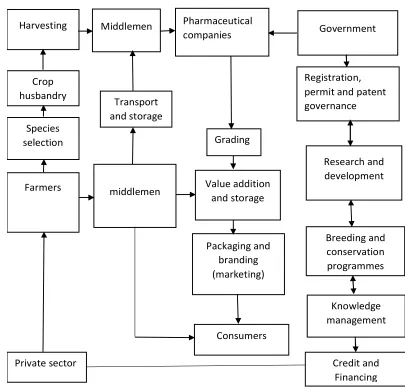
its origin, through different phases of production, to its final customer [46,47]. The activities in the 262
value chain include research, production, transportation/ distribution, processing and trading, 263
warehousing/ storage activities geared towards meeting consumer needs and preferences. Value 264
chain analysis is thus one of the most useful tools for understanding how markets for a particular 265
good, such as, plant derived pharmaceuticals, operate. 266
Value chains hold a critical role in the sustainable commercialisation and integration of medicinal 267
plants especially the wildings. Though few value chain studies have been done on medicinal plants, 268
available findings suggest that they are critical to sustainability, equity and safety of herbal 269
medicines [48]. Value chains can be used to account for power and dominance relationships between 270
different actors, such as, producers, retailers, middlemen and associated differences in income 271
accruing to them, the characteristics of the final product, as well as, the competitive advantage of the 272
product over similar products [49,50]. We posit that value chains are critical to sustainable 273
exploitation of medicinal plant resources. 274
Medicinal plants value chain is among the highly inequitable and unregulated hence they tend to be 275
inefficient [51,52]. In the upstream value chains, market information, capital and skills, volume, 276
quality, and consistency of supply are major bottlenecks, especially in small scale farmers’ value 277
chains[52]. In particular, medicinal plant supply chains are extra ordinarily long and dominated by 278
middlemen. Poor availability of market information exacerbates disincentives in medicinal value 279
chains[51]. The domination by middlemen greatly reduces the margins to farmers and harvesters. It 280
further increases the risk of biopiracy or the patenting and selling pharmaceutical agents derived 281
from indigenous plant species without acknowledging or providing financial compensation for the 282
traditional knowledge or royalties earned from the sales of the drugs to the source countries of the 283
chain 285
Fig 2 : Medicinal and Aromatic Plants Value chain (Adapted from Phondani et al., 2016) Pharmaceutical
companies
Harvesting Government
Value addition and storage Crop
husbandry
Grading
Breeding and conservation programmes Species
selection
Research and development Farmers
Knowledge management
Credit and Financing Middlemen
Packaging and branding (marketing)
Registration, permit and patent governance
Consumers Transport
and storage
middlemen
Private sector
286
The knowledge held or owned by indigenous people and local communities is the basis for 287
bioprospecting or production of useful products, such as, herbal medicine, cosmetics, food flavours 288
and fragrances [12,13]. Such knowledge may be oral, documented or in other forms. Hence, a rich 289
cultural heritage is relevant in the conservation and sustainable use of biological diversity. Since 290
genetic resources and traditional knowledge are inseparable, its documentation becomes integral 291
part to the conservation of biological diversity. However, medicinal plants are faced by continuous 292
erosion of the IK among many other threats [51] ,as well as, biopiracy [14]. 293
Lack of and/or inadequate governance systems on intellectual property rights in most developing 294
countries increases the vulnerability of their genetic resources to biopiracy[46]. Under Nagoya 295
convection on access to and benefit sharing ( ABS) protocol [13], utilisation of genetic resources, 296
research on genetic or biochemical composition of genetic resources, as well as, subsequent 297
application and commercialization of the isolated active ingredients are considered. This partly 298
resolves the ambivalence around difficulties in the definition of biological and genetic resources 299
alluded to by [12]. Though the Nagoya protocol has the potential to strengthen collective action and 300
claims to benefits from bioprospection of genetic resources, it does not conclusively resolve 301
One of the major threats to medicinal plants is the increased loss of genetic diversity due to 303
unsustainable exploitation and loss of habitats. The increased pressure on medicinal flora is fuelled by 304
high and increasing demand for medicinal plants[53,5]. For example, in a study in Tanzania, the 305
indiscriminate and widespread harvesting of wild medicinal flora extended into sacred forests with 306
many plant species becoming extinct or endangered[54]. Risks of extinction could negatively impact 307
livelihoods, economies and health especially in communities where medicinal plants are found[14,55]. 308
Biotechnology and domestication of MAPs can be adopted to address the threat of resource 309
overexploitation. Molecular marker assisted selection, tissue culture and genetic transformation 310
which alter pathways for biosynthesis of target metabolites are some of the biotechnological 311
technologies with potential for rapid domestication of MAPs [56]. Though domestication of medicinal 312
plants provides opportunities for overcoming misidentification, genetic and phenotypic variability, 313
extract variability and contamination risks [56], the existence of agrotechnology challenges, such as, 314
difficulties in the identification of the right cultivar, uncertainty on level of active ingredients in the 315
domesticated cultivars, pest and disease challenges and low environmental tolerance or survival 316
under cultivation, constraints domestication pathways [51]. Domestication of medicinal plants is 317
further constrained by limited knowledge on management, as well as, inadequate basic research 318
effort on the distribution, genetic diversity and ecology of the species[57]. This could be the plausible 319
reason for preference of wildings in the medicinal value chain. Sustainable exploitation of the wild 320
plant genetic resources is thus critical. 321
Marketing and promotion of wild plants and their derivative products requires substantial capital 322
investment that can hardly be committed without clear market and value chains information [58]. 323
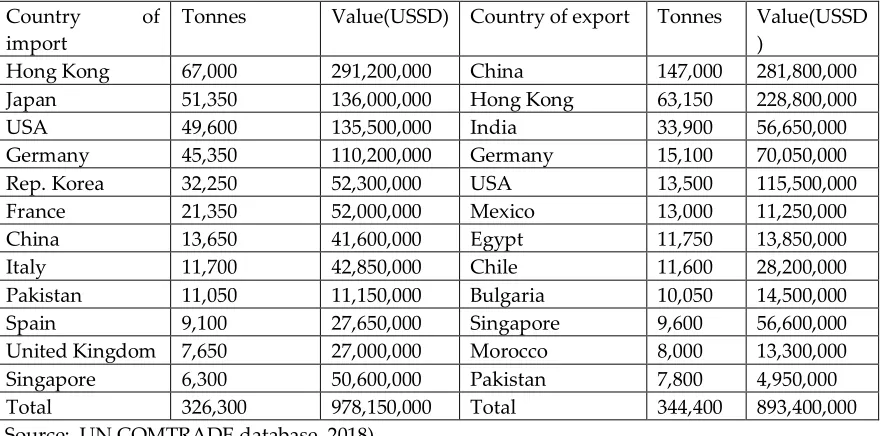
This possibly accounts for dominance of medicinal value chain by 12 countries. According to [59], 324
80% of international trade on plant derived pharmaceuticals are controlled by 12 countries (Table 2). 325
Dominance by a few value chain actors could create monopolies with negative outcomes on returns 326
for suppliers of medicinal plant resources. 327
Table 2 : The world’s leading countries in the import and export of commodity group
328
pharmaceutical plants,1991-2003
329
Country of import
Tonnes Value(USSD) Country of export Tonnes Value(USSD )
Hong Kong 67,000 291,200,000 China 147,000 281,800,000 Japan 51,350 136,000,000 Hong Kong 63,150 228,800,000
USA 49,600 135,500,000 India 33,900 56,650,000
Germany 45,350 110,200,000 Germany 15,100 70,050,000
Rep. Korea 32,250 52,300,000 USA 13,500 115,500,000
France 21,350 52,000,000 Mexico 13,000 11,250,000
China 13,650 41,600,000 Egypt 11,750 13,850,000
Italy 11,700 42,850,000 Chile 11,600 28,200,000
Pakistan 11,050 11,150,000 Bulgaria 10,050 14,500,000
Spain 9,100 27,650,000 Singapore 9,600 56,600,000
United Kingdom 7,650 27,000,000 Morocco 8,000 13,300,000
Singapore 6,300 50,600,000 Pakistan 7,800 4,950,000
Total 326,300 978,150,000 Total 344,400 893,400,000
Source: UN COMTRADE database, 2018) 330
331
The major sources of risks to commercialisation of medicinal plants through deliberate cultivation 332
(domestication) include biopiracy, illegal collection, long gestation period to maturity, unresponsive 333
permit /licencing systems, dispersed producers and lack of linkages among chain actors[51], as well 334
as, poor quality planting material and uneconomic plots adopted by farmers [60,51]. Other risks 335
multiple pharmaceutical active ingredients hence of high risk to any investor to commit funding to a 337
single plant production), as well as, preferences for naturally sourced products by consumers [56]. 338
Other bottlenecks to field cultivation include lack of detailed and accurate market 339
information[61,51,5]. Reliance on wildings could thus be a risk management strategy in the medicinal 340
plant value chain. 341
Though Intellectual property rights(IPRs) in the form of copyrights, patents and industrial design 342
protection offer strong protection to creations that are original, novel, and attributable to an 343
individual creator/owner (person or corporation), they systematically exclude products arising from 344
traditional creativity [62]. Accordingly, under patent law, the synthesis of biochemical compounds is 345
not part of the indigenous medical knowledge [62,63]. For example, the USA patent law, only 346
recognises prior knowledge, use or invention which occur within USA or is evidenced by accessible 347
publication in the USA [62,64]. The inherent contradiction has potential to weaken IK, promote 348
biopiracy, as well as, monopolistic tendencies with negative impact on international price for the 349
affected plant derived products [64]. Decline in IK constraints the development of MAPs [51,5]. 350
The pervasiveness of bio-piracy in medicinal plant value chains is illustrated by cases challenging the 351
granting of patents on antifungal extracts from Neem tree (Azadirachta indica) and anti-cancer agents 352
from turmeric (Curcuma longa) among others [62,64]. Since knowledge ( in particular IK) is intangible, 353
it is difficult to protect it legally by means of IPR instruments, such as, patents, copyright, or trade 354
secret registration. On the other hand, the use of technology, including biotechnology, to develop a 355
useful product (such as the isolation and commercialisation of active ingredients) from medicinal 356
plant resources based on traditional knowledge stocks is generally protected under patent law and 357
IPR systems[62]. The interplay between indigenous knowledge, biopiracy and weakness of 358
international conventions and national legal frameworks is further illustrated by several other case 359
studies, such as, the patenting of chemotherapeutic agent, vinblastine, from rosy 360
periwinkle(Catharanthus roseus), a native of Madagascar and the drama around Hoodia (Hoodia 361
gordonii), a succulent plant used for centuries by indigenous San people of South Africa. 362
5.1 Value chains, commercialisation and Ecological degradation risks: The case of Prunus
363
africana 364
MAPs represent part of the natural biodiversity endowment around the world and is essential for 365
human wellbeing in terms of food security, human health, provision of clean air and water, local 366
livelihoods, economic development in addition to being central component of many belief systems, 367
worldviews and identities[65,57]. In particular, wild medicinal plants are an important source of 368
livelihood for many of the poor people in developing countries [48]. In addition to meeting the 369
requirements of medicine for an increasing human population, plant derived medicines have minimal 370
side effect relative to synthetic medicines [51]. In this section, we use the case on Prunus africana to 371
demonstrate how value chains, collective action in a community, power, knowledge, institutions on 372
property rights and ecological degradation interact. 373
Commercialisation of wild Prunus africana in Cameroon is chronicled by [16]. Prior to 1972, only 374
small-scale harvesting of Prunus africana bark occurred for local medicinal use. This changed 375
dramatically in 1972 when Plantecam, a subsidiary of the French company Laboratories Debat, 376
obtained a monopoly over the commercial trade in Prunus africana bark. Although commercial 377
harvesting started to take place, a system of controlled harvest by teams of Plantecam workers was 378
maintained. This worked relatively well until 1985 when the Government of Cameroon issued 379
licenses for P. africana bark exploitation to additional fifty entrepreneurs. The award of quotas to 380
additional entrepreneurs was not based on any forest inventories or assessments of sustainable 381
harvest technologies[16]. The adoption of a free market model created pervasive incentives among 382
suppliers (middlemen and local individual harvesters) and buyers. Since no incentives for seeking or 383
maintaining stocks in their area were in place, increasing the number of permitees by default 384
As the wild populations were the sole source of the bark, the increase in number of licenses, had a 386
devastating effect including depletion of the wild populations in West and North West regions. The 387
overexploitation became especially serious in 1994, when the Cameroonian government ended 388
Plantecom’s monopoly over bark harvest on Mt. Cameroon and on bark export. The result was a 389
spate of uncontrolled bark exploitation, particularly by young men, which focused on the major 390
remaining source of Prunus africana bark in the forests of Mt. Cameroon. 391
Several explanations are given for the over-exploitation of Prunus africana wildings in Cameron. 392
According to [66], the top down approaches to command and control policies were ineffective due to 393
their failure to consider perception of target groups and actors in Prunus africana value chain. This 394
was further exacerbated by the failure in sustainability safeguards that had been formulated to 395
distinguish between the legal and illegally harvested bark [67]. The failure of traceability instruments 396
is symptomatic of inefficiencies in the enforcement command chain[16]. It is also illustrative of 397
institutional failures in the commercialisation of medicinal plants[16,67]. 398
According to [16], conflict between the formal and customary institutions, inconsistent non-timber 399
policies and legal frameworks, market structure that favours the elite investors, as well as, the 400
contestation about legitimacy to access, use and control, multiplicity of actors and flawed system of 401
permit issuing were responsible for the degradation of prunus wildings. The foregoing reflects the 402
role of value chain, ineffectiveness of command–control governance approaches and institutional 403
failures on sustainability outcomes in commercialisation of medicinal plant. Insufficient enforcement 404
capacity, pervasive free rider incentives, institutional weaknesses and vested interests[68], seem to be 405
the underlying risks underpinning such failures. 406
In the forest sector, vested interests are motivated by necessity for capital accumulation, as well as, 407
conflict of interest among decision, policy makers, and compliance and enforcement agencies, with 408
the restrictive and complex permitting processes being some of the instruments used to favour elite 409
capture of the market share [68]. Implicitly, differentials in power and knowledge relations could be a 410
driver of vulnerability to degradation in the integration of indigenous plant genetic resources into the 411
global value chain. The profit motive and associated power politics in the integration of lucrative 412
medicinal flora into global supply chain is exemplified by resistance and failure to include cultivated 413
bark into the value chain. This was inspite of evidence that the bark from cultivated plantations had 414
great potential for enhancing equity in the distribution of benefits to the community, as well as, 415
ensuring the sustainable exploitation of Prunus africana plant resources[16]. 416
The ecological degradation risks in the exploitation of endemic medicinal plants, such as, Prunus 417
africana is exacerbated by climate change, pests and diseases. Such drivers could negatively influence 418
the ecological distribution of Prunus africana by 2050 [69]. For example, between 1997 and 2003, 21% of 419
the Prunus Africana at Ischeno, Kakamega forest, died from bark harvesting, with 9-50 % of the trees 420
experiencing canopy dieback from other causes other than debarking [15]. Given that the genetic and 421
chemotypic variation of Prunus africana reflects ancient dispersal routes and evolution in isolated 422
vulnerable montane and rare forest ecosystems in Africa [69], the destructive harvesting practices are 423
expected to affect the reproductive future and genetic diversity of exploited populations [70]. In the 424
next section we explore some of the successful innovations in the agricultural value chain and 425
identify opportunities that can support the sustainable integration of endemic medicinal flora into the 426
global value chain.
427
5.2. Opportunities for sustainable integration of medicinal plants into global value chain
428
In the global medicinal plant value chain, certification and safety requirements are critical. This limits 429
the power and influence of disorganised sellers/collectors/producers and actual participation of 430
producer organizations in partnerships. Though partnerships are associated with some constraints, 431
they have the potential to shorten the supply chain, improve quality and earning of premiums by 432
farmers, as well as, trigger development of human capital associated with development of 433
certification schemes [71]. The role of organisations in market access for plant derived medicines is 434
critical [46]. This includes collaboration and partnership along the value chain. For example, 435
stimulate adoption of certification standards that increase their visibility, market access and 437
realisation of premium prices. In the long run, value chain partnerships increase the potential for 438
improved environmental management [71]. 439
Coordinating research effort, marketing and policy issue also require linkage of value chain actors at 440
local, regional, national and international levels [57]. For example, under the sustainable livelihoods 441
framework, the ability of MAP farmers in some parts of China to participate in global trade has been 442
enhanced. This is seen through the formation of internal and external trade networks, and increased 443
linkages between farmers and buyer alliances [48]. Integrated value chain (IVC) approaches, thus 444
have the potential to solve coordination constraints, reduce vulnerability to exploitation for 445
individual chain participants, provide a means to pricing intervention by policy makers and 446
governments, strengthen collaboration, drive market reforms, address regulatory constraints, as well 447
as, create strong backward and forward linkages [47]. 448
IVCs provide opportunity for forward contracting. In turn, it greatly reduces the motivation for 449
adulteration while inducing price stability [72]. By addressing market access barriers, IVCs positively 450
impact on efficiency, empowers and motivates primary producers to sustainably manage their 451
resources, reinvest the higher profit margins and innovate with potential for positive impact on the 452
eradication of rural poverty [73]. The contribution of IVCs in poverty reduction and economic growth 453
is particularly significant for communities whose education levels are low and therefore have to 454
depend on IK for their livelihoods [14]. 455
456
Quality and safety, traceability, certification , reliability of supply, as well as, consumer tastes and 457
preferences are critical drivers in purchasing decisions by consumers and MAP value chain [74].The 458
success of validated supply chain by medicinal cannabis growers in the Netherlands in which Good 459
Agricultural practices (GAPs) are adopted to ensure traceability and guarantee human safety and 460
efficacy of the products through a documentation process that can be monitored by internal and 461
external auditors [53], provides an opportunity for arresting illegal harvesting and biopiracy in 462
medicinal plant value chains. Further it provides the baseline for advancing the adoption of fair trade 463
principles in the medicinal value chain. Fair trade principles have been used in agricultural value 464
chains e.g. the smallholder farmer tea production, to advocate for premium prices, improve product 465
quality and promote environmental sustainability [71]. 466
Innovative domestication of the Nagoya convention on ABS offers a window of opportunity in 467
reducing the risk of biodiversity loss and conflicts in CPRs. The Biodiversity Economy Strategy (BES), 468
Republic of South Africa, provides an innovative pathway that can resolve PRs conflicts, hence the 469
sustainable integration of medicinal plants into local and global value chains. The biodiversity 470
stewardship approach under BES, encourages voluntary agreements that support the conservation 471
and sustainable use of biodiversity. Under the biodiversity stewardship approach, conservation 472
authorities guide and encourage private and communal land owners to protect and manage land in 473
biodiversity priority areas [65]. The approach, a form of Private Public Partnership(PPP), recognises 474
land owners as custodians of biodiversity on their land. The participatory inventory, protection and 475
conservation of ecologically viable areas operationalises the protected Areas Act [75]. 476
The controversy between India and a USA firm (W.R.Grace & Co) on the patenting of products from 477
Azadirachta indica and Curcuma longa is illustrative of the role documentation, biotechnology, a priori 478
information, conflict and compliance to International conventions vis avis territorial jurisdictions on 479
patents and the diminishing power of indigenous property rights. Though India had for a long time 480
been identified with the IK and processing of an oil based pesticide from the neem tree, it lost the 481
patent contest on the basis that the USA based firm had modified the IK to improve the shelf life of 482
the active ingredients, in itself an intellectual novelty [62]. In contrast, it won the turmeric contest on 483
balance of evidence providing extensive documentation of traditional knowledge databases 484
alongside research that validates such knowledge (through documentation, clinical and efficacy trials) 486
could thus strengthen IK and reduce biopiracy. 487
6.0 Towards a conceptual framework in the sustainable integration of medicinal plants into the
488
global value chain
489
Theoretically, medicinal plants are non-excludable CPRs. The non-excludability nature of a CPR 490
increases the tendency to free ride or gain benefits without contributing to the costs of maintaining 491
and regulating the resource among potential beneficiaries. This increases their vulnerability to 492
overuse or destruction [33], especially when pervasive incentives are presented by the actors in the 493
value chain. Regulating access to CPR and enforcing rules formulated to govern its use is thus critical. 494
However, many national agencies that govern CPR lack sufficient resources to enforce entry rules, a 495
situation which by default change dejure state resources to defacto open resources [27]. Change of 496
dejure state resources to defacto open resources is recipe for conflict among competing rule systems 497
with negative impacts on resources[31], particularly in situations where external regulatory agencies 498
and resource users create and enforce competing rules and regulations on the same resource. 499
Overexploitation of medicinal plant resources, such as Prunus africana can be explained by Micro-500
social theory [76] on interdependent collective action. Since bioprospecting licensees require a critical 501
mass of individual suppliers to reduce cost of production and maximise profits, a system that by 502
default undermines legal, regulatory and compliance frameworks is deliberately promoted by 503
concentrating organising effort on individuals whose potential contributions are the largest. The 504
micro social theory on interdependent collective action can thus be contextualised in explaining how 505
free rider behaviour is incentivised and the resulting degradation risks under evolving open resource 506
access governance systems that emergence to replace CPR governance systems in bioprospection and 507
commercialisation of medicinal floral. Given that open access natural resource governance systems 508
are characterised by uncertainty in the value chain, free riding appropriation of medicinal flora, 509
minimises risks for competing entrepreneurs but increase ecological degradation risks. 510
Protecting a CPR from overuse requires users or external authorities to create rules that regulate its 511
use. Devising such rules requires joint effort of a large proportion of resource users or local collective 512
action, a costly affair that requires that the users overcome collective action dilemmas [33]. Under 513
formal institutional arrangements, such costs are prohibitive and unenforceable, especially there is 514
lack of commitment and legitimacy. In such scenarios, self-organised collective action arrangements 515
are preferable as they can produce operational rules that closely match the physical and economic 516
conditions of a particular site [31]. Under the latter, the cost of regulation are largely borne by the 517
same beneficiaries and institutional arrangements that internalises the costs of monitoring and 518
exclusion[77]. Such efficacy justifies the use of IK and local collective action in lowering the costs of 519
enforcement and pursuit of sustainability objectives. 520
Loss of medicinal fauna is a slow onset disaster whose impacts may not be reversed in the short term 521
planning horizon. For example, though the donor support initiatives between 1993 and 1996 522
succeeded in halting the illegal harvest of Prunus africana on Mt. Cameroon, they were not enough to 523
allow wild population to recover from decades of destructive harvesting [16]. Further the inclusion of 524
Prunus africana in Appendix II of CITES (Convention on International Trade on Endangered species), 525
had little success as the export ban was largely subverted with adverse ramifications on population 526
from other countries such as, Madagascar, Kenya, Congo, Uganda and South Africa. 527
The less understood relationship and indistinctiveness between genetic and biological resources, 528
ownership and traditional knowledge, as well as, patent regime systems are drivers of the divergence 529
among majority of policy makers in conceptualization of bioprospection, in which the majority of the 530
actors have the tendency to solely base their decision making on de jure instruments. This is a recipe 531
for emergence of conflict between defacto and de jure governance system. The resulting legal 532
dilemmas and inherent conflict creates a state of uncertainty among local level institutions [12]. We 533
exploited by commercially oriented bio-prospectors to provide pervasive incentives that negatively 535
impact the conservation of medicinal plants. 536
Since local people are the source of information for revealing the potentials of medicinal species, their 537
distribution and local use, their participation in any intervention is critical [57]. IK is generally 538
understood as being the result of creation and innovation by the community as a collective 539
originator [62]. Hence, any transformation agenda pursuing the sustainable integration of medicinal 540
plant genetic resources into global value chains, should seek to integrate IK, property rights, power, 541
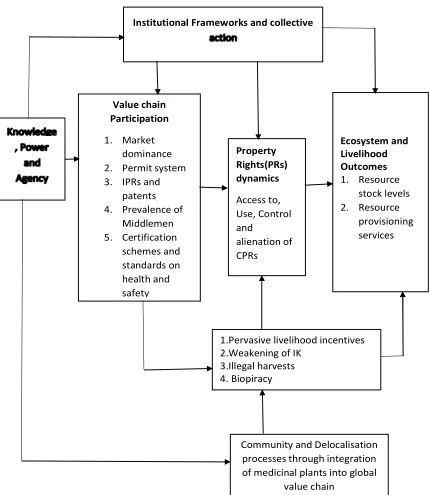
knowledge and agency as analytical and planning lenses. We suggest a conceptual framework(Fig. 3), 542
that can be utilised in assessing ecological impacts from medicinal plant value chains. The framework 543
may be used in the development of responsive policies on CPRs, bioprospection, conservation and 544
Institutional Frameworks and collective
Property Rights(PRs) dynamics
Access to, Use, Control and
alienation of CPRs
Community and Delocalisation processes through integration of medicinal plants into global
value chain
Value chain Participation
1. Market
dominance
2. Permit system
3. IPRs and
patents
4. Prevalence of
Middlemen
5. Certification
schemes and standards on health and safety
Ecosystem and Livelihood Outcomes
1. Resource
stock levels
2. Resource
provisioning services
1.Pervasive livelihood incentives 2.Weakening of IK
3.Illegal harvests 4. Biopiracy
546
Figure 3: Conceptual framework on integration of medicinal plants into Global value Chain
547
and ecological outcomes (Authors’, 2018) 548
7.0 Conclusions and policy implications
549
In this paper , we examined the interaction of power, knowledge and subjectivity on the one hand 550
and the concept of property rights and collective action as institutional frameworks as critical factors 551
that influence ecological outcomes in medicinal plant value chains. The interactions were 552
contextualised through a critical analysis and reference to policy failures associated with 553
exploitation of medicinal plant resources. Environmental vulnerability was conceptualised as a 555
cognitive attribute associated with actions and related conflict between PR systems and 556
noncompliance outcomes arising from delocalisation processes in bioprospection initiatives. We have 557
identified significant linkages between medicinal value chains, power, knowledge, agency, property 558
rights and ecological degradation risks. Though delocalisation of community based resource 559
management systems, such as medicinal plants, offer opportunities for income earning and 560
employment, they are biased in favour of dominant actors in the value chain. Accordingly, 561
commercialisation of medicinal plants undermine locally established values and norms that regulate 562
access to and control of CPRs through creation of pervasive incentives. The pervasive livelihood 563
incentives offered by middlemen in the value chain lead to the overexploitation of medicinal plant 564
resources and ultimately environmental vulnerability to degradation. Increasing demand for 565
medicinal flora, as well as, legal dilemmas, agrotechnological risks and governance challenges, are 566
thus the main drivers for overexploitation and/or extinction of medicinal flora. We conclude that 567
sustainable exploitation and integration of endemic medicinal plants into the global value chain 568
require multipronged strategies, such as, innovative domestication of the Nagoya convention on 569
access and benefit sharing in reducing the risk of biodiversity loss and conflicts in CPRs, 570
documentation and validation of IK. The strategies should be anchored on reflective models that 571
recognise and integrate feedback loops that enhance complementarity and synergy around 572
indigenous property rights, collective action, knowledge, power relations and agency. 573
574
Acknowledgment: The research is part of Post-Doctoral Research Fellowship programme, University
575
of Venda and courtesy of the Department for Higher Education (DHET), Republic of South Africa 576
Declaration of Interest: The authors declare that they have no financial or personal relationships that
577
may have inappropriately influenced them in writing this article 578
Author’s contribution: Dr. Volenzo Tom Elijah was the originator of research idea and conceptual
579
framework and wrote the manuscript, Prof. John Odiyo advised on the organisation, edited and 580
revised the manuscript, Offoro contributed to refining of the conceptual framework. 581
582 583
REFERENCES
584
[1] MEA, “Ecosystems and Human Well-being: A Framework for Assessment,” Island Press, 585
Washington, Covelo and London, Nairobi, 2003. 586
[2] H. R. Ojha, R. Ford, R. J. Keenan, and D. Race, “Delocalizing Communities : Changing Forms 587
of Community Engagement in Natural Resources Governance,” World Dev., vol. 87, pp. 274– 588
290, 2016. 589
[3] C. Folke, S. R. Carpenter, B. Walker, M. Scheffer, T. Chapin, and J. Rockström, “Resilience 590
Thinking : Integrating Resilience , Adaptability and,” Ecol. Soc., vol. 15, no. 4, 2010. 591
[4] S. H. Eriksen, A. J. Nightingale, and H. Eakin, “Reframing adaptation: The political nature of 592
climate change adaptation,” Glob. Environ. Chang., vol. 35, no. 2015, pp. 523–533, 2015. 593
[5] FAO, “Trade in Medicinal Plants,” Rome, Italy, Background papers prepared for Workshop on 594
Medicinal Plants; 22 – 26 July 2004 Bangalore, India., 2004. 595
[6] European Union(EU), directive 2001 / 83 / ec of the european parliament and of the council of 6 596
november 2001 on the community code relating to medicinal products for human use as amended by 597
Directive 2002 / 98 / EC of the European Parliament and of the Council of 27 January, no. November 598
2001. European Union Parliament, 2004, pp. 67–128. 599
[7] World Health Organization, “WHO guidelines on good agricultural and collection practices 600
(GACP) for medicinal plants,” Geneva, Swirtzeland, 2003. 601
[8] R. A. Street and G. Prinsloo, “Commercially important medicinal plants of South Africa: A 602
review,” J. Chem., vol. 2013, 2013. 603
[9] E. P. Rybicki, R. Chikwamba, M. Koch, J. I. Rhodes, and J. H. Groenewald, “Plant-made 604
459, 2012. 606
[10] R. Singh, “Medicinal plants : A review,” J. Plant Sci., vol. 3, no. 1–1, pp. 50–55, 2015. 607
[11] UN comtrade, “Export-Import value of products reported in code HS1211,” Trade Statistics 608
Database reported in code H1211. Department of Economics and Social Affairs, Statistics Division, 609
2018. [Online]. Available: https:/comtrade.un.org/data/. [Accessed: 24-Oct-2018]. 610
[12] K. P. Oli, “Access and benefit sharing from biological resources and associated traditional 611
knowledge in the HKH region -protecting community interests,” Int. J. Biodivers. Conserv., vol. 612
1, no. 5, pp. 105–118, 2009. 613
[13] UN Convention on Biological Diversity, “Access To Genetic Resources and the Fair and 614
Equitable Sharing of Benefits Arising Convention on,” MONTREAL, CANADA, 2011. 615
[14] Department of Environment and Tourism, “South Africa’s National Biodiversity Strategy and 616
Action Plan,” Pretoria, 2005. 617
[15] P. J. Fashing, “Mortality trends in the African cherry (Prunus africana) and the implications for 618
colobus monkeys (Colobus guereza) in Kakamega Forest, Kenya,” Biol. Conserv., vol. 120, no. 4, 619
pp. 449–459, 2004. 620
[16] A. Cunningham, V. F. Anoncho, and T. Sunderland, “Power, policy and the Prunus africana 621
bark trade, 1972-2015,” J. Ethnopharmacol., vol. 178, pp. 323–333, 2016. 622
[17] B. G. Ndawonde, A. M. Zobolo, E. T. Dlamini, and S. J. Siebert, “A survey of plants sold by 623
traders at Zululand muthi markets, with a view to selecting popular plant species for 624
propagation in communal gardens,” African J. Range Forage Sci., vol. 24, no. 2, pp. 103–107, 625
2007. 626
[18] A. Nightingale, “Nature-society and development: Social, cultural and ecological change in 627
Nepal,” Geoforum, vol. 34, no. 4, pp. 525–540, 2003. 628
[19] E. M. Biggs et al., “Sustainable development and the water – energy – food nexus : A 629
perspective on livelihoods,” Environ. Sci. Policy, vol. 54, no. 2015, pp. 389–397, 2015. 630
[20] M. Foucault, Governmentality.In: The Foucault Effects. Studies in Governmentality. Hempstead, 631
London: Harvester Wheatsheaf, 1991. 632
[21] A. J. Nightingale, “Beyond design principles: Subjectivity, emotion, and the (Ir)rational 633
commons,” Soc. Nat. Resour., vol. 24, no. 2, pp. 119–132, 2011. 634
[22] M. Foucault, Discipline and Punish, 2nd ed. New York: Vintage Books, 1995. 635
[23] H. Arendt, Between Past and Future: Eight Exercises in Political Thought. Newyork: Penguin 636
Books, 1993. 637
[24] A. J. Nightingale and H. R. Ojha, “Rethinking Power and Authority: Symbolic Violence and 638
Subjectivity in Nepal’s Terai Forests,” Dev. Change, vol. 44, no. 1, pp. 29–51, 2013. 639
[25] J. C. Ribot, “Vulnerability does not just fall from the sky,” in Social Dimensions of Change in 640
awarming World, 2010. 641
[26] H. Eakin and K. Appendini, “Livelihood change, farming, and managing flood Risk in Lerma 642
Valley, Mexico,” Agric. Human. Values, vol. 25, pp. 555–566, 2008. 643
[27] E. Ostrom, “An institutional approach to the study of self-organization and self- governance in 644
CPR situations:Chapter 2,” in Governing the commons : the evolution of institutions for collective 645
action, Cambridge: Cambridge University Press ©, 1990, pp. 29–57. 646
[28] D. North., “Institutions, Institutional Change, and Economic Performance,” J. Econ. Perspect., 647
vol. 5, no. 1, pp. 97–112, 1991. 648
[29] G. Winter, “Perspectives, Sociology and the Law,” in Multilevel Governance of Global 649
Environmental Change, G. Winter, Ed. Cambridge: Cambridge University Press, 2006, pp. 77–78. 650
[30] D. W. Bromley, Environment and Economy: Property Rights and Public Policy. Blackwell: Basil 651
Blackwell ltd, 1991. 652
[31] E. Schlager, E; Ostrom, “Property-Rights Regimes and Natural Resources : A Conceptual 653
Analysis,” Land Econ., vol. 68, no. 3, pp. 249–262, 1992. 654
[32] F. Berkes, “Marine Inshore Fishery Management,” in conference on Common Property Resource 655