Numerical counterexamples of Lorenz system in implicit time scheme
X. Chen
Numerical Analysis Research Center, GZ 510510, China.
Abstract
In nonlinear self-consistent system, Lorenz system (Lorenz equations) is a classic case with chaos
solutions which are sensitively dependent on the initial conditions. As it is difficult to get the analytical
solution, the numerical methods and qualitative analytical methods are widely used in many studies. In these
papers, Runge-Kutta method is the one most often used to solve these differential equations. However, this
method is still a method based on explicit time scheme, which would be the main reason for the chaotic
solutions to Lorenz system. In this work, numerical experiments based on implicit time scheme and explicit
scheme are setup for comparison, the results show that: in implicit time scheme, the numerical solutions
(counterexamples) are without chaos; for an original volume, the volume shrinks exponentially fast to 0 in
common.
Key words: Lorenz system; implicit time scheme; counterexamples
1.
Introduction
Chaos is one of the most important scientific achievements, and is also very important in modern nonlinear
science. Lorenz [1] got a much simpler and easier-to-analyze system (Lorenz system). Later, numerical solutions of
the Lorenz system and behavior of Lorenz flow are analyzed in many studies [2, 3, 4, 5, 6, 7, 8]; for computing the
numerical methods, the explicit time schemes are widely used; and in numerical methods, Runge-Kutta method is
the widely used. For the numerical solutions of Lorenz system, the solutions sensitively dependent on the initial
conditions are a very important phenomenon, which has an effect on numerical weather prediction [9, 10]. But
most of these numerical solutions are computed on the basis of explicit time schemes and the very less are based on
implicit time schemes.
This paper is organized as follows. In Section 2, we will present a brief introduction to Lorenz system and
numerical scheme applied in this paper. The numerical results are shown in Section 3. Discussion and conclusions
* Corresponding author: Xuan Chen (E-mail: [email protected] or [email protected]).
are presented in Section 4.
2.
Introduction to Lorenz System and numerical scheme
The Lorenz equations are
(
)
X X Y
Y X Y XZ
Z XY Z
σ ρ β = − − = − − = −
,where the parameters σ, ρ, and β are kept constant within integration. The particular parameter values chosen by
Lorenz [1]: σ = 10, ρ = 28, and β = 8/3, which result in chaotic solutions. Although Lorenz system is a much
simpler and easier-to-analyze system, it is very hard to get the analytical solutions as with two nonlinear terms.
However, Gilberto et al. [11] applied an analytical approach to solve the Lorenz system without chaos. The explicit
solution maybe wrong as the solution is also chaotic with the initial conditions
(
−6 2+ −ε, 6 2+ε, 27+ε)
as σ= 10, ρ= 28, β= 8/3, and ε= O(10-20).
On the basis of the qualitative analytical methods and numerical methods, much progress has been made in the
study of Lorenz system. With the qualitative analytical methods, a lot of analytical scheme or exponents are applied
in the geometric morphology analysis (the convergence domains, attractors, et al.), such as Lyapunov exponents,
limit cycle, perturbation theory and so on. In numerical methods, Runge-Kutta method is widely used to solve
Lorenz system.
Taking the Runge-Kutta 4th order method as an example, for an integrand F (F =G F
( )
), on the previouspoint Ft, the next point Ft+1 can be written as:
1 2 3 4
1
2 2
6
t t t t
t t
k k k k
F+ = + ΔF + + +
,
where Δ is time step, and i t
k (i=1, 2, 3, 4) are
( )
(
)
1 1 2 2 3 4 3 , , 2 2 , 2 2 , t t t t t t t tt t t
k G t F
k
k G t F
k
k G t F
k G t F k
= Δ = +Δ + Δ Δ = + + = + Δ + Δ .
(
)
(
)
(
)
1 1
1 1 1 1
1 1 1
1 0
1 0
1 0
t t t
t t t t t
t t t t
X Y X
Y X X Z Y
Z X Y Z
σ σ
ρ β
+ +
+ + + +
+ + +
+ Δ − Δ − =
+ Δ − Δ + Δ − =
+ Δ − Δ − =
. (1)
In numerical experiments in this work, Δ = 0.01s (too small time step may make the implicit solution
transform to the explicit solution, the proof can be found in appendix); and simulation time is 1000s. In implicit
time scheme, equations (1) can be solved by using the Optimization Theory [12].
3.
Numerical results
In this section, the Runge-Kutta 4-5th order method and implicit time scheme are applied in the three groups of
contrastive experiments. The three parameters' values are chosen by Lorenz [1], σ = 10, ρ = 28, and β = 8/3. In
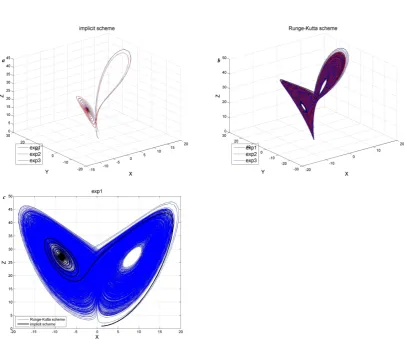
Table 1 we present initial conditions for different groups of contrastive experiments. The phase figures are shown
in Fig. 1, in explicit time scheme, these trajectories tend to circle around the stable equilibrium points but do not
ever repeat the same curve twice.
Fig. 1. Numerical solutions of the Lorenz equations, in (a) and (b), the black line with initial conditions (1.0 ,1.0, 1.0); the red line
(the Runge-Kutta 4-5th order method). (c) Numerical solutions of the first group of contrastive experiment (the black line in implicit
time scheme, the blue line in explicit time scheme.
Table 1. Initial conditions for different groups of contrastive experiments
X(0) Y(0) Z(0)
exp1 1.0 1.0 1.0
exp2 2.0 3.0 4.0
exp3 1.0 1.3 1.0
Figure 1 shows that:
(1) In implicit time scheme, the numerical solution is not sensitive dependence on initial conditions, one of the
main features of a chaotic system;
(2) In implicit time scheme, the trajectory converges to the value (
–
8.4855,–
8.4855, 27.0004), which is the approximation to(
−6 2, 6 2, 27−)
; there are obvious shock exists in the phase Figure by the Runge-Kuttamethod (the explicit time scheme). It is also worth to mention that there are three equilibrium points in Lorenz
system for the classical parameter values: (0, 0, 0),
(
−6 2, 6 2, 27−)
and(
6 2,6 2, 27 .)
In addition, the change curves of each variables (X, Y and Z) are also compared. Here, the change curves of X-t
are shown in Fig. 2.
The change curves of X-t (both two other are similar to the change curve of X-t) shows that: in the first few
seconds, calculating results in both explicit time scheme (the Runge-Kutta 4-5th order method) and implicit time
scheme are similar in all experiments. Later, in implicit time scheme, the value of X converges to –8.485; but, there
are obvious shock exists in the change curve of X-t in explicit time scheme. We can also find that all the change
curves of X-t in implicit time scheme are similar. On the basis of Fig. 2, we can conclude that:
(3) In implicit time scheme, the sensitivity dependence on initial conditions is non-existent.
Here, we defined the error expression representing calculating accuracy of single step calculation as below, in
implicit time scheme
(
)
(
)
(
)
1 1
1 1 1 1
1 1 1
1 1 1
X t t t
Y t t t t t
Z t t t t
err X Y X
err Y X X Z Y
err Z X Y Z
σ σ ρ β + + + + + + + + + = + Δ − Δ − = + Δ − Δ + Δ − = + Δ − Δ − ,
and in explicit time scheme
(
)
(
)
(
)
1 1 1 1 1 1X t t t
Y t t t t t
Z t t t t
err X X Y
err Y Y X X Z
err Z Z X Y
σ σ ρ β + + + = + Δ − − Δ = + Δ − − Δ + Δ = + Δ − − Δ .
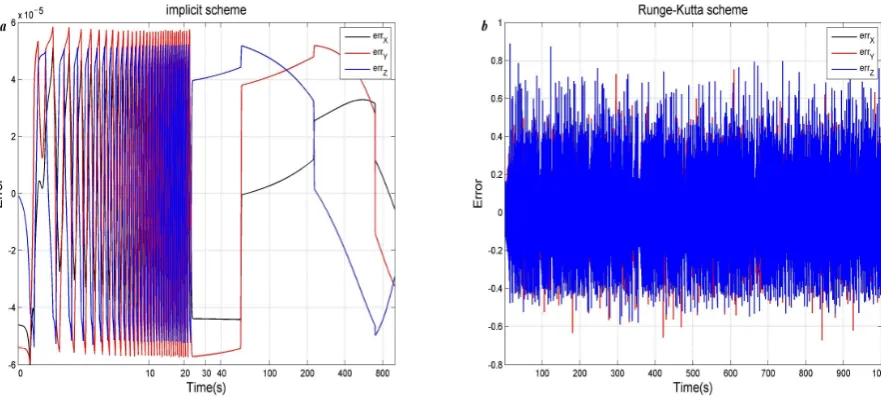
As Runge-Kutta scheme is also an iterative method in single step calculation, the error expression is only for
qualitative reference only, which means that the error is not the real calculating error. But the error expressions in
implicit time scheme are the calculating errors in single step calculation. Both accuracies in each step calculation
with initial conditions (1.0, 1.0, 1.0) are shown in Fig. 3, and the others are similar to Fig. 3.
Figure 3 shows that: in implicit time scheme, in the first about 20 seconds, the error is very complex, but
simple in the later. But there is no special period in the integral process in explicit time scheme. In addition, we can
find that the absolute errors are below O(10–4) in integral process (left part of Fig. 3). By Lax–Richtmyer Theorem,
on the basis of Fig. 3, Eq. (1) can be seen as the approximation to Lorenz system. With analyzing the structure of
Lorenz system, we can find that: no matter what discrete scheme applied in numerical analysis to Lorenz system,
the numerical results do not contain points in the Z-axis.
There are three equilibrium points, all of implicit solutions converge to
(
−6 2, 6 2, 27−)
. But bothequilibrium points
(
−6 2, 6 2, 27−)
and(
6 2,6 2, 27 are symmetrical and similar. So, why all of these)
numerical solutions converge to the equilibrium point
(
−6 2, 6 2, 27−)
is a very interesting problem. For thisproblem, we set up two implicit experiments with initial conditions (100, 178, –311) and (–100, 178, –311); the
numerical solutions of each experiments converge to
(
−6 2, 6 2, 27−)
and(
6 2,6 2, 27 respectively. On the)
basis of these, we indicate that there must be a symmetrical interface (the interface is not a plane, and we take a
special mapping relation of X and Y as this interface), points (initial conditions) on both sides of which with slightly
difference will converge to different equilibrium points. Compared to explicit time scheme (such as Runge-Kutta
method), in implicit time scheme, the sensitivity dependence on initial conditions is non-existent may except points
near the interface.
In Lorenz system, the divergence of the flow
(
1)
X Y Z
X Y Z σ β
∂ +∂ +∂ = − + +
∂ ∂ ∂
.
We define a volume matrix function Fv(t;Xit) (i=0,1,2,3)
(
)
11 22 33 00 00 001 2 3 0 0 0
;
t t t t t t
it t t t t t t
t t t t t t
X X X X X X
Fv t X Y Y Y Y Y Y
Z Z Z Z Z Z
= −
Here i represents different experiments (expi) with different initial conditions, and i=0 means the experiment with
initial conditions (2.0, 2.0, 2.0). The Liouville's Theorem asserts that
( )
d d d D t
X Y Z
V X Y Z
X Y Z
∂ ∂ ∂
= + +
∂ ∂ ∂
,
( )
( )
0 e ( 1) 1 det( )
6 t
V t =V − + +σ β = Fv . (2)
Here, σ β+ + ≈1 13.67. So, the volume converges to the zeros as time increasing, which means most trajectories
will converge to some special points when σ+β+1 > 0. If the numerical solutions with different initial conditions
hold chaotic characteristics, the initial sensitivity may not make V(t) converge to zero. Contrast to explicit solution,
in implicit time scheme, the volume converges to zeros in the experiment (Fig. 4). By analyzing equation (2), with
σ+β+1 > 0, we can find that Lorenz system is a dissipative system. In Fig. 4, we can indicate that the volume
function V(t) in implicit time scheme converges to zero in a very short time about 2 seconds. So, the chaotic
solution may be caused by the numerical scheme in explicit time scheme. In addition, different trajectories cannot
have common intersections, which include equilibrium points, such as the point
(
−6 2, 6 2, 27−)
in this work.Fig. 4. Volumes series. The volumes are calculated by equation (2) with the points on the trajectories at the same time in different
experiments with different initial values: (1.0, 1.0, 1.0), (2.0, 3.0, 4.0), (1.0, 1.3, 1.0), (2.0, 2.0, 2.0).
4.
Discussion and conclusions
In this work, on the basis of two numerical schemes, implicit scheme and explicit scheme (the Runge-Kutta
implicit results. Numerical results show that: different types of numerical methods have an important influence on
numerical solutions of Lorenz system. In implicit time scheme, there is no chaotic solution; compared to explicit
scheme, there are less chaotic characteristics in the phase figures. On the basis of these, we can conclude that
different types of numerical methods have a very important effect on the nonlinear equations' numerical solutions.
Reference
[1] E. N. Lorenz. Deterministic nonperiodic flow. Journal of the Atmospheric Sciences. 20, (1963), 130-141.
[2] D. A. Kaloshin. Search for and Stabilization of Unstable Saddle Cycles in the Lorenz System, Differential
Equations. 11, (2001), 1636–1639.
[3] J. Biazar & Z. Ayati. An Approximation to the Solution of the Brusselator System by Adomian Decomposition
Method and Comparing the Results with Runge-Kutta Method. International Journal of contemporary
Mathematical Sciences. 2, (2007), 983 – 989.
[4] N. Razali & Ahmad R. Rozita. New Fifth-Order Runge-Kutta Methods for Solving Ordinary Differential
Equation. Proceeding of Seminar on Engineering Mathematics. 2, (2008), 155-162.
[5] N. Razali & Ahmad R. Rozita. Ahmad R. Solving Lorenz system by using Runge-Kutta method. European
Journal of Scientific Research. 2, (2009), 241-251.
[6] Zaid M. Odibat, Cyrille Aziz-Alaoui M. A., Bertelle & H. E. Gérard. Duchamp. A multi-step differential
transform method and application to non-chaotic or chaotic systems. Computers and Mathematics with
Applications. 59, (2010), 1462-1472.
[7] S. A. Eftekhari & A. A. Jafari. Numerical simulation of chaotic dynamical systems by the method of
differential quadrature. Scientia Iranica B. 5, (2012), 1299–1315.
[8] Zhang Chengli & Zeng Yun. A Simple Numerical Simulation Method for Lorenz System Families. Applied
Mechanics and Materials. 444-445, (2014), 786-790.
[9] E. N. Lorenz. The predictability of hydrodynamic flow. Transactions of the New York Academy Sciences
Series II. 25, (1963), 409-432.
[10] Eugenia Kalnay. Atmospheric Modeling, Data Assimilation and Predictability. New York: Cambridge
University Press, 2002.
[11] Gilberto González-Parra, Luis Acedo & Abraham J. Arenas. A novel approach to obtain analytical numerical
solutions of nonlinear Lorenz system. Numerical Algorithms, 67, 2014, 93–107.
Athena Scientific, 2003.
[13] Morris W. Hirsch. Smale, Stephen & Devaney, Robert L. Differential equations, dynamical systems, and an
introduction to chaos (Third edition). Singapore: Elsevier (Singapore) Pte Ltd, 2015.
Appendix
Here, we give a proposition that when time step Δ→0, the numerical solution in implicit time scheme are
similar to explicit solution for a linear system.
Proof: For a linear system,
0
t x
F +F = ,
with the confirm boundary conditions, in explicit time scheme, the finite difference equation to this equation can be
written as,
1
j+ = j+ Δ j
F IF AF ,
where subscript j indicates jΔ, A is invertible matrix, and I is identity matrix. In implicit time scheme, this equation
can be written as,
1 1
j+ − Δ j+ = j
IF AF F ,
So, in implicit time scheme, the numerical solution can be written as,
(
)
1 1j j
−
+ = − Δ
F I A F,
With the initial condition F0, both numerical solutions can be written as,
implicit solution:
(
)
0n n
−
= − Δ
F I A F ,
explicit solution:
(
)
0n n = + Δ
F I A F .
As A is invertible matrix, we can write this matrix as,
=
A UΛV,
where UV=I, Λ is diagonal matrix and as we known, Λij=0 as i≠j. So, both solutions can be written as,
(
)
(
)
0 0 n n n n − = − Δ = + Δ F U I Λ VF
F U I Λ VF
,
For the I–ΔΛ, the invertible matrix is
(
)
−1 1− Δ = =
− Δ
I Λ D
where Dii = (1 – ΔΛii) –1, and Dij=0 as i≠j. When the time step Δ→0, this matrix can be written as,
( )
21
ii ≈ + Δ +ii O Δ
D Λ ,
This matrix is I+ΔΛ; the implicit solution can be approximately written as,
(
)
( )
2(
)
10 0 ...
n n
n nO
−
= + Δ + Δ + Δ +
F U I Λ VF U I Λ VF
We can find that the first right term is the explicit solution, as time step Δ→0, we can neglect the high order terms,