Skills Based Learning Environments: Semantic
Annotation with Mapping Method
R.AnishDhanalakshmi Srinivasan College of Engineering and Technology Mamallapuram, Chennai, Tamilnadu, India
Abstract—A ubiquitous learning environment provides an interoperable, pervasive, and seamless learning architecture to connect, integrate, and share three major dimensions of learning resources such as learning collaborators, learning contents, and learning services. Ubiquitous learning is characterized for identifying right learning collaborators, right learning contents and right learning services in the right place at the right time. As a result, it promotes the acquisition of practical skills as well as decision making, communication, and problem solving with help of Skills-based learning environments. These environments are a significant to give feedback about the students from the practically conducted sessions and observations of students’ actions can notify to the estimation of their quality process. And also, those learning environments are helping to the researchers for better understand the learning process. The proposed system examined the utilization of semantic annotation in the recording of those types of simulated learning environments. Also, achieve the better student feedback as well as improve the understanding of learning environments, we proposed a new mechanism such as semantic based approach (An Domain based Ontology with various annotation methods and their combinations) is used.
Keywords—Learning environment, Decision Making, Sessions, Semantic, Ontology.
I.INTRODUCTION
This project presents a series of prototype demonstrators that have looked to evaluate the use of semantic annotation as part of a skills-based learning environment to better understand how students learn. Simulations are used to promote the acquisition of practical skills as well as decision making, team working, communication, and problem solving. They can be incorporated into assessment of student performance, which brings a requirement that the approaches for assessment and feedback need to be sound, valid, reliable, feasible, educational, and of course acceptable to practitioners.
Through the simulation, the student experiences are designed to be exactly as they would experience in the workplace in real time. The University of Southampton has such a clinical skills laboratory. The laboratory mimics the reality of ward life in both its behaviors and resources, equipment, clinical charts, wall displays, and phones. The ward is equipped with computerized and interactive SimMan1 mannequins, non-computerized mannequins, and a range of equipment that are purposively arranged to provide clinical activities for the students.
These activities provoke the students to move themselves and equipment around the ward, to interact with each other and the supervising staff members, and to use the telephone. This also means that not only is concurrent activity taking
place in different parts of the ward but there is plenty of background noise and movement. The cameras are remotely controlled from an adjacent room, where teaching staff can monitor the students through the audio/video streams and direct proceedings without interrupting the ongoing simulation. In this case, the key issues were 1) the access of patient related material to the research team; 2) the collection, storage, and dissemination of staff and student data that could not be anonymized. The students and staff members willingly participated and contributed to the debriefing session of the trials with suggestions for improvement and an outline of their experiences. Previous findings have shown that being filmed as part of an assessment activity of this type does not significantly modify student behavior any more than having assessors physically present in the room. Audio and video together present a highly detailed capture of an activity; perhaps too detailed, because reviewing a recording can be as time consuming as the original activity. Similarly, annotating a video by hand can be an intensive and laborious process and often involves reviewing the entire digital record. One approach is to make annotations “live,” during the teaching session, although this is unlikely to be a comprehensive record of events and precludes the full engagement in the activity itself. Ubiquitous computing technologies and techniques provide us with an additional mechanism to capture annotations on events that take place in the clinical skills laboratory and from sources that have a low impact and overhead on the participants. Annotations are at their simplest, just metadata, but by harvesting annotations with meaning, defined by ontologies— semantic annotations— we aim to fuse metadata sources together. By combining both automatic annotations gathering with manual annotation techniques, we aim to provide much richer data sets to help shed new light on how and why students are learning. This could lead to improved assessment of student learning, facilities for student self-reflection, and further research into understanding student learning in skills-based environments.
II. RELATED WORK
“Semantic Smart Laboratory” work [8] uses RDF from the very first stage of capturing the activities of chemists working in a laboratory, as well as a sensor network to capture laboratory environmental conditions. This is used to establish a complete provenance trail through to scholarly output, enabling researchers to chase back to the original data.The Task Computing project at Fujitsu Labs America [9] applies Semantic Web technologies (RDF, OWL, DAML-S) and Web Services (SOAP, WSDL) to pervasive computing, aiming to “fill the gaps between tasks and services.” Users see the tasks that are possible in their current context and are assisted in creating complex tasks from simpler tasks, which can then be reused. The agents research community has also applied ontologies in the pervasive area, such as the FIPA Device Ontology specification (see http://www.fipa.org) which enables agents to pass profiles of devices. The Standard Ontology for Ubiquitous and Pervasive Applications (SOUPA) [10] is a comprehensive example of an ontology. It includes vocabularies to represent intelligent agents with associated beliefs, desires, and intentions, time, space, actions and events, user profiles, actions, and policies for security and privacy. In our context, one can envisage agents which work with the accumulating knowledge—perhaps automating elements of assessment or flagging errors as they occur. Many spatial annotation efforts are emerging. For example, accumulation of annotations in a spatial region is the basis of the OpenGuides “WIKI” city guides (http://openguides.org). The Basic Geo vocabulary is used in Locative Packets for spatial annotation (locative.net). The Open Geospatial Consortium (OGC) pursues standards for geospatial and location-based services (http://www.opengeospatial.org). Although location is at a much coarser granularity than in our work, some of the underlying principles are transferable. Hypermedia links are another way of expressing associations between things, and the hypermedia research community has a long history of working with these associations as “first class citizens,” as they will be in our ontology. This was originally achieved using, for example, XML and XLink technology, but now increasingly uses RDF. Recent work on digital-physical linking illustrates the extension of these ideas into the physical world [1]. Work on authoring and design for ubiquitous systems tends to have concentrated on the system designer, with the assumption that they would also be deploying and maintaining the system. Work, such as the iStuff framework, provide an interface for connecting and orchestrating devices in a ubiquitous system [di2]. The Urban Tapestries project looked at the idea of public authoring [3], where members of the public could create locations in an ubiquitous system by uploading GPS co-ordinates, and then attach media items such as notes or photos, either in-situ using a PDA or at a later point on a web site. In this way, Urban Tapestries hands some of the design to the users, and allowing nontechnical people to create a ubiquitous experience. Similarly, M-studio allows users to create an experience by authoring content [4], delivering video content to PDAs according to their location. A graphical authoring tool allows authors to place video content at locations, but also supports storyboarding and simulated located playback, so authors can check the
effect of movement on their narratives. Topiary is a rapid prototyping system that uses a high level of abstraction (people and places, rather than sensors and devices). Topiary allows authors to storyboard, situate,and simulate information placed into a geographic environment on a map [5]. Topiary also supports automatic pathfinding and more advanced trigger conditions based on user and place (such as user1 and/or user2 are near, etc.).Such spatial triggers are echoed in the spatial inference we will discuss later. The eDiary [6] allowed architecture students to record their path during a site visit using a handheld device which would map photos and notes to a map of the site. Later on this could be edited on a PC and the path calibrated to the map. Nodes of the path, representing locations where notes had been taken, could be moved or expanded. The annotated map then was used in multimedia presentations on the site visit. This two-phase approach of bookmark annotations with subsequent refinement is something that has emerged from our findings. There are numerous video annotation systems, two of which we would note. The DIVER system [7] allows users to attach textual annotations segments of video with a view to fostering collaboration. The LORAMS framework [8] notes the time consuming nature of such manual textual annotation and seeks to mitigate against this through the use of simple RFID markers with which users can perform searches on an annotated video set. Other work has focussed on automatically identifying events within video streams [9]. Initial uses of skills-based learning environments innursing education have traditionally been very task specific, for example managing a cardiac arrest [2], or performing a specific intervention, for example giving an injection [1]. These simulations are generally short and easily objectively marked according to a defined set of criteria, “You do this, in this order.” It is also of note, however, that many educational institutions have invested in facilities in simulated environments and use video for a variety of educational purposes. For example, the analysis and assessment of student performance and or competence, the analysis of events [2] or processes [3], and Objective Structured Video Examination [4].
III.SEMANTIC ANNOTATION
has evolved [26]. Part of the added value of the Semantic Web approach is the “network effect” that can be achieved by having metadata accumulate about the same things— those things then effectively interlink different pieces of knowledge, forming rich structures. For example, information about relationships between people (friend-of-a-friend, coauthorship, etc.) accumulates on those people to describe communities of practice. Similar effects are achieved when the metadata describes regions in time or in space, and there are RDF vocabularies (such as the Basic geo vocabulary, http://www.w3.org/2003/01/geo) for spatially located things. One of the important roles for RDF in pervasive computing, together with the associated Web Ontology Language (OWL) which is used to describe shared vocabularies, is in describing context [7]. A variety of notions of context may be expressed, including location and user tasks [8]. Ontologies can also be used to describe device capabilities, for example to facilitate content delivery to devices with diverse characteristics [9]. So what do we mean by semantic annotation? This work builds on earlier work which looked at adding hyperstructure to video collaborations [8], [9]. Mechanisms for capturing annotations from the skills-based sessions have been developed by combining Semantic Web technologies and techniques previously applied to enhanced field trips for children [2]. These annotations can be attached to people, as in FOAF (friend of a friend networks) [3],nphysical objects [10], or tasks [9]. Annotations describing an activity space can then be used to generate an index into the video structure through which the detail-rich record can be more effectively used. The uptake of Semantic Web technologies in education has been slow, with the main uses being in the creation of well-formed metadata for repositories [4]. Web 2.0 systems have also enabled lightweight knowledge modeling approaches (typically folksonomies) based around techniques such as community tagging, clustering, and community authoring [5].
Fig.1 Text Annotation
The coming together of Web 2.0 technologies and semantic technologies are proposed as an inevitable development of existing technologies [6]. More simplistic keyword tagging approaches could be used such as those employed by Flickr (http://www.flickr.com) and del.icio.us (http://del.icio.us), however, these WEAL ET AL.: SEMANTIC ANNOTATION OF UBIQUITOUS LEARNING ENVIRONMENTS 145 benefit from scale and we felt that
lightweight ontologies may give us the following advantages:
Well-formed metadata providing consistency in the data.
This makes for easier comparison across data sets as
equivalence can be established more easily. The formal description allows for the relationships
between concepts to be mapped out more easily than with a looser, keyword-based tagging system. Lightweight annotations made real time can then
become more complex afterward as more detail is added or they are combined.
Data can be exported and shared with a guaranteed shared vocabulary. Interoperability is one of the cornerstones of the Semantic Web and allows researchers to more easily share data and provide machine readable versions for software agents. The Semantic Web-based annotations provide an
underlying data sets that allow for rule-based analysis or complex inferences (such as those supported by the JENA framework [37])..
IV. SYMBOL ANNOTATION
Symbols can be used to express any specific function in the learning materials. Symbol annotation will be done with text annotation. An annotation feature class contains a collection of one or more text symbols held in a symbol collection that you define as part of the process of defining your annotation feature class. Every time you create a new annotation feature, you assign it one of the predefined symbols that is in your symbol collection. When you create your annotation feature class, you will provide a default text symbol. Once the annotation feature class has been created, you can create additional text symbols as part of the feature class's symbol collection at any time. Each text symbol in the collection contains properties that describe how the annotation feature is drawn, such as font, size, and color. For example, if you have annotation for small, medium, and large cities, create three text symbols of varying font sizes to assign to the annotation.
V.EDUCATOR REFLECTION ACROSS ACTIVITIES
noticing when they observe students carrying out these activities. Our approach to attempt to provide answers to some of these questions is through the use of manually authored and automatically generated semantic annotations
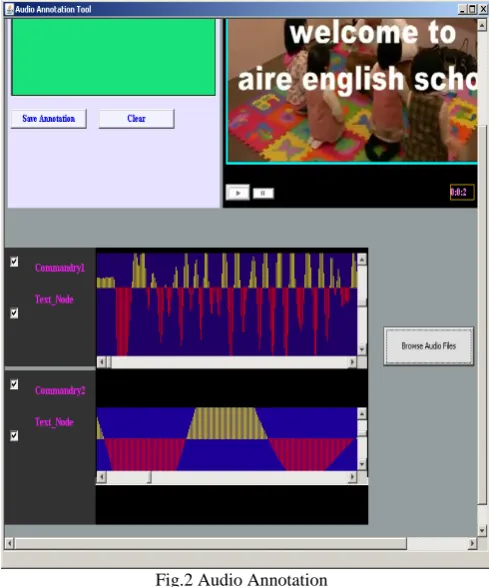
Fig.2 Audio Annotation
VI .THE DEVELOPMENT OF AN ONTOLOGY
A number of ontologies underpin these demonstrators. A system ontology was constructed that contains all the entities describing the videos, sessions, and participants. Fig. 3 shows the session entity and how this links the various videos of the session, the students, instructors, and objects of interest. Fig. 4 shows the annotation entity in the ontology and how it connects annotations to the video(s) that it annotates, the author of the annotation and the session in which the annotation occurs.
Fig. 3. The system ontology session entity.
For the creation of specific annotations, a domain ontology was developed to contain the domain specific annotation information. This allowed the underlying video annotation framework to be independent of the specific context of annotation. The nursing domain ontology was developed through a series of workshops, observational sessions, and discussion groups.
Fig. 4. The annotation entity.
VII.CONCLUSION
The proposed work demonstrated that analysis of simulation environment activities offers huge potential once the appropriate techniques and tools have been more fully developed and tested. Opening usability evaluation of our systems suggests that practitioners find such annotation tools usable and can see benefits in the data that they produce. The outcomes of such work could offer insights into new and better ways of working; tools to train and educate staff to be more effective and self-reflective; strategies and tools to measure, collect, and analyze different data streams; and modeling of clinical environments to better reflect the activities within the environments. The system could also be used by students in the longer term by allowing the students to make annotations of their activities during their placements. The reuse of the ontology would provide a link between their placement and the knowledge acquired in the university learning environment. Parallel work that considered the potential of video analysis in the assessment of student performance indicates that an annotation facility could help realize effective formative and assessment strategies. The proposed work believes annotations derived from the location data to be a useful bridge between observational text annotations\ and the full video record of the session.
REFERENCES
[1] M. Gobbi, E. Monger, G. Watkinson, A. Spencer, M. Weaver, J. Lathlean, and S. Bryant, “Virtual Interactive Practice: A Strategy to Enhance Learning and Competence in Health Care Students,” Proc. Medinfo, pp. 874-878, 2004.
[2] M. Seropian, K. Brown, J.S. Gavilanes, and B. Driggers, “Simulation: Not Just a Manikin,” J. Nursing Education, vol. 43, no. 4, pp. 164-169, 2004.
[3] R. Hays, H. Davies, J. Beard, L. Caldon, E. Famer, and P. Fincane, “Selecting Performance Assessment Methods for Experienced Physicians,” Medical Education, vol. 36, pp. 910-917, 2002.
[4] T. Blackburn and C. Sadler, “The Role of Human Simulators in Health-Care Training,” British J. Hospital Medicine, vol. 64, no. 11, pp. 677-681, 2004.
[5] T. D. of Health, “Delivery 21st Century IT Support for the NHS: National Strategic Programme,” technical report, The Stationary Office, June 2002.
[6] M. Gobbi and E. Monger, “Using Web Based Multimedia, Simulated and Virtual Practice to Assess Students Professional Practice Skills,” technical report, HEA, 2008.
[7] M. Hatala, R. Wakkary, and L. Kalantari, “Rules and Ontologies in Support of Real-Time Ubiquitous Application,” J. Web Semantics: Science, Services and Agents on the World Wide Web, vol. 3, pp. 5-22, 2005.
[8] G. Hughes, H. Mills, D. De Roure, J. Frey, L. Moreau, M.C. schraefel, G. Smith, and E. Zaluska, “The Semantic Smart Laboratory: A System for Supporting the Chemical Escientist,” Organic and Biomolecular Chemistry, vol. 2, pp. 1-10, 2004.
[9] R. Masuoka, B. Parsia, and Y. Labrou, “Task Computing—The Semantic Web Meets Pervasive Computing,” Proc. Second Int’l Semantic Web Conf., pp. 866-881, Oct. 2003.