DIS structure functions in the NLO approximation of the Parton
Reggeization Approach
MaximNefedov1,and VladimirSaleev1,
1Samara National Research University, Moskovskoe Shosse, 34, 443086, Samara, Russia
Abstract.The main ideas of the NLO calculations in Parton Reggeization Approach are illustrated on the example of the simplest NLO subprocess, which contributes to DIS: γ+R → q+q¯. The double counting with the LO contribution γ+Q → qis
re-solved. The problem of matching of the NLO results for single-scale observables in PRA on the corresponding NLO results in Collinear Parton Model is considered. In the devel-oped framework, the usual NLO PDFs in theMS-scheme can be consistently used as the collinear input for the NLO calculation in PRA.
1 Introduction
Multiscale and correlational observables, related with the hard processes in the hadronic or lepton-hadronic collisions, still present a challenge for the state-of-the-art calculational methods in perturba-tive QCD. By such observables we mean, for example, angular correlations of pairs of vector bosons, jets or reconstructed hadrons, or observables related with the polarization of virtual photon/Z-boson
in the Drell-Yan process. All these observables are highly sencitive to QCD radiation over wide range of scales – from soft and collinear to the hard emissions with transverse momenta of the order of the hard scale. Parton showers (PS) are most accurate in modelling of the soft and collinear emissions, while fixed-order calculations in QCD demonstrate good convergence only for single-scale quantities. The aim of the Parton Reggeization Approach (PRA) is to improve our understanding of the transition between soft/collinear and hard regimes, using the information from the Multi-Regge limit of
scatter-ing amplitudes in QCD, and thus to reduce the gap between fixed-order and PS Monte-Carlo (MC) techniques.
In the present contribution we continue the development of formalism of the Next-to-Leading Order (NLO) calculations in PRA, concentrating on the classic example ofsingle-scaleobservable:
F2(xB,Q2)-structure function of the electron-proton Deep Inelastic Scattering (DIS). For the
single-scale observables, the NLO results of PRA should be consistent with the corresponding NLO results in the Collinear Parton Model (CPM). We exploit this relation to fix the formalism of NLO calculations in PRA in such a way, that the Parton Distribution Functions (PDFs) from NLO global fits, which are conventionally defined in theMS-scheme, can be used as an input to the NLO calculations in PRA.
The discussion of loop corrections in PRA has been started by us in the Ref. [1]. In the present contribution we concentrate exclusively on tree-level corrections, and issues related with the double-counting and scheme-dependence of PDFs. The present paper has the following structure. In the
P ր
qց k1→
p1↑
k2→
q1↑
+ +
− −
+ +
− −
qց
q1↑
k1→
qt↑ k2→ +
+ +
2
−
+
−
+
2
−
+
−
+
2
(a) (b)
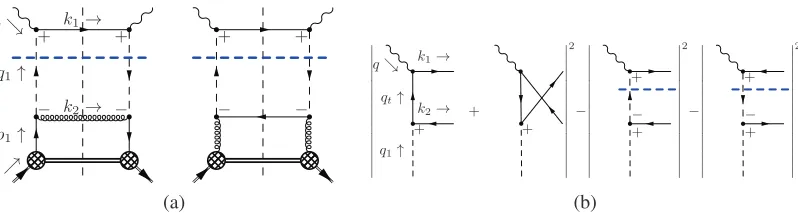
Figure 1. Panel (a): contributions to the DIS structure functions in the LO of PRA. Panel (b): Contribution γ+R→q+q¯and double-counting subtraction terms. The horizontal thick dashed line denotes the
mMRK-approximation, i.e. the “small”q−
1 andq−t light-cone components oft-channel momenta do not propagate to the
upper part of the graph.
Sec. 2 the LO-formalism of PRA is reviewed and the main ideas beyond the NLO calcualtions in PRA are formulated. In the Sec. 3 the firstO(αs) contribution, which comes from the dependence of
the LO hard-scattering coefficient (HSC) in PRA on the transverse momentum of initial-state parton is
isolated. In the Sec. 4 the contribution of the NLO subprocessγ+R→q+q¯and the corresponding
double-counting subtraction is introduced. Finally, in the Sec. 5 the formulated scheme of NLO calculations is tested numerically.
2 DIS at LO and NLO framework in PRA
We will consider the process of lepton-proton DIS, which is traditionally described as a process of desintegration of the proton with the four-momentumPµ(we put P2 = 0, since Ep Mp) by the
virtual photon with the four-momentumqµ (q2 = −Q2 < 0). We will work in the center-of-mass
frame of the proton and virtual photon, where the Sudakov(light-cone) components1of momentum of
the photon are:
q+=−x
BP+, q−= Q
2
xBP+, qT =0,
wherexB=Q2/(2qP) is the usual Bjorken variable. Inclusive DIS is fully described by the hadronic tensor, with the following standard parametrization in terms of structure functions [2, 3]:
Wµν =
−gµν+
qµqν
q2
F1(xB,Q2)+
Pµ−
qµ(Pq)
q2 Pν−qν(Pq)
q2
F2(xB,Q2)
(Pq) , (1)
where the functionF1 is related with the commonly used structure functionFL(xB,Q2) as follows:
F1 =(F2−FL)/(2xB).
In the CPM, the hadronic tensor is represented as a convolution of the partonic tensor of hard inter-action of the virtual photon with the partonic target and the PDFfi(x, µ2). To derive the factorization
formula of PRA for DIS, we will start with the specific NLO CPM hard subprocesses:
γ(q)+q(p
1)→q(k1)+g(k2), (2)
γ(q)+g(p1)→q(k1)+q¯(k2). (3)
1We use the following Sudakov decomposition for the four-momentumk: kµ =(nµ
+k−+nµ−k+)/2+kTµ,nµ± =(n±)µ =
(1,0,0,∓1)µ,n
P ր
qց k1→
p1↑
k2→
q1↑
+ + − − + + − − qց
q1↑
k1→
qt↑ k2→ + + + 2 − + − + 2 − + − + 2 (a) (b)
Figure 1. Panel (a): contributions to the DIS structure functions in the LO of PRA. Panel (b): Contribution γ+R→q+q¯and double-counting subtraction terms. The horizontal thick dashed line denotes the
mMRK-approximation, i.e. the “small”q−
1 andq−t light-cone components oft-channel momenta do not propagate to the
upper part of the graph.
Sec. 2 the LO-formalism of PRA is reviewed and the main ideas beyond the NLO calcualtions in PRA are formulated. In the Sec. 3 the firstO(αs) contribution, which comes from the dependence of
the LO hard-scattering coefficient (HSC) in PRA on the transverse momentum of initial-state parton is
isolated. In the Sec. 4 the contribution of the NLO subprocessγ+R→q+q¯and the corresponding
double-counting subtraction is introduced. Finally, in the Sec. 5 the formulated scheme of NLO calculations is tested numerically.
2 DIS at LO and NLO framework in PRA
We will consider the process of lepton-proton DIS, which is traditionally described as a process of desintegration of the proton with the four-momentumPµ(we put P2 =0, since Ep Mp) by the
virtual photon with the four-momentumqµ (q2 = −Q2 < 0). We will work in the center-of-mass
frame of the proton and virtual photon, where the Sudakov(light-cone) components1of momentum of
the photon are:
q+=−x
BP+, q−= Q
2
xBP+, qT =0,
wherexB =Q2/(2qP) is the usual Bjorken variable. Inclusive DIS is fully described by the hadronic tensor, with the following standard parametrization in terms of structure functions [2, 3]:
Wµν =
−gµν+
qµqν
q2
F1(xB,Q2)+
Pµ−
qµ(Pq)
q2 Pν−qν(Pq)
q2
F2(xB,Q2)
(Pq) , (1)
where the functionF1 is related with the commonly used structure functionFL(xB,Q2) as follows:
F1=(F2−FL)/(2xB).
In the CPM, the hadronic tensor is represented as a convolution of the partonic tensor of hard inter-action of the virtual photon with the partonic target and the PDF fi(x, µ2). To derive the factorization
formula of PRA for DIS, we will start with the specific NLO CPM hard subprocesses:
γ(q)+q(p
1)→q(k1)+g(k2), (2)
γ(q)+g(p1)→q(k1)+q¯(k2). (3)
1We use the following Sudakov decomposition for the four-momentumk: kµ = (nµ
+k−+nµ−k+)/2+kµT,nµ± =(n±)µ =
(1,0,0,∓1)µ,n
±kT=0,k±=k±=(n±k), so thatk2=k+k−−k2T,P+0 andP−=0.
Following the general scheme of LO PRA calculations, which is described in more detail in the Refs. [4, 5], we write down the modified MRK (mMRK) approximation for the partonic tensor of processes (2) and (3):
ˆ
wµνq/g= 2g 2
s
(−q2 1)
Pq(q/g)(˜z)
˜
z wˆ
µν
LO, (4)
whereq1 = p1−k2,gs = √4παsis the coupling contant of strong interaction, ˜z =q+1/p+1,Pq(q/g)(z)
denotes the (non-regularized) DGLAP splitting functions: Pqq(z) = CF(1+z2)/(1−z) orPqg(z) =
TR
z2+(1−z)2for process (2) and (3) respectively, C
F = (Nc2 −1)/(2Nc), TR = 1/2, Nc = 3,
and ˆwµνLOis the LO partonic tensor in PRA. The diagrammatic representation of Eq. (4) is given in the Fig. 1(a). The dashed lines (dashed lines with arrow) in the Fig. 1 denote Reggeized gluons(R) (quarks –Q). By definition of the mMRK-approximation, theq−
1 light-cone component of the momentumq1
does not propagate to theγQq-scattering vertex, so that the LO partonic tensor is given by the hard subprocessγ(q)+Q(˜q
1)→q(k1), where ˜qµ1=q+1nµ−/2+qµT1. The partonic tensor of this subprocess
reads:
ˆ
wµνLO= e 2
q
2 tr
ˆ
k1Γµ(˜q1,q) q+
1
2 nˆ−
Γν(˜q1,q)
, (5)
whereΓµ(q1,k) = γµ+qˆ
1(nµ−)/k− is the gauge-invariant effective vertex ofγQq-interaction
(Fadin-Sherman vertex [6, 7]), andeqis the electric charge of the quark in units of the electron charge.
Substituting the results (4) and (5) to the factorization formula of the CPM and projecting-out the
F2structure function, one can rewrite the structure function in thekT-factorized form:
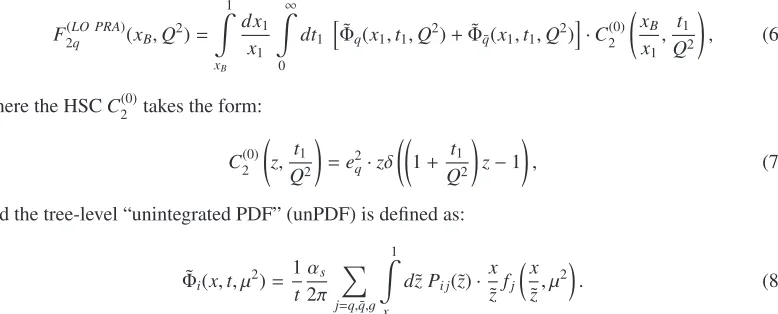
F(2LO PRAq )(xB,Q2)=
1 xB dx1 x1 ∞ 0
dt1 Φ˜q(x1,t1,Q2)+Φ˜q¯(x1,t1,Q2)·C2(0)
xB
x1, t1 Q2
, (6)
where the HSCC(0)2 takes the form:
C(0)2
z, t1
Q2
=e2q·zδ
1+ t1 Q2
z−1
, (7)
and the tree-level “unintegrated PDF” (unPDF) is defined as:
˜
Φi(x,t, µ2)=1
t
αs
2π
j=q,q¯,g
1
x
dz P˜ i j(˜z)· x
˜
zfj x
˜
z, µ2
. (8)
TheFLstructure function is equal to zero in the LO of PRA, due to the properties of the
Fadin-Sherman vertex.
Integration overt1 in the Eq. (6) with “unPDF” (8) is logarithmically divergent att1 → 0 and at
˜
z→1 (for the case of diagonal splitting fuctions). The latter divergence is regularized in PRA by the following cutoffon ˜z-variable:
˜
z<1−∆KMR(t, µ2), (9)
where the Kimber-Martin-Ryskin [8] cutofffunction∆KMR(t, µ2) = √t/(µ2+ √t) is given by the
condition of ordering in rapidity between the particles produced in the hard process and the parton emitted on the last step of the ISR parton cascade in the kinematics ofpp-collisions2.
2In the case of DIS, the rapidity ordering leads to the weaker condition on ˜z: ˜z<1−t1/(Q2+2t1), but we will keep KMR
Collinear divergence att1 → 0 in (8) is regularized by the introduction of Sudakov formfactor,
which resums the doubly-logarithmic corrections∼log2(t
1/µ2) in LLA, analogously to the treatment
of this divergence in standard PS algorithms [9]. The exact expression of this formfactor is dictated by the DGLAP evolution for PDFs fi(x, µ2) and the following normalization condition for unPDFs:
µ2
0
dtΦi(x,t, µ2)=x fi(x, µ2), (10)
which, as it will be explained in the Sec. 3, is equivelent to the normalization of single-scale observ-ables on the corresponding LO CPM results up to NLO terms inαsand power-supressed corrections.
Condition (10) is obviously fulfilled by the followingderivative formof unPDF:
Φi(x,t, µ2)= ∂ ∂t
Ti(t, µ2,x)·x fi(x,t), (11)
whereTiis the Sudakov formfactor with the boundary conditions3Ti(0, µ2,x)=0 andTi(µ2, µ2,x)=
1. Eq. 11 can be shown to coincide exactly with the followingintegral formof unPDF:
Φi(x,t, µ2)=Ti(t, µ
2,x) t
αs(t)
2π
j=q,q¯,g
1
x
dz P˜ i j(˜z)·xz˜fj
x
˜
z,t
·Θ(˜z,t, µ2), (12)
whereΘ(˜z,t, µ2)=θ1−∆KMR(t, µ2)−z˜
, and the Sudakov formfactor is given by:
Ti(t, µ2,x)=exp
−
µ2
t dt
t
αs(t)
2π (τi+ ∆τi)
, τi= j
1
0
dz˜Θ(˜z,t, µ2)·zP˜ ji(˜z),
∆τi= j
1
0
d˜z 1−Θ(˜z,t, µ2)·zP˜ ji(˜z)− x ˜ zfj(xz˜,t)
x fi(x,t) Pi j(˜z)·θ(˜z−x)
. (13)
The integral form of unPDF (12) reproduces Eq. 8 whent∼µ2, in this way it is connected with
the derivation of factorization formula (6). Another important property of the Eqns. 12 – 13 is that they are equivalent to Eq. 11 in any order inαsfor the evolution kernelsPi j(z) if the PDFs fi(x, µ2)
are defined in the corresponding subtraction scheme, e. g. both in theMS-scheme.
The LO framework of PRA has been formulated above, on the example of DIS process. Exten-sion to the NLO would require the definition of subtraction scheme for double counting andrapidity divergences(see Ref. [1]) in the real and virtual NLO corrections to the HSC, as well as the defini-tion of NLO unPDFs. As the main guidance to resolve all these issues we will employ thephysical normalization condition(PNC), which simply states, that for a given set of collinear PDFs, defined in theMS scheme, the NLO PRA calculation of any single-scale observable with the scaleQ2should
reproduce the corresponding NLO CPM result up to corrections, which are formally of higher order in
αs(Q2) or supressed by the negative power ofQ2. Validity of this condition in QCD is guaranteed by
the standard collinear factorization theorems [3]. To formulate PNC, we coose thestructure-function of DIS on a specified quark flavor–F2q(xB,Q2) as a benchmark single-scale gauge-invariant quantity,
3The first boundary condition is actually nonperturbative and introduced only to simplify the presentation of the analytic
arguments. In our numerical calculations, the unPDFt·Φi(x,t, µ2) is defined by quadratic polynomial fort<Q2
0 =1 GeV2,
Collinear divergence att1 → 0 in (8) is regularized by the introduction of Sudakov formfactor,
which resums the doubly-logarithmic corrections∼log2(t
1/µ2) in LLA, analogously to the treatment
of this divergence in standard PS algorithms [9]. The exact expression of this formfactor is dictated by the DGLAP evolution for PDFs fi(x, µ2) and the following normalization condition for unPDFs:
µ2
0
dtΦi(x,t, µ2)=x fi(x, µ2), (10)
which, as it will be explained in the Sec. 3, is equivelent to the normalization of single-scale observ-ables on the corresponding LO CPM results up to NLO terms inαsand power-supressed corrections.
Condition (10) is obviously fulfilled by the followingderivative formof unPDF:
Φi(x,t, µ2)= ∂ ∂t
Ti(t, µ2,x)·x fi(x,t), (11)
whereTiis the Sudakov formfactor with the boundary conditions3Ti(0, µ2,x)=0 andTi(µ2, µ2,x)=
1. Eq. 11 can be shown to coincide exactly with the followingintegral formof unPDF:
Φi(x,t, µ2)=Ti(t, µ
2,x) t
αs(t)
2π
j=q,q¯,g
1
x
d˜z Pi j(˜z)· x˜zfj
x
˜
z,t
·Θ(˜z,t, µ2), (12)
whereΘ(˜z,t, µ2)=θ1−∆KMR(t, µ2)−z˜
, and the Sudakov formfactor is given by:
Ti(t, µ2,x)=exp
−
µ2
t dt
t
αs(t)
2π (τi+ ∆τi)
, τi= j
1
0
d˜zΘ(˜z,t, µ2)·zP˜ ji(˜z),
∆τi= j
1
0
d˜z 1−Θ(˜z,t, µ2)·zP˜ ji(˜z)− x ˜ zfj(x˜z,t)
x fi(x,t) Pi j(˜z)·θ(˜z−x)
. (13)
The integral form of unPDF (12) reproduces Eq. 8 whent ∼µ2, in this way it is connected with
the derivation of factorization formula (6). Another important property of the Eqns. 12 – 13 is that they are equivalent to Eq. 11 in any order inαsfor the evolution kernelsPi j(z) if the PDFs fi(x, µ2)
are defined in the corresponding subtraction scheme, e. g. both in theMS-scheme.
The LO framework of PRA has been formulated above, on the example of DIS process. Exten-sion to the NLO would require the definition of subtraction scheme for double counting andrapidity divergences(see Ref. [1]) in the real and virtual NLO corrections to the HSC, as well as the defini-tion of NLO unPDFs. As the main guidance to resolve all these issues we will employ thephysical normalization condition(PNC), which simply states, that for a given set of collinear PDFs, defined in theMSscheme, the NLO PRA calculation of any single-scale observable with the scaleQ2should
reproduce the corresponding NLO CPM result up to corrections, which are formally of higher order in
αs(Q2) or supressed by the negative power ofQ2. Validity of this condition in QCD is guaranteed by
the standard collinear factorization theorems [3]. To formulate PNC, we coose thestructure-function of DIS on a specified quark flavor–F2q(xB,Q2) as a benchmark single-scale gauge-invariant quantity,
3The first boundary condition is actually nonperturbative and introduced only to simplify the presentation of the analytic
arguments. In our numerical calculations, the unPDFt·Φi(x,t, µ2) is defined by quadratic polynomial fort<Q2
0=1 GeV2,
which is adjusted to ensure continuity and the validity of Eq. 10. Other nonperturbative definitions are also possible.
which is well-defined in any order of QCD perturbation theory. In the present paper we will study the contributions to PNC, which are related to the NLO PRA subprocess:
γ(q)+R(q
1)→q(k1)+q¯(k2), (14)
and we will match them to the correspondingO(αs) contribution of gluon PDF in the NLO of CPM
forF2q(xB,Q2). The NLO CPM test function, which is to be compared with our NLO PRA results,
reads: ˜
F2(NLO CPMq )(xB,Q2)=(e2qxB)
fMS
q (xB,Q2)+fq¯MS(xB,Q2)+2
CMS
2g ⊗f
MS
g
(xB,Q2)
, (15)
where the Mellin convolution is defined as:C⊗f(x,Q2)= 1
x dz
zC(x/z)f(z,Q2) and the textbook [3]
result for NLO HSC inMS-scheme is:CMS
2g (z)=TR αs(Q2)
2π
z2+(1−z)2log1−z z
−8z2+8z−1.
3 NLO contribution from
k
T-factorization
In this section we will study the effects of nontrivial dependence of the LO HSC (7) ont1. Substituting
the derivative form of unPDF to the factorization formula, one obtains:
F2(LO PRAq )(xB,Q2)=
1
xB
dx1 x1
∞
0 dt1 ∂∂t
1
Tq(t,Q2,x1)·x1fq(x1,t)
·C(0)2 x
B
x1, t1 Q2
+c.c., (16)
where “c.c.” denotes the antiquark term. Since the unPDFs decrease like a negative power oft1 for t1 > Q2 and the HSC behaves as 1/t1 for t1 Q2, one can conclude, that the contribution to the
integral fromt1>Q2is supressed by the negative power ofQ2, and therefore can be neglected, which
is denoted by the () sign in the following equations. With the help of integration by parts, the residual integral over the range 0≤t1≤Q2can be decomposed as follows:
F(2LO PRAq )(xB,Q2)eq2xBfq(xB,Q2)+ ∆F2(qf)(xB,Q2)+ ∆F2(Tq)(xB,Q2)+c.c., (17)
where the first term is the usual CPM expression, and the corrections, which originate from the de-pendence ofC(0)2 ont1, have the following form:
∆F2(fq)(xB,Q2)=
1
0 dx1
Q2
0
dt1Tq(t1,Q2,x1)fq(x1,Q2)−fq(x1,t1)·∂∂t1C
(0) 2
xB
x1, t1 Q2
, (18)
∆F2(Tq)(xB,Q2)=
1
0
dx1 fq(x1,Q2)
Q2
0 dt1
1−Tq(t1,Q2,x1)
· ∂ ∂t1C
(0) 2
xB
x1, t1 Q2
. (19)
Expressions in the square brackets in Eqns. 18 and 19 are ofO(αs(Q2)), since both the running
of PDFs with the scale and difference of Sudakov formfactor from unity are perturbative effects.
Therefore both corrections∆F(2fq)and∆F2(Tq) are of the NLO inαs, and the condition (10) guarantees
the physical normalization at LO, as it was stated in the Sec. 2.
To compute∆F2(qf), one taylor-expands fq(x,Q2)−fq(x,t1) inαs(Q2) log(t1/Q2) using the DGLAP
equations:
fq(x,Q2)−fq(x,t1)=−αs(Q 2)
2π log
t 1
Q2 Pqq⊗fq
(x,Q2)+Pqg⊗fg
Since in the present paper we deal with the gluon-induced subprocess (14), we will be interested only in the contribution, which contains the gluon PDF. Contribution to∆F2(fq)which contains quark PDFs,
as well as the∆F(2Tq) should be considered together with theγ+Q → q+g subprocess and loop
correction to theγ+Q→qsubprocess respectively. To compute theO(α
s) contribution to∆F2(fgq),
terms of higher order inαsin (20) and the Sudakov formfactor in the Eq. 18 can be omitted altogether.
Applying integration by parts to the integral overt1in (18), one obtains:
∆F(2fgq) =(e2qxB)αs(Q 2)
2π
1
0
dx1
x1 fg(x1,Q
2) −Pqg
xB
x1
logQλ22
+
Q2
λ2 dt1
t1 x1
xB
dz Pqg
z
x1
δz−xBQ 2+t
1 Q2
.(21)
The spurious collinear divergence is regulated by the cutoff λ2 in Eq. 21, and it cancels between
two terms in curly brackets. Taking the integrals over z andt1 one finds, that∆F(2qfg)(xB,Q2) =
(e2
qxB)∆C(qkgT)⊗fg
(xB,Q2), where:
∆C(kT) qg (z)=TR
αs(Q2)
2π
ξz((4+ξ)z−2)+z2+(1−z)2logξ, (22)
andξ=min (1,(1−z)/z). In such a way, theO(αs) contributions, which arize from thet1-dependence
of LO HSC, can be calculated explicitly and taken into account in the PNC.
4 Gluon-induced NLO contribution
Contribution of the subprocess (14) to the HSC is depicted by the first term of diagrammatic expres-sion in the Fig. 1(b) and explicitly depends onqT1. This contribution can be written down using
Feynman Rules of Lipatov’s theory, see e. g. Ref. [5] and references therein. It is convenient work in terms of kinematic variables:
z= xB x1, z˜=
q+ 1 −k2+
q+ 1
, (23)
and express the transverse momentumkT1in terms ofqT1and a new vectorkT:
kT1=qT11˜z−−zz+kT. (24)
The square ofkT is fixed by the conditionk2 1 =0:
k2
T =(˜z−1z)(1−z−z˜)
Q2
z − t1
1−z
, (25)
and we will integrate over azimuthal angleψbetweenkTandqT1. In this notation, contribution of the
subprocess (14) to theF2qstructure function takes the form:
F(1,g)
2q (xB,Q2)=(e2qxB)
1
xB
dx1 x2
1
tmax 1
0
dt1Φg(x1,t1,Q2)·C2(1,g) x
B
x1, t1 Q2
, (26)
where the upper limittmax
1 =Q2(1−z)/zfollows from the condition (k1+k2)2>0,
C(1,g) 2NS
z, t1
Q2
= αs(Q 2)
2π 1
z
d˜z
(1−z)
2π
0 dψ
2π C (1,g) 2
z,z˜,t1,k2T1,Q2
Since in the present paper we deal with the gluon-induced subprocess (14), we will be interested only in the contribution, which contains the gluon PDF. Contribution to∆F(2fq)which contains quark PDFs,
as well as the∆F(2Tq) should be considered together with theγ+Q → q+g subprocess and loop
correction to theγ+Q→qsubprocess respectively. To compute theO(α
s) contribution to∆F(2fgq),
terms of higher order inαsin (20) and the Sudakov formfactor in the Eq. 18 can be omitted altogether.
Applying integration by parts to the integral overt1in (18), one obtains:
∆F(2fgq)=(e2qxB)αs(Q 2) 2π 1 0 dx1
x1 fg(x1,Q
2) −Pqg
xB
x1
logQλ22
+ Q2 λ2 dt1 t1 x1 xB
dz Pqg
z
x1
δz−xBQ 2+t
1 Q2
. (21)
The spurious collinear divergence is regulated by the cutoff λ2 in Eq. 21, and it cancels between
two terms in curly brackets. Taking the integrals over z andt1 one finds, that ∆F2(qfg)(xB,Q2) =
(e2
qxB)∆Cq(kgT)⊗fg
(xB,Q2), where:
∆C(kT) qg (z)=TR
αs(Q2)
2π
ξz((4+ξ)z−2)+z2+(1−z)2logξ, (22)
andξ=min (1,(1−z)/z). In such a way, theO(αs) contributions, which arize from thet1-dependence
of LO HSC, can be calculated explicitly and taken into account in the PNC.
4 Gluon-induced NLO contribution
Contribution of the subprocess (14) to the HSC is depicted by the first term of diagrammatic expres-sion in the Fig. 1(b) and explicitly depends onqT1. This contribution can be written down using
Feynman Rules of Lipatov’s theory, see e. g. Ref. [5] and references therein. It is convenient work in terms of kinematic variables:
z= xB x1, z˜=
q+ 1 −k+2
q+ 1
, (23)
and express the transverse momentumkT1in terms ofqT1and a new vectorkT:
kT1=qT11z˜−−zz+kT. (24)
The square ofkT is fixed by the conditionk2 1 =0:
k2
T =(˜z−1z)(1−z−˜z)
Q2
z − t1
1−z
, (25)
and we will integrate over azimuthal angleψbetweenkTandqT1. In this notation, contribution of the
subprocess (14) to theF2qstructure function takes the form:
F(1,g)
2q (xB,Q2)=(e2qxB)
1 xB dx1 x2 1 tmax 1 0
dt1Φg(x1,t1,Q2)·C2(1,g) x
B
x1, t1 Q2
, (26)
where the upper limittmax
1 =Q2(1−z)/zfollows from the condition (k1+k2)2>0,
C(1,g) 2NS
z, t1
Q2
=αs(Q 2)
2π 1
z
dz˜ (1−z)
2π
0 dψ
2π C (1,g) 2
z,z˜,t1,k2T1,Q2
, (27)
where subscriptNS denotes, that no double-counting subtractions has been performed yet, and
C(12,g) =
TR
t1
Q2(˜z−1)(z−z˜)+k2
T1z2 2
Q2z˜(z−z˜)+k2
T1z2 2
× Q10(˜z−1)2(z−˜z)4+Q8(˜z−1)(z−z˜)3(2k2
T1z(z+3˜z−4)+t1z˜(z−z˜)) + Q6k2T1z(z−z˜)2k2T1zz2+2z(6˜z−7)+6(˜z−4)˜z+19
+ t1(z−˜z)(z(2˜z−1)+2(˜z−1)˜z))
+ Q4k4T1z2(z−z˜)6k2T1(z−1)z(z+2˜z−3)+t1(z−˜z)z2+z(4˜z−2)+2(˜z−1)˜z
+ 2Q2k6T1z43k2T1(z−1)2+t1(z−z˜)(z+2˜z−1)+2k8T1t1z6.
Contribution of the subprocess (14) clearly contains double-counting with the contribution of the second diagram in the Fig. 1(a). To resolve this problem, we construct the corresponding mMRK double-counting subtraction (DCS) terms, which are depicted as the second and third terms of dia-grammatic expression in the Fig. 1(b). In these DCS terms one should implement the same kinematic approximations, as in the LO diagrams of the Fig. 1(a), i. e. one have to neglect theq−
t momentum
component on the entrance to theγQq-scattering vertex. This operation can be consistently performed by the following substitution:
δ(q+
1 +q+−k1+−k+2)δ(q−−k−1 −k−2)→
dq+
tdq−t δ(q+1 −k+2 −q+t)δ(k−2 +q−t)
×δ(q++q+
t −k+1)δ(q−+q−t −k−1).
In mMRK kinematics there is no need to introduce the vector kT, since the square of kT1 is
expressed simply as:
k2
T1(mMRK)=Q2
˜
z−z
z , (28)
and we will integrate over the angleφbetweenkT1 andqT1 instead ofψ. Also the factor (1−z) in
denominator of the Eq. 27 is replaced by (1−z˜).
Expression for the integrand of thet-channel DCS term reads:
∆C(2t) = PQR(˜z,qT1,kT1)
˜
z
Q2
(−t)·Θ
˜
z,k2T1,Q2, (29)
wheret =(q1−k2)2 =−Q2(˜z−z)+zz˜·qT1(qT1+2kT1)/z(1−z˜) and the Transverse-Momentum Dependent splitting functionPQRequals to:
PQR(z,qT1,qT2)=TRz
2(q2
T1−2qT1qT2)2+2z(qT1qT2)(q2T1−2qT1qT2)+q2T1q2T2
q2
T1
q2
T2+z(q2T1−2qT1qT2)
. (30)
Eq. 30 coincides with Eq. 13 of the Ref. [10] and reproduces thePqg(z) DGLAP splitting function
in the collinear limit.
Theu-channel DCS term can be obtained from thet-channel DCS term (29) via the substitution: ˜
z→1−(˜z−z). Finally, subtracted HSC for the subprocess (14) takes the form:
C(1,g) 2
z, t1
Q2 = 1 z
dz˜
2π 0 dψ 2π 1
(1−z)C
(1,g)
2 −
1 (1−z˜) ∆C(
t) 2
(mMRK)
φ=ψ −
1 (˜z−z) ∆C(
The analysis fully analogous to that of the Sec. 3 shows, that if the HSC (31) is finite in collinear limitqT1 →0, then theO(αs) contribution of the subprocess (14) is given by the convolution of the
gluon PDF with the collinear limit of Eq. 31. Indeed, NLO HSC (31) is finite in this limit, despite the fact, thatC(12,g)contains collinear singularities fort→0 andu→0 whenqT1 =0. These singularities
manifest themselves as 1/(˜z−z) and 1/(1−z˜) poles inC2(1,g), but∆C(2t)and∆C(2u)also contain this poles
whenqT1=0, so that the integrand of (31) is free from any singularities even in the collinear limit.
It is convenient to study the collinear limit for Eq. 31, using dimensional regularization, since in this limit the unsubtracted NLO HSC in PRA coincides with the textbook result [3] for the unsub-tracted NLO HSC of the subprocess (3):
C(1,g)
2NS(z,0)=C2(NLO CPMgNS )(z)=2
¯
αs(Q2)
2π
−1 −log µ2
Q2
Pqg(z)+C2MSg (z)+O()
, (32)
where =(4−D)/2,Dis the dimension of space-time, ¯αs =(4π/µ2)e−γEαsis the dimensionless
coupling constant of QCD in theMS-scheme andγE 0.5772 is the Euler-Mascheroni constant.
One can derive the collinear limit oft-channel DCS term inDdimensions, introducing the mMRK approximation for the partonic tensor into the standard calculation of the contribution of subprocess (3) in CPM. The result reads:
∆C(2t)(z,0)=α¯s(Q 2)
2π
µ2z Q2
1
z
dz˜ (1−)
Pqg(˜z, )
(˜z−z)1+ ·Θ
˜
z,Q2z˜−z z ,Q2
, (33)
where the factor (1−) in the denomiantor stands for averaging overD−2=2(1−) polarizations of
the on-shell gluon in the initial state, andPqg(z, )=TR
z2+(1−z)2−is the space-like DGLAP
splitting function inD-dimensions, see e.g. Eq. 4.15 in Ref. [11]. The functionΘ, which implements
KMR kinematic constraint (9), leads to the upper bound on ˜z<Z˜(z), where ˜Z(z)<1 is the solution
of a cubic equation: ˜
Z(z)=13d1/3−2z(3−2z)d−1/3+2z, d=2z4z(4z−9)+39+ √81+24z(2z−5). (34) Calculating integral (33) and expanding the result inone obtains
∆C(2u)(z,0)= ∆C2(t)(z,0)= α¯s(Q 2)
2π
−1 −log µ2
Q2
Pqg(z)+ ∆Cqg(z)+O(), (35)
where
∆Cqg(z)= αs(Q2)
2π
log
˜ Z(z)−z
z
Pqg(z)+TRZ˜2(z)−2(1−z) ˜Z(z)+z(4−5z). (36)
Comparing Eqns. 35 and 32 one can see, that collinear divergences cancel explicitly, but the collinear limit of the subtracted HSC in PRA differs from the CPM result in MS-scheme by the ∆Cqg(z) term:
C(1,g)
2 (z,0)=2
CMS
2g (z)−∆Cqg(z)
. (37)
5 Numerical results
The PRA analog of CPM test-function (15) reads: ˜
F2(NLO PRAq )(xB,Q2) = (xBe2q)
fPRA
q (xB,Q2)+fq¯PRA(xB,Q2)+2∆C(kT) qg ⊗fgPRA
(xB,Q2)
The analysis fully analogous to that of the Sec. 3 shows, that if the HSC (31) is finite in collinear limitqT1 →0, then theO(αs) contribution of the subprocess (14) is given by the convolution of the
gluon PDF with the collinear limit of Eq. 31. Indeed, NLO HSC (31) is finite in this limit, despite the fact, thatC(12,g)contains collinear singularities fort→0 andu→0 whenqT1=0. These singularities
manifest themselves as 1/(˜z−z) and 1/(1−z˜) poles inC2(1,g), but∆C(2t)and∆C(2u)also contain this poles
whenqT1=0, so that the integrand of (31) is free from any singularities even in the collinear limit.
It is convenient to study the collinear limit for Eq. 31, using dimensional regularization, since in this limit the unsubtracted NLO HSC in PRA coincides with the textbook result [3] for the unsub-tracted NLO HSC of the subprocess (3):
C(1,g)
2NS(z,0)=C2(NLO CPMgNS )(z)=2
¯
αs(Q2)
2π
−1 −log µ2
Q2
Pqg(z)+C2MSg (z)+O()
, (32)
where =(4−D)/2,Dis the dimension of space-time, ¯αs =(4π/µ2)e−γEαs is the dimensionless
coupling constant of QCD in theMS-scheme andγE0.5772 is the Euler-Mascheroni constant.
One can derive the collinear limit oft-channel DCS term inDdimensions, introducing the mMRK approximation for the partonic tensor into the standard calculation of the contribution of subprocess (3) in CPM. The result reads:
∆C(2t)(z,0)=α¯s(Q 2)
2π
µ2z Q2
1
z
dz˜ (1−)
Pqg(˜z, )
(˜z−z)1+ ·Θ
˜
z,Q2z˜−z z ,Q2
, (33)
where the factor (1−) in the denomiantor stands for averaging overD−2=2(1−) polarizations of
the on-shell gluon in the initial state, andPqg(z, ) =TR
z2+(1−z)2−is the space-like DGLAP
splitting function inD-dimensions, see e.g. Eq. 4.15 in Ref. [11]. The functionΘ, which implements
KMR kinematic constraint (9), leads to the upper bound on ˜z<Z˜(z), where ˜Z(z)<1 is the solution
of a cubic equation: ˜
Z(z)=13d1/3−2z(3−2z)d−1/3+2z, d= z24z(4z−9)+39+√81+24z(2z−5). (34) Calculating integral (33) and expanding the result inone obtains
∆C(2u)(z,0)= ∆C2(t)(z,0)=α¯s(Q 2)
2π
−1 −log µ2
Q2
Pqg(z)+ ∆Cqg(z)+O(), (35)
where
∆Cqg(z)= αs(Q2)
2π
log
˜ Z(z)−z
z
Pqg(z)+TRZ˜2(z)−2(1−z) ˜Z(z)+z(4−5z). (36)
Comparing Eqns. 35 and 32 one can see, that collinear divergences cancel explicitly, but the collinear limit of the subtracted HSC in PRA differs from the CPM result in MS-scheme by the ∆Cqg(z) term:
C(1,g)
2 (z,0)=2
CMS
2g (z)−∆Cqg(z)
. (37)
5 Numerical results
The PRA analog of CPM test-function (15) reads: ˜
F2(NLO PRAq )(xB,Q2) = (xBe2q)
fPRA
q (xB,Q2)+fq¯PRA(xB,Q2)+2∆C(kT) qg ⊗fgPRA
(xB,Q2)
+ F(12q,g)(xB,Q2), (38)
Q2
104 GeV2
MS & NO DCS
MS
PRA
105 104 0.001 0.01 0.1 1xB
0.9 1.0 1.1 1.2 1.3 1.4 1.5 Ratio
105 104 0.001 0.01 0.1 1
xB
0.90 0.95 1.00 1.05 1.10 Ratio
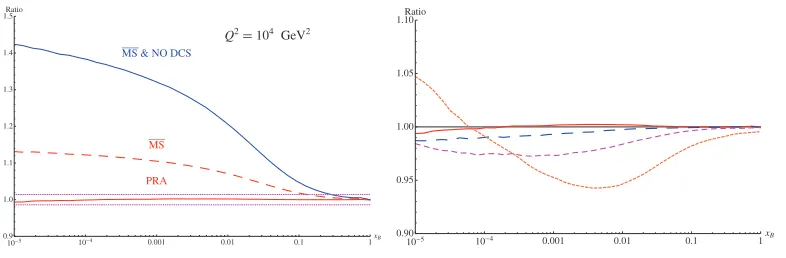
Figure 2. Numerical results for the ratio of ˜F(NLO PRA)
2q (xB,Q2)/F˜(2NLO CPMq )(xB,Q2) as a function of xB. Left
panel:significance of different contributions to ˜F2(NLO PRAq )is illustrated. Curves from bottom to top: full PRA
case; MS → PRAscheme transformation isturned off; subtraction of double-counting isturned off. Dotted
horizontal lines denote 1±α2s(Q2) band. Right panel: scale-dependence of the ratio. Solid line –Q2 = 104
GeV2, dashed line –Q2=103GeV2, short-dashed line –Q2=102GeV2, dotted line –Q2=10 GeV2.
where fPRA
i are PDFs in thePRA scheme, precise definition of which is given in Eq. 40 below. In
the first line of Eq. 38, theO(α0s) andO(αs) terms from the LO PRA contribution (6), relevant for
our present analysis, are written. Term in the second line of Eq. 38 is given by Eq. 26, i. e. it takes into account theqT1-dependence of NLO HSC. Using the results of Sec. 4, one can collect allO(αs)
contributions in Eq. 38 together: ˜
F2(NLO PRAq )(xB,Q2) = (xBe2q)
fPRA
q (xB,Q2)+fq¯PRA(xB,Q2)
+ 2
CMS
2g −∆Cqg+ ∆C(qkgT)
⊗fPRA
g
(xB,Q2)+O(α2s)+O
(Q2)−γ, (39)
whereγ >0. To ensure matching of theO(α0s) andO(αs) terms in the Eq. 39 to the CPM result (15),
PDFs in PRA scheme should be related with PDFs inMS scheme as follows:
fPRA
g (x, µ2)= fgMS(x, µ2), fqPRA(x, µ2)=fqMS(x, µ2)+
∆Cqg−∆C(qkgT)
⊗fMS
g
(x, µ2). (40)
In the complete NLO PRA calculation, all LO and NLO terms should be written inkT-factorized
form,with the unPDFs normalized to the NLO PDFs in PRA scheme as prescribed by the Eq. 10. To this end, the usualMS PDFs shold be transformed into PRA scheme by the transformation, similar to the transformation (40), and then the unPDFs can be constructed from them, using Eqns. 12 and 13. NLO splitting functions in this equations also recieve theO(αs) corrections, due to the difference
betweenMS andPRAschemes. These corrections are known, but the corresponding formulae are too lengthy to present them here. In contrast to the complete NLO calculation, in the present paper we have concentrated on the contribution of only one subprocess (14), and therefore, PDFs in PRA scheme appear explicitly in Eq. 38.
In the Fig. 2 the PRA test function (38) is compared numerically to the CPM test function (15). The NLO set of MSTW-2008 PDFs [12] has been used as the collinear input for this computation, togeher with the value ofαs(MZ)=0.1202 from the PDF fit. As it is explained above, Eq. 38 should
reproduce the CPM result up toO(α2s) terms and corrections supressed by the negative power ofQ2.
than 1% forQ2 =104GeV2 (see the right panel of Fig. 2). Their agreement become less good with Q2decreasing, but even for theQ2 =10 GeV2the error does not exceed±7%, which is compatible
with the value ofα2s(Q2) at this scale.
In the left panel of Fig. 2, the role of different contributions in the PRA result is illustrated.
Ne-glecting the scheme-transformation (40) one clearly misses someO(αs)∼O(10%) correction, while
turning offthe DCS terms one overshoots the NLO CPM result by 40% in the small-xBregion.
In the present contribution, the problem of double-counting of real NLO corrections in PRA is adressed, and the procedure for the subtraction of this double counting, together with the definition of NLO unPDF in PRA is constructed, which resolves this problem and correctly takes into account the scheme-dependence of NLO PDFs in CPM. In such a way, significant part of the formalism of NLO calculations in PRA has been formulated.
Acknowledgements: This work was supported by the Ministry of Education and Science of
Russia under Competitiveness Enhancement Program of Samara University for 2013-2020, project 3.5093.2017/8.9.
References
[1] M. Nefedov and V. Saleev, “Towards NLO calculations in the parton Reggeization approach,” arXiv:1608.04201 [hep-ph].
[2] B. L. Ioffe, V. S. Fadin and L. N. Lipatov,Quantum chromodynamics, perturbative and nonper-turbative aspects(Cambridge University Press, Cambridge, UK, 2011)
[3] J. C. Collins,Foundations of preturbative QCD(Cambridge University Press, Cambridge, UK, 2011)
[4] A. Karpishkov, M. Nefedov, V. Saleev and A. Shipilova, “Heavy quark production at the LHC in the Parton Reggeization Approach,” arXiv:1702.05081 [hep-ph].
[5] A. Karpishkov, M. Nefedov and V. Saleev, “BB¯ angular correlations at the LHC in parton Reggeization approach merged with higher-order matrix elements,” arXiv:1707.04068 [hep-ph]. [6] V. S. Fadin and V. E. Sherman, JETP Lett.23, 599 (1976); JETP45, 861 (1977).
[7] A. V. Bogdan and V. S. Fadin, “A Proof of the reggeized form of amplitudes with quark ex-changes,” Nucl. Phys. B740, 36 (2006).
[8] M. A. Kimber, A. D. Martin and M. G. Ryskin, “Unintegrated parton distributions,” Phys. Rev. D
63, 114027 (2001); A. D. Martin, M. G. Ryskin and G. Watt, “NLO prescription for unintegrated parton distributions,” Eur. Phys. J. C66, 163 (2010).
[9] A. Buckleyet al., “General-purpose event generators for LHC physics,” Phys. Rept.504, 145 (2011).
[10] F. Hautmann, M. Hentschinski and H. Jung, “Forward Z-boson production and the unintegrated sea quark density,” Nucl. Phys. B865, 54 (2012).
[11] S. Catani, S. Dittmaier, M. H. Seymour and Z. Trocsanyi, “The Dipole formalism for next-to-leading order QCD calculations with massive partons,” Nucl. Phys. B627, 189 (2002).