FOR
IN THE LIMA BEAN R. W. ALLARD
University of California, Dauis, California
Received May 28, 1963
is some evidence from studies of related species of plants that low T E a E a frequency is associated with outcrossing and high chiasma frequency is associated with selfing (reviews in GRANT 1958; BODMER and PARSONS 1962). From this it has been inferred that crossover rates have been adjusted by natural selection toward high values in selfing species to compensate for the restrictions imposed on the variability system by breeding habit, and vice versa for outcross- ing species. The present experiment on the lima bean, a highy self-pollinated species, is reported for the bearing it has on the adjustment of mechanisms which regulate recombination rates.
Estimates of recombination between any given pair of linked loci in lima beans often differ strikingly in different hybrids and/or in different environments (ALLARD 1956; ALLARD and CLEMENT 1959). Similar fluctuations have long been known to occur in other plant species, e.g. maize ( STADLER 1925). It was there- fore decided to divide the experiment into two parts. In the first part, genetically uniform hybrid plants were sown, or harvested, at different times to determine the effect of various natural environments on recombination values. In the second part of the experiment, selection for high and low recombination values was practiced among selfed progeny of certain hybrids to detemine the extent of chromosomal control of recombination values.
MATERIALS A N D METHODS
Three different pairs of linked loci were studied, as shown in Table 1. Pheno- typic expressions of these loci are: R/r-dark red us. red seed-coat color;
Wl/wl-
lanceolate us. ovate-lanceolate us. ovate leaflet shape; D/d-indeterminate us. determinate habit of growth; L,/l,-green us. yellow plant color; S/s-mottled1390 R. W. ALLARD
not available and their development would have been laborious and time con- suming in this species.
The parental strains used (Table 1 ) had been maintained for many generations by growing seeds from a single selfed plant each generation. Hence, they were presumably highly homozygous, Further assurance that the F, hybrid plants studied were genetically identical was obtained by utilizing only a single plant of each parent in making each of the hybrids.
Recombination values were estimated by the method of maximum likelihood. The estimator for p , the recombination value, for the type of family studied is
d 1% L - - ( e
+
f
>
( 2 p ) + (g+ +
i) ( 2 p
-
11
+( i
+
k)
( 2-
2 p ) + ~-dP 1
7’
1 - p + p z P ( 2 - P )21 m ( l -2p) 2n
-+
+-=OP p ( 1 - p ) p - 1
where e, f,
. . .
n denote, respectively, observed numbers in classes A B / A B , AB/aB, A B / A b , AB/ab, Ab/aB, Ab/Ab, Ab/ab, aB/aB, aB/ab, and ab/ab. Explicit solu- tions for this equation do not appear to exist but it is solved readily by iteration. The standard error of p is given by (ZP-l) %, where+
d’logL - - 2 ( e
+
f ) ( 1+
p’)+-
( g+
h+
i)
(1 + 2 p - 2 p * )- I p = -
d p 2 ( 1 -p’jZ (1 - p
+
p’)2( 2 )
- 2 ( j
+
k)
( 2-
2 p+
p z )+-
- 21+
- m( 1 - 2 p+
2 p 2 )+
- 2n[p(2--P)12
P2
[ P ( l - P)12 ( p -Computation of the recombination values and their standard errors was facilitated by use of a digital computer.
T H E EFFECTS OF ENVIRONMENT
40- 5 0
@ RWl/rwl (Hybrld-I)
-
0-
O I@I SL,/sl, (Hybrid-2)
0 K w
a @
D W l / U w l (Hybrid-3) 0
-
10- 0
-
PLANTING DATE
15'
'
I I I 1 I@) D W l / d w l ( H y b r i d - 4 )
1
c
IPLANTING DATE
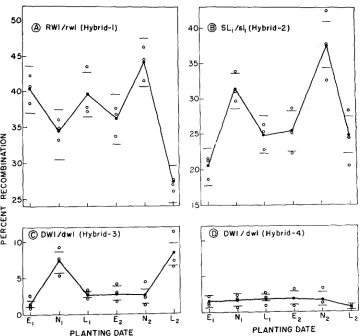
FIGURE 1.-Recombination values for genetically uniform F, plants seeded at different times.
E,, N,,
. .
., L, denote early, normal and late planting times i n the h s t and second years. Open circles represent recombination values for single plants and solid circles represent joint estimates for each planting time. Horizonal lines give 95 percent confidence limits for the joint estimates.also reveals no consistent pattern in the fluctuations of the four different hybrids at different planting dates, suggesting that each hybrid responds uniquely to each environment.
TABLE 1
Loci studied and their linkage relations
Hybrid Parents Genotype Recombination value* Linkage group
1 L& x L124 R Wl/rwl 38.0 I
2 L121 x L124 SL,/Sl, 26.9 I1
3 L63 x L48 WlD/wld 2.1 I
1392 R. W. ALLARD
Comparison of recombination rates for hybrids 3 and 4 (Figure IC, D) shows that the recombination rates were higher and more variable in the former hybrid. Thus background genotype has an effect on recombination between W l and D. However these two hybrids differed in time of floral initiation, and consequently they were not necessarily of equivalent physiological age at any given time, even though they were planted at the same time. The observed difference in recombi- nation values may therefore reflect no basic difference in control of the chromo- somal mechanism of crossing-over but merely a possibly simply inherited differ- ence in earliness.
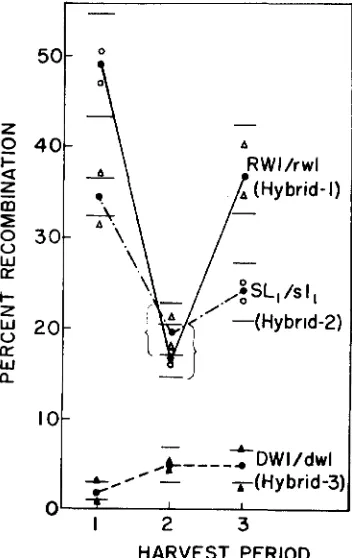
Variations within indiuiduals: The extent to which recombination rates vary during different periods for individual plants was tested by harvesting all seeds which reached maturity during specified intervals and determining recombina- tion values for each seed lot separately. The harvest intervals were August 25- September 12 (Period l ) , September 13-October 15 (Period 21, and October 16-
November 20 (Period 3). Two F, plants each were studied for hybrids 1,2 and 3
with the results shown in Figure 2. These data were homogeneous within
(P
>
.05) but highly heterogeneous amongst periods for each hybrid. Thus, inz
k
2
40-a
z
a3
30- W
[IC
I-
;
20-[IC
W
a
-
I
A- J
2 3
HARVEST PERIOD
FIGURE &.-Recombination values for samples harvested at three different times from the same plant (see text). Open circles (triangles for SL,/sl,) represent estimates for single plants
these materials, the amount of recombination varies widely from period-to-period for single individuals, providing further evidence that recombination is very sensitive to fluctuations in environment.
For RWl/rwZ and SL,/sZ, recombination was much lower for harvest Period 2 than for Periods 1 and 3. Since meiosis occurred during the period of highest summer temperatures for seeds harvested in Period 2, this observation suggests that high temperatures reduce recombination between these two loci. However, considering the generally sporadic nature of the fluctuations in recombination rates observed in this experiment, such inferences must be regarded with caution.
RESPONSE T O SELECTION
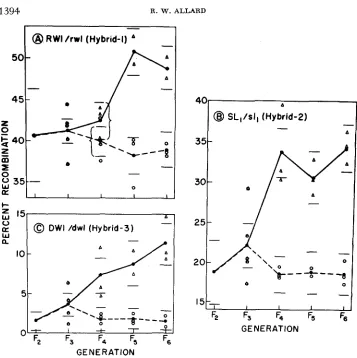
In the high-low selection experiment, five F, plants each of hybrids 1 , 2 and 3 were chosen by random methods and the recombination value for each plant determined from the segregation ratios of its F, progeny. Three random F, plants were then taken from the F, progeny whose F, parent had the highest recombi- nation value. Similarly three random plants were chosen from the F, progeny whose F, parent had the lowest recombination value. This was repeated in F,, F,
and FG generations with the results shown in Figure 3.
Inspection of Figure 3 shows that the selection lines were subject to year-to-year fluctuations of the same order of magnitude as the F, hybrids discussed earlier. However, these fluctuations do not camouflage a sharp response to selection in the high direction and little or no response to downward selection. Final mean differ- ences between high and low selection lines in the F, generation, as measured by segregation ratios in F e progenies, were RWZ/rwZ-lO.O, SL,/sZ,-20.0 and DWZ/
dwZ-7.5 crossover units. Nearly all of these differences resulted from response to upward selection. These consistent differences observed between the high and low selection lines in several environments indicate basic alteration of the chromo- somal mechanism of recombination and not mere genotypic-environmental inter- action.
DISCUSSION
Recombination rates were found to be highly variable when stocks of high genetic uniformity were grown in different natural environments. Similarly, samples of \seed harvested from the same plant at different times differed signifi- cantly i n recombination values. These environmental influences often led to differences in recombination values of the order of 10 crossover units and differ- ences greater than 20 crossover units were observed occasionally. Thus consider- able caution should be exercised in comparing crossover rates of different geno- types or of different species. Numerous individuals grown in different environ- ments and sampled at various times must be studied before it can be said that different genotypes or species have different recombination rates.
1394 R. W. ALLARD
-
-
@
R
WI /rwl (Hybrid-I) A2
wL 0
t
-
@ DWI /dwl ( H y b r i d - 3 ) 50
t
G E N E R A T I O N G E N E R A T ION
FIGURE 3.-Recombination values for lines selected for low and high recombination rates. Open circles and triangles represent recombination values for individual plants in the low and high selection lines, respectively. Closed circles represent joint estimates for each generation and hori- zontal lines give 95 percent confidence intervals for the joint estimates.
and rapid response was obtained to selection for increased recombination rates in each of three hybrids. The lima bean is difficult cytologically and it was therefore impractical to determine directly whether any of the observed changes had a cytological basis. However, since the responses were almost entirely in the direc- tion of increased recombination, and cytological aberrations tend to decrease recombination, it seems likely that the changes observed resulted from altering
the frequencies of genes influencing recombination rates rather than from select- ing cytological aberrants. Assuming that the changes were due to genes affecting crossover rates, the steadiness of the responses suggests that more than one gene was involved in each case, and the rapidity of the responses indicates that certain of the genes involved may have had fairly large effects.
1395
The ineffectiveness of selection in the downward direction suggests that the genetic system in this highly self-pollinated species has been adjusted by previous selection to reduce crossing-over to a minimum. Apparently, therefore, the in- breeding habit of the lima bean does not in itself adequately suppress variability and further restriction of recombination through adjustment of the chromosomal mechanism of crossing-over is advantageous. The materials studied were culti- vated types, and since great premium is placed on uniformity under cultivation, it is perhaps not surprising that these factors in the recombination system are here found in reinforcement rather than in opposition. These results thus provide further evidence that adjustment of recombination is associated with fitness in the broadest sense, but they also indicate that the adjustment reached depends on
the circumstances encountered in individual cases.
SUMMARY
Recombination values were found to be highly variable for seeds harvested from individual lima plants at different times. Similarly genetically uniform stocks differed in amounts of recombination when planted at different times i n two years. These results indicate that caution must be exercised in comparing crossover rates for different genotypes and for different species.
A selection experiment for high and low recombination rates led to differences between high and low lines of 7.5, 10.0 and 20.0 crossover units, respectively, for three pairs of loci. Nearly all of the response was in the high direction, suggesting that the chromosomal mechanism is adjusted to restrict crossing-over in the lima bean, even though the mating system is one of predominant self-fertilization, which also presumably restricts recombination.
ACKNOWLEDGMENTS
The author wishes to express his appreciation to W. M. CLEMENT for assistance with these experiments, to CONRAD WEHRHAHN for performing the computer analyses of the data, and to the Computing Center, University of ,California, Davis, for use of electronic data processing equipment.
LITERATURE CITED
ALLARD, R. W., 1956
ALLARD, R. W., and W. M. CLEMENT, 1959 BODMER, W. F., and P. A. PARSONS, 1962
GRANT, VERNE, 1958
STADLER, L. J., 1925
Formulas and tables to iacilitate the calculation of recombination values in heredity. Hilgardia 22 : 235-278.
Linkage in lima beans. Heredity 50: 63-67. Linkage and recombination in evolution. Advan.
The regulation of recombination i n plants. Cold Spring Harbor Symp.
The variability of crossing over i n maize. Genetics 11: 1-37. Genet. 11: 1-100.