ABSTRACT
BOBOLEA, RUXANDRA. A Study of Continuous Electrochemical Processing Operation Feasibility for Spent Nuclear Fuel. (Under the direction of Dr. Man-Sung Yim.)
A Study of Continuous Electrochemical Processing Operation Feasibility for Spent Nuclear Fuel
by
Ruxandra Bobolea
A thesis submitted to the Graduate Faculty of North Carolina State University
in partial fulfillment of the requirements for the Degree of
Master of Science
Nuclear Engineering
Raleigh, North Carolina 2009
APPROVED BY:
_______________________________ _______________________________ Dr. David N. McNelis Dr. Jeff Thompson
DEDICATION
BIOGRAPHY
ACKNOWLEDGMENTS
I would like to thank my adviser Dr. Man-Sung Yim for his constant support and valuable advice throughout the course of my research work. His guidance and encouragement served as a continuous source of inspiration. I would also like to express my gratitude to Dr. David N. McNelis and Dr. Jeff Thompson for their kind support and useful feedback towards the completion of this thesis.
TABLE OF CONTENTS
LIST OF TABLES ... viii
LIST OF FIGURES ... x
LIST OF SYMBOLS ... xiii
LIST OF ABREVIATIONS ... xvii
Chapter 1 Introduction ... 1
1.1 Nuclear Energy and Spent Nuclear Fuel ... 1
1.2 Overview of Reprocessing ... 3
1.2.1 History of Reprocessing ... 4
1.2.2 Reprocessing Today ... 5
1.3 Reprocessing Technology Comparison ... 8
1.4 Electrochemical Processing Modeling Overview ... 10
1.5 Scope of Thesis ... 13
Chapter 2 Theory ... 15
2.1 Electrochemical Processing ... 15
2.1.1 Process Overview ... 15
2.1.2 Principle of Electrorefining ... 20
2.1.3 Electrode Reactions ... 26
2.1.4 Mass Transport Mechanisms ... 28
2.2.1 Factors and Experimental Domain ... 32
2.2.2 Experimental Designs for Computers ... 33
2.3 Three dimensional CFD Modeling ... 35
2.3.1 Basic Equations ... 35
2.3.2 Boundary Conditions ... 37
2.3.3 Turbulence Model ... 39
2.3.4 Component Model ... 41
Chapter 3 Continuous Electrochemical Processing Concept ... 45
3.1 Main Requirements ... 45
3.2 Concept Description ... 48
Chapter 4 Computation Modeling and Simulation ... 56
4.1 Electrochemical Modeling ... 56
4.1.1 Geometry... 57
4.1.2 Process Parameters of Electrochemical Cell ... 62
4.1.3 Initial Element Concentrations at Anode and Molten Salt ... 64
4.1.4 Design of Experiment ... 66
4.2 Three dimensional CFD Modeling ... 71
4.2.1 Electrorefiner Geometry and Mesh ... 72
4.2.2 Component Model ... 78
Chapter 5 Results and Discussion ... 81
5.1 Electrochemical Modeling Results ... 81
5.2 Design of Experiment Results ... 102
5.3 CFD Modeling Results ... 107
5.4 Final Electrochemical Results ... 123
5.5 Results Overview ... 132
Chapter 6 Conclusions and Future Work Recommendations ... 134
6.1 Conclusions ... 134
6.2 Future Work Recommendations ... 136
REFERENCES ... 138
APPENDICES ... 143
APPENDIX A. Design of Experiment Detailed Results ... 144
LIST OF TABLES
Table 1.1 – Composition of LWR spent nuclear fuel [1] ... 2
Table 1.2 – Main reprocessing technologies of spent nuclear fuel ... 6
Table 1.3 – Estimated uncertainties in electrochemical processing material balance [8] ... 10
Table 2.1 – Free energies of formation of selected chlorides at 500 °C [3, 15] ... 23
Table 2.2 – Activity coefficient of actinides and rare earths at infinite dilution [9] ... 26
Table 4.1 – Geometrical features of REFIN cell (red contours in Figures 3.2 and 4.2) ... 60
Table 4.2 – Volumes and areas of interface of electrochemical cell modeled with REFIN ... 61
Table 4.3 – Process parameters for electrochemical modeling [9] ... 63
Table 4.4 – Electrolyte parameters ... 64
Table 4.5 – Anode parameters ... 65
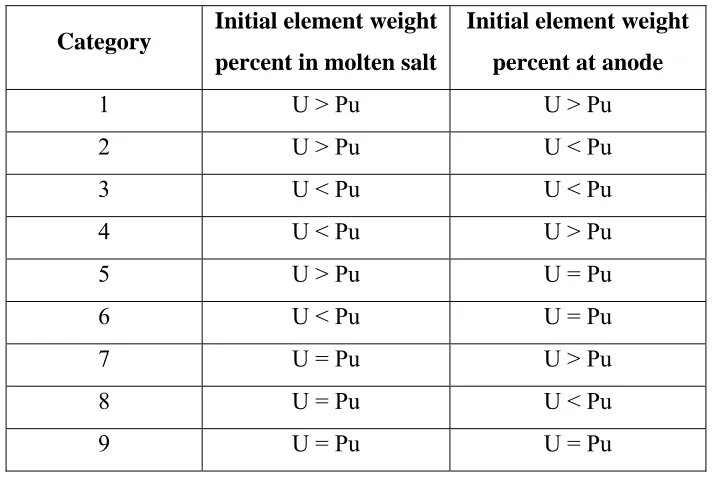
Table 4.6 – Combinations of initial element concentration at anode and molten salt ... 66
Table 4.7 – Input variable space ... 67
Table 4.8 – Latin Hypercube design with optimal spacing for electrorefiner ... 68
Table 4.9 – Electrorefiner mesh characteristics ... 76
Table 4.10 – Molten salt data [25] ... 78
Table 4.11 – Uranium data [26] ... 78
Table 5.1 – Initial electrorefiner inventory for uranium extraction stage – category 1 ... 82
Table 5.2 – Final electrorefiner data for uranium extraction stage – category 1 ... 85
Table 5.5 – Initial electrorefiner inventory for uranium extraction stage – category 3 ... 91
Table 5.6 – Final electrorefiner data for uranium extraction stage – category 3 ... 94
Table 5.7 – Initial electrorefiner inventory for uranium extraction stage – category 4 ... 95
Table 5.8 – Initial electrorefiner data for uranium and plutonium extraction stage ... 99
Table 5.9 – Results summary for design of experiment ... 107
Table 5.10 – Diffusion layer thickens for left cathode – molten salt interface ... 119
Table 5.11 – Diffusion layer thickens for right cathode – molten salt interface ... 120
Table 5. 12 – Final rotational model for stirrer and cathodes ... 122
Table 5.13 – Final diffusion layer thickness for electrorefiner ... 122
Table 5.14 – Material balance per cathode and operation time for optimum case ... 129
Table 5.15 – Continuous electrorefiner performance ... 132
Table A.1 – Design of experiment results-uranium extraction stage ... 145
Table A.2 – Design of experiment results-uranium and plutonium extraction stage ... 150
LIST OF FIGURES
Figure 2.1 – Electrochemical processing flowchart [12] ... 16
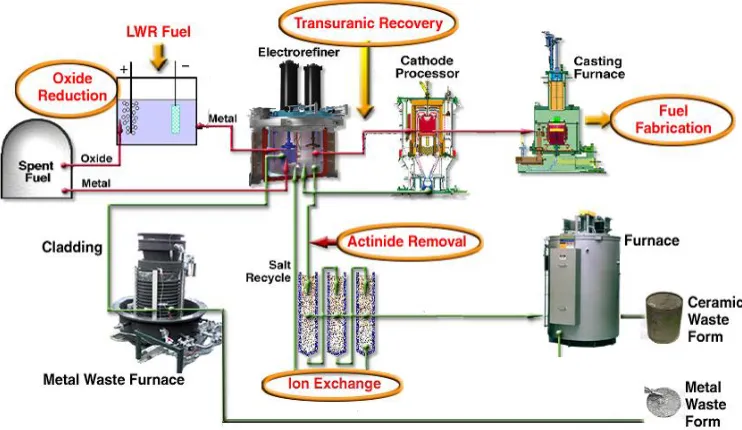
Figure 2.2 – Electrorefining process [12] ... 19
Figure 2.3 – Standard free energies of formation of fission product, actinide element and electrolyte chlorides at 500 °C ... 21
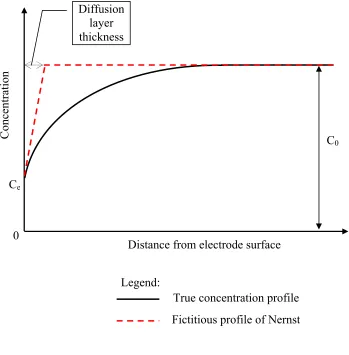
Figure 2.4 – Concentration profile and diffusion layer thickness ... 31
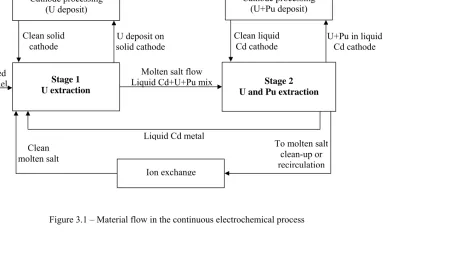
Figure 3.1 – Material flow in the continuous electrochemical process ... 49
Figure 3.2 – Continuous electrochemical processing concept flowchart ... 50
Figure 3.3 – Cathode assembly used for uranium extraction (top view) ... 51
Figure 3.4 – Cathode mandrel with insulator disc (front view) ... 52
Figure 4.1 – Schematic of electrochemical circuits in continuous operation (front view) ... 58
Figure 4.2 – Electrochemical cell modeled with REFIN code (top view) ... 59
Figure 4.3 – Latin Hypercube design with optimal spacing ... 70
Figure 4.4 – REFIN and ANSYS CFX coupling ... 71
Figure 4.5 – Different electrochemical cell designs ... 74
Figure 4.6 – Final electrochemical cell geometry ... 75
Figure 4.7 – Electrochemical cell mesh ... 77
Figure 5.1 – Element mass in electrorefiner for uranium extraction stage – category 1 ... 83
Figure 5.2 – Element cathode potential for uranium extraction stage – category 1 ... 84
Figure 5.5 – Element mass in electrorefiner for uranium extraction stage – category 3 ... 92
Figure 5.6 – Element cathode potential for uranium extraction stage – category 3 ... 93
Figure 5.7 – Element mass in electrorefiner for uranium extraction stage – category 4 ... 96
Figure 5.8 – Element cathode potential for uranium extraction stage – category 4 ... 97
Figure 5.9 – Element mass in electrorefiner for uranium and plutonium extraction stage – category 4 ... 100
Figure 5.10 – Element cathode potential for uranium and plutonium extraction stage – category 4 ... 101
Figure 5.11 – First stage recovery efficiency and operation time as function of electric current and element concentration ... 103
Figure 5.12 – Overall recovery efficiency and operation time as function of electric current and element concentration ... 104
Figure 5.13 – First stage recovery efficiency vs. operation time ... 105
Figure 5.14 – Global recovery efficiency vs. total operation time ... 106
Figure 5.15 – U volume fraction in molten salt for first stirrer design ... 108
Figure 5.16 – U volume fraction in molten salt for second stirrer design ... 110
Figure 5.17 – U volume fraction in molten salt for final stirrer design at 30 rpm ... 111
Figure 5.18 – U velocity on cathodes and stirrer for final stirrer design at 120 rpm ... 112
Figure 5.21 – Diffusion layer at right cathode for 60 rpm stirrer rotational velocity ... 117 Figure 5.22 – U velocity for final stirrer design at 60 rpm stirrer rotational velocity ... 118 Figure 5.23 – U concentration profile at left and right cathode surfaces ... 121 Figure 5.24 – Change in element mass per cell per stage for uranium extraction stage – optimum case ... 124 Figure 5.25 – Element cathode potential variation per cell per stage for uranium extraction stage – optimum case ... 125 Figure 5.26 – Change in element mass per cell per stage for uranium and plutonium
extraction stage – optimum case ... 126 Figure 5.27 – Element cathode potential variation per cell per stage for uranium and
LIST OF SYMBOLS
ai activity of species iA interfacial area density, (m-1)
Ci concentration of species i, (mol/cm3)
1
Cε k-ε turbulence model constant, (1.44)
2
Cε k-ε turbulence model constant, (1.92)
μ
C k-ε turbulence model constant, (0.09) d distance or length, (m)
Di diffusion coefficient of species i, (cm2/s)
E standard electrochemical potential defined by Gibbs free energy, (V) E° standard electrode potential, (V)
F Faraday’s constant, (96,487 Coulomb/mol)
ΔG “standard” Gibbs energy change for a reaction, (kcal/mol) D
f G
Δ free formation energy of selected compound, (kcal/mol)
htot specific total enthalpy, (J/kg) I electric current intensity, (A)
Ji net flux density for species i, (mol/cm2·s)
Ji,migration flux density due to migration of species i, (mol/cm2·s) k turbulent kinetic energy per unit mass, (m2/s2)
Keq equilibrium constant
m mass of material transported, (kg)
M molar mass, (mol/kg)
MD momentum due to interphase drag force ML momentum due to lift force
MLUB momentum due to wall lubrication force MS momentum due to solids pressure force MTD momentum due to turbulence dispersion force MVM momentum due to virtual mass force
n number of electrons transferred through the external circuit N number of components in mixture
p, pstat static (thermodynamic) pressure, (Pa) p` modified pressure, (Pa)
ptot total pressure, (Pa)
Pk shear production of turbulence, (kg/m·s3)
Pr Prandtl number
Q amount of electric charge, (Coulomb)
R universal gas constant, (8.3143 J/mol·K)
Re Reynolds number
Rv radial vector from the domain axis of rotation to the wall, (m) SE energy source, (kg/m·s3)
SM momentum source, (kg/m2·s2) SMS mass source, (kg/m3·s)
t time, (s)
T static (thermodynamic) temperature, (K) ui mobility of species i, (cm2·mol/J·s) U vector of velocity Ux,y,z, (m/s) v bulk fluid velocity, (cm/s)
vi velocity of ions in electrolyte, (cm/s)
V volume, (m3)
Xi mole fraction of species i zi charge number of species i
α subscript to indicated that the quantity applies to component α
β subscript to indicated that the quantity applies to component β
ε turbulence dissipation rate, (m2/s3)
Φ electric potential, (V)
Γ diffusivity, (m2/s)
λ thermal conductivity, (W/m·K)
μ molecular (dynamic) viscosity, (Pa·s) µeff effective viscosity, (Pa·s)
μt turbulent viscosity, (Pa·s)
ρ density, (kg/m3)
σk k-ε turbulence model constant, (1.0)
σε k-ε turbulence model constant, (1.3)
τ shear stress, (Pa)
LIST OF ABREVIATIONS
ANL Argonne National LaboratoryCFD Computational Fluid Dynamics COEX Combined Extraction Process DOE Department of Energy
ERB-II Experimental Breeder Reactor II KAPL Knolls Atomic Power Laboratory IMSE Integrated Mean Squared Error INL Idaho National Laboratory LWR Light Water Reactor
ORNL Oak Ridge National Laboratory
Chapter 1 Introduction
A unique feature of nuclear energy is the availability in spent nuclear fuel of
recyclable fissile and fertile materials able to provide new fuel to generate power. When we
recycle paper, glass, plastic or metal we separate useful materials from waste, mainly to
reduce the consumption of fresh raw materials and also to diminish the air and water
pollution. Spent nuclear fuel contains considerable amounts of useful materials. To illustrate
this, the composition of used nuclear fuel is presented in the first section of this chapter.
Furthermore, an overview of reprocessing is given to bring this thesis into context. A
comparison of reprocessing methods, underlining the advantages and disadvantages of
current electrochemical processing technology, is provided for a better understanding of the
motivation of using and improving this technology.
1.1 Nuclear Energy and Spent Nuclear Fuel
One of the most critical topics in today’s society is energy. Major concerns include
resource depletion, impact on air and water pollution, security and cost. Energy generation
affects all aspects of life, from every day tasks to industrial productivity and feeding the
Conventional nuclear power is based on the nuclear fission reaction to generate
energy. When the fissile uranium-235 isotope absorbs a neutron, the intermediate nuclide
uranium-236 becomes immediately unstable and fissions. The products of this reaction
typically include two fission products, 200 MeV of energy and an average of 2.5 neutrons.
More uranium is bombarded by some of these neutrons to produce energy whereas others are
used to create fissionable plutonium-239 from uranium-238.
Table 1.1 illustrates the composition of the LWR spent nuclear fuel.
Table 1.1 – Composition of LWR spent nuclear fuel [1]
Element or group of elements Percent, by weight Actinides
Uranium 95.6 Plutonium 0.9
Minor Actinides 0.1
Fission products
Stable / Short Lived 3.0
Cesium / Strontium 0.3
Iodine / Technetium 0.1
As it can be seen, the bulk of spent nuclear fuel is reusable material. This represents
By separating uranium and plutonium from waste, the volume of material to be
disposed of as high-level waste is reduced and also allows uranium and plutonium to be used
as reactor fuel. The spent nuclear fuel is highly toxic because it contains very large inventory
of radioactive isotopes with high radiation energy whose half-lives can be extremely long.
Also, due to its high fissile plutonium content, the proliferation issue becomes important
specifically if any further partitioning is involved.
1.2 Overview of Reprocessing
Reprocessing of spent nuclear fuel refers to the separation process of useful material
from waste. Separation is usually achieved by utilizing the differences in chemical and
physical properties of the substances through the mean of a separating agent. The main goals
for conducting spent fuel separation are to recover useful materials, uranium, plutonium, and
thorium, if present, and to reuse them as fuel, to remove radioactive fission products from
them and to obtain a suitable form for safe and long-term storage. Reprocessing technologies
can be grouped into two main categories: technologies based on aqueous chemistry and those
1.2.1 History of Reprocessing
Initially, Oak Ridge National Laboratory (ORNL) developed a bismuth phosphate
method of reprocessing spent fuel which was used at Hanford, Washington site beginning in
1944. The process, operating in batches, required several stages including dissolution of
cladding material. Uranium and most of the fission products were discarded as heavy metal
waste whereas plutonium was further purified. Large amounts of waste and chemicals were
generated and no uranium was separated.
Argonne National Laboratory (ANL) developed a new reprocessing method based on
aluminum nitrate in aqueous phase using hexone as solvent for extraction. The process was
continuous but required large amounts of aluminum nitrate.
This method was replaced by plutonium and uranium extraction process (PUREX)
developed by Knolls Atomic Power Laboratory (KAPL) and tested at ORNL in 1950-52 and
used worldwide today. PUREX is a solvent-extraction technique used to extract uranium and
plutonium, independent of each other, from fission products. The method uses nitric acid and
tri-butyl phosphate dissolved in an organic liquid [2]. Adaptations to PUREX have been
applied to become more suitable for treatment of waste and civilian use. Uranium extraction
process (UREX) can be used to remove uranium, which represents most of the volume and
mass of spent nuclear fuel. The PUREX process has been modified to prevent plutonium
extraction by adding acetohydroxamic acid to the extraction and scrub sections, and thus
ANL developed another related process for recovering transuranic metals from waste,
called TRUEX. This process added another extraction agent to tri-butyl phosphate to remove
transuranic elements from spent fuel and thus to lower alpha activity of the waste. A melt
refining process has been developed in the 1960s to process EBR-II metal fuel in which the
volatile fission products were removed [3]. This process offered partial separation of
actinides and no separate plutonium was recovered. This represents the initial work carried
out in electrochemical processing, also known as pyroprocessing.
1.2.2 Reprocessing Today
Generally, there are two main categories of reprocessing technologies of spent
nuclear fuel. They are either based on aqueous or non-aqueous processes, as presented in
Table 1.2.
Among all these processes, PUREX is the most completely developed and widely
used at present. It is based on the selective affinity of tri-butyl phosphate for uranium and
plutonium. Combined extraction (COEX) of uranium and plutonium was proposed as a
simplification of the PUREX technology. This process, developed in France, leaves
plutonium with uranium to fabricate mixed oxide fuel. Other variations of PUREX are
developed. These recover initially only uranium and then the residual is treated to recover
Table 1.2 – Main reprocessing technologies of spent nuclear fuel
Aqueous processes Non-aqueous processes
PUREX Electrochemical Processing (also
known as Pyroprocessing)
COEX Fluoride Volatility
UREX - UREX+ - TRUEX -
Supercritical CO2 -
The main difference between variations of UREX+ consists of how plutonium is
mixed with various actinides. UREX technology only separates pure uranium and technetium
and nothing else. Also, experiments using supercritical CO2 technology are ongoing and it is
considered a promising alternative for liquid-liquid extraction systems [4].
The non-aqueous processes include electrochemical processing and fluoride
volatility. Electrochemical processing technologies employ molten salt and molten metal
electrorefining process. Fluoride volatility, which uses the volatility of the uranium
hexafluoride, neptunium hexafluoride, and plutonium hexafluoride to separate them from
Electrochemical processing techniques to separate actinide elements from waste have
been under development in U. S., notably at ANL, as well as in Russia (at Research Institute
of Atomic Reactors), Japan (at Central Research Institute of Electric Power Industry), India
(at Indira Gandhi Center for Atomic Research), and Republic of Korea (at the Korea Atomic
Energy Research Institute). Production of a separate plutonium stream is very difficult for
this process, since plutonium is collected together with uranium and other elements.
Studies on the molten salt electrorefining process for metallic fuels and oxide
electrowinning process for oxide fuels have been carried out also in India. There,
electrochemical processing studies on uranium alloys have been performed in a
laboratory-scale argon atmosphere facility for molten salt processes [5].
In Japan, basic electrochemical processing research became very important,
especially studies which involved electrochemical and thermodynamic approach.
Electrochemical and related experiments for uranium, plutonium, and other minor actinides
were performed in a large-sized inert glove box built for molten salt processes. Also, a
special attention was given to electrochemical processing of nitride fuels in Japan, due to
their good reactor performance for the future fast breeder reactor [6].
Investigation of continuous operation of electrochemical process has started to
become more important during the last few years. One of the recent U.S. patents presents a
continuous electrorefining process [7]. This approach is focused on uranium separation from
1.3 Reprocessing Technology Comparison
Several attributes applicable to reprocessing technologies can be compared. A brief
comparison of the most important features of spent fuel reprocessing methods is provided in
the following paragraphs.
Proliferation risk plays a major role in selecting the reprocessing technology. The risk
is mainly given by the possibility of separating pure plutonium from spent nuclear fuel. From
this point of view, electrochemical processing has an advantage over PUREX technology
because it recovers plutonium together with uranium and other transuranic elements
(neptunium, americium, and curium). Also, UREX does not separate plutonium.
Waste toxicity is also important in evaluating a spent fuel reprocessing method. A
concern about PUREX is that neptunium, americium, and curium are kept in waste. These
elements are very toxic and affect the design of geologic repositories. UREX can be an
alternative to PUREX since plutonium is not separated and other elements are kept with
plutonium. Electrochemical processing recovers all the actinides and therefore the remaining
waste is not as long lived as it would otherwise be. Most of these actinides can be consumed
by reactors as fuel and thus the long term threat from waste is reduced.
Another advantage of electrochemical processing over aqueous methods is that the
desired outcome is achieved in fewer steps and the technology is considerably more compact,
allowing on-site reprocessing of reactor waste. This minimizes the burden during spent fuel
Also, electrochemical processing can be applied to high burn-up fuel and fuel with
little cooling time, as the operation temperature is high. Electrochemical processing does not
use water, which is easily contaminated and also tends to serve as a moderator, but uses
molten salt and molten metals which are known for their fast kinetics and radiation
resistance.
Advanced aqueous methods are best suited to treat spent fuel that is stored and
generated today. The PUREX process only dissolves some types of fuel (oxide fuel) but it
does not dissolve metal fuels. At the same time, electrochemical processing can be adapted to
treat both metal and oxide fuels.
Unlike the PUREX and UREX+ processes, current electrochemical processing
technology relies on batch operation and, therefore, the total throughput of the system is
limited and the uncertainties in total amount of material processed are significant. This is due
to fact that some material remains in the molten salt for several batches until the salt is
processed. The estimated uncertainties, per element, for electrochemical processing are
Table 1.3 – Estimated uncertainties in electrochemical processing material balance [8]
Element Error [%]
Np 27 %
Pu 6 %
Am 39 %
Cm 12 %
U 13 %
1.4 Electrochemical Processing Modeling Overview
Several models have been developed in order to predict and to keep track of the
material balance in electrochemical processing. Simulation represents a useful tool to
investigate the performance of the electrochemical process. Also, the capability to calculate
the process outcome using modeling saves time and energy.
Models use thermodynamic equilibrium based on the high temperature process
operation and fast kinetics. In 1989 Ackerman developed at ANL, based on the theoretical
model of Johnson, the code called PYRO to calculate mass flow and compositions in
electrochemical processing. The code, written in PASCAL, was based on thermodynamic
equilibrium considerations. Furthermore, the code was extended to include mass tracking of
isotopes and their radioactive decay [9].
Nawada and Bhat developed in 1995 a thermochemical model for application to a
Next, in 1996, Ahluwalia and Geyer developed at ANL a computer code, named GC,
for flow sheet simulation of electrochemical processing of spent nuclear fuel [9]. The code
utilizes an algorithm for analyzing simultaneous chemical reactions between species
distributed across many phases. They applied the computer code GC to electrochemical
processing flow sheet of LWR oxide fuel.
Researchers at CRIEPI, Japan have developed TRAIL code based on a diffusion
model [9]. This code uses diffusion layer theory in the vicinity of the electrodes.
Diffusion layer thickness was determined based on polarization data measured with
uranium. They assumed fast kinetics at interface between electrode and electrolyte based on
the high temperature of the process. The code assumes a linear concentration profile within
the diffusion layer and uniform concentrations in electrolyte and cadmium.
Models presented above are based on thermodynamic equilibrium or simple diffusion
kinetics. These models work well at low current densities but their accuracy degrades at high
current densities, when kinetic factors become important.
A FORTRAN-based electrorefining model, called REFIN, has been developed based
on a new mathematical model formulated to treat the time-dependent behavior of
multi-component electrochemical systems [9]. The model is able to predict the current density for
each species participating in the electrochemical reactions. The code solves the
electrochemical reactions within the diffusion layer. REFIN has a unique advantage over
REFIN code can simulate different types of electrodes, such as liquid anode and
liquid / solid cathode. The type of electrode employed in the simulation is defined in the
input file, by specifying the diffusion layer thickness. Seven elements of interest are defined
in this code. These are: uranium, plutonium, neodymium, cadmium, lithium, potassium, and
chlorine.
REFIN code has been benchmarked against Tomczuk et al. experiment performed at
ANL [11]. Tomczuk et al. performed several experiments to investigate the electrodeposition
of uranium and plutonium to solid cathode as part of the electrochemical processing
development. The electrorefiner used in the experiment consisted of a liquid cadmium anode,
a molten LiCl-KCl electrolyte, and a rotating solid cathode. During the experiment five tests
have been performed. In each test the electrorefiner was operated for a preset time at a
selected constant current. The molten salt, liquid anode and solid cathode were analyzed
before and after each test for uranium, plutonium, americium, and rare earths (Ce, Nd, and
Y). The solid cathode was removed after each test. Also, during these tests, the ratio of
plutonium inventory to uranium inventory in the electrorefiner and the PuCl3/ UCl3 ratio in
the electrolyte have been increased by removing pure uranium on the solid cathode.
In the study presented herein, REFIN code was employed to solve mass transfer in
1.5 Scope of Thesis
The main objective of this thesis was to investigate the feasibility of continuous
electrochemical processing operation for spent nuclear fuel to achieve the desired separation
performance by using computer based simulations. This study focused on computational
simulation of the processes that take place in the electrorefiner, the key equipment of the
electrochemical process.
Since the current electrochemical processing technology relies on batch operation, the
total throughput of the system is inherently limited. Furthermore, nuclear materials
accounting is also difficult because some of the material is held in the molten salt for several
batches until the salt is recovered.
Simulation of the electrochemical reactions at the electrode surfaces was based on the
kinetic modeling capability of a time-dependent one dimensional code, REFIN [9]. The code
was benchmarked against experimental data [11]. REFIN code was used to determine the
mass of uranium deposited at solid cathode and also the amount of uranium and plutonium
collected at liquid cadmium cathode. In addition, the operation time for the electrochemical
process was estimated using REFIN code, based on the operational and geometrical
parameters of the electrorefiner. The flow velocity profiles and chemical concentration
distribution of elements in the molten salt were determined through 3D CFD simulation
using ANSYS CFX-11.0. By solving the mass and momentum transfer in the bulk solution
Moreover, a design of experiment for computers was performed to investigate the
separation efficiency of the electrochemical process for the proposed concept, using JMP-7.0
statistical software.
Electrochemical processing of spent nuclear fuel plays an important role in the
development of the next generation nuclear reactors and also the technologies that will close
the nuclear fuel cycle. Successful demonstration of the continuous electrochemical
processing leads to development of a new process of reprocessing for spent nuclear fuel that
does not allow pure plutonium separation, which is an important advantage over
conventional aqueous processing. Additionally, this approach offers several improvements
over current batch electrochemical processing operation including larger throughput and
significant safeguards benefit with the reduction of the measurement uncertainties.
Chapter 1 of this thesis presents the motivation for reprocessing spent nuclear fuel
and a brief reprocessing history and technology comparison. The uncertainties in material
balance for electrochemical processing are given to underline the need for a continuous
process development. In Chapter 2, the chemical and physical principles of electrochemical
process and the theory behind the CFD simulation are reviewed. Chapter 3 describes the
continuous electrochemical processing concept proposed in this study. In Chapter 4, the
computational simulation for the continuous concept is presented. The results are shown and
discussed in Chapter 5. The conclusions derived from findings and recommendations for
Chapter 2 Theory
In order to embark on our explorations of the continuous electrochemical processing
operation concept, we need to understand first the principles that are behind the
electrochemical separation. This chapter begins by presenting the technology and equipment
involved in electrochemical processing of spent nuclear fuel. Next, it provides a description
of the physics and chemistry of the electrochemical processing. Furthermore, a discussion on
design of experiment for computers is given. This technique is used in this study to optimize
the separation efficiency and operation time of the continuous electrochemical processing
concept. Finally, a review of the mathematics of CFD is presented. CFD simulations are
employed to determine the hydrodynamic conditions of the electrochemical process and to
calculate the diffusion layer thickness.
2.1 Electrochemical Processing
2.1.1 Process Overview
Electrochemical processing of spent nuclear fuel refers to the set of operations
Electrorefining is the most important among them because it separates actinide elements
from the fission products present in the spent nuclear fuel. Other processes are mainly
employed to manage the waste. The electrochemical processing flowchart is presented in
Figure 2.1.
Figure 2.1 – Electrochemical processing flowchart [12]
One of the advantages of the electrochemical processing is the use of molten salts as
electrolyte. Besides their fast kinetics, molten salts have a high radiation resistance. Liquid
metals, which can be used as anodes or cathodes, have similar advantages. In the
brought into contact. The processing operations begin with decladding and chopping the
spent fuel. The chopping operation is performed by a chopper, where the fuel rods are cut
into short lengths. The chopped fuel rod segments are placed in a perforated steel basket,
which represents the anode during the electrorefining operation. For spent fuel from
commercial reactors, which consists of uranium oxide, another step is performed prior to the
electrorefiner, in order to convert the oxide fuel into metallic form. The oxide fuel loaded
into the cathode basket is reduced to produce oxygen gas or CO2 at the anode. This operation
is known as electrolytic oxide reduction.
The electrorefining of spent nuclear fuel is virtually the same as the electrorefining
process used in the minerals industry. During this process an impure metal, which represents
the anode, is electrotransported through an electrolyte to the cathode where it is deposited in
a condition of greater purity. Electrorefining in chloride salt is mainly used to extract
uranium and plutonium. A molten salt medium of LiCl-KCl eutectic is employed and
dissolved actinide chlorides, such as UCl3 and PuCl3, are added to the process. The
electrorefiner operating temperature is typically 500 °C.
After the anode basket is loaded with chopped spent fuel, it is lowered into the molten
salt and virtually pure uranium is collected at a solid mandrel cathode by means of an applied
electric current. It has been observed experimentally that the morphology of the
uranium-plutonium mixture deposited on solid cathode has changed from dendritic form that
The amorphous deposit is non-adherent on solid cathode [13]. As a result, liquid
cadmium cathode was employed for collecting uranium-plutonium mixture. Other elements,
such as americium, neptunium, curium and some rare-earth fission products are also
collected at the liquid cadmium cathode. In electrochemical process, actinides are recovered
as a group and no pure plutonium is collected at cathode. The fact that the plutonium product
contains some highly radioactive material and it is diluted with uranium discourages weapons
proliferation and undesirable diversion. This represents a major advantage of this technology.
The remaining fission products accumulate in the salt and in the cadmium pool
situated at the bottom of the electrorefiner vessel. The role of the liquid cadmium pool is to
collect the uranium dendrites that drop from the solid cathode during electrorefining. Also, it
acts as an anode during the deposition mode and as an intermediate electrode during the
direct transport mode [14].
The electrorefiner can be operated in three different modes, which can be visualized
in Figure 2.2:
• Anodic Dissolution – in this mode the perforated steel basket, called fuel dissolution
basket, serves as anode and the liquid cadmium pool from the bottom of the
electrorefiner vessel represents the liquid cathode.
• Direct Transport – is the process that takes place when uranium is electrotransported
from solid anode to solid cathode through the molten salt. It has been experimentally
electrode during the direct transport operation and only a portion of the applied
current passes directly from the anode basket to cathode, through the electrolyte [14].
• Deposition – this is the process of deposition to solid cathode of uranium that has
been dissolved in liquid cadmium pool and molten salt during anodic dissolution
process.
Figure 2.2 – Electrorefining process [12]
The cathode deposit, removed from the electrorefiner, is sent to the cathode
could be salt, in case of a solid uranium deposit, or liquid cadmium, in case of a liquid
cadmium cathode deposit. The cathode processor product is sufficiently free of impurities to
be used as feed material for the next operational steps, casting furnace and fuel fabrication.
The electrochemical processing of spent nuclear fuel results in two high-level waste
forms, the ceramic waste form and the metal waste form. The ceramic waste form has been
developed to stabilize the active fission products and transuranic elements of the electrolyte.
The ceramic waste form is produced by mixing and blending the waste salt with zeolite. The
salt-loaded zeolite is mixed with borosilicate glass and consolidated at high temperature and
pressure to make the final ceramic waste form. The metal waste form is used to stabilize
noble metal fission products, non-active fuel matrix and cladding materials. The material is
placed in the metal waste furnace and the resulting ingot represents the metal waste form.
2.1.2 Principle of Electrorefining
Electrorefining is the most important step in the electrochemical processing
operation. This is the process where the actinides are separated and recovered from the
fission products in the spent fuel. Electrochemical processing of spent fuel is based on the
partition of the spent fuel elements according to the free energies of formation of selected
chlorides at 500 °C. The chloride electrolyte system is used because it presents the advantage
Figure 2.3 – Standard free energies of formation of fission product, actinide element and
Δ
G°, (kcal/mole of chlorine at 500°C)
Am, Cm -10 -20 -30 -40 -50 -60 -70 -80 -90 Tc Mo Fe Cd Zr U Np Pu Y Nd Ce La Na Li Sr K Cs
Three main thermodynamic classes are observed in Figure 2.3, based on the standard
free energies of formation of fission product, actinide element, and electrolyte chlorides at
500 °C. Elements located at the top of Figure 2.3 have relatively unstable chlorides. These
elements include cadmium, cladding hull constituents and the transition-metal fission
products. As a consequence, during electrorefiner operation, these elements remain in the
anode basket and at the end will be part of the metal waste form.
The elements positioned at the bottom of Figure 2.3 have highly stable chlorides.
These elements are completely oxidized to chlorides and accumulate in the molten salt
during the electrorefiner operation. They are periodically removed from the molten salt into
the ceramic waste form by means of ion exchange.
The middle group consists of elements that are electrotransportable to solid or liquid
cathode by means of an externally applied electric current. These elements are those of
interest in the electrochemical processing of spent fuel. Table 2.1 presents an ordered list of
the stabilities of the element chlorides involved in electrochemical processing at 500 °C.
At anode, electric current is used to oxidize metal into the salt phase and to
simultaneously reduce the same amount of chloride from the salt phase to the cathode phase.
By controlling electrotransport phenomenon, a pure uranium deposit can be collected at solid
cathode and a mixed uranium-plutonium-rare-earth metal product can be obtained at liquid
cadmium cathode. During the operation of the electrorefiner, the elements of this group are in
pairs between salt and metal phases can be determined based on the equilibrium constants for
the reactions between each pair of elements in this group.
Table 2.1 – Free energies of formation of selected chlorides at 500 °C [3, 15]
Element Chloride Free Energy [kcal/mole of chlorine]
CsCl -87.8 KCl -86.7 SrCl2 -84.7
LiCl -82.5 NaCl -81.2 LaCl3 -70.2 PrCl3 -69.0 CeCl3 -68.6 NdCl3 -67.9 YCl3 -65.1 PuCl3 -62.4 NpCl3 -58.1 UCl3 -55.2 ZrCl4 -46.6
CdCl2 -32.3
FeCl2 -29.2
NbCl5 -26.7
The exchange reaction between any two different metallic elements, M and N, in this
class is given by:
y x NCl 3 y M 3 x N 3 y MCl 3
x + ↔ +
(2.1)
For the exchange reaction, the free energy change is given by the following formula:
) MCl ( G 3 x ) NCl ( G 3 y
G= Δ f° y − Δ f° x
Δ (2.2)
where )ΔGf°(⋅ represents the free energy of formation of that compound.
The equilibrium constant for the exchange reaction is determined using the free energy
change: ) RT / G exp(
Keq = −Δ (2.3)
Also, the equilibrium constant can be written using the activity coefficients of the reactants
and products of the exchange reaction, as follows:
3 / y N 3 / x MCl 3 / x M 3 / y NCl eq ) a ( ) a ( ) a ( ) a ( K x y = (2.4)
where ai represents the activity of species i.
Expressing the activity of species i as the product between the activity coefficient γi and the
mole fraction Xi, Equation (2.4) becomes:
3 / x MCl M 3 / y N NCl 3 / x MCl M 3 / y N NCl eq x y x y X X X X
K ⎟⎟
⎠ ⎞ ⎜ ⎜ ⎝ ⎛ ⎟⎟ ⎠ ⎞ ⎜⎜ ⎝ ⎛ ⎟ ⎟ ⎠ ⎞ ⎜ ⎜ ⎝ ⎛ γ γ ⎟⎟ ⎠ ⎞ ⎜⎜ ⎝ ⎛ γ γ
The equilibrium condition given by Equation (2.5) is satisfied at each interface by the
element distribution in the salt and metal phases. The amount of electric charge passed gives
the amount of material in the anode and cathode metal phases.
The Nernst equation, which relates the potential generated by an electrochemical cell to the
standard potential E0 and the activities of the species involved in the cell reaction, is then
given by: 3 / y N 3 / x MCl 3 / x M 3 / y NCl ) a ( ) a ( ) a ( ) a ( ln nF RT E E x y −
= ° (2.6)
where R is the universal gas constant, F is the Faraday’s constant, T is the absolute
temperature and n represents the number of electrons transferred through the external circuit
for the reaction.
Table 2.2 shows the activity coefficients of actinides and rare earths at infinite dilution in
Table 2.2 – Activity coefficient of actinides and rare earths at infinite dilution [9]
Element Coefficient in
liquid Cd Chloride
Coefficient in LiCl-KCl
U 75 UCl3 5.79⋅10−3
Np 8.2⋅10−3 NpCl3 -
Pu 1.38⋅10−4 PuCl3 6.62⋅10−3
Am ≈2⋅10−6 - -
Cm ≈3⋅10−5 - -
Ce 9.76⋅10−9 CeCl3 1.5⋅10−3
La 3.58⋅10−9 LaCl3 4.7⋅10−3
Pr 1.8⋅10−8 PrCl3 3.3⋅10−3
Nd ≈6⋅10−9 NdCl3 1.8⋅10−2
Y - YCl3 6.3⋅10−6
2.1.3 Electrode Reactions
The electrode at which positive charge enters the solution and the reactant is said to
be oxidized is termed the anode. Similarly, the cathode represents the electrode where the
negative charge enters the electrolyte solution or the positive charge leaves the solution. In
this case, the reactant is reduced. General anode and cathode reactions are:
−
+
→M (moltensalt) z e
) metal (
M0 zi i (Anode process) (2.7)
) metal ( M e z ) salt molten ( M 0 i
zi + −→ (Cathode process) (2.8)
The reaction at the anode involves removal of zi electrons per atom and, therefore, the
i
z
M ions are formed in the salt phase. The removed electrons are conducted through an
external circuit to the cathode, where the metal is formed. The amount of material being
electrotransported from the anode to the cathode is proportional to the electric charge passed
in the electric circuit. The electric charge is given by the product of the electric current and
time, thus the mass of material transported is given by:
F n Q M m ⋅ ⋅ = (2.9)
where M is the molar mass of the element, Q represents the amount of charge passed and n is
the number of electrons involved in the reaction.
Equation (2.9) is known as the Faraday’s first law and is used to determine the amount of
material deposited at the cathode. Expressing the electric charge as the product of the electric
current and time, the mass of material electrodeposited at the electrode is given by:
t I const F n t I M
m = ⋅ ⋅
⋅ ⋅ ⋅
= (2.10)
where I is the value of the applied electric current and t represents the operation time.
Equation (2.10) shows that the amount of material collected at the cathode is directly
proportional to the molar mass of the element, the applied electric current, and time of
2.1.4 Mass Transport Mechanisms
Similarly to the movement of electrons in a conductor in response to an electric field,
ions move in an electrolyte in response to an electric field, and also concentration gradients
and bulk fluid motion. The movement of ions due to the electric field is called migration. In
this case, the electric field represents the driving force for the motion of the charged particles.
The process of progression of ions from an area with high concentration to an area of lower
concentration represents diffusion. The bulk movement of a fluid is convection. The sum of
all these processes gives the net flux of ions.
The velocity of ions in the electrolyte as a consequence of the electric field represents
the migration velocity, which can be expressed as:
Φ ∇ − = zuF
vi i i (2.11)
where ui represents the mobility of species i and Ф is the potential in solution. Mobility is the
proportionality factor that indicates how fast the ions move as a result of the electric current.
Using Equation (2.11), the flux density due to migration is given by:
Φ ∇ −
=
= i i i i i
migration ,
i v C z u FC
J (2.12)
where Ci represents the concentration of the species i.
The application of an electric current creates the movement of all ions in molten salt
by migration. As a result, a change in concentration is observed across the molten salt. These
concentration gradients drive mass transport by process of diffusion, in addition to
The flux density due to diffusion is:
i i diffusion ,
i D C
J =− ∇ (2.13)
where Di is the diffusion coefficient of species i.
Convection refers to the movement of ions in the bulk solution. It can be caused by
density gradients (natural convection) or by mechanical stirring (forced convection). Also,
convection can be turbulent, when the motion is chaotic, or laminar, described by smooth,
constant fluid motion. The Reynolds number characterizes whether the flow conditions lead
to laminar (low Reynolds numbers) or turbulent flow (high Reynolds numbers).
The flux density by convection of a species i is expressed as:
v C
Ji,convection = i (2.14)
where v represents the bulk fluid velocity.
Combining the Equations (2.12), (2.13), and (2.14) the net flux density is obtained:
v C C D FC u z
Ji =− i i i∇Φ− i∇ i + i (2.15)
Equation (2.15) shows that mass transport mechanisms in an electrochemical cell are
migration, diffusion and convection [16].
The mobility of chemical species can be expressed using the Nernst – Einstein relation, as:
i i RTu
D = (2.16)
Inserting Equation (2.16) in Equation (2.15), the net flux density is given by:
v C C D C D z RT F
From Equation (2.17), the current in solution can be obtained from the flux density of
charged species:
∑
=
i i iFJ
z
I (2.18)
where Ji represents the flux density of species i.
2.1.5 Diffusion Layer
Although there is fluid motion in the bulk solution, there is a thin layer adjacent to the
electrode where the molten salt is stationary. In the bulk solution, the governing mass
transport mechanisms are convection and migration. Diffusion is almost negligible in the
bulk solution because the concentration is approximately constant. The ions travel by
convection and migration from the bulk up to the stationary layer and then cross the layer by
diffusion. This thin layer adjacent to the electrode surface is called diffusion layer.
The diffusion layer represents the region in the vicinity of an electrode where the
concentrations are different from the values in the bulk solution [17]. The exact value of the
diffusion layer thickness is hard to obtain since it represents an approximate property. The
diffusion layer thickness depends strongly on the effectiveness of the forced convection,
being smaller when the convection is more intense [18]. The method of determining the
diffusion layer thickness is presented below. Figure 2.4 shows the concentration profile near
the electrode surface. The concentration profile would be constant, equal to C0, if no electric
When the electric current is applied the electrode surface concentration decreases to
Ce. The thickness of diffusion layer is given by the distance from the electrode surface to the
intersection of the tangent to the true concentration profile at interface and the straight line
extension of the concentration in the bulk solution [17, 19].
Figure 2.4 – Concentration profile and diffusion layer thickness Distance from electrode surface
C0
Ce
Diffusion layer thickness
Concentration
Legend:
2.2 Design of Experiment for Computers
Nowadays, experiments are used widely to study and optimize processes and systems.
Usually, the goals of experiments performed in modern industry and engineering are to
improve the quality of products, to reduce the operation time and overall costs of the process.
Experiments are categorized as physical or computer experiments. Typically, an experiment
is performed in a laboratory. This type of experiment is called a physical experiment. During
the past years, conducting an experiment with appropriate computer hardware and software
became increasingly popular. In most of the cases a computer experiment is feasible when
physical experiments are impossible to implement. Such examples may include experiments
that are time consuming, have a number of factors that is too large to perform a physical
experiment or are too expensive to run on the scale needed for answering a particular
research question. Whereas physical experiments measure a stochastic response, computer
experiments yield a deterministic answer for a given set of input conditions. Therefore, most
of the traditional tools of design of experiment (blocking, replication and randomization) are
not used in solving computer experiments [20].
2.2.1 Factors and Experimental Domain
A factor represents a variable that can be controllable and is of interest in the
experiment. Usually, a factor is called an input variable in a computer experiment [21].
Factors can be quantitative or qualitative. A quantitative factor is one that has a
numerical value and can vary in a range or interval whereas qualitative or categorical factors
are those defined as categories of different materials, operators, etc. Most of the factors
employed in a computer experiment are quantitative.
The space where the factors take values is defined as the experimental domain [21].
There may be several specific values within the experimental domain where the factor is
tested. An experimental domain can be defined by two (low and high) or more specific
values. These particular values represent the levels of that factor. In computer experiment,
the experimental domain is also defined as the input variable space. A run is described by the
implementation of one of the possible combinations of levels of the factors. The result of a
run represents the response or the output, for computer experiments. Like factors, the
response of an experiment can be quantitative or qualitative, based on the objective of the
experiment.
2.2.2 Experimental Designs for Computers
Selection of an experimental design is a key issue in performing a computer
experiment. Classical designs are abandoned when performing computer experiments in
favor of others that treat all the regions of the design space equally. The type of design that
fills the space of experiment by spreading the points evenly throughout the experimental
There are several space-filling designs that can be employed when performing a computer
experiment [22], such as:
• Sphere Packing Design;
• Uniform Design;
• Latin Hypercube Design;
• Minimum Potential Design;
• Maximum Entropy Design;
• Gaussian Process IMSE Optimal Design.
Sphere Packing design tries to spread the points as much as possible in the input variable
space by maximizing the minimum distance between pairs of design points. This operation is
done without any constrains. Uniform design minimizes the discrepancy between the design
points. This does not always result in an even spacing of the factor levels. Latin Hypercube
design assigns for each factor a number of levels equal to the number of runs performed in
the experimental design. The levels are spaced evenly throughout the variable domain.
Compared to the sphere packing design, Latin Hypercube design maximizes the minimum
distance between points maintaining the even spacing between factor levels. Minimum
Potential design spreads points out inside a sphere. This type of design has spherical
symmetry and uniform spacing. Maximum Entropy design optimizes a measure of the
amount of information contained in an experiment. Gaussian Process IMSE Optimal design
2.3 Three dimensional CFD Modeling
Computational Fluid Dynamics, a computer based tool, is used to simulate the
behavior of systems involving fluid flow, multiphase and multicomponent interactions, heat
transfer and other physical processes. Current advances in computer power and performance
allow saving time and effort in creating a CFD model. Nowadays, CFD represents a
recognized tool for research and industry. Performing a CFD simulation assumes several
steps. First of all, the geometry is created and the required mesh is generated, depending on
the objective of the simulation. The next step is to specify the physics of the problem that has
to be investigated by creating the input file for solver. After that, the CFD problem is solved
and the results are processed.
The CFD tool used in this study to solve the mass and momentum transfer in bulk solution is
ANSYS CFX-11.0. This represents a finite element analysis tool developed by ANSYS, Inc.
2.3.1 Basic Equations
The set of equation solved by ANSYS CFX are the unsteady Navier-Stokes equations
in their conservation form [23]. The instantaneous equations of mass, momentum and energy
conservation are averaged, for turbulent flows, leading to additional terms.
Before presenting the equations, several mathematical notations are given.
Gradient operator
k z j y i x ∂ φ ∂ + ∂ φ ∂ + ∂ φ ∂ = φ ∇ (2.19) Divergence operator
For a vector functionU
(
x,y,z)
, the divergence is given by:z U y U x U
U x y z
∂ ∂ + ∂ ∂ + ∂ ∂ = •
∇ (2.20)
Dyadic operator
The dyadic operator of two vectors, U and V, is given by:
⎥ ⎥ ⎥ ⎦ ⎤ ⎢ ⎢ ⎢ ⎣ ⎡ = ⊗ z z y z x z z y y y x y z x y x x x V U V U V U V U V U V U V U V U V U V
U (2.21)
The instantaneous equation of mass is:
( )
U 0t +∇• ρ =
∂ ρ ∂
(2.22)
where ρ is the density and U is the velocity vector.
The momentum equation is given by:
( )
(
)
M S p U U tU +∇• ρ ⊗ =−∇ +∇•τ+
∂ ρ ∂
(2.23)
where p is the static pressure, τ is the shear stress and SM is the momentum source.
The term ∇•
(
ρU⊗U)
in Equation (2.23) can be expressed in the specific tensor notation,(
)
(
)
(
)
(
)
(
)
(
)
(
)
(
)
(
)
(
)
⎥ ⎥ ⎥ ⎥ ⎥ ⎥ ⎥ ⎦ ⎤ ⎢ ⎢ ⎢ ⎢ ⎢ ⎢ ⎢ ⎣ ⎡ ρ ∂ ∂ + ρ ∂ ∂ + ρ ∂ ∂ ρ ∂ ∂ + ρ ∂ ∂ + ρ ∂ ∂ ρ ∂ ∂ + ρ ∂ ∂ + ρ ∂ ∂ = ⊗ ρ • ∇ z z z y z x y z y y y x x z x y x x U U z U U y U U x U U z U U y U U x U U z U U y U U x UU (2.24)
The total energy equation can be written as:
(
)
(
)
(
)
(
)
E M tot
tot Uh T U U S S
t p t
h +∇• ρ =∇• λ∇ +∇• •τ + • +
∂ ∂ − ∂ ρ ∂ (2.25)
where htot is the total enthalpy, λ represents thermal conductivity, T is temperature, and SE is
the energy source. The term U•SMrepresents the work due to external momentum sources.
This term is currently neglected in ANSYS-CFX. The term ∇•
(
U•τ)
represents the workdue to viscous stresses.
2.3.2 Boundary Conditions
To be able to solve a CFD problem, we have to specify boundary conditions. The
type of boundary condition employed in the investigation of the diffusion layer thickness is
wall. There are several types of boundary conditions for wall that can be specified in
ANSYS-CFX. Those used herein are No Slip (Not Moving, no Wall Velocity) and No Slip
Wall - No Slip (Not Moving, no Wall Velocity) Boundary Condition
This type of boundary condition is used for the molten salt domain boundary. In this case, the
velocity of the electrolyte at the wall boundary is set to zero, and, therefore, the boundary
condition for the velocity is:
0
UWall = (2.26)
Wall - No Slip (Moving, with Wall Velocity) Boundary Condition
As mentioned in a previous section, the thickness of the diffusion layer strongly depends on
the forced convection. In an electrochemical cell, both the cathodes and the stirrer are used to
mix the molten salt and to create suitable conditions for the electrochemical process.
For this type of boundary condition, the molten salt at the wall boundary moves with the
same velocity as the wall. Three options are available in ANSYS-CFX for the wall velocity:
• Cartesian Components:
In this case, the user can specify Cartesian components in a local or global coordinate frame:
k W j V i U
UWall = spec + spec + spec (2.27)
• Cylindrical Components:
Cylindrical components are specified in a local cylindrical coordinate system and these are
transformed by ANSYS-CFX into the global Cartesian coordinate system:
zˆ U ˆ U rˆ U
UWall = r,spec + θ,specθ+ z,spec (2.28)
• Rotating Wall:
v
Wall R
U =−ω (2.29)
where ω is the angular velocity of the domain and Rv is the radial vector from the domain
axis of rotation to the wall.
The rotating wall boundary condition has been used for the cathodes and stirrer in this thesis.
Different values and directions can be specified for each of them. The ANSYS solver
transforms the wall velocity specified by user into Cartesian components.
2.3.3 Turbulence Model
Fluctuations in time and space of the fluid represent turbulence. Turbulence occurs
when the inertia forces in the fluid are more significant compared to the viscous forces.
Turbulence modeling is an important issue in CFD simulations. The turbulence model used
in CFD simulation of electrochemical cell is the k-epsilon model. The k-epsilon model is one
of the most common models in turbulence. It is a two-equation model in which transport
equations are solved for the turbulent kinetic energy k and its dissipation rate ε. The
turbulence kinetic energy k is defined as the variance of fluctuations in velocity.
The continuity equation for k-ε model is given by:
( )
U 0t +∇• ρ =
∂ ρ ∂
(2.30)
The momentum equation is expressed as:
(
U U)
(
U)
p'(
U)
Bt
U T
eff
eff∇ =−∇ +∇• μ ∇ +
where B is the body forces, µeff is the effective viscosity, p′ is the modified pressure, equal
to p in ANSYS, by default.
In the k-ε model, the effective viscosity accounting for turbulence is expressed as:
ε ρ + μ = μ + μ =
μeff t Cμ k2 (2.32)
where Cµ is a constant and µt is the turbulence viscosity.
Writing the differential transport equations for the turbulence kinetic energy:
( )
(
)
+ −ρε ⎥ ⎦ ⎤ ⎢ ⎣ ⎡ ∇ ⎟⎟ ⎠ ⎞ ⎜⎜ ⎝ ⎛ σ μ + μ • ∇ = ρ • ∇ + ∂ ρ ∂ k kt k P
Uk t
k
(2.33)
and for the turbulence dissipation rate:
( )
(
)
+ ε(
− ρε)
⎥ ⎦ ⎤ ⎢ ⎣ ⎡ ε ∇ ⎟⎟ ⎠ ⎞ ⎜⎜ ⎝ ⎛ σ μ + μ • ∇ = ε ρ • ∇ + ∂ ρε ∂ ε ε ε 2 k 1t C P C
k U
t (2.34)
the values of k and ε are determined.
In Equations (2.33) and (2.34) Cε1,Cε2,σk,σε are constants and Pk represents the
2.3.4 Component Model
In ANSYS CFX two separate flow models are available, an Eulerian-Eulerian
multiphase model and a Lagrangian Particle Tracking multiphase model [23]. For
Eulerian-Eulerian model two distinct sub-models can be used, the homogeneous model and the
inter-fluid transfer (inhomogeneous) model. In this study, the inhomogeneous model has been
employed.
Several notations are given before presenting the model. First, the volume fraction of
component α is denoted rα. The volume occupied by component α in a small volume V
around a point where the volume fraction is rα is given by:
V r
Vα = α (2.35)
The mixture density ρm is defined as:
∑
α α αρ =
ρm r (2.36)
The total pressure is given by:
2 stat
tot r U
2 1 p
p α α α
α
ρ +
=
∑
(2.37)where pstat represents the static (thermodynamic) pressure, rα is the volume fraction for
component α, ρα is the density of component α and Uα is the velocity magnitude for
component α.
In the inhomogeneous model the momentum, heat and mass interfacial transfer
interfacial area per unit volume, denoted as the interfacial area density Aαβ. Interfacial
transfer can be modeled using particle or mixture models. Mixture model has been used in
this thesis to model the uranium and molten salt solution in the electrorefiner. The surface
area per unit volume is determined as:
αβ β α αβ = d r r
A (2.38)
where dαβ is the interfacial length scale.
Interphase transfer coefficients can be correlated to give the mixture Reynolds
number and Prandtl number, as follows:
αβ αβ α β αβ αβ μ − ρ
= U U d
Re (2.39)
αβ αβ
αβ λ
μ
= Cp
Pr (2.40)
where ραβ, µαβ, Cpαβ, and λαβ are the density, viscosity, specific heat capacity and thermal
conductivity of the mixture. These are defined as:
β β α α
αβ = ρ + ρ
ρ r r (2.41)
β β α α
αβ = μ + μ
μ r r (2.42)
The momentum and mass transfer equations for the inhomogeneous model in ANSYS CFX
![Figure 2.2 – Electrorefining process [12]](https://thumb-us.123doks.com/thumbv2/123dok_us/1732446.1221317/38.612.143.495.236.471/figure-electrorefining-process.webp)

![Table 2.2 – Activity coefficient of actinides and rare earths at infinite dilution [9]](https://thumb-us.123doks.com/thumbv2/123dok_us/1732446.1221317/45.612.150.480.103.384/table-activity-coefficient-actinides-rare-earths-infinite-dilution.webp)
![Table 4.3 – Process parameters for electrochemical modeling [9]](https://thumb-us.123doks.com/thumbv2/123dok_us/1732446.1221317/82.612.154.479.101.527/table-process-parameters-electrochemical-modeling.webp)