Analysing the Benefits of Value Stream
Mapping in Mining Industry
N. Pavan Kumar
Team Lead, Cyient Ltd., Plot No.11, Software Units Layout, Infocity, Madhapur, Hyderabad, Telangana, India.
ABSTRACT:Mining sector is an important segment of the World Economy. In the recent years, there has been a
pronounced growth in the mineral production both in terms of quantity and value and many of the mining companies has focussed on the Process Improvements in order to increase their Productivity, Efficiency, Quality etc., With many companies integrating Lean and Six Sigma methodologies into a single improvement tool kit, value stream mapping has emerged as a preferred tool to identify process improvement opportunities. In this Paper an attempt is made to discuss on the Process Improvement Tools (Value Steam Mapping) which can improve the performance of mining operations.
KEYWORDS:Mining, Value Stream Mapping, Process Improvement.
I. INTRODUCTION
Lean principles have been applied with great success in manufacturing industry. In recent years many of the other industries including mining industry are also started to penetrate implementing the Lean principles as well.When work is compared with automotiveindustry, mining work is characterized as dynamic, uncertain, volatile and risky work environment, but few business processes are common in both industries as follows [1-6]:
Both rely if effective business processes;
Both rely on efficiency within the value stream;
Both strive to maximise operational efficiency;
Both rely on an extensive supply chain;
Both sectors have a ruthless focus on safety.
These similarities bring an opportunity to successfully apply lean principles into the mining industry. In this paper, a review on verifying the possibility of implementing Value Stream Mapping method into mining industry, especially underground coal mining is presented.
II. LITERATURESURVEY
Value stream mapping is a lean manufacturing or lean toolthat employs a flow diagram documenting in high detail every step of a process.Value Stream Mapping provides a high level system view that will enable to apply the right tools in the right sequence and achieve significantly better results, it is usedto identify waste, reduce process cycle times, and implement process improvement [1-6].
Overview of the Process
Value Stream Mapping is used to plan improvements for the start to end processes (i.e. value stream) for a specific product or service.
The current state map is a visual display of the process highlighting problems with the major steps and flow of work and information.
The future state map shows what the process will look like after improvements.
DOI: 10.15680/IJIRSET.2014.0310035
Value Stream Mapping starts with the macro level.
Value Steam Map for a mining operation have separate maps and action plans for drill and blast, load / haul, crushing and processing. Each map is ―owned‖ by the manager of the specific area.
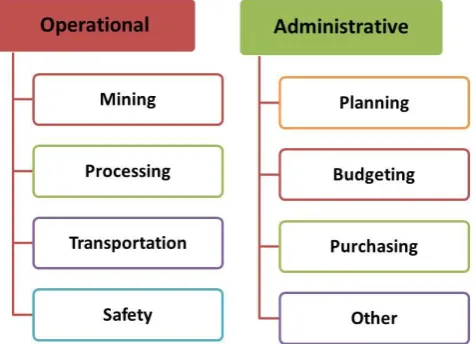
Fig. 1 General Operational and Administrative processes in mining industry
An overview of Operational (Mining, Processing, Transportation and Safety) and Administrative activities involved in mining industry are shown in Fig. 1; in this paper we are focussing on Operational processes.
Using the Method
Planning and preparation.Identify the target product family or service. Create a charter, define the problem, set the goals and objectives, and select the mapping team. Socialize the charter with the leadership team.
Draw while on the shop floor a current state value stream map, which shows the current steps, delays, and information flows required to deliver the target product or service. This may be a production flow (raw materials to consumer) or a design flow (concept to launch). There are 'standard' symbols for representing entities.
Assess the current state value stream map in terms of creating flow by eliminating waste.
Draw a future state value stream map.
Work towards the future state condition.
Develop action (Kaizen) plans and review actions.
Drawing a Process Map
Fig. 2 Example of visual display of Process map
Objectives which can improve performance in mining industry are:
Improve Safety
Reduce Cost
Increase Production
Enhance Productivity
Others
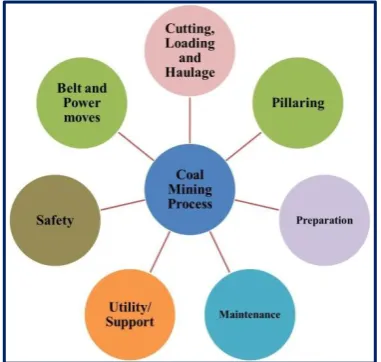
There are a wide range of mining process improvement programs, since each company has its own unique goals and characteristics. As a result, companies follow different performance improvement models based on their needs, cultures and styles, while performance improvement programs differ across mining companies, the types of processes they address are similar, within each process, there are a wide range of issues that can be addressed (Table 1).An illustrative example ofUnderground Coal Mining Process is shown in Fig.3. [7-9].
DOI: 10.15680/IJIRSET.2014.0310035
General Issues Underground Mining Surface Mining
Performance consistency Production shortfalls Dragline performance
Cost reduction Loading time lost Truck shovel performance
Facility-based planning Equipment issues Haulage – coal and overburden
Communication and teamwork
Timing of production and development
Drilling and blasting
Standard operating
procedures Usage of scheduled downtime Pit planning
Organization and staffing
issues Belts Reclamation
Roles and responsibilities Belt and power moves De-watering
Performance measurement and monitoring
Construction planning and management
Equipment maintenance
Work schedules Drainage management Fuel and lube
Maintenance planning Heavy haulage
Parts and supplies
Processing Transportation Safety
Plant availability shortfalls Priority/Effectiveness of load
out operations Training
Feed rates Integration of mining,
processing and loading Awareness
Linkage to mine operating
plans Delay tracking
Communication, coordination and teamwork
Sampling Load out maintenance Safe operating procedures
Refuse disposal Utilization and maximization of
track/load out capacity Supervision
Mobile equipment productivity and management
Manual processes Monitoring and enforcement
Magnetite usage Railroad issues Accident investigation
Coal losses Repeat incidents
Coal quality compliance Root cause analysis
Analysis e.g. injury types and categories
Table1. Operational Issues by Process in Coal mining industry (In this paper we are focussing on Operational Processes for Coal mining)
schedules, mucking, the movement of men and machinery, etc., and the interdependency of related tasks further complicates the situation.
Examples of waste that can be noticed in a mine [1-6]:
Motion—inefficient truck paths, People moving, Shovels making too many passes
Waiting—information or materials not complete or ready to go, idle equipment and resources, Trucks may be waiting
at a dump site
Over Production—Large batches, ignoring customer demands, mining capacity may outstrip the plant’s ability to
process ore
Processing—Processing ore to a better grade than the customer is willing to pay; drilling more holes than necessary,
adding more value than the customer wants, unnecessary process steps
Defects—incorrect action, out of standard, requires remediation and costly rework
Inventory—keeping too much or the wrong stock
Transportation—Moving mined ore many times before it reaches its final destination, unnecessary movement and
shifting, extra handling
III.PROSPECTSFORIMPROVEMENT
Mine performance optimization is all about the loss elimination. An improvement made in one part of the process would not improve the overall system performance if there was a constraint downstream from the improvement.
Prospects for Improvement
Lack of procedures and standards
Inconsistent section set-up
Inconsistent/non-existent cut cycle
Poor teamwork within crews and across shifts
Large amount of loading time lost
Cable damage
Frequent emergency breakdowns
Poor preparation for following shift
Violations and accidents
Belt and power moves disrupt loading time
Solutions
There are frequently many options to address the problem areas that have been identified, and these options need to be identified, evaluated and narrowed down before the best solutions can be selected. By selecting right processes like: creating continuous process flow, using the Pull system, levelling the workload, Standardization, using the visual control and the reliable tested technology can produce the right results.
Potential Current Performance Measures Potential Early Warning System Measures
Tons mined Ability to remain on cut cycle
Operating cost per ton Time to start loading at beginning of shift
Cost versus budget Section ready for next shift
Productivity Loading time lost
Accidents and violations Completion of planned maintenance work
DOI: 10.15680/IJIRSET.2014.0310035
Measuring and tracking performance which are shown in Table 2 are key steps to help identify potential changes and sustain improvements. Performance measures for the underground coal mining process can include current performance levels and an early warning system.
IV.CONCLUSION
In applying lean principle into mining industry, one should understand that lean principle is an operating philosophy in its original context (automotive industry) that had particular values, needs and characteristics. Standardization is critical foundation in lean principle, as TaiichiOhno said; ―Where there is no standard, there can be no Kaizen‖. In mining, standardization is a difficult task as a work in mining is very much depends on the uncontrollable factors [1-6].
Lean principles have the potential to be successfully applied in the mining industry; however there are challenges that need to be considered and overcome. Think of lean not just as a change of process but also a change in company culture. It is a slow process and one that will require total devotion. Applied correctly, lean principles could have some seriously positive impacts on business.
Lean principles are not purely about cost saving; instead, it focuses on working smarter to reduce or eliminate the nonvalue-adding work people do each day. Lean thinking is not complex but requires detailed understanding of the process, it can save time, money and effort – and empower the workforce to increaseproductivity, efficiency and morale.
V. ACKNOWLEDGEMENTS
Apart from the efforts of myself, I wish to express my sincere gratitude to the BESt Team, I am grateful for their constant support and help.
REFERENCES
[1] Collard, M., Noort, D., and Seal, W., ―The Lean Mining Network Connecting Lean Mind‖, The Association for Manufacturing Excellence (AME) Conference, Chicago, USA, 2007.
[2] AndiWijaya, R Kumar, U Kumar; ―Implementing lean principle into mining industry issues and challenges‖, International Symposium on Mine Planning and Equipment Selection, 2009.
[3] Wikipedia, http://en.wikipedia.org/wiki/Value_stream_mapping
[4] Maria Rosienkiewicz, ―Idea of Adaptation Value Stream Mapping method to the conditions of the Mining Industry‖, AGH Journal of Mining and Geoengineering , Vol. 36, pp.3, 2012.
[5] Klippel, A. F., Petter, C.O. and Antunes Jr., J.A.V., ―Management Innovation‖, a way for mining companies to survive in a globalized world, Utilities Policy, 16, 2008.
[6] Shingo, S., & Dillon, A. P. ―A study of the Toyota production system from an industrial engineering viewpoint‖. New York, NY, 10016: Productivity Press, 1989.
[7] ArpitaAshaKhanna, Governance in Coal Mining: ―Issues and Challenges‖, The Energy and Resources Institute,New Delhi, August 2013. [8] IBM (Indian Bureau of Mines), ―Indian Minerals Yearbook‖, Ministry of Mines, Government of India, 2011- 2012.