Abstract
VENKATRAMAN, MAHADEVAN. Specifying and Verifying Compliance in Commit-ment Protocols (Under the direction of Dr. Munindar P. Singh).
Interaction protocols are specific, often standard, constraints on the behaviors of au-tonomous agents in a multiagent system. Protocols are essential to the functioning of open systems, such as those that arise in most interesting web applications. A variety of common protocols in negotiation and electronic commerce are best treated as commitment protocols, which may be defined and analyzed in terms of the creation, satisfaction, or manipulation of the commitments among the participating agents.
SPECIFYING AND VERIFYING COMPLIANCE IN
COMMITMENT PROTOCOLS
BY
MAHADEVAN VENKATRAMAN
A THESIS SUBMITTED TO THE GRADUATE FACULTY OF
NORTH CAROLINA STATE UNIVERSITY
IN PARTIAL FULFILLMENT OF THE
REQUIREMENTS FOR THE DEGREE OF
MASTER OF SCIENCE
DEPARTMENT OF COMPUTER SCIENCE
RALEIGH
SEPTEMBER 1999
APPROVED BY:
Biography
Mahadevan Venkatraman was born on February 16th, 1976 in Mumbai, India. He lived in Anushaktinagar, Mumbai until January 1997. His schooling was from Atomic Energy Central School until tenth grade, and from Atomic Energy Junior College until the twelfth grade.
Acknowledgments
Table of Contents
List of Figures vi
1 Introduction 1
1.1 Commitments in an Open Architecture . . . 6
1.2 Languages for Defining Protocols . . . 8
1.3 Contributions . . . 9
1.4 Organization . . . 10
2 Technical Framework 11 2.1 Potential Causality . . . 11
2.2 Temporal Logic . . . 13
2.3 Social Commitments . . . 15
3 Specification of a Commitment Protocol 20 3.1 Specifying Commitment Protocols . . . 20
3.1.1 Protocol Server . . . 22
3.1.2 BNF . . . 23
3.2 The Layering Approach . . . 25
3.2.1 Commitment . . . 26
3.2.2 Coordination . . . 26
3.2.3 Authentication . . . 28
3.3 Representing Well-Known Protocols . . . 28
4 Verification 36 4.1 The Quasimodel and the General Model . . . 38
4.2 Implications of the Specification Language . . . 41
4.3 Reasoning with the Quasimodel . . . 43
4.4 Model Checking . . . 47
4.5.1 Message Losses . . . 51 4.5.2 Message Delays . . . 52
5 Conclusion 54
List of Figures
2.1 Vector clocks in the fish market protocol . . . 13
2.2 Message pattern for delegate(l) and assign(r). . . 18
3.1 Different layers and their functionality . . . 26
3.2 Skeletons of the haggling protocol . . . 31
3.3 Skeletons of the fish market protocol . . . 34
4.1 An example quasimodel and its corresponding general model . . . 40
4.2 Observations for auctioneer and a bidder in the fish market protocol . . . . 41
4.3 Illustration of Theorem 3 . . . 44
4.4 State transition diagram of a commitment . . . 48
Chapter 1
Introduction
Interaction among agents is the distinguishing property of multiagent systems. However, ensuring that only the desirable interactions occur is one of the most challenging aspects of multiagent system analysis and design. This is especially so when the given multiagent system is meant to be used as an open system, for example, in web-based applications.
Because of its ubiquity and ease of use, the web is rapidly becoming the platform of choice for a number of important applications, such as trading, supply-chain management, and in general electronic commerce. However, the web can enforce few constraints on the behavior of agents. Current approaches to security on the web emphasize how the different parties to a transaction may be authenticated or how their data may be encrypted to prevent unauthorized access. Even with authentication and controlled access, the parties would neither have support beyond conventional protocol techniques (such as finite state machine models) to specify the desired interactions nor to detect any violation. Authentication and access control are conceptually orthogonal to ensuring that the parties behave and interact correctly. Even when the parties are authenticated, they may act undesirably through error or malice. It is important in such situations that agents be accountable for their actions.
with an object or action can be proved to a third party [Kailar, 1995].
Without proper accountability assurances in electronic commerce transactions, there would be no means to reliably enforce punitive measures against fraudulent individuals or organizations [Kailar, 1995, Kessler and Neuman, 1998]. Non-repudiation is another essential security service required in electronic commerce. Non-repudiation services pro-tect the parties involved in a transaction against the other party denying that a particular action or event took place. The two basic non-repudiation services required to establish ac-countability of parties are non-repudiation of origin (NRO) and non-repudiation of receipt (NRR) [Zhou and Gollmann, 1997]. NRO provides the recipient with evidence of origin of a message, which protects against any attempt by the originator to falsely deny having sent the message. In this respect, NRO is similar to accountability. On the other hand, NRR provides the originator of a message with evidence of receipt, which protects against any attempt by the recipient to falsely deny having received the message.
However, accountability and non-repudiability are not sufficient to ensure correct be-havior by an agent in situations where the time corresponding to a particular action is important. In the Internet, where messages are lost or delayed and not necessarily deliv-ered in a FIFO manner, accountability becomes a rather weak property. As an example to demonstrate the importance of time consider the following example of a fish market protocol [Rodr´ıguez-Aguilar et al., 1998].
Example 1 In the fish market protocol, we are given agents of two roles: a single
the auctioneer lowers the price; if more than one bidder says Yes, the auctioneer raises the price. In either case, if the price changes, the auctioneer announces the revised price and the process iterates.
Suppose, in the above example, a bidder responds with a Yes to a certain price quote, but the message gets delayed to a point where the advertised price becomes much higher. In this case, the buyer will suffer a loss if he is unable to further evidence regarding the time he sent the message. This situation illustrates the importance of associating time with actions. Even if we assume that we have an effective timestamping mechanism which allows us to determine that the message was an old one, we are still faced with the problem of determining if the agents are following the behavioral rules of the given protocol. For example, if the auctioneer backs out of the auction, even if there is exactly one bidder who said Yes, then there is no way to automatically prove the incorrect behavior of the auctioneer. It is up to a human being to examine the trace of each program and determine that the auctioneer committed a violation. Specification and verification of such behavioral properties of agents is the main concern of this study. It is also worthwhile to note that we do not concern ourselves with fairness properties of such protocols. As an instance, the fish market protocol does not incorporate fairness criteria based on varying network delays among different bidders. If a bidder has a slow network connection to the auctioneer, then he is clearly at a disadvantage with respect to other bidders and we do not explicitly model this fact in our system.
sources and serve different interests. Thus, these agents must be treated as
autonomous—with few constraints on behavior, reflecting the independence of
their users, and
heterogeneous—with few constraints on construction, reflecting the
indepen-dence of their designers.
Effectively, a multiagent system is specified as a kind of standard that its member agents must respect. In other words, a multiagent system can be thought of as specifying a protocol that governs how its member agents must act. For our purposes, the standard may be de jure as created by a standards body, or de facto as may emerge from practice or even because of the arbitrary decisions of a major vendor or user organization. All that matters for us is that a standard imposes some restrictions on the agents.
The fish market protocol is an example of such a standard in an electronic agent mar-ketplace. Because of its relationship to protocols in electronic commerce and because it is more general than the popular English and Dutch auctions, the fish market protocol has become an important one in the recent multiagent systems literature [Rodr´ıguez-Aguilar et al., 1998]. Accordingly, we use it as our main example in this study.
Testing is the process of executing a program with selected tests in order to detect faults [Tai and Carver, 1996]. Testing is not applicable to our domain, because the program code or even the executable code for an agent might not be available for testing. This may be so because the vendors might not want to share their trade secrets. We could, in principle, try to test an agent by verifying its compliance in different situations, but again this is subject to availability of the code.
comes close to our approach, except for the differences noted above.
Another important distinction is that verification may be performed by a central au-thority or by any of the participating agents whereas testing and debugging are performed centrally. This verification is based solely on the behavior of an agent, in other words, only on the messages that it generates. However, the requirements for behavior in multiagent systems can be quite subtle. Thus, along with languages for specifying such requirements, we need corresponding techniques to verify compliance.
1.1
Commitments in an Open Architecture
There are three levels of architectural concern in a multiagent system. One deals with individual agents; another deals with the systemic aspects of how different services and brokers are arranged. Both of these have received much attention in the literature. In the middle is the multiagent execution architecture, which has not been as intensively studied within the multiagent research community. An execution architecture must ultimately be based on distributed computing ideas albeit with an open flavor, e.g., [Agha and Jamali, 1999, Carriero and Gelernter, 1992, Francez and Forman, 1996]. A well-defined execution functionality can be given a principled design, and thus facilitate the construction of robust and reusable systems. Some recent work within multiagent systems, e.g., Ciancarini et al. [1996, 1998] and Singh [1998c], has begun to address this level.
enter into with each other. The commitments of the agents are not only base-level commit-ments dealing with what actions they must or must not perform, but also metacommitcommit-ments dealing with how they adjust their base-level commitments [Singh, 1999]. Commitments provide a layer of coherence to the agents’ interactions with each other. They are especially important in environments where we need to model any kind of contractual relationships among the agents. The ContractNet approach discussed in [Smith, 1980] tries to model such kind of contractual relationships, but it lacks a formal verification methodology.
Such contractual environments are crucial wherever open multiagent systems must be composed on the fly, e.g., in electronic commerce of various kinds on the Internet. The presence of commitments as an explicit first-class object results in considerable flexibility of how the protocols can be realized in changing situations. We term such augmented protocols commitment protocols.
Verifying compliance deals with checking if the different agents resolve their commit-ments to one another. These commitcommit-ments are created as agents send messages to each other. Also, some commitments are created when the agents bind themselves to a given protocol, and may be thought of as rules of the protocol. The task of determining if dif-ferent agents are resolving their commitments to each other are performed by the agents themselves. In case of conflict, they submit their evidence to a trusted third party who then resolves the conflict based on the evidence.
Example 2 We informally describe the protocol of Example 1 in terms of commitments.
to capture the practical meanings of such a protocol. For instance, the auctioneer may not honor his offering price if a sudden change in weather indicates that fishing will be harder for the next few days.
Commitments could also be associated with a continuous penalty level, where com-mitments vary from unbreakable to breakable as a continuum by assigning a commitment breaking cost to each commitment separately [Sandholm and Lesser, 1995]. Agents form and break commitments to maximize their own gain. The advantages of a leveled commit-ment protocol are formally analyzed in [Sandholm and Lesser, 1995]. Although we do not discuss leveled commitments in our study, we believe the same could be incorporated in our framework through appropriate metacommitments.
1.2
Languages for Defining Protocols
The need for languages to define protocols is well understood in the literature. In the computer security community, the focus has been on defining languages for cryptographic protocols or authentication protocols. On the other hand, this study is concerned with the high-level behavioral properties of agents rather than low-level authentication properties. As a result, we need a language that helps us specify typical kinds of protocols that are prevalent in electronic commerce applications. Desirable properties for such a language include
Expressiveness
Verifiability of compliance with the stated requirements Efficiency of the associated verification procedure
expressiveness of the language.
1.3
Contributions
Agents participating in a commitment protocol send messages to each other forming social commitments. In addition, there are metacommitments specific to the given protocol that exist from the start of the system. These could be thought of as laws of the system. These commitments are expressed in a specification language based on operations on commit-ments and the Computation Tree Logic (CTL).
It is essential for the participating agents to determine if other agents are indeed dis-charging their commitments to them. The agents can do so by creating a quasimodel based on the causal order of messages and apply a model checking algorithm over it. We do not concern ourselves with the details of the model checking, but concentrate more on the conditions under which an individual agent may check others’ commitments to it and also optionally keep track of its own pending commitments.
An agent can perform this local verification on the quasimodel itself by transforming the temporal formulae associated with the commitments. Traditionally, one would blow up the quasimodel into a finitely branching, infinitely deep tree model by considering all possible interleavings of the causally unrelated messages. We show that it is unnecessary to do so. This is one of the salient features of the specification language that we develop. Our main contributions include
developing a high-level specification language to specify behavioral properties
of agents.
incorporating potential causality and temporal logic for the specification and
showing that it is unnecessary to consider all interleavings between causality
unrelated messages, and thereby suggesting an efficient procedure to check compliance.
showing how to verify compliance based on local information. handling message losses and delays
achieving clear delineation between the roles of the commitment layer and the
coordination layer.
1.4
Organization
Chapter 2
Technical Framework
Commitment protocols as defined here are a multiagent concept. They are far more flex-ible and general than commitment protocols in distributed computing and databases, such as two-phase commit [Gray and Reuter, 1993, pp. 562–573]. This is because our under-lying notion of commitment is flexible, whereas traditional commitments are rigid and irrevocable. However, because multiagent systems are distributed systems and commit-ment protocols are protocols, it is natural that techniques developed in classical computer science will apply here. Accordingly, our technical framework integrates approaches from distributed computing, logics of program, and distributed artificial intelligence.
2.1
Potential Causality
knowledge of the internals of the agents, we cannot be sure that true causation was in-volved. It is customary to define the local time of an agent as the number of steps it has executed. [Schwarz and Mattern, 1994] and [Fidge, 1991] introduced the notion of a vector clock, which defines a partial order between events of a distributed system. A vector clock is a vector, each of whose elements corresponds to the local time of each communicating agent. A vector
v
is considered later than a vectoru
ifv
is later on some, and not sooner on any, element.Definition 2 A clock over
n
agents is ann
-ary vectorv
=
hv
1
:::v
niof natural numbers.
The starting clock is
~
0
4h
0
:::
0
i.Notice that the vector representation is just a convenience. We could just as well use pairs of the form hagent-id, local-timei, which would allow us to model systems of
varying membership more easily.
Definition 3 Given
n
-ary vectorsu
andv
,u
v
if and only if(
8i
: 1
i
n
:
u
i
v
i)
and
(
9i
: 1
i
n
:
u
i
< v
i)
.Each agent starts at
~
0
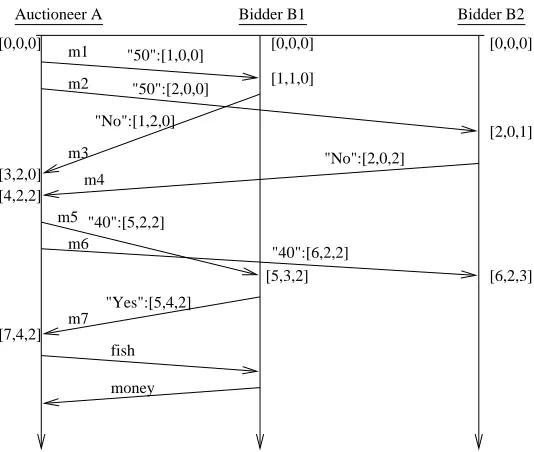
. It increments its entry in that vector whenever it performs a local event. It attaches the entire vector as a timestamp to any message it sends out. When an agent receives a message, it updates its vector clock to be the element-wise maximum of its previous vector and the vector timestamp of the message it received. Intuitively, the message brings news of how far the system has progressed; for some agents, the recipient may have better news already. However, any message it sends after this receive event will have a later timestamp than the message just received.Example 3 Figure 2.1 illustrates the evolution of vector timestamps for one possible run
000000000 000000000 111111111 111111111 00000000 00000000 00000000 00000000 00000000 00000000 11111111 11111111 11111111 11111111 11111111 11111111 000000000 000000000 000000000 000000000 111111111 111111111 111111111 111111111 00000000 00000000 00000000 00000000 11111111 11111111 11111111 11111111 000000000 000000000 000000000 111111111 111111111 111111111 00000000 00000000 00000000 11111111 11111111 11111111 "50":[2,0,0]
Auctioneer A Bidder B1 Bidder B2
m1 [0,0,0] [0,0,0] [0,0,0] [1,1,0] m2 "No":[1,2,0] [2,0,1] "No":[2,0,2] m3 m4 [3,2,0] m5 m6 [5,3,2] [6,2,3] "Yes":[5,4,2] m7 [7,4,2] "50":[1,0,0] "40":[5,2,2] "40":[6,2,2] money fish [4,2,2]
Figure 2.1: Vector clocks in the fish market protocol
of
50
for a certain bucket of fish. Bidders B1 and B2 both decline. A lowers the price to40
and announces it. This time B1 says Yes, leading A to transfer the fish to B1 and B1 to send money to A. For uniformity, the last two steps are also modeled as communications. The messages are labeledm
ito facilitate reference from the text.2.2
Temporal Logic
is Computation Tree Logic (CTL), which we adapt here in our formal language L.
Con-ventionally, a model of CTL is expressed as a tree. Each node in the tree is associated with a state of the system being considered; the branches of the tree or paths thus indicate the possible courses of events or ways in which the system’s state may evolve. CTL provides a natural means by which to specify acceptable behaviors of the system.
The following Backus-Naur Form (BNF) grammar with a distinguished start symbol L gives the syntax ofL. Lis based on a set
of atomic propositions. Below, slant typefaceindicates nonterminals;,! andjare metasymbols of BNF specification;anddelimit
comments; the remaining symbols are terminals. As is customary in formal semantics, we are only concerned with abstract syntax.
L1. L,! Propatomic propositions: members of
L2. L,! :Lnegation
L3. L,! L^Lconjunction
L4. L,! APuniversal quantification over paths
L5. L,! EPexistential quantification over paths
L6. P,! LULuntil: operator over a single path
The meanings of formulas generated from
L
are given relative to a model and a state in the model. The meanings of formulas generated fromP
are given relative to a path and a state on the path. The boolean operators are standard. Useful abbreviations includefalse
(
p
^:p
)
, for anyp
2 ,true :false,p
_q
:p
^:q
andp
!q
:p
_q
.The temporal operatorsAandE are quantifiers over paths. Informally,
p
Uq
means that onmeans “eventually
q
” and abbreviatestrue Uq
.Gq
means “alwaysq
” and abbreviates:F:q
.Therefore, E
p
Uq
means that on some future path from the given state,q
will eventuallyhold and
p
will hold untilq
holds.Definition 4
M
=
hS;<;
Iiis a formal model for L. Sis a set of states;<
S
S
is apartial order indicating branching time, andI
:
S7! P()
is an interpretation, which tellsus which atomic propositions are true in a given state. For
t
2 S, Pt is the set of paths
emanating from
t
.M
j=
t
p
expresses “M
satisfiesp
att
” andM
j=
P;t
p
expresses “M
satisfiesp
att
alongpath
P
.” M1.M
j=
t iff
2I
(
t
)
, where 2M2.
M
j=
tp
^
q
iffM
j=
t
p
andM
j=
t
q
M3.
M
j=
t:
p
iffM
6j=
tp
M4.
M
j=
tA
p
iff(
8P
:
P
2P t)
M
j=
P;tp
)
M5.
M
j=
tE
p
iff(
9P
:
P
2Ptand
M
j=
P;t
p
)
M6.
M
j=
P;tp
U
q
iff(
9t
0:
t
t
0and
M
j=
P;t0
q
and(
8t
00
:
t
t
00
t
0
)
M
j=
P;t00
p
))
The above is an abstract semantics. In Section 4.3, we specify the concrete form of
,S,<
, andI, so the semantics can be exercised in our computations.2.3
Social Commitments
and powerful variety of social commitments, which are the commitments of one agent to another [Singh, 1999]. These commitments are defined relative to a context, which is typi-cally the multiagent system itself. The debtor refers to the agent that makes a commitment, and the creditor to the agent who receives the commitment. Thus we have the following logical form.
Definition 5 A commitment is an expression C
(
x;y;G;p
)
, wherex
is the debtor,y
thecreditor,
G
the context, andp
the condition committed to.Definition 6 A commitment
c
=
C(
x;y;G;p
)
is base-level ifp
does not refer to any othercommitments;
c
is a metacommitment ifp
refers to a base-level commitment.Intuitively, a protocol definition is a set of metacommitments for the different roles (along with a mapping of the message tokens to operations on commitments). In combination with what the agents communicate, these lead to base-level commitments being created or manipulated, which is primarily how a commitment may be referred to within a protocol. The violation of a base-level commitment can give us proof or the “smoking gun” that an agent is noncompliant.
The following operations on commitments define how they may be created or manipu-lated. When we view commitments as an abstract data type, the operations are methods of that data type.
the protocol, through its metacommitments, allows that operation. However, when an op-eration is allowed, it affects the agents’ commitments. For simplicity, we assume that the operations on commitments are given a deterministic interpretation. Here
z
is an agent andc
=
C(
x;y;G;p
)
is a commitment.O1.
Create(
x;c
)
instantiates a commitmentc
. Create is typically performed as a con-sequence of the commitment’s debtor promising something contractually or by the creditor exercising a metacommitment previously made by the debtor. Create usually requires a message from the debtor to the creditor.O2.
Discharge(
x;c
)
satisfies the commitmentc
. It is performed by the debtor concurrently with the actions that lead to the given condition being satisfied, e.g., the delivery of promised goods or funds. For simplicity, we treat the discharge actions as performed only when the propositionp
is true. Thus the discharge actions are detached, meaning thatp
can be treated astruein the given moment. We model the discharge as a singlemessage from the debtor to the creditor.
O3.
Cancel
(
x;c
)
revokes the commitmentc
. It can be performed by the debtor as a single message. At the end of this action, :c
holds. However, depending on the existingmetacommitments, the cancel of one commitment may lead to the create of other commitments.
O4.
Release(
G;c
)
orrelease(
y;c
)
essentially eliminates the commitmentc
. This is dis-tinguished from both discharge and cancel, because release does not mean success or failure, although it lets the debtor off the hook. At the end of this action, :c
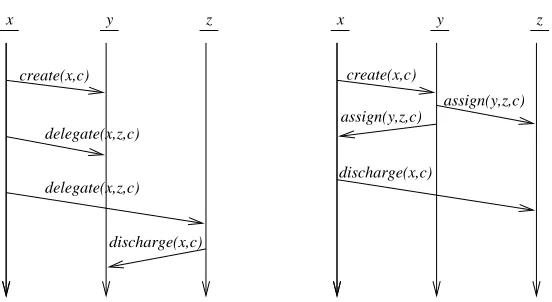
holds.delegate(x,z,c)
y z x y z
assign(y,z,c) create(x,c)
assign(y,z,c) delegate(x,z,c)
discharge(x,c)
discharge(x,c) x
create(x,c)
Figure 2.2: Message pattern for delegate(l) and assign(r).
O5.
Delegate(
z;c
)
shifts the role of the debtor to another agent within the same context, and can be performed by the old debtor or the context. Letc
0=
C
(
z;y;G;p
)
. At theend of the delegate action,
c
0^:
c
holds.To prevent the risk of miscommunication, we require the creditor to also be involved in the message pattern. Figure 2.2(l) shows the associated pattern. The first message sets up the commitment
c
fromx
toy
and is not part of the pattern. Whenx
delegates the commitmentc
toz
,x
tells bothy
andz
that the commitment is delegated.z
is now committed toy
. Laterz
may discharge the commitment. The two delegate messages constitute the pattern.O6.
Assign(
z;c
)
transfers a commitment to another creditor within the same context, and can be performed by the present creditor or the context. Letc
0=
C
(
x;z;G;p
)
. At theend of the assign action,
c
0^:
c
holds.Here we require that the new creditor and the debtor are also involved as shown in Figure 2.2(r). The figure shows only the general pattern. Here
x
is committed totricky situation is if
x
discharges the commitmentc
even asy
is assigningc
toz
(i.e., the messages cross). In this case, we requirey
to discharge the commitment toz
— essentially by forwarding the contents of the message fromx
. Thus the worst case requires three messages.We write the operations as propositions indicating successful execution. Based on the applicable metacommitments, each operation may entail additional operations that take place implicitly.
Chapter 3
Specification of a Commitment Protocol
This chapter discusses the components of a commitment protocol, and the specification language in particular, that we use to specify and verify commitment protocols.
We present a BNF to define the language and discuss the salient properties of the lan-guage with respect to electronic commerce protocols. We also discuss the underlying co-ordination layer and the role it plays in our verification framework.
3.1
Specifying Commitment Protocols
Protocols in general can be represented by means of communicating finite state machines. We could set up the system in such a way that all agents are constrained to satisfy their skeletal finite state machine thus always resulting in correct and coherent behavior. But, this destroys the autonomy of the agents in being able to perform desired actions. Agents should be able to do anything they want. But specifying and verifying correct behavior in such situations is difficult.
this is to have a skeletal program for each role in a protocol. A skeleton is a coarse descrip-tion of how an agent may behave [Singh, 1998c]. A skeleton is associated with each role in the given multiagent system to specify how an agent playing that role may behave in order to coordinate with others. The coordination layer knows about the skeleton and ensures that agents act according to their skeletons. Coordination includes the simpler aspects of inter-action, e.g., turn-taking. Coordination is required so that the agents’ commitments make sense. For instance, a bidder should not make a bid prior to the advertisement; otherwise, the commitment content of the bid would not even be fully defined.
The skeletons may be constructed by introspection or through the use of a suitable methodology [Singh, 1998d]. No matter how they are created, the skeletons are the first line of compliance verification, because an agent that does not comply with the skeleton for its role is automatically in violation. So as to concentrate on commitments in this study, we postulate that a proxy object is interposed between an agent and the rest of the system. The proxy agent ensures that the agent follows the dictates of the skeleton of its role. Proxies are discussed further in Section 3.2.2.
Every agent is forced to comply with the skeleton. Further, every agent in complying with the skeleton creates some commitments. To satisfy these commitments is up to the agent. Thus, we respect the autonomy of the agents in that they are able to decide for themselves whether or not to break commitments. The less restrictive the skeleton, the more autonomous the agents. In the light of the above discussion, we can now state what a protocol specification must include.
Definition 7 A commitment protocol specification has five components :
Roles and context group
Protocol tokens whose meaning is described in terms of commitments Skeletal programs for all roles. The skeletons describe the basic ordering of
actions between agents, i.e., the basic coordination between agents. We use a finite state machine augmented with programming language syntax for this. The representation of the skeleton is shown in the examples.
This describes the basic components of a commitment protocol. We now elaborate on how this is realized.
3.1.1
Protocol Server
The protocol server is the main entity that stores the definition of the commitment protocol. It plays the role of a trusted third party in the system. It allows agents to bind themselves to the roles defined in the specification of the protocol and provides them with the coordi-nation stub corresponding to their role in the protocol. The need for this stub is discussed in Section 3.2.2 below. Once the role binding process is complete, the communication between agents is completely distributed and the messages that agents send to each other need not be routed through the protocol server.
The protocol officially begins when the protocol server broadcasts a start message to each agent to start the protocol. The protocol ends when each of the individual agents express their desire to end the execution. When that happens, the protocol server broadcasts an end message to each agent, and this is when the protocol officially ends. The protocol server can be thought of as the context group of the execution.
knows about all the events that happens at the local space of an agent. This trace contains information about the events that happened in an agent’s local space. The protocol server may then verify the compliance of all agents in the system with regard to the commitments they formed. Any unresolved or broken commitment constitutes a violation. If a metacom-mitment exists that describes what needs to be done in such a situation, then the protocol server takes the appropriate action. However, if no metacommitment deals with the situa-tion, then human intervention is required. This describes a retrospective approach to verify compliance but we believe the same could be extended for online checking and control also.
This study is not concerned with how a violation is handled by the authorities once it is detected, but in generating a proof that a violation occurred or, in other words, provability of (non-)compliance is the main concern. It is up to the authorities to handle the situation appropriately.
3.1.2
BNF
[Rodr´ıguez-Aguilar et al., 1998]. The latter is a hypothetical protocol, but often seen in use in human interactions.
We now define the syntax of the specification language through the following grammar whose start symbol is Protocol. The braces f and g indicate that the enclosed item is
repeated
0
or more times. The angled bracketsanddelimit comments. Note that ourlanguage is context-free.
The following syntax describes the structure of the commitments (both meta and ordi-nary) that can be used in a commitment protocol.
Protocol,! fMetagfMessageg
Message ,! Token: fActg each message corresponds to a sequence of
actions
Commitment,! C(Debtor, Creditor, Context, Prop)
Prop ,! AG[BoolAct ) AFSendAct] j AG[SendAct ) BoolAct] j AFsend DomAct
Meta,! C(Debtor, Creditor, Context, MetaProp)
MetaProp,! AG[BoolAct)AFsend OpAct]jAG[send OpAct)BoolAct] a metacommitment always has a nested commitment
BoolAct,! boolean combinations of Act and Commitment Act,! SendActjRecvAct
SendAct,! send OpActjsend DomActall the send events RecvAct,! recv OpActjrecv DomActall the receive events OpAct,! Operation(Agent, Commitment)
Operation ,! the six operations
DomAct,! domain-specific actions, e.g., fish(A, B)
verification approach is to detach the outer actions and commitments, so we can process the inner L part as a temporal logic. By using commitments and operations on them,
instead of simple domain propositions, we can capture a variety of subtle situations, e.g., to distinguish between release and cancel operations both of which result in the given commitment being removed.
The above syntax allows commitments like C(A, B, G, AFsend fish(C, D)) although
these do not make sense. As a rule, we allow only those commitments in which the debtor can verify the truth of the proposition contained in the commitment, or in other words, the debtor sees all the actions present in the definition of the commitment. Specifically, the debtor must be mentioned in the scope of any action present in the commitment definition. A simple algorithmic check can identify commitments of the form described above. Al-ternatively, we could avoid such commitments from the syntax explicitly by using labels corresponding to agents in the syntax above, but we choose not to do so for simplicity. We just assume commitments of the form described above are not allowed. Protocols where the debtor has less control over the commitments that it creates do not fit our model, but it is worthwhile to note that in competitive scenarios such as electronic commerce, this is often not the case.
3.2
The Layering Approach
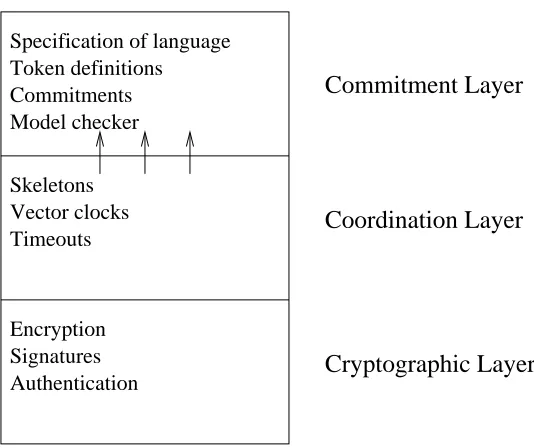
Specification of language Token definitions
Commitments Model checker
Cryptographic Layer
Skeletons Vector clocks Timeouts
Encryption Signatures Authentication
Commitment Layer
Coordination Layer
Figure 3.1: Different layers and their functionality
3.2.1
Commitment
The commitment layer bears the high-level definition of the commitment protocol, i.e., the metacommitments and the definitions of the various tokens of the protocol. This study primarily deals with the commitment layer and its verification methodology as applied to our specification language.
3.2.2
Coordination
comply with its skeleton. The other way is to use the coordination layer as the medium or the proxy object through which the agents communicate. The proxy can ensure that agents are indeed complying with their skeleton, since all the messages are routed through it. All it needs to do is to check if the agent’s action is consistent with the current state of the finite state machine corresponding of the role. The coordination layer timestamps the messages according to a timestamping mechanism as discussed in Section 2.1. It is possible that agents could forge their timestamps, but there are mechanisms by which these could be prevented [Reiter and Gong, 1993]. For simplicity, we assume that the coordination skele-ton corresponding to every role is provided by the protocol server at bind time, and this acts as the trusted stub through which agents communicate with one another. Thus we do not risk the situation in which malicious agents forge their timestamps. Alternatively, tech-niques for handling reliable message delivery despite byzantine failures could be adopted [Reiter and Gong, 1993]. Also, the coordination layer could sign the messages so that it is not possible to use a different stub from the one provided.
Skeleton specification
price quote made by the auctioneer earlier. Note that we are only storing the last statement by the auctioneer rather than the entire history. This illustrates that the commitment layer is dependent upon the coordination layer to provide it with values of variables. This de-pendence may be thought of as the point where the coordination layer and the commitment layer interface with each other. This is similar to the service access point (SAP) concept in the OSI reference model, whereby a higher layer requests services from a lower layer. Fig-ures 3.2 and 3.3 below illustrate the skeleton specification details. In these figFig-ures, the first element of every
p=q
pair is an action or an event that corresponds to the send or the receive of a token. We distinguish between send and receive events as always. The labels of the some transitions do not have the q part. The symbol e corresponds to the empty string or the epsilon transition, i.e., this transition can be fired without any local event taking place.Every agent complies with its skeleton in terms of providing the basic coordination. For instance, a seller cannot send 2 price quotes one after the other without receiving a price quote from the buyer. This is easily seen from Figure 3.2. Once an agent reaches its end state, it can receive messages, but cannot send any messages.
3.2.3
Authentication
This layer is the lowest level of compliance checking, and includes cryptographic means by which messages can be authenticated. A key distribution protocol could be used to authenticate messages. We do not concern ourselves with these aspects as they already well-known in literature [Burrows et al., 1990].
3.3
Representing Well-Known Protocols
Example 4 This is the classical buyer-seller haggling protocol. First, a seller proposes a
price for an item. The buyer responds with another price quote (smaller if the buyer is rational). The seller then responds with another price quote, and so on.
If after a certain price quote by the seller, the buyer is satisfied, then he sends
the money to the seller upon which the seller sends the item to the buyer.
If after a certain price quote by the buyer, the seller is satisfied, then he sends
the item to the buyer upon which the buyer sends the money to the seller.
We represent the haggling protocol in our framework as follows, thus giving a formal and unambiguous definition to the protocol.
Roles and Context:
Seller, henceforth called S. Buyer, henceforth called B.
Context group for the haggling protocol, henceforth called HP.
Domain specific propositions and actions:
ItemAct
(
S;B
)
corresponds to the action of giving the item to the buyer.
MoneyAct p
(
B;S
)
corresponds to the action of giving the money to theseller (
p
dollars).Metacommitments:
There are no metacommitments for this protocol.
Protocol Tokens and Skeletons:
In the example, we use temporary variables called
currBuyerPrice
andcurrSellerPrice
to store the most recent price quotes by the two parties. Then, the tokens
CS
p
=
C
(
S, B, HP,AG[
recv Money Act
p
(
B;S
)
)
AF
send ItemAct
(
S;B
)])
CB
p
=
C
(
B, S, HP,AG[
recv Item Act
(
S;B
)
)AF
send MoneyAct
p
(
B;S
)])
Now we define the four tokens that are used in the protocol.
SellerPrice
p : This token is equivalent to releasing the buyer from his
pre-vious commitment to the seller, and creates a new commitment for the seller. release(
S
,CB
currBuyerPrice) followed bycreate(
S
,CS
p)
BuyerPrice
p : This token is equivalent to releasing the seller from his
pre-vious commitment to the buyer, and creates a new commitment for the buyer. release(
B
,CS
currSel l erPrice) followed bycreate(
B
,CB
p)
ItemAct
: This token corresponds to the actual sending of the item to thebuyer.
discharge(
S;
C(
S;B;
HP
;
AFsend ItemAct
(
S;B
)))
MoneyAct
p : This token corresponds to the actual sending of the money to
the seller.
discharge(
B;
C(
B;S;
HP
;
AFsend MoneyAct
p
(
B;S
)))
Fig 3.2 shows the skeletons of the seller and the buyer in the haggling protocol.
1
receive_SellerPrice_p /
2 currBuyerPrice = p
3 e / send_BuyerPrice_p /
4
send_Money_Act_p
e /
/ currSellerPrice = p
receive_ItemAct /
BUYER SKELETON
currBuyerPrice = p 1
receive_BuyerPrice_p / currBuyerPrice = p
2
3
receive_BuyerPrice_p /
4 e /
send_Item Act /
SELLER SKELETON
send_SellerPrice_p /
currSellerPrice = p
receive_MoneyAct_p /
Figure 3.2: Skeletons of the haggling protocol
Example 5 The messages in Figure 2.1 can be given a content based on the following
definitions. Here
FM
is the fish market context.Roles and Context:
Auctioneer, henceforth called
A
Bidders, henceforth calledB
j
Context group for the fish market protocol, henceforth called FM.
sh
: a domain proposition meaning the fish is deliveredmoney
i: a domain proposition meaning that the appropriate money is paid
(subscripted to allow different prices)
bad
: a domain proposition meaning the fish is spoiledMetacommitments:
The protocol includes metacommitments that are not associated with any single mes-sage. In the present protocol, there are two metacommitments. The high demand metacom-mitment says that the auctioneer can cancel his commetacom-mitment to supply fish at a given price, provided there is high demand at that price. The bad fish metacommitment is of the context itself to release a committing party under certain circumstances. For practical purposes, we could treat these as metacommitments of the creditor. Alternatively, we could have mod-eled this commitment in the same way as we modmod-eled the high demand commitment, by allowing the bidder to cancel his commitment if the fish were bad.
High demand: C
(
A;B
j;
FM
;
AG
[
cancel
i(
B
j)
)
demand
i
])
Bad fish: C(FM
;B
j
;
FM
;
AG
[bad
)AF
release(FM
;
C(
B
j
;A;
FM
;
AF
send money
i))])
Protocol Tokens and Skeletons:
First, we define some abbreviations for simplicity.
Bid
i(
B
j)
:C
(
B
j
;A;
FM
;
AG
[recv sh
)A
Fsend money
i
])
—meaning thebidder promises to pay
money
iif given the fishAd
i
(
B
j)
:C
(
A;B
j;
FM
;
AG
[
recv
Bid
i(
B
j)
) AF
send sh])
—meaning theauctioneer offers to deliver the fish if he gets a bid for
money
idemand
i:
(
9
j;k
:
j
6=
k
^Bid
i(
B
j)
^
Bid
i
(
B
k))
—meaning that at least twobidders have bid for the fish at price
i
cancel
Armed with the above, we can now state the commitments associated with the different messages (tokens) in the fish market protocol.
money
i
Payment of
i
fromB
j:discharge(
B
j;
C(
B
j
;A;
FM
;
AF
send money
i))
fish
Delivering fish to
B
j:discharge(
A;
C
(
A;B
j;
FM
;
AF
sh
))
Y es
Yes from
B
j (for pricecurrPrice
):create(
B
j;
Bid
currPrice(
B
j))
No
No from
B
j (for pricecurrPrice
): true
price
=
i
Advertise to
B
j (for pricei
):create(
A;
Ad
i(
B
j))
cancel
Cancel the ad to
B
j (for pricecurrPrice
):cancel
currPrice(
B
j)
In addition, in a monotonic framework, we would also need to state the completion requirements to ensure that only the above actions are performed.
The auctioneer is not committed to a price if no bid is received. If more than one bid is received, the auctioneer is allowed to cancel his commitment. Notice that the auctioneer can exit the market or adjust the price in any direction if a unique Yes is not received for the current price
money
i. It would neither be rational for the auctioneer to raise the priceif there are no takers at the present price, nor to lower the price if takers are available. However, the protocol per se does not legislate against either behavior.
how the reasoning takes place in a successful run of the protocol.
e / 1
2
1
2
AUCTIONEER SKELETON
send_Price_p / currPrice = p time_out
3 time_out
BIDDER SKELETON
recv_Price_p /currPrice = p Yes /
No /
3 e /
Figure 3.3: Skeletons of the fish market protocol
Example 6 The auctioneer sends out an advertisement, which commits him to supplying
the fish if he receives a suitable bid. This commitment will be discharged ifAG
[Bid
i(
B
j)
)
AF
send sh]
holds. WhenBid
i
(
B
j)
is sent byB
j, the bidder is committed to the bid,which is discharged ifAG
[sh
) AFmoney
i]
holds. To discharge the advertisement, the auctioneer must eventually supply the fish. If he does not supply the fish, he is in violation. If he supplies the fish, the bidder is then committed to eventually supply the money. If the bidder does so, the protocol is executed successfully, i.e., without any violation.
Chapter 4
Verification
in other circumstances. However, if an execution is inappropriate, that does entail that the system does not satisfy the protocol. Consequently, although we are verifying specific exe-cutions of the multiagent system, we can only falsify (but not verify) the correctness of the construction of the agents in the system.
Model checking of the form introduced above may be applied by any observer in the multiagent system. A useful case is when the observer is one of the participating agents. Another useful case is when the observer is some agent dedicated to the task of managing or auditing the interactions of some of the agents in the multiagent system.
Potential causality is most often applied in distributed systems to ensure that the mes-sages being sent in a system satisfy causal ordering [Birman, 1993]. Causality motivates vector clocks and vector timestamps on messages, which help ensure correct ordering by having the messaging subsystem reorder and retransmit messages as needed. This applica-tion of causality can be important, but is controversial [Birman, 1994, Cheriton and Skeen, 1993], because its overhead may not always be justifiable.
In our approach, the delivery of messages may be non-causal. However, causality serves the important purpose of yielding accurate models of the observations of each agent. These are needed, because in a distributed system, the global model is not appropriate. Creating a monolithic model of the execution of the entire system requires imposing a central authority through which all messages are routed. Adding such an authority would take away many of the advantages that make distributed systems attractive in the first place. Consequently, our method of constructing and reasoning with models should
not require a centralized message router
work from a single vantage of observation, but be able to handle situations
where some agents pool their evidence.
The observations made by each agent are essentially a record of the messages it has sent or received. Since each message is given a vector timestamp, the observations can be partially ordered. In general, this order is not total, because messages received from different agents may be mutually unordered.
4.1
The Quasimodel and the General Model
For the purposes of the semantics, we must define a global model with respect to which commitment protocols may be specified. The formal semantics of our language are then defined over this global model. Our specific concrete model identifies states with messages. Recall that the timestamp of a message is the clock vector attached to it. The states are ordered according to the timestamps of the messages. The proposition true in a state is the one corresponding to the operation that is performed by the message.
The quasimodel refers to the model generated based on the causal ordering between messages. As a result, it has two states corresponding to each message, one for the send event and one for the receive event. There are two additional states, the
start
and theend
states. We assume that a start message and an end message is broadcast to every participant of the protocol. This is done by the protocol server. We do not distinguish between the send and receive events ofstart
andend
messages. Thus, we arrive at the following definition for the set of statesQ
.Definition 8 Q
=
fsend
(
m
) :
m
is a message
g [ frecv
(
m
) :
m
is a message
g [f
start;end
gWe now define a partial order between states in
Q
based on the causality relationdefinedDefinition 9 Let
<
denote the minimum relation onQ
such that<
+=
. Here,
start
corresponds to
~
0
. Note that(
8q
2Q
:
start < q
)
and(
8q
2Q
:
q < end
)
.Definition 10 For
s
2 Q, I(
s
)
= fthe operations or actions mapped to or executed bymessage
s
gThe structure
M
Q=
hQ
;<;
Iiis a quasimodel(Here and below, we assume that<
and Iare appropriately projected to the available states).M
Qis structurally a model, because it
matches the requirements of Definition 4. However,
M
Qis not a model of the computationsthat may take place, because the branches in
M
Qare concurrent events and do notindividu-ally correspond to a single path. A quasimodel can be mapped to a model,
M
S=
hS
;<;
Iiwith an initial state
~
0
, by including all possible interleavings of the causally unordered states. That is,Swould include a distinct state for every message in each possible orderingof the states inQthat is consistent with the temporal order
<
ofM
Q. The relation
<
canbe suitably defined for
M
S.M
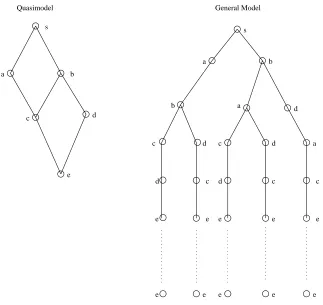
S can be interpreted as a finitely branching, infinitely tallrooted tree. The end state is repeated infinitely many times below each distinct ordering, so as to be consistent with the CTL model. In figure 4.1, the state
e
represents the end state. The root corresponds to the start state. Figure 4.1 shows an example quasimodel and its corresponding general model. However, there is a potentially exponential blowup in the size ofSas a state inQ
could possibly map to many states inS
.Definition 11 Let state
u
2S
map to statev
2Q
, i.e., to say bothu
andv
correspond toeither the send or the receive of the same message. Then, we say
v
=
quasi
(
u
)
.Here,
quasi
:
S
7!Q
is a many-to-one function. In fact, the number of elementse s b a c d e s a b a c d c d d e d d c e b c a c e e
Quasimodel General Model
e e
e
e
e
Figure 4.1: An example quasimodel and its corresponding general model
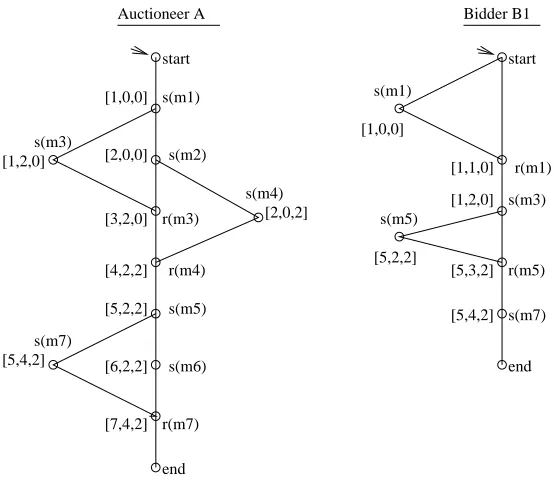
Example 7 Figure 4.2 shows the models constructed locally from the observations of the
auctioneer and a bidder in the run of Example 3.
Although a straightforward application of causality, the above example shows how local models may be constructed. The quasimodel is in some sense the union of all the local models. Given local models,
M
i=
h
Q
i
;<
i;I
ii, the corresponding global quasimodel is
M
=
hQ;<;I
i whereQ
=
S i
Q
i,
I
(
q
) =
I
j(
q
)
whereq
2Q
j, and
<
is the minimum[6,2,2] s(m6) [1,0,0] end s(m1) s(m2) [2,0,0] r(m3) [3,2,0] [5,2,2] s(m5) r(m7) end s(m3) [5,4,2] s(m7) s(m4) [2,0,2] r(m4) [7,4,2] [4,2,2] s(m7) [1,0,0] [1,1,0] r(m1) [5,4,2] s(m5) [5,2,2] [1,2,0] s(m3) [5,3,2] r(m5) [1,2,0]
Auctioneer A Bidder B1
start s(m1)
start
Figure 4.2: Observations for auctioneer and a bidder in the fish market protocol
4.2
Implications of the Specification Language
First, we define some important concepts that apply to commitments.
Definition 12 A commitment
c
is resolved through a release, discharge, cancel, delegate, or assign performed onc
. The commitmentc
ceases to exist when resolved. However, a new commitment is created for delegate or assign.Theorem 1 If event
e
i creates commitmentc
and evente
j resolvesc
, then the creditor ofc
sees both
e
i ande
j, provided all actions in the definition ofc
contain it as either the senderor the receiver.
Proof. Since all the actions in the definition of
c
contain the creditor ofc
, it can always verifydischarge
(
c
)
. For other operations, an inspection of the corresponding message patterns defined in Section 2.3 helps establish this fact. This is because all operations require a message to be sent to the creditor.Definition 13 A commitment
c
is ultimately resolved through a release, discharge or can-cel performed onc
where it is resolved, or where any commitments created by the delegate or assign ofc
are ultimately resolved.Theorem 2 essentially states that the creation and ultimate resolution of a commitment occur along the same causal path. This is important, because it legitimizes a significant optimization below. Indeed, we defined the above message patterns so we would obtain Theorem 2.
Theorem 2 If message
m
i creates commitmentc
and messagem
j ultimately resolvesc
,then
m
im
j.
Proof. As stated in section 3.1.2, only commitments in which the debtor is able to verify
the discharge of the commitments are allowed in our framework. This is the reason that all the actions leading to the
discharge
ofc
are seen by the debtor and hence occur on the same causal path. For other operations, an inspection of their message patterns helps establish this fact. This is because all the other operations require a message to be sent or received by the debtor, and thus are causally related to the initial commitment.In the following definitions let
M
=
hS;<;
Iibe a model that matches the requirements ofDefinition 14 Let
c
be any commitment, meta or ordinary. We say thatM
c
iffc
isresolved in
M
.Definition 15 Let
c
be a commitment created in stateq
2S
. Then,M
j=
p
c
iffq < p
andthe commitment is not resolved on any path from
q
top
. In other words, the commitment exists in the system in statep
and has not yet been resolved.It is our goal to apply the model-checking procedure on the quasimodel itself, so that we can eliminate the potential blowup in the number of states. For this purpose, we need to transform the temporal formulae encapsulated inside the commitments, so that they can be applied to the quasimodel. Accordingly, we define the following transformation.
Definition 16 Define
M
T Q=
hQ
;<;
I Tiwhere each commitment
c
inI
is transformed toc
Tby replacing every eventuality formulaAFin
c
byEF.The basic structure of all commitments remains the same. All that changes is the temporal formula inside a commitment.
4.3
Reasoning with the Quasimodel
Now we explain the main reasoning steps in our approach and show that they are sound. A protocol execution is considered compliant with the specifications if all commitments created in it are resolved. This means that inappropriate actions such as cancel must be prevented or constrained, unless they are allowed by the metacommitments.
where the debtor is committed to perform an action eventually. In such a case, it does not matter how the different events are ordered among themselves. All that matters is that the discharge action is causally after the creation of the commitment. Also, since all the events relevant to a commitment occur on the same causal path, it is sufficient to look at paths in the quasimodel rather than look at interleavings in the general model.
Our construction ensures that all the events relevant to another event are totally ordered with respect to each other. Notice that, as shown in Figure 2.2, the construction may appear to require one more message than necessary for the assign and delegate operations. As we show below, however, this linear amount of extra work (for the entire set of messages) pays off in reducing the complexity of our reasoning algorithm.
end q
sendAct p
General Model
q
sendAct
p
end
p
sendAct
end Quasimodel
Figure 4.3: Illustration of Theorem 3
Theorem 3
M
T Qc
TProof. Figure 4.3 shows an example quasimodel where
M
S j=
q
bool
. Let the propositioncontained in
c
beAG[
bool
) AFsendAct
]
, which meansc
T=
AG
[
bool
) EFsendAct
]
.First we prove
M
Sc
)M
T Qc
T. We assume that
M
Sj
=
q
bool
, which meansM
S j=
q
AF
sendAct
, which means all pathsrooted at
q
inM
S contain a state corresponding tosendAct
below. If we assume thatsendAct
andq
were causally unrelated, then there must exist a path along whichsendAct
happens before
q
inM
S. But this is contradictory to the fact thatM
S j=
q
AF
sendAct
.Hence our assumption is false and
sendAct
is causally after stateq
. This means there exists a causal path fromq
tosendAct
, which meansM
TQ j
=
q
EF
sendAct
, and this showsM
TQ
c
T
.
Now, we prove the converse, i.e.,
M
T Qc
T)
M
Sc
. IfM
T Qj
=
qEF
sendAct
, thenthere is a causal path from state
q
to the state corresponding tosendAct
, and hence this state will be belowq
along all interleavings, which meansM
Sj
=
qAF
sendAct
.The above results show that compliance can be verified and without blowing up the model unnecessarily. However, we would like to test for compliance based on local information— so that any agent can decide for itself whether it has been wronged by another. For this reason, we would like to be able to project the global model onto local models for each agent, while ensuring that the local models carry enough information that they are indeed usable in isolation from other local models. Accordingly, we can define the construction of local models corresponding to an agent’s observations. This is simply by defining a subset ofSfor a given agent
a
.Definition 17 S a
=
f
send
(
m
) :
m
is a message from or to a
g [ frecv
(
m
) :
m
is a message from or to a
gTheorem 4 shows that if we restrict our attention to commitments whose resolution the given agent can verify, then the projected quasimodel yields all and only the correct con-clusions relative to the global quasimodel. Thus, if the interested party is vigilant, it can check if anyone else violated the protocol.
Theorem 4
M
T ac
Tif and only if
M
T Qc
T, provided that
a
sees all the commitments mentioned inc
.Proof. Since
a
sees all the commitments mentioned inc
, this meansM
T ahas all the in-formation required to verify compliance. Furthermore, the CTL state formulaEF
sendAct
requires the existence of one causal path along which
sendAct
occurs, which is the same for bothM
Ta
and
M
T Q, except possibly that there might be some intermediate, though irrel-evant, states missing in
M
Ta. Hence, the result follows.
Example 8 If one of the bidders backs down from a successful bid, the auctioneer
im-mediately can establish that he is cheating, because the auctioneer is the creditor for the bidder’s commitment. However, a bidder cannot ordinarily decide whether the auctioneer is noncompliant, because the bidder does not see all relevant commitments based on which the auctioneer may be released from a commitment to the bidder.
Theorem 5 lifts the above results to sets of agents. Thus, a set of agents may pool their evidence in order to establish whether a third party is noncompliant. Thus, in a setting with two bidders, a model that includes all their evidence can be used to determine whether the auctioneer is noncompliant. Ordinarily, the bidders would have to explicitly pool their information to do so. However, in a broadcast-based or outcry protocol (like a traditional fish market in which everyone is screaming), the larger model can be built by anyone who hears all the messages. Let
A
be a set of agents.Definition 18 S A
=
S a2A
S a.
M
Theorem 5 Let the commitments observed by agents in
A
include all the commitments inc
. ThenM
T Ac
Tiff
M
T Qc
T.
Proof. From the construction of
M
Aand the proof of Theorem 4. The set of agents couldbe thought of as a single agent who observes all the events for any agent, and the proof for Theorem 4 can be applied here as well.
4.4
Model Checking
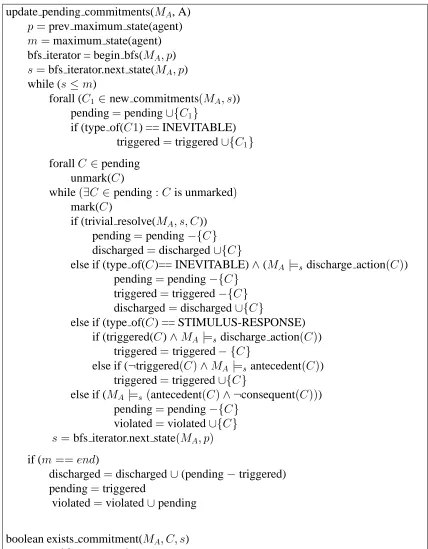
Given the theorems above, we need to apply model checking to the quasimodel. The states in the model correspond to operations on commitments, and domain actions. Operations like delegate and assign trivially resolve a commitment but create new commitments. The release and cancel operations serve in deleting commitments from the system, but we need to check if they are allowed by the metacommitments.
In this section, we present pseudocode for performing various types of commitment analyses on the quasimodel both for online and retrospective verification. The create, dele-gate and assign operations create new commitments. Any commitment is trivially resolved if one of cancel, release, delegate or assign is performed on it. We assume that these oper-ations are performed only if allowed by the metacommitments. This assumption is suitable because the agents interact through predefined tokens, and the coordination layer would not allow sending arbitrary messages.
There are three types of commitments allowed by our specification language namely:
INEVITABLE(I): This refers to commitments of the form
C
(
x;y;G;
AFdischarge action)
CONDITIONAL(C): This refers to commitments of the form
C
(
x;y;G;
AG[
antecedent)consequent])
S-R non-triggered
pending/
violated
pending/triggered
discharged
C, S-R I
I C, S-R
S-R
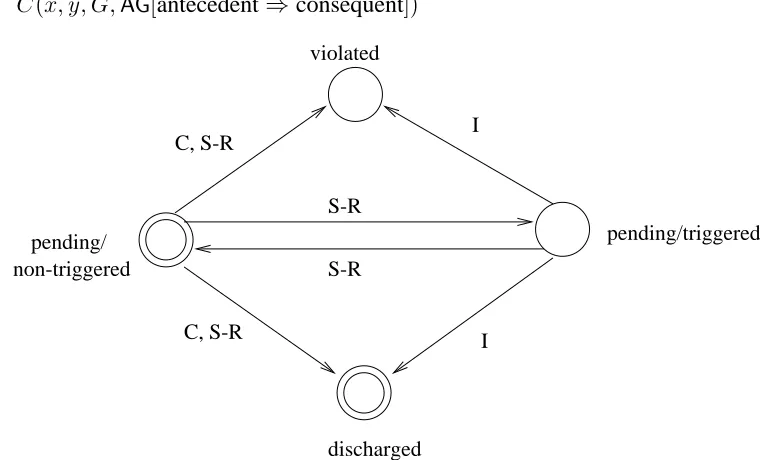
Figure 4.4: State transition diagram of a commitment
Furthermore, during the protocol execution each commitment is associated with one or more of the following states:
pending: this means the commitment has not yet been resolved violated: this means the commitment has already been violated discharged: this means the commitment has already been discharged
triggered: this means an action is required on the part of the debtor to discharge
the commitment. An inevitable commitment is always in the triggered state until it is discharged or violated.
At any point of time, a commitment is either pending, discharged, or violated. Fig-ure 4.4 shows the state transition diagram of a commitment during the execution of proce-dure 4.5.