On the Distribution
of the Mean
and
Variance
of
a Quantitative
Trait
Under Mutation-Selection-Drift Balance
Reinhard
Biirger*and Russell Landet
*Znstitut f u r Mathematik, Uniuersitat Wien, A-1090 Wien, Austria, and 'Department of Biology, University of Oregon, Eugene, Oregon 97403
Manuscript received February 14, 1994 Accepted for publication July 21, 1994
ABSTRACT
The distributions of the mean phenotype and of the genetic variance of a polygenic trait under a balance between mutation, stabilizing selection and genetic drift are investigated. This is done by stochastic simu- lations in which each individual and each gene are represented. The results are compared with theoretical predictions. Some aspects of the existing theories for the evolution of quantitative traits are discussed. The maintenance of genetic variance and the average dynamics of phenotypic evolution in finite populations (with Ne < 1000) are generally simpler than those suggested by some recent deterministic theories for infinite populations.
T
HE importance of polygenic mutations for the maintenance of genetic variation in quantitative traits and for the response to long-term directional se- lection has been investigated and discussed in numerous publications (e.g., LANDE 1975,1988; HILL 1982; TURELLI1984; LYNCH and HILL 1986; KEIGHTLEY and HILL 1983, 1988; SLATKIN 1987; BURGER et al. 1989; HOULE 1989) [cf. BULMER (1989) and BARTON and TURELLI (1989) for re- views and further references]. There seems to be some consensus that mutation can contribute substantially to the maintenance of genetic variation although the ex- tent may differ greatly between species and traits. Many other mechanisms and models have been suggested or
investigated that either reduce or increase the amount of heritable variation compared to the simple mutation- selection-balance hypothesis. As a consequence of the well known disputes about this subject, fresh experimen- talapproaches have been started ( e . g . , CABALLERO et al.
1991; MACKAYet al. 1992; SANTIAGO et al. 1992; LOPEZ and LOPEZ-FANJUL 1993a,b).
Many of the theoretical analyses have been devoted to deterministic models, ignoring the consequences of ge- netic drift in finite populations, and considerable progress in the understanding of such multilocus mod- els has been achieved (LATTER 1960; &MUM 1965;
BULMER 1972; LANDE 1975; FLEMING 1979; TURELLI 1984;
BARTON 1986; BARTON and TURELLI 1987; SLATKIN
1987; BURGER 1989; FRANK and SLATKIN 1990; HASTINGS
1990; TURELLI and BARTON 1990; B ~ R G E R and HOFBAUER
1994; to mention just a few). However, the overall con- clusion that must be drawn from these investigations, and this was particularly stressed by TURELLI and BARTON
(1990), is that the evolutionary dynamics of quantitative traits crucially depends on so many assumptions and ge- netic details that it is unlikely that general, simple, and reliable predictions can ever be made.
Genetics 138: 901-912 (November, 1994)
In this study, we investigate the distribution of the mean phenotype and of the genetic variance of a quan- titative character under mutation-stabilizing selection balance in a finite population. We compare the simu- lation results with the phenotypic theory for the mean phenotype Of LANDE (1976) and with predictions for the distribution of the genetic variance by LYNCH and HILL
(1986), BARTON (1989) and BURGER et al. (1989). On the basis of these and other results, we conclude that several of the complications occurring in deterministic poly- genic models are simplified by genetic drift and thus are of much less importance in small or moderately large populations.
THEORY
We give a brief summary of those theoretical results on the distribution of a quantitative trait in a finite popu- lation whose validity will be investigated in the next sec- tion. We consider a randomly mating, finite population of constant effective size Ne with discrete generations. Individual fitness is determined by a single quantitative character under Gaussian stabilizing selection on viabil- ity, with the optimum phenotype at zero, Le., the viabil- ity of an individual with phenotypic value z is assumed to be
where o2 is inversely proportional to the strength of sta- bilizing selection.
The quantitative character under consideration is as-
902 R. Biirger and R. Lande
the genetic contribution and a normally distributed en- vironmental effect with mean zero and variance a: = 1. Therefore, the phenotypic mean 5 equals the mean of the additive genetic values, g, and the pheno- typic variance is u: = ai
+
uf , with ui denoting the(additive) genetic variance. We shall use the parameter
V ,
= w 2+
af = w 2+
1 to describe the strength of sta- bilizing selection on the breeding values.Distribution of the mean phenotype: Random sam- pling in a finite population induces stochasticity in the evolution of the mean phenotype and, more generally, of the whole distribution of phenotypic values. There- fore, a proper understanding of phenotypic evolution requires the knowledge of the sampling distribution of the average phenotype, of the genetic (and hence phe- notypic) variance, etc. Under the empirically testable assumption of a normal distribution of phenotypic val- ues, LANDE (1976) showed that the distribution of the average phenotype is normal under stabilizing selection as in ( 1 ) . In particular, he derived the dynamics of the expected mean phenotype and of its variance. At sto- chastic equilibrium, the expected mean phenotype o b viously coincides with the optimum phenotype zero, and LANDE'S (1976) formula (17b) yields the variance of the distribution of Z, i e . ,
V(2) = (6;
+
v,)2 af Ne(&;+
2V,)+-
BN,where 6; denotes the average genetic variance at equi- librium, and the second term in (2a) accounts for mea- suring the phenotype among a finite number BN of progeny before selection ( B the birth rate; see below). LANDE'S theory for the distribution of the mean pheno- type does not depend on specific mechanisms determin- ing how genetic variation is maintained under stabiliz- ing selection and random drift. It depends on the assumption that selection acts only on the phenotype, and that nothing other than selection and drift affect the mean phenotype.
Distribution of the genetic variance: To obtain ap- proximations for the distribution of the genetic vari- ance, the mechanism by which genetic variability is maintained must be specified. We assume that it is through mutation. Let p denote the mutation rate per haploid locus. Following CROW and &MUM'S (1964) continuum-of-alleles model, we assume an effectively continuous distribution of possible effect for mutants with mean zero, variance a2, and no skewness. There is no restriction on the number of possible alleles per locus.
Various theories and approximations have been de- rived for the expected value of the additive genetic vari- ance in a finite population under a balance between
selection, mutation, and random genetic drift (see ref- erences below).
For a neutral phenotypic character, LYNCH and HILL
(1986) showed that the expected genetic variance under mutationdrift balance is
(2N, - 1)'
6: (N) = V,
2%
-
2Ne V,, (3b)where V, = 2npa2 is the variance introduced by mutation each generation (see also CLAWON and ROBERTSON 1955). Their model assumes that 4N,p < 1, so that it is unlikely to have more than two alleles per locus.
For stabilizing selection acting on the phenotype ac- cording to ( l ) , the approximate formula
6;(SHC) = 4npa2Ne
1
+
(ff2Ne/V,>for the expected genetic variance has been found in- dependently, by different methods, and almost at the same time by four groups of authors (BURGER 1988;
KEIGHTLEY and HILL 1988; BARTON 1989; BURGER et al.
1989; HOULE 1989). It has been called the stochastic house-of-cards approximation because, in the limit of infinite population size, (4) reduces to TURELLI'S (1984)
so-called house-ofcards (HC) approximation
6i(HC) = 4npV,. (5)
This is identical to the two-allele approximations of LATTER (1960) and BULMER (1972). The generality and accuracy of (5) were investigated recently by BURGER
and HOFBAUER (1994). In the limit of weak selection, i. e., V, + m, (4) reduces to the neutral formula (3b).
The approximation (4) was derived for the continuum-of-alleles model using the HGapproxima- tion (5) and diffusion theory (cf. BURGER et al. 1989),
and it can be rewritten as half the harmonic mean of (3b) and (5), L e . ,
&;(N)~;(Hc) 6i(SHC) =
b i ( N )
+
6i(HC)'The validity of the SHGapproximation (Equation 4 or
6) requires low mutation rates per locus and a high vari- ance a2 of the distribution of mutant effects because the HC-approximation does so and because the neutral a p proximation requires small p. For high mutation rates or low
CY',
the Gaussian approximation of KIMURA (1965) and its multilocus extension by LANDE (1975) are more appropriate and could be inserted into (6) instead of 6: (HC) (see also LATTER 1970; LYNCH and LANDE 1993). All the formulas in this section are based on the assump- tion of linkage equilibrium.Extensive stochastic computer simulations (BURGER
903
equilibrium variance for a wide range of parameters. KEIGHTLEY and HILL (1988) obtained values of the ge- netic variance that are up to 30% larger than predicted by (4). The reason is that their transition matrix a p proach, for equal allelic effects across loci being equiva- lent to BULMER’S (1972) model, is based on a determin- istic recursion equation with heterozygote disadvantage at each locus. This heterozygote disadvantage is a con- sequence of the assumption that the gene frequencies are always such that the mean phenotype is at the fitness optimum, which, however, is not satisfied in the full mul- tilocus model. Consideration of the marginal fitness val- ues, as appropriate under the assumption of global link- age equilibrium, shows that each locus is under directional selection and this should lead to a lower ge- netic variance. BARTON’S (1989) simulation model with
two alleles per locus, is based on the correct determin- istic equations for the gene frequency change in the full multilocus model and yields estimates of the genetic variance that are below those of BULMER (1972) and KEIGHTLEY and HILL (1988) but higher than (4). This is not surprising, because in BARTON’S simulation model alleles still occur in pairs, symmetric with respect to the optimum. The present simulations [as those in B~JRGER
et al. (1989) and B ~ R G E R (1989)l neither assume linkage equilibrium, nor equal allelic effects, nor are they based on deterministic recursion equations. It turns out that a better approximation is obtained in the case where ran- dom drift is strong compared to selection if in (6) for- mula (3a) is used for &: (N) instead of (3b).
The distribution of the genetic variance, in particular the variance of the genetic variance,
qui)
has been stud- ied in detail only in the neutral case. Under the assump tion 4Nep < 1, so that the likelihood of more than two segregating alleles per locus is negligible, LYNCH andHILL (1986) showed that for a normal distribution of mutational effects with mean zero
‘I
-
&;(N)(Y*,if 4Nep
<<
1 and 2np<<
1.ZENC and COCKERHAM (1991), using a different model of mutation with a limited range of allelic effects, obtained (7a) but with +2/n instead of - l / n . For a neutral model without mutation, BULMER (1980, p. 230) calcu- lated the variance of the components of genetic variance that are due to random departures from Hardy- Weinberg equilibrium, Cw, and linkage disequilibrium,
q.
Denoting the “true” variance, which would be ob- served in Hardy-Weinberg and linkage equilibrium for a given set of gene frequencies, by V, he showed that Var( Cw) = V$/Ne and, in the absence of linkage, Var(Ci) == 5V$/3Ne. Comparison with (7a) shows thatthese terms are small provided that 4np
<<
1. LYNCHand HILL (1986) apparently neglected variation due to Hardy-Weinberg disequilibrium and their term
2&:(N)‘/(3Ne), for variation due to departures from link- age equilibrium, differs from BULMERS by a factor 5/2. AWRY and HILL (1977) obtained 4V$/(3Ne) for that quantity. Our formula (A.27) for the variance of the genetic variance agrees, to first order, with (7b) if 4Nep
<<
1 and if the mutant distribution is normal.For phenotypic characters under stabilizing selection, the variance of the genetic variance can be approxi- mated by
&.2,(SHC)a2 = 1
+
(a2Ne/V,)(BARTON 1989). In the limit of V, + m, this reduces to (7b). Higher moments of the distribution of the genetic variance seem to be unknown.
METHODS AND RESULTS
The theoretical results about the distribution of the mean phenotype and the genetic variance are based on various simplifjmg assumptions. This is unavoidable be- cause of the notorious difficulties encountered in the analysis of polygenic models. Therefore, we have per- formed comprehensive stochastic computer simulations to check these approximations.
The simulation model: This has been adapted from the one used in BURGER et al. (1989) and BURGER and
LYNCH (1994). It uses direct Monte-Carlo simulation, representing each individual and each gene. The geno- typic value of the character is determined by n additive loci with no dominance or epistasis. We chose n = 50 for all of our simulations. We simulate the continuum-of- alleles model of CROW and KIMURA (1964) by drawing individual allelic effects from a continuous distribution, so the number of possible segregating alleles per locus is limited only by population size. The phenotypic value of an individual is obtained from the genotypic value by adding a random number drawn from a normal distri- bution with mean zero and variance a: = 1. The gen- erations are discrete, and the life cycle consists of three stages: (a) random sampling of breeding pairs from the surviving offspring of the preceding generation, (b) pro- duction of offspring, including mutation and recombi- nation, (c) viability selection according to (1).
Each breeding pair produces exactly 2B offspring and, for all parameter values shown below, more than
90% of these survive viability selection. Random sam- pling of N parents is performed without replacement and the sex-ratio is 1:l. Thus, the number of breeding adults is always N and the mating system is dioecious and monogamous. The effective population size is Ne =
4N/(V,
+
2), where V, = 2(1 - l / B ) [ l - (2B - 1)/( B N - l ) ] is the variance in family size. For further details see BURGER et al. (1989) and BURGER and LYNCH
904 R. Burger and R. Lande
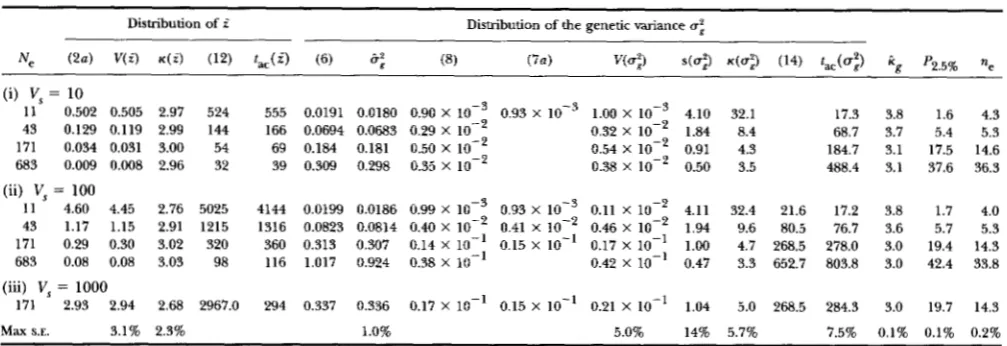
TABLE 1
The distribution of the mean phenotype Z and of the genetic variance a: under mutationaelection-drift balance
Distribution of i Distribution of the genetic variance a:
Ne ( 2 a ) V ( i ) K ( Z ) (12) t a c ( i ) (6) &f (8) (7a) Wu:) s ( u 3 4 ~ : ) (14) &(ai) kg P2.5% ae
(i) V, = 10
11 0.502 0.505 2.97 524 555 0.0191 0.0180 0.90 X 0.93 X 1.00 X lop3 4.10 32.1 43 0.129 0.119 2.99 144 166 0.0694 0.0683 0.29 X lo-' 0.32 X 10⁶' 1.84 8.4
171 0.034 0.031 3.00 54 69 0.184 0.181 0.50 X lo-' 0.54 X lo-' 0.91 4.3 683 0.009 0.008 2.96 32 39 0.309 0.298 0.35 X 10⁶'
17.3 3.8 1.6 4.3 68.7 3.7 5.4 5.3 184.7 3.1 17.5 14.6 0.38 X lo-' 0.50 3.5 488.4 3.1 37.6 36.3 (ii) V, = 100
11 4.60 4.45 2.76 5025 4144 0.0199 0.0186 0.99 X lop3 0.93 X 0.11 X 106' 4.11 32.4 21.6 17.2 3.8 1.7 4.0 43 1.17 1.15 2.91 1215 1316 0.0823 0.0814 0.40 X lo-' 0.41 X lo-' 0.46 X 10⁶' 1.94 9.6 80.5 76.7 3.6 5.7 5.3 171 0.29 0.30 3.02 320 360 0.313 0.307 0.14 X 10⁻¹ 0.15 X 10⁻¹ 0.17 X 10⁶' 1.00 4.7 268.5 278.0 3.0 19.4 14.3
683 0.08 0.08 3.03 98 116 1.017 0.924 0.38 X lo-' 0.42 X 10" 0.47 3.3 652.7 803.8 3.0 42.4 33.8 (iii) V, = 1000
171 2.93 2.94 2.68 2967.0 294 0.337 0.336 0.17 X 10⁻¹ 0.15 X 10⁻¹ 0.21 X 10⁶' 1.04 5.0 268.5 284.3 3.0 19.7 14.3 Max S.E. 3.1% 2.3% 1.0% 5.0% 14% 5.7% 7.5% 0.1% 0.1% 0.2%
The symbols V ( . ) , s(.), and K ( . ) refer to the variance, the skewness, and the kurtosis, respectively. Also shown are the autocorrelation time for
the mean phenotype, t,, ( i ) , the autocorrelation time of the genetic variance, tac(ai), the average kurtosis k of genotypic values, the average number of polymorphic loci, P2.596, on a 2.5% level, and the effective number ne of segregating loci. Theoretical values are indicated by their equation number and compared to observed values from the simulation (see text). For all parameter combinations in this table, the mutant distribution is Gaussian with variance cy2 = 0.05 and the mutation rate per haploid locus is p = 0.0002. This gives a genomic mutation rate of
2 n p = 0.02 and a mutational variance per generation of V,/a; = as approximately observed in empirical studies (LANDE 1975; LYNCH 1988). There is free recombination between all loci. The bottom row contains the maximum standard error in percent of the mean of the data in the
g
corresponding column.
In our simulations, we chose four different popula- tion sizes, i.e., N = 8, 32, 128, and 512 breeding adults. For all these population sizes, we chose B = 2. This leads to effective population sizes of Ne = 11,43,171, and 683, respectively. The observed Ne's in our simulations differ from these by less than 1 % , for large N by less than 0.1 %
.
(The effective population size has been calculated by storing for each offspring the (indices of the) parents it came from, and then calculating the variance of family size among the offspring that survived selection.) For each parameter combination, a certain number of r e p licate runs with stochastically independent initial popu- lations were performed, each run over lo5 generations. Initial populations were obtained from a preceding ini- tial phase of several hundreds or thousands of genera- tions (depending on N ) during which mutation- selection balance had been reached. The number of replicate runs per parameter combination was 100, 40, 25, and 10 for N = 8,32,128,512, resp. This yieldedvery small standard errors (see below), much smaller than in earlier simulations.
The distribution of the mean phenotype and of the genetic variance: The present simulations show, con- firming a trend suggested by the simulation results in
BURGER et al. (1989) and BURGER (1989) that the SHC-
approximation (4) tends to overestimate the true equi- librium variance, in particular when genetic drift pre- vails. One of the reasons is that (3b) overestimates the neutral variance &;(N) for small Ne. Also the H G approximation overestimates the true equilibrium vari- ance in infinite populations (cf. BURGER and HOFBAUER
1994). Therefore, all theoretical results below are based
on choosing (6) in conjunction with (3a) as analytical approximation for the genetic variance. For the variance of the mean phenotype V(Z), Equation 2a in conjunc- tion with (6) is used. Results for the distribution of the mean phenotype and the genetic variance are summa- rized in Tables 1 and 2. Previous simulations (BURGER
et al. 1989) have shown, as suggested by formulas (3) and (4), that the average genetic variance depends in a linear way on the genomic mutation rate 2np and not on p and n separately, if the loci are unlinked and n is not too small (say n 2 10). Equations 2,7, and 8 suggest
that this remains true for the variance of the mean phe- notype and of the genetic variance but we have not checked this by simulation.
The statistics displayed in Table 1 show that the dis- tribution of the mean phenotype is almost perfectly Gaussian (a Gaussian distribution has a kurtosis of K = m4/u4 = 3.0) and LANDE'S (1976) formula for the vari- ance of the mean phenotype (Equation 2) is very accu- rate. Only for weak selection, i e . , small Ne/V,, is the distribution of the mean slightly platykurtic. This Gaus- sian theory also works well for other mutation param- eters and mutant distributions, and also for linked loci (see Table 2). In contrast to our results, BARTON (1989) had found that the variance of the mean phenotype is lower than predicted by (2b) which is even smaller than (2a) and yields V(Z) = 0.0292 for the parameters in Table 2. In his model, however, there are exactly two
alleles with effects ctu at each locus. This may lead to multiple stable equilibria, and the mean phenotype does not necessarily coincide with the optimum (BARTON
Quantitative Dynamics
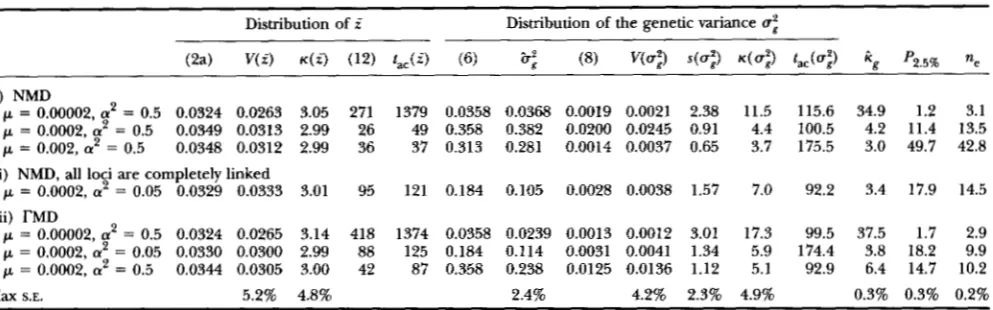
TABLE 2
Continuation of the distribution of the mean phenotype i and of the genetic variance u: under mutation-selectiondrift balance
Distribution o f f Distribution of the genetic variance u:
(i) NMD
p = 0.00002, 'a = 0.5 0.0324 0.0263 3.05 271 1379 0.0358 0.0368 0.0019 0.0021 2.38 11.5 115.6 34.9 1.2 3.1
p = 0.0002, a2 = 0.5 0.0349 0.0313 2.99 26 49 0.358 0.382 0.0200 0.0245 0.91 4.4 100.5 4.2 11.4 13.5
p = 0.002, 'a = 0.5 0.0348 0.0312 2.99 36 37 0.313 0.281 0.0014 0.0037 0.65 3.7 175.5 3.0 49.7 42.8 (ii) NMD, all loci are completely linked
p = 0.0002, 'a = 0.05 0.0329 0.0333 3.01 95 121 0.184 0.105 0.0028 0.0038 1.57 7.0 92.2 3.4 17.9 14.5 (iii) TMD
p = 0.00002, 'a = 0.5 0.0324 0.0265 3.14 418 1374 0.0358 0.0239 0.0013 0.0012 3.01 17.3 99.5 37.5 1.7 2.9
p = 0.0002, 'a = 0.05 0.0330 0.0300 2.99 88 125 0.184 0.114 0.0031 0.0041 1.34 5.9 174.4 3.8 18.2 9.9
p = 0.0002, a2 = 0.5 0.0344 0.0305 3.00 42 87 0.358 0.238 0.0125 0.0136 1.12 5.1 92.9 6.4 14.7 10.2
Max S.E. 5.2% 4.8% 2.4% 4.2% 2.3% 4.9% 0.3% 0.3% 0.2%
Since, for many of the parameter combinations here, (6) does not give accurate estimates for the equilibrium genetic variance, the values of (2a), (8), and (12) are based on the observed value 6;. In all cases, V, = 10 and Ne = 171. NMD indicates a normal mutant distribution with variance a', TMD a reflected rdistribution with variance a2 and j3 = 0.5. (The latter is defined by As( x i 8-1 exp(-A i x i )/(2r(j3)), where the constants A and fl can be chosen such that this distribution has a predefined variance and kurtosis. For j3 = 0.5, the kurtosis becomes 11.7) (See KEIGHTLEY and HILL 1988; BURGER 1993).
locus continuum-of-alleles model behaves more simply (and likely more realistically) than this biallelic model and always leads to an equilibrium distribution of ge- notypic values such that the mean phenotype coincides with the optimum if the mutant distribution is symmet- ric ( c j BURGER and HOFBAUER 1994). This seems to carry over to some extent to the finite population case (see also BARTON 1989) and is most likely the reason for the different results.
Concerning the average genetic variance, Table 1 confirms the finding by BURGER et al. (1989) that the SHGapproximation (Equations 4 or 6) predicts the ob- served genetic variance accurately, although in all cases it gives a slight overestimate. The variance of the genetic variance is well predicted by BARTON'S (1989) formula (our (8)), however, it always underestimates the ob- served V(a:) by approximately 10%. Calculating (8) on the basis of the observed average variance 6:, leads to a slightly greater underestimate. For the cases where
Ne/ V, <
2,
the approximation (7a), due to LYNCH and HILL (1986), is included. For small Ne and very weak selection, it is even lower than BARTON'S prediction be- cause then (7a) is smaller than (7b) which would cor- respond to (8).As
observed in BURGER (1989), the SHC- prediction tends to overestimate the observed genetic variance considerably, either if the loci are very tightly linked (so that effectively there is only one locus with a high mutation rate), or if the variance of mutational effects becomes small, or if the mutant distribution is highly leptokurtic. This overestimate is a consequence of the corresponding property of the HGapproximation in the infinite population case (see BURGER and HOFBAUER 1994). Then the approximation (8) for V(ug may become rather inaccurate even if, as in Table2,
the observed genetic variance 6: instead of (6) is inserted into (8). Nevertheless, the Gaussian approxi-mation for the distribution of the mean phenotypes re- mains fairly accurate, unless the genomic mutation rate 2np becomes very low, as for p = 0.00002.
The average genic variance is always slightly larger than the average genetic variance but for the parameter combinations displayed in Table 1, this difference is al- ways less than two percent (results not displayed). This shows that Hardy-Weinberg and linkage disequilibria can safely be ignored unless linkage is tight ( c j LANDE 1975; BURGER 1989; TURELU and BARTON 1990).
906 R. Riirger and R. Lande
0.50 I I I I
0.45
0.15
'
I I I I0 1000 2000 3000 4000 5000
5.0 1 I I I I
.z? 4.5
d I t I
1 - 1
2.5 I ""~~ I
0 1000 2000 3000 4000 5000
Generations
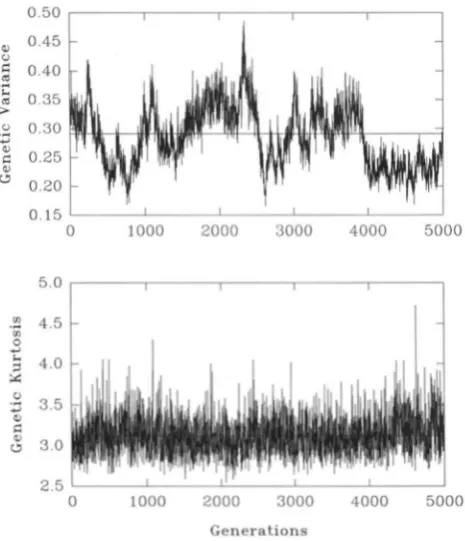
FIGURE 1 .-Evolution of genetic variance (upper panel) and genetic kurtosis (lower panel) under mutation-selection-drift
balance in one run with the following parameters: N , = 683,
V,
= 10, 50 loci, p = 0.0002, normal mutant distribution with variance a* = 0.05. The straight lines represent the average genetic variance (= 0.285) and the average genetic kurtosis (= 3.12) for this run (compare Table 1, (i), line 4). The medians of the distributions of genetic variance and genetic kurtosis are 0.284 and 3.10, respectively.nearly Gaussian most of the time with occasional ex- cursions that may be dramatic if mutational effects are large.
Autocorrelation of the mean phenotype and the genetic variance: The simulations show high fluctua- tions of the mean, variance, etc., between generations and substantial autocorrelation. This has been noticed earlier by KEICHTLEY and HILL (1983) for directional se- lection and by KEICHTLEY and HILL (1988) and BURGER
et al. (1989) for stabilizing selection. Figures 1 and 2 display the extent of this phenomenon.
In the present investigation, we have measured these autocorrelations as follows. Denote by X( t ) the value of a random variable ( e . g . , the genetic variance) in gen- eration t . Then the autocorrelation function is
Cov[X(t), X(t
+
41
( P ( 4 = (9)
vVar[X(t)JVar[X(t
+
T)].
In our simulations, t ran from 1 to IO', whereas the au- tocorrelation function was calculated only for T between
1 and 5 X lo4, so that the values for the Cov[X(t), X( t
+
T)] are based on at least 5 X lo4 data points. We found that the function ( ~ ( 7 ) declines exponentially andthen fluctuates around zero for large 7. Using a least
squares method, an exponential function e P r was fit-
0.9
,
I I I I I0.8
0.7
.: 0.6
2
0.5 v 0.4r, 0.3
0 0.2
0.1
-
.-
2
u0 . 0 L
0 1000 2000 3000 4000 5000
7 0 'g 60
2
50u)
r)
x 40
5
30$ 20 u
10
0 I O 0 0 2000 3000 '1000 5000
Generations
FIGURE 2.-& Figure 1, but with the following parameters: N, = 171, V, = 10, 50 loci, p = 0.0002, reflected
r
mutant distribution with variance a* = 0.5. The average genetic vari- ance and the average genetic kurtosis for this run are 0.233 and 6.27, respectively (compare Table 2, (iii), line 3). The corre- sponding medians are 0.213 and 4.83.ted to ( ~ ( 7 ) such that
x:zifl
((~(7)-
is minimized.The reciprocal of the unique solution yc is called the characteristic autocorrelation time and denoted by
1
Y c
t,, =
-
.
Different methods, like performing the least squares approximation with weights, yielded similar results. The data (Tables 1, 2) provide quantitative estimates for the importance of the autocorrelation of the mean phenotype and the genetic variance and confirm pre- vious qualitative observations.
An approximation for the autocorrelation function of the mean phenotype can be obtained from LANDE'S (1976) analysis of genetic drift and stabilizing selection. Under weak selection ( V ,
>>
1) and the assumption of a constant genetic variance, he identified the corre- sponding stochastic process as an Ornstein-Uhlenbeck diffusion process for the mean phenotype with infini- tesimal mean &:/(V,
+
6:) and variance &:/Nc. This has autocorrelation functionautocorrelation time is
This result does not depend explicitly on Ne and gives a rather good approximation to the observed values as long as the coefficient of variation of a: is small ( CJ Tables 1 and 2).
We have shown for a neutral model, assuming two segregating alleles per locus, i. e., 4Nep
<<
1, and global linkage equilibrium, that the autocorrelation function for the genetic variance is given byso that the autocorrelation time is
(see APPENDIX). BULMER (1980, p. 230) showed that ran- dom departures from Hardy-Weinberg equilibrium cause uncorrelated fluctuations of the genetic variance and, in the absence of linkage, random departures from linkage disequilibrium lead to a correlation of 1/2 be- tween successive values of genetic variance. The first gives an autocomelation time of zero whereas the latter gives a value of two, which is small compared to (14) ( cf.
also AWRY and HILL 1977). For weak selection and 4Nep
<<
1, theory and data are in reasonably good agree- ment ( cf. Table 1).We have also measured the autocorrelation time of the genetic kurtosis. It tends to be slightly larger than that of the genetic variance (results not shown).
The effective number of segregating factors: In the present model, the number of segregating loci is always smaller than the number of all loci potentially contrib uting to the trait. We calculated the effective number ne
of loci according to LANDE’S (1981) formula
where a, is the standard deviation of the distribution of
allelic effects at one (haploid) locus, and the expecta- tion is taken over all loci at male and female gametes. Data are displayed in Tables 1 and 2. If the number of
effective loci i s sufficiently high, in our simulations ap- proximately ne 2 15, the distribution of breeding values
is nearly Gaussian. In addition, we compared ne to the average polymorphism P2,5% on a 2.5% level. The crite- rion in our simulations for a locus to be polymorphic was that there were more than 5% heterozygotes at a locus which implies that the most frequent allele has a frequency of less than 97.5%.
Directional selection: It would be desirable to have a theory for the distribution of the mean phenotype and
the genetic variance under directional selection. Such a theory is not currently available. Following LYNCH and
LANDE (1993) and BCIRGER and LYNCH (1994), we modeled directional selection by a “moving optimum,” i.e., by
Yt
= exp{-
T } ,
(Z
-
kt)2where k is a positive constant describing the rate at which the optimum phenotype moves. For k low enough (below a critical rate of environmental change, c$ LYNCH and L W D E 1993; BCIRGER and LYNCH 1994), populations prac- tically persist for ever. For this kind of directional selection, the variances of the mean phenotype and of the genetic variance have a major influence on the dynamics of evo- lution and extinction (BCIRGER and LYNCH 1994).
Extending these investigations, we performed several simulations for a slowly moving optimum, i . e., k so small that the average mean fitness was still higher than 0.85,
compared to 0.95 for pure stabilizing selection with w2 = 9. Thus the number of breeding adults and the effective populations size remained constant during the lo5 generations, each simulation run lasted.
As
shown by LYNCH and LANDE (1993), a steady-state distribution builds up that responds constantly to directional selec- tion but the mean phenotype lags behind the optimum. For this “traveling wave,” we found (results not shown) that even a very low k , i . e . , k-
4% of a phenotypic standard deviation of an i n i t i a l population, leads to a more than twofold increase of 6;, to a sixfold increase of V(ai), to a 3.5-fold increase of V ( i ) , and to a decrease of tac by a factor 1/6, as compared to the initial equi- librium distribution (with k = 0 ) . Further increasing kleads to a further increase of 6:, V(a:), and V ( f ) , and to a further decrease of
tat.
The genetic variancee:,
however, levels off soon (see also BCJRGER and LYNCH 1994) and always remains below the neutral prediction (3).DISCUSSION AND CONCLUSIONS
For many evolutionary biologists and geneticists, the only simple conclusion emerging from the last decade of theoretical investigations on the dynamics of quantitative-genetic variance and the dynamics of phe- notypic evolution might be that the theories are often excessively complicated and frequently depend on a plethora of parameters that are difficult or impossible to measure. We would like to summarize below a few simple and useful results that have emerged from our simulations and other recent studies.
The majority of the theoretical studies dealt with in- finite populations, i . e . , they neglected random drift, It turned out that many results depend strongly on details of the assumptions. For example, under stabilizing se- lection the Gaussian theory of &Mum (1965) and LWDE
908 R. Biirger and R Lande
reason for the discrepancy between these approxima- tions is that they are based on different assumptions about the mutation parameters, ie., they are valid in different regions of the parameter space. Both approxi- mations can be mathematically justified, and both a p proximations always overestimate the true equilibrium variance (BURGER and HOFBAUER 1994). As is well known, TURELLI (1984) and BARTON and TURELLI (1989) have argued that current empirical knowledge suggests pa- rameter values in favor of the HGapproximation to be the more plausible ones.
We based many of our simulations on such parameters estimates [ c$ also LANDE (1975) and LYNCH (1988)l. In addition, we investigated how the shape of the mutant distribution affects the equilibrium distribution of the trait because theoretical arguments (KEIGHTLEYand HILL
1988) as well as recent empirical results ( e . g . , MACKAY
et al. 1992) indicate that mutant distributions may be highly leptokurtic. This means that most new mutational variance is due to few mutants with large effects whereas the majority of mutants has very little or no effect. The present simulations show, and for infinite populations this was mathematically proved by BCJRGER and HOFBAUER
(1994), that increasing the kurtosis of the mutant dis- tribution leads to increasing deviations from the SHC- approximation (see Tables 1 and 2). Ironically, given that all other parameters are the same, Gaussian mutant distributions are more favourable to TURELLI’S (1984)
HC-approximation (or rare-alleles approximation) than mutant distributions dominated by rare alleles with large effects.
It is important to notice that genetic drift in finite populations reduces the discrepancy between the Gaus- sian and the HC-approximation, as encompassed in de- terministic models. In finite populations, the genetic variance is always below that predicted by the neutral mutationdrift balance (LYNCH and HILL 1986) and, in small populations, it is always very close to it. In fact, for small population size or weak selection, the SHG prediction (6) and the stochastic version of the Gaussian approximation ( cf. LATER 1970; LYNCH and LANDE 1993)
deviate only slightly, because both are close to the neu- tral prediction. The present simulations confirm earlier results (BURGER et al. 1989) that the SHGprediction is a very good approximation for a reasonably wide range of parameters. However, in most cases it is an overesti- mate. Our results also show that BARTON’S (1989) theory for the variance of the genetic variance (8) provides good estimates as long as the SHC-approximation applies.
In deterministic multilocus models the situation is
much more complicated. For example, BARTON (1986)
showed that many simultaneously stable equilibria, giv- ing rise to different levels of genetic variance and to mean phenotypes deviating from the optimum, may ex- ist. On the other hand, a deterministic multilocus model allowing for a continuum of possible alleles at each lo-
cus, yields much simpler results: the mean phenotype is always very close to the optimum (and agrees with the optimum if the mutant distributions are symmetric) and, for small mutation rates or large variance of mu- tational effects, the equilibrium genetic variance is closely approximated by the HC-prediction (cf. B~JRGER and HOFBAUER 1994).
Although our simulations are based on the continuum-of-alleles model, the number of actually seg- regating alleles per locus typically is small. Depending on the parameters, for any given point in time, a con- siderable fraction of loci even is monomorphic (see Tables 1 and 2 for the average polymorphism and the effective number of factors), and at the other loci two or
(sometimes) more alleles segregate. This is certainly more realistic than the above deterministic models, and also more realistic than stochastic models based on di- allelic loci with symmetric effects, as in BULMER (1972),
KEIGHTLEY and HILL (1988) and Barton (1989). Never- theless, in contrast to the deterministic models, all these stochastic models, including the simulations of HOULE
(1989) of a model with three alleles per locus and that of FOLEY (1992), yield qualitatively similar results in many respects, though they differ quantitatively to a moderate extent.
The present simulations show that in finite popula- tions the mean phenotype indeed behaves extremely simply, at least on the average. Its distribution is almost perfectly Gaussian, as predicted by LANDE’S (1976) phe- notypic theory, and the variance of the mean phenotype agrees closely with the phenotypic prediction V,/2Ne
(2), unless the variance of mutational effects is very large and the (genomic) mutation rate very low. This, to- gether with the fact that the genetic variance is almost always less than or equal to the SHGapproximation, sug- gests that multiple stable equilibria are of little relevance in populations of small and moderate effective size.
One potentially cumbersome problem investigated and quantified by the present simulations and theory is the high autocorrelation of the genetic variance and other quantities (like mean phenotype, mean fitness, genic variance, genetic kurtosis). This was already no- ticed previously (KEIGHTLEY and HILL 1988; BURGER et al.
Quantitative Dynamics
These high autocorrelations pose serious problems for conclusions based on measurements of genetic variance because of the long-lasting influence of random excur- sions of the variance.
Under directional selection according to a moving op- timum (16), the autocorrelation of the genetic variance becomes much smaller. On the other hand, the variance of the mean phenotype and of the genetic variance may be an order of magnitude larger than under stabilizing selection of the same strength. Also the genetic variance increases under this form of selection and approaches a steady-state value which is higher than the SHC- prediction but lower than the neutral prediction ( CJ
BURGER and LYNCH 1994). The latter has been shown to be the asymptotic variance under both truncation se- lection (HILL 1982) as well as under exponential direc- tional selection (BURGER 1993). In the latter case, a simple Gaussian approximation yields correct predic- tions for the evolution of the mean phenotype and of the genetic variance. This is not the case for a moving op- timum, where the Gaussian approximation gives an ap- proximately correct theory only for the evolution of the mean phenotype but always underestimates the lag be- tween the optimum and the mean (cf. LYNCH and LANDE
1993; B ~ R G E R and LYNCH 1994). Nevertheless, in all these cases the distribution of the breeding values is approxi- mately Gaussian unless selection becomes very strong. No satisfjmg theory for the distribution of the mean phenotype or the genetic variance is available for a mov- ing optimum. Finite populations of small or moderate size (say Ne < 500) also behave more reasonably in re- sponse to directional selection than predicted from de- terministic theory (BARTON and TURELLI 1987). Neither under exponential directional selection nor under a moving optimum is a substantial increase of genetic vari- ance observed unless previous stabilizing selection was extremely strong (cf. B ~ R G E R 1993; B ~ R G E R and LYNCH
1994). The reason is that for such population sizes the equilibrium variance under stabilizing selection, which is approximately given by the SHC-prediction, is not much lower than the neutral prediction which appears to pose an upper limit to the genetic variance under most forms of directional selection.
To summarize, there are a number of issues that are simplified by having small population size. Among these are that (i) multiple equilibria apparently are of little relevance as suggested by the accuracy of the Gaussian theory for the mean phenotype (compare also BARTON
1989); (ii) for small populations, the stochastic ana- logues of the Gaussian and the house-ofcards approxi- mation for the genetic variance do not differ very much because both are close to the neutral prediction. The stochastic house-ofcards prediction yields a good ap- proximation; (iii) if a finite population under mutation- selectiondrift balance is exposed to directional selec- tion, a large increase of genetic variance, as predicted by the deterministic theory (BARTON and TURELLI, 1987) but
usually not observed in experiments, does not occur un- less the population size is very large or stabilizing selec- tion was very strong (BURGER 1993; BURGER and LYNCH
1994; cf. also KEIGHTLEY and HILL 1989).
The general conclusion that we would like to draw from the present results and those discussed above- though with appropriate caution-is that the mainte- nance of genetic variance and the dynamics of pheno- typic evolution appear to be simpler in finite populations of small or moderate size, compared to the corresponding dynamics in infinite populations when many details of the genetics play an important role. However, due to the sto- chastic nature of mutation, recombination, and selection, any single population may considerably deviate from that expected behavior of the average population.
The work was partially supported by a research exchange grant from the Max Kade Foundation to R.B., and by National Institutes of Health grant GM27120 to R.L. Numerical simulations were per- formed on the IBM ES/9021-720 mainframe of the EDV-Zentrum der Universitit Wien. Generous supply with computing time is gratefully acknowledged. We thank the reviewers for their comments.
LITERATURE CITED
AWRY, P. J., and W. G. HILL, 1977 Variability in genetic parameters among small populations. Genet. Res. 2 9 193-213.
BARTON, N. H., 1986 The maintenance of polygenic variation through a balance between mutation and stabilizing selection. Genet. Res. 47: 209-216.
BARTON, N. H., 1989 Divergence of a polygenic system subject
to stabilizing selection, mutation and drift. Genet. Res. 54:
59-77.
BARTON, N. H., and M. Tu-, 1987 Adaptive landscapes, genetic distance and the evolution of quantitative characters. Genet. Res. BARTON, N. H., and M. TURELLI, 1989 Evolutionary quantitative genetics: how little do we know? Annu. Rev. Genet. 23: 337-370.
BULMER, M. G., 1972 The genetic variability of polygenic characters under optimizing selection, mutation and drift. Genet. Res. 19:
BULMER, M. G., 1980 The Mathematical Theory of Quantitative
Genetics. Clarendon Press, Oxford, U.K.
BULMER, M. G., 1989 Maintenance of genetic variability by mutation- selection balance: a child’sguide through thejungle. Genome 31:
BURGER, R., 1988 Mutation-selection balance and continuum-of- alleles models. Math. Biosci. 91: 67-83.
BURGER, R., 1989 Linkage and the maintenance of heritable variation by mutation-selection balance. Genetics 121: 175-184.
BURGER, R., 1993 Predictions of the dynamics of a polygenic character under directional selection. J. Theor. Biol. 162:
487-513.
BURGER, R., and J. HOFBAUER, 1994 Mutation load and mutation- selection balance in quantitative genetic traits. J. Math. Biol. 32:
193-218.
BI~RGER, R, and M. Lwm, 1994 Evolution and extinction in a changing environment: a quantitativegenetic analysis. Evolution (in press). BURGER, R., G. P. WAGNER, and F. STETTINGER, 1989 How much heri-
table variation can be maintained in finite populations by a mutation-selection balance? Evolution 45: 1748-1766.
CABWERO, A., M. A. TORO, and C. LOPEZ-FANJUL, 1991 The response to artificial selection from new mutations in Drosophila melano-
gaster. Genetics 127: 89-102.
CLAYTON, G. A., and A. ROBERTSON, 1955 Mutation and quantitative variation. Am. Nat. 89: 151-158.
COX, D. R., and H. D. MILLER, 1965 The Theory of Stochastic
Processes. Methuen, London.
49: 157-173.
17-25.
910 R. Biirger and R. Lande
CROW, J. F., and M. KIMuRA, 1964 The theory of genetic loads, pp.
495-505 in Proceedings of the X I International Congress o j
Genetics, edited by S. J. GEERTS. Pergamon, Oxford, U.K.
CROW, J. F., and M. KIMURA, 1970 A n Introduction to Population
Genetics TheoTy. Harper & Row, New York.
FLEMING, W. H., 1979 Equilibrium distributions of continuous poly- genic traits. SIAM J. Appl. Math. 36: 148-168.
FOLEY, P., 1992 Small population genetic variability at loci under sta- bilizing selection. Evolution 64: 763-774.
FRANK, S. A., and M. SLATKIN, 1990 The distribution of allelic effects under mutation and selection. Genet. Res. 55: 111-117.
GARDINER, C. W., 1983 Handbook of Stochastic Methods. Springer- Verlag, New York.
~ I N G S , A., 1990 Maintenance of polygenic variation through mutation-selection balance: bifurcation analysis of a biallelic model. J. Math. Biol. 2 8 329-340.
HILL, W. G., 1982 Rates of change in quantitative traits from fixation of new mutations. Proc. Natl. Acad. Sci. USA 7 9 142-145. HOULE, D., 1989 The maintenance of polygenic variation in finite
populations. Evolution 4 3 1767-1780.
&x-, P. D., and W. G. H n , 1983 Effects of hnlcage on response to directional selection fiom new mutations. Genet Res. 42: 193-206.
KEIGHTLEY, P. D., and W. G. HILL, 1988 Quantitative genetic variation maintained by mutation-stabilizing selection balance in finite populations. Genet. Res. 59: 33-43.
KEIGHTLEY, P. D., and W. G. HILL, 1989 Quantitative geneticvariability maintained by mutation+abilizing selection balance: sampling variation and response to subsequent directional selection. Genet. Res. 54: 45-57.
KIMURA, M, 1965 A stochastic model concerning the maintenance of genetic variability in quantitative characters. Proc. Natl. Acad. Sci. KIMURA, M., and T. OHTA, 1969 The average number of generations
763-771.
until fixation of a mutant gene in a finite population. Genetics 61:
LANDE, R, 1975 The maintenance of genetic variability by mutation in a polygenic character with linked loci. Genet. Res. 26: 221-235.
DE, R., 1976 Natural selection and random genetic drift in phe- notypic evolution. Evolution 3 0 314-334.
LANDE, R., 1981 The minimum number of genes contributing to quantitative variation between and within populations. Genetics
LANDE, R, 1988 Quantitative genetics and evolutionary theory, pp.
71-84 in Proceedings of the Second International Conference on
Quantitative Genetics edited by B. S. WEIR, E. J. EISEN, M. M.
GOODMAN and G . NAMKOONG. Sinauer, Sunderland, Mass. LA-ITER, B. D. H., 1960 Natural selection for an intermediate opti-
mum. Aust. J. Biol. Sci. 13 30-35.
LATTER, B. D. H., 1970 Selection in finite populations with multiple alleles. 11. Cenrripetal selection, mutation and isoallelic variation. Genetics 6 6 165-186.
LOPEZ, M. A,, and C. MPEZ-FANJUL, 1993a, b Spontaneous mutation
for a quantitative trait in Drosophila rnelanogaster. I. Response to artificial selection. Genet. Res. 61: 107-116. 11. Distribution of
mutant effects on the trait and fitness. Genet. Res. 61: 117-126.
LYNCH, M., 1988 The rate of polygenic mutation. Genet. Res. 51:
LYNCH, M., and W. G. HILL, 1986 Phenotypic evolution by neutral mutation. Evolution 4 0 915-935.
LYNCH, M., and R. LANDE, 1993 Evolution and extinction in response
to environmental change, pp. 234-250 in Biotic Interactions and
Global Change edited by P. M. KARENA, J. G. KINGSOLVER and R. B.
HUEY. Sinauer, Sunderland, Mass.
IMACKAY, T. F. C., R. F. L w , M. S. JACKSON, C. TERZIAN, and W. G. HILL,
1992 Polygenic mutation in Drosophila Melanogastel: estimates from divergence among inbred strains. Evolution 4 6 300-316. SANTUGO, E., J. h o m o z , A. DOMINGUEZ, M. A. TORO, and C. LOPEZ-
FANJUL, 1992 The distribution of spontaneous mutations on quantitative traits and fitness in Drosophila melanogaster. Genet- ics 132: 771-781.
SLATKIN, M., 1987 Heritable variation and heterozygosity under a bal- ance between mutations and stabilizing selection. Genet. Res. 50:
53-62.
TURELLI, M., 1984 Heritable genetic variation via mutation-selection balance: Lerch's zeta meets the abdominal bristle. Theor. Pop. Biol. 25: 138-193.
USA 51: 731-736.
99: 541-553.
137-148.
TURELLI, M., and N. H. BARTON, 1990 Dynamics of polygenic char- acters under selection. Theor. Pop. Biol. 3 8 1-57.
ZENG, Z.-B., and C. C. COCKERHAM, 1991 Variance of neutral genetic variances within and between populations for a quantitative char- acter. Genetic 129: 535-553.
Communicating editor: B. S. WEIR
APPENDIX
Here we derive the autocorrelation function of the genetic variance in a population of size Ne under the following simple model.
(i) First, we consider a single locus with two selectively neutral alleles and equal forward and backward muta- tion rates u. If the effects of the three genotypes are 0,
a, and 2a, and the frequency of the alleles are x and 1
-
x, the genetic variance isv,(x) = 2a2x(1
-
x).It is well known that there exists a stationary distribution in this model which is approximately given by
where b = 2N,u (cf. CROW and KIMURA 1970, Chap. 8.5). This stationary distribution allows for a relatively simple calculation of the terms needed for the autocor- relation function ( ~ ( 7 ) in (9). Let the random variable
X(t) in (9) be given by X ( t ) = V,(x,). Then, due to stationarity, the following hold:
J O
r'
J O
where E , [ q ] = lirnT+ (11'7) .f,'X(t)dt
(6
GARDINER 1983, Sect. 3). The integrals in (A.3) and (A.4) are easily evaluated and one obtainsb 1
+
4b'E,[V,(X,)] = 2 ~ '
-
b
(1
+
4b)2(3+
4b)Var,[V&x,)] = 2u4 (A7)
To evaluate (A.5), we need an expression for the con- ditional expectation E[x,+,(l
-
I x, = x]. To this aim, we derive the recursion equations for the firsttwo central moments p l ( t ) = E[x,] and p 2 ( t ) =
Quantitative Trait Dynamics 911
x f + l =x,
+
Sx, and denote the expectation of a random change of Sx, by E,. Then a straightforward calculation shows that1
a ,= - - ( ( I - 4 u ) - 4 u 2 1"
2N,
(
&).
( A l l ) Then, proceeding as in CROW and IMURA (1970, Chap. 7.4), we obtain the following recursionsPl(t
+
1) = u+
(1-
2U)Pl(t), (A1 2) P.p(t+
1) = a0+
%P.l(t)+
CPp(0, (A131where
c=
(
1 --
(1 - 2u)Z:Ne)
The solutions of the difference equations (A.12) and (A.13) are
p1(t) = 34
+ (pl(0)
- %)(1-
2u): (A16)+
(
p1(0)-
-:)
(1 - 2u)+
&(0)Cf,c - 0 - 2 4
c
- (1-
2u)respectively. With p1 ( 0 ) = x and &(O) =
2,
this givespl(t) - k(t) = A,
+
XB,-
f C f , (A181 where+
2
a,
(Ct-
(1 - 2 4 9 ,Now we can evaluate (A.5) because
= p1(7)
-
~ ~ ( 7 ) = A,+
xB, -2c.
Integration of (A.5) using (A.22), and subsequent in- sertion of the resulting expression together with (A.6) and (A.7) into (9), yields the autocorrelation function of the genetic variance,
(~(7) = -2b(3
+ 4b)
+
(1+
4b)(3+
4b)(2AT+
B,) ( M 3 )-
2(1+
b)(1+ 4b)C.
From (A.19) and (A.20) we have
1 1
2 4Ne(C- 1) 2A,
+
B, = -+
and this is exact. However, formula (A.2) for the sta- tionary distribution f is only approximate because it is based on the diffusion approximation which assumes that b = 2Neu is of order one. Therefore, we have to use the approximation
2Ne(C- 1) = -(1
+
46)+
4u(l+
b)-
4u2-
-(1+
4b),to obtain
with C as in (A.15). This gives an autocorrelation time for the genetic variance of
I
"The autocorrelation function of the mean genotype at a single diallelic locus is easily calculated to be
(1
-
2u)', giving an autocorrelation time of approxi- mately 1/(2u).(ii) More generally, we assume n loci in linkage equi- librium and assume that the mutational effects a are distributed with mean zero, variance
2,
and kurtosis K ,so that E,(a4) = K U ~ , where E, denotes the expectation
with respect to the distribution of mutant effects a. For a normal distribution of mutational effects one has K =
912 R. Biirger and R. Lande
ai =
v:
from (A.6) and (A.7), by taking expec- tations over mutational effects and summing over all loci i:b
(1
+
4b)2(3+
lb).
vda;]
= 2rucu4Similarly, Cov[oi(t), ai(t
+
7)] = 2 n ~ Cov[V,(t), VJt+
T)], so that the autocorrelation function and the au-
tocorrelation time are given by (A.24) and (A.25), re- spectively.
For n diallelic loci in the absence of selection, the variance of the mean phenotype is calculated
to be
Var[f] = nu2
1
+
8N,uThis may be compared with Equation 2 from the phe- notypic theory. The autocorrelation function of the mean phenotype in the n-locus case is, as with one locus, ( 1 - 2u)
'.
This leads to an autocorrelation time of1
2u t a c ( i ) =