Summ-it++: an enriched version of the Summ-it corpus
A. Antonitsch, A. Figueira, D. Amaral, E. Fonseca, R. Vieira, S. Collovini
PUCRS University – Porto Alegre – Brazilandre.antonitsch, anny.figueira, daniela.amaral,
evandro.fonseca, sandra.abreu (@acad.pucrs.br), [email protected]
Abstract
This paper presents Summ-it++, an enriched version the Summ-it corpus. In this new version, the corpus has received new semantic layers, named entity categories and relations between named entities, adding to the previous coreference annotation. In addition, we change the original Summ-it format to SemEval.
Keywords:Coreference, Named entities, Semantic relations
1.
Introduction
Coreference resolution is an important challenge for language processing. Currently for Portuguese there are three main corpora with some kind of corefer-ence annotation: HAREM (Freitas et al., 2010), Gar-cia’s corpus (Garcia and Gamallo, 2014) and Summ-it (Collovini et al., 2007).
HAREM contains annotation of named entities and their identity relations, its main purpose was the eval-uation of Named Entity Recognition (NER) systems. The corpus contains manually annotated named enti-ties distributed in ten semantic categories. Relations between these named entities have also been annotated manually, in four types: identity, inclusion, placement and other.
Garcia’s corpus contains coreference annotation for person entities.
Summ-it contains noun phrase coreference annotation, being thus the corpus with the most complete coref-erence chains. It was semi-automatically annotated with morphosyntactic information, and manually an-notated with coreference. Besides coreference the texts were also manually annotated with rhetorical relations. Also, for each text, there are manual and automatically generated summaries.
In this paper we describe Summ-it++, an enriched Ver-sion of Summ-it. The proposed new verVer-sion adds two new annotation layers: named entities and relations between named entities. In addition, the format was changed to the SemEval (Recasens et al., 2010), a well-known and widely used format.
Therefore we provide a corpus that integrates differ-ent annotation layers, in a format that can be evaluated according to usual evaluation metrics for coreference, making use of available tools that compute such met-rics. So, with this resource we aim to contribute to further Portuguese NLP research.
The paper is organized as follows: Section 2 describes the new Summ-it++ corpus, as well as its annotation scheme; Section 3 presents the process of the cor-pus generation; Section 4 describes the conversion from corpus to SemEval form; and finally, Section 5 presents our conclusions and future work.
2.
Summ-it++
Summ-it++ is an evolution of the corpus Summ-it (Collovini et al., 2007). The original Summ-it con-sists of fifty journalistic texts from the Science sec-tion of the Folha de São Paulo newspaper. The texts are annotated in many layers. Here we will consider mainly the morphosyntactic and coreference annota-tion, which we want to integrate with two new seman-tic layers. The corpus has a total of 560 coreference chains with an average of 3 members (noun phrases for each chain). The largest chain has 16 members (noun phrases). Summ-it has been used in previous coref-erence resolution research for Portuguese ((de Souza et al., 2008), (Coreixas, 2010), (Fonseca et al., 2014), (Da Silva et al., 2010)) and has had an important role in the training and the validation of classification models. Basically, in this new version, we added two seman-tic layers (named entities and their relations). In addi-tion, the original format was changed to SemEval (Re-casens et al., 2010). To provide the two new seman-tic layers, two resources based on CRF algorithm were used: the CRF classifier, proposed in (Collovini et al., 2014), for relation extraction and NERP-CRF (?) for named entities. These new layers were automatically annotated and manually revised by humans. For the morphosyntatic annotation we used CoGrOO (Silva, 2013). In the following subsections we describe each semantic layer provided by the new corpus version.
2.1.
Morphosyntactic Annotation
For Summ-it++ morphosyntactic annotation we used CoGroo (Silva, 2013). CoGroo is a open-source gram-mar checker widely used for Portuguese. It is capa-ble of identifying Portuguese mistakes such as pronoun placement, noun agreement, subject-verb agreement, usage of the accent stress marker, subject-verb agree-ment, and other common errors of Portuguese writing. Besides, CoGrOO has pos-tagging, chunking and mor-phosyntactic annotation.
2.2.
Named Entities
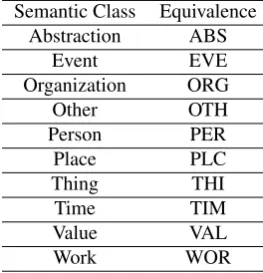
to a specific entity in the text. NERP-CRF (Amaral and Vieira, 2014) is the system responsible for the extraction of such entities in Summ-it ++. In this work, we classified the NEs according to the HAREM Conference’s guidelines, which have the following classes: Abstraction, Event, Organization, Other, Per-son, Place, Thing, Time, Value, and Work (Freitas et al., 2010). In sentence (a), for example, we have the following NE classes: Person, such as “Miguel Guerra”, Organization, such as “University of Santa Catarina”, and Place such as“Santa Catarina”.
(a)“A opinião é do agrônomo Miguel Guerra, da UFSC (Universidade de Santa Catarina).”(The opinion is from the agronomist Miguel Guerra, of UFSC (University of Santa Catarina)).
2.3.
Semantic Relations between entities
Relation Extraction (RE) is the task of identifying and classifying semantic relations that occur between enti-ties in a given text (Jurafsky and Martin, 2009). Rela-tion extracRela-tion can be useful in many NLP tasks, in par-ticular, for Coreference Resolution, the focus of which is to determine antecedent chains. The identification of these chains in a text can improve the process of relation extraction (Gabbard et al., 2011).
In the proposed corpus, we include relations of any type (as in open RE) occurring between named entities of the following categories: Organization, Person and Place. For that, we use the CRF classifier, proposed in (Collovini et al., 2014). The annotations were pro-vided automatically, but manually revised. We define a relation descriptor as the text chunks that describe the explicit relation occurring between a pair of named entities in the sentence. For example: in sentence (a), we have the relation descriptor“de”(of) that oc-curs between the named entities“Miguel Guerra”and “UFSC”, in this sentence.
2.4.
Coreference
Coreference basically consists of finding different references to a same entity in a text. In (a) the noun phrases“o agrônomo ” “the agronomist ”and “Miguel Guerra” “ Guerra”are considered ent, in other words, they belong to the same corefer-ence chain. The proposed corpus presents the man-ual annotation of coreference previously provided by Summ-it now in the SemEval format, which is more adequate for evaluation purposes, since available tools such as the CoNLL scorer1 might be used. This
tool generates widely used coreference metrics, as de-scribed in (Pradhan et al., 2011).
2.5.
Annotation Scheme
The Summ-it++ new annotation format is SemEval: a single file, containing all Summ-it texts. Each text document is separated by “#begin document ID” and
1
http://conll.cemantix.org/2012/software.html
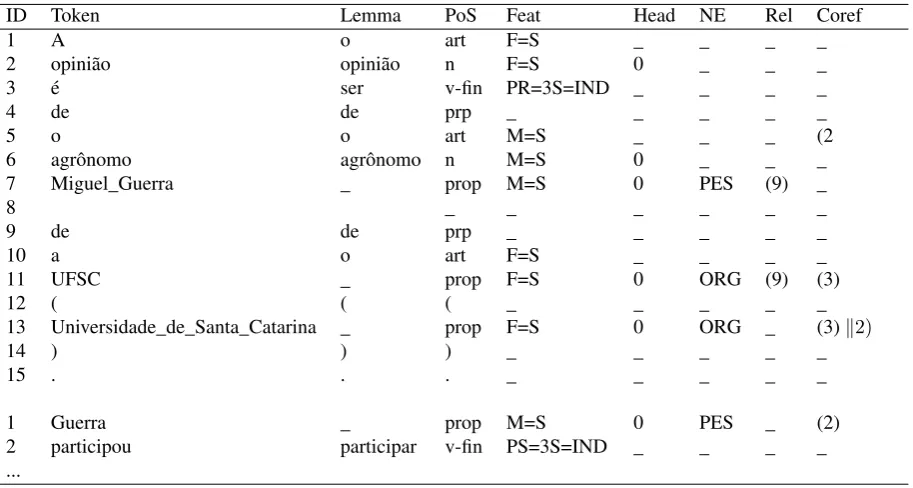
“#end document ID”. The information of each sen-tence is organized vertically with one token per line, and a blank line after the last token of each sentence. The information associated with each token is avail-able in columns (separated by “\t”). Besides the for-mat, the novelty is the integration of coreference with named entities and their relations (seen in the last three columns in Table 2).
The annotation columns are:
ID: Token ID in sentence order;
Token: the word or multiword;
Lemma: the word lemma;
POS: Part-of-speech tagging of each word;
Feat: features (gender and number) of each word;
Head: denotes if the word is a head word (if yes, this field receives ’0’);
NE: represents the semantic category, as below:
Semantic Class Equivalence
Abstraction ABS
Event EVE
Organization ORG
Other OTH
Person PER
Place PLC
Thing THI
Time TIM
Value VAL
Work WOR
Table 1: Semantic class equivalence scheme.
Rel: represents the relation descriptor which ex-presses a relation between a pair of named ties. When this relation exists, both named enti-ties involved receive the token ID from the words that compose the relation descriptor. If the re-lation contains two or more descriptors, like in : [“Cassius Vinicius Stevani"] , [“químico de"] [chemist of] , [“USP"], it’s separated by a pipe.
Coref: each noun phrase starts using “( ” followed by the chain ID. Note that the “) ” just occurs in the last NP token. Basically: coreferent NPs receives the same chain ID.
ID Token Lemma PoS Feat Head NE Rel Coref
1 A o art F=S _ _ _ _
2 opinião opinião n F=S 0 _ _ _
3 é ser v-fin PR=3S=IND _ _ _ _
4 de de prp _ _ _ _ _
5 o o art M=S _ _ _ (2
6 agrônomo agrônomo n M=S 0 _ _ _
7 Miguel_Guerra _ prop M=S 0 PES (9) _
8 _ _ _ _ _ _
9 de de prp _ _ _ _ _
10 a o art F=S _ _ _ _
11 UFSC _ prop F=S 0 ORG (9) (3)
12 ( ( ( _ _ _ _ _
13 Universidade_de_Santa_Catarina _ prop F=S 0 ORG _ (3)k2)
14 ) ) ) _ _ _ _ _
15 . . . _ _ _ _ _
1 Guerra _ prop M=S 0 PES _ (2)
2 participou participar v-fin PS=3S=IND _ _ _ _
...
Table 2: Annotation scheme
3.
Corpus Generation
The generation of the new corpus had the goal of the addition of two new semantic layers of annotations to the original Summ-it, named entities and semantic re-lations. And converting this expanded corpus to the more common SemEval format.
3.1.
Morphosyntactic Annotation
The morphosyntactic annotation of the corpus was ob-tained through the CoGrOO (Silva, 2013) PoS-tagger and morphosyntactic annotator. Each text was split by the CoGrOO parser into tokens. It is worth not-ing, however, that CoGrOO concatenates composite proper nouns into a single token. As well as split-ting preposition-article abbreviations that are common to Portuguese (‘da’, ‘do’ changes to ‘de + a’, ‘de + o’). For each token produced, CoGrOO also sup-plies, lemma, Part-of-Speech tag, gender and number features. The CoGrOO chunker and shallow-parser was then used to generate the noun-phrases and sub-sequently annotate which tokens are head of a noun-phrase.
3.2.
Named Entities
In this work the CRF-based classifier NERP-CRF (Amaral and Vieira, 2014) was applied to the Summ-it texts in order to extract and classify the named entities (NEs).
As a pre-processing phase, the POS tagging was pro-vided through the use of the OpenNLP parser. With the texts properly tagged, the system is then able to extract and classify the NEs.
For the training of the CRF model, the Second HAREM’s Golden Collection was utilized. Using this model, NERP-CRF was applied to the Summ-it texts
and the output with the identified and classified ENs was generated. After this process, the output was man-ually revised and corrected by two annotators to be used as a reference to evaluate the system.
As a result, there were 1,086 NEs identified, dis-tributed in the ten HAREM categories.
Precision (P), Recall (R) and F-Measure (F) obtained by the system are given for Person, Place and Organi-zation classes, since the Relation Extraction task (Sec-tion 3.3) considers only rela(Sec-tions between these three classes (see Tables 3 and 4). The corpus incorporated the manually revised entities.
Classes R P F
Person 68.47% 79.43% 73.54%
Place 86.98% 100.00% 93.03%
Organization 72.63% 52.47% 60.92%
Table 3: NERP-CRF NE Identification
Classes R P F
Person 59.11% 68.57% 63.49%
Place 56.25% 69.23% 62.06%
Organization 71.05% 51.33% 59.60%
Table 4: NERP-CRF NE Classification
3.3.
Semantic Relation
described in Section 3.2..
After, we identify the first pair of NEs in each sentence. Therefore we consider only one pair per sentence. As result, the pair of NEs identified in the sentence is considered candidate for arguments of the relation instances as a triple (NE1, relation descriptor, NE2). For example, in the sentence (a) we have this triple: (Miguel Guerra, de, UFSC).
A sum of 101 relation candidates was extracted and given as input to the classifier. The classifier indicated the valid descriptors.
We evaluated the results considering the manual an-notation of relation descriptors using two criteria (Collovini et al., 2015): exact matching (having all words in commnon) and partial matching (having at least one word in common). The results considering of number of correct (#C), Recall (R), Precision (P) and F-measure (F) for exact and partial matching are pre-sented in Table 5, respectively.
#C R P F
Exact matching 28 0.43 0.70 0.53 Partial matching 35 0.54 0.87 0.67
Table 5: Results of the relation extraction of the subset from Summ-it
3.4.
Coreference
The coreference information was extracted from it (Collovini et al., 2007). The original Summ-it corpus contains 560 coreference chains (annotated manually) with an average of 3 members (noun phrases for each chain). The largest chain has 16 mentions (noun phrases).
4.
Conversion to SemEval
The conversion to the SemEval format began with the parsing of the original Summ-it texts. For that we used CoGrOO (Silva, 2013) to extract the tokens which form the base structure of the SemEval format. Then morphosyntactic, named entities, entity relations and coreference were converted as follows.
4.1.
Morphosyntactic Annotation
The morphosyntactic annotation is simply extracted by CoGrOO and displayed in the appropriate columns. CoGrOO (Silva, 2013) parses the natural language text from the original corpus and breaks it into tokens which are used to structure the SemEval format (Re-casens et al., 2010). The morphosyntactic annotations (lemma, part-of-speech, gender and number features) are then displayed raw, as obtained from the parser, in the SemEval format in their respective columns.
4.2.
Named Entities
The layer with the NEs was generated using the output from the NERP-CRF (?) classifier described in Section 3.2. The output consists of the identified and classified
NEs extracted from the Summ-it texts. The NEs were then paired with the tokens included in the SemEval file. The matching was done through the criteria of exact matching of a token and a NE in the same sen-tence. The matched token in the SemEval format is then marked with the correct NE category.
4.3.
Semantic Relation
The entity relation layer was obtained from the output of the CRF classifier (Collovini et al., 2014) described in Section 3.3. The data consists of the relation de-scriptors that were correctly extracted by the classifier (partial and exact matching) in the triple format (NE1, relation descriptor, NE2). Next, the elements in the triples were matched to tokens in the sentences of the SemEval file. A match of the three elements in a sen-tence signals a matched triple. In the matching pro-cess, some triples were disregarded due to error in the NE identification step.
4.4.
Coreference
The coreference annotation was extracted from Summ-it (Collovini et al., 2007) and used to identify mentions and coreference links. The NP matching is based on the head nouns. The coreference chain information is then included in the SemEval file, following the pair-ing realized in the previous step. It is important to note the annotation in Summ-it++ considers noun phrases as captured by the CoGrOO parser, sometimes differ-ent from the original Summ-it annotation.
5.
Conclusion
In this paper we presented a new version the Summ-it corpus. This new version was enriched with two addi-tional layers, named entities and entity relations. These layers were obtained with the help of tools being de-veloped in our research group. The output of the tools was analysed and corrected to be included in Summ-it++. As one main contribution we produced a unified corpus, which may contribute to the study of several NLP tasks, such as: Coreference Resolution, Relation Extraction, Named Entities Recognition, among oth-ers. The corpus is freely available2. As further work, we want to perform more detailed corrections of the resulting corpus, and increase the number of texts.
Acknowledgments
The authors acknowledge the financial support of CNPq (Conselho Nacional de Desenvolvimento Cien-tífico e Tecnológico), CAPES (Coordenação de Aper-feiçoamento de Pessoal de Nível Superior) and FAPERGS (Fundação de Amparo à Pesquisa do Rio Grande do Sul).
2
6.
References
Amaral, D. O. F. d. and Vieira, R. (2014). Nerp-crf: uma ferramenta para o reconhecimento de entidades nomeadas por meio de conditional random fields. Linguamática, vol. 6, pages 41–49.
Collovini, S., Carbonel, T. I., Fuchs, J. T., Coelho, J. C., Rino, L., and Vieira, R. (2007). Summ-it: Um corpus anotado com informações discursivas visando a sumarização automática. InProceedings of V Workshop em Tecnologia da Informação e da Linguagem Humana , Rio de Janeiro, RJ, Brasil, pages 1605–1614.
Collovini, S., Pugens, L., Vanin, A. A., and Vieira, R. (2014). Extraction of relation descriptors for por-tuguese using conditional random fields. In Pro-ceedings of Advances in Artificial Intelligence - IB-ERAMIA 2014 - 14th Ibero-American Conference on Artificial Intelligence, pages 108–119, Santiago de Chile, Chile.
Collovini, S., de Bairros Filho, M., and Vieira, R. (2015). Analysing the role of representantion choices in portuguese relation extraction. In Pro-ceedings of Conference and Labs of the Evalua-tion Forum - CLEF 2015, pages 91–102, Toulouse, France. Springer.
Coreixas, T. (2010). Resolução de correferência e categorias de entidades nomeadas. Dissertação de Mestrado, Pontifícia Universidade Católica Do Rio Grande Do Sul.
Da Silva, F. J. V., Carvalho, A. M. B. R., and Ro-man, N. T. (2010). A comparative analysis of centering-based algorithms for pronoun resolution in portuguese. InProceedings of Advances in Artifi-cial Intelligence–IBERAMIA 2010, pages 336–345. Springer.
de Souza, J. G. C., Gonçalves, P. N., and Vieira, R. (2008). Learning coreference resolution for por-tuguese texts. In Computational Processing of the Portuguese Language - LNCS 5190, pages 153–162. Springer.
Fonseca, E. B., Vieira, R., and Vanin, A. A. (2014). Coreference resolution in portuguese: Detecting person, location and organization. InJournal of the Brazilian Computational Intelligence Society, vol-ume 12, pages 86–97.
Freitas, C., Mota, C., Santos, D., Oliveira, H. G., and Carvalho, P. (2010). Second harem: Advancing the state of the art of named entity recognition in por-tuguese. InProceedings of Language Resources and Evaluation Conference - LREC 2010.
Gabbard, R., Freedman, M., and Weischedel, R. (2011). Coreference for learning to extract rela-tions: yes, virginia, coreference matters. In Pro-ceedings of the 49th Annual Meeting of the As-sociation for Computational Linguistics: Human Language Technologies: short papers-Vol. 2, pages 288–293. Association for Computational
Linguis-tics.
Garcia, M. and Gamallo, P. (2014). Multilingual cor-pora with coreferential annotation of person entities. In Proceedings of the 9th edition of the Language Resources and Evaluation Conference - LREC 2014, pages 3229–3233.
Jurafsky, D. and Martin, J. H. (2009). Speech and Language Processing: An Introduction to Natu-ral Language Processing, Computational Linguis-tics and Speech Recognition. Prentice Hall series in Artificial Intelligence. Pearson Education Ltd., Lon-don, 2 edition.
Pradhan, S., Ramshaw, L., Marcus, M., Palmer, M., Weischedel, R., and Xue, N. (2011). Conll-2011 shared task: Modeling unrestricted coreference in ontonotes. InProceedings of the Fifteenth Confer-ence on Computational Natural Language Learn-ing: Shared Task, pages 1–27. Association for Com-putational Linguistics.
Recasens, M., Màrquez, L., Sapena, E., Martí, M. A., Taulé, M., Hoste, V., Poesio, M., and Versley, Y. (2010). Semeval-2010 task 1: Coreference resolu-tion in multiple languages. In Proceedings of the 5th International Workshop on Semantic Evalua-tion, pages 1–8. Association for Computational Lin-guistics.