Dynamic Programming Matching for Large Scale Information Retrieval
Eiko Yamamoto
Communications Research Laboratory, Kyoto Japan [email protected]
Masahiro Kishida Yoshinori Takenami
Sumitomo Electric Information Systems Co., Ltd., Osaka Japan {kishida-masahiro, takenami-yoshinori}@sei.co.jp
Yoshiyuki Takeda Kyoji Umemura Toyohashi University of Technology, Aichi Japan {[email protected], umemura@tutics}.tut.ac.jp
Abstract
Though dynamic programming matching can carry out approximate string matching when there may be deletions or insertions in a document, its effectiveness and efficiency are usually too poor to use it for large-scale information retrieval. In this paper, we propose a method of dynamic programming matching for information retrieval. This method is as effective as a conventional information retrieval system, even though it is capable of approximate
matching. It is also as efficient as a
conventional system.
Keywords: Dynamic programming, Corpus-based, Japanese.
1 Introduction
The dynamic programming method is well-known for its ability to calculate the edit distance between strings. The method can also be applied to informa-tion retrieval. Dynamic programming matching can measure the similarity between documents, even if there are partial deletions or insertions. However, there are two problems in applying this method to information retrieval. One problem is search effec-tiveness. It is poor because dynamic programming matching lacks an adequate weighting schema. The second problem is computational efficiency. Also, lack of an adequate indexing schema means that dy-namic programming matching usually has to process the entire document.
Yamamoto et al. proposed a method of dynamic programming matching with acceptable search ef-fectiveness (Yamamoto et al., 2000; Yamamoto,
Takeda, and Umemura, 2003). They report that
the effectiveness of dynamic programming match-ing improves by introducmatch-ing an IDF (Inverse Doc-ument Frequency) weighting schema for all strings that contribute similarity. They calculate matching weights not only for words but also for all strings. Although they report that effectiveness is improved, the speed of their method is slower than that of conventional dynamic programming matching, and much slower than that of a typical information re-trieval system.
In this paper, we aim to improve the retrieval ef-ficiency of the dynamic programming method while keeping its search effectiveness. From a mathemat-ical point of view, we have only changed the defini-tion of the weighting. The mathematical structure of similarity remains the same as that of the dynamic programming method proposed by (Yamamoto et al., 2000; Yamamoto, Takeda, and Umemura, 2003). Although it has the same definition, the new weight-ing method makes it possible to build a more effi-cient information retrieval system by creating the in-dex in advance. To our surprise, we have observed that our proposed method is not only more efficient but also more effective.
2 Similarities Based on Dynamic Programming Matching
form of dynamic programming matching. These similarities include translation of the edit distance. This distance has been described by several authors. We have adopted Korfhage’s definition: ‘the edit distance is the minimum number of edit operations, such as insertion and deletion, which are required to map one string into the other’ (Korfhage, 1997).
There are three related similarities. The first is dy-namic programming matching, which is simply con-version of the edit distance. The second similarity is an extension of the first similarity, introducing a character weighting for each contributing character. The third and proposed similarity is an extension of the second one, using string weight instead of char-acter weight.
2.1 Dynamic Programming Matching
As stated above, dynamic programming (DP) matching is a conversion of edit distance. We call this similarity SIM1. While the edit distance (ED) is a measure of difference, counting different charac-ters between two strings , SIM1 is a measure of sim-ilarity, counting matching characters between two strings. ED and SIM1 are defined as follows:
Definition 2.1 Edit Distance (Korfhage, 1997)
Letαandβbe strings,xandybe a character, and “” be empty string.
• If both strings are empty then
ED(“”,“”) = 0.0
• Ifx6=ythen
ED(x, y) = 1.0
• If their first characters are the same then
ED(xα, xβ) =
M IN(ED(α, xβ), ED(xα, β), ED(α, β) + 1.0)
• Otherwise
ED(xα, yβ) =
M IN(ED(α, yβ), ED(xα, β), ED(α, β))
Definition 2.2 SIM1
Letαandβbe strings,xandybe a character, and “” be empty string.
• If both strings are empty then
SIM1(“”,“”) = 0.0
• Ifx6=ythen
SIM1(x, y) = 0.0
• If their first characters are the same then
SIM1(xα, xβ) =
M AX(SIM1(α, xβ), SIM1(xα, β), SIM1(α, β) + 1.0)
• Otherwise
SIM1(xα, yβ) =
M AX(SIM1(α, yβ), SIM1(xα, β), SIM1(α, β))
2.2 Character Weight DP Similarity
SIM1 adds 1.0 to the similarity between two strings for every matching character, and this value is con-stant for all the time. Our assumption for the new function is that different characters make different contributions. For example, in Japanese informa-tion retrieval, Hiragana characters are usually used for functional words and make a different contribu-tion than Kanji characters, which are usually used for content words. Thus, it is natural to assign a dif-ferent similarity weight according to the nature of the character. The below method of defining Charac-ter Weight DP Similarity adds not 1.0 but a specific weight depending on the matching character. We call this similarity SIM2. It resembles Ukkonen’s Enhanced Dynamic Programming ASM (Approxi-mate String Matching) (Berghel and Roach, 1996). The weight is expressed by a function calledScore. SIM2 is defined as follows:
Definition 2.3 SIM2
Letαandβbe strings,xandybe a character, and “” be empty string.
• If both strings are empty then
SIM2(“”,“”) = 0.0
• Ifx6=ythen
SIM2(x, y) = 0.0
• If their first characters are the same then
SIM2(xα, xβ) =
M AX(SIM2(α, xβ), SIM2(xα, β), SIM2(α, β) +Score(x))
• Otherwise
SIM2(xα, yβ) =
2.3 String Weight DP Similarity
DP procedure usually considers just a single char-acter at a time, but since some long substrings can receive good scores, it is natural to consider all pre-fixes of the longest common prefix, not just the next character.
While SIM2 uses a character weight whenever a character matches between strings, a single
char-acter may not be enough. In some cases, even
when each character has a low weight, the string as a whole may be a good clue for information re-trieval. For example, ”chirimenjyako” is a Japanese word that could be a retrieval key word. This word, which means ”boiled and dried baby sardines,” con-sists only of Hiragana characters ”chi-ri-me-n-jya-ko” but each character would make a small contri-bution in SIM2.
The proposed similarity is called String Weight DP Similarity, which is a generalization of SIM2. We call this similarity SIM3. It considers the weight of all matching strings and is defined as follows:
Definition 2.4 SIM3
Letαandβbe strings,xandybe a character, and “” be empty string.
• If both strings are empty then
SIM3(“”,“”) =Score(“”) = 0.0
• Otherwise
SIM3(α, β) =
M AX(SIM3s(α, β), SIM3g(α, β))
– SIM3s(ξα, ξβ) =
M AX(Score(γ) +SIM3(δα, δβ))
where ξ(= γδ) is the maximum length
string matching from the first character.
– SIM3g(xα, yβ) =
M AX(SIM3(α, yβ), SIM3(xα, β), SIM3(α, β))
2.4 Weighting Function
Yamamoto et al. have used IDF (Inverse Document Frequency) as a weight for each string. The weight is computed using a Score function as follows:
Definition 2.5 Yamamoto et al.’sScorefunction
Letξbe string,df(ξ)the frequency of documents includingξ in the document set for retrieval, andN be the number of documents in the set.
Score(ξ) =IDF(ξ) =−log(df(ξ)/N)
The standard one-character-at-a-time DP method assumes that long matches cannot receive exception-ally good scores. In other words, it regardsScore(ξ) as 0 if the length of ξ is greater than one. If the
Score function obeys the inequality,Score(δγ) <
Score(δ) +Score(γ) for all substrings δ and γ, the best path would consist of a sequence of sin-gle characters, and we would not need to consider long phrases. However, we are proposing a different
Scorefunction. It sometimes assigns good scores to long phrases, and therefore SIM2 has to be extended into SIM3 to establish a DP procedure that considers more than just one character at a time.
3 Proposed Weighting Function
Although SIM3, as shown in Section 2.3, has rea-sonable effectiveness, its computation is harder than that of the edit distance, and much harder than that of the similarity used in a conventional information retrieval system. In this paper, we have modified the weighting function so that it keeps its effective-ness while improving efficiency. To achieve this im-provement, we use the SIM3 with the same defini-tion but with a different score funcdefini-tion.
3.1 Proposed String Weighting
We reduce the computational cost by limiting strings that have positive scores. First, we select bigrams as such strings. In other words, we assign a score of zero if the length of the string does not equal to 2. Several language systems use Kanji characters (e.g. Chinese and Japanese), and bigram is an effective indexing unit for information retrieval for these lan-guage systems (Ogawa and Matsuda, 1997). In addi-tion, we may assume that the contribution of a longer string is approximated by the total bigram weight-ing. We have also restricted our attention to infre-quent bigrams. Thus, we have restricted the weight-ing function Score as follows, whereKis the num-ber decided by the given query.
• If string length is 2 andcf(ξ)< Kthen
Score(ξ) =−log(df(ξ)/N)
• OtherwiseScore(”) = 0.0
3.2 Using a Suffix Array for Indexing
a query, we can collect all the positions of such strings. To make it possible, we need some index-ing in advance. We have used a suffix array for this index. Below we summarize our proposed algorithm using a suffix array:
I. Make a suffix array of the document set.
II. For each query,
A. Make a set of substrings consisting of two characters (bigram).
B. For a given number n, extract the total n of less frequent bigrams, calculating corpus frequency.
C. For each bigram from step B,
i. Record all positions in which the
bi-gram appears in the query and
docu-ment set,
ii. Record all documents that contain the
bigram.
D. For each document recorded,
i. Compute the similarity between the query and the document with SIM3, using the recorded position of the cor-responding bigram.
ii. Assign the similarity to the document. E. Extract the most similar 1000 documents from the recorded documents as a retrieval result for the query.
We call the retrieval method described above Fast Dynamic Programming (FDP). In general, retrieval systems use indexes to find documents. FDP also uses an index as a usual method. However, unlike conventional methods, FDP requires information not only on the document identification but also on the position of bigrams.
Manber and Myers proposed a data structure called “suffix array.” (Manber and Myers, 1993) Figure 1 shows an example of suffix array. Each suffix is expressed by one integer corresponding to its position. We use this suffix array to find out the position of selected bigrams. A suffix array can be created in O(Nlog(N)) time because we need to sort all suffixes in alphabetical order. We can get the position of any string in O(log(N)) time by a binary search of suffixes and by then obtaining its corresponding position.
4 Experiment
In the experiment, we compared the proposed FDP method with SIM1, SIM2, and SIM3, which were described in Section 2. We measured three values:
Figure 1: Suffix Array
search effectiveness, memory usage, and execution time.
We used the NTCIR1 collection (NTCIR Project, 1999). This collection consists of 83 retrieval topics and roughly 330,000 documents of Japanese tech-nical abstracts. The 83 topics include 30 training topics (topic01-30); the rest are for testing (topic31-83). The testing topics were more difficult than the training topics. Each topic contains five parts, “TI-TLE”, “DESCRIPTION”, “NARRATIVE”, “CON-CEPT”, and “FIELD.” We retrieved using “DE-SCRIPTION,” which is retrieval query and a short sentence.
All the experiments reported in this section were conducted using a dual AMD Athlon MP 1900+ with 3GB of physical memory, running TurboLinux 7.0.
4.1 Search Effectiveness
The proposed FDP method restricts the number of
bigrams that can contribute to string matching. That
is, only a small number of strings are considered. It was not clear whether FDP maintains its effective-ness like SIM3. To verify it, we compared the effec-tiveness of FDP with that of SIM1, SIM2, and SIM3. We also needed to know how the effectiveness might
vary by the number of bigrams. We set numbern
Table 1: Statistical Significant Test for difference of MAP (α= 0.005, ν = 83−1)
SIM2 SIM3 FDP5 FDP10 FDP15 FDP20 FDP30 FDP50 FDP500
SIM1 << << << << << << << << <<
SIM2 << = < << << << << <<
SIM3 = = < << << << <<
FDP5 = << << << << <<
FDP10 = << < < <
FDP15 < = = =
FDP20 = = =
FDP30 = =
FDP50 =
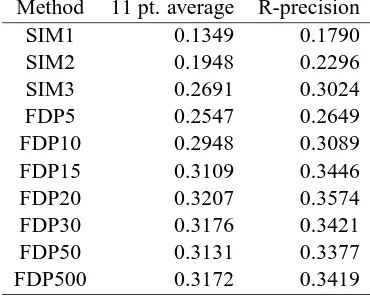
Table 2: Search Effectiveness for Topic01-30
Method 11 pt. average R-precision
SIM1 0.1349 0.1790
SIM2 0.1948 0.2296
SIM3 0.2691 0.3024
FDP5 0.2547 0.2649
FDP10 0.2948 0.3089
FDP15 0.3109 0.3446
FDP20 0.3207 0.3574
FDP30 0.3176 0.3421
FDP50 0.3131 0.3377
FDP500 0.3172 0.3419
The NTCIR1 collection also contains a relevance judgment. We obtained the 11-point average pre-cision and R-prepre-cision using standard tools called TRECEVAL. And we tested about statistical signif-icance for difference of MAP (Mean Average Preci-sion) (Kishida et al., 2002).
Tables 2 and 3 show the search effectiveness for all methods. We found that FDP20 is the most ef-fective. Table 1 shows the results of one-sided t-test for difference of MAPx¯i−y¯i, wherex¯i andy¯i are
MAP of i-th method in the first row and MAP of
i-th method in the first column, respectively. The level of significance α is 0.005 and the degree of freedomν is 83−1. The Symbols<<, <,= rep-resent ”much less than α”, ”less than α, and ”not less thanα”, respectively. We found that except for FDP5 and FDP10, the other FDPs are significantly more effective than SIM3 at a level of significance
0.005. In additional, this shows that FDP30, FDP50, and FDP500 are not significantly more effective than FDP20. These have demonstrated our proposed FDP
Table 3: Search Effectiveness for Topic31-83
Method 11 pt. average R-precision
SIM1 0.0545 0.0845
SIM2 0.1245 0.1596
SIM3 0.1807 0.2083
FDP5 0.1277 0.1505
FDP10 0.1766 0.2013
FDP15 0.2144 0.2280
FDP20 0.2398 0.2621
FDP30 0.2353 0.2485
FDP50 0.2354 0.2488
FDP500 0.2350 0.2477
method maintains its effectiveness, even though the strings that contribute similarity are restricted to a small number of bigrams. Also, it is interesting that the FDP with 20 bigrams is significantly more effec-tive than the one with many more bigrams.
4.2 Memory Usage
The proposed method needs to record all the posi-tions considered bigrams. A memory area is there-fore required to hold position information; in the worst case, the memory size required is the prod-uct of the number of documents and the number of substrings in a query. This means the memory re-quirement could be very large. However, using FDP, we have found that the amount of memory requested is of a reasonable size.
0 20000000 40000000 60000000 80000000 100000000
1 6 11 16 21 26 31 36 41 46 51 56 61 66 71 76 81 Query
T
ot
al
C
ol
le
c
ti
on
F
r
e
q
u
e
n
c
y
AllNgram 20Bigram AllBigram
Figure 2: Memory Usage (Total Number of Collection Frequency for Each String)
0 500000 1000000 1500000 2000000 2500000 3000000 3500000 4000000 4500000
1 6 11 16 21 26 31 36 41 46 51 56 61 66 71 76 81 Query
T
ot
al
C
ol
le
c
ti
on
F
r
e
q
u
e
n
c
y
20Bigram AllBigram
Figure 3: Memory Usage for Different Number of Restricted Bigrams
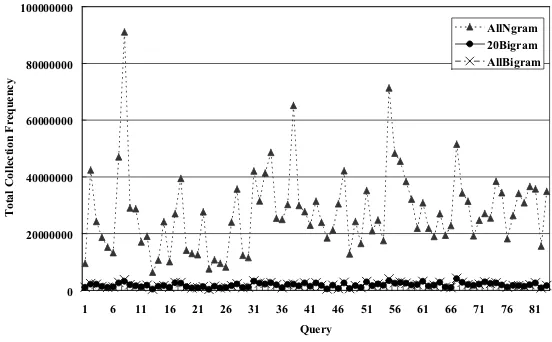
Figure 2 shows the total sum of collection fre-quency for three kinds of string sets. In the fig-ure, AllNgram is for sets of all substrings consid-ered by SIM3, AllBigram is for sets of all bigrams, and 20Bigram is for sets of 20 bigrams considered by FDP20. The field surrounded by the plot line and the horizontal axis represents the total sum of collection frequency. As the figure shows, AllBi-gram and 20BiAllBi-gram occupy a much smaller field than AllNgram. This means the memory require-ment of FDP is much smaller than that of SIM3. This result shows that FDP is possible to efficiently perform large-scale information retrieval on a com-puter with a reasonable amount of memory.
Figure 3 shows enlarged graphs of AllBigram and
20Bigram from Figure 2. The figure shows that
20Bigram equals AllBigram for most queries, but not always. However, as shown in Table 2 and Ta-ble 3, FDP20 actually has the highest precision in all FDPs. This means that considering more bigrams is not necessarily an advantage. Probably, by choosing substrings with a high contribution, we manage to get rid of noisy strings.
4.3 Execution Time
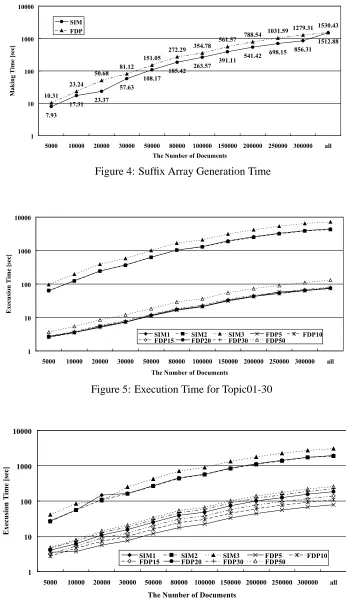
to make a suffix array, we found that FDP took 1.5 times as long as SIM in Figure 4. Thus, for the same algorithm, the execution speed of Java is generally slower than that of C language.
Figures 5 and 6 show the time taken to retrieve for each topic01-30 and topic31-83. In the figures, the vertical axis is the number of documents, and the horizontal axis is the execution time. We found that all SIMs took much longer than FDPs. This demon-strates that our algorithm in Section 3 sharply im-proves execution speed. Moreover, we found that execution time did not increase exponentially even if the candidate documents for retrieval increased; instead, the retrieval collection becomes larger and larger. This suggests that FDP is an effective DP technique for large-scale information retrieval.
5 Related Work
Our proposed technique is a type of DP matching. The most typical application of DP matching is gene information research, because DP is effective for gene information matching. However, this system has a very slow processing speed.
In recent years, advances in this field of re-search have meant that high-speed systems have
been required for gene information retrieval. A
high-speed gene information retrieval system called BLAST was developed (Setubal and Meidanis,
2001). BLAST has achieved higher processing
speed by using heuristics that specify characteristic gene arrangements, rather than using DP matching. In contrast, we have managed to achieve fast match-ing usmatch-ing the DP technique.
Moreover, in music information retrieval, an error in copying a tune corresponds to a deficit (deletion) and insertion of data. For this reason, a music search engine has been built based on the DP technique (Hu and Dannenberg, 2002). Since there is a great deal of music information available these days, scalabil-ity is also an important problem for music informa-tion retrieval systems. Our proposed DP method is scalable and can cope with deficits. It therefore has potential applications in music information retrieval.
6 Conclusion
In this study, we proposed a DP matching method for large-scale information retrieval. To improve
its efficiency, this method selects the strings that contribute more to retrieval. This selection process reduces the memory requirement and frequency of memory access. We conclude that our method is suitable for large-scale information retrieval where approximate matching is required.
Acknowledgement
This work was supported in The 21st Century COE Program ”Intelligent Human Sensing,” from the Ministry of Education, Culture, Sports, Science, and Technology.
References
Hal Berghel and David Roach. 1996. An extension of Ukkonen’s enhanced dynamic programming ASM al-gorithm. Journal of ACM TOIS, 4(1):94–106.
Kazuaki Kishida, Makoto Iwayama, and Koji Eguchi. 2002. Methodology and Pragmatics of Retrieval Ex-periments at NTCIR Workshop. Pre-meeting Lecture at the NTCIR-3 Workshop.
Ning Hu and Roger B. Dannenberg. 2002. Comparison of Melodic Database Retrieval Techniques Using Sung Queries. Proceedings of JCDL 2002, 301–307.
Robert R. Korfhage. 1997. Information Storage and
Retrieval. WILEY COMPUTER PUBLISHING, 291— 303.
Udi Manber and Gene Myers. 1993. Suffix arrays: a new method for on-line string searches. SIAM Journal of Computing, 22(5):935–948.
NTCIR Project. http://research.nii.ac.jp/ntcir/.
Yasushi Ogawa and Toru Matsuda. 1997. Overlapping statistical word indexing: A new indexing method for Japanese text. Proceedings of SIGIR97, 226–234.
Joao Carlos Setubal and Joao Meidanis. 2001.
Introduction to Computational Molecular Biology. BrooksCole Publishing Company.
Eiko Yamamoto, Mikio Yamamoto, Kyoji Umemura, and Kenneth W. Church. 2000. Dynamic Prgramming: A Method for Taking Advantage of Technical
Ter-minology in Japanese Documents. Proceedings of
IRAL2000, 125–131.
7.93
17.31 23.37 57.63
108.17
185.42 263.57
391.11 541.42
698.15 856.31 1512.88
10.31 23.24
50.68 81.12
151.05
272.29 354.78
561.57 788.54
1031.59 1279.31 1530.43
1 10 100 1000 10000
5000 10000 20000 30000 50000 80000 100000 150000 200000 250000 300000 all The Number of Documents
M
ak
in
g T
im
e [
se
c]
SIM FDP
Figure 4: Suffix Array Generation Time
1 10 100 1000 10000
5000 10000 20000 30000 50000 80000 100000 150000 200000 250000 300000 all
The Number of Documents
E
xe
c
u
si
on
T
im
e
[
se
c
]
SIM1 SIM2 SIM3 FDP5 FDP10
FDP15 FDP20 FDP30 FDP50
Figure 5: Execution Time for Topic01-30
1 10 100 1000 10000
5000 10000 20000 30000 50000 80000 100000 150000 200000 250000 300000 all
The Number of Documents
E
xe
c
u
si
on
T
im
e
[
se
c
]
SIM1 SIM2 SIM3 FDP5 FDP10 FDP15 FDP20 FDP30 FDP50