Optimization of Welding Parameters to Reduce
Distortion in Welding of SA 203 GRADE-E by
ANOVA
Prashant A. Kapse Dr. Sachin A. Mastud
PG Student Professor & Head of Dept.
Department of Production Engineering Department of Production Engineering
V.J.T.I. Mumbai, India V.J.T.I. Mumbai, India
Abstract
Tungsten Inert Gas (TIG) welding is widely used in fabrication industries. Distortion is major problem due to which reworks and time, cost gets affected. So it has to be controlled. The main objective of this research is to optimize the TIG welding para meters to reduce distortion in plate to plate butt weld joint of material SA203 GRADE –E. An experiment is conducted to study the effect of three TIG welding control parameters as welding current, WEP angle, preheat temperature on welding distortion. Here root gap is taken constant and welding position is same through the experiment. The Experiments were planned using the strategy of DOE. The levels of input parameters were selected and experiments were carried out. The results obtained under the combination of these parameter were analyzed by using ANOVA (analysis if variance), statistical method to investigator the critical parameter affecting the distortion in welding and their contribution.
Keywords: ANOVA, Distortion, DOE, TIG Welding, SA203 Grade-E
________________________________________________________________________________________________________
I.
I
NTRODUCTIONWelding is major joining technique in fabrication industries for the welding of steels for manufacturing of different structures, pressure vessels, aerospace, shipping, and heat exchangers applications. TIG is arc welding used for smaller fillet and butt welds. In this process the arc is formed between a pointed on consumable tungsten electrode and the work piece, in an inert atmosphere of argon or helium for shielding & electrode replace by filler material. The major design and industry constraints are weld strength and cost competitive.
In optimization of TIG welding processes, parameters play an important role for the final product quality in terms of weld distortions, welding defects, joint efficiency and mechanical properties. As welding process involves the heating and cooling process in non-uniform, uneven manner, the distortions are unavoidable. The weld process contributes to the development of several kinds of distortions like longitudinal, transverse or angular distortions and defects like porosity, cracks, lack of penetration, lack of fusion, undercut, and spatter. Various factors affecting the quality of weld are weld current, consumable size, gas flow rate and the weld speed, preheat temperature weld edge preparation angle, inter pass temperature and transfer speed of consumable. Optimization of these parameters can avoid the major rework and saves production time and cost.
II.
E
XPERIMENT SET UP AND DETAILSFactorial Design A.
Design of experiment is technique of defining and investigating all possible combinations in an experiment involving multiple factors and to identify the best combination. Here the different factors and their level are identified. We have used factorial design, and used full factorial design. The three parameters are varied at three different levels so the no of iteration goes to 27
Welding Arrangement B.
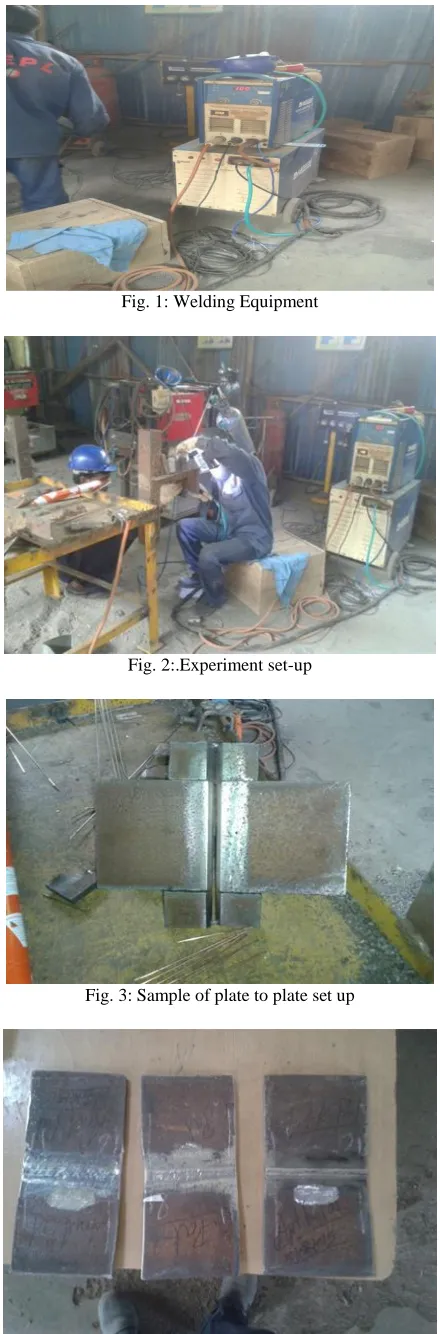
Fig. 1: Welding Equipment
Fig. 2:.Experiment set-up
Material Selection C.
Here we have selected material as, SA 203 GRADE E with plate of 10mm thick. We have chosen this material as it normally used n fabrication of pressure vessel , heat exchangers , also having good corrosive persistence , resistance to oxidation ease of cleaning and easily available with low cost. The chemical composition is as shown
Table - 1 Chemical Composition
Elements C Mn P S Si Ni Fe
Composition 0.20 0.70 0.035 0.035 0.15 3.25 Balance
Process Parameter D.
In this study there are three parameters as welding current, weld edge preparation angle and preheat temperature. Each process parameter has here level of values as mentioned in below table
Constant parameter: welding position and work piece thickness, root gap (4mm) Table - 2
Input parameters at different levels
Parameter Unit Level 1 Level 2 Level 3 Low Medium High
Current Ampere 100 150 200
WEP angle Degree 45 60 75
Preheat
temp Celsius 50 100 150
Response Parameter E.
Here all experiments were conducted; distortion was measured, as shown below Table - 3
Experimental results Sr
no Welding Current WEP Preheat Temp Distortion
1 100 45 50 3.75
2 100 45 100 3.55
3 100 45 150 3.4
4 100 60 50 3.8
5 100 60 100 3.6
6 100 60 150 3.5
7 100 75 50 4.1
8 100 75 100 4
9 100 75 150 3.9
10 150 45 50 4.15
11 150 45 100 4.5
12 150 45 150 4.3
13 150 60 50 4.7
14 150 60 100 4.4
15 150 60 150 4.2
16 150 75 50 5.25
17 150 75 100 5
18 150 75 150 4.9
19 200 45 50 5.5
20 200 45 100 5.4
21 200 45 150 5.3
22 200 60 50 6.5
23 200 60 100 6.3
24 200 60 150 6.2
25 200 75 50 6.9
26 200 75 100 6.7
III.
R
ESULTS AND DISCUSSIONANOVA is carried out to analyze the effect of control parameter on reponse with the aid of trial version of MINITAB 16 software
ANOVA Results A.
Fig. 5: Minitab result for Analysis of Variance
Main Effects Plot B.
Main effects plot shows that welding current is the main significant parameter then WEP and preheat temperature.here as welding current and WEP angle increses the distotion also gets increses but as preheat temp increses ,the distortion get decreses
Fig. 6: Main Effects Plot (Data Means) For Distortion
Interaction Plot C.
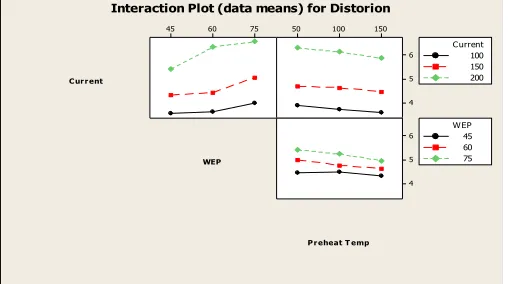
Interaction plot shows there is no significant interaction among the parameters. Each parameter contribute indivisualy towards output.here we have seen thet there is interaction between WEP and welding current but has no more significance.
M e a n o f D is to ri o n 200 150 100 6.0 5.5 5.0 4.5 4.0 75 60 45 150 100 50 6.0 5.5 5.0 4.5 4.0 Current WEP Preheat Temp
Main Effects Plot (data means) for Distorion
Cur r ent
75 60
45 50 100 150
Table -3
Manual ANOVA results of parameters and their interaction
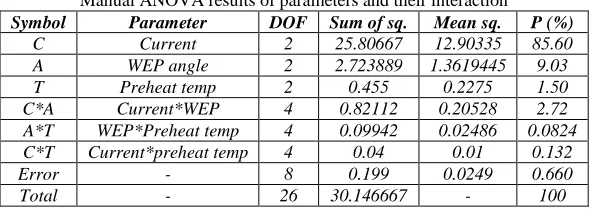
Symbol Parameter DOF Sum of sq. Mean sq. P (%)
C Current 2 25.80667 12.90335 85.60
A WEP angle 2 2.723889 1.3619445 9.03
T Preheat temp 2 0.455 0.2275 1.50
C*A Current*WEP 4 0.82112 0.20528 2.72
A*T WEP*Preheat temp 4 0.09942 0.02486 0.0824
C*T Current*preheat temp 4 0.04 0.01 0.132
Error - 8 0.199 0.0249 0.660
Total - 26 30.146667 - 100
A
CKNOWLEDGEMENTI would like to acknowledge with much appreciation the crucial role of Mr. AJIT PANDITRAO, Production Manager of PC4, LARSEN & TOUBRO LIMITED MUMBAI, and Mr, UDAY PADVAL WELDING INCHAGE, at PC4 ,LARSEN &TUOBRO MUMBAI for their valuable comments, sharing their time and knowledge on the research carried out during this project. They have contributed a lot towards my understanding and thoughts.
IV.
C
ONCLUSIONDistortion in welding is very important in fabrication industries, welding current is moistly affecting parameter for distortion From the experiments on work piece plate by TIG welding and analysis by statistical tool ANOVA, welding current is the most influencing parameter to the distortion on weld joints than WEP angle and preheat temperature. Here distortion is directly proportional with thwe welding current and WEP angle , it means as welding current or WEP angle increases the distortion gets also increases , but the preheat temperature having inversely with distortion
The percentage contributions for welding current, WEP angle and Preheat temperature are 85.60%, 9.03% and 1.50% respectively.
R
EFERENCES[1] S. C. Juang, Y. S.Tarng, “Process parameter selection for optimizing the weld pool geometry in the tungsten inert gas welding of stainless steel”, Journal of Materials Processing Technology.
[2] Balasubramanian M., V.Jayabalan, V. Balasubramanian, “Application of Taguchi Method in Process Parameter Selection of TIG Titanium Welds”, Journal for Manufacturing Science and Production. 2007.
[3] SattariFar, Y. Javadi (2008), “Influence of welding sequence on welding distortions in pipes”, International Journal of Pressure Vessels and Piping, vol -85, pp.264-274.
[4] Dongjie Li, Shanping Lu∗, Wenchao Dong, Dianzhong Li, Yiyi Li (2012), “Study of the law between the weld pool shape variations with the welding parameters under two TIG processes”, Journal of Materials Processing Technology, vol-212,pp. 128– 136
[5] J.J. Del Coz Díaz, P. Menéndez Rodríguez a, P.J. García Nieto, D. Castro-Fresno (2010), “Comparative analysis of TIG welding distortions between austenitic and duplex stainless steels by FEM”, Applied Thermal Engineering, vol-30, pp.2448-2459.
[6] S.Akellaa, B. Ramesh Kumar (2013), “Distortion Control in TIG Welding Process with Taguchi Approach”, advanced materials manufacturing & characterization,vol-3 Issue 1.