Grounding styles of aged dyads: an exploratory study
Atsue Takeoka, Atsushi Shimojima School of Knowledge Science
Japan Advanced Institute of Science and Technology 1-1, Asahidai, Tatsunokuchi, Ishikawa, 923-1292, Japan
{takeoka, ashimoji}@jaist.ac.jp
Abstract
This paper reports an exploratory study of the grounding styles of older dyads, namely, the characteristic ways in which they mutually agree to have shared a piece of information in dialogue. On the basis of Traum’s classification of grounding acts, we conducted an exploratory comparison of dialogue data on older and younger dyads, and found that a fairly clear contrast holds mainly in the types of acknowledgement utterances used by the two groups. We will discuss the implications of this contrast, concerning how some of the negative stereotypes about conversations with older people may arise from this difference in grounding styles.
1 Introduction
Clark (1996) developed the notion of grounding to capture intricate processes with which conversants establish a set of information as a shared common ground for on-going (and possibly subsequent) dialogue. In a grounding process, a conversant presents a piece of information verbally or non-verbally, and the partner issues a particular public signal of the receipt, understanding, or acceptance of that information. Once a piece of information is thus incorporated into a common ground, it is available as something than can be presupposed in subsequent communication, in which still another change to the common ground is worked out.
On the basis of Clark’s work, Traum (1994) shows a way of substantiating the process of grounding in a finite-state transition model, which specifies what contributions to a grounding
process can be made by individual utterances in dialogue and how individual contributions combine themselves to make a sequence that completes the grounding. In Traum’s terms, such contributions are grounding acts, and the units of utterance that can perform grounding acts are
utterance units, and the sequences of utterance units that complete are discourse units.
Now, both Clark’s and Traum’s models of grounding are generic, in the sense that they both admit a significant range of forms or styles in which actual processes of grounding may take place. That is, their models tell us what forms of grounding sequences are possible or well-formed, but do not tell what particular forms are most frequent in actual dialogues or, more specifically, what forms are most frequent in what sorts of dialogue situations. Thus, on the basis of Clark’s and Traum’s work, natural questions arise as to
grounding styles, namely, the possibility of characteristic forms of grounding sequences adopted by particular types of conversants in particular types of occasions.
This paper investigates this question in its special application to casual, non-task-oriented dialogues conducted by aged people. Do people develop a characteristic style of grounding as they age? If so, what exactly distinguish their grounding styles in casual, non-task-oriented settings?
To address these questions, we collected a spoken dialogue data comprising both older dyads and younger dyads, and analyzed the grounding processes in our data on the basis of Traum’s finite-state model.
therefore boring. It is perhaps because of these oft-felt problems that younger people often adopt “patronizing speech styles” or “secondary baby talk” toward aged people, characterized by restricted topics, childlike expressions, directive speech, and exaggerated nonverbal signals (Ryan & Hummert, 1995) or by slower speech, varied paraphrases, decreased grammatical complexity, lower propositional density, and other modifications (Kemper & Vandeputte, 1995).
Now, it seems customary that these communicative problems between older people and younger people are attributed to the side of aged people only, to their difficulties in auditory reception, alleged slowness of understanding, and alleged stubbornness in accepting new ideas. However, they may not be problems with one side only, nor problems with cognitive capacities or personal characters of aged people, but may largely come from different grounding styles adopted by the two groups of people. That is, the ways they agree to have a piece of information shared may have different recurrent patterns, and this difference may be a real cause of the difficulty and the negative stereotype. If so, digging out this difference and identifying the characteristic grounding styles of aged people are a necessity for scientific treatments of communicative problems commonly attributed to aged people, as well as informed design of dialogue systems that interact with aged people.
Nevertheless, most studies related to communications of aged people have focused on the influence of aging on basic linguistic competence such as word retrievals (Tatsumi 1997, Ministry of Health and Welfare 1999), and studies of their behaviors in actual dialogues have been quite scarce. The studies by Ryan & Hummert (1995) and Kemper & Vandeputte (1995) did touch on the conversational styles adopted by aged people, but their focus was more on the conversational styles adopted by younger people toward aged people. The study by Bortfeld et al. (2001) was exceptional in that it measured the number of fillers, restarts, and repairs to evaluate disfluency of aged people’s speech in conversational settings. Yet, the focus of this study was on the characteristics of speech by individual conversants, rather than the ways in which they interact. Thus, conversational styles of aged people, let alone their grounding styles, have been seldom
studied systematically.
Under this situation, we have no specific hypothesis as to whether aged people have any characteristic grounding styles and if so, what they are. Our purpose in this study is therefore exploratory, dedicated to a search for plausible hypotheses about grounding styles of aged dyads, rather than a verification of their existence and specifics. Although our study is thus hypothetical in nature, we did identify two clearly distinguishable grounding styles in our data, correlated with the age ranges of conversants. In the following, we will report what they are, how they are found, and what implications their difference has as to some negative stereotypes about conversations with aged people.
2 Method
The details of the corpus, its collection, and the assignment of tags are given below.
2.1 Dialogue Data
Our data consist of 5 dialogues by older dyads (age range: 80-88, sd: 2.1) and 5 dialogues by younger dyads (age range: 23-39, sd: 5.2). Most of the older participants were therefore so-called “older-olds,” meaning that they were between 75 and 85 years of age. Familiarities of the older dyads were strong: they had known each other since they were children or after they moved into the current areas of residence, although they started talking each other frequently after they joined an common local association several years ago. The younger dyads were also familiar with each other: they had worked in the same department of an institute for at least 3 months and up to 5 years and had talked with each other almost every working day.
50 minutes. Older adults participated in our data collection on the voluntary basis, while we paid a small amount of money for participation of younger adults.
2.2 Transcription and coding
Transcription
We transcribed a 5-minute portion after 3 minutes from the beginning of each dialogue. All words and word fragments audible to the ear were transcribed, including overlapping speech, nonlexical fillers (such as “uh”), and other vocalizations (such as laughter and whistle). After each dialogue was transcribed, we checked the videotape to add data of all noddings and salient gestures (facial expressions and hand movements) to the transcription. The transcriber solicited the help of some local residents to understand some of the dialectical expressions contained used in dialogues by older dyads.
Coding
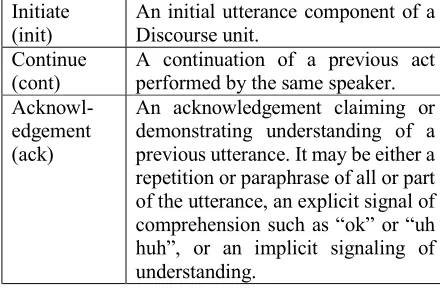
[image:3.595.69.289.583.727.2]On the basis of Traum’s finite-state transition model of grounding, we divided all speech in our dialogue data into utterance units (UUs), namely, “continuous speech by the same speaker, punctuated by prosodic boundaries (including pauses of significant length and boundary tones)” (Traum, 1994). One of the present authors then classified each utterance unit into one of seven categories of grounding acts, according to its contribution to a grounding process. Table 1 shows the seven categories of grounding acts and their definitions.
Table 1. Seven categories of grounding acts
Initiate (init)
An initial utterance component of a Discourse unit.
Continue (cont)
A continuation of a previous act performed by the same speaker. Acknowl-
edgement (ack)
An acknowledgement claiming or demonstrating understanding of a previous utterance. It may be either a repetition or paraphrase of all or part of the utterance, an explicit signal of comprehension such as “ok” or “uh huh”, or an implicit signaling of understanding.
Repair
(repair) Changes the content of the current DU. ReqRepair
(reqRepair)
A request for a repair by the other party.
ReqAck (reqAck)
Attempt to get the other agent to acknowledge the previous utterance. Cancel
(cancel)
Closes off the current DU as ungrounded.
Reliability
To check the reliability of our coding scheme, we asked two independent subjects to code a portion of our data and compared their results with our own. As an instruction to these independent coders, we produced a coding manual that lists Traum’s definitions of the seven categories of grounding acts (see Table 1), sample utterances of each category, and some general notes on treatments of marginal cases such as fillers, simultaneous utterances, and utterances with both Init and Ack functions. The subjects did some exercise coding before actual coding, and they were encouraged to ask questions about the coding standard during the exercise period. Both transcribed text and audio recording were available to the subjects during the actual coding. The subjects coded two partial dialogues one from older dyads and the other from younger dyads. Each dialogue was about 2.5 minute in length.
The interrater reliability among the original coder and these two subjects was excellent; there was an 83% agreement, with a Cohen’s Kappa of .78, for dialogues by older dyads (UUs = 138, coders = 3, categories = 9) and a 78% agreement, with a Cohen’s Kappa .77, for dialogues by younger dyads (UUs = 128, coders = 3, categories = 9).
3 Results
length of disourse units, (2) the types of frequently used acknowledgments, and (3) the frequencies of collaborative completions and echoic responses.
3.1 Utterance units and discourse units
The two groups of dialogues had no significant differences in the total numbers of discourse units (older adults, 446; younger adults, 482) and the total numbers of utterance units (older adults, 1406; younger adults, 1309). This roughly means that older dyads grounded information as frequently as younger dyads, and the numbers of utterances needed for each grounding are about the same in older dyads and in younger dyads.
Also, the frequencies of occurrences of the seven categories of grounding acts were about the same in older dyads and younger dyads (Figure 1).
33.3% 24.5% 29.9%
33.2% 32.9%
30.6% 5.6%
7.1%
0% 20% 40% 60% 80% 100%
Init Cont Ack no acts older dyads
[image:4.595.72.287.334.446.2]younger dyads
Figure 1. Ratios of grounding acts in older dyads and younger dyads
That is, older dyads used grounding acts in about the same variety and variance as younger dyads did.
3.2 Types of Acknowledgements
Initiation-acknowledgements
Generally, an “acknowledgement act” appears at the end of a grounding unit, indicating that conversants have mutually understood what the presenter said. In contrast, an “initiate act” appears at the beginning of a grounding unit, initiating the presentation of a new information unit. Sometimes, a speaker performs both initiation and acknowledgement at the same time, by producing an initiation utterance whose content presupposes the understanding of the preceding presentation.
An example is found in dialogue excerpt (1)
from an older dyad, where one of B’s utterances, “a-hon-na-ikatta (that’s good),” acknowledges the previous utterance of speaker A while initiating B’s presentation of her own information.
(1)
act UU Utterance
init17 35.1 A: honera
(so)
cont17(35.1) 35.2 : koneda[laugh]
(the other day)
cont17(35.2) 35.3 : isha-so-ii-mashita
(the doctor said so) ack17 init18 36.1 B: a-hon-na-ikatta
(that’s good)
ack18 37.1 A: n
(m)
init19 38.1 B: sore-kiitara-anshin-yawano
(that may make you feel at ease)
We found that acknowledgements of this type accounts for a 27% of all acknowledgement utterances made by younger adults, while they account for only a 10% of those by older adults (see the top section of each column in Figure 2). The difference was significant (t(5)=2.87, .01<p<.05, two-tailed).
233 225
203
110 138 51
0% 20% 40% 60% 80% 100%
older dyads younger dyads (10.3% )
(42.8% )
(46.9% )
(26.7% )
(22.4% )
(50.9% ) initiation-ack
general-purpose ack
[image:4.595.308.523.432.526.2]non-general-purpose ack
Figure 2. Ratios of the three types of acknowledgements in older dyads and younger
dyads
General-purpose acknowledgements
presentations. The other type comprises
special-purpose acknowledgements, such as repeating or paraphrasing responses, whose contents must vary depending on the contents of the preceding presentations. An example of general-purpose acknowledgement is speaker A’s short utterance “n (m)” in excerpt (2). In contrast, speaker B’s utterance “n-n-mite (m, you saw it)” in excerpt (3) is a case of special-purpose acknowledgment since it paraphrases the preceding utterance by speaker A and thus depends on its specific content.1
(2)
act UU Utterance
init26 50.1 B: nanka-sono
(well)
cont26(50.1) 50.2 shinseki-no-hito-kaeru
(the relative left)
cont26(50.2) 50.3 koro-ni-natte
(at time)
ack26 51.1 A: n
(m)
init27 B: obaasan-ga-kite
(her grand mother came and)
cont27(52.1) anta-aisatu-senkaine-tte
(said “`you must greet them”)
(3)
act UU Utterance
init1 2.1 B: hora-sangousha-noran-naran-wa
-tte
(then I had to get in the third car)
ack1 3.1 A: [laugh]
init2 4.1 B: isshokenme-ni-sangousha-n-tok
o-he
(I tried hard to get to the car)
cont2(4.1) 4.2 : hata-sanbon-mitoite
(seeing the flag)
ack2 5.1 A: n-n-mite
(m, you saw it)
init3 6.1 B: hoite-ittara-mannin-ya-yappa
(When I got to the car, it had no seats)
ack3 7.1 A: aa
(ah)
1 Actual classifications of dedicated acknowledgements into general-purpose and special purpose acknowledgements are subtler than suggested here. For example, an utterance that sounds “n (m)” could be classified as special-purpose if it has a marked prosodic feature that signals the speaker’s emotion or feeling.
Interestingly, older dyads produced more general-purpose acknowledgements (43%) than younger adults did (23%). The difference is highly significant (χ2(2)=67.2, p<.01), as we can also see
by comparing the middle sections of the two column in Figure 2.
Post-grounding acknowledgements
Dialogues conducted by older dyads contained several instances of requests for acknowledgement issued after acknowledgements, while those by younger dyads contained no such instances (older dyads, 9; younger dyads, 0). For example, the second request for acknowledgement “ne (see?)” towards the end of excerpt (4) was issued after the acknowledgment “n (m)” by speaker A, requesting further acknowledgement of the presentation “watashi-no-shita-wo (and my younger sister)” that had been already grounded. This phenomenon is particularly interesting since a request for acknowledgement after acknowledgement is not in the scope of Traum’s finite-state transition model of grounding sequences.
(4)
act UU Utterance
init92 178.1 B: hoide-shita-ga
(and my younger brother)
reqAck92 178.2 : ne
(see?)
ack92 179.1 A: n
(m)
init93 180.1 B: ano
(what was that?)
cont93(180.1) 180.2 : nakanogou-he-yattee
(they left him in relative hand)
ack93 181.1 A: n
(m)
init94 182.1 B: watashi-no-shita-wo
(and my younger sister)
ack94 183.1 A: n
(m)
reqAck94 184.1 B: ne
(see?)
ack94 185.1 A: n
(m)
(5)
act UU Utterance
cont34(64.3) 64.4 B:
hachiju-kara-ue-ni-narya-nani-wo-nn-na-aryan-na (as we get over 80’s)
cont34(64.4) 64.5 : otoroeru-bakkari-ya
(we are languishing)
ack34 65.1 A: hou-ya
(right)
ack34 66.1 B: nn
(m)
3.3 Collaborative completion and echoic response
Collaborative completions were slightly more frequent in older dyads than in younger dyads (older adults, 13; younger adults, 7). Likewise, echoic responses were more frequent in older dyads than in younger dyads (older adults, 23; younger adults, 10). Speaker A’s second utterance in excerpt (6) is an example of collaborative completion done by an older dyad, and speaker B’s second utterance in excerpt (7) is an example of echoic response done by an older speaker.
(6)
act UU Utterance
init37 74.1 B: hitori-oru-ga-to
(whether being alone or)
ack37 75.1 A: n
(m)
init38 76.1 B: nina-tooru-ga-to
(being with someone)
cont38(76.1) 76.2 : debu-kibun-ga
(feels)
ack38 init39 77.1 A: chigau-ga
(a big difference)
ack39 78.1 B: chigota-tte-ne
(yes, it’s different)
(7)
act UU Utterance
ack1 2.2 B: ooi-yo
(you’re right)
init2 3.1 A: tanba-dekiru-ga-ya
(that’s how rice can grow)
ack2 4.1 B: dekiru-ga-ya
(can grow)
4 Discussions
Thus, our exploratory comparison suggests several points of difference between dialogues by older dyads and dialogues by younger dyads. What
would these individual differences reveal about common stereotypes about conversations with aged people? Do these individual differences combine themselves to define two different grounding styles attributable to older and younger dyads?
4.1 Initiation-acknowledgement
utterances were less frequent in older dyads.
Initiation-acknowledgements are dual-functional utterances, performing two grounding acts by single utterance units. Dedicated acknowledgments are mono-functional, performing single grounding functions per single utterance units. Thus, if we define the grounding tempo of a given part of dialogue as the ratio of the number of utterance units to the number of different grounding acts performed by them, then an occurrence of initiation-acknowledgement certainly increases the grounding tempo of the local context.
In contrast, a dedicated acknowledgement has no such accelerative effect on grounding tempo, and a frequent use of dedicated acknowledgements may even cause impressions of relative slowness of the grounding tempo in the local context. Now our exploratory comparison indicated that older dyads used dedicated acknowledgements more frequently than younger dyads, who used initiation-acknowledgements more frequently. It is then plausible that this contrast in the kinds of frequently used acknowledgements underlies the common impression that conversations with older people are slow-paced and, since the grounding tempo is related to how efficiently information is shared, this contrast might partially account for the common impression that older people understand things slowly.
4.2 Older adutls often acknowledged after acknowledgements.
acknowledgement, and thus the ratio of the number of utterance units to the number of grounding functions performed by them is even worse than the case of dedicated acknowledgments. Now again, our exploratory comparison indicated that older dyads used post-grounding acknowledgements more frequently than younger dyads. This contrast therefore might be an added cause to the stereotypes mentioned above, slow-pacedness and slow-understanding.
4.3 Older adults tended to use
general-purpose acknowledgements more frequently.
Precisely because the form of a general-purpose acknowledgement, such as “uh-huh” and “m,” does not depend on the content of the utterance being acknowledged, a general-purpose acknowledgement gives only weak evidence of reception or understanding of the content. In contrast, a special-purpose acknowledgement, such as repeating or paraphrasing responses, has stronger evidentiality, since its form is the result of an appropriate choice relative to the content of the acknowledged utterance. Now, our preliminary comparison indicated that older dyads used general-purpose acknowledgements more frequently than younger dyads, and this contrast may well be still another cause to the negative stereotype on older people’s capacities for understanding during conversation.
4.4 Two Grounding Styles
Overall, our exploratory comparison suggests a particular style of grounding as characteristic to older dyads. That is, older dyads use more dedicated acknowledgments than dual-functional acknowledgements involving initiations, and among dedicated acknowledgements, older dyads use more general-purpose acknowledgements than special-purpose acknowledgements; they also use post-grounding acknowledgements relatively often, either spontaneously or solicited by requests for acknowledgements. Let us call this grounding style
style A, and call the grounding style characterized by the opposite tendencies style B.
Now we have obtained this hypothetical contrast in grounding styles through an overall comparison of the entire group of older dyads and the entire group of younger dyads. So the question
remains how much this contrast applies to
individual dyads of older and younger people. Aren’t there any exceptional older dyads with grounding style B? Any younger dyads with grounding style A?
To address these questions, we re-evaluated our data and ranked all ten dialogues in our data according to the ratios of dedicated acknowledgements, the ratios of general-purpose acknowledgements, and the counts of post-grounding acknowledgements (solicited acknowledgements and spontaneous acknowledgements). Table 2 shows the result of ranking, where the hatched cells indicate dialogues by older dyads. Here we see that the contrast of style A and style B divides older dyads and younger dyads fairly clearly. In fact, the separation of older and younger dyads is statistically significant in the ratio of dedicated acknowledgements (W0>=w5,5(0.01)=39,
two-tailed), the ratio of general-purpose acknowledgements (W0>=w5,5(0.025)=38,
two-tailed) and the counts of solicited post-grounding acknowledgements (E(R)=27.5, V(R)=36, Z0=3.75, Z(a)=3.09, p<0.002,
two-tailed). Thus, our hypothesis associating style A to older dyads and style B to younger dyads receives some initial supports from this analysis.
Table 2. Rank order of ten dialogues according to the ratios of dedicated acknowledgements, the ratios of general-purpose acknowledgements, and the counts of post-grounding acknowledgements (solicited
acknowledgements and spontaneous acknowledgements)
post-grounding acknowledgements dedicated
acknowledgments
general-purpose
acknowledgments solicited spontaneous
percentage rank percentage rank counts rank counts rank
58.41% 1 10.90% 1 0 1 3 1
62.02% 2 18.60% 2 0 1 4 2
80.00% 3 19.40% 3 0 1 5 5.5
81.32% 4 21.50% 4 0 1 5 5.5
84.11% 5 25.20% 5 0 1 5 5.5
84.95% 6 41.30% 6 0 1 5 5.5
88.89% 7 41.80% 7 0 1 6 7
88.99% 8 42.40% 8 1 8 7 8
93.27% 9 48.30% 9 4 9.5 10 9.5
93.33% 10 56.90% 10 4 9.5 10 9.5
*Hatched cells are data of older dyads.
5 Conclusion
As a pilot study of the grounding styles of older dyads, we analyzed dialogue data featuring both older and younger dyads, and identified a certain contrast in grounding style that separates the two groups fairly clearly. In the style associated with older dyads, people use more dedicated acknowledgements than dual-functional ones, use more general-purpose acknowledgements than special-purpose ones, and use relatively many post-grounding acknowledgements. In the style associated with younger dyads, the opposite tendencies on the use of acknowledgements hold. On the basis of this contrast, we also discussed the implications of the adoption of the first grounding style, and conjectured that some of the negative stereotypes about conversations with older people may be based on this grounding style they adopt. Certainly, as the result of an exploratory study, all these observations are purely hypothetical. We only hope that this study has provided enough materials to set a stage for a further, more controlled comparison of grounding styles of older and younger dyads.
References
Bortfeld, H., Leon, S.D., Bloom, J.E., Schober, M.F., & Brennan, S.E. 2001. Disfluency Rates in Conversation: Effects of Age, Relationship, Topic,
Role, and Gender. Language and Speech, 44(2): 123-147
Clark, H.H. 1996. Using language. Cambridge: Cambridge University Press.
Fleiss, J.L. 1981. Statistical Methods of Rates and Proportions. John Wiley & Sons, Inc.
Kemper, S. & Vandeputte, D. 1995. Speech adjustments to aging during a referential communication task. Journal of Language & Social Psychology, 14(1/2): 40-59
Ministry of Health and Welfare. 1999. White paper. Tokyo: Gyousei.
Ryan, E.B. & Hummert, M.L. 1995. Communication predicaments of aging: patronizing behavior toward elder adults. Journal of Language & Social Psychology, 14’1/2): 144-166.
Shimojima, A., Katagiri, Y., Koiso, H, & Swerts, M. 1999. Informational and dialogue-coordinating functions of prosodic features of Japanese echoic responses. Speech
communication. Speech Communication,
36(2002):113-132
Tatsumi, I. 1997. Word finding difficulty as aging, Gengo, 26(13): 26-33
Tannen, D. 1989. Taking Voices: Repetition, Dialogue, and Imagery in Conversational Discourse. Cambridge: Cambridge University Press.