
Topical Word Trigger Model for Keyphrase Extraction
Zhi yuan Liu Chen Liang
M aosong Sun
Department of Computer Science and Technology State Key Lab on Intelligent Technology and Systems National Lab for Information Science and Technology
Tsinghua University, Beijing 100084, China
{lzy.thu, henliang.harry}gmail.om, smstsinghua.edu.n
A
BSTRACTKeyphrase extraction aims to find representative phrases for a document. Keyphrases are expected to cover main themes of a document. Meanwhile, keyphrases do not necessar-ily occur frequently in the document, which is known as thevocabulary gapbetween the words in a document and its keyphrases. In this paper, we propose Topical Word Trigger Model (TWTM) for keyphrase extraction. TWTM assumes the content and keyphrases of a document are talking about the same themes but written in different languages. Under the assumption, keyphrase extraction is modeled as a translation process from document content to keyphrases. Moreover, in order to better cover document themes, TWTM sets trig-ger probabilities to be topic-specific, and hence the trigtrig-ger process can be influenced by the document themes. On one hand, TWTM uses latent topics to model document themes and takes the coverage of document themes into consideration; on the other hand, TWTM uses topic-specific word trigger to bridge the vocabulary gap between the words in document and keyphrases. Experiment results on real world dataset reveal that TWTM outperforms existing state-of-the-art methods under various evaluation metrics.
T
ITLE ANDA
BSTRACT INC
HINESEæ æ
æ^^^ÄÄÄuuuÌÌÌKKK>>>uuu...???111''' ÄÄÄ
' Ä3uy©¥kL5½öá"Ä' ACX©
Ì{K"Ó§' ¿Ø½3©¥ªÑy§ùÒ´¤¢©' m / ® õ 0 ¯ K " © J Ñ « Ä u Ì K >u . £TWTM¤? 1 ' Ä " T . b © S N Ú ' ´ 3 ^ Ø Ó ó£ ã Ó { K" 3 ù b e §' Ä Ò ± ï Ǒ l © ' È L §" Ǒ / CX © { K§ T . > u V Ç Ñ ´ Ì K ' § l > u L §É © ÌK KǑ " ¡§ T . |^ Û¹ Ì K é © { K ? 1 ï § l ò © ÌK CX Ý Ä 3S ¶, ¡ §T .æ ^Ì K ' > u ï á å © ' x ù "3 ý¢ ê âþ ¢ (J L² § T .` u ®k' Ä{"
K
EYWORDS:
keyphrase extraction, latent topic model, word trigger model.1 Introduction
For information retrieval and management, people usually annotate a collection of keyphrases to a document as its brief summary. Keyphrases can be found in most digital libraries and information retrieval systems (Turney, 2000; Nguyen and Kan, 2007). Web information, most of which is in the form of text, is growing at a rapid rate. For the large volume of documents, it will be inefficient for human editors to manually index keyphrases. Therefore, automatically extracting keyphrases for documents is proposed as a challenging task in natural language processing. The task is also referred to askeyphrase extraction.
When we enter Web 2.0 era, social tagging is invented to help users manage and share information. The social tags can be regarded as a type of keyphrases. Various methods have been proposed for automatic social tag suggestion, which can be regarded as a special type of keyphrase extraction. In social tag suggestion, given a document, the system will select keyphrases from a controlled tag list instead of document itself. It indicates that keyphrases do not necessarily occur in the given document. It is obvious that it provides a more flexible and convenient scheme compared to traditional keyphrase extraction, and thus becomes the main application of keyphrase extraction. In this paper, we will focus on the new setting of keyphrase extraction, which is named askeyphrase extraction from a controlled vocabulary. In the following paper, unless specifically noted, we use keyphrase extraction as referred to the new setting.
or non-keyphrase). Keyphrase extraction can also be considered as a multi-label classifi-cation problem (Tsoumakas and Katakis, 2007), in which each keyphrase is regarded as a category label. Various methods such as Naive Bayes (Garg and Weber, 2008) andkNN (Li et al., 2009) have been explored. Some researchers proposed using latent topics to build semantic relations between words and tags. The representative methods include TagLDA (Krestel et al., 2009; Si and Sun, 2009) and Content Relevance Model (CRM) (Iwata et al., 2009). However, these methods usually suffer from the over-generalization problem. Recently, a new approach based on word alignment models (WAM) in statistical machine translation (SMT) has been proposed for keyphrase extraction (Ravi et al., 2010; Liu et al., 2011b,a, 2012). WAM-based methods assume the content and keyphrases of a document are describing the same themes but written in different languages. Under this assump-tion, WAM-based methods regard keyphrase extraction as a translation process from doc-ument content to keyphrases. This process is modeled as a trigger from important words in document content to keyphrases according to trigger probabilities between words and keyphrases. WAM-based methods will learn trigger probabilities from sufficient document-keyphrase pairs. With the trigger probabilities, given a novel document, WAM-based meth-ods are able to extract relevant keyphrases that do not necessarily occur so frequently in the document.
Although achieving significant improvement in bridging the vocabulary gap between docu-ment and keyphrases, WAM-based methods, however, cannot well guarantee the coverage of document themes. The crucial reason is analyzed as follows. WAM-based methods, for-malizing trigger probabilities at word level, consider each single word in document and project from document content to keyphrases. However, the coverage of document themes should be appreciated attopic level, which is beyond the power of WAM-based methods. A promising approach for representing document themes is latent topic models (Blei et al., 2003). In topic models, both words/keyphrases and documents are represented as proba-bilistic distributions over latent topics. Topic models are widely adopted as a guaranteed approach to represent document themes. Topic models themselves can also be used for keyphrase extraction, referred to as topic-based methods, by simply ranking keyphrases according to their semantic relevance with the document themes in terms of latent topics. Topic-based methods can be regarded as a trigger process at topic level, contrast to the trigger process at word level in WAM-based methods. Since common keyphrases receive larger probabilities given a topic, topic-based methods tend to select those keyphrases that are too general to tightly capture the main themes of the document. For example, it may select “IT” as keyphrase for the above mentioned document, which is so general that cannot reflect the document themes well.
Is there a way to leverage the power of both word-level projection and topic-level coverage in keyphrase extraction? Can the two techniques, i.e., word alignment models and latent topic models, be integrated together to complement each other for keyphrase extraction? To address the problems, we propose Topical Word Trigger Model (TWTM) for keyphrase extraction. TWTM inherits the advantage of WAM-based methods, and also incorporates latent topic models so as to promise the coverage of document themes.
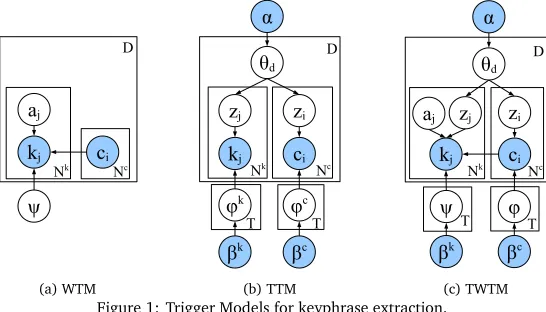
As these names suggest, WTM identifies keyphrases by triggering at word level; while TTM triggering at topic level. TWTM, integrating their advantages, performs both word-level and topic-level triggers to extract keyphrases.
To demonstrate the effectiveness of our method, we carry out experiments on a real-world dataset crawled from a website with keyphrases having been annotated collaboratively by users. Experiment results show that TWTM can identify appropriate keyphrases with better coverage of document themes compared to existing WAM-based methods.
2 Our Method
In this section we first introduce two simple trigger methods, WTM and TTM, in which WTM performs triggering at word level while TTM at topic level. Afterwards, we introduce our method TWTM.
(a) WTM (b) TTM (c) TWTM
Figure 1: Trigger Models for keyphrase extraction.
2.1 Notations and Definitions
Before introducing baselines and our method, we give some notations. We denote a docu-ment asd∈D, whereDis the document set. For each documentd, we denote its content as a sequence of wordsc={ci}N
c
i=1and its keyphrases as a setk={ki}N k
i=1. The vocabulary of words in documents is denoted asW, and the vocabulary of keyphrases asV. Each word ciin documents is an instance of a word typewinW, i.e.,ci=w∈W; each keyphraseki of documents is an instance of a keyphrase typevinV, i.e.,ki=v∈V.
We define keyphrase extraction as follows. Given a document d with its content c, keyphrase extraction aims to seek a set of keyphraseskthat maximizes Pr(k|c). By simply as-suming the keyphrases are independent conditional overd, we have Pr(k|c) =Qk∈kPr(k|c). The optimal set of keyphrasesk∗can be represented as follows:
k∗=arg max
k Pr(k|c) =arg maxk Y
k∈k
Pr(k|c). (1)
each candidate keyphrasev ∈V according to its score Pr(v|c)in descending order and selecting top-Nkkeyphrases.
2.2 Word Trigger Model
Word Trigger Model (WTM) is inspired by IBM Model-1 (Brown et al., 1993), the most widely used word alignment models in SMT. WTM assumes the content and the keyphrases of a document are describing the same themes while written in two different languages: document content in one language while keyphrases in the other. From this perspective, keyphrase extraction can be regarded as a translation process from a given document con-tent to keyphrases.
In more detail, the translation process is modeled as a trigger process as follows. First, WTM finds several important words in the document content astrigger words. Then, activated by these trigger words, WTM maps the document content into keyphrases. Atriggerin the translation process can be regarded as a mapping function from the words in document to keyphrases.
WTM formalizes a trigger as a hidden variablea. By assuming each keyphrase of a docu-ment is triggered by only one word in the content, aamaps each keyphrase at positionj (i.e.,kj) as triggered by a word at positioniin document contentc(i.e.,ci), denoted as aj=i. Given a document, its contentcand keyphraseskcan be connected by a trigger variablea. The probability of triggeringkfromccan be formalized as
Pr(k|c) =X
a
Pr(k,a|c) =X
a
Pr(k|a,c)Pr(a|c). (2)
Following the same assumptions of IBM Model-1 (Brown et al., 1993), for each document d∈D, WTM assumes the contentcofdalready exists, and the keyphraseskare generated fromcas follows:
1. For each documentdwith contentcandNkkeyphrases: (a) Forjfrom 1 toNk:
i. Sample each word trigger linkajfrom 1, . . . ,Ncaccording to a uniform dis-tribution.
ii. Sample eachkj=vaccording to trigger probability Pr(kj=v|caj=w,ψ).
Here we denote the trigger probability from a wordw ∈ W to a keyphrase v ∈ V as
ψvw =Pr(v|w), and the trigger probabilities fromW toV form a matrixψ. The corre-sponding graphical representation is shown in Figure 1a. The boxes are “plates” represent-ing replicates. In this graphical model, the variableskandcare shaded indicating that they are observed; while the unshaded variables, includingaandψ, are latent (i.e., unobserved). Under the same assumptions of IBM Model-1, we write
data. We use Expectation-Maximization (EM) (Dempster et al., 1977) to estimate trigger probabilitiesψ.
Using the estimatedψ, when given a novel documentd with its contentc, we can rank each candidate keyphrasevas follows:
Pr(v|c) =X
w∈c
Pr(v|w,ψ)Pr(w|c) =X
w∈c
ψvwPr(w|c), (4)
where Pr(w|c)indicates the weight of the wordwinc, which can be calculated using the TFIDF score ofwinc. From the ranking list in descending order, we can select the top-ranked ones as keyphrases of the given document.
2.3 Topic Trigger Model
WTM triggers keyphrases at the word level. We can also trigger at the topic level, and thus propose Topic Trigger Model (TTM) for keyphrase extraction. TTM is inspired by Polylingual Topic Models (Mimno et al., 2009), which is originally proposed to model par-allel documents in multiple languages. TTM is an extension of latent Dirichlet allocation (LDA) (Blei et al., 2003).
Suppose there areTlatent topics in TTM, and the number of topics|T|can be pre-defined by users. TTM assumes that the contentcand keyphraseskof a documentdshare the same distribution over|T|topics (i.e.,θd), which is drawn from a symmetric Dirichlet prior with concentration parameterα. TTM also assumes that each topict ∈ T corresponds to two different multinomial distributions over words, one for keyphrases (i.e.,φkt) and
another for content (i.e.,φtc), each of which is drawn from a specific symmetric Dirichlet with concentration parameter,βkorβc. TTM can be viewed as a generative process of both document content and keyphrases as follows:
1. Sample word distributionφctfromDirichlet(βc)and sample keyphrase distribution
φtkfromDirichlet(βk)for each topict∈T.
2. For each documentd∈DwithNcwords andNkkeyphrases: (a) Sample topic distributionθdfromDirichlet(α). (b) Forifrom 1 toNc
i. Sample a topiczi=tfromMul tinomial(θd).
ii. Sample a wordci=waccording to multinomial distribution Pr(ci=w|zi= t,φc).
(c) Forjfrom 1 toNk
i. Sample a topiczj=tfromMul tinomial(θd).
ii. Sample a keyphrasekj=vaccording to multinomial distribution Pr(kj= v|zj=t,φk).
The corresponding graphical model is shown in Figure 1b, where the observed variables (i.e., wordsc, keyphraseskand hyper-parametersβkandβc) are shaded.
each documentd, and the distributions over wordsφtcandφkt of each topict. By assum-ing a Dirichlet priorβonφ,φcan be integrated according to the Dirichlet-multinomial conjugacy. In this paper, we use Gibbs Sampling to estimate parameters, which has been widely used as an inference method for many latent topic models. In Gibbs sampling, it is usual to integrate out the mixturesθand topicsφand just sample the latent variablesz. The process is thus calledcollapsed.
Gibbs Sampling iteratively performs latent topic assignments for each word in the document set, and estimates the distributions over words of each topic (i.e.,φcwt=Pr(ci=w|zi=t) andφkvt = Pr(kj = v|zj = t)), and the distribution over topics of each document (i.e.,
θtd=Pr(zi=t|d)). Take a word tokenci=windfor example, given the current state of all but the variablezi, the conditional probability ofzi=tis
Pr(zi=t|ci=w,c¬i,z¬i,k)∝
wherezis the current topic assignments for all tokens in the document set; Nc wt is the number of occurrences of wordwthat are assigned with topic t; Nc
t is the number of occurrences of all words that are assigned with topict;Ntdis the number of occurrences of topictassigned in the current documentd;Nc
dandNdkare the numbers of all tokens in the content and keyphrases ofd, respectively;¬iindicates taking no account of the current positioni.
According to the posterior probability Pr(zi=t|ci=w,c¬i,z¬i,k), we re-sample the topic assignmentziof theci ind. Wheneverzi ofci is assigned with a new topic drawn from Equation (5),Nc
wtandNtdare updated. We perform topic assignments in the same way for each wordkiinkofd. After enough sampling iterations to burn in the Markov chain,φc,
φkandθare estimated as follows:
φcwt= N
When finishing the learning process, we obtain the distributions over words of each topic, i.e.,φkandφc. Suppose we are asked to extract keyphrases from a novel document with only contentc. First, we infer topic assignments for each word incwith Gibbs Sampling. With the topic assignments, we summarize the distribution over topics of the contentcas
Pr(t|c) = N
Triggered by the topics ofc, we rank each candidate keyphrasev∈Vas follows:
Pr(v|c) =X
t∈T
Pr(v|t,φk)Pr(t|c) =X
t∈T
φkv tθtd, (8)
and then select the top-ranked as keyphrases of the given document.
2.4 Topical Word Trigger Model
keyphrases that are uncommon or even not showing up in the given document. TTM, on the other hand, takes the main themes of the given document in consideration when extracting keyphrases. In order to aggregate the advantages of the both methods, extended from WTM and TTM, we propose Topical Word Trigger Model (TWTM) for keyphrase extraction. Similar to TTM, TWTM also assumes that topics are sampled at the word level. Each doc-ument is represented as a multinomial distribution overTlatent topics. On the document content side, each topict∈Tcorresponds to a multinomial distribution over words, which is similar to TTM. On the keyphrase side, each topict∈Tcorresponds to a topic-specific translation tableψt. Given each documentd∈D, the generative process of both document content and keyphrases is as follows:
1. Sample word distributionφctfromDirichlet(βc)for each topict∈T.
2. Sample keyphrase distributionψwt fromDirichlet(βk)for each topict∈Tand each wordw∈W.
3. For each documentd∈DwithNcwords andNkkeyphrases: (a) Sample topic distributionθdfromDirichlet(α). (b) Forifrom 1 toNc
i. Sample a topiczi=tfromMul tinomial(θd).
ii. Sample a wordci=waccording to multinomial distribution Pr(ci=w|zi= t,φc).
(c) Forjfrom 1 toNk
i. Sample a topiczj=tfromMul tinomial(θd).
ii. Sample each word trigger linkaj from all words ind that are generated fromtaccording to a uniform distribution.
iii. Sample eachkj=vaccording to trigger probability Pr(kj=v|caj=w,ψ t
).
The graphical model is shown in Figure 1c. Topic-dependent translation probabilitiesψt are the key parameters. Eachψt maintains the translation probability from each word ci=win contents to each keyphrasekj=vunder topict, i.e.,ψtvw=Pr(kj=v|ci=w,t). Given the observed words and keyphrases in a collection of documents, the task of TWTM learning is to compute the posterior distribution of the latent topic assignmentsz, the topic mixturesθd of each documentd, the distribution over wordsφtof each topict, and the trigger probabilitiesψt of each topict. We can also use Gibbs Sampling to estimate pa-rameters in TWTM. On the document content side, we can perform topic assignmentsz for each word as in TTM using Equation (5). On the keyphrase side, the problem is more complicated. Suppose we will assign each keyphrasekj with a topiczj and a triggeraj. Take a keyphrasekj=vfor example, given the current state of all but the variablezjand aj, the conditional probability ofzj=t,aj=iis calculated as follows,
Pr(zj=t,aj=i|kj=v,k¬j,z¬j,a¬j,ci=w,c)∝
Nt,¬j vw +βk
Nt
w−1+|V|βk
× N
¬j td+α
Nd−1+|T|α, (9)
wherezis the current topic assignments for all translation pairs in the document set;Nt vw is the number of occurrences thatwis translated tovgiven topict;Nt
the current documentd;¬jalso indicates taking no account of the current positionj. Given
After re-assigning the topiczj=tfor the current keyphrase according to Equation (10), we can further compute the trigger probability as follows:
Pr(aj=i|zj=t,kj=v,k¬j,z¬j,a¬j,c) =
According to Equation (11), we re-assign trigger wordcifor the current keyphrasekj. After enough sampling iterations to burn in the Markov chain,φc,ψtandθare estimated as
follows:
The potential size of topical trigger probabilitiesψis|V|×|W|×|T|. The size is comparative larger thanψin WTM, and thus faces more serious problem of data sparsity. To remedy the problem, we use interpolation smoothing technique forψof TWTM. In this paper, we employ smoothing usingψof WTM as follows:
PrSMOOT H(v|w,t) =λPrTW T M(v|w,t) + (1−λ)PrW T M(v|w,t), (13)
where PrSMOOT H(v|w,t)is the smoothed topical trigger probabilities, PrT W T M(v|w,t)is the original topical trigger probabilities of TWTM, PrW T M(v|w,t)is the trigger probabilities of WTM.λis the smoothing factor ranging from 0.0 to 1.0. Whenλ=0.0, Prt
SMOOT H(v|w)will be reduced to non-topic trigger probabilities; and whenλ=1.0, there will be no smoothing in PrSMOOT H(v|w,t).
In TWTM, we perform keyphrase extraction as follows. Suppose we need perform keyphrase extraction for a documentd with its contentc. We perform Gibbs Sampling to iteratively estimate the topic distribution ofd(i.e.,θd) according to document content c. Afterwards, we selectNkkeyphrases using the ranking score of each keyphrasev:
Pr(v|c) =X
To evaluate the performance of TWTM for keyphrase extraction, we carry out experiments on a real world dataset, crawled fromdouban.om, the largest product review website in
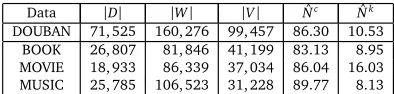
as standard keyphrases. The dataset consists of annotations for three types of products, i.e., book, movie and music. The statistics of the dataset is shown in Table 1, where|D|,|W|, |V|, ˆNcand ˆNkare the number of documents, the vocabulary of contents, the vocabulary of keyphrases, the average number of words and keyphrases in each document, respectively. In Table 1, we use DOUBAN to represent the whole dataset and use BOOK, MOVIE and MUSIC to show the statistics for instances for different product types.
Data |D| |W| |V| Nˆc Nˆk
DOUBAN 71, 525 160, 276 99, 457 86.30 10.53
BOOK 26, 807 81, 846 41, 199 83.13 8.95
MOVIE 18, 933 86, 339 37, 034 86.04 16.03
MUSIC 25, 785 106, 523 31, 228 89.77 8.13
Table 1: Statistical information of dataset.
To evaluate the performance of our method and compare with other methods, we randomly select 1, 000 instances from each of three types of products to form the test set with 3, 000 instances, and use the rest of the dataset as training set.
In our experiments we select three evaluation metrics. The first metric is precision, recall and F-measure represented asp=ccorrect/cex t ract,r=ccorrect/cstandardandF=2pr/(p+r), whereccorrectis the total number of keyphrases that are correctly suggested by a method, cex t ract is the total number of automatic extracted keyphrases, andcstandard is the total number of human-labeled standard keyphrases.
In fact, ranking order of extracted keyphrases also indicates the performance of different methods. A method is regarded better than another one if it ranks correct keyphrases higher. However, precision/recall/F-measure does not take the order of extracted keyphrases into account. To address the problem, we select the following two additional metrics. One met-ric isbinary preference measure(Bpref) (Buckley and Voorhees, 2004). Bpref can consider the order of extracted keyphrases for evaluation. For a document, if there areRcorrect keyphrases withinMextracted keyphrases by a method, in whichris a correct keyphrase andnis an incorrect keyphrase. It is defined as Bpref=R1
P
r∈R 1−|nranked higher thanM r|
. The other metric ismean reciprocal rank(MRR) (Voorhees, 2000) which is usually used to evaluate how the first correct keyphrase for each document is ranked. For a documentd, rankdis denoted as the rank of the first correct keyphrase with all extracted keyphrases, It is defined as MRR=|D|1 Pd∈Drank1d, whereDis the document set for keyphrase extraction.
3.2 Case Studies
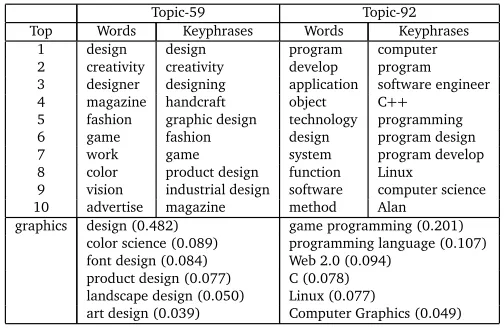
Before quantitative evaluation, we perform case studies by looking into the topics learned by TWTM. By settingT=100 of TWTM, We select two topics, i.e., Topic-59 and Topic-92 for study. In first several rows of Table 2, we list the top-10 words and top-10 keyphrases given the two topics separately (i.e., ranked by Pr(w|t)and Pr(v|t)). From the top words and keyphrases, we can conclude that Topic-59 is about “art design” and Topic-92 is about “computer programming”.
word “graphics” generally refers to “computer graphics” and thus correlates to “program-ming”, “software” and “programming language”. At the bottom of Table 2, we show the top-6 keyphrases triggered by the word “graphics” with respect to the two topics. The value in the bracket after each keyphrasevis the probabilityψtvw=Pr(v|w,t), which is the top-ical specific trigger probability fromw(here is the word “graphics”) tovunder the topic t. From the top triggered keyphrases by “graphics” under two topics, we can see they are discriminative with each other, and have intense topic characteristics.
Topic-59 Topic-92
Top Words Keyphrases Words Keyphrases
1 design design program computer
2 creativity creativity develop program
3 designer designing application software engineer
4 magazine handcraft object C++
5 fashion graphic design technology programming
6 game fashion design program design
7 work game system program develop
8 color product design function Linux
9 vision industrial design software computer science
10 advertise magazine method Alan
graphics design (0.482) game programming (0.201)
color science (0.089) programming language (0.107)
font design (0.084) Web 2.0 (0.094)
product design (0.077) C (0.078)
landscape design (0.050) Linux (0.077)
art design (0.039) Computer Graphics (0.049)
Table 2: Examples of topics learned with TWTM.
After investigating the topics, we look into keyphrase extraction results given a product description. Here we select a Japanese classical literatureThe Tale of Genjifor example, which was written byMurasaki Shikibuin the early years of the 11th century1. The book recounts the life and love stories of a son of the Japanese emperor. In Table 3, we show the top-10 keyphrases extracted by WTM, TTM and TWTM, in which we use(−)to highlight the inappropriate keyphrases.
Method Extracted Keyphrases
WTM The Tale of Genji, classic, Japan, foreign literature, Murasaki Shikibu, politics (-), love, political science (-), eason (-), political philosophy (-)
TTM novel, Japan, foreign literature, history, love, sociology (-), culture, literature, Russia (-), female (-)
TWTM novel, foreign literature, The Tale of Genji, history, Japan, classic, literature, love, Murasaki Shikibu, politics (-)
Table 3: Examples of extracted keyphrases for the bookThe Tale of Genji. From Table 3 we observe that: (1) WTM can suggest keyphrases that are closely related to the book, such as “The Tale of Genji” and “Murasaki Shikibu”. However, due to not consider-ing document themes, WTM will extract irrelevant keyphrases such as “politics”, “political
1
science”, “eason” and “political philosophy”. (2) TTM triggers keyphrases with the favor of latent topics, which are usually too general to commendably represent the document main themes. We can see TTM fail to extract specific keyphrases such as “The Tale of Genji” and “Murasaki Shikibu”. What is worse, TTM over-generalizes the document themes and ex-tract inappropriate keyphrases “sociology”, “’Russia” and “female”. (3) Taking advantages of both WTM and TTM, TWTM can extract specific and representative keyphrases and at the same time guarantee the coverage of document themes. We can see that TWTM achieves a smart balance between word-level projections and topic-level coverage.
3.3 Parameter Influences
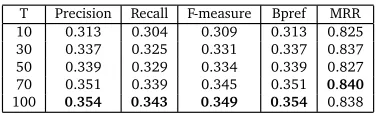
There are two crucial parameters in TWTM, the number of topicsTand the smoothing factorλ. In Table 4 and Table 5, we demonstrate the performance of TWTM for keyphrase extraction when parameters change.
T Precision Recall F-measure Bpref MRR
10 0.313 0.304 0.309 0.313 0.825
30 0.337 0.325 0.331 0.337 0.837
50 0.339 0.329 0.334 0.339 0.827
70 0.351 0.339 0.345 0.351 0.840
100 0.354 0.343 0.349 0.354 0.838
Table 4: The influence of topic numberTof TWTM for keyphrase extraction whenNk
=10 and smoothing factorλ=0.4.
λ Precision Recall F-measure Bpref MRR
0.0 0.310 0.254 0.279 0.310 0.676
0.2 0.318 0.314 0.316 0.318 0.823
0.4 0.354 0.343 0.349 0.354 0.838
0.6 0.364 0.349 0.357 0.364 0.812
0.8 0.350 0.334 0.342 0.351 0.764
1.0 0.323 0.306 0.314 0.324 0.731
Table 5: The influence of smooth factorλof TWTM for keyphrase extraction whenNk=10
and the number of topicsT=100.
From Table 4, we can see that, as the number of topicsTincreases fromT=10 toT=100, the performance roughly improves. This indicates that the granularity of topics will influ-ence the keyphrase extraction performance. WhenT=70 andT=100, the performance
achieves a relatively stable good status. Hence, when comparing TWTM with other meth-ods, we setT=100 for TWTM.
3.4 Performance Comparison
Besides WTM and TTM, we also select three representative methods as baselines for compar-ison: the classification-based method Naive Bayes (NB) (Garg and Weber, 2008), the topic-based method CRM (Iwata et al., 2009) and the word-projection method TAM (Si et al., 2010). We setT=1, 024 for CRM which achieves its best performance.
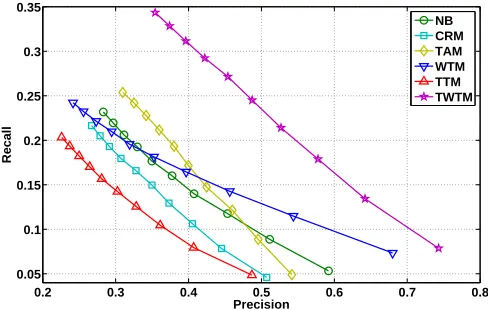
In Figure 2 we show the precision-recall curves of NB, CRM, TAM, WTM, TTM and TWTM on the dataset. Each point of a precision-recall curve represents extracting different number of keyphrases ranging fromNk
=1 (bottom right, with higher precision and lower recall) toNk=10 (upper left, with higher recall but lower precision), respectively. The closer the curve to the upper right, the better the overall performance of the method.
0.2 0.3 0.4 0.5 0.6 0.7 0.8
0.05 0.1 0.15 0.2 0.25 0.3 0.35
Precision
Recall
NB CRM TAM WTM TTM TWTM
Figure 2: Precision-recall curves for keyphrase extraction.
Figure 2 clearly shows that TWTM outperforms other methods significantly. The interesting phenomena is that, whenNkis getting larger, the advantages of TWTM are more obvious compared to baselines. We know that when a system is asked to extract more keyphrases (i.e.,Nkis larger), it is becoming important for extracted keyphrase to have a good cover-age of document themes. Otherwise, the performance will drop sharply. This is the issue suffered by WTM. We can see that, although WTM is relatively excellent when suggesting top several keyphrases, it performs poor when suggesting more keyphrases due to the poor ability on ensuring coverage.
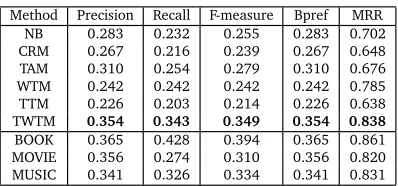
In Table 6 we list the comparison results of various methods when extractingNk
=10
Method Precision Recall F-measure Bpref MRR
NB 0.283 0.232 0.255 0.283 0.702
CRM 0.267 0.216 0.239 0.267 0.648
TAM 0.310 0.254 0.279 0.310 0.676
WTM 0.242 0.242 0.242 0.242 0.785
TTM 0.226 0.203 0.214 0.226 0.638
TWTM 0.354 0.343 0.349 0.354 0.838
BOOK 0.365 0.428 0.394 0.365 0.861
MOVIE 0.356 0.274 0.310 0.356 0.820
MUSIC 0.341 0.326 0.334 0.341 0.831
Table 6: Comparison results when extractingNk
=10 keyphrases.
also eventually improve the performance of keyphrase extraction.
Conclusion and Future Work
This paper focuses on keyphrase extraction from a controlled vocabulary. The proposed TWTM has two features: (1) TWTM uses latent topics to represent document themes, and thus takes the coverage of document themes into consideration; (2) TWTM models topic-specific word triggers, which are more discriminative. Hence TWTM is able to bridge the vocabulary gap between document content and keyphrases more precisely. Experiment results on real world dataset demonstrate that TWTM outperforms existing state-of-the-art methods under various evaluation metrics. We also demonstrate that TWTM achieves a balance between word-level projection and topic-level coverage.
Moreover, TWTM is not restricted to supervised learning. TWTM can also be adopted in unsupervised fashion. So long as we can build appropriate translation pairs to represent semantic relations between documents and keyphrases, TWTM will be able to exert its capacity. For example, for news articles, we can use news titles and contents to build trans-lation pairs, by regarding titles as an approximate language to keyphrases; for scientific papers, we can use abstracts and contents to build translation pairs.
We design the following research plans: (1) The number of topics in TWTM requires be-ing pre-defined by users. We plan to incorporate Bayes Nonparametric (Blei et al., 2010) for TWTM to automatically learn the number of topics. (2) The trigger probabilities in TWTM do not take rich linguistic knowledge into consideration. We plan to incorporate more complicated alignment models from SMT into our model. (3) This paper focuses on supervised learning of TWTM. We plan to investigate unsupervised learning of TWTM for documents such as news articles and scientific papers. (4) The influence of product types for keyphrase extraction has not been thoroughly investigated in this paper. We plan to study the impact of product types and explore domain adaptation (Blitzer et al., 2006) for cross-domain keyphrase extraction using TWTM.
Acknowledgments
References
Blei, D., Griffiths, T., and Jordan, M. (2010). The nested chinese restaurant process and bayesian nonparametric inference of topic hierarchies.Journal of the ACM, 57(2):7.
Blei, D. and Lafferty, J. (2009). Text mining: Classification, Clustering, and Applications, chapter Topic models. Chapman & Hall.
Blei, D., Ng, A., and Jordan, M. (2003). Latent dirichlet allocation. Journal of Machine Learning Research, 3:993–1022.
Blitzer, J., McDonald, R., and Pereira, F. (2006). Domain adaptation with structural corre-spondence learning. InProceedings of EMNLP, pages 120–128.
Brown, P., Pietra, V., Pietra, S., and Mercer, R. (1993). The mathematics of statistical machine translation: Parameter estimation.Computational linguistics, 19(2):263–311.
Buckley, C. and Voorhees, E. (2004). Retrieval evaluation with incomplete information. InProceedings of SIGIR, pages 25–32.
Dempster, A., Laird, N., Rubin, D., et al. (1977). Maximum likelihood from incomplete data via the em algorithm.Journal of the Royal Statistical Society. Series B (Methodological), 39(1):1–38.
Frank, E., Paynter, G., Witten, I., Gutwin, C., and Nevill-Manning, C. (1999). Domain-specific keyphrase extraction. InProceedings of IJCAI, pages 668–673.
Garg, N. and Weber, I. (2008). Personalized, interactive tag recommendation for flickr. In Proceedings of RecSys, pages 67–74.
Grineva, M., Grinev, M., and Lizorkin, D. (2009). Extracting key terms from noisy and multi-theme documents. InProceedings of WWW, pages 661–670.
Heinrich, G. (2005). Parameter estimation for text analysis. Web: http://www. arbylon. net/publications/text-est.
Iwata, T., Yamada, T., and Ueda, N. (2009). Modeling social annotation data with content relevance using a topic model. InProceedings of NIPS, pages 835–843.
Krestel, R., Fankhauser, P., and Nejdl, W. (2009). Latent dirichlet allocation for tag recom-mendation. InProceedings of ACM RecSys, pages 61–68.
Li, X., Snoek, C., and Worring, M. (2009). Learning social tag relevance by neighbor voting.IEEE Transactions on Multimedia, 11(7):1310–1322.
Liu, Z., Chen, X., and Sun, M. (2011a). A simple word trigger method for social tag suggestion. InProceedings of EMNLP, pages 1577–1588.
Liu, Z., Chen, X., and Sun, M. (2012). Mining the interests of chinese microbloggers via keyword extraction.Frontiers of Computer Science, 6(1):76–87.
Liu, Z., Huang, W., Zheng, Y., and Sun, M. (2010). Automatic keyphrase extraction via topic decomposition. InProceedings of EMNLP, pages 366–376.
Liu, Z., Li, P., Zheng, Y., and Sun, M. (2009). Clustering to find exemplar terms for keyphrase extraction. InProceedings of EMNLP, pages 257–266.
Mihalcea, R. and Tarau, P. (2004). Textrank: Bringing order into texts. InProceedings of EMNLP, pages 404–411.
Mimno, D., Wallach, H., Naradowsky, J., Smith, D., and McCallum, A. (2009). Polylingual topic models. InProceedings of EMNLP, pages 880–889.
Nguyen, T. and Kan, M. (2007). Keyphrase extraction in scientific publications. In Pro-ceedings of the 10th International Conference on Asian Digital Libraries, pages 317–326. Ravi, S., Broder, A., Gabrilovich, E., Josifovski, V., Pandey, S., and Pang, B. (2010). Au-tomatic generation of bid phrases for online advertising. InProceedings of WSDM, pages 341–350.
Salton, G. and Buckley, C. (1988). Term-weighting approaches in automatic text retrieval. Information processing and management, 24(5):513–523.
Si, X., Liu, Z., and Sun, M. (2010). Modeling social annotations via latent reason identifi-cation.IEEE Intelligent Systems, 25(6):42–49.
Si, X. and Sun, M. (2009). Tag-LDA for scalable real-time tag recommendation. Journal of Computational Information Systems, 6(1):23–31.
Tsoumakas, G. and Katakis, I. (2007). Multi-label classification: An overview.International Journal of Data Warehousing and Mining (IJDWM), 3(3):1–13.
Turney, P. (2000). Learning algorithms for keyphrase extraction. Information Retrieval, 2(4):303–336.
Voorhees, E. (2000). The trec-8 question answering track report. InProceedings of TREC, pages 77–82.
Wan, X. and Xiao, J. (2008a). Collabrank: towards a collaborative approach to single-document keyphrase extraction. InProceedings of COLING, pages 969–976.
Wan, X. and Xiao, J. (2008b). Single document keyphrase extraction using neighborhood knowledge. InProceedings of AAAI, pages 855–860.
![Cost effectiveness of microendoscopic discectomy versus conventional open discectomy in the treatment of lumbar disc herniation: a prospective randomised controlled trial [ISRCTN51857546]](data:image/gif;base64,R0lGODlhAQABAIAAAP///wAAACH5BAEAAAAALAAAAAABAAEAAAICRAEAOw==)