62
Effect of Electrolyte on Phase Separation of Aqueous
Organic System
Ms. Neha B. Shinde
1, Prof. S. V. Ranade
2Department of Chemical Engineering1, 2, Mahatma Gandhi Mission's College of Engineering & Technology1, 2 Email: [email protected], [email protected]
Abstract- The influence of salt on Liquid- Liquid Equilibrium cannot be ignored because it significantly changes the equilibrium composition. Liquid-Liquid Equilibrium is the result of intermolecular forces which can significantly change due to salt addition which introduces ionic forces , affecting the thermodynamic equilibrium . Aqueous electrolyte liquid-liquid equilibrium is often related to extraction processes. In the present work the salt effect on the system namely ‘2-Propanol+Water’ has been studied with various salts under varied concentration. The salts used in the above system are Na2S2O3.5H2O and Na2CO3. The
effect of salt concentration on aqueous organic system has been studied using Cloud Point Method. The effect of different salt on phase separation of studied system is discussed on the base of intermolecular interactions. The free energy, enthalpy and entropy of clouding point is estimated using simple method, and the driving force for two phase formation process is discussed on the base of the estimated free energy values.
Index Terms- Alcohol, Cloud point data, Gibb’s free energy, Enthalpy, Entropy Liquid - liquid equilibrium, Salt effect.
1. INTRODUCTION
Study of effect of salt on aqueous organic systems is very important for chemical industry due to its applications in separation and purification processes. Such as separation of solutropic mixtures, design of extractor, recycling of organic solvent in mixed solvent system. Salt effect also finds application in biological separation processes such as purification of proteins, enzymes, nucleic acids and others. Liquid-Liquid extraction technique utilizing Aqueous two Phase Systems (ATPSs) is clean alternative for traditional organic +water solvent extraction system due to its advantages such as easy processing on any scale, high capacity, easy and precise scale up, high product yields and low cost. Therefore many research groups have focused on theoretical and experimental study of phase equilibrium conditions in ternary aqueous two phase systems (ATPSs).
When one short-chain alcohol and one salt are dissolved in water above a critical concentration, two immiscible phases are usually formed which is referred to as aqueous two phase systems (ATPSs). These types of systems have shown great potential for efficient extraction and purification of biological products because of biocompatibility and low cost. Greve and Kula have described the use of some aqueous biphasic systems containing short-chain alcohols + water + inorganic salts for the extraction of salt from the primary bottom phase of protein extraction processes in polymer + salt systems. Liquid-liquid equilibria (LLE) in ATPSs are due to intermolecular forces, predominantly hydrogen
bonding and ion-dipole interactions. Addition of a salt to such a system introduces ion-dipole interactions which alter the structure of the hydrophilic solvents such as alcohols in equilibrium. The molecules of water that surround the ions become unavailable for the hydrophilic solvents, and it becomes “salted out” from the aqueous phase. The opposite process can occur if a polar organic solvent is added to an aqueous salt solution. It captures part of the molecules of water that have been solvating the ions; hence, the salt crystallizes. This effect is used in a process called extractive crystallization in which salts can be recovered from concentrated aqueous solutions by the addition of a polar organic solvent, rather than by the more expensive evaporation process. On the other hand, the salting out effect is utilized for removing organic compounds from water.
2. MATERIALS
Table 1: Materials & Specifications
Chemical Source Purity
(%)
2-Propanol Rankem (India) >99.7 Anhydrous Sodium
carbonate
Lobachemie
(India) >99.5 H2O Milipore >99.9
Sodium thiosulphate Emparta Merck
63 Double distilled deionizer water with specific
conductance about < 0.2 µS/cm was used in all experiments.
3. EXPERIMENTAL PROCEDURE
To examine the effect of change in salt concentration on cloud point of aqueous 2-propanol solution, a measured (2-2-propanol+water) solution is taken inside the glass sample tube. Ratio of alcohol to water is maintained at constant value. A measured amount of salt is added into aqueous organic system. Sample tube is placed inside the glass water bath so that cloud point can be easily observed. The mixture inside the sample tube for uniform temperature distribution. Temperature is decreased at the rate of 0.1°C per minute with the help of ice, until solution become cloudy or turbid. Temperature of solution is measured using digital temperature indicator whose sensor is inserted inside the tube. The temperature at which first cloud appears is noted as cloud point temperature. Then solution again heated slowly at the rate of 0.1°C per minute till cloud gets disappeared. This process is repeated to get reproducibility in results. Similarly, at constant salt: water ratio, effect of change 2-propanol concentration on cloud point is measured.
Figure 1: Experimental Setup to Study Effect of Salt on Aqueous organic System
4. RESULTS AND DISCUSSIONS
4.1 Effect of Change in Salt Concentration
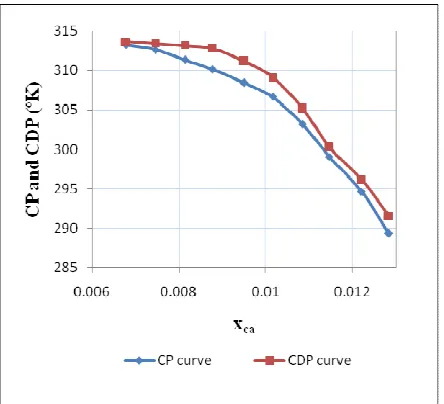
To study the effect of salt (or electrolyte) on the investigated systems, the cloud point and cloud disappearance point temperatures were measured as functions of mole fraction of the salt at constant alcohol: water mole ratio. Figure 2 and figure 3 shows the salt concentration dependence of the cloud point and cloud disappearance point at constant concentration of aqueous 2-Propanol solution for each of the system studied. As shown in figure 2 in case of Aqueous Two Phase System (ATPS) composed of
sodium carbonate salt as electrolyte, cloud point temperature decreases with increase in concentration of electrolyte at constant 2-propanol:water mole ratio(0.0.247069). Same phenomenon is observed in case of sodium thiosulphate salt (figure 3) as electrolyte at constant 2-propanol to water mole ratio (0.0.2470). In other words, the salting out ability of salt increases with increase in concentration and decrease in temperature. The experimental result from figure 2 and figure 3 lead to conclusion that a salting out effect exists for both the salts under study and this effect increase with increase with concentration of salt.
This observation can be explained in terms of kosmotropicity of salts. Zafarani-moattor et.al researched on behavior of aqueous alcohol system in presence of kosmotropic salt. When such salt added into aqueous alcohol solution, the salt and alcohol compete with each other for water molecules. Salt have higher affinity towards water than alcohol. So intermolecular attraction between salt and water molecule increases and results into increased alcohol-alcohol self-intermolecular interactions of alcohol-alcohol as they have weaker affinity towards water.
Figure 2 : Cloud Point (CP) and Cloud Disapperance Point (CDP) curve for 2-Propanol (m) + sodium
64 Figure 3 : Cloud Point (CP) and Cloud Disapperance
Point (CDP) curve for 2-Propanol (m) + sodium thiosulphate (ca) + water (w) at constant 2-Propanol:
water (mole ratio) = 0.2470
4.2 Phase Separation Ability of Different Salt In the present work, two sets of experiment with two different salts were carried out to study salting effect produced by addition of different salts to aqueous solution of alcohol.
As shown in figure 4, sodium thiosulphate is more effective than sodium carbonate at low concentration. For the same concentration of electrolyte sodium thiosulphate gives higher decrement in cloud point than sodium carbonate. For higher decrement in cloud point more concentration of sodium carbonate is required.
Phase separation ability of different salt can be explained in terms of solubility of salt in water. As the solubility of salt in water increases (i.e. salt- water interaction increases, alcohol get salted out more readily. Solubility of sodium thiosulphate in water (70.1 gm/100 gm of water at 20C) is higher than sodium carbonate (21.80gms/100gms of water) in water. As the solubility of salt in water increases the phase separation ability of increases. Sodium thiosulphate and sodium carbonate both are insoluble in alcohol and there is no data found on solubility of sodium thiosulphate and sodium carbonate in alcohol. Therefore salt-alcohol interactions are neglected in both the system studied and only salt-water and alcohol-water interactions are taken into consideration.
Figure 4 : Comparison between Cloud Point (CP) and Cloud Disappearance Point (CDP) curve for
2-Propanol (m) + sodium carbonate / sodium thiosulphate (ca) + water (w) at constant 2-Propanol :
water (mole ratio) = 0.24707
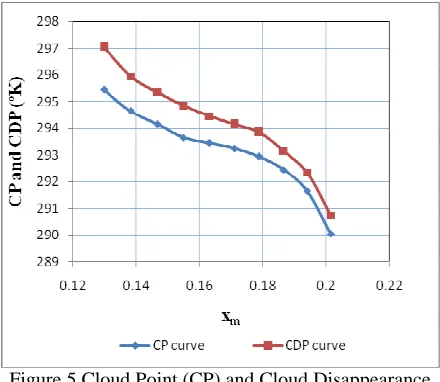
4.3 Effect of Change in Alcohol Concentration As shown in figure 5 for the system (2-propanol- sodium carbonate-water), the experimental results are in good agreement with literature.
65 Figure 5 Cloud Point (CP) and Cloud Disappearance
Point (CDP) curve for
2-Propanol (m) + sodium carbonate (ca) + water (w) at constant sodium carbonate: water (mole ratio) =
0.025835
Figure 6 Cloud Point (CP) and Cloud Disappearance Point (CDP) curve for
2-Propanol (m) + sodium thiosulphate (ca) + water (w) at constant sodium thiosulphate: water (mole
ratio) = 0.011033
4.4 EFFECT OF SALT AND ALCOHOL CONCENTRATION ON GIBB’S FREE ENERGY
(∆GC), ENTHALPY (∆HC) AND ENTROPY (∆SC)
Recently, Dan et al., with consideration of clouding as the point of phase separation (or the solubility limit) estimated the free energy, ∆GC,
enthalpy, ∆HC, and entropy, ∆SC, of phase-separation
to obtain some information about the driving force of the aqueous two-phase formation process. Following Dan et al., the free energy of phase separation or clouding (∆GC) can be calculated from the following
relation:
∆GC = R.T.ln x (Eq. 1)
Where x is the mole fraction concentration of component at cloud point (CP or T). The values of ∆Gc, ∆Hc, ∆Sc are reported in Table 2, Table 3, with reference to the clouding point concentrations of T for the same concentration of the alcohol in the studied systems. The values of ∆Gc, ∆Hc, ∆Sc are reported in Table. 4, Table 5 with reference to the clouding point concentrations of T for the same concentration of the salt in the studied systems.
The ∆Gc values at different CP (or T) were processed according to the equation given below to get ∆Hc from the slope of the linear (least squares) plot of (∆Gc /T) against (1/T) for each of the studied ATPSs.
∆Hc = d (∆Gc/T) / d(1/T) (Eq. 2)
Moreover, the following Gibbs–Helmholtz equation was used to calculate the entropy changes:
∆Gc = ∆Hc – T.∆Sc (Eq. 3)
Table 2: Estimated ∆Gc (kJ.mol-1), ∆Hc (kJ.mol-1)
∆Sc (kJ.mol-1) for the {2-Propanol (m) +salt (ca) +water (w)} as function of mole fraction of salt System 2-Propanol (m) +sodium carbonate (ca)
+water (w)
T (ºK)
∆Gc
(kJ.mol-1)
∆Hc
(kJ.mol-1)
T ∆Sc
(kJ.mol-1) 313.65 -13.0223 18.132 31.15432
313.45 -12.7678 18.132 30.89975
313.15 -12.5252 18.132 30.65721 312.75 -12.3122 18.132 30.44425
311.15 -12.047 18.132 30.179
309.15 -11.7968 18.132 29.92879 305.15 -11.4773 18.132 29.60926
300.25 -11.1548 18.132 29.28676 296.15 -10.8504 18.132 28.98244
291.55 -10.5582 18.132 28.69022
The effect on change in salt concentration on free energy, enthalpy and entropy of studied aqueous two phase system is tabulated in Table 4.5 and Table 4.6.The values shows that the (∆GC) of ATPS
composed of sodium thiosulphate is more (∆GC
=-13.4095 kJ.mol-1) than the ones of the sodium carbonate (∆GC = -13.0223 kJ.mol-1). The salting out
66 energy from isolated naked ion in the gas phase to
aqueous solvated ion in solution, and therefore the ions with the higher kosmotropicity have more negative value, due to resulting more structured water molecules ‘lattice’ the ion .In present cases, taking into account that both salt have same cation (Na+), the phase separation ability of different salt can be
mobilized water molecules available to hydrated the alcohol molecules decreased, and subsequently the third component, alcohol, more effectively salted-out.
Table 3: System: 2-Propanol (m) +sodium thiosulphate (ca) +water (w) 296.25 -13.4095 21.8716 35.28109 295.55 -12.8321 21.8716 34.70371 295.15 -12.3701 21.8716 34.24172 294.35 -11.9618 21.8716 33.83344 293.95 -11.6219 21.8716 33.49353 293.35 -11.3135 21.8716 33.18506 292.75 -11.0365 21.8716 32.90814 292.55 -10.9813 21.8716 32.85294 292.05 -10.9159 21.8716 32.78752 291.75 -10.859 21.8716 32.73061 291.25 -10.7956 21.8716 32.66724 290.95 -10.7408 21.8716 32.61235 290.65 -10.6868 21.8716 32.55835 290.25 -10.6297 21.8716 32.50132 289.45 -10.5591 21.8716 32.43067 288.15 -10.4712 21.8716 32.34279 285.75 -10.3058 21.8716 32.17737 283.65 -10.1922 21.8716 32.06377 280.95 -10.035 21.8716 31.90664 278.05 -9.91862 21.8716 31.79022
The calculated ∆HC and T∆SC values are
presented in Table 3,Table 4,Table 5 and Table 6 which are all positive in the case of ATPSs composed of propanol+sodium carbonate+water) and (2-propanol + sodium thiosulphate + water) and shows that the aqueous two phase formation processes are endothermic in these cases.
Also, the estimated T∆SC values are positive for the
systems composed of (2-propanol+sodium carbonate+water) and (2-propanol+sodium thiosulphate+water). The positive entropy and enthalpy of the ATPSs suggest that the increase of
entropy is the driving force for the aqueous two-phase formation processes in these cases.
Table 4: Estimated ∆Gc (kJ.mol -1
), ∆Hc (kJ.mol -1
) ∆Sc
(kJ.mol-1) for the {2-Propanol (m) +salt (ca) +water (w)} as function of mole fraction of 2-Propanol. System: {2-Propanol (m) +sodium carbonate (ca)
+water (w)}
T (ºK) ∆Gc (kJ.mol-1) ∆Hc (kJ.mol-1) T∆Sc (kJ.mol-1)
297.05 -5.04373 56.3014 61.34513 295.95 -4.86714 56.3014 61.16854 295.35 -4.71199 56.3014 61.01339 294.85 -4.56967 56.3014 60.87107 294.45 -4.43866 56.3014 60.74006 294.15 -4.31771 56.3014 60.61911 293.85 -4.20432 56.3014 60.50572 293.15 -4.09213 56.3014 60.39353 292.35 -3.98494 56.3014 60.28634 290.75 -3.87291 56.3014 60.17431
67 with higher solubility is more than salt with lower
solubility due to comparatively weaker salt to water intermolecular interaction.
Additionally, the result obtained for the effect of 2-Propanol concentration on electrolyte solutions show that the effect of alcohol concentration on Sodium Carbonate is higher than Sodium Thiosulphate.
Furthermore on the base of estimated free energy, enthalpy and entropy of clouding point as function of mole fraction of salt and mole fraction of 2-Propanol obtained in this work, it can be concluded that the increase of entropy is driving force for the aqueous two phase formation.
Acknowledgments
We are gratefully acknowledging to Department of Chemical Engineering, Mahatma Gandhi Mission’s College of Engineering & Technology, Navi Mumbai, for experiment facility & their guidance, help in completion of this research.
REFERENCES
[1] Nemati-Knade, E.; Shekaari, H.; Jafari, S. (2012): Thermodynamic study of aqueous two phase Partially Miscible Systems of n-Propanol-Water and i-Propanol-Water, Ind. Eng. Chem. Res., 37, pp. 2039-2044.
[3] Aznar, M.; Arau, R.; Romanato, J.; Santos, G.; D'Avila, S. (2000): Salt Effects on Liquid-Liquid Equilibrium in Water + Ethanol +Alcohol + Salt Systems, J. Chem. Eng. Data, 45, pp. 1055-1059. [4] Nemati-Kande, E.; Shekaari, H. (2013):
Thermodynamic investigation of the ATPSs composed of some (aliphatic alcohol + sodium carbonate + water) ternary systems, J. Chem. Thermodynamic, 57, pp. 541–549.
[5] Santos, F. M.; D’Ávila, S.; Aznar, M. (2001): Salt effect on liquid–liquid equilibrium of water + 1-butanol + acetone system: experimental determination and thermodynamic modeling, Fluid Phase Equilibria, 187–188, pp. 265–274. [6] Dagade, D.H.; Kumbhar, R. R.; Sabale, S. R.;
Patil, K. J. (2007): Phase diagram of Na2S2O3 +
ethanol + water at ambient pressure and temperature, Fluid Phase Equilibria, 255, pp. 110–114.
[7] Shekaari, H.; Sadeghi, R.; Jafari, S. A. (2010): Liquid-Liquid Equilibria for Aliphatic Alcohols + Dipotassium Oxalate + Water, J. Chem. Eng. Data, 55, pp. 4586–4591.
[8] Furter, F. W.; Cook, A. R. (1967): Salt Effect In Distillation: A Literature Review, Int. J. Heat Mass Transfer, 10, pp. 23-36.
[9] Mohsen-Nia, M.; Rasa, H.; Modarress, H.; Cloud-Point Measurements for Salt Poly(ethylene glycol)Water Systems by Viscometry and Laser Beam Scattering Methods, Journal of Applied Polymer Science, 89, pp. 1983–1990.
[11] Boutris, C.; Chatzi, E. G.; Kiparissides, C. (1997): Characterization of the LCST behavior of aqueous Poly (N-isopropyl acrylamide) solutions by thermal and cloud point techniques, Polymer, 38(10), pp. 2567 -2570.
[12] Gomis, V.; Ruiz, F.; Boluda, N.; Saquete, M. D. (1997): The influence of temperature on the liquid-liquid-solid equilibrium of the ternary system water-potassium chloride-2-propanol, Fluid Phase Equilibria, 130, pp. 223-229.
[13] Wang, Y.; Hu, S.; Yan, Y.; Guan, W. (2009): Liquid–liquid equilibrium of potassium/sodium carbonate + 2-propanol/ethanol + water aqueous two-phase systems and correlation at 298.15 K, CALPHAD: Computer Coupling of Phase Diagrams and Thermochemistry, 33, pp. 726–731. [14] Nemati-Kande, E.; Shekaari, H.; Jafari, S. A. (2012): Liquid–liquid equilibrium of 1-propanol, 2-propanol, 2-methyl-2-propanol or 2-butanol + sodium sulfite + water aqueous two phase systems, Fluid Phase Equilibria, 329, pp. 42–54. [15] Zafarani-Moattar, M. T.; Hosseinpour-Hashemi,
V.; Banisaeid, S.; Shamsi Beirami M. A. (2013): The study of phase behavior of aqueous 1- propanol/2-propanol/2-butanol/2-methyl-2-propanol systems in the presence of disodium tartrate or disodium succinate at T = 298.15 K, Fluid Phase Equilibria, 338, pp. 37–45.
[16] Zafarani-Moattar, M. T.; Banisaeid, S.; Shamsi Beirami M. A. (2005): Phase Diagrams of Some Aliphatic Alcohols + Potassium or Sodium Citrate + Water at 25 °C, J. Chem. Eng. Data, 50, pp. 1409-1413.
[17] Salabat, A.; Hashemi, M. (2006): Temperature Effect on the Liquid-Liquid Equilibria for Some Aliphatic Alcohols + Water + K2CO3 Systems, J. Chem. Eng. Data, 51, pp. 1194-1197
[18] Shekaari, H.; Sadeghi, R.; Jafari, S. A. (2010): Liquid-Liquid Equilibria for Aliphatic Alcohols + Dipotassium Oxalate + Water, J. Chem. Eng. Data, 55, pp. 4586–4591.