Quantifiers in Dependency Tree Semantics
Leonardo Lesmo, Livio Robaldo, Jelle Gerbrandy
Dipartimento di Informatica - Universit´a di Torino {lesmo,robaldo,gerbrand}@di. unito. it
Abstract
Dependency Tree Semantics (DTS) is an underspecified formalism for representing quantifier scope ambiguities in natural language. DTS features a direct interface with a Dependency grammar and an incremental, constraint-based disambiguation mechanism. In this paper, we discuss the meaning of quantifier dependency in DTS by translating its well formed structures into formulae of a Second Order Logic augmented with Mostowskian generalized quantifiers.
1
Introduction
Dependency Tree Semantics (DTS) is an underspecified formalism for deal-ing with quantifier scope ambiguity. DTS tries to keep the advantages of most common underspecification techniques: it has a straightforward syntax-semantics interface with a Dependency Grammar, just as QLF has [1], and it allows for monotonically adding constraints to take partial disambiguations into account, just as in UDRT [12], MRS [3] or CLLS [4]. These features have been presented in [7] and [8], whereas in [9] DTS is proposed as a possible underspecified semantic structure of Meaning⇔Text Theory [10]. This paper discusses a third property of DTS in further depth: the possibility to represent branching quantifier (BQ) readings. Branching quantification in DTS has partially been discussed in [7] and [8], in which we compared DTS with First Order Logic (FOL). However, FOL is limited in that it allows to represent only standard quantifiers (∃ and ∀); in this paper we compare DTS with the logic developed in [13] and [14], which is a fragment of Second Or-der Logic which allows for a representation of branching quantification with Generalized Quantifiers.
1.1 Intuitions behind Dependency Tree Semantics
predicate-arguments relations, without any quantification. The nodes of G are either predicates or discourse referents; each arc connects a predicate with a discourse referent and is labelled with the number of the predicate argument position. With each discourse referent we associate a quantifier (given by a function QU AN T from discourse referents to quantifiers) and its restriction, which is given by a functionREST R that associates a subgraph of Gto each discourse referent. In (1), we show a first simple example
(1) Two students study three theorems
study’
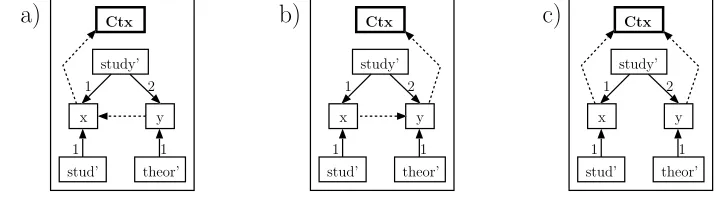
The representation in (1) is still ambiguous; to disambiguate, we need to specify how the quantifiers depend on each other. This is done by inserting dotted arcs between discourse referents, named semdeparc. In figure 1.a and fig 1.b two fully-specified representations of sentence (1) are given. Fig.1.a shows the reading in which the quantifier ‘three’ depends on (has scope inside) the quantifier ‘two’. In figure 1.b, the arc linkingx toy specifies that the two students depend on the theorems. In both interpretations, the wide-scope quantifier is linked to a new node called Ctx – the context.
But DTS allows for very natural representation of a third reading of sentence (1): in figure 1.c, both discourse referents are linked to the context. This is the branching quantifier (BQ) reading. As we will see, the BQ reading is true only in those models in which we can find a set of two students and a set of three theorems, for which it holds that each student in the first set studies each theorem in the second one. In NL, there are many cases in which the correct
study’
Fig. 1. The three readings of sentence (1)
Finally, even if there are not explicit syntactic elements forcing a BQ reading, in many cases this is done by world knowledge; for example, in (2.iii), world knowledge seems to render the reading in which two students have seen the same three drug dealers the most salient; in fact, the presence of drug-dealers in front of a school is (fortunately) a rare event and this induces to prefer the reading minimizing the number of involved drug dealers.
(2) (i) Two students, John and Jack, study three theorems: the first three of the book.
(ii) Two friends of mine went to three concertswith my sister.
(iii) Two students of mine have seen three drug dealers in front of the school.
Not all possible configurations of semdep arcs are allowed. For instance, a well-formed DTS cannot contain cycling paths, which would correspond to a reading in which two sets of entities depend on each other, which is clearly absurd. Furthermore, there are constraints to reduce the available readings to those admitted in NL. In this paper, we will focus on the expressivity of the general formalism, and provide a precise definition of the meaning of all configurations that respect a minimal set of syntactic constraints, and abstract from the question whether they correspond to an actual reading in NL. In other words, in DTS the set of logical admitted readings is kept separate from the subset of readings admitted in NL, and this paper focus on the former.
1.2 Formalisation: Syntax of DTS
A well-formed structure (wfs) in DTS is a Scoped Dependency Graph (SDG) as defined below. We take as given a set of predicates pred and a set of discourse referents D.
Definition 1.1 [Flat Dependency Graphs (FDG)]
A Flat Dependency Graph is a tuple hN, L, A, Dom, fi s.t.: - N is a set of nodes {n1, n2, . . . , nk}.
- L is a set of labels {l1,l2,. . ., lm}; in fig.1, L≡{1,2}.
- Dom≡pred∪Dis a set domain objects: predicates and discourse referents - f is a functionf :N 7→Dom, specifying the node referent, i.e. the domain
object with which the node is associated. In the following, wheneverf(n)∈
X, we will say that noden is of type X.
- A is a set of arcs. An arc is a triple (ns, nd, l), where ns, nd ∈ N, ns is of
typepred,nd is of type D and l ∈L.
Without going into further details, we stipulate thatGf is a connected acyclic
graph such that each node of type pred has one node of typeD for each of its places. Note that there can be two different nodes u and v s.t. f(u)=f(v), i.e. the nodes in N can be seen as occurrences of symbols fromDom.
Definition 1.2[Scoped Dependency Graph (SDG)]
- Gf =hN, L, A, Dom, fi is an FDG.
- ctx is a special element called the context.
- Q is a set of 2-place Mostowskian quantifiers {every, most, two,. . .}1 - quant is a total functionND 7→Q, where ND ⊆N are the nodes of typeD
- restr is a function assigning to each d ∈ ND its restriction, which is a
sub-graph of Gf.
- SemDep is a relation ND×(ND ∪ {{ctx}}).
When SemDep(d,d′), we say thatd depends ond′. Note that a discourse
ref-erent can depend on more than one other discourse refref-erent. The dependence relation needs to satisfy the following constraints:
• The transitive closure ofSemDepis a partial order on all discourse referents
and ctx, with ctx as its maximal element.
• Letdbe a discourse referent, and let R(d) be the smallest set that contains
d, and for which it holds that ifd′ is inR(d) and d′′occurs in the restriction
of d′, then also d′′ ∈D. It must hold that:
· Ifd1 ∈R(d),d2 6∈R(d), andd1 depends on d2, then also d depends on d2
· Ifd1 ∈R(d),d2 6∈R(d), andd2 depends on d1, then also d depends on d1
These last two constraints serve to exclude certain dependency relations that are ‘logically impossible’, and make sure that, for example, a sentence like “Most representatives of a company took every sample” does not get a reading in which ‘a’ depends on (only) ‘every’ and ‘every’ depends (only) on ‘most’.
2
Branching quantification
Branching quantification was introduced by Henkin [5] in the context of FOL; Hintikka [6] showed that it can occur also in NL. A great step toward the definition of a model-theoretic schema for BQ was made by Barwise [2] who merged Hintikka’s BQ account with the theory of Generalized Quantifiers. Barwise’s idea was that the truth-conditions of BQ readings are connected with the monotonicity of the involved quantifiers. He claimed that there is no uniform schema for BQ: the formulae associated to sentences featuring all monotone increasing (M↑) quantifiers are different from those associated to sentences featuring all monotone decreasing (M↓) quantifiers. According to Barwise, sentences with mixed quantifiers (some M↑ and some M↓) make no
1 A 2-place Mostowskian Quantifier [11] (see also [13]) is a symbolQsuch that, ifxis an individual variable and Ψ, Φ are formulae thenQx(Ψ,Φ) is also a formula. Semantically,Q
denotes, in every modelM with universeA, a functionqwhich takes in input two subsetsB
andC ofAand returns a truth-value. Mostowskian Quantifiers are cardinality quantifiers, in the sense that q(B, C) depends only on the cardinalities of the sets (B∩C), (B\C), (C\B) and (A\(B∪C)). Some examples are
· kAllx(P1(x), P2(x))kM
=trueiff|(kP1(x)∧ ¬P2(x)kM
)|= 0 · kF ewx(P1(x), P2(x))kM
=trueiff|(kP1(x)∧P2(x)kM
sense from a linguistic point of view.
On the other hand, Sher [13], [14] observed that since the semantics of linearly ordered quantification is provided regardless to monotonicity, there seems to be no methodological reason for imposing further constraints in case of partially ordered quantification. In other words, even if readings from NL are not available, this should not exclude their logical interpretation.
Sher specified the semantics of BQ on the basis of a precise definition of the involved groups, according to so-called maximality conditions; roughly, her claim is that the interpretation of a BQ reading with quantifiers of any type corresponds to the one of Barwise for M↑ quantifiers augmented with a maximality condition requiring that the involved sets are maximal with respect to the body of the formula. Consider the two following sentences:
(3) (i) Most of the dots and most of the stars are all connected by lines. (ii) Few of the dots and few of the stars are all connected by lines.
In Sher’s logic (let us name itL0) sentences in (3) are associated with formulas of the following form:
(4) ∃P1, P2[ C1 :Q1x(dot(x), P1(x))∧
C2 :Q2y(star(y), P2(y))∧
IN :∀xy[(P1(x)∧P2(y))→conn(x, y)]∧ Max(hP1, P2i, IN) ]
whereQ1 andQ2 are the Mostowskian quantifiers corresponding to the deter-miners in our example: Q1=Q2=M ost for (3.i); and Q1=Q2=F ew for (3.ii). The symbolsC1,C2,IN are labels on the subformulae and Max(hP1, P2i, IN) is an abbreviation for a maximality condition that states that two setsP1 and
P2 are maximal with respect to the formula with label IN, in the sense that there are no strict supersets of P1 andP2 that satisfy IN. Formally, the max-imality condition in (4) is the following formula:
Max(hP1, P2i, IN)⇔
∀P′
1, P2′[ ∀xy[ (P1(x)∧P2(y))→(P1(′ x)∧P2(′ y))∧
(P1(′ x)∧P2(′ y))→conn(x, y) ]→ ∀xy[ (P1(′ x)∧P2(′ y))→(P1(x)∧P2(y)) ]]
Sher generalizes the schema of (4), so that it applies to any partially ordered set of arbitrary quantifiers. To achieve this, it is necessary to existentially quantify n-ary generalized Skolem functions Hi rather than simple sets Pi,
and to assert maximality conditions also on the subformulae with label Ci.
Here, an n-ary Skolem function is just an n + 1-ary relation H – we will write H(x1, . . . xn+1) if x1. . . xn+1 stand in the relation H, but also write
H(x1. . . xn) for the set of objects xn+1 s.t. H(x1, . . . xn+1). Consider now a
F ewx(man’(x)) @
In this reading, the quantifierAdepends on bothThreeandFew: there can be a different coin for every pair of a man and a coffee machine. This is reflected by the fact that Hz, the Skolem function associated with the quantifierA, is a
2-ary function, while Hx, Hy are 0-ary Skolem functions (that is, predicates).
The formula states that we have to find witnesses Hx, Hy and Hz such that
Hz corresponds to the extension of inserted’, and Hx and Hy are maximal
sets of individuals x and y such that the set of objects z inserted by x in
y, Hz(x, y, z), includes at least one coin; Hx is a set of a ”few men” and Hy
contains ”three coffee machines”. See [14] for the formal details.
3
Nested Quantification
A limitation of Sher’s logic is that it does not handle the case in which one quantifier occurs in the syntactical restriction of another quantifier. Consider:
(6) Two representatives of three African countries arrive.
rep’
we introduce a new abbreviation to increase readability.
We will omit the reference to the variables x1. . . xn in the notation when this
does not lead to confusion. By using
⊆
max, the formula in (5) can be replaced
by the following equivalent
For representing the restriction of quantifiers in the logic, in addition to the Skolem functions Hx that represent the body of the quantifiers, we introduce
restriction sets Ψx. The three readings of (6) can now be represented as:
x
Let us shortly discuss each of these readings.
Hy are unary Skolem functions whose values depend on the value for x. The
restriction set of ’three’, Ψy(x), is (for each x) the set of all African countries,
while Hy(x) is the set of objects represented by x. Therefore, the restriction
set of ‘two’, Ψx, is a maximal set of individualsx that represent three African
countries. Two of these individuals must be in Hx – the set of those that
arrive.
In the second reading, x depends on y. The set Ψy consists of all African
countries. The set Hy must contain three of these, and it is required that for
each element y inHy there are two individuals in the set of all its
representa-tives Ψx(y) that are inHx(y), which consists of all individuals that arrive.
The third formula represents the branching reading of the sentence, in which the two discourse referents do not depend on each other. This formula states that there are sets Ψx and Hy such that each individual in Ψx represents all
elements from Hy (this is expressed by the maximality condition on the pair
(Ψx, Hy)), and for which it holds that Hy contains three African countries,
and that two of the representatives from Ψx must arrive. In the following, we
report a last complex example:
(7) Everyx teacher failed twoy students that studied less than halfz of the
topics in thew program.
The following DTS represents a reading of (7) in which the discourse referent
w depends on both y and z, and y and z depend onx.
This DTS gets the translation reported below; in this interpretation, the two students and the program depend on a teacher, while the set of topics depends both on a program and on a student. In the formula, the pair of students associated to a teacher x ∈ Hx has to belong to the set Ψy, i.e. the set of
students y such that the set of things studied by y, i.e. Hz(x, y, w), contains
less than half elements of Ψz, i.e. the set of topic in Hw(x), i.e. the program
∃Hx, Hy, Hz, Hw,Ψx,Ψy,Ψz,Ψw[
Everyx(Ψx(x), Hx(x)) & {Ψx}
⊆
max
(teacher’(x)) &
{Hx}
⊆
max[
T hew(Ψw(x, w), Hw(x, w)) & {Ψw(x)}
⊆
max(progr’( w)) &
T woy(Ψy(x, y), Hy(x, y))] &{Hy(x)}
⊆
max(failed’(
x, y)) &
{Ψy(x), Hw(x)}
⊆
max[
Lthz(Ψz(x, y, w, z),Hz(x, y, w, z)) &
{Ψz(x, y, w)}
⊆
max(topic’(
z)∧of’(z, w)) &
{Hz(x, y, w)}
⊆
max(stud’(
y)∧study’(y, z))]]]
4
Conclusions and further works
In this paper, a comparison between Dependency Tree Semantics and Sher’s work on Branching Quantification and Generalized Quantifiers has been pre-sented. In particular, we have shown how disambiguated DTS structures can be related to formulae of an extension of the formalism from [14] to represent branching quantification. This provides a way to model-theoretically inter-pret disambiguated DTS structures. Concerning further work, one of the next steps in research on DTS will be extending its expressivity in order to deal with cumulativity, which is a topic that has received very little attention in re-cent studies on underspecification. Cumulative readings arise from a different kind of branching quantification, as argued in [13], so the step for including them is more natural in DTS than in other underspecified logics that do not take BQ into account.
References
[1] Alshawi, H., editor, “The Core Language Engine,” Mit Press, Cambridge, MA, 1992.
[2] Barwise, J., On branching quantifiers in english, The Journal of Philosophical Logic (1979), pp. 47–80.
[3] Copestake, A., D. Flickinger and I. Sag, Minimal recursion semantics. an introduction, Technical report, Manuscript, Stanford University (1999).
[4] Egg, M., A. Koller and J. Niehren, The constraint language for lambda structures, J. of Logic, Language and Information10 (2001), pp. 457–485.
[6] Hintikka, J., Quantifiers vs quantification theory, Dialectica (1973), pp. 329– 358.
[7] Lesmo, L. and L. Robaldo, Dependency tree semantics and underspecification, in: Proc. Int. Conf. On Natural language processing (ICON2004), Hyderabad, India, 2004.
[8] Lesmo, L. and L. Robaldo,From dependency tree semantics to fol, in:Proc. 6th Workshop on Computational Semantics (IWCS-6), Tilburg, 2005, pp. 384–386.
[9] Lesmo, L. and L. Robaldo, Underspecification of quantifier scope in mtt, in: Proc. 2th Int.Conf. on Meaning Text Theory, Moscow, 2005.
[10] Melcuk, I., Semantics and the lexicon in modern linguistics., in: A. Gelbukh, editor, In Proc. of the 1st International Conference on Intelligent Text Processing and Computational Linguistics (CICLing), 2000, pp. 6–18.
URLwww.CICLing.com
[11] Mostowski, A., On a generalization of quantifiers., Fundamenta Mathematicae
44 (1957), pp. 12–36.
[12] Reyle, U., Dealing with ambiguities by underspecification: Construction, representation and deduction, Journal of Semantics (1993), pp. 123–179.
[13] Sher, G., Ways of branching quantifiers, Linguistics and Philosophy (1990), pp. 393–422.