Tree-Adjoining Grammars for Optimality Theory Syntax
Virginia Savova
Department of Cognitive Science
Johns Hopkins University
[email protected]
Robert Frank
Department of Cognitive Science
Johns Hopkins University
[email protected]
Abstract
This paper explores an optimality-theoretic approach to syntax based on Tree-Adjoining Grammars (TAG), where two separate opti-mizations are responsible for the construc-tion of local pieces of tree structure (ele-mentary trees) and the combination of these pieces of structure. The local optimization takes a non-recursive predicate-argument struc-ture (PA-chunk) as an underlying representa-tion and chooses the best tree structure real-izing it. The linking optimization takes as an underlying representation a tree whose nodes are labeled by PA-chunks and chooses among a set of structurally isomorphic TAG deriva-tion trees. We provide formal definideriva-tions of the OTAG system and prove equivalence in strong generative capacity between OTAG and TAG. Finally, we apply the mechanics of the formal system to the analysis of cross-serial dependen-cies in Swiss-German.
1
Introduction
Optimality Theory (OT) claims that linguistic expres-sions are restricted by a set of universal, mutually incon-sistent and violable constraints (Prince and Smolensky, 1993). Conflicts result in the satisfaction of higher ranked constraints at the expense of their lower ranked adver-saries. The variations among languages are attributed to differences in the constraint rankings. In OT, a gram-matical linguistic expression is a winner of an optimiza-tion. Given an underlying representation (UR), a gener-ator function (Gen) produces a (potentially infinite) set of surface realizations (SRs), and a process of optimiza-tion picks the SRs that minimally violate the constraints according to a language-particular ranking.
OT is a general framework that can give rise to a va-riety of specific formal instantiations depending on the types of representations and constraints invoked, but it is a largely unresolved question just what sort of for-malism is appropriate for OT syntax. Since natural lan-guage syntax permits recursively embedded structures, this suggests that the OT optimizations ought to apply to unbounded domains. However, optimization over such structures can give rise to a system with excessive gener-ative capacity, if the number of violations of a constraint can grow without bound as well (Frank and Satta, 1998; Wartena, 2000). Moreover, if we look at the properties of natural language syntax, it appears that the structural tradeoffs that arise from the resolution of constraint con-flict take place over local domains.
We therefore propose an OT formalism based on Tree Adjoining Grammar, which we call Optimality Tree Ad-joining Grammar (OTAG), where separate optimizations are responsible for the construction of local pieces of tree structure (elementary trees) and the combination of these pieces of structure.The first optimization (which we call local optimization) takes as UR a non-recursive predicate argument structure (PA-chunk) and chooses among a set of local trees generated by Gen as candidate SRs of this PA-chunk. The local optimization yields a finite tree lan-guage which serves as a set of elementary trees. The sec-ond type of optimization (which we refer to as linking optimization) takes as UR a tree whose nodes are labeled by PA-chunks (a derivation tree of sorts) and chooses among a set of structurally isomorphic TAG derivation trees, where each node in these trees is labeled by an ele-mentary tree that is among the locally optimal outputs for the corresponding PA-chunk.
2
Definitions
Let us begin with a formal definition of an OT system, adapted from (Frank and Satta, 1998).
{Σ,Γ, Gen, C} whereΣandΓ are the finite input and output alphabets, Gen is a relation overΣ∗×Γ∗, andC
is a finite set of total functions fromΣ∗×Γ∗toN.
As seen in this definition, Gen maps a UR to a set of SRs, while a constraint is a function from a candidate UR-SR pair to a natural number, which we take to represent the degree of violation incurred by that candidate on that con-straint. An OS gives rise to a set of optimality grammars (OG), defined in (2):
Def. 2 An optimality grammar OG is an OS together with a total orderingRonC, called a ranking.
Frank and Satta’s definition is not directly applicable to OT syntax because it defines the URs and the SRs as strings. We assume that in syntax, the SRs are trees, while the URs are predicate-argument (PA) structures in tree form. A PA structure may contain simple and nested predicates. A simple predicate is a predicate applied over atomic arguments, i.e., arguments that do not contain predicates, as in example (1).
(1) loves(John, Mary)
A nested predicate is a predicate applied to other predi-cates, like says in example (2).
(2) says(Bill, (loves(John, Mary)))
We postulate a grammatical component, the
PA−chunker, which breaks down a complex PA
structure into simple PA structures by substituting non-atomic arguments with predicate labels, which are treated as atomic arguments in the local optimization.
Def. 3 A PA-chunker is a function from a nested PA structure P to a set of pairs containing a simple PA-structure (PA-chunks)Sand a labellfor that structure, such that
i. each predicate inP is a predicate in exactly one of the PA-chunks inS;
ii. the atomic arguments of each predicate inPare the same as the arguments of that predicate in corre-sponding PA-chunk inS; and
iii. each complex argumentAof a predicateπinP is replaced in the PA-chunk containingπinS by the label uniquely associated with the simple PA-chunk inScorresponding toA.
For example, the nested PA structure in (2) will give rise to the set of simple PA structures in (3) (where X and Y are predicate labels).
(3) {([says (Bill, X)], Y), ([loves (John, Mary)], X)}
In our setting, PA-chunks are the URs for optimizations over bounded domains whose outputs are local trees. The URs for optimizations over unbounded domains are tree
structures over nodes labeled by a PA-chunk and all win-ning surface realizations of that PA-chunk (in the form of syntactic trees).
With this in mind, we define Optimality Tree Adjoin-ing Systems (OTAS) as follows:
Def. 4 An Optimality Tree Adjoining System is a 9-tuple
OT AS = {Σ,Γ,Π, Chunk, Loc, GenC, GenK, C, K}
where
• ΣandΓare finite input and output alphabets;
• Πis a set of predicate labels;
• Chunk and Loc are finite sets of finite trees la-beled byΣ∪ΠandΓrespectively;
• GenCis a relation overChunk×Loc;
• GenKis a relation overΨ×Ξ, where
i. Ψis the set of finite trees each of whose nodes are labeled by members ofChunk×Π×2Loc
where for eachτ∈Ψ,a node labeled(σ, π, γ)
is a daughter of node(σ0, π0, γ0)iffσ0contains labelπ;
ii. Ξis the set of finite trees labeled byΓ;
• C is a finite set of total functions fromChunk× LoctoN;
• Kis a finite set of total functions fromΨ×ΞtoN
(withΨandΞdefined as above).
The alphabetsΣandΓare the sets of symbols in the rep-resentations making up the UR and SR, respectively. In our current conception,Σconsists of the set of predicate and argument symbols, whileΓcontains the set of termi-nal and non-termitermi-nal symbols.1 Chunkwill contain the set of URs that feed the local optimization, the set of PA-chunks, whileLoccontains the SRs that can be the out-put of this process, the possible syntactic realizations of the PA-chunks. GenCmaps a PA-chunkσ∈Chunkto
corresponding SRγ ∈Loc. GenK maps any tree
struc-ture whose nodes are labeled by (local-UR, pred-label, locally-optimal-SRs) triples to a recursive surface tree re-alization. Cis the set of constraints on local trees, while
Kis the constraints over recursive trees.2 According to definition (2), an OT grammar is obtained by imposing a unique ranking on the set of constraints. In OTAG, a ranking must be specified for each type of optimization.
Def. 5 An OTAG Grammar (OTG) is an OTAS with a pair of rankingsRC, RKonCandK.
1
To keep things relatively simple, our definition neither enforces the arity requirements of predicate symbols nor the proper placement of predicate labels, terminal and non-terminal symbols in building members ofChunkorLoc.
2
Grammar A. YN A
HH
a Y
c
Y
HH
b Y
L=ab∗c
Grammar B. Y
HH
a YN A
c
Y
HH
b Y
[image:3.612.72.278.79.204.2]L=b∗ac
Figure 1: Related TAG grammars.
With these definitions in place, we can now define the notion of optimization in an OTG. Let us begin with local optimization:
Def. 6 The local optimum, LOpt(p), associated with a simple predicate argument structurepis defined recur-sively, as in (Frank and Satta, 1998):
LOpti(p) =
GenC(p) ifi= 0;
argminci(LOpt
i−1(p)) ifi≥1
LOpt(p) =LOptm(p)wherem=|C|
Given such a set of local optima, we can now define the linking optimization process. Assume that we have a re-cursive predicate argument structureΠ. The input to the linking optimization is a tree whose labels are taken from the following set of locally optimal pairings:
Λ ={(p, π, LOpt(p))|(p, π)∈ PA-Chunk(p)}
Given such aΛ, there will be a unique treeτ such that
(p, π, γ)is a daughter of node(p0, π0, γ0)iffp0contains predicate labelπ. Linking optimization is now defined over thisτas in definition 6, usingGenK and constraint
setK.
3
Substitution, adjoining and the Linking
Optimization
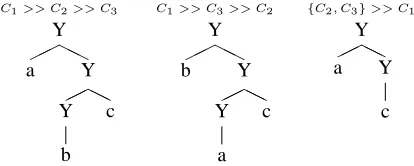
In traditional TAG, grammars sharing the same set of lo-cal trees can generate different languages. An example of this situation is depicted in Figure 1, where we see two grammars that differ only in the locus of adjoining con-straints and generate distinct languages. Since the link-ing optimization in OTAG constrains how the elementary trees that result from the local optimization are put to-gether, the languages of these grammars could also gener-ated by two OTAGs derived from the same OTAG system with different constraint rankings (Figure 2).
The constraints on adjoining are implemented in the set of violable constraints K, which prohibit or require
adjoining at a set of nodes. In the grammar illustrated here, C1 requires some adjoining to take place,C2
for-bids adjoining at the root Y node of the ac elementary tree, andC3forbids adjoining at the lower Y node of the
same tree. WhenC1is ranked above either or both ofC2
orC3, the higher ranked of this latter pair of constraints
determines where adjoining applies, whereas whenC1is
lowest ranked, no adjoining takes place at all. Constraint reranking, then, achieves the effect of altering the loci of adjoining constraints. In principle, the linking opti-mization may apply globally, evaluating the whole UR against a derivation, but that would lead to the possibil-ity of conditioning an adjunction at high levels on lower level adjunctions. In order to limit the generative power of OTAG, we require that the linking optimization apply cyclically. Each cycle adjoins a set of auxiliary trees into a single local tree, and these cycles proceed in a bottom-up fashion through the PA-chunk structure that is the in-put to the linking optimization. The result of a linking optimization may be used for a subsequent cycle, when a derived auxiliary is adjoined. This constraint enforces a strong parallelism between the OTAG derivation and the TAG derivation. They differ only by the presence of an optimization step in OTAG, which determines where the auxiliary tree is adjoined into another elementary tree. In other words, an OTAG derivation tree represents a series of optimal adjoining operations.
With this restriction in place, it turns out that the result-ing formalism is exactly as powerful as the TAG formal-ism. Specifically, we can prove the following theorems (see appendix for proofs):
Theorem 1 For any TAG G, there is a OTAG G’ such that T(G) = T(G’).
Theorem 2 For any OTAG G’, there is a TAG G such that T(G’) = T(G).
4
OTAG in action: An illustrative example
To illustrate the practical application of the formalism, we will go through the steps of a derivation of the Swiss-German cross-serial construction, and the corresponding
C1>> C2>> C3 Y
HH
a Y
HH Y
b c
C1>> C3>> C2 Y
HH
b Y
HH Y
a c
{C2, C3}>> C1 Y
HH
a Y
c
[image:3.612.326.533.604.687.2]German and English constructions. Swiss-German ex-hibits cross-serial dependencies that can be modeled by the languageLCross=anbmcndm|m, n∈N(Shieber,
1985).
(4) De Jan John-NOM s¨ait, says dass that mer we em Hans Hans-DAT es the huus house h¨alfed helped aastriiche. paint (Swiss German)
‘John says that we helped Hans paint the house.’
Compare this to the English and German equivalents.
(5) John says that we helped Hans paint the house.
(6) Jan John sagt, says daß that wir we Hans Hans das the Haus house-Acc anstreichen paint hilften. helped (German)
‘John says that we help Hans paint the house.’
The German sentence exhibits center embedding - the in-nermost verb case-marking the inin-nermost noun, the out-ermost verb case-marking the outout-ermost noun. In the En-glish case, there is no embedding at all: verbs always immediately precede their associated arguments.
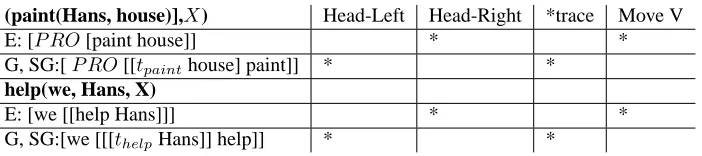
Let us consider the necessary steps in an OTAG analy-sis of these data. First, we must isolate the local winners. As we know, they are SRs corresponding to PA-chunks. Table 4 shows the simple predicates and the correspond-ing yield of the local winners in English, German, and Swiss-German. The symbol marks the insertion site for the other SR. The question we need to tackle is what kind of trees yield these strings. We notice that the German and Swiss-German cases differ from the English case by the position of the verb with respect to its arguments. One way to account for this difference would be to invoke a Headedness constraint on the local trees, Head-Left, and a counter-constraint, e.g., Head-Right. We also invoke a local Markedness constraint such as “Move V” which conflicts with a Faithfulness constraint “*trace” (a.k.a. “Stay!”, cf. Grimshaw1977). These constraints are de-fined as follows:
• Move V: Raise V to T.
• *trace: No traces.
In German, unlike English, “*trace” is ranked lower than “Move V”. Note that the overt difference between En-glish and German can be explained by assuming the verb help raises to node Y, without assuming anything about the verb paint. However, our OTAG analysis forces us to make a theoretical commitment that paint also raises, since the tree it is part of is a winner of a local optimiza-tion under the same constraint hierarchy.
We can now characterize the Swiss-German case in a way consistent with our theory of the English and Ger-man cases. At this point, we are going to make use of the
X1 H H H H H we H H H H H H HH Hans thelp
X2 help X3 H H H H P RO H H H X4 HH house tpaint
[image:4.612.318.538.81.246.2]paint
Figure 3: Adjoining occurs atX4in Swiss-German,X3
in German
linking optimization to distinguish German from Swiss-German in particular. Descriptively, Swiss-Swiss-German dif-fers from German by the fact that help intervenes between paint and its argument. This is exactly what we expect if we assume that adjoining in Swiss-German takes place at a lower node than adjoining in German. In the analysis of English and German, the nodeX3was the adjoining site.
By supposing that instead, the adjoining site for Swiss-German isX4, we obtain the desired cross-serial
depen-dency. To enforce this difference in adjoining sites, we need to postulate two constraints that play a role in the linking optimization by favoring nodesX3 andX4,
re-spectively. A linguistically motivated constraint favoring
X3may be related to the relationship between Hans and
PRO resulting from the adjoining. In English and Ger-man, but not in Swiss-GerGer-man, Hans c-commands PRO in the output of the linking optimization. Another plausi-ble constraint is a subcategorization constraint on the ad-joining tree. Suppose the adad-joining tree is of type A and nodeX3is of a particular type N. Thus, the linking
opti-mization may involve a constraint “C-PRO: PRO must be c-commanded” and a constraint “A-to-N: Adjoin trees of type A to nodes of type N” ranked differently with respect to each other. In our case, let us suppose “trees of type A” means “Auxiliary trees of type VP” and “Nodes of type N” means “Highest VP node of initial tree.” To recount, here is how our model analysis would play out. Table 4 presents the local optimizations with candidate struc-tures, including the winners for English (E), German (G) and Swiss-German (SG).
PA-chunks English German Swiss-German
[image:5.612.106.502.67.344.2]([paint(Hans, house)], X) paint the house das Haus anstreichen es huus aastriiche helped(we, Hans,X) We helped Hans wir Hans hilften mer em Hans h¨alfed
Table 1: PA-chunks
(paint(Hans, house)],X) Head-Left Head-Right *trace Move V
E: [P RO[paint house]] * *
G, SG:[P RO[[tpainthouse] paint]] * *
help(we, Hans, X)
E: [we [[help Hans]]] * *
[image:5.612.134.485.141.219.2]G, SG:[we [[[thelpHans]] help]] * *
Table 2: Local optimizations
paint(Hans, house) Head-Left Head-Right E: [P RO[paint [tpainthouse]]] *
G, SG: [P RO[[tpainthouse ] paint]] *
help(we, Hans,X)
E: [we [help [thelpHans]]] *
G, SG: [we [[[thelpHans ]] help]] *
Table 3: Local optimization simplified
we have the option of scrapping either the pair Head-Left, Move V or the pair Head-Right, *trace from the con-straint set. If we get rid of the former pair, we will essen-tially be claiming that movement of the verb happens in order to position the head to the right of the verb phrase. Alternatively, if we remove the latter constraint pair, we will be suggesting that movement of the verb can only happen to the right and hence necessarily violates Head-Left. There is no reason to dismiss either scenario right away. On the other hand, some new data might discredit either alternative and persuade us to keep all constraints in the set. Finally, a third scenario may involve obliga-tory verb movement in both English and German/Swiss-German. In this case, the only relevant players in the constraint set are Head-Left and Head-Right, which force the movement to take the preferred direction. The op-timization would include only candidate representations in which movement has occurred (i.e. Loc would be re-stricted to such structures, Table 3).
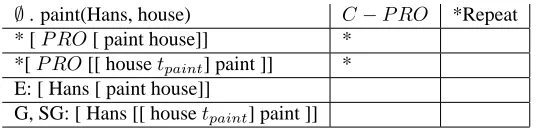
Another issue in the local optimization is the realiza-tion of the argument “Hans” as PRO in one sentence, but as Hans in the other. This issue can only be solved by exploiting the possibility of multiple winners in the local optimizations. In other words PRO and the full argument must be indistinguishable from the point of view of the local optimization, but one or the other must be preferred in the linking optimization. The argument is simple. By virtue of our definition of the PA chunker, the predicate argument structure paint(Hans, house) is independent of
the larger complex predicate it was embedded in. Con-sequently, the same predicate argument structure would qualify as an UR of Hans paints the house since the lat-ter is a grammatical structure, Hans may equally surface as PRO or simply Hans. We need to update our Table once again by adding two more competitors, as shown in Table 4. This competition is resolved in the subse-quent linking optimizations as seen in Table 5. The con-straint “*Repeat” penalizes the repetition of a nominal element. Admittedly, this is a very crude way of enforc-ing the presence of PRO in the final structure. A more sophisticated way of defining *Repeat could refer to the relationship between trees with argument Arg in SpecVP on one hand, and trees with the same argument Arg in a complement position on the other. For example: *Re-peat: Do not adjoin trees with complement Arg to trees with Arg in SpecVP This formulation is a better match for the type of constraints we have used in our formal treatment of OTAG so far.
[image:5.612.169.443.254.334.2]paint(Hans, house) Head-Left Head-Right E: [P RO[paint [[tpainthouse]]] *
G, SG: [P RO[[tpainthouse] paint]] *
E: [Hans [paint [tpainthouse]]] *
[image:6.612.167.443.71.136.2]G, SG: [ Hans [[tpainthouse] paint]] *
Table 4: Full NP andP ROare tied in the local optimization
help(we, Hans,X). paint(Hans, house) C−P RO A-to-N *Repeat
E: [ we [[help Hans] [P RO[paint house]]]] *
G: [ we [[[ Hans t help] [P RO[[housetpaint] paint ]]]help]] *
SG: [P RO[[ we [[[ Hansthelp] [housetpaint]] help]]paint]] *
* [ we [[help Hans] [Hans [paint house]]]] * *
* [ we [[[ Hansthelp] [Hans [[housetpaint] paint ]]]help]] * *
* [ Hans [[ we [[[Hans thelp] [housetpaint]]help]]paint]] * *
Table 5: Linking optimization licensesP ROin subordinate clause
∅. paint(Hans, house) C−P RO *Repeat
* [P RO[ paint house]] *
*[P RO[[ housetpaint] paint ]] *
E: [ Hans [ paint house]]
G, SG: [ Hans [[ housetpaint] paint ]]
Table 6: Linking Optimization eliminates PRO in main clause
analysis of the Swiss-German construction and its cross-linguistic counterparts. The important points to remem-ber are:
• When analyzing a complex structure, complex PA structures are broken into chunks.
• Predicate labels in the PA chunks constrain what ad-joins into what in the linking optimization.
• Adjustments in the ranking among constraints in the local optimization permit different structural vari-ants to win.
• Both main clause and the embedded clause variants of a PA chunk must be possible winners in the local optimization.
• If the embedded clause is not grammatical as a main clause, the linking optimization must include a con-straint that favors the embedded clause over the main clause.
5
Conclusion
Our proposal is a step towards a restrictive and adequate framework for handling syntactic phenomena in the spirit of OT. We have demonstrated that the generative power of any grammar specified within the framework is lim-ited to the class of MCSLs, which many believe is the complexity class of natural languages. The main theo-retical advantage of the OTAG formalism is the locality
imposed by the optimization over simple predicates in the first stage of the derivation of an arbitrarily complex structure. Another, more practical advantage stems from the relative transparency of the components of the frame-work. Our formalism relies on a specific kind of under-lying representation, a specific way to handle recursion, and a general template for constraints. Clearly, further work is needed to test the viability of this framework for a broader range of empirical phenomena.
Acknowledgments
Special thanks to Paul Smolensky for helpful comments on an earlier draft. The research in this paper was sup-ported in part by NSF grant SBR-9972807.
References
Robert Frank and Giorgio Satta. 1998. Optimality theory and the generative complexity of constraint violability. Comput. Linguist., 24(2):307–315.
Alan Prince and Paul Smolensky. 1993. Optimality theory: Constraint interaction in generative grammar. Technical report, Rutgers University Center for Cogni-tive Science.
[image:6.612.173.441.292.358.2]context-freeness of natural language. Linguistics and Philos-ophy, 8:333–343.
Christian Wartena. 2000. A note on the complexity of optimality systems. Ms. Universit¨at Potsdam, Rutgers Optimality Archive (ROA-385-03100).
Appendix: Proofs of theorems
We define a TAG G as a tuple(A, I, R), whereAis the set of auxiliary trees, Iis the set of initial trees, and R
is the set of adjoining constraints associated with nodes ofA∪I. We require thatAcontain a distinguished null auxiliary tree, capable of adjoining at any node. With such antree, we can assume without loss of generality that every legal TAG/OTAG derivation involves adjoin-ing to every node of every tree involved in the derivation. An adjoining constraintr ∈ Rspecifies a set of treesS
and a nodedsuch thatScannot adjoin atd(r=∗S@d). Such a constraint corresponds to the usual notion of se-lective adjoining constraint. Obligatory adjoining con-straints can be modeled as a constraint which forbids ad-joining of. Null adjoining constraints permit adjoining of only the tree. On the OTAG side, we will assume a constraint *NIL that penalizes SRs in the linking op-timization in which trees present in the UR do not par-ticipate in the TAG derivation yielding the surface tree. Finally, we use the notationT(G)to refer to the set of well-formed derivation trees in a TAG or OTAG. Theorem 1. For any TAG G, there is a OTAG G’ such that T(G) = T(G’).
Given a TAG G = (I, A, R), we define OTAG G0 = (Σ,Γ,Π, Chunk, Loc, C, K), such thatLoc = A ∪I
andKG0 ={∗N IL} ∪ {kr|r ∈R}wherekrpenalizes
a candidate if it involves an adjoining that would violate TAG adjoining constraintr.3
Claim 1D∈T(G)→D∈T(G0)
Proof by induction on the depth ofD(represented(D)): Base case Let(D) = 0.Dconsists of a nodetwhose only children are instances of the empty tree. Lettbe a tree with nodes{1...n}. D /∈ T(G0)iff one of the following is true:
1. {t, } ∈/ Loc. Butis always in A. Moreover,D ∈ T(G)by hypothesis, which is true only ift∈A∪I. SinceLoc=A∪I, t∈Loc.
2. ∃k1...kn∈K|ki=∗{}@i, foria node∈t.This is
true only if∃{r1...rn} ∈R|ri =∗{}@i,ia node
∈t.But if{r1...rn} ∈Rwas trueD∈T(G)would
be false.
Hence{k1...kn}do not exist andD∈T(G0)
Induction hypothesis Suppose Claim 1 is true for all
3
We do not define Σ,Π, Chunk,or C since the there is no counterpart to the local optimization in TAG. Since the set of elementary trees is finite, we can assume the existence of some set of constraintCthat will produce this set of trees from appropriate URs.
(D) ≤ k. Lett be the root of D and {1...n} the set of nodes int. Let{D1...Dn}be a set of derivations with
roots{a1...an} ∈Asuch thataiis adjoined to nodeiin
t. Observe that(Di)≤kfor1 ≤i≤n. D /∈T(G0)iff
one of the following is true:
1. t /∈ Loc. ButD ∈ T(G)by hypothesis, which is true only ift∈A∪I. SinceLoc=A∪I, t∈Loc; 2. {D1...Dn} ∈/ T(G0).But {D1...Dn} ∈ T(G0)by
the induction hypothesis;
3. ∃ki ∈ K|ki = ∗ai@i. This is true only if∃ri ∈
R|ri = ∗ai@i. But if this were true, D ∈ T(G)
would be false.
Hencekido not exist andD∈T(G0)
Claim 2W ∈T(G0)→W ∈T(G)
Proof by induction on the depth of W:
Base case (W) = 0. W consists of one optimization ad-joining the empty treeinto somew∈Loc.W /∈T(G)
iff one of the following is true:
1. w /∈A∪I. ButLoc=A∪Iandw∈Loc. Hence
w∈A∪I.
2. ∃r1...rn ∈ R|ri = ∗{}@i, foria node∈ t.This
is true only if∃{k1...kn} ∈ K|ki = ∗{}@i, fori
a node∈ t.But if{k1...kn} ∈ K was true,W ∈
T(G0)would be false.
Hence{r1...rn}do not exist andW ∈T(G)
Induction hypothesis Suppose Claim 2 is true for any derivation W,(W) ≤ k. Letw be the root of W and
{1...n} the set of nodes inw. Let {W1...Wn}be a set
of derivations with roots {z1...zn} ∈ Loc such that
zi is adjoined at node i. Observe that (Wi) ≤ k for
all1≤i≤n.W /∈T(G)iff one of the following is true:
1. w /∈A∪I. Butw∈T(G0)by hypothesis, which is true only ifw∈Loc. SinceLoc=A∪I, w∈A∪I; 2. {W1...Wn} ∈/ T(G).But {W1...Wn} ∈ T(G)by
hypothesis;
3. ∃ri ∈ R|ri = ∗zi@i. This is true only if ∃ki ∈
K|ki =∗zi@i. But ifki∈Kwas trueW ∈T(G0)
would be false.
Hencerido not exist andW ∈T(G).
Theorem 2. For any OTAG G’, there is a TAG G such that T(G’) = T(G).
Here, we will also give a general procedure for convert-ing a OTAG into an equivalent TAG. Before we proceed, it would be useful to informally consider the two cases that cause complications in this conversion. Both cases are easily illustrated with a minimal OTAG. Suppose Loc contains only two trees: the initial tree t and the aux-iliary tree a. In addition, let t contain only two non-terminal nodes (n1, n2). Case 1: Now suppose that the constraint set K of our OTAG G contains two OA con-straints,k1 andk2, such thatk1 andk2 require the
ad-joining of the same treeaat different nodes(n1, n2)of
Furthermore, suppose ∗N ull >> k1 >> k2. This
constraint ranking would enforce the adjoining ofainto
n2(t)only if another instance ofais adjoined atn1(t).
Case 2 is similar: Suppose that the constraint set K of our OTAG G contains two NA constraints,k1andk2against
adjoining any auxiliary tree aat either one of two dif-ferent nodes (n1, n2)of the same treet. Furthermore,
suppose ∗N ull >> k1 >> k2. This constraint
rank-ing would allow adjoinrank-ing into n1(t)only if adjoining
has taken place already atn2(t). It is clear from these
cases that a simple translation of constraints into adjoin-ing constraints is not sufficient. The violated OA con-straintk2cannot be emulated by an OA constraint
forc-inga to adjoin atn2 (because the adjoining fails when
ais not adjoined atn1); nor does it correspond to a SA
constraint that merely allows adjoining of aat n2
(be-cause it the adjoining is obligatory whenever an instance of ais already adjoined at n1). Thus, instead of
pick-ing a spick-ingle type of constraint to place on each elemen-tary tree, we need to multiply out the trees in Loc af-fected by problematic constraint sets of this type. The treetcorresponds to a subset of two trees in the elemen-tary tree set of the corresponding TAG: One tree has an OA constraint on node n1. The other has an NA
con-straint on noden2. Similarly, the violated NA constraint
k2 cannot be emulated by a NA constraint againstaon
n1(because the adjoining could occur if an instance ofa
is already adjoined atn2). Neither can it be completely
disregarded, because it preventsafrom adjoining inton1
if a has not adjoined ton2 beforehand. The treetmaps
to a subset of two trees in the elementary tree set of the corresponding TAG: One tree has an NA constraint on
n1, the other has an OA constraint onn2. Let G’ be a
OT AG ={Σ,Γ,Π, Chunk, Loc, GenC, GenK, C, K}
with rankingsRCandRK. Then TAGG= {A, I, R},
obtained based on the outcome of all linking optimiza-tions involving the adjoining of a setSof trees fromLoc
into some treet inLoc(note that|S| ≤ the number of non-terminals int).
Conversion algorithm:
Step 1: Create a tableTtof sizen×passociated with each
treetin Loc, wherenis the number of nodes int, andpis the number of possible multisets of treesZ drawn from
Locof cardinalityn. In each cell(j, k), enter all trees
z ∈ Z adjoined to nodej in some linking optimization overΥ, whereΥis a UR tree whose nodes are labeled with triples(σi, π, γi)and∪(γi) =k.
Step 2: For every treet∈Loc, create a set of elementary trees Etcontaining distinct copies oft for each cell of
Tt. For each sucht(i,j)∈Et, create adjoining constraints
r=∗A−Tt(i, j)@h, wherehis the name of the copy of
nodeiint(i,j).
Claim 1:W ∈T(G0)→W ∈T(G)
Proof by induction on depth ofW.
Base case Let(W) = 0. W involves one optimization adjoining of only instances of the empty treeinto some
w∈Loc.W /∈T(G)iff one of the following is true: 1. w /∈A∪I. ButA∪I⊇Locandw∈Loc. Hence
w∈A∪I.
2. ∃r1...rn∈R|ri =∗{}@i,ia node∈t.This is true
only ifnever adjoins into w in the linking optimiza-tion of G’. But if this were the case, W ∈ T(G0)
would be false.
Hence{r1...rn}do not exist andW ∈T(G)
Induction hypothesis Suppose Claim 1 is true for any derivation (W) ≤ k. Let w be the root of W and
{1...n} the set of nodes inw. Let {W1...Wn}be a set
of derivations,(Wi)≤kwith roots{z1...zn} ∈Locsuch
thatzi is adjoined at nodei. W /∈ T(G)iff one of the
following is true:
1. w /∈A∪I. Butw∈T(G0)by hypothesis, which is
true only ifw ∈Loc. SinceA∪I contains copies of all the trees inLoc, w∈A∪I;
2. {W1...Wn} ∈/ T(G). But{W1...Wn} ∈ T(G)by
hypothesis;
3. ∃ri ∈ R|ri =∗zi@i. This is true only if G’
disal-lows adjoining ofzitoi, in which caseW ∈T(G0)
would be false.
Hencerido not exist andW ∈T(G).
Claim 2:D∈T(G)→D∈T(G0)
Proof by induction on depth ofD:
Base case Let(D) = 0. Dconsists of a node twhose only children are the empty tree. Lettbe a tree with nodes{1...n}. D /∈ T(G0) iff one of the following is true:
1. {t, } ∈/ Loc. Butis always in A. Moreover,D ∈ T(G)by hypothesis, which is true only ift∈A∪I. SinceA∪Icontains only copies of trees inLoc, t∈ Loc.
2. ∃k1...kn ∈ K|ki = ∗{}@i,ia node∈ t.This is
true only if∃{r1...rn} ∈ R|ri =∗{}@i,ia node
∈t.But if{r1...rn} ∈Rwas trueD∈T(G)would
be false.
Hence{k1...kn}do not exist andD∈T(G0)
Induction hypothesis Suppose Claim1 is true for any
(D) ≤ k. Lett be the root ofDand{1...n}the set of nodes int. Let{D1...Dn}be a set of derivations,(Di)≤
kwith roots{a1...an} ∈ Asuch thatai is adjoined to
nodei.D /∈T(G0)iff one of the following is true: 1. t /∈ Loc. ButD ∈ T(G)by hypothesis, which is
true only ift ∈ A∪I. SinceA∪I contains only copies of trees inLoc,t∈Loc;
2. {D1...Dn} ∈/ T(G0).But {D1...Dn} ∈ T(G0)by
hypothesis;
3. ∃ki ∈ K|ki = ∗ai@i. This is true only if∃ri ∈
R|ri =∗ai@i. But ifri ∈Rwas trueD ∈ T(G)
would be false.