CRITICAL SUCCESS FACTORS FOR A CONSTRUCTION
PROJECT- A CASE STUDY
Pankaj P. Bhangale
Head of Department, Civil Engineering Department,
Shri Sant Gadge Baba College of Engineering and Technology, Bhusawal, India.
ABSTRACT
The construction industry is a key sector in the fulfillment of a country’s development agenda. The problem of failure in the construction industry either due to delays or overruns and loss is a global phenomenon. The goal of all parties involved in construction projects is to successfully complete the project on schedule, within planned budget, with the highest quality and in the safest manner. Construction projects are frequently influenced by success factors that help project parties reach their goal as planned for successful project completion as well as better performance. The aim of this study is to identify the critical success factors which are responsible for completion of construction projects and analyze them to identify success which can help project parties reach their intended goals with greater efficiency.The critical success factors found in this project are top management support, risk analysis, technical background of project team members, technological factor, effective leadership and motivation and goal orientation of project manager.Findings of this study asserted that the critical success factors perceived as most influential as can lead to better performance within construction industries and they are likely to improve success in building construction projects.
Keywords—Construction industry, Critical success factors, Project success and performance
Introduction
As construction is dynamic in nature due to the increasing uncertainties in technology, budgets, and development processes and hence it a risky business and the possibility of business failure always exists, companies have to consider the parameters that can have a direct effect to their success in business. In this study, the critical factors leading to construction company success will be investigated.Nowadays, building projects are becoming much more complex and difficult. The project team is facing unprecedented changes. The study of project success and the critical success factors (CSFs) are considered to be a means to improve the effectiveness of project.A construction project is completed as a result of a combination of many events and interactions, planned or unplanned, over the life of a facility, with changing participants and processes in a constantly changing environment. Certain factors are more critical to project success than others. These factors are called critical success factors (CSFs). The term critical success factors in the context of projects and the management of projects is defined as those factors predicting success on projects.Achieving success is a highly critical issue for the companies to survive in a competitive business environment.
In construction projects, the ultimate goal is to deliver a quality facility that meets, or exceeds, owner expectations, while eliminating as much stress as possible for the customer. The construction industry needs to pay special attention to critical success factors, besides the „golden triangle‟, if it is to survive the challenges posed by globalization. An assumption is made that, if a project is completed on time,
GE-International Journal of Engineering Research
Vol. 5, Issue 1, January 2017 Impact Factor- 5.613
ISSN(O): 2321-1717, ISSN(P): 2394-420X
© Associated Asia Research Foundation (AARF) Publication
within the agreed budget and set quality, referred to as the „golden triangle‟, then the project is deemed successful [2]
The traditional approach to success in the construction industry is to focus on the ability to plan and execute projects. Traditionally, the success parameters for projects in this industry are cost, time and quality [1]
The term "critical success factors," in the context of projects and the management of projects, was first used by Rockart (1982) and is defined as those factors predicting success on projects (Sanvido et al. 1992)[3]
Pinto and Slevin, and de Wit viewed success as being judged by the degree to which project objectives have been met. These views centered on success of project management delivery processes and also acknowledged that project success is also a matter of the project stakeholder‟s perception of the value (in their terms) of what was delivered. [4,6]
Cooke, Davies are the inputs to management system that lead directly or indirectly to success of the project. He tried to answer three basic questions in order to find out the critical success factors that affect the performance of any project, namely: What factors lead to a project management success, what factors lead to a successful project and what factors lead to consistently successful projects. He identified critical factors that affect the performance of projects. [7]
Albert Chan identifies KIPs that helps in setting a benchmark for measuring the performance of a construction project. The study reveals that cost, time and quality are the three basic and most important performance indicators in construction projects. Other measures such as safety, functionality and user expectation and satisfaction, participant‟s satisfaction, value and profit, environmental impacts are attracting increasing attention. [8]
Iyer and Jha indicate that CSF affecting schedule performance for a construction projects are: project manager competence, owners & top management support and monitoring, feedback, and coordination. In addition, Iyer and Jha concluded two success factors and one failure factor in Indian Construction Projects: commitment of project participants; owner's competence; and conflict among project participants contribute significantly in enhancement of current performance level of the project. They also identified various critical factors affecting the quality performance of construction projects. The by critical success factors obtained were: project manager‟s competence, top management support, monitoring and feedback by project participants, interaction among project participants and owners competence. Study also led to the conclusion that the extent of contribution of various success factors varies with the current performance rating of the project. Project manager‟s competence and top management support, are found to contribute significantly in enhancing the quality performance of construction projects. [3]
Amaka Ogwueleka investigates the critical success factors influencing project performance in Nigeria. The result revealed six critical success factors which can influence project performance. These factors were objectives management, management of design, technical factors, top management support and risk management. [9]
In this study, critical success factors for the completion of construction projects in the regions of Mumbai and Pune will be analyzed. Critical success factors are used to measure performance in construction projects. Then these indicators will be used as, a key element of any organizations step in achieving best practice so as to conquer the performance and success problem. However, this study aims at identifying the factors which are helpful for successful completion of construction projects and the analysis of the factors using the rating method with likert scale and finding the ranking positions of factors accordingly.
I.AIM AND OBJECTIVES
The aim of the research is to improve project management performance in the construction industry in India.
The objective of this study is to identify, analyzed and define the critical factors that lead to project success in the construction industry and to provide a forecasting tool to enable parties to rapidly assess the possibility of a successful project from their point of view.
The above study can have the following objectives: 1. To study critical success factor for a project.
2. To study factors which define success criteria of project management in Indian environment.
3. To understand construction project performance and to study the influence of various success factors on construction project performance.
4. A statistical analysis of the responses will be carried out and give suggestions for the influence of various critical success factors.
II.STATEMENTOFTHEPROBLEM
One of the most significant problems facing construction projects in developing countries is the lack of consideration and planning in the pre-implementation stage, as well as the failure of projects during their execution. As a result, the desired goals are neither achieved nor integrated with the general developmental or economic strategy of the country. Whilst there is also a lack of methods and mechanisms to monitor and control projects, as can be the case in developed countries, some research has been undertaken in developed countries regarding how to control and measure the performance of construction projects. Therefore, these are investigated to select suitable methods and appropriate mechanisms that can be applied to address the poor performance of construction projects. However, a CSF is anticipated to address and remedy these issues involving institutional aims, plans, goals and strategies.
III.METHODOLOGY
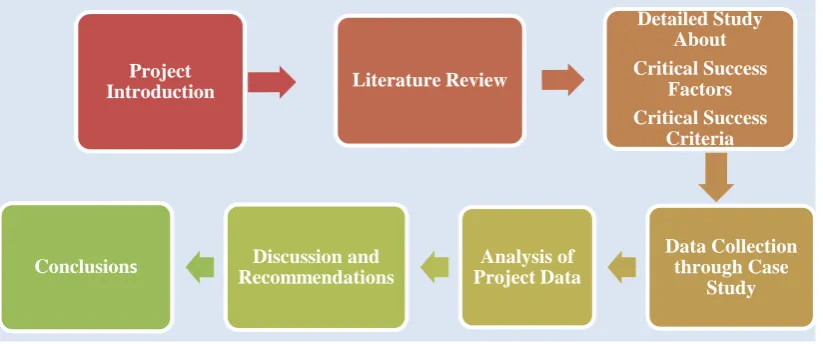
The methodology adopted to achieve above objectives comprises of following steps:
A. Literature survey was carried to describe, summarize, evaluate, clarify or integrate the content of information regarding critical success factors for a project. The sources of information for Review Literature include journal publications, books, magazine articles, international agendas and reports.
B. Success criteria of project management in Indian environment are found out through literature review and actual case study.
C. Data collection is obtained from different sizes residential construction projects with the help of questionnaires prepared on basis of objectives. It aims at collecting information about the critical factors that can be attributed to the success of a construction project from the experienced professionals such as any engineer who worked or has been working in the construction field and owners who have experience in building construction projects.
D. A questionnaire was designed for the survey in residential construction project. The questionnaire included questions from the view of project related, project manager related , project team related, organization related, external environment related, and last is tools and techniques related factors.
F. Respondents were asked to rank the questions from one to five based on the ranking criteria like least critical, less, moderately, critical and most critical.
G. Based up on the responses received from the questionnaire, analysis was done by SMART technique which means Simple Multi Attribute Rating Technique. It is used for ranking each success factors. Then this ranking gets converted into score.
H. From this score, the weightage of each main factor is found out. After finding weightage of each main factor, importance weightage of each sub factor is found out.
I. From importance weightage of each sub factors, the criticality of each factor is found out. The factor having highest importance weightage is the factor which is most critical for achieving project success.
J. Data Collection and Survey will investigate the success factors in residential building construction projects. Data analysis on the basis of survey responses received from expert opinion, it will possible to identify critical success factors by analysis of those critical success factors.
Figure1: Flow Chart showing Methodology.
DATA COLLECTION –
[image:4.595.83.495.240.412.2]For collecting data, a questionnaire survey method is adopted as described in methodology. The questionnaire was distributed in Large, Medium and small sizes of construction companies. For large company, two projects are considered. Three projects are considered for the data collection from medium size company and two projects belongs to small company are visited in order to get data regarding the questions.
Table no. 1: Data collection and rating of success factors for residential projects
Company
Size Category Large Medium Small
Company Name Project
1
Project 2
Project 1
Project 2
Project 3
Project 1
Project 2
Project size and value 3.75 3.78 4 3.9 3.9 3.86 2.56
PROJECT Realistic schedule 3.5 3.44 3.86 3.6 3.8 3.86 3.78
RELATED Clear goals and
objectives 3.75 4.44 4.14 3.9 4.1 4.71 2.78
FACTORS Adequate funds and
resources 4.38 3.89 4.29 4.7 4.5 4.29 3.78
Uniqueness of project
activities 4.13 4.33 4.14 3.9 4.4 4 2.89
Project
Introduction Literature Review
Detailed Study About
Critical Success Factors
Critical Success Criteria
Data Collection through Case
Study Analysis of
Project Data Discussion and
Density of project network(independencies
between activities)
3 3.78 3.43 3.7 3.7 3.43 3.11
Project life cycle 3.13 4.44 4.29 3.3 3.8 4 3.89
Ability to delegate
authority & trade off 3.75 3.33 3.29 3.8 4.2 3.14 3.56
Relevant experience 3.63 3.89 4 4.6 4.8 4 3.89
PROJECT
Effective leadership 4.25 4.33 4.71 4.4 4.3 4.57 4.67
MANAGEMENT
Motivation and goal
orientation 3.88 4.67 4 3.7 4 4.71 4.33
RELATED
Ability to coordinate 3.88 3.78 3.86 3.8 3.9 4.14 4.11
FACTORS
Effective conflict
resolution 4 3.33 3.71 3.7 3.9 3.29 4.67
Perception of role and
responsibility 4 4.11 4.14 3.8 4 4.14 4
Use if most modern
communication tool 4.25 4.22 3.71 4.6 4.5 4.43 4.22
Company
Size Category Large Medium Small
Company
Name Project 1 Project 2 Project 1 Project 2 Project 3 Project 1 Project 2
Ability to handle unexpected
crisis and deviations from
plan
4.25 3.33 3.43 4.4 4.7 3.57 4.22
PROJECT
Level of trust among team
members
4 3.56 3.43 4 4 4.29 4.11
TEAM RELATED
Effective monitoring &feedback
3.75 3.44 3.43 3.7 3.6 4.57 3.89
FACTORS Team
commitment 3.25 4 4.14 3.9 3.8 4.43 3.89
Technical background of
project team
3.13 4 4.14 3.3 3.2 4.86 3.89
Top management
support
4.38 4.56 4.29 4.6 4.7 4.57 4.56
ORGANIZ -ATION
Monitoring
committee 3.63 3.67 4 3.6 3.8 3.86 4
RELATED organizational Project
structure
3.5 3.44 3.86 3.2 3.5 3.71 3.56
FACTORS Functional managers
support
4.13 3.56 4 3.7 4.2 4 4.11
Degree of
autonomy 3 3.33 3.43 3.8 3.1 4.29 3.44
Company Size
Category Large Medium Small
Company
Name Project 1 Project 2 Project 1 Project 2 Project 3 Project 1 Project 2
Political
environment 2.75 2.89 3.29 4.1 2.9 3.43 2.56
Economical 3.75 3.56 3.86 3.8 3.7 4.29 3.78
Social 2.88 2.89 3.29 3.2 2.4 3.43 2.78
ENVIRON
-MENT Technological 3.5 4 3.57 3.5 3.7 4.57 3.78
RELATED
FACTORS Competitors 3 3.33 3.14 2.6 2.5 3.14 2.89
Sub-contractors 2.13 4 3.57 2.9 2.8 4 3.11
Client knowledge and
experience
3.75 3.89 4 3.3 3.4 3.71 3.89
Proper planning/ scheduling
3.63 4.22 4.57 3.8 4.1 4.71 4
TOOLS
AND Monitoring/ control 3.88 4.22 4.57 3.8 3.6 4.71 4
TECHNIQ UES
Cost estimation/
budgeting
4.25 4.22 4.29 3.9 4 4.43 4.22
RELATED
FACTORS Adherence to procedure 3.88 3.33 3.29 4 4.2 3.43 3.56
Quality control 4.13 4.33 4.43 3.9 4.3 4.57 4.11
Risk analysis 4 4.44 4.29 4.1 4.8 4.57 4.22
NOTE: - In above tables „1‟ represented least critical factor and „5‟ represented most critical success factor.
PROJECT RELATED FACTORS -
KEY
Realistic schedule A
Project size and value B
Clear goals and objectives C
Adequate funds and resources D
Uniqueness of project activities E
Density of project network
(independentness between activities) F
Project life cycle G
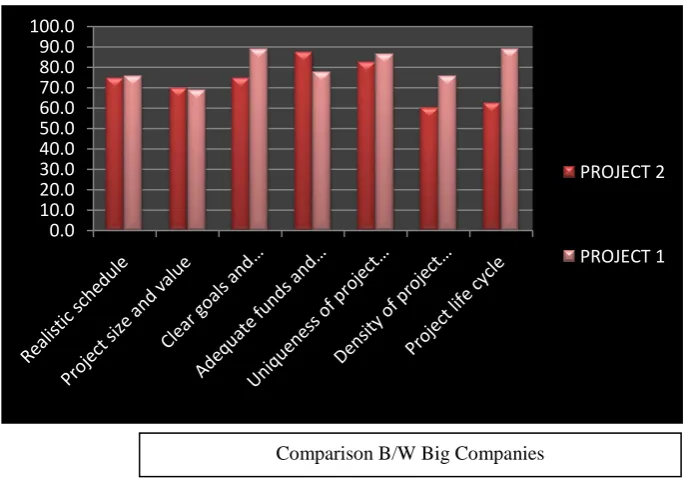
Table No.2 Showing Score of Each Success Factors Related To Project for Big Residential Construction Projects
PROJECT RELEATED FACTORS
BIG COMPANY A B C D E F G
PROJECT 2 75.0 70.0 75.0 87.5 82.5 60.0 62.5 PROJECT 1 75.6 68.9 88.9 77.8 86.7 75.6 88.9
Chart No.1 Showing Comparison of Different Project Related Success Factors between Two Big Residential Construction Projects.
Above chart showing comparison of different success factors related to project between two big construction companies. It is found that project life cycle, clear goals and objectives both having highest score as 88.9 and uniqueness of project activities having score 86.7 are critical success factors for project 1. Whereas adequate funds and resources having score 87.5 and uniqueness of project activities having score 82.5 are the critical success factors for project 2.
PROJECT MANAGER RELATED FACTORS -
For the purpose of simplicity in presentation each sub factor is given a code as shown in the key.
KEY
Ability to delegate authority &tradeoff H
Relevant experience I
Effective leadership J
0.0 10.0 20.0 30.0 40.0 50.0 60.0 70.0 80.0 90.0 100.0
PROJECT 2
PROJECT 1
[image:7.595.130.474.319.561.2]Motivation and goal orientation K
Ability to coordinate L
Effective conflict resolution M
Perception of role and responsibility N
Use of most modern communication tools O
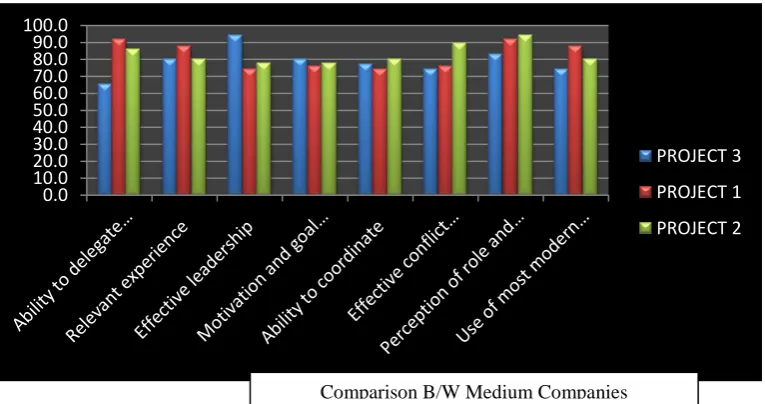
Table No.3Showing Score Of Each Success Factors Related To Project Manager For Medium Residential Construction Projects.
PROJECT MANAGER RELEATED FACTORS
MEDIUM COMPANY H I J K L M N O
PROJECT 3 65.7 80.0 94.3 80.0 77.1 74.3 82.9 74.3 PROJECT 1 92.0 88.0 74.0 76.0 74.0 76.0 92.0 88.0 PROJECT 2 86.0 80.0 78.0 78.0 80.0 90.0 94.0 80.0
Chart No.2 Showing Comparison of Different Project Manager Related Success Factors between Three Medium Residential Construction Companies.
Above chart showing comparison of different success factors related to project manager between three medium construction companies. It is found that as per project 3, Effective leadership having score of 94.3 is the critical success factors and as per project 1, ability to delegate authority & tradeoff and Perception of role and responsibility both having score 92.0 are the critical success factors. As per project 2, Perception of role and responsibility is a critical success factor.
ENVIRONMENTAL RELATED FACTORS -
For the purpose of simplicity in presentation each sub factor is given a code as shown in the key.
KEY
Political environment AA
Economical AB
Social AC
Technological AD
Competitors AE
Sub-contractors AF
Client knowledge and experience AG
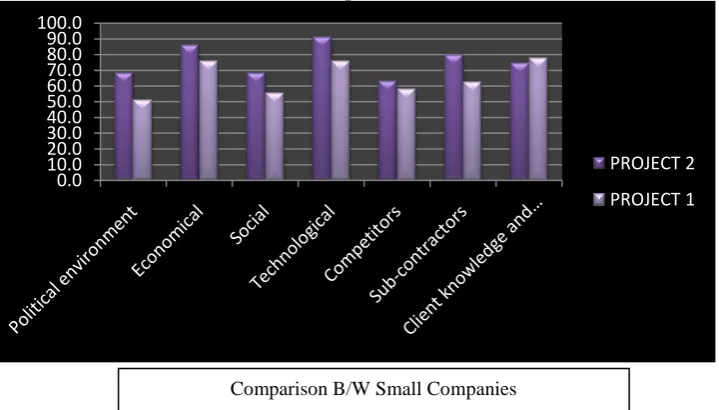
Table No.4 Showing Score Of Each Success Factors Related To Environment For Small Residential Construction Projects.
0.0 10.0 20.0 30.0 40.0 50.0 60.0 70.0 80.0 90.0 100.0
PROJECT 3
PROJECT 1
PROJECT 2
[image:8.595.111.494.281.483.2]ENVIRONMENT RELEATED FACTORS
SMALL COMPANY AA AB AC AD AE AF AG
PROJECT 2 68.6 85.7 68.6 91.4 62.9 80.0 74.3 PROJECT 1 51.1 75.6 55.6 75.6 57.8 62.2 77.8
Chart No. 3- Showing Comparison of Different External Environmental Related Success Factors between Two Small Residential Construction Companies.
Above chart shows comparative study of success factors related to environment. By comparing critical success factors for two big residential construction companies, it is found that, it is found that as per results from project 2, technological is the critical success factor having highest score 91.4 while as per project 1, Client knowledge and experience is the critical success factor.
TOOLS AND TECHNIQUES RELATED FACTORS -
For the purpose of simplicity in presentation each sub factor is given a code as shown in the key.
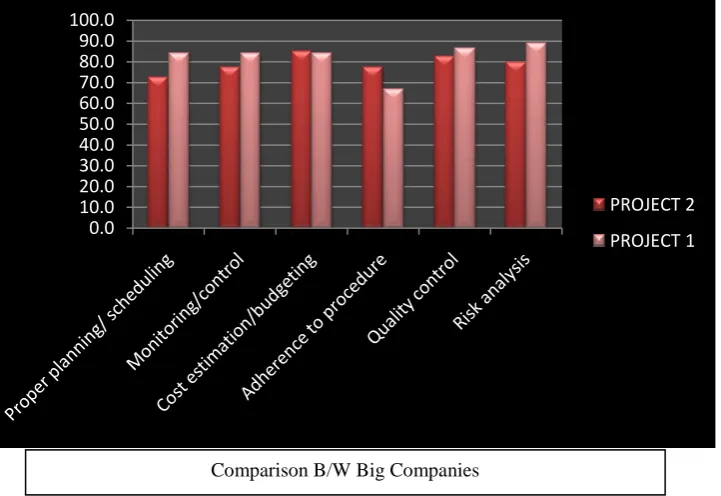
Table No.5 Showing Score Of Each Success Factors Related To Tools And Technique For Big Residential Construction Projects.
TOOLS AND TECHNIQUES RELATED FACTORS
BIG COMPANY AH AI AJ AK AL AM
PROJECT 2 72.5 77.5 85.0 77.5 82.5 80.0 PROJECT 1 84.4 84.4 84.4 66.7 86.7 88.9
Chart No.4 Showing Comparison of Different Tools and Techniques Related Success Factors between Two Big Residential Construction Companies.
0.0 10.0 20.0 30.0 40.0 50.0 60.0 70.0 80.0 90.0 100.0
PROJECT 2
PROJECT 1
KEY
Proper planning/ scheduling
AH Monitoring/control
AI Cost estimation/budgeting
AJ Adherence to procedure
AK Quality control
AL Risk analysis
[image:9.595.123.483.127.332.2]Above chart shows comparative study of success factors related to Tools and Techniques. By comparing critical success factors from above chart for two big residential construction companies, it is found that as per project 1, risk analysis having score 88.9 is the critical success factors and as per project 2, cost estimation/budgeting having score 85.0 and quality control of score 82.5 are the critical success factors.
In the same way, we have carried out score and comparison of all success factors of big, medium and small residential construction companies for project related factors, project management related, project team related, organization related, environment related and tools and technique related factors.
IV.RESULT AND DISCUSSION
[image:10.595.123.484.37.285.2]The factors which are critical for achieving success for construction projects considered were identified based on a literature review. A total of 6 possible factors that were felt to have an effect on the construction business success of companies in residential construction are determined. These main factors are Project Related Factors, Project Manager Related Factors, Project Team Related Factors, Organization Related Factors, Environment Related Factors, Tools and Techniques Related Factors. Similarly, the sub-factors of these main factors were determined. Data collection is done from 7 different sizes residential construction projects related to these factors by taking personal interview from different managerial level from each company.
Table no. 6: The most critical success factors responsible for completion of construction projects
Rating Big Medium Small
Most Project Related Factor
Uniqueness of project activities
Adequate funds and resources
Uniqueness of project activities
Critical Project Management Related Factor
Effective leadership and motivation and goal orientation
Effective leadership
motivation and goal orientation 0.0
10.0 20.0 30.0 40.0 50.0 60.0 70.0 80.0 90.0 100.0
PROJECT 2
PROJECT 1
Success Project Team Related Factor
Ability to handle unexpected crisis and deviations
from plan and level of trust
among team members
Ability to handle unexpected crisis and deviations
from plan
Technical background of
project team
Factor
Organization Related Factor Top management support
Top management support
Top management support
Environment Related Factor Client knowledge
and experience Economical Technological Tools and techniques
Related Factor
Quality control
and Risk Analysis Risk Analysis Risk Analysis
Above table shows the most critical success factors related to all factors according to their importance weightage.
A. For project related factors, It is found that Uniqueness of project activities and Adequate funds and resources is one of the critical success factors for residential construction projects as this factor rank as 1st and 2nd for all projects.Hence for achieving success, it is require for companies to give importance on regular funding meeting their working capital and capital expenditure requirements as well as uniqueness of project activities.
B. In case of project management related factors, It is found that Effective leadership and Motivation and goal orientation are one of the critical success factors for residential construction projects as this factor rank as 1st and 2nd for all projects. Hence Effective leadership skills and his self- motivation as well as skills to confront and challenge adversity should be possess by project manager and he needs to be a clear leader with the power to create objectives and plans, to handle contracting issues and to approve changes in work for successful completion of project.
C. It is found for project team related factors that Ability to handle unexpected crisis and deviations from plan and level of trust among team members are one of the critical success factors as these factors rank as 1st for big and medium residential construction projects. While Technical background of project team is rank as 1st factor for small projects as they act as a liaison between the users of a facility, supervisory physical plant personnel, trades people, construction contractors, or subcontractors to gather information, provide technical construction advice and assistance to effect mutual accord on construction plans, specifications, scheduling.
D. It is found that Top management support is one of the most critical success factors in case of organization related success factors as these factors rank as 1st for big, medium as well as small residential construction projects. Thus, a certain amount of oversight is necessary in organizations to prevent wrongdoing that may go unnoticed when there are high levels of autonomy.
E. For environment related factors, It has been seen that Technological factor is one of the most critical success factors as these factors rank as 2nd and 1st for big, medium and small residential construction projects respectively. Also Client knowledge and experience is found most critical success factor for big companies as it is a significant resource that can be managed to improve innovation, to facilitate sensing of emerging market opportunities and to support the management of long-term customer relationships. Customer information and knowledge generated has to be integrated into that organization‟s everyday operations and processes at the right time to benefit both the company and customer.
G. While density of project network (independencies between activities),Ability to delegate authority & tradeoff, Effective monitoring and feedback,Degree of autonomy, Adherence to procedure ,Political environment are found least critical success factors hence success can be achieved without being giving less importance these all factors.
H. The results of the study is revealed that there are different sets of construction success factors for different objectives they are likely to improve success in building construction projects.
I. The study can be discussed by considering each factor responsible for success of construction project.Effective conflict resolution related to project manager is critical success factor except for project 1 of big size Company having score 66.7 and project 2 with score 65.7 for this factor. It is suggested that project manager of these two companies should utilize project management principles, understand the dynamics of conflict, and learn approaches to conflict resolution.
J. Top-management support is on everyone‟s list of critical success factors (CSFs). In fact, it is usually at the very top of the list.I suggest that top management should motivate Project managers and team members to finish a project successfully. Motivation comes in many forms, and one of them is to provide monetary or other rewards for successful projects.
K. From analysis of data collected from different sites, it is found that level of trust among team members is one of the critical success factors. In project 2 of big Company and project 3 of medium company, it was found that there is lacking of trust among team members. So I would suggest that these two companies should focus first on building trust between their team members by getting team members to open up among the team and expose their weaknesses and fears to each other. L. Technology factor related to environmental is found critical success factor. o remain competitive in
market, it is the need to use latest technology and Risk analysis factor related to tools and techniques is identified as most critical success factor for all sizes residential construction projects. Risk identification and management are key contributors to a successful project. Project managers need to spend time doing risk planning and project tasks will need to include steps for risk mitigation and response.
V.CONCLUSION
1. This study will give an overview of several critical success factors for the construction project.By learning which critical success factors are perceived as most influential, this study can lead to better performance within construction industries.
2. The set of critical success factors obtained in this study can serve as a checklist for practitioners when conducting briefing in their construction projects and also be considered as the foundation for further quantitative studies such as using factor analysis to determine the CSFs for briefing in general, as well as for specific types of projects such as hospitals or hotels.
3. Uniqueness of project activities, Effective leadership and Motivation and goal orientation, Ability to handle unexpected crisis and deviations from plan and Level of trust among team members, Top management support, Client knowledge and experience, risk analysis are found most critical success factor for large companies.Hence special attention should be given on this factor for achieving success.
4. Adequate funds and resources, Effective leadership, Ability to handle unexpected crisis and deviations from plan, Top management support, Economical, risk analysis are found most critical success factor for medium companies.Funds are the essential part of project to be successful so its proper management must be done. Top management should motivate Project managers and team members to finish a project successfully.
6. From the data from all the seven surveyed companies, the most critical success factors as well as least critical success factors were found out for the respective construction companies to be followed.However, I would suggest that more importance be given to these factors as according to our basic framework regarding the problems associated with the construction industry. The resolution of these problems ultimately is aimed towards client satisfaction which is again concerned with the quality of the finished product.
7. Basically, it can be briefly concluded that for successful completion of a construction project various factors are responsible but among those some factors are more critical for achieving success than others. Out of these factors, most critical ones have to be attended to with lot of attention and care. Findings of this study asserted that the critical success factors perceived as most influential as can lead to better performance within construction industries and they are likely to improve success in building construction projects.
VI.ACKNOWLEDGMENT
I would like to express my profound gratitude and great appreciation to my guide Prof. P. P. Bhangale for his encouragement, valuable advice, constructive suggestions, tireless guidance and enduring patience throughout this study.
REFERENCES
[1] G. Arslan, and S. Kivrak, (2009) “Critical Factors to Company Success in the Construction Industry”, InternationalJournal of Human and Social Sciences, 4(8), pp no.561 -564.
[2] AaronJ. Shenhar, (2002) “Improving PM: Linking Success Criteria to Project Type”, AEW Services, Vancouver, BC©2002, A paper presented to the Southern Alberta Chapter, Project Management Institute, Symposium "Creating Canadian Advantage through Project Management", Calgary.
[3] K. C. Iyer, And K.N.Jha, (August 2006) “Critical Factors Affecting Schedule Performance: Evidence from Indian Construction Projects”, Journal of Construction Engineering and Management, 132(8), pp.no. 871– 881.
[4] Anton de Wit, (August 1988), “Measurement of project success”, Journal of Project Management, 6(3), pp.no.164-170.
[5] R. Atkinson, (1999) “Project Management: Cost, Time and Quality, Two Best Guesses and A
Phenomenon, It‟s Time to Accept Other Success Criteria”, International Journal of Project Management, 17(6), pp. no.337–342.
[6] J. K. Pinto and, D. P. Slevin, (1987) “Critical factors in successful project implementation”, IEEE Transactions on Engineering Management, 34(1), pp no.22-27.
[7] Terry Cooke-Davies, (2002) “The Real Success Factors on Projects”, International Journal of Project Management, 20, pp. no.185-190.
[8] Dr Albert PC Chan,(2003),“Framework For Measuring Success Of Construction Projects” pp.no.1-21
[9] Amaka Ogwueleka(april2011) “The Critical Success Factors Influencing Project Performance In Nigeria”, International Journal Of Management Science And Engineering Management, 6(5), pp.no343-349.
[10] Dr. Satish Taneja, (January-June2011) “Critical Success Factors and Success Criteria of Project Management”, Bi-Annual of IMS Ghaziabad, Volume 8 No.1, pp.no.13-23.
[11] Hari Garbharran, Jeevarathnam Govender & Thulani Msani, (2012) “Critical success factors influencing projectsuccess in the construction industry”, Critical success factors; pp no. 90-108.
[12] Walid Belassi And Oya Icmeli Tukel(1996) “New Framework For Determining Critical Success/failure Factors In Project”, International Journal Of Project Management14(3), pp no.141-151.
[14] Amaka Ogwueleka(april2011) “The Critical Success Factors Influencing Project Performance in Nigeria”, International Journal of Management Science and Engineering Management, 6(5), pp.no343-349.