Support Vector Machines Applied to the Classification of Semantic Relations
in Nominalized Noun Phrases
Roxana Girju
Computer Science Department
Baylor University
Waco, Texas
[email protected]
Ana-Maria Giuglea, Marian Olteanu,
Ovidiu Fortu, Orest Bolohan, and
Dan Moldovan
Department of Computing Science
University of Texas at Dallas
Dallas, Texas
[email protected]
Abstract
The discovery of semantic relations in text plays an important role in many NLP appli-cations. This paper presents a method for the automatic classification of semantic relations in nominalized noun phrases. Nominalizations represent a subclass of NP constructions in which either the head or the modifier noun is derived from a verb while the other noun is an argument of this verb. Especially designed fea-tures are extracted automatically and used in a Support Vector Machine learning model. The paper presents preliminary results for the se-mantic classification of the most representative NP patterns using four distinct learning mod-els.
1
Introduction
1.1 Problem description
The automatic identification of semantic relations in text has become increasingly important in Information Ex-traction, Question Answering, Summarization, Text Un-derstanding, and other NLP applications. This paper dis-cusses the automatic labeling of semantic relations in nominalized noun phrases (NPs) using a support vector machines learning algorithm.
Based on the classification provided by the New
Web-ster’s Grammar Guide (Semmelmeyer and Bolander
1992) and our observations of noun phrase patterns on large text collections, the most frequently occurring NP level constructions are: (1)Compound Nominals consist-ing of two consecutive nouns (eg pump drainage - anIN
-STRUMENT relation), (2) Adjective Nounconstructions where the adjectival modifier is derived from a noun (eg
parental refusal -AGENT), (3)Genitives(eg tone of
con-versation - aPROPERTY relation), (4)Adjective phrases
in which the modifier noun is expressed by a preposi-tional phrase which functions as an adjective (eg
amuse-ment in the park - aLOCATIONrelation), and (5) Adjec-tive clauseswhere the head noun is modified by a relative clause (eg the man who was driving the car - anAGENT
relation between man and driving).
1.2 Previous work on the discovery of semantic relations
The development of large semantically annotated cor-pora, such as Penn Treebank2 and, more recently, Prop-Bank (Kingsbury, et al. 2002), as well as semantic knowledge bases, such as FrameNet (Baker, Fillmore, and Lowe 1998), have stimulated a high interest in the automatic acquisition of semantic relations, and espe-cially of semantic roles. In the last few years, many re-searchers (Blaheta and Charniak 2000), (Gildea and Ju-rafsky 2002), (Gildea and Palmer 2002), (Pradhan et al. 2003) have focused on the automatic prediction of se-mantic roles using statistical techniques. These statistical techniques operate on the output of probabilistic parsers and take advantage of the characteristic features of the semantic roles that are then employed in a learning algo-rithm.
While these systems focus on verb-argument semantic relations, called semantic roles, in this paper we inves-tigate predicate-argument semantic relations in nominal-ized noun phrases and present a method for their auto-matic detection in open-text.
1.3 Approach
pro-vides valuable insights into defining the most representa-tive feature vectors that ultimately drive the discriminat-ing learndiscriminat-ing models.
An important characteristic of this work is that it re-lies heavily on state-of-the-art natural language process-ing and machine learnprocess-ing methods. Prior to the discovery of semantic relations, the text is syntactically parsed with Charniak’s parser (Charniak 2001) and words are seman-tically disambiguated and mapped into their appropriate WordNet senses. The word sense disambiguation is done manually for training and automatically for testing with a state-of-the-art WSD module, an improved version of a system with which we have participated successfully in Senseval 2 and which has an accuracy of 81% when disambiguating nouns in open-domain. The discovery of semantic relations is based on learning lexical, syntactic, semantic and contextual constraints that effectively iden-tify the most probable relation for each NP construction considered.
2
Semantic Relations in Nominalized Noun
Phrases
In this paper we study the behavior of semantic relations at the noun phrase level when one of the nouns is nom-inalized. The following NP level constructions are con-sidered: complex nominals, genitives, adjective phrases, and adjective clauses.
Complex Nominals
Levi (Levi 1979) defines complex nominals (CNs) as ex-pressions that have a head noun preceded by one or more modifying nouns, or by adjectives derived from nouns (usually called denominal adjectives). Each sequence of nouns, or possibly adjectives and nouns, has a particular meaning as a whole carrying an implicit semantic rela-tion; for example, “parental refusal” (AGENT).
The main tasks are the recognition, and the
interpre-tation of complex nominals. The recognition task deals
with the identification of CN constructions in text, while the interpretation of CNs focuses on the detection and classification of a comprehensive set of semantic rela-tions between the noun constituents.
Genitives
In English there are two kinds of genitives; in one, the modifier is morphologically linked to the possessive clitic
’s and precedes the head noun (s-genitive e.g. “John’s conclusion”), and in the second one the modifier is
syn-tactically marked by the preposition of and follows the head noun (of-genitive, e.g. “declaration of
indepen-dence”).
Adjective Phrases are prepositional phrases attached to nouns and act as adjectives (cf. (Semmelmeyer and Bolander 1992)). Prepositions play an important role
both syntactically and semantically ( (Dorr 1997). Prepo-sitional constructions can encode various semantic re-lations, their interpretations being provided most of the time by the underlying context. For instance, the preposi-tion “with” can encode different semantic relapreposi-tions: (1) It was the girl with blue eyes (MERONYMY), (2) The baby
with the red ribbon is cute (POSSESSION), (3) The woman
with triplets received a lot of attention (KINSHIP).
The conclusion for us is that in addition to the nouns se-mantic classes, the preposition and the context play im-portant roles here.
Adjective Clauses are subordinate clauses attached to nouns (cf. (Semmelmeyer and Bolander 1992)). Often they are introduced by a relative pronoun/adverb (ie that,
which, who, whom, whose, where) as in the following
ex-amples: (1) Here is the book which I am reading (book is theTHEMEof reading) (2) The man who was driving
the car was a spy (man is theAGENTof driving). Adjec-tive clauses are inherently verb-argument structures, thus their interpretation consists of detecting the semantic role between the head noun and the main verb in the relative clause. This is addressed below.
3
Nominalizations and Mapping of NPs
into Grammatical Role Structures
3.1 Nominalizations
A further analysis of various examples of noun - noun pairs encoded by the first three major types of NP-level constructions shows the need for a different taxonomy based on the syntactic and grammatical roles the con-stituents have in relation to each other. The criterion in this classification splits the noun - noun examples (re-spectively, adjective - noun examples in complex nom-inals) into nominalizations and non-nominalizations. Nominalizations represent a particular subclass of NP constructions that in general have “a systematic corre-spondence with a clause structure” (Quirk et al.1985). The head or modifier noun is derived from a verb while the other noun (the modifier, or respectively, the head) is interpreted as an argument of this verb. For example, the noun phrase “car owner” corresponds to “he owns a car”. The head noun owner is morphologically related to the verb own. Otherwise said, the interpretation of this class of NPs is reduced to the automatic detection and inter-pretation of semantic roles mapped on the corresponding verb-argument structure.
As in (Hull and Gomez 1996), in this paper we use the term nominalization to refer only to those senses of the nominalized nouns which are derived from verbs. For example, the noun “decoration” has three senses in WordNet 2.0: an ornament (#1), a medal (#2), and the act
of decorating (#3). Only the last sense is a
the underlying verb has more than one sense that refers to an action/event. This is the case of “examination” which has five senses of which four are action-related. In this case, the selection of the correct sense is provided by the context.
We are interested in answering the following ques-tions: (1) What is the best set of features that can capture
the meaning of noun - noun nominalization pairs for each NP-level construction? and (2) What is the semantic be-havior of nominalization constructions across NP levels?
3.2 Taxonomy of nominalizations
Deverbal vs verbal noun.
(Quirk et al.1985) generally classify nominalizations based on the morphological formation of the nominal-ized noun. They distinguish between deverbal nouns, i.e. those derived from the underlying verb through word for-mation; e.g., “student examination”, and verbal nouns, i.e. those derived from the verb by adding the gerund suffix “-ing”; e.g.: “cleaning woman”. Most of the time, verbal nouns are derived from verbs which don’t have a deverbal correspondent.
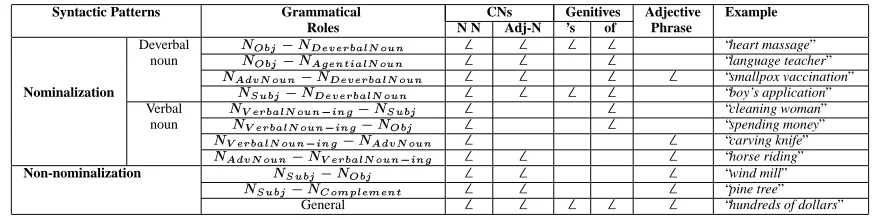
Table 1 shows the mapping of the first three major syn-tactic NP constructions to the grammatical role level. By analyzing a large corpus, we have observed that Quirk’s grammatical roles shown in Table 1 are not uniformly dis-tributed over the types of NP-constructions. For example,
the “ ” pattern cannot be encoded
by s-genitives (e.g., “language teacher”, “teacher of
lan-guage”).
Some of the non-nominalization NP constructions can also capture the arguments of a particular verb that is missing (e.g., subject - object, subject - complement). The “General” subclass refers to all other types of noun - noun constructions that cannot be mapped on verb-argument relations (e.g., “hundreds of dollars”). Adjec-tive clauses are not part of Table 1 as they describe by default verb-argument relations (semantic roles). Thus they cannot be classified as nominalizations or non-nominalizations.
Two other useful classifications for nominalizations are: paraphrased vs. non-paraphrased, and the clas-sification according to the nominalized noun’s verb-argument underlying structures as provided by the
Nom-Lex dictionary of English nominalizations (Macleod et al.
1998) discussed more later.
Paraphrased vs non-Paraphrased.
In most cases, the relation between the nominalized noun and the other noun argument can be captured from the subcategorization properties of the underlying verb. Oth-erwise said, most of the time, there is a systematic cor-respondence between the nominalized NP construction and the predicate-argument structure of the correspond-ing verb in a clausal paraphrase (paraphrased
nominal-ization). The predicate-argument structure can be
cap-tured by three grammatical roles: subject,
verb-object, and verb-complement. We call the arguments of
the verb that appear more frequently or are obligatory - frame arguments. From this point of view the non-nominalized noun can be mapped on the verb-argument frame or not. Thus we can classify paraphrased nom-inalizations in framed and non-framed according to the presence or absence of the non-nominalized noun in the frame of the verb. The semantic classification of nom-inalizations involves first the detection of a nominaliza-tion, the selection of the correct sense of the root verb, and finally the detection of the semantic relationship with the other noun.
Besides the paraphrase nominalization, there is an-other type which occurs less frequently. We call this type
non-paraphrased nominalization as its meaning is
differ-ent from its most related paraphrase clause. Examples:
research budget, design contract, preparation booklet, publishing sub-industry and editing error. An important
observation is that the nominalized noun occurs most of the time on the first position in an NP construction.
The criteria presented here consider also nominaliza-tions with adjectival modifiers such as “parental refusal”. These adjectives are derived from nouns, so the con-struction is just a special case of nominalization between nouns.
NomLex classification
The NomLex dictionary of nominalizations (Macleod et al. 1998) contains 1025 lexical entries and lists the verbs from which the nouns are derived. This dictionary spec-ifies the complements allowed for a nominalization. The mapping is done at a syntactic level only. NomLex is used in the first phase of our algorithm in order to de-tect a possible nominalization and the corresponding root verb. The criterion of NomLex classification is based on the verb-argument correspondence:
a. Verb-nom: The nominalized noun represents the ac-tion/state of the verb (e.g., “acquisition challenge”,
“de-positary receipt)”,
b. Subj-nom: The nominalized noun refers to the sub-ject of the verb (e.g., “auto maker”, “math teacher”). This type is also called agential nominalization (Quirk et al.1985) as the nominalized noun captures information about both the subject and verb.
c. Obj-nom: The nominalized noun refers to the object of the verb (e.g., “court order”, “company employee”), d. Verb-part: the nominalized noun is derived from a compositional verb (e.g., “takeover target”).
3.3 Corpus Analysis at NP level
The data
Syntactic Patterns Grammatical CNs Genitives Adjective Example
Table 1: Classification of noun phrase constructions on the types of grammatical roles (cf. (Quirk et al.1985)) needed for semantic roles detection. The classification is the result of our observations of nominalization patterns at noun phrase level.
category the number of randomly selected sentences, the number of instances found in these sentences, and finally the number of nominalized instances our group managed to annotate by hand. The annotation of each example consisted of specifying its feature vector and the most ap-propriate semantic relation as defined in (Moldovan et al. 2004).
Inter-annotator Agreement
The annotators, four PhD students in Computational Se-mantics worked in groups of two, each group focusing on one half of the corpus to annotate. Besides the type of relation, the annotators were asked to provide informa-tion about the order of the modifier and the head nouns in the syntactic constructions if applicable. For example, “owner of the car” and “car of the owner”.
The annotators were also asked to indicate if the in-stance was a nominalization and if yes, which of the noun constituents was derived from a verb (e.g. the head noun nominalization “student protest”, or the modifier noun nominalization “working woman’” cf. (Quirk et al.1985)).
The annotators’ agreement was measured using the Kappa statistics (Siegel and Castellan 1988), one of the most frequently used measure of inter-annotator agree-ment for classification tasks: 8:9<;=!>
?
is the proportion of times the raters agree and BDC1E'IJG
is the probability of agreement by chance. The K coefficient is 1 if there is a total agreement among the annotators, and 0 if there is no agreement other than that expected to occur by chance.
For each construction, the corpus was split after agree-ment with an 80/20 training/testing ratio. For each pat-tern, we computed the K coefficient only for those in-stances tagged with one of the 35 semantic relations (K value for: NN (0.64), AdjN (0.70), s-genitive (0.69), of-genitive (0.73), adjective phrases (0.67), and adjective clauses (0.71)). For each pattern, we also calculated the number of pairs that were tagged withOTHERSby both annotators, over the number of examples classified in this
category by at least one of the judges, averaged by the number of patterns considered (agreement forOTHERS: 75%).
The K coefficient shows a good level of agreement for the training and testing data on the set of 35 relations, tak-ing into consideration the task difficulty. This can be ex-plained by the instructions the annotators received prior to annotation and by their expertise in lexical semantics.
3.4 Distribution of Semantic Relations
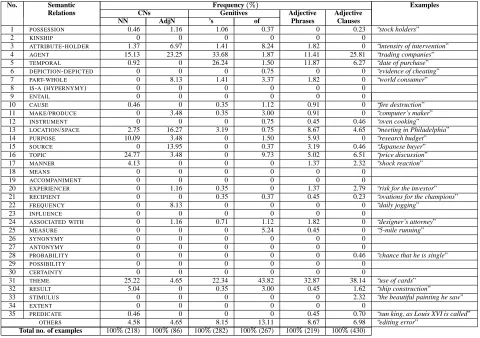
Even noun phrase constructions are very productive al-lowing for a large number of possible interpretations, Ta-ble 3 shows that a relatively small set of 35 semantic re-lations covers a significant part of the semantic distribu-tion of these construcdistribu-tions on a large open-domain cor-pus. Moreover, the distribution of these relations is de-pendent on the type of NP construction, each type en-coding a particular subset. For example, in the case of s-genitives, there were 13 relations found from the total of 35 relations considered. The most frequently occur-ring relations wereAGENT,TEMPORAL,LOCATION, and
THEME. By comparing the subsets of semantic relations in each column we can notice that these semantic spaces (the set of semantic relations an NP construction can en-code) are not identical, proving our initial intuition that the NP constructions cannot be alternative ways of pack-ing the same information. Table 3 also shows that there is a subset of semantic relations that can be fully encoded by all types of NP constructions. The statistics about the an-notated nominalized examples are as follows (lines 3 and 4 in Table 2): N-N (32.30%), Adj-N (30.80%), s-genitive (21.09%), of-genitive (21.8%), adjective phrase (40.5%). 80% of the examples in adjective phrases (respectively in 94% in s-genitives) had the nominalized noun on the head position.
This simple analysis leads to the important conclusion that the NP constructions must be treated separately as their semantic content is different. We can draw from here the following conclusions:
Wall Street Journal
CNs Genitives Adjective Adjective NN AdjN ’s of Phrases Clauses No. of sentences 7067 5381 50291 27067 14582 31568
No. of instances 5557 500 2990 4185 3502 6520 2
No. of annotated instances 2315 383 1816 3404 1341 563
No. of annotated nominalized instances 747 118 383 742 543 563
No. of annotated nominalized instances used in the learning task 312 118 383 344 297 563
Table 2: Corpus statistics.
syntactic constructions.
2. There are semantic relations that have preferences over particular syntactic constructions.
3.5 Model
3.6 Support Vector Machines
Support Vector Machines (SVM) have a strong mathe-matical foundation (Vapnik 1982) and have been applied successfully to text classification (Tong and Koller 2001), speech recognition, and other applications. We applied SVM to the semantic classification problem and obtained encouraging results.
SVM algorithms are a special class of hyperplane classifiers that use the information encoded in the dot-products of the transformed feature vectors as a simi-larity measure. The similarity between two instances
and
is given as a function 8
, 8 E
G 9HE GHE
G
. The Kernel function
8
is the
inner product of the non-linear function that
maps the original feature vectors into real feature space. The function that provides the best classification is of the form:
E G 9! #"
%$ A'&
)( 8 E *+
G
. The vec-tors +
for which the Lagrange multipliers ( -,9/.
are called support vectors. Intuitively, they are the closest to the separating hyperplane. SVM provide good classifiers with few, well chosen training examples.
In order to achieve classification in classes, 021 , a binary classifier is built for each pair of classes (a total of354
classifiers). A voting procedure is then used to es-tablish the class of a new example. For the experiments with semantic relations, the simplest voting scheme has been chosen; each binary classifier has one vote which is assigned to the class it chooses when it is run. Then the class with the largest number of votes is considered to be the answer. Using the specific nature of the semantic re-lation detection problem, new voting schemes can be de-signed, with good perspectives of improving the overall precision.
The software used in these experiments is the pack-age LIBSVM, http://www.csie.ntu.edu.tw/6 cjlin/libsvm/ which implements the SVM algorithm described above.
The choice of the kernel is the most difficult part of applying SVM algorithms as the performance of the clas-sifier might be enhanced with a judicious choice of the kernel. We used in our experiments 4 types of general
kernels (linear, polynomial, radial-based and sigmoid), with good results. All of them had nearly the same per-formance, with slight deviations between 2% and 4% on a reduced testing set. However, remarkable is the fact that all classifiers, regardless of the kernel used, made the same mistakes (misclassified the same examples - eg, a classifier with 58% precision makes the same mistakes as one with 62% precision, plus some of its own, and this situation occurred even when the two classifiers had dif-ferent kernels), while the overall precision seems to be around to the same value during the coefficient tuning. This shows that the limitation is rather imposed by the classification task than by the kernel type.
3.7 Feature space
The key to a successful semantic classification of NP con-structions is the identification of their most specific lexi-cal, syntactic, semantic and contextual features. We de-veloped algorithms for finding their values automatically. The values of these features are determined with the help of some important resources mentioned below.
ComLex (Grishman et al.1994) is a computational lexi-con providing syntactic information for more than 38,000 English headwords. It contains detailed syntactic infor-mation about the attributes of each lexical item and the subcategorization frames when words have arguments. This last feature is the most useful for our task as the senses of verbs are clustered by the syntactic frames. We will use ComLex in combination with VerbLeX to map the syntactic behaviors to verb semantic classes.
No. Semantic Frequency> Examples
Relations CNs Genitives Adjective Adjective
NN AdjN ’s of Phrases Clauses
1 POSSESSION 0.46 1.16 1.06 0.37 0 0.23 “stock holders”
2 KINSHIP 0 0 0 0 0 0
3 ATTRIBUTE-HOLDER 1.37 6.97 1.41 8.24 1.82 0 “intensity of intervention”
4 AGENT 15.13 23.25 33.68 1.87 11.41 25.81 “trading companies”
5 TEMPORAL 0.92 0 26.24 1.50 11.87 6.27 “date of purchase”
6 DEPICTION-DEPICTED 0 0 0 0.75 0 0 “evidence of cheating”
7 PART-WHOLE 0 8.13 1.41 3.37 1.82 0 “world consumer”
8 IS-A(HYPERNYMY) 0 0 0 0 0 0
9 ENTAIL 0 0 0 0 0 0
10 CAUSE 0.46 0 0.35 1.12 0.91 0 “fire destruction”
11 MAKE/PRODUCE 0 3.48 0.35 3.00 0.91 0 “computer’s maker”
12 INSTRUMENT 0 0 0 0.75 0.45 0.46 “oven cooking”
13 LOCATION/SPACE 2.75 16.27 3.19 0.75 8.67 4.65 “meeting in Philadelphia”
14 PURPOSE 10.09 3.48 0 1.50 5.93 0 “research budget”
15 SOURCE 0 13.95 0 0.37 3.19 0.46 “Japanese buyer”
16 TOPIC 24.77 3.48 0 9.73 5.02 6.51 “price discussion”
17 MANNER 4.13 0 0 0 1.37 2.32 “shock reaction”
18 MEANS 0 0 0 0 0 0
19 ACCOMPANIMENT 0 0 0 0 0 0
20 EXPERIENCER 0 1.16 0.35 0 1.37 2.79 “risk for the investor”
21 RECIPIENT 0 0 0.35 0.37 0.45 0.23 “ovations for the champions”
22 FREQUENCY 0 8.13 0 0 0 0 “daily jogging”
23 INFLUENCE 0 0 0 0 0 0
24 ASSOCIATED WITH 0 1.16 0.71 1.12 1.82 0 “designer’s attorney”
25 MEASURE 0 0 0 5.24 0.45 0 “5-mile running”
26 SYNONYMY 0 0 0 0 0 0
27 ANTONYMY 0 0 0 0 0 0
28 PROBABILITY 0 0 0 0 0 0.46 “chance that he is single”
29 POSSIBILITY 0 0 0 0 0 0
30 CERTAINTY 0 0 0 0 0 0
31 THEME 25.22 4.65 22.34 43.82 32.87 38.14 “use of cards”
32 RESULT 5.04 0 0.35 3.00 0.45 1.62 “ship construction”
33 STIMULUS 0 0 0 0 0 2.32 “the beautiful painting he saw”
34 EXTENT 0 0 0 0 0 0
35 PREDICATE 0.46 0 0 0 0.45 0.70 “sun king, as Louis XVI is called”
OTHERS 4.58 4.65 8.15 13.11 8.67 6.98 “editing error”
Total no. of examples 100 (218) 100 (86) 100 (282) 100 (267) 100 (219) 100 (430)
Table 3: The distribution of the semantic relations on the annotated corpus after agreement. The list of 35 semantic relations was presented in (Moldovan et al. 2004). The percentages represent the number of examples that encode a semantic relation for a particular pattern. The last row shows the number of examples covered by each pattern in the entire annotated corpus (1502 pairs).
An essential aspect of our approach below is the word sense disambiguation (WSD) of the content words (nouns, verbs, adjectives and adverbs). Using a state-of-the-art open-text WSD system, each word is mapped into its corresponding WordNet 2.0 sense. When dis-ambiguating each word, the WSD algorithm takes into account the surrounding words, and this is one important way through which context gets to play a role in the se-mantic classification of NPs.
So far, we have identified and experimented with the following NP features:
1. Semantic class of the
non-nominalized noun. The non-nominalized noun is classified into one of the 39 EuroWordNet noun semantic classes. VerbNet classes extended in VerbLeX contain selectional restrictions for different semantic roles inside the verb frame. These restrictions are pro-vided based on the EuroWordNet noun semantic classes.
Example: “computer maker”, where “computer” is
mapped to the ABSTRACTnoun category in
EuroWord-Net. We intend to map the EuroWordNet top noun
semantic classes into their WordNet correspondents.
2. Verb class for nominalized noun, or verb in adjective clauses maps the nominalizing verb into its VerbLeX class. The intuition behind this feature is that semantic relations cluster around specific VerbLeX verb classes.
3. Type of nominalization indicates the NomLex nominalization class. For this experiment we considered only examples that could be found in NomLex. By specifying subj-nom, obj-nom, and
verb-nom types of nominalization, we reduce the list of
possible semantic relations the verb can have with the non-nominalized noun. Example: “computer maker”, where “maker” is an agential deverbal noun that captures both the subject (respectively, AGENT) and the verb. Thus, the noun “computer” can only map to object (respectively,THEME).
not. Chomsky (Chomsky 1970) showed that gerundive nominalizations have different behavior than derived nominalizations. Example: ”woman worker” vs
“work-ing woman”; here “work“work-ing” is a verbal nominal. 5. Semantic class of the
coordinating word. This is a contextual fea-ture and can be either a noun (if the phrase that contains the nominalization is attached to a noun) or a verb (if the phrase is an argument of the verb in the sentence). The feature value is either the VerbLeX class of the verb or the root of the noun in the WordNet hierarchy. The coordinating word captures some properties present in the noun phrase, properties that help to discriminate between various competing semantic relations. Example: “Foreigners complain that they have limited access to
[government procurement] in Japan.” - the coordinating
word is “access” which is a psychological feature.
6. Position of the nominalized noun
depicts the position of the nominalizing verb in the com-pound; ie, either head or modifier. Example: “working
woman”, where the nominalized noun is the modifier,
and “computer maker” where the nominalized noun is the head noun.
7. In frame is a three-value feature indicating whether the compound has a paraphrase or if the peer in the compound is framed or not. If the peer in the NP noun-noun pair is in the corresponding VerbLeX predicate-argument frame, than the relation is captured in the predicate-argument structure. If it is not in the VerbLeX frame, but is an external argument (eg,LOCA
-TION, TEMPORAL, MANNER, etc.), then it is no-frame. Otherwise, there is no paraphrase that keeps the meaning, so the relation is not defined by the predicate-argument frame. Example: “computer maker” is framed where as “backyard composting” is non-framed, and “editing
error” is no-paraphrase (has no paraphrase of type
verb-argument).
8. Relative pronoun/adverb applies only to adjective clauses and embeds information about the grammatical and/or semantic role of the head noun in the subordinate clause. Example: “the room where the
meeting took place” - the word where implies location. 9. Grammatical role of relative
pronoun/adverb applies only to adjective clauses and specifies the grammatical role of the relative pro-noun/adverb, if one exists. This feature depicts better the grammatical role played in the sentence by the head noun. We used for this purpose an in-house rule-based grammatical role detection module, which annotates the following roles (cf. (Quirk et al.1985): subject, direct
object, indirect object, subject complement (argument
for copular verbs), object complement (second argument for complex transitive verbs), object oblique, free
pred-icative, and approximates extent and temporal semantic
roles. Example: “the man who gave Mary the book” -Mary and the book are indirect object and, respectively
direct object, so man cannot beTHEMEorRECIPIENT.
10. Voice. This feature applies only to adjective clauses and indicates the voice of the verb in the relative clause. The voice plays an important role in the correla-tion between grammatical roles and semantic roles in a sentence. Example: “the child that was taken to the zoo” - passive voice, so the child is in aTHEMErelation with
the verb take.
Let’s consider an example of nominalization with its features.
“Several candidates have withdrawn their names from consideration after administration officials asked them for their views on abortion and fetal-tissue transplants.”
The noun compound “fetal-tissue#1 transplant#1” is detected as a nominalization as the noun “transplant” is derived from the verb “to transplant#3”. The features and their values are: Feature 1: semantic class for fetal-tissue:
body-part; Feature 2: verb class for transplant: fill-9.8;
Feature 3: type of nominalization: verb-nom; Feature 4: gerundive: no (0); Feature 5: semantic class for coordi-nating word (“view”) = psychological feature#1; Feature 6: position of the nominalized noun = second; Feature 7: in frame = yes.
The in-house extended verb lexicon VerbLeX shows the following semantic frame for the verb class
fill-9.8: Agent[+animate] Destination[+location -region] Theme[+concrete] Body-part is a subcategory of con-crete. Thus, for this example the semantic relation is
THEME.
4
Overview of Results
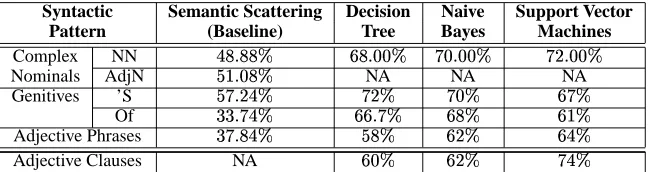
The f-measure results obtained so far are summarized in Table 4. They are divided in two categories, nominaliza-tions, and adjective clauses since the feature vectors differ from one category to another. We have compared the per-formance of SVM with three other learning algorithms: (1) semantic scattering (Moldovan et al. 2004), (2) deci-sion trees (a C4.5 implementation), and (3) Naive Bayes. We considered as baseline semantic scattering which is a new learning model (Moldovan et al. 2004) devel-oped in-house for the semantic classification of noun-noun pairs in NP constructions. The semantic relation derives from the WordNet semantic classes of the two nouns participating in those constructions, as well as the surrounding context provided by the WSD module.
Syntactic Semantic Scattering Decision Naive Support Vector Pattern (Baseline) Tree Bayes Machines
Complex NN
Nominals AdjN NA NA NA
Genitives ’S
Of
Adjective Phrases
Adjective Clauses NA
Table 4: F-measure results for the semantic classification of NP patterns obtained with four learning models on a corpora with an 80/20 training/testing ratio. “NA” means not available.
f1 f2 f3 f4 f5 f6 f7 f8 f9 f10 Nominalized H M M M L H H
Adjective Clauses M H H L H
Table 5: The impact of each feature
on the overall performance; H-high (over 8%), M-medium(between 2% and 8%), and L-low (below 2%). Empty boxes indicate the absence of features.
This explains in part our initial intuition that nominaliza-tion construcnominaliza-tions at NP level have a different semantic behavior than the NP non-nominalization patterns.
We studied the influence of each feature on the per-formance, and since there are too many cases to discuss we only show in Table 5 the average impact as High, Medium, or Low. This table also shows the features used in each case.
References
C. Baker, C. Fillmore, and J. Lowe. 1998. The Berkeley FrameNet Project. In Proceedings of COLLING/ACL.
D. Blaheta and E. Charniak. 2000. Assigning function tags to parsed text. In Proceedings of the NAACL.
E. Charniak. 2001. Immediate-head parsing for language models. In Proceedings of ACL, Toulouse, France.
N. Chomsky. 1970. Remarks on Nominalization. In
Readings in English Transformational Grammar.
Ja-cobs, R. A., and Rosenbaum, P.S. (eds), Ginn and Company.
B. Dorr. 1997. Large-scale dictionary construction for foreign language tutoring and interlingual machine translation. In Machine Translation, 12(4).
D. Gildea and D. Jurafsky. 2002. Automatic Labeling of Semantic Roles. In Computational Linguistics, 28(3).
D. Gildea and M. Palmer. 2002. The Necessity of Parsing for Predicate Argument Recognition. In ACL.
R. Grishman, C. Macleod, and A. Meyers. 1994. Comlex syntax: Building a computational lexicon. In
Proceed-ings of COLING, Kyoto, Japan.
R. Hull and F. Gomez. 1996. Semantic interpretation of nominalizations. In AAAI conference, Oregon.
K. Kipper, H. T. Dang, and M. Palmer. 2000. Class-based construction of a verb lexicon. In AAAI, Austin, Texas.
P. Kingsbury, M. Palmer, and M. Marcus. 2002. Adding Semantic Annotation to the Penn TreeBank. In
Pro-ceedings of HLT, California.
P. Kingsbury and M. Palmer. 2002. From Treebank to Propbank. In Third International Conference on
Lan-guage Resources and Evaluation, LREC-02, Las
Pal-mas, Canary Islands.
Judith Levi. 1979. The Syntax and Semantics of Com-plex Nominals. New York: Academic Press.
C. Macleod, R. Grishman, A. Meyers, L. Barrett, and R. Reeves. 1998. Nomlex: A lexicon of nominalizations. In Proceedings of the 8th International Congress of the
European Association for Lexicography, Belgium.
D. Moldovan, A. Badulescu, M. Tatu, D. Antohe, and R. Girju. 2004. Semantic Classification of Non-nominalized Noun Phrases. In Proceedings of
HLT/NAACL 2004 - Computational Lexical Semantics workshop, Boston, MA.
S. Pradhan, K. Hacioglu, V. Krugler, W. Ward, J. Mar-tin, and D. Jurafsky. 2003. Semantic role parsing: Adding semantic structure to unstructured text. In
ICDM, Florida.
R. Quirk, S. Greenbaum, G. Leech, and J. Svartvik. 1985. A comprehensive grammar of English language, Long-man, Harlow.
S. Siegel and N.J. Castellan. 1988. Non Paramet-ric Statistics for the behavioral science. New York:
McGraw-Hill.
M. Semmelmeyer and D. Bolander. 1992. The New
Web-ster’s Grammar Guide. Lexicon Publications, Inc.
S. Tong and D. Koller. 2001. Support Vector Machine Active Learning with Applications to Text Classifica-tion. In Journal of Machine Learning Research.