R e c e n t I m p r o v e m e n t s and B e n c h m a r k R e s u l t s for
P a r a m a x A T I S S y s t e m
L e w i s M. N o r t o n , Deborah A . Dahl, and M a r c i a C. Linebarger *
P a r a m a x S y s t e m s C o r p o r a t i o n , a U n i s y s C o m p a n y P . O . B o x 5 1 7
P a o l i , P A , 19301
t h e
A B S T R A C T
This p a p e r d e s c r i b e s t h r e e relatively d o m a i n - i n d e p e n d e n t ca-
p a b i l i t i e s recently added to the Paramax spoken language un-
derstanding system: non-monotonic reasoning, implicit refer- ence resolution, and database query paraphrase. In addition, we discuss the results of the February 1992 A T I S benchmark
tests. We describe a variation on the standard evaluation metric which provides a more tightly controlled measure of progress. Finally, we briefly describe an experiment which we have done in extending the n-best speech/language inte- gration architecture to improving OCR accuracy.
1. I N T R O D U C T I O N
In recent work on the P a r a m a x spoken language under- standing system we have focused on domain-independent capabilities whose relevance extends beyond the ATIS ap- plication. These include non-monotonic reasoning, im- plicit reference resolution, and the ability to create a simple p a r a p h r a s e of a query for feedback to the user. Although these capabilities were m o t i v a t e d by ATIS data, they are likely to be required for processing d a t a from other domains. We describe these i m p r o v e m e n t s in the following section. In addition, we discuss our results on the ATIS b e n c h m a r k tests. Because test d a t a vary from test to test, it can be difficult to know whether fluctua- tions in performance are real, or are due to idiosyncracies in the particular test d a t a selected. We have experi- mented with an evaluation p a r a d i g m in which systems used in earlier tests run the test d a t a from the current test, thus controlling for the effect of variations in the test data. We suggest t h a t this p a r a d i g m could provide a valuable supplement to the official tests.
2. S Y S T E M I M P R O V E M E N T S 2 . 1 . N o n - M o n o t o n i c R e a s o n i n g
We previously described [1] a feature of the PUN- DIT n a t u r a l language processing system whereby the
*This p a p e r was s u p p o r t e d by DARPA contract N000014-89- C0171, administered by the Office of Naval R e s e a r c h , a n d by inter- nal funding from P a r a m a x Systems Corporation (formerly Unisys D e f e n s e Systems). We wish to t h a n k Suzanne Taylor for help- ful discussions on applying natural language constraints to OCR enhancement.
system makes inferences involving more t h a n one decomposition. 1 For example, the instantiated decom- positions produced for "flights leaving Boston" are:
f l i g h t _ C ( f l i g h t l , s o u r c e ( _ ) . . . . ) l e a v e P ( l e a v e l , f l i g h t ( f l i g h t l ) ,
s o u r c e ( b o s t o n ) . . . . )
Application of a rule relating the leaveP and the flight_C decompositions results in the source slot of the flight_C decomposition being instantiated to "boston".
We have extended this feature to m a k e it possible to re- tract such inferences. This extension allows PUNDIT to do non-monotonic reasoning ([2]). T h a t is, the s y s t e m can m a k e and reason from tentative inferences, which can be removed from the context if they are not sup- ported by the developing dialog. T h e facility has been i m p l e m e n t e d in a fully general way, so t h a t any test t h a t can be coded in PROLOG can be the trigger for retraction. Currently we use this capability to retract certain infer- ences which result in a database call with no answers. This facilitates better dialog processing. If the query Do
any flights from Boston to Denver serve dinner? is an-
swered by a list of one or more such dinner flights, the preferred antecedent of a subsequent reference to "those flights" is the set of those dinner flights. In contrast, if the answer to the query is "no", a subsequent refer- ence to "those flights" refers to all flights from Boston to Denver. As explained in detail below, the ability to conditionally retract the inference enables our system to correctly identify the preferred antecedent in b o t h cases. In addition, this capability simplifies our s y s t e m ' s pro- cessing of y e s / n o questions. T h e same inference rule applies to b o t h flights serving dinner and Do any flights
serve dinner; i.e., the rule makes no provision for dis-
tinguishing between these two contexts. Yet when they are embedded in a dialog, there are some differences. If a query such as Show me flights from Boston to Denver serving dinner revealed t h a t there were no such flights,
a subsequent query a b o u t "those flights" would seem rather odd. In contrast, as shown in the preceding para- graph, such a subsequent query can follow the y e s / n o question quite naturally.
T h e detailed processing of the e x a m p l e query
Do any flights from Boston to Denver serve dinner?
proceeds as follows. First a rule relating the decompo- sitions for "flights" and "serve" causes the meals slot of the flight_C decomposition to be instantiated:
flight_C(flight2, source(boston),
goal(denver),
m e a l s ( d i n n e r l ) . . . . )T h e n a d a t a b a s e request is m a d e for all dinner flights f r o m Boston to Denver. If there are any, the flight_C decomposition as modified by the inference is retained; i.e., the context is left with a concept of the dinner flights
from Boston to Denver. If there are no such flights, the
inference is retracted, leaving in the context a concept of
(all) th.e flights from Boston to Denver. In b o t h cases, the correct concept is m a d e available for subsequent ref- erence resolution.
2.2. Implicit R e f e r e n c e R e s o l u t i o n
T h e p r a g m a t i c s c o m p o n e n t in PUNDIT takes care of ex- plicit reference resolution ([3]), as in What is the cost of those flights? But there are m a n y cases where the ref- erence to be resolved is implicit. A second extension to our system handles implicit reference resolution as in the following pair of queries:
Show me morning flights from Boston to Washington.
Show me afternoon flights.
We have i m p l e m e n t e d an AWIS-specific heuristic which addresses this need. It is invoked when our system is a t t e m p t i n g to produce a d a t a b a s e request for flights or fares but cannot find either the origin or destination (or both) in the current utterance. T h e heuristic allows the s y s t e m to broaden its search for this information to ear- lier inputs. We have circumscribed this search in order to limit incorrect inferences; currently the heuristic works only in the following restricted manner:
T h e s y s t e m finds the m o s t recent flight entity in the dis- course context other t h a n the one explicitly involved in the current request, and checks t h a t this entity satisfies two conditions:
a. If any origin or destination information is known a b o u t the current flights, the candidate entity m u s t have
no conflicting origin or destination information. So, for example, if a dialog proceeds
Show me flights from Boston to Philadelphia.
Show me the earliest flight from Boston.
the condition will be satisfied and the heuristic will ap- ply, whereas for
Show me flights from Boston to Philadelphia.
Show me the earliest flight leaving Philadelphia.
it
will
not apply. Unfortunately, the heuristic currently will not apply in the following case, either:Show me flights from Boston to Philadelphia.
Show me flights to Pittsburgh.
It would not be hard to refine the heuristic to apply to the above sequence, but we have not done so.
b. T h e query giving rise to the candidate entity m u s t have been successfully processed, and m u s t have received a non-null response. By successfully processed, we m e a n t h a t a d a t a b a s e request was m a d e for the query. T h e sys- t e m cannot tell, of course, if it was the correct request. But if no request was made, t h a t is evidence t h a t the earlier query either was not properly understood or t h a t it was flawed in some way, and t h a t it would be danger- ous to use the candidate entity as a referent. Given the fact t h a t our s y s t e m currently fails to create d a t a b a s e requests for over one-third of its inputs, taking this con- servative approach turns out to be well-justified. T h e requirement t h a t the d a t a b a s e request produce a non-null response is needed for cases such as:
Show me afternoon flights from Boston to San Francisco.
[there aren't any]
Show me flights on wide-body aircraft.
If the heuristic applied, it would create a request for afternoon flights f r o m Boston to San Francisco on wide- b o d y aircraft, and obviously none would be found. If the candidate entity satisfies b o t h of the above condi- tions, the non-conflicting properties of the current (ori- gin or destination-deficient) entity and the candidate en- tity are merged. T h u s for the pair of queries
Show me morning flights from Boston to San Francisco.
our system generates a request for morning flights from Boston to San Francisco on wide-body aircraft. How- ever, for
Show me flights from Boston to San Francisco that serve lunch.
Show me dinner flights.
it asks for flights f r o m Boston to San Francisco t h a t serve dinner, not flights t h a t serve b o t h lunch and dinner. If the candidate entity fails to satisfy b o t h conditions, the heuristic simply fails; no other candidate entities are considered.
On the basis of training data, we predicted t h a t the im- plicit reference resolution heuristic would apply to a b o u t 15 percent of discourse-dependent utterances. T h e re- cent b e n c h m a r k test showed t h a t our heuristic was more relevant t h a n we expected, although it also turned out to be s o m e w h a t m o r e error-prone. On the February 1992 n a t u r a l language test, it resulted in the produc- tion of a database request for 48 class D utterances t h a t otherwise would have been unanswered. 38 of these re- quests obtained the correct answer, 10 did not, so t h a t the heuristic produced a net i m p r o v e m e n t in our overall score in spite of its unfortunately high level of errors. (It also was invoked on 4 class A queries, p r e s u m a b l y inap- propriately, although one of the four ended up with the correct answer!) There were 285 class D utterances in the test, so the heuristic was invoked for 16.8 percent of them. In addition, there was an undetermined n u m b e r of other utterances for which it could have been invoked if our system had successfully processed the a p p r o p r i a t e antecedent utterances.
2 . 3 . D a t a b a s e Q u e r y P a r a p h r a s e s
We have added a d a t a b a s e query paraphrase capability to our ATIS system, which is used as follows.
When a database query is created by the system and the response received f r o m the database, the query as well as the response is passed to an o u t p u t f o r m a t t i n g rou- tine. At first this routine merely f o r m a t t e d the t a b u l a r response, but it turned out to be difficult for users to no- tice if the table displayed to t h e m contained the desired information or not. Some of the time the system would mis-interpret the user's query, but the misinterpretation would go undetected. For example, a request for flights from Boston to P i t t s b u r g h on Monday m a y have resulted in a table of all flights f r o m Boston to Pittsburgh, and of a large n u m b e r of flights, perhaps only one did not oper- ate on Mondays. To address this shortcoming, we imple- mented a query paraphraser. T h e database query, after
all, encodes what is actually retrieved from the database, so if we label the o u t p u t table with a description of what it contains, any discrepancy between what the user re- quested and what the system provided can be spotted more easily. And in the m a j o r i t y of cases, when the sys- t e m provided the desired output, the paraphrase served as a useful header to the table. For example, for the input sentence
Show me round-trip fares for flights from Boston to Den- ver leaving on Sunday.
the following p a r a p h r a s e is produced.
Displaying:
F a r e ( s ) :
- r o u n d - t r i p
- o n S u n d a y
- f o r F l i g h t s :
- f r o m B o s t o n
- t o D e n v e r
As can be seen f r o m the above example, the paraphrase is not in sentence form, but in a stylized form t h a t is easy to read and understand. Sometimes it gives useful feed- back concerning the s y s t e m ' s interpretation of imprecise queries by the user, as in:
I need a flight from Boston to Pittsburgh that leaves early in the morning.
D i s p l a y i n g :
F l i g h t ( s ) :
- d e p a r t i n g b e f o r e 8 am
- f r o m B o s t o n
- t o P i t t s b u r g h
And when an error is made, the user can notice it easily, particularly if told to check the easy-to-read paraphrases for missing conditions, as in this example from the Oc- tober 1991 dry run test:
I want to travel from Atlanta to Baltimore early in the morning first flight.
D i s p l a y i n g :
F l i g h t ( s ) :
- f r o m A t l a n t a
- t o B a l t i m o r e
capable of assisting the user in reaching a successful con- clusion to the travel planning task.
3. B E N C H M A R K
E V A L U A T I O N
" P a r a m a x undertook the February 1992 ATIS b e n c h m a r k evaluation tests, with the cooperation of BBN, who pro- vided us with speech recognizer o u t p u t as described be- low. Our results were, in a word, disappointing. One c o m p o n e n t of the set of factors leading to this level of performance was our concentration on i m p r o v e m e n t s to our system which were of applicability to spoken lan- guage understanding systems in general, as opposed to specific features t h a t would only be applicable to the ATIS domain. But it is clear from the experience of this test t h a t domain-specific features will have to be in- cluded if we are to p e r f o r m in the ATIS domain. While we knew we were underemphasizing such features, we were s o m e w h a t taken by surprise since as recently as three m o n t h s ago our level of performance had been c o m p a r a - ble with other sites.
This latest test has not only gotten us thinking a b o u t the performance level of our system, but also a b o u t the sub- ject of evaluation in general. T h e D A R P A Spoken Lan- guage Understanding p r o g r a m , along with the MUC ef- fort, has m a d e significant advances in the state of the art of evaluation of language understanding systems ([4]). Particularly for the n a t u r a l language community, these advances have given a new objectivity to the assessment of the level of achievement of their systems. Tests such as the ATIS b e n c h m a r k s allow participants to find out how well their systems p e r f o r m on suites of hundreds of utterances, not only in the simple absolute sense, but in relation to other similar systems.
T h e b e n c h m a r k tests as administered, however, fall short of quantifying progress in any satisfactory sense. One might be t e m p t e d to claim t h a t a history of scores on a series of similar tests gives an indication of progress or the lack thereof. It appears, however, t h a t the only sense in which this might be meaningful is if one compares relative performance of different systems f r o m one test to another. For example, our system, as remarked above, performed c o m p a r a b l y to a n u m b e r of other systems in past tests, yet did poorly in relation to those systems on this test. Yet t h a t tells us nothing a b o u t whether our s y s t e m improved, stagnated, or degraded.
T h e reason t h a t the current c o m m o n evaluation p a r a d i g m fails to quantify progress over time is t h a t the test d a t a varies f r o m test to test. This variability tends to lessen the reliability of comparisons between system performance on different evaluations. T h a t is, it is dif- ficult to interpret variations in a single s y s t e m ' s perfor-
mance over t i m e because we cannot quantify the effect of accidental differences in the particular test d a t a t h a t happens to be selected for a particular evaluation. Fur- thermore, the test p a r a d i g m has undergone a n u m b e r of changes which m a k e it difficult to c o m p a r e results f r o m evaluation to evaluation. For example, in June 1990, the test d a t a included only Class A utterances. In February 1991, Class D1 utterances were included, but in a sep- arate test. In the February 1992 test, Class A, D, and X utterarices were all included together. In addition, in the current test scoring is being conducted under the m i n / m a x rules ([5]). All of these differences contribute to lessening the reliability of comparisons.
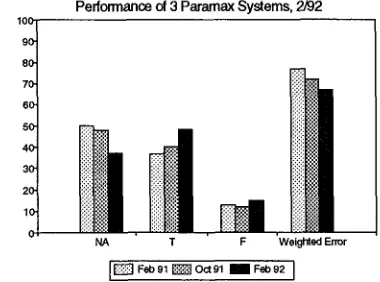
We have experimented with a more tightly controlled variation of the c o m m o n evaluation metric in which the s a m e test d a t a is processed by several different versions of our system - the current version, and two older ver- sions. These older versions correspond generally to the system which was reported on in February 1991 ([1]) and the s y s t e m which we used to participate in an informal evaluation in October 1991. 2 By holding the d a t a con- stant and varying the system, we eliminate the effect of d a t a variations on scores. Furthermore, by comparing scores produced this way with the scores our system has received on the s t a n d a r d evaluations, we d e m o n s t r a t e t h a t variations in the test d a t a are a real concern, be- cause we see a much less consistent p a t t e r n of develop- m e n t over t i m e with the s t a n d a r d evaluation. Figure 1 shows how the scores on the February 1992 n a t u r a l lan- guage test for the three different versions of the P a r a m a x system varied.
Perfonnance of 3 Pararnax Systems, 2i92 100
90-
80-
70-
6C ~
50-
4@
30-
20-
10"
NA T F 'Weighted Error
[
~ Feb 91 ~ ] Oct 91 IBM Feb 92 ]Figure 1: C o m p a r a t i v e performance of systems.
From Figure 1 we can see t h a t our system has m a d e m o d -
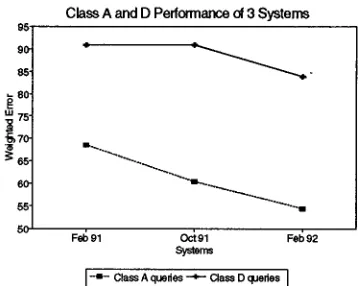
[image:4.612.343.533.436.577.2]est improvements over time, as shown by the decrease in weighted error rate. Additionally, the percentage of cor- rectly answered (T) inputs has increased, while the per- centage of unanswered (NA) inputs has decreased and the percentage of incorrectly answered (F) inputs has remained nearly constant. In contrast, if we compare our scores on the October dry run with the February 1992 benchmark test, we find that our system obtained a weighted error score of 64.1% on the October dry run when all utterances in classes A, D1, and D were consid- ered. For the February benchmark, the corresponding figure was 66.7%. Breaking this down more finely, our class D error decreased from 97.9% to 83.9%, while our class A error increased from 47.4% to 54.5%. From this we might have concluded that our class D performance improved at the expense of our class A performance and overall system performance.
80
75
70
65
~ 60
~ so
45 4O
3O
Figure 2:
Pararnax Class A Performance
Jun 90 Feb 91 Oct 91 Feb 92
Evaluations
Comparative performance on class A tests.
Focusing only on class A utterances, we can go back far- ther in time, finding (Figure 2) that our system's error consistently decreased until the most recent test, which would reinforce the hypothesis that our class A perfor- mance degraded recently. Yet we see from Figure 3, which elaborates upon the information in Figure 1, that such a conclusion is unwarranted.
By running the same test with different versions of the understanding system, as described above, we obtain im- portant information on the changes over time in system performance. This simple extension of the evaluation methodology already in place supplements comparisons between systems from different sites and comparisons be- tween different tests with clear-cut documentation of the progress made by an individual site on its system. As such, it is a valuable tool to add to the ever-increasing arsenal of objective system evaluation techniques. Table 1 summarizes our scores on the February 1992 natural language and spoken language benchmark tests. The SLS results were obtained by filtering nbest out-
95"
90"
85"
~ se
m 75"
6O-
5G
Class A and D Performance of 3 Systems
Feb 91 Oct 91 Feb 92
Systems
l
- ~ - Class A quod0s ~ Class D quedes IFigure 3: System performance on classes A and D.
put from BBN's speech recognition system through the P a r a m a x natural language processing system, using an N of 6. This SLS score is only five percentage points inferior to our NL score. The corresponding difference for other sites ranged from ten to thirty-six points, with no correlation between actual scores and this difference. At this time we have no explanation for this intriguing phenomenon. 3
Weighted
Test T F NA Error
NL 331 102 254 66.7% SLS 322 128 237 71.8%
Table 1: P a r a m a x 1992 ATIS benchmark results.
3 . 1 . S p e e c h R e c o g n i t i o n
The speech recognition scores which P a r a m a x submitted for this evaluation were produced by using the P a r a m a x natural language processing system to filter the n-best o u t p u t from BBN's speech recognition system. T h e n- best o u t p u t used in this evaluation had a word error
[image:5.612.349.528.48.191.2] [image:5.612.91.283.264.405.2] [image:5.612.356.526.345.397.2]rate of 10.7%. N was set to 6 for this test. T h e nat- ural language system selected the first candidate in the n-best which passed its syntactic, semantic, and appli- cation constraints, and o u t p u t this candidate as the rec- ognized utterance. If no candidate passed the natural language constraints, the first candidate of the n-best was o u t p u t as the recognized utterance. After natural language filtering, the official speech recognition score was 10.6%. Although intuitively, natural language con- straints should be able to reduce speech recognition er- ror, they do not appear to do so in this case. There are at least three possible reasons for this outcome. One, the speech recognition is already quite good, consequently there is less room for improvement. Two, the natural language processing is not very good. Three, there is always going to be some residue of speech recognizer er- rors which result in perfectly reasonable recognized ut- terances, and no amount of natural language knowledge will be able to correct these. We have not explored these hypotheses in detail; however, we have done a related experiment with n-best data of a totally different kind, which shows a remarkably similar pattern. We briefly describe this experiment in the following section.
3 . 2 . O p t i c a l C h a r a c t e r R e c o g n i t i o n
Although the nbest architecture was developed in the context, of spoken language understanding, it is in fact applicable to any kind of input where indeterminacies in the input result in misrecognitions. In addition to speech recognizers, optical character recognition systems (OCR's) also have this property. Although current OCR technology is quite accurate for relatively clean data, ac- curacy is greatly reduced as the d a t a becomes less clean. For example, faxed documents tend to have a high OCR error rate. Many O C R errors result in o u t p u t which is meaningless, either because the o u t p u t words are not le- gitimate words of the language, or because the o u t p u t sentences do not make sense. We have applied linguis- tic constraints to the OCR problem using a variation of the N-best interface with a natural language process- ing system. Because the OCR produces only one alter- native, an "alternative generator" was developed which uses spelling correction, a lexicon, and various scoring metrics to generate a list of alternatives from raw OCR output. Just as in the case of speech recognizer output, alternatives are sent to the natural language processing system, which selects the first candidate which passes its constraints.
T h e system was tested with 120 sentences of ATIS data on which the natural language system had previously been trained. The text d a t a was faxed and then scanned. NIST speech recognition scoring software was used to compute word error rates. The word error rate for out-
put directly from the OCR was 13.1%. After the o u t p u t was sent through the spelling corrector, it was scored on the basis of the first candidate of the N-best set of al- ternatives. The error rate was reduced to 4.6%. Finally, the o u t p u t from the natural language system was scored, resulting in a final average error rate of 4.2%.
Sending the uncorrected OCR o u t p u t directly into the natural language system for processing without correc- tion led to a 73% average weighted error rate. Spelling correction improved the error rates to 33%. Finally, with natural language correction, the weighted error rate im- proved to 28%. Thus, although improvements in word accuracy were minimal, application accuracy was greatly improved. This is consistent with previous experiments we have done on speech recognizer o u t p u t [6]. Additional detail on this experiment can be found in [7].
Interestingly, training on the O C R d a t a led to a process- ing time improvement. Comparing the performance of the October system and the February system, we found that total cpu time for processing the February test d a t a was reduced by one-third. This improvement was due to improving processing inefficiencies which were noted during analysis of the processing of the OCR data. It is encouraging that the system is sufficiently general that training on O C R data can improve the processing of nat- ural language and spoken language data.
R e f e r e n c e s
1. L. M. Norton, M. C. Linebarger, D. A. DaM, and N. Nguyen, "Augmented role filling capabilities for se- mantic interpretation of natural language," in Proceedings
of the DARPA Speech and Language Workshop, (Pacific
Grove, CA), February 1991.
2. M. L. Ginsberg, ed., Readings in Nonmonotonie Reason-
ing. Los Altos, California: Morgan Kaufmann, 1987.
3. D. A. DaM and C. N. Ball, "Reference resolution in PUN- DIT," in P. Saint-Dizier and S. Szpakowicz, eds., (Logic
and logic grammars for language processing). Ellis Hor-
wood Limited, 1990.
4. D. A. DaM, D. Appelt, and C. Weir, "Multi-site natural language processing evaluation: MUC and ATIS," in Pro- ceedings o] the Workshop on Natural Language Processing
Evaluation, (Berkeley, CA), June 1991.
5. MADCOW, "Multi-site data collection for a spoken lan- guage corpus," in Proceedings of the DARPA Speech and
Natural Language Workshop, Morgan Kaufmann, Feb.
1992.
6. D. A. Dahl, L. Hirschman, L. M. Norton, M. C. Linebarger, D. Magerman, and C. N. Ball, "Training and evaluation of a spoken language understanding system,"
in Proceedings of the DARPA Speech and Language Work-
shop, (Hidden Valley, PA), June 1990.