Massimiliano Ciaramita
Department of Cognitive and Linguistic Sciences Brown University
Providence, RI, USA 02912
massimiliano [email protected]
Abstract
In this paper we investigate the impact of morphological features on the task of au-tomatically extending a dictionary. We approach the problem as a pattern clas-sification task and compare the perfor-mance of several models in classifying nouns that are unknown to a broad cov-erage dictionary. We used a boosting clas-sifier to compare the performance of mod-els that use different sets of features. We show how adding simple morphological features to a model greatly improves the classification performance.
1 Introduction
The incompleteness of the available lexical re-sources is a major bottleneck in natural language processing (NLP). The development of methods for the automatic extension of these resources might af-fect many NLP tasks. Further, from a more general computational perspective, modeling lexical mean-ing is a necessary step toward semantic modelmean-ing of larger linguistic units.
We approach the problem of lexical acquisition as a classification task. The goal of the classifier is to insert new words into an existing dictionary. A dictionary1 in this context simply associates lexical
I would like to thank for their input everybody in the Brown Laboratory for Linguistic Information Processing (BLLIP) and Information Retrieval and Machine Learning Group at Brown (IRML), and particularly Mark Johnson and Thomas Hofmann. I also thank Brian Roark and Jesse Hochstadt.
1
Or lexicon, we use the two terms interchangeably.
forms with class labels; e.g.,
, where the arrow can be interpreted as the ISA rela-tion. In this study we use a simplified version of Wordnet as our base lexicon and we ignore other relevant semantic relations (like hyponymy) and the problem of word sense ambiguity. We focus on finding features that are useful for associating un-known words with class labels from the dictionary. In this paper we report the following preliminary findings. First of all we found that the task is dif-ficult. We developed several models, based on near-est neighbor (NN), naive Bayes (NB) and boosting classifiers. Unfortunately, the error rate of these models is much higher than what is found in text categorization tasks2 with comparable numbers of classes. Secondly, it seems obvious that informa-tion that is potentially useful for word classifica-tion can be of very diverse types, e.g., semantic and syntactic, morphological and topical. There-fore methods that allow flexible feature combination and selection are desirable. We experimented with a multiclass boosting algorithm (Schapire and Singer, 2000), which proved successful in this respect. In this context boosting combines two sources of in-formation: words co-occurring near the new word, which we refer to as collocations, and morpholog-ical properties of the new word. This classifier shows improved performance over models that use only collocations. In particular, we found that even rudimentary morphological information greatly
im-2
Text categorization is the task of associating documents with topic labels (POLITICS, SPORT, ...) and it bears simi-larities with semantic classification tasks such as word sense disambiguation, information extraction and acquisition.
SHAPE TRAIT QUALITY PROPERTY OTHER ATTR SOCIAL REL SPATIAL REL OTHER REL TIME OTHER ABS
ATTRIBUTE RELATION
MEASURE ABSTRACTION
Figure 1: A few classes under the root class ABSTRACTION in MiniWordnet.
proves classification performance and should there-fore be part of any word classification model.
The outline of the paper is as follows. In section 2 we introduce the dictionary we used for our tests, a simplified version of Wordnet. In section 3 we de-scribe more formally the task, a few simple mod-els, and the test methods. In section 4 we describe the boosting model and the set of morphological fea-tures. In section 5 we summarize the results of our experiments. In section 6 we describe related work, and then in section 7 we present our conclusions.
2 MiniWordnet
Ideally the lexicon we would like to extend is a broad coverage machine readable dictionary like Wordnet (Miller et al., 1990; Fellbaum, 1998). The problem with trying to directly use Wordnet is that it contains too many classes (synsets), around 70 thou-sand. Learning in such a huge class space can be extremely problematic, and intuitively it is not the best way to start on a task that hasn’t been much ex-plored3. Instead, we manually developed a smaller lexicon dubbed MiniWordnet, which is derived from Wordnet version 1.6. The reduced lexicon has the same coverage (about 95 thousand noun types) but only a fraction of the classes. In this paper we con-sidered only nouns and the noun database. The goal was to reduce the number of classes to about one hundred4 of roughly comparable taxonomical gen-erality and consistency, while maintaining a little bit of hierarchical structure.
3
Preliminary experiments confirmed this; classification is computationally expensive, performance is low, and it is very hard to obtain even very small improvements when the full database is used.
4
A magnitude comparable to the class space of well stud-ied text categorization data sets like the Reuters-21578 (Yang, 1999).
The output of the manual coding is a set of 106 classes that are the result of merging hundreds of synsets. A few random examples of these classes are PERSON, PLANT, FLUID, LOCATION,
AC-TION, and BUSINESS. One way to look at this set
of classes is from the perspective of named-entity recognition tasks, where there are a few classes of a similar level of generality, e.g, PERSON,
LOCA-TION, ORGANIZALOCA-TION, OTHER. The difference
here is that the classes are intended to capture all possible taxonomic distinctions collapsed into the
OTHER class above. In addition to the 106 leaves
we also kept a set of superordinate levels. We maintained the 9 root classes in Wordnet plus 18 intermediate ones. Examples of these intermedi-ate classes are ANIMAL, NATURAL OBJECT,
AR-TIFACT, PROCESS, and ORGANIZATION. The
rea-son for keeping some of the superordinate structure is that hierarchical information might be important in word classification; this is something we will in-vestigate in the future. For example, there might not be enough information to classify the noun ostrich in the BIRD class but enough to label it as ANIMAL. The superordinates are the original Wordnet synsets. The database has a maximum depth of 5.
We acknowledge that the methodology and results of reducing Wordnet in this way are highly subjec-tive and noisy. However, we also think that go-ing through an intermediary step with the reduced database has been useful for our purposes and it might also be so for other researchers5. Figure 1 de-picts the hierarchy below the root class
ABSTRAC-TION. The classes that are lined up at the bottom
of the figure are leaves. As in Wordnet, some
sub-5
More information about MiniWordnet and the
database itself are available at www.cog.brown.edu/
For example, the ABSTRACTION sub-hierarchy is more populated (11 leaves) than that of EVENT (3 leaves). The most populated and structured class is
ENTITY, with almost half of the leaves (45) and
sev-eral superordinate classes (10).
3 Automatic lexical acquisition
3.1 Word classification
We frame the task of inserting new words into the dictionary as a classification problem: is the set of classes defined by the dictionary. Given a vector of features
we want to find functions of the form
. In particular we are interested in learning functions from data, i.e., a training set of pairs
! #"$
%&
and , such that there will be a small probability of error when we apply the classifier to unknown pairs (new nouns).
Each class is described by a vector of features. A class of features that intuitively carry semantic in-formation are collocations, i.e., words that co-occur with the nouns of interest in a corpus. Collocations have been widely used for tasks such as word sense disambiguation (WSD) (Yarowsky, 1995), informa-tion extracinforma-tion (IE) (Riloff, 1996), and named-entity recognition (Collins and Singer, 1999). The choice of collocations can be conditioned in many ways: according to syntactic relations with the target word, syntactic category, distance from the target, and so on.
We use a very simple set of collocations: each word ' that appears within (*) positions from a noun + is a feature. Each occurrence, or token, , of + , +.-, is then characterized by a vector of fea-ture counts+/- . The vector representation of the noun type+ is the sum of all the vectors representing the contexts in which it occurs. Overall the vector repre-sentation for each class in the dictionary is the sum of the vectors of all nouns that are members of the class
while the vector representation of an unknown noun is the sum of the feature vectors of the contexts in which it occurred
90 2
+:-about collocations is the set of articles from the 1989 Wall Street Journal (about 4 million words) in the BLLIP’99 corpus.
We performed the following tokenization steps. We used the Wordnet ”morph” functions to mor-phologically simplify nouns, verbs and adjectives. We excluded only punctuation; we did no filtering for part of speech (POS). Each word was actually a word-POS pair; i.e., we distinguished between
plant:NN and plant:VB. We collapsed sequences of
NNs that appeared in Wordnet as one noun; so we have one entry for the noun car company:NN. We also collapsed sequences of NNPs, possibly inter-leaved by the symbol ”&”, e.g., George Bush:NNP and Procter & Gamble:NNP. To reduce the number of features a little we changed all NNPs beginning with Mr. or Ms. to MISS X:NNP, all NNPs ending in
CORP. or CO. to COMPANY X:NNP, and all words
with POS CD, i.e., numbers, starting with a digit to
NUMBER X:CD. For training and testing we
con-sidered only nouns that are not ambiguous accord-ing to the dictionary, and we used only features that occurred at least 10 times in the corpus.
3.2 Simple models
We developed several simple classifiers. In particu-lar we focused on nearest neighbor (
;
) and naive Bayes (<
) methods. Both are very simple and powerful classification techniques. For NN we used cosine as a measure of distance between two vectors, and the classifier is thus
Since we used aggregate vectors for classes and noun types, we only used the best class; i.e., we always used 1-nearest-neighbor classifiers. Thus
) in this paper refers only to the size of the win-dow around the target noun and never to number of neighbors consulted in ) -nearest-neighbor classifi-cation. We found that using TFIDF weights instead of simple counts greatly improved performance of the NN classifiers, and we mainly report results rel-ative to the TFIDF NN classifiers (;RQTS:U$VIS
1 2 3 4 5 6 7 8 9 10
Figure 2: Error of the
;XWMY!Z\[
words and re-weights features by their informative-ness, thus making a stop list or other feature manip-ulations unnecessary. The naive Bayes classifiers is also very simple
The parameters of the prior and class-conditional distributions are easily estimated using maximum likelihood. We smoothed all counts by a factor of .5.
3.3 Testing procedure
We tested each model on an increasing numbers of classes or level. At level 1 the dictionary maps nouns only to the nine Wordnet roots; i.e., there is a very coarse distinction among noun categories at the level of ENTITY, STATE, ACT,.... At level 2 the dictionary maps nouns to all the classes that have a level-1 par-ent; thus each class can be either a leaf or an inter-mediate (level 2) class. In general, at level , nouns are only mapped to classes that have a level (,Im
_
), or smaller, parent. There are 34 level-2 classes, 69 level-3 classes and 95 level-4 ones. Finally, at level 5, nouns are mapped to all 106 leaves. We compared the boosting models and the NN and NB classifiers over a fixed size for) of 4.
For each level we extracted all unambiguous in-stances from the BLLIP’99 data. The data ranged from 200 thousand instances at level 5, to almost 400 thousand at level 1. As the number of classes grows
there are less unambiguous words. We randomly se-lected a fixed number of noun types for each level: 200 types at levels 4 and 5, 300 at level 3, 350 at level 2 and 400 at level 1. Test was limited to com-mon nouns with frequency between 10 and 300 on the total data. No instance of the noun types present in the test set ever appeared in the training data. The test data was between 5 and 10% of the training data; 10 thousand instances at level 5, 16 thousand at level 1, with intermediate figures for the other levels. We used exactly the same partition of the data for all ex-periments, across all models.
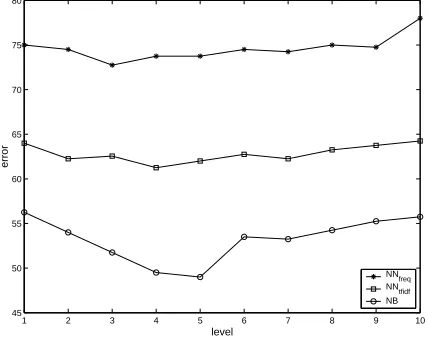
Figure 2 shows the error rate of several simple models at level 1 for increasing values of ) . The error keeps dropping until) reaches a value around 4 and then starts rising. Testing for all values of
)onp
d
confirmed this pattern. This result sug-gests that the most useful contextual information is that close to the noun, which should be syntactic-semantic in nature, e.g., predicate-argument prefer-ences. As the window widens, the bag of features becomes more noisy. This fact is not too surprising. If we made the window as wide as the whole docu-ment, every noun token in the document would have the same set of features. As expected, as the num-ber of classes increases, the task becomes harder and the error of the classifiers increases. Nonetheless the same general pattern of performance with respect to
) holds. As the figure shows
RQTS:U^VIS
greatly im-proves over the simpler
classifier that only uses counts.;<
outperforms both.
4 Boosting for word classification
4.1 AdaBoost.MH with abstaining
Boosting is an iterative method for combining the output of many weak classifiers or learners6 to produce an accurate ensemble of classifiers. The method starts with a training setq and trains the first classifier. At each successive iterationr a new clas-sifier is trained on a new training set qFs, which is obtained by re-weighting the training data used at
rRm
_
so that the examples that were misclassified atrtm
_
are given more weight while less weight is given to the correctly classified examples. At each
6
to the ensemble with weightw#s. The final ensemble
In the most popular version of a boosting algorithm, AdaBoost (Schapire and Singer, 1998), at each it-eration a classifier is trained to minimize the expo-nential loss on the weighted training set. The ex-ponential loss is an upper bound on the zero-one loss. AdaBoost minimizes the exponential loss on the training set so that incorrect classification and disagreement between members of the ensemble are penalized.
Boosting has been successfully applied to sev-eral problems. Among these is text categoriza-tion (Schapire and Singer, 2000), which bears similarities with word classification. For our experiments we used AdaBoost.MH with
real-valued predictions and abstaining, a version of
boosting for multiclass classification described in Schapire and Singer (2000). This version of Ad-aBoost minimizes a loss function that is an upper bound on the Hamming distance between the weak learners’ predictions and the real labels, i.e., the number of label mismatches (Schapire and Singer, 1998). This upper bound is the product~
s
s. The function -! is 1 if is the correct label for the train-ing example
- and is -1 otherwise;
0
ll is the total number of classes; and
0
lqXl is the number of training examples. We explain what the term for the weak learneruFs
"
means in the next section. Then
AdaBoost.MH looks schematically as follows:
ADABOOST.MH
is the weight assigned to the instance-label pair (
). In the first round
each pair is assigned
weighted s is normalized so that it forms a distri-bution; i.e.,
s is a normalizing factor. The algo-rithm outputs the final hypotheses for an instance
-with respect to class label
f
since we are interested in classifying noun types the final score for each unknown noun is
x
In this version of AdaBoost weak learners are ex-tremely simple. Each feature, e.g., one particular collocation, is a weak classifier. At each round one feature ' is selected. Each feature makes a real-valued predictionº}s^'
"
with respect to each class
. Ifº»s^'
"
is positive then feature' makes a pos-itive prediction about class ; if negative, it makes a negative prediction about class . The magnitude of the prediction lº¼s^'
"
l is interpreted as a mea-sure of the confidence in the prediction. Then for each training instance a simple check for the pres-ence or abspres-ence of this feature is performed. For example, a possible collocation feature is eat:VB, and the corresponding prediction is “if eat:VB ap-pears in the context of a noun, predict that the noun belongs to the class FOOD and doesn’t belong to classes PLANT, BUSINESS,...”. A weak learner is defined as follows:
is computed as follows:
º$s^'
) is the sum of the weights of noun-label pairs, from the distribution
s, where the feature ap-pears and the label is correct (wrong); È
0
{
W=August; PL=0; MU=1; CO=’:POS; CO=passenger:NN; CO=traffic:NN; ... W=punishment; PL=1; MU=0; MS=ment; MS=ishment; CO=in:IN; CO=to:TO; ... W=vice president; PL=0; MU=0; MSHH=president; CO=say:VB; CO=chief:JJ; ... W=newsletter; PL=0; MU=0; MS=er; MSSH=letter; CO=yield:NN; CO=seven-day:JJ; ...
Figure 3: Sample input to the classifiers, only <BË
rÍÌ has access to morphological information. CO stands for the attribute “collocation”.
is shown that
s is minimized for a particular fea-ture ' by choosing its predictions as described in equation (8). The weight wjs usually associated with the weak classifier (see equation (2)) here is simply set to 1.
If the value in (8) is plugged into (4),
s becomes
s
0
ÆÏÎ
Ç
Â
2
58ÐÒÑ
Æ
£
Æ
¯
(9)
Therefore to minimize
s at each round we choose the feature ' for which this value is the smallest. Updating these scores is what takes most of the com-putation, Collins (2000) describes an efficient ver-sion of this algorithm.
4.3 Morphological features
We investigated two boosting models: <8Ë rÍÓ , which uses only collocations as features, and <BBË
r Ì , which uses also a very simple set of mor-phological features. In<BË
rÓ we used the colloca-tions within a window of (*)
0Ô
, which seemed to be a good value for both the nearest neighbor and the naive Bayes model. However, we didn’t fo-cus on any method for choosing) , since we believe that the collocational features we used only approx-imate more complex ones that need specific investi-gation. Our main goal was to compare models with and without morphological information. To spec-ify the morphological properties of the nouns being classified, we used the following set of features:
Õ
plural (PL): if the token occurs in the plural form, PL=1; otherwise PL=0
Õ
upper case (MU): if the token’s first character is upper-cased MU=1; otherwise MU=0
Õ
suffixes (MS): each token can have 0, 1, or more of a given set of suffixes, e.g., er,
-ishment, -ity, -ism, -esse, ...
Õ
prefixes (MP): each token can have 0, 1 or more prefixes, e.g., pro-, re-, di-, tri-, ...
Õ
Words that have complex morphology share the morphological head word if this is a noun in Wordnet. There are two cases, depending on whether the word is hyphenated (MSHH) or the head word is a suffix (MSSH)
– hyphenated (MSHH): drinking age and
age share the same head-word age
– non-hyphenated (MSSH): chairman and
man share the same suffix head word, man. We limited the use of this feature
to the case in which the remaining prefix (chair) also is a noun in Wordnet.
We manually encoded two lists of 61 suffixes and 26 prefixes7. Figure 3 shows a few examples of the input to the models. Each line is a training instance; the attribute W refers to the lexical form of the noun and was ignored by the classifier.
4.4 Stopping criterion
One issue when using iterative procedures is decid-ing when to stop. We used the simplest procedure of fixing in advance the number of iterations. We no-ticed that the test error drops until it reaches a point at which it seems not to improve anymore. Then the error oscillates around the same value even for thousands of iterations, without apparent overtrain-ing. A similar behavior is observable in some of the results on text categorization presented in (Schapire and Singer, 2000). We cannot say that overtrain-ing is not a potential danger in multiclass boostovertrain-ing models. However, for our experiments, in which the main goal is to investigate the impact of a particu-lar class of features, we could limit the number of
7
0 500 1000 1500 2000 2500 3000 3500 20
30 40 50 60 70 80
t
error
BoostM
Figure 4: Training error at level 4.
0 500 1000 1500 2000 2500 3000 3500
75 80 85 90 95 100
Test error
t
error
Boost
S
BoostM
Figure 5: Test error at level 4.
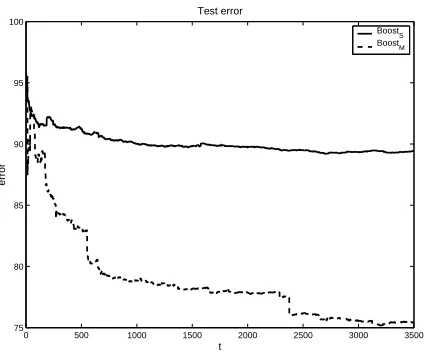
iterations to a fixed value for all models. We chose this maximum number of iterations to be 3500; this allowed us to perform the experiments in a reason-able time. Figure 4 and Figure 5 plot training and test error for
<BË
rÓ and <BË
r Ì at level 4 (per instance). As the figures show, the error rate, on both training and testing, is still dropping after the fixed number of iterations. For the simplest model, <BBË
r Ó at level 1, the situation is slightly different: the model converges on its final test error rate after roughly 200 iterations and then remains stable. In general, as the number of classes grows, the model takes more iterations to converge and then the test error remains stable while the training error keeps slowly decreasing.
The following table summarizes the different models we tested:
MODEL FEATURES
ÖXÖ×ØFÙ}ÚTØ
TFIDF weights for collocations
ÖXÛ
collocation counts
Boost s collocations (binary)
Boost m collocations (binary)+morphology
Figure 6 plots the results across the five different subsets of the reduced lexicon. The error rate is the error on types. We also plot the results of a baseline (BASE), which always chooses the most frequent class and the error rate for random choice (RAND). The baseline strategy is quite successful on the first sets of classes, because the hierarchy un-der the rootÜ
Ý
is by far the most populated. At level 1 it performs worse only than<BË
rÌ . As the size of the model increases, the distribution of classes becomes more uniform and the task becomes harder for the baseline. As the figure shows the im-pact of morphological features is quite impressive. The average decrease in type error of
<ÒBË
rÌ over <BBË
r!Ó is more than 17%, notice also the difference in test and training error, per instance, in Figures 4 and 5.
In general, we observed that it is harder for all classifiers to classify nouns that don’t belong to the ENTITY class, i.e., maybe not surprisingly, it is harder to classify nouns that refer to abstract con-cepts such as groups, acts, or psychological
fea-tures. Usually most of the correct guesses regard
members of the ENTITY class or its descendants, which are also typically the classes for which there is more training data. <BË
rÌ really improves on <BBË
r
Ó in this respect. <ÒBË
rÌ guesses correctly several nouns to which morphological features ap-ply like spending, enforcement, participation,
com-petitiveness, credibility or consulting firm. It makes
also many mistakes, for example on conversation,
1 2 3 4 5 30
40 50 60 70 80 90 100
level
error
RAND BASE Boost_S NNtfidf NB Boost_M
Figure 6: Comparison of all models for 03_Baba´Þ
.
Ratnaparkhi (1996)), where all suffixes up to a cer-tain length are included. We observed also cases of recurrent confusion between classes. For example between ACT and ABSTRACTION (or their subor-dinates), e.g., for the noun modernization, possibly because the suffix is common in both cases.
Another measure of the importance of morpho-logical features is the ratio of their use with respect to that of collocations. In the first 100 rounds of <BBË
r Ì , at level 5, 77% of the features selected are morphological, 69% in the first 200 rounds. As Figures 4 and 5 show these early rounds are usually the ones in which most of the error is reduced. The first ten features selected at level 5 by <8Ë
r¶Ì were the following: PL=0, MU=0, PL=1, MU=0, PL=1, MU=1, MS=ing, PL=0, MS=tion, and finally CO=NUMBER X:CD. One final characteristic of morphology that is worth mentioning is that it is independent from frequency. Morphological features are properties of the type and not just of the token. A model that includes morphological information should therefore suffer less from sparse data problems.
From a more general perspective, Figure 6 shows that even if the simpler boosting model’s perfor-mance degrades more than the competitors after level 3, <BË
r Ì performs better than all the other classifiers until level 5 when the TFIDF nearest neighbor and the naive Bayes classifiers catch up. It should be noted though that, as Figures 4 and 5
showed, boosting was still improving at the end of the fixed number of iterations at level 4 (but also 5). It might quite well improve significantly after more iterations. However, determining absolute per-formance was beyond the scope of this paper. It is also fair to say that both
and ;<
are very competitive methods, and much simpler to imple-ment efficiently than boosting. The main advantage with boosting algorithms is the flexibility in manag-ing features of very different nature. Feature combi-nation can be performed naturally with probabilistic models too but it is more complicated. However, this is something worth investigating.
6 Related work
covery (Berland and Charniak, 1999), and hierar-chy building (Caraballo, 1999). These methods are very interesting but of limited applicability, because nouns that do not appear in known lexico-syntactic patterns cannot be learned.
7 Conclusion
All the approaches cited above focus on some aspect of the problem of lexical acquisition. What we learn from them is that information about the meaning of words comes in very different forms. One thing that needs to be investigated is the design of better sets of features that encode the information that has been found useful in these studies. For example, it is known from work in word sense disambiguation that conditioning on distance and syntactic relations can be very helpful. For a model for lexical acquisition to be successful it must be able to combine as many sources of information as possible. We found that boosting is a viable method in this respect. In par-ticular, in this paper we showed that morphology is one very useful source of information, independent of frequency, that can be easily encoded in simple features.
A more general finding was that inserting new words into a dictionary is a hard task. For these classifiers to become useful in practice, much bet-ter accuracy is needed. This raises the question of the scalability of machine learning methods to mul-ticlass classification for very large lexicons. Our im-pression on this is that directly attempting classifi-cation on tens of thousands of classes is not a viable approach. However, there is a great deal of informa-tion in the structure of a lexicon like Wordnet. Our guess is that the ability to make use of structural in-formation will be key in successful approaches to this problem.
References
M. Berland and E. Charniak. 1999. Finding parts in very large corpora. In Proceedings of the 37th Annual Meeting of the
Association for Computational Linguistics.
S. Caraballo. 1999. Automatic acquisition of a hypernym-labeled noun hierarchy from text. In Proceedings of the 37th
Annual Meeting of the Association for Computational Lin-guistics.
named entity classification. In Proceedings of the Joint
SIG-DAT Conference on Empirical Methods in Natural Language Processing and Very Large Corpora.
M. Collins. 2000. Discriminative reranking for natural lan-guage parsing. In Proceedings of the 17th ICML.
C. Fellbaum. 1998. WordNet: An Electronic Lexical Database. MIT Press, Cambridge, MA.
R. Granger. 1977. Foul-up: A program that figures out mean-ings of words from context. In Proceedmean-ings of the Fifth
In-ternational Joint Conference on Artificial Intelligence.
P.M. Hastings and S.L. Lytinen. 1994. The ups and downs of lexical acquisition. In AAAI-94.
M. Hearst. 1992. Automatic acquisition of hyponyms from large text corpora. In Proceedings of the 14th International
Conference on Computational Linguistics.
P. Jacobs and U. Zernik. 1988. Acquiring lexical knowledge from text: A case study. In AAAI-88.
G.A. Miller, R. Beckwith, C. Fellbaum, D. Gross, and K. Miller. 1990. Introduction toWordnet: An on-line lexical database.
International Journal of Lexicography, 3(4).
A. Ratnaparkhi. 1996. A maximum entropy model for part-of-speech tagging. In Proceedings of the First Empirical
Meth-ods in Natural Language Processing Conference.
E. Riloff. 1996. An empirical study of automated dictionary construction for information extraction in three domains.
Ar-tificial Intelligence, 85.
B. Roark and E. Charniak. 1998. Noun-phrase co-occurrence statistics for semi-automatic semantic lexicon construction. In Proceedings of the 36th Annual Meeting of the
Associ-ation for ComputAssoci-ational Linguistics and 17th InternAssoci-ational Conference on Computational Linguistics.
R. E. Schapire and Y. Singer. 1998. Improved boosting algo-rithms using confidence-rated predictions. In Proceedings of
the Eleventh Annual Conference on Computational Learning Theory.
R. E. Schapire and Y. Singer. 2000. Boostexter: A boosting-based system for text categorization. Machine Learning, 39.
M. Stevenson and Y. Wilks. 2001. The interaction of knowl-edge sources in word sense disambiguation. Computational
Linguistics, 27.
Y. Yang. 1999. An evaluation of statistical approaches to text categorization. Information Retrieval, 1.
D. Yarowsky. 1995. Unsupervised word sense disambiguation rivaling supervised methods. In Proceedings of the 33rd